Software as a Services
       and the
 Quest for Freemium
     What it takes to be
 Sticky, Viral and Touchless
What makes Freemium work
• Free:
  Lower friction = faster traction
• Sticky:
  Grows more valuable the more its used.
• Viral:
  Ecstatic customers + Incentives to share with
  friends.
• Touchless:
  Guide users to become customers
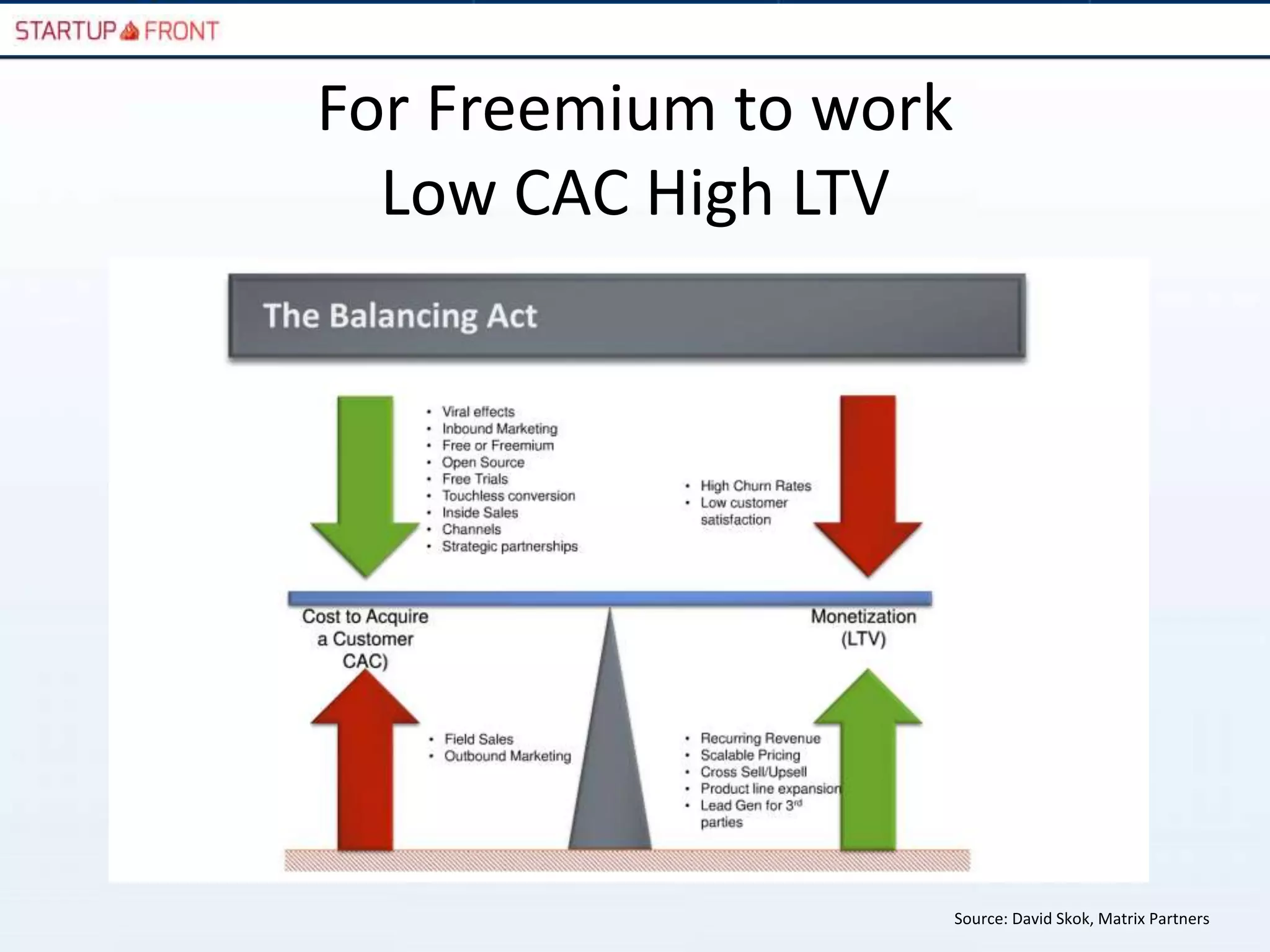
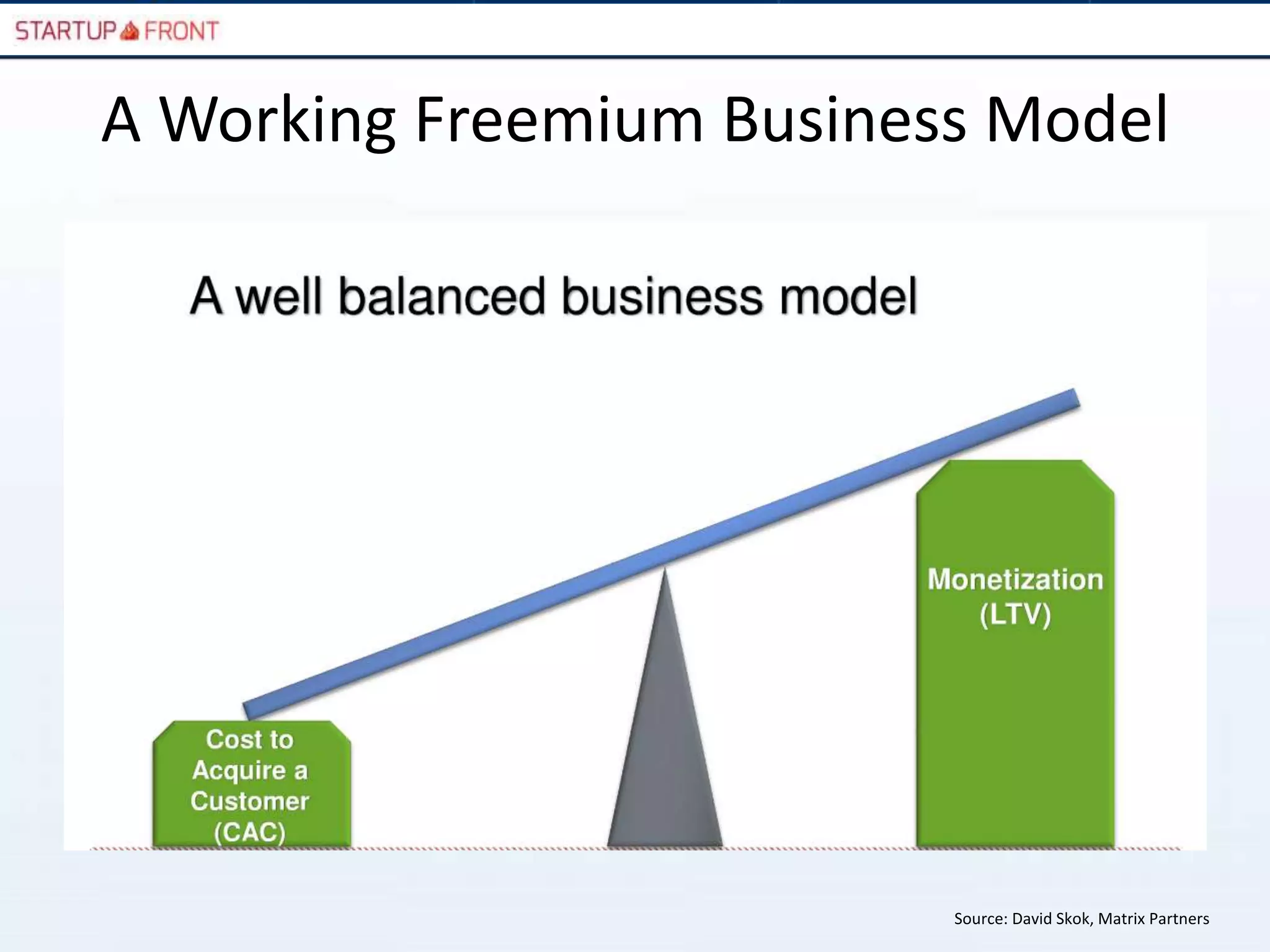
For Freemium to work
  Low CAC High LTV


                       Source: David Skok, Matrix Partners
Why Free?
• It Optimizes spread,
• Creates large footprint,
• Fast decisions
  Examples:
  – Started with free = Freshbooks, Dropbox,
    Evernote.
  – Added Free = MailChimp


                                         Source: David Skok, Matrix Partners
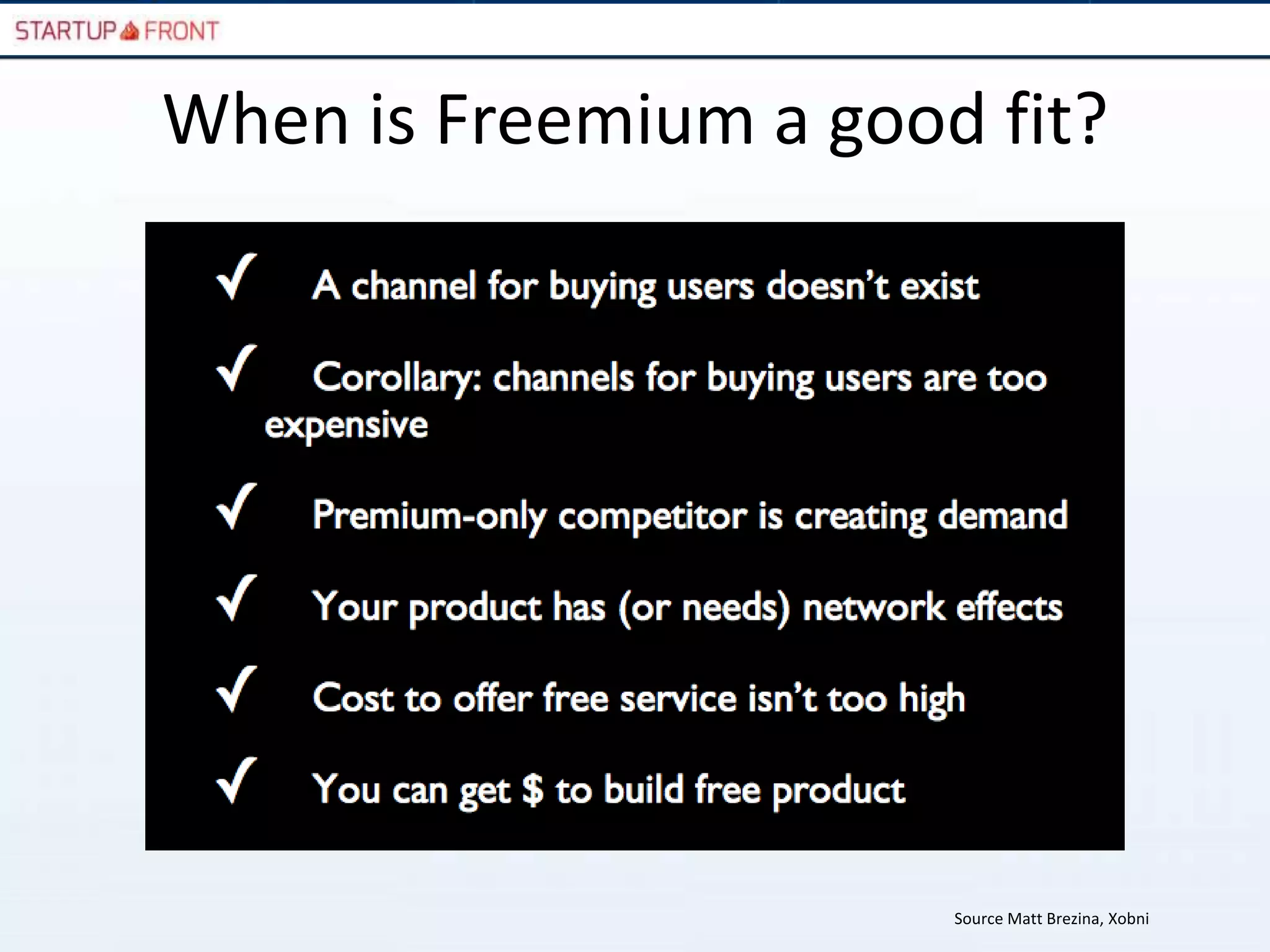
When is Freemium a good fit?


                       Source Matt Brezina, Xobni
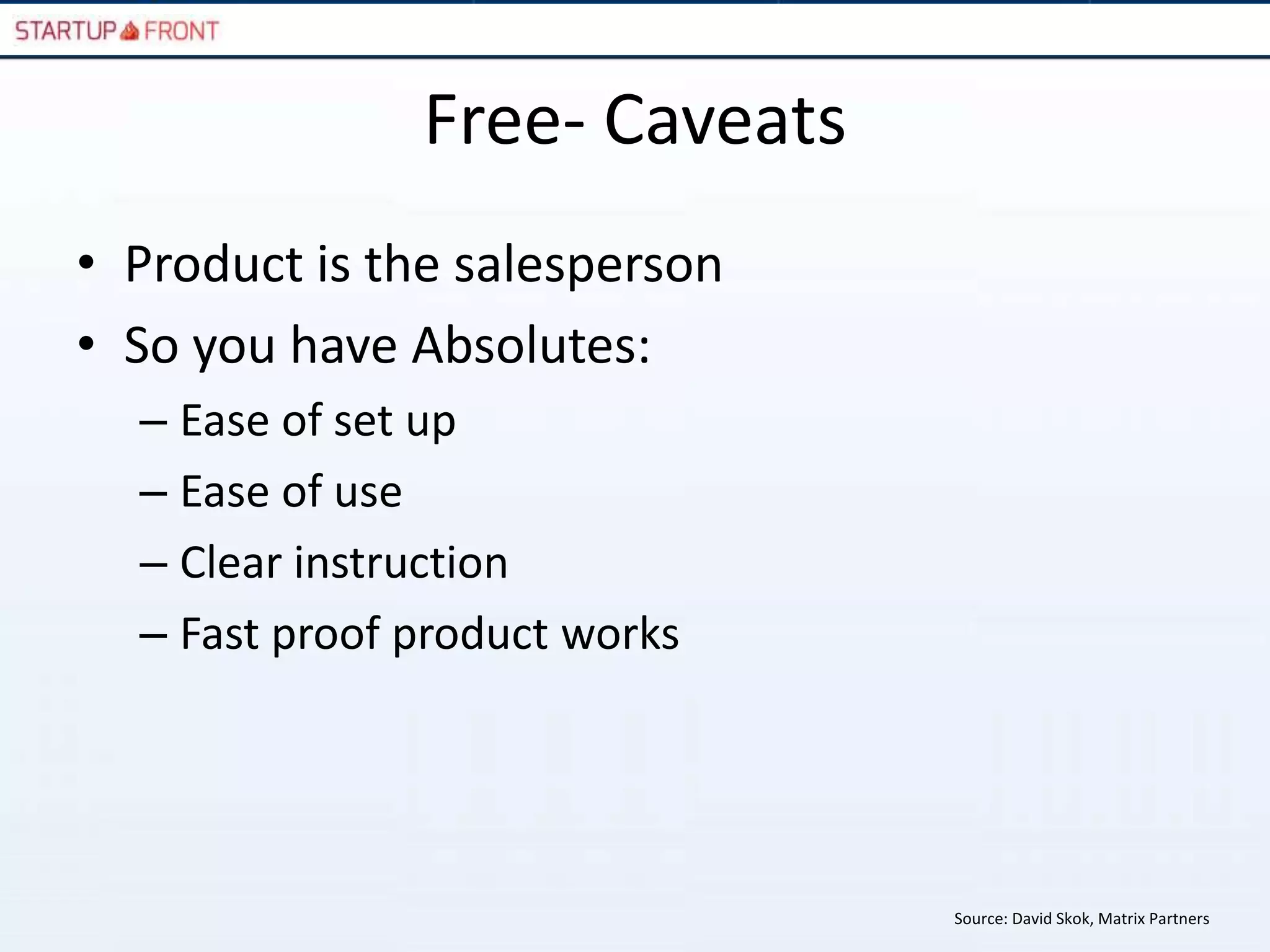
Free- Caveats
• Product is the salesperson
• So you have Absolutes:
  – Ease of set up
  – Ease of use
  – Clear instruction
  – Fast proof product works


                               Source: David Skok, Matrix Partners
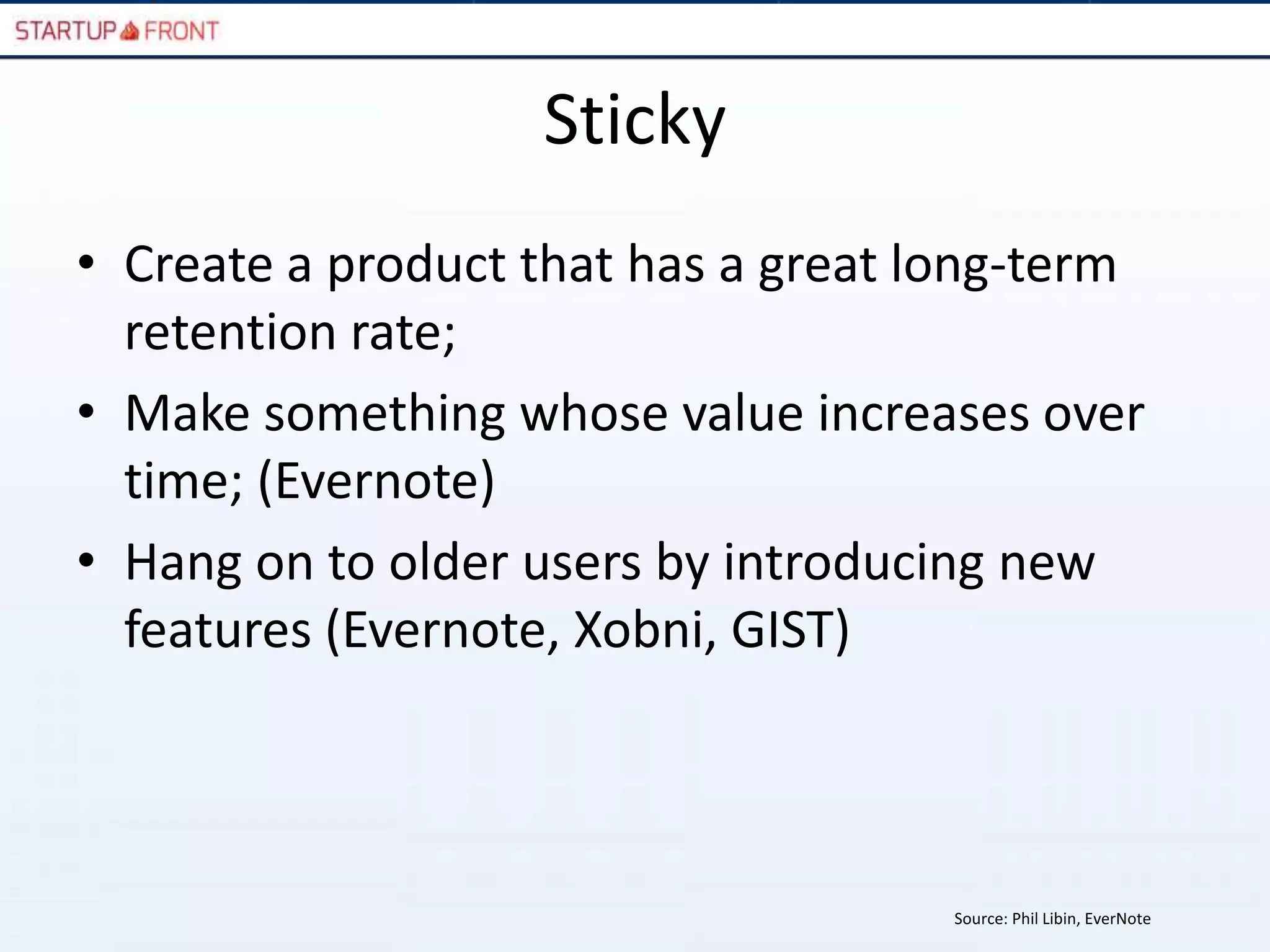
Sticky
• Create a product that has a great long-term
  retention rate;
• Make something whose value increases over
  time; (Evernote)
• Hang on to older users by introducing new
  features (Evernote, Xobni, GIST)


                                    Source: Phil Libin, EverNote
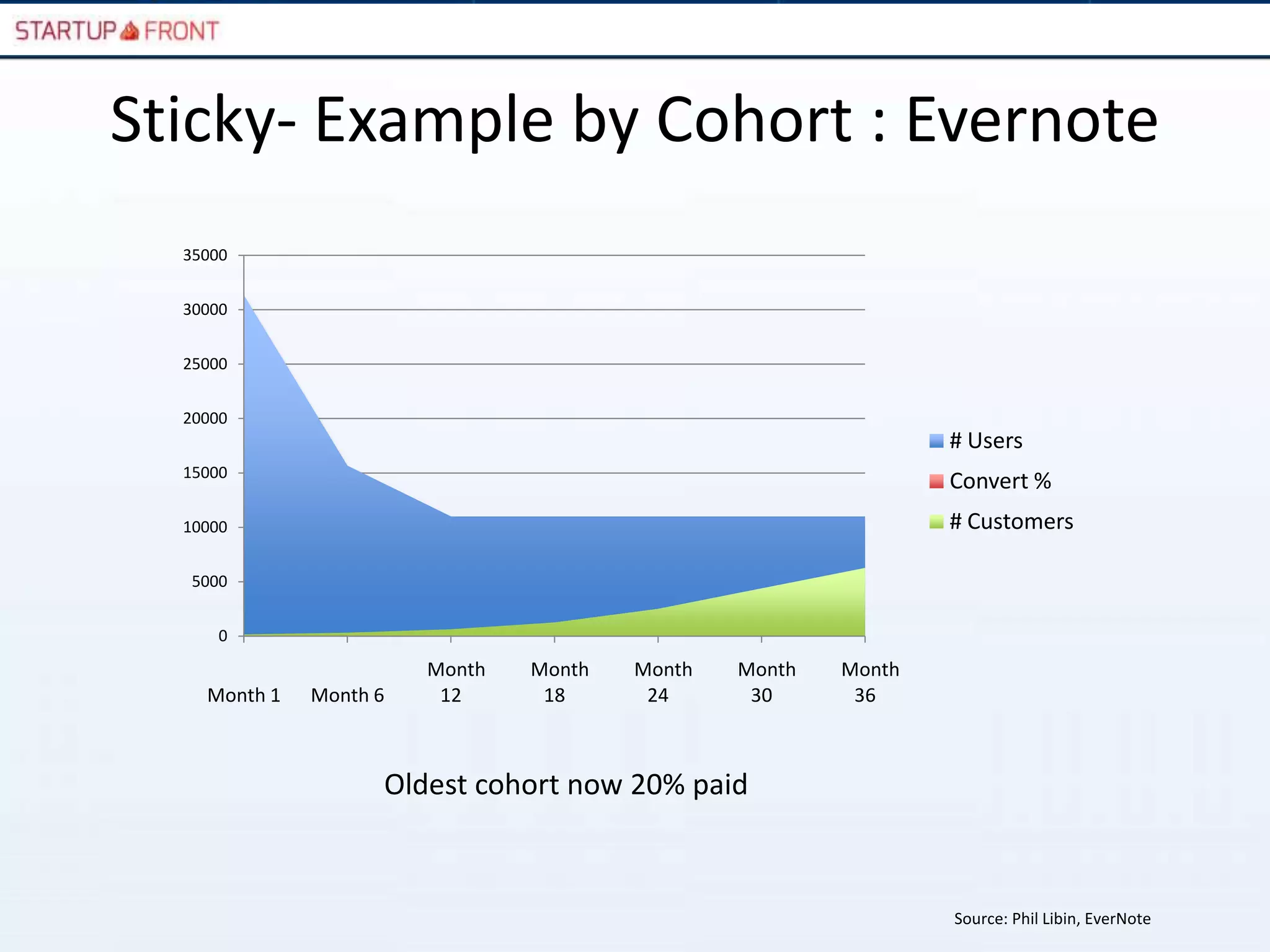
Sticky- Example by Cohort : Evernote
  35000


  30000


  25000


  20000
                                                                # Users
  15000
                                                                Convert %
  10000                                                         # Customers

  5000


      0
                        Month   Month   Month   Month   Month
    Month 1   Month 6    12      18      24      30      36


                    Oldest cohort now 20% paid


                                                                Source: Phil Libin, EverNote
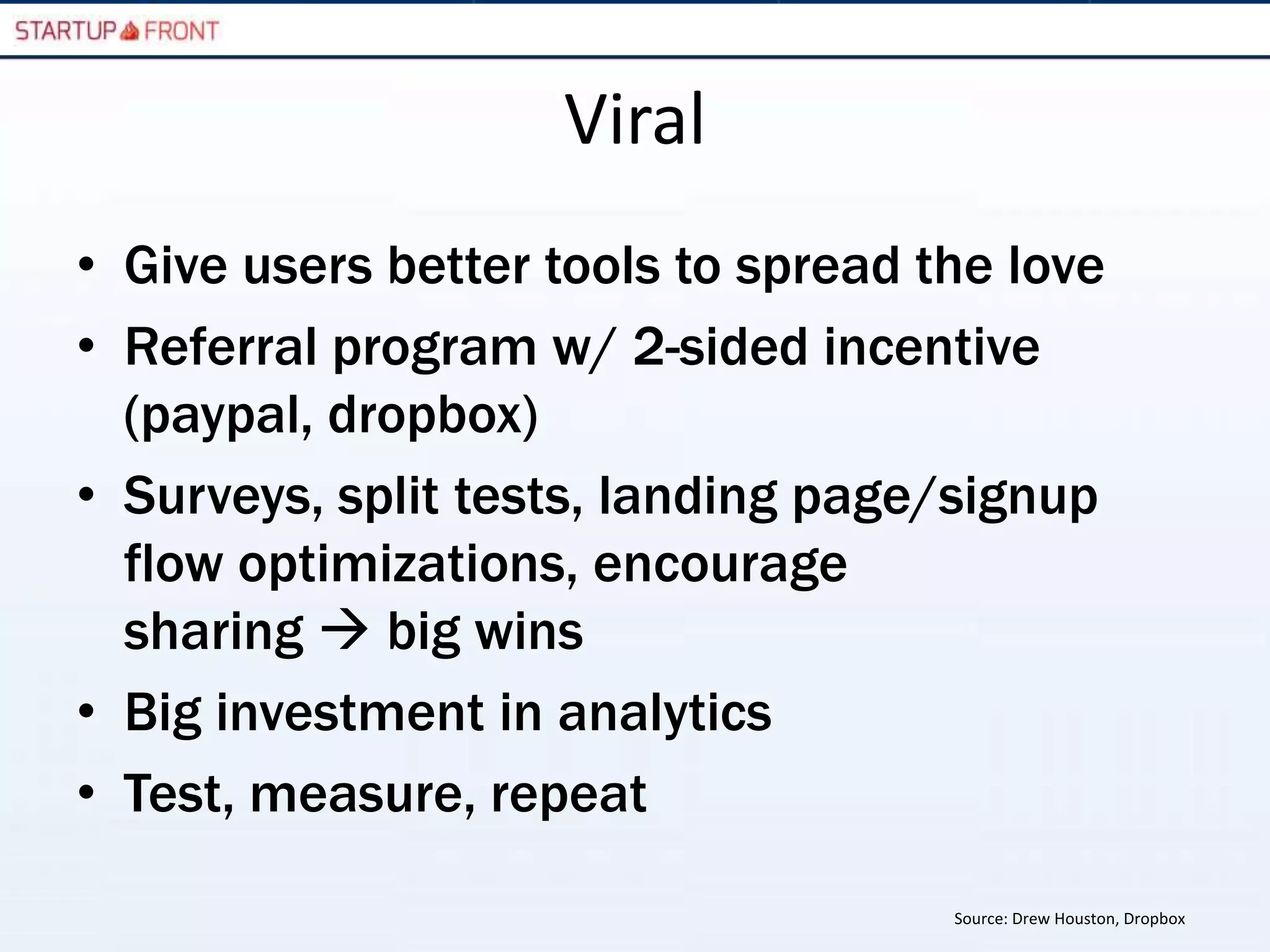
Viral
• Give users better tools to spread the love
• Referral program w/ 2-sided incentive
  (paypal, dropbox)
• Surveys, split tests, landing page/signup
  flow optimizations, encourage
  sharing  big wins
• Big investment in analytics
• Test, measure, repeat
                                     Source: Drew Houston, Dropbox
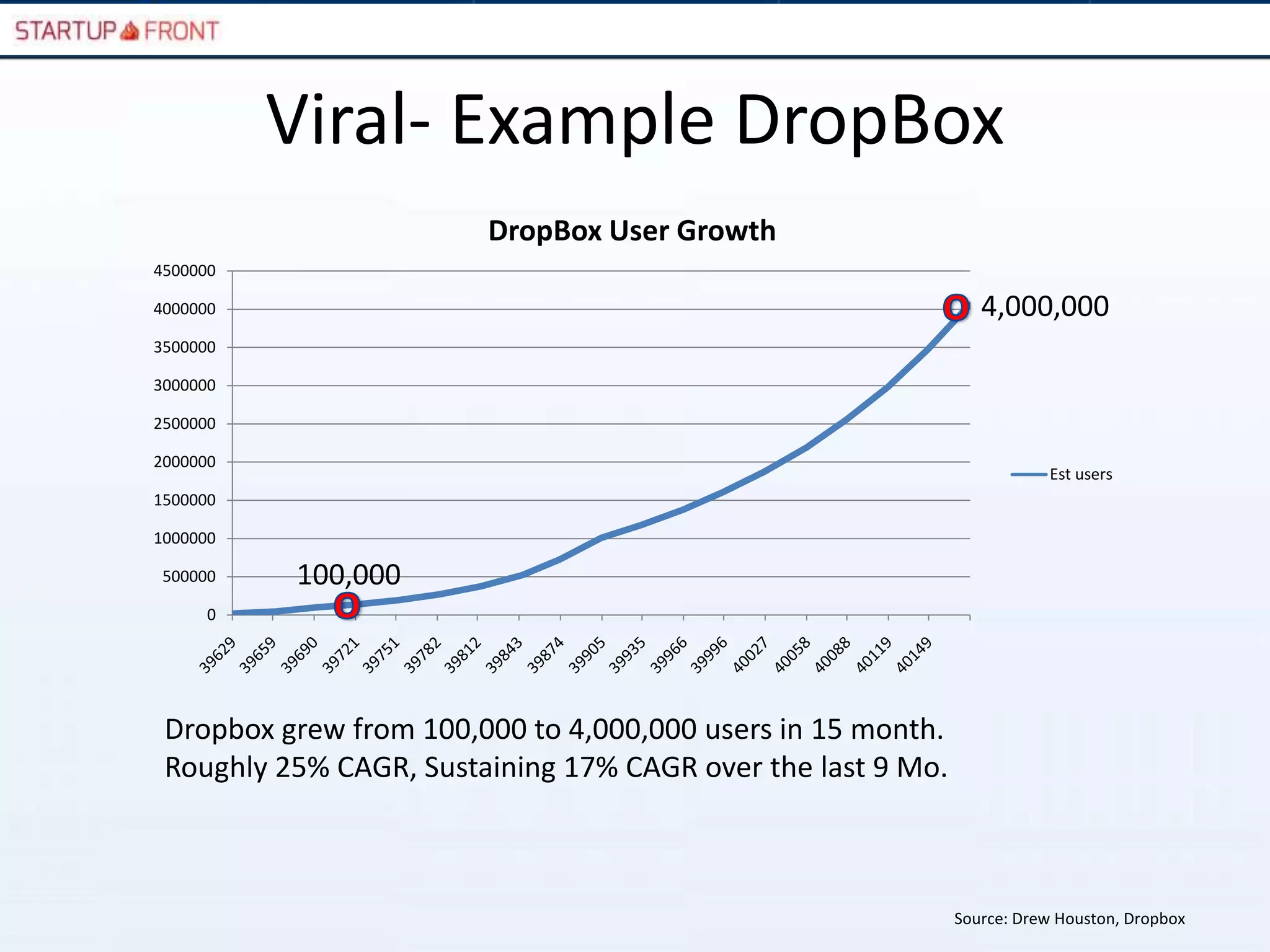
Viral- Example DropBox
                        DropBox User Growth
4500000

4000000                                                         4,000,000
3500000

3000000

2500000

2000000
                                                                        Est users
1500000

1000000

 500000   100,000
      0


 Dropbox grew from 100,000 to 4,000,000 users in 15 month.
 Roughly 25% CAGR, Sustaining 17% CAGR over the last 9 Mo.


                                                             Source: Drew Houston, Dropbox
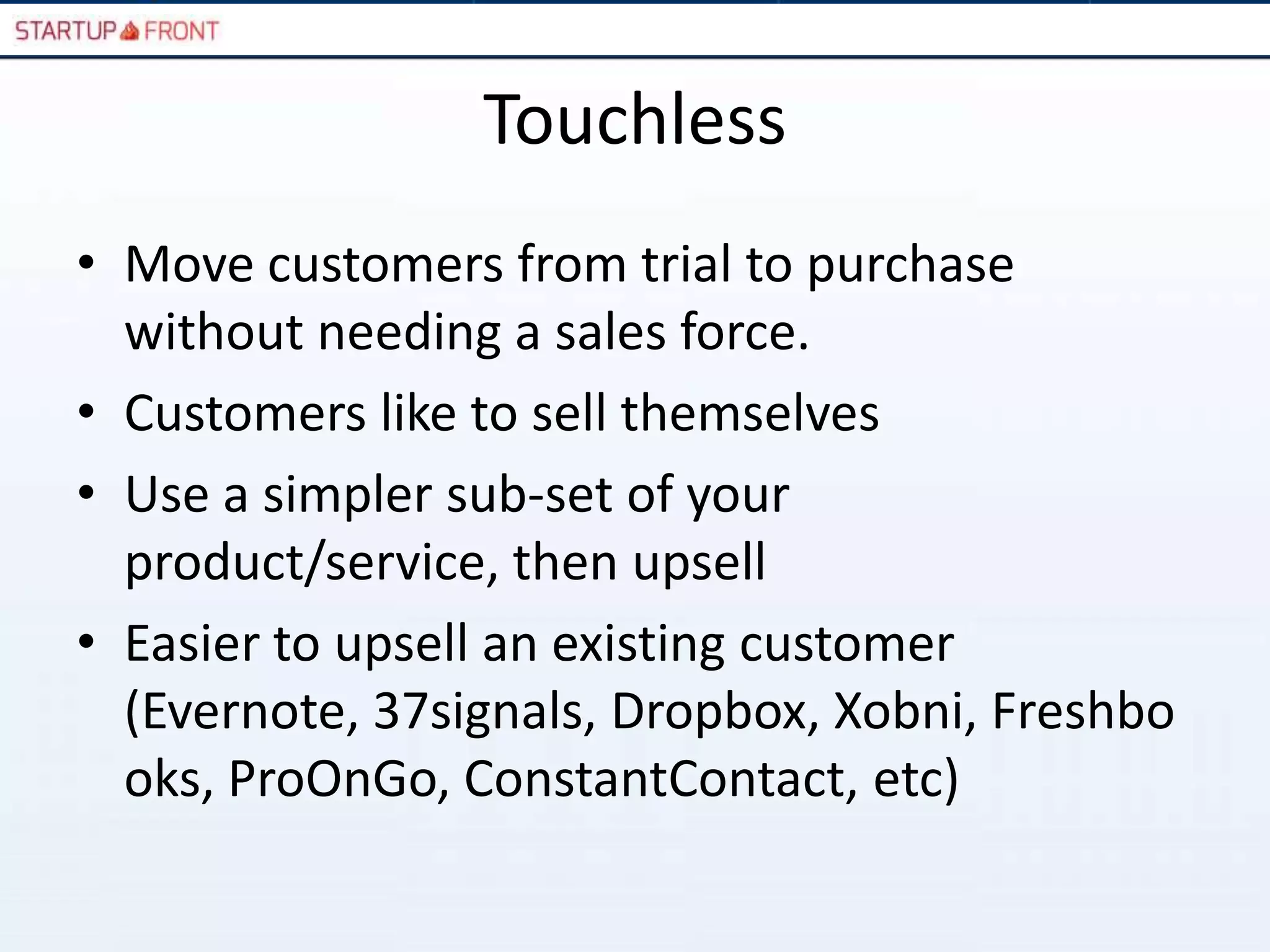
Touchless
• Move customers from trial to purchase
  without needing a sales force.
• Customers like to sell themselves
• Use a simpler sub-set of your
  product/service, then upsell
• Easier to upsell an existing customer
  (Evernote, 37signals, Dropbox, Xobni, Freshbo
  oks, ProOnGo, ConstantContact, etc)
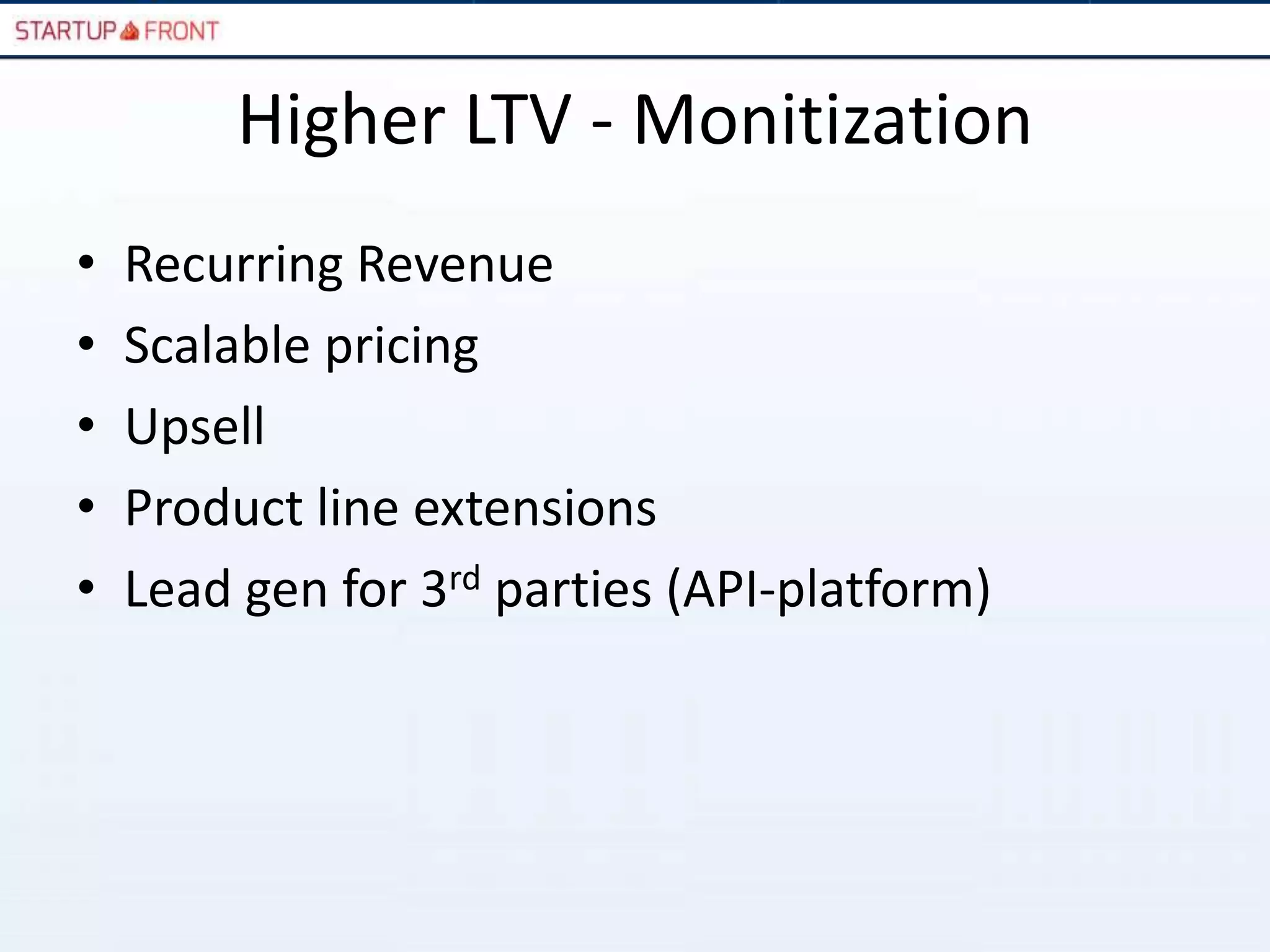
Higher LTV - Monitization
•   Recurring Revenue
•   Scalable pricing
•   Upsell
•   Product line extensions
•   Lead gen for 3rd parties (API-platform)
A Working Freemium Business Model


                          Source: David Skok, Matrix Partners
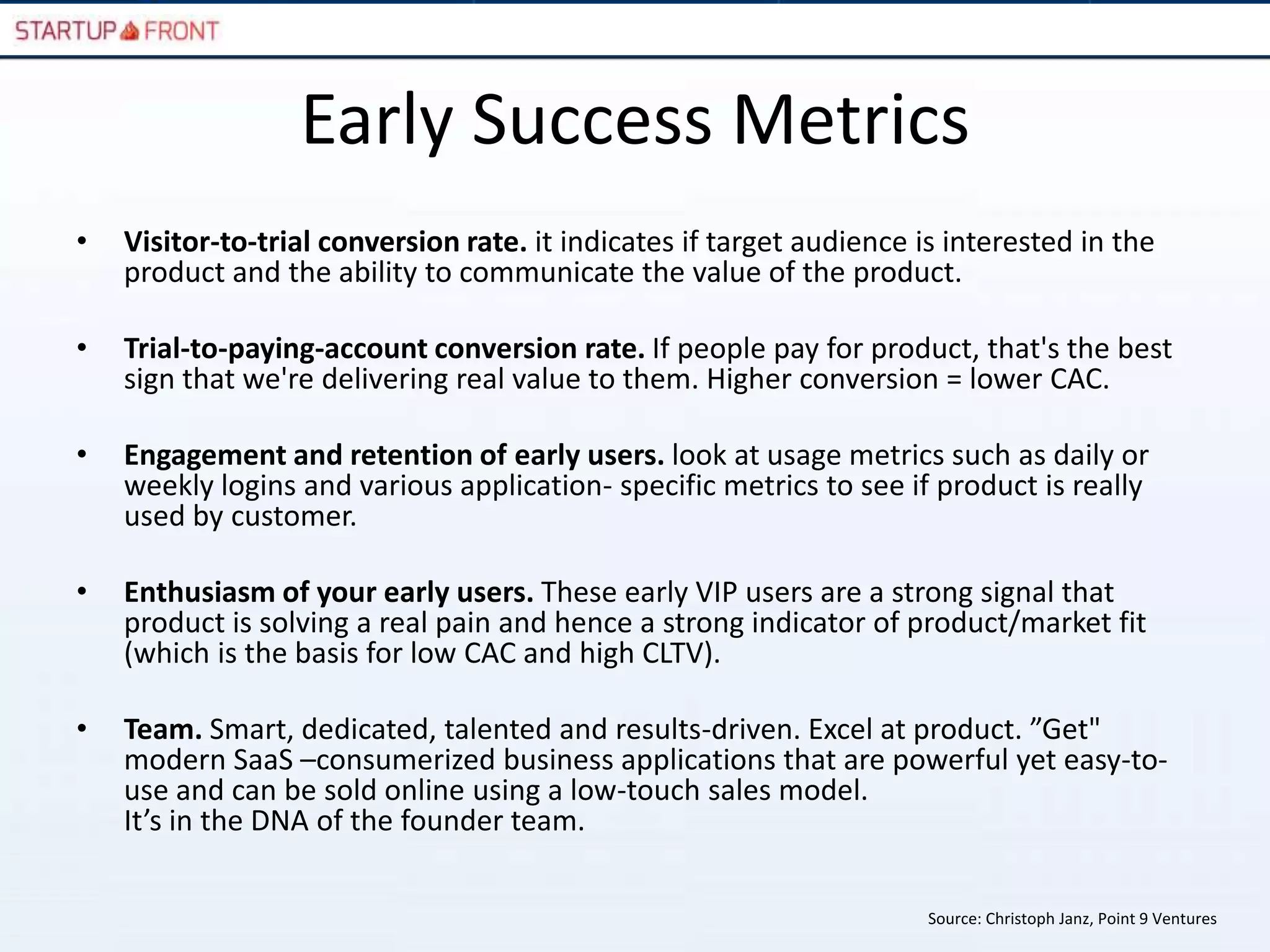
Early Success Metrics
•   Visitor-to-trial conversion rate. it indicates if target audience is interested in the
    product and the ability to communicate the value of the product.

•   Trial-to-paying-account conversion rate. If people pay for product, that's the best
    sign that we're delivering real value to them. Higher conversion = lower CAC.

•   Engagement and retention of early users. look at usage metrics such as daily or
    weekly logins and various application- specific metrics to see if product is really
    used by customer.

•   Enthusiasm of your early users. These early VIP users are a strong signal that
    product is solving a real pain and hence a strong indicator of product/market fit
    (which is the basis for low CAC and high CLTV).

•   Team. Smart, dedicated, talented and results-driven. Excel at product. ”Get"
    modern SaaS –consumerized business applications that are powerful yet easy-to-
    use and can be sold online using a low-touch sales model.
    It’s in the DNA of the founder team.

                                                                       Source: Christoph Janz, Point 9 Ventures
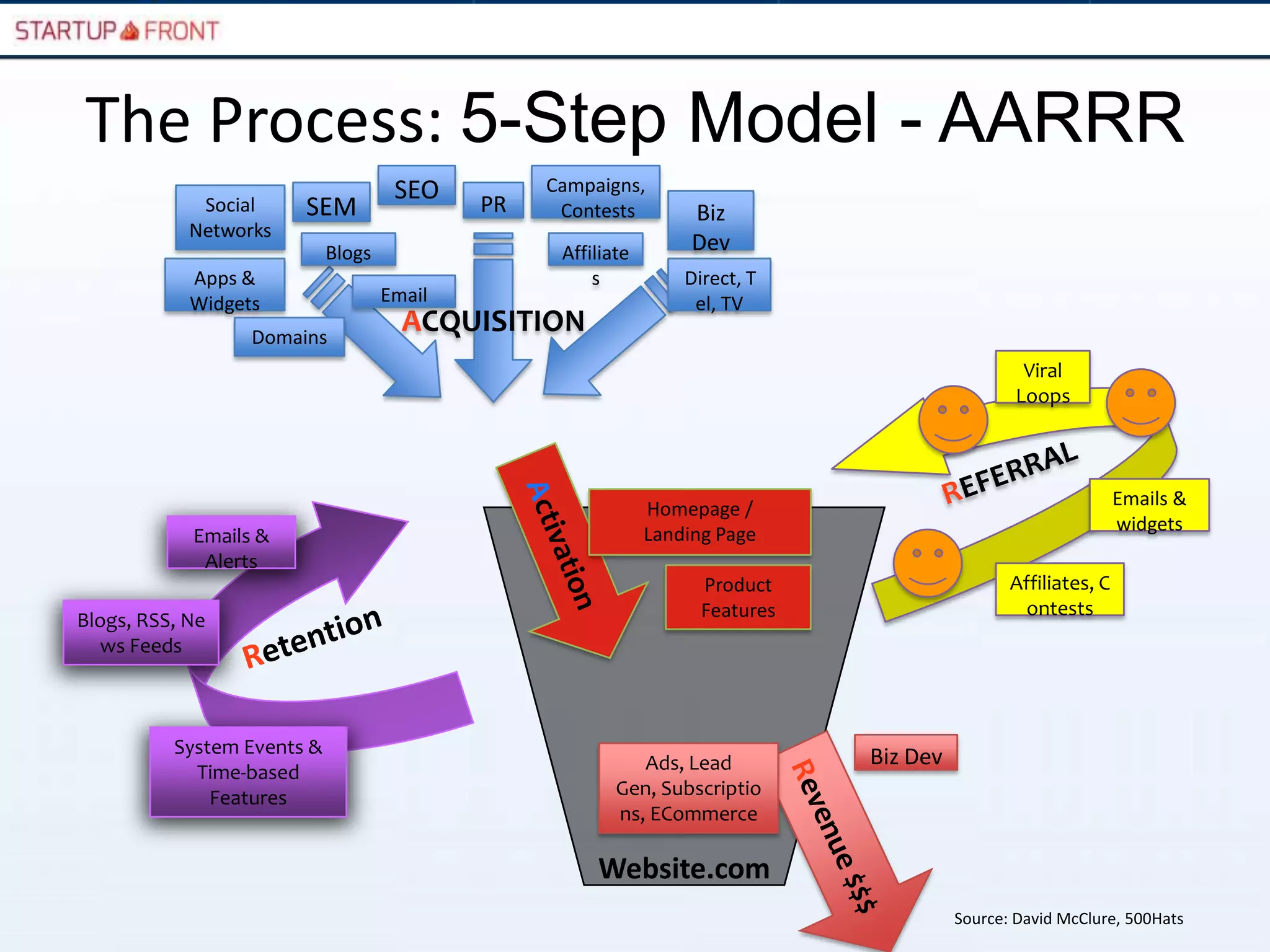
The Process: 5-Step Model - AARRR
                                     SEO         Campaigns,
             Social    SEM                  PR    Contests         Biz
            Networks
                            Blogs                 Affiliate        Dev
            Apps &                                    s           Direct, T
            Widgets                 Email                          el, TV
                  Domains
                                      ACQUISITION
                                                                                                  Viral
                                                                                                 Loops


                                                              Homepage /                                        Emails &
                                                              Landing Page                                      widgets
            Emails &
             Alerts
                                                                    Product                     Affiliates, C
                                                                    Features                      ontests
Blogs, RSS, Ne
  ws Feeds


          System Events &
                                                            Ads, Lead          Biz Dev
            Time-based
              Features                                   Gen, Subscriptio
                                                         ns, ECommerce

                                                      Website.com
                                                                                         Source: David McClure, 500Hats
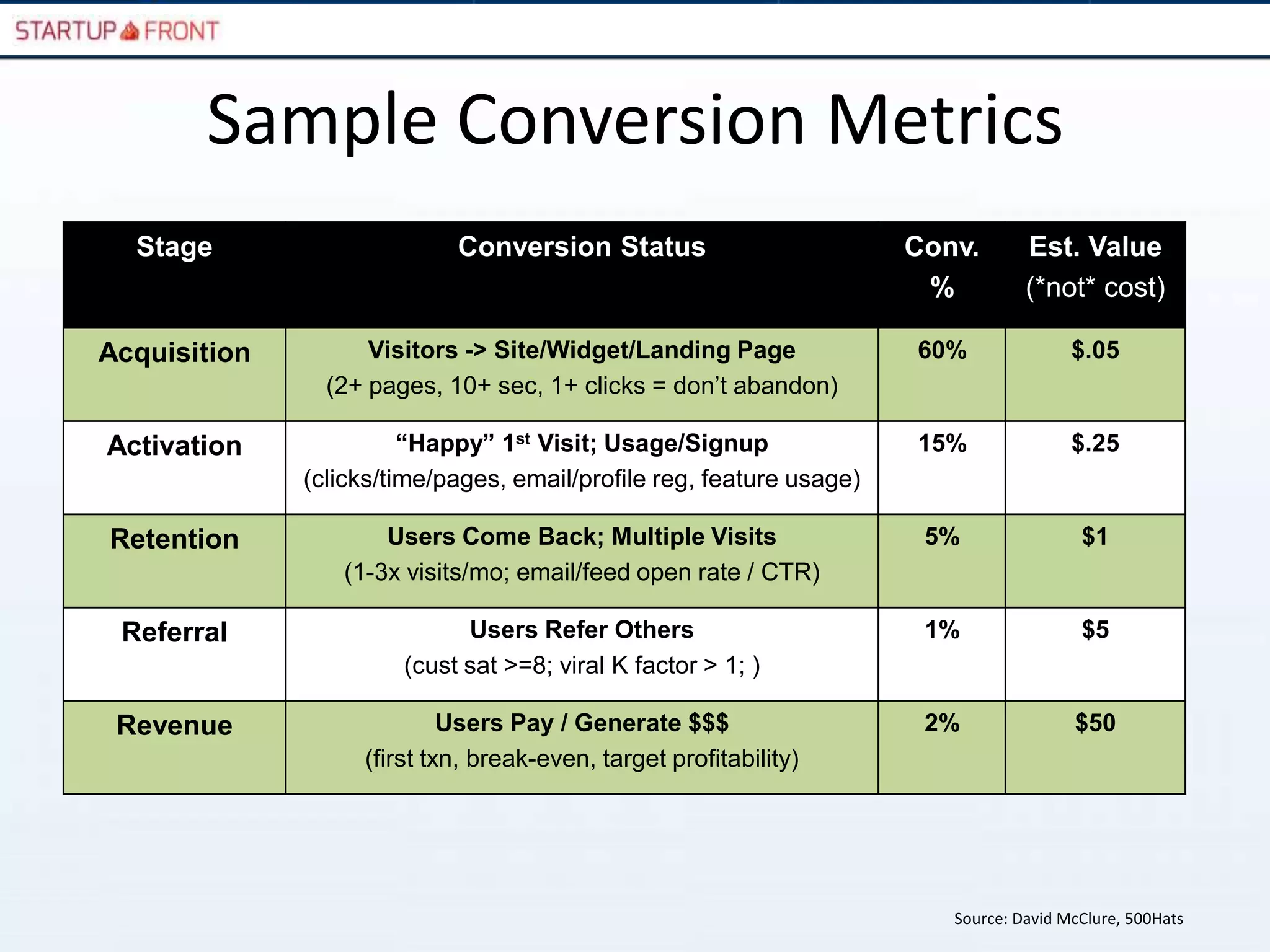
Sample Conversion Metrics
  Stage                     Conversion Status                         Conv.       Est. Value
                                                                       %          (*not* cost)

Acquisition         Visitors -> Site/Widget/Landing Page              60%               $.05
                (2+ pages, 10+ sec, 1+ clicks = don’t abandon)

Activation              “Happy” 1st Visit; Usage/Signup               15%               $.25
              (clicks/time/pages, email/profile reg, feature usage)

Retention            Users Come Back; Multiple Visits                  5%                $1
                 (1-3x visits/mo; email/feed open rate / CTR)

 Referral                    Users Refer Others                        1%                $5
                       (cust sat >=8; viral K factor > 1; )

 Revenue                    Users Pay / Generate $$$                   2%               $50
                   (first txn, break-even, target profitability)


                                                                         Source: David McClure, 500Hats
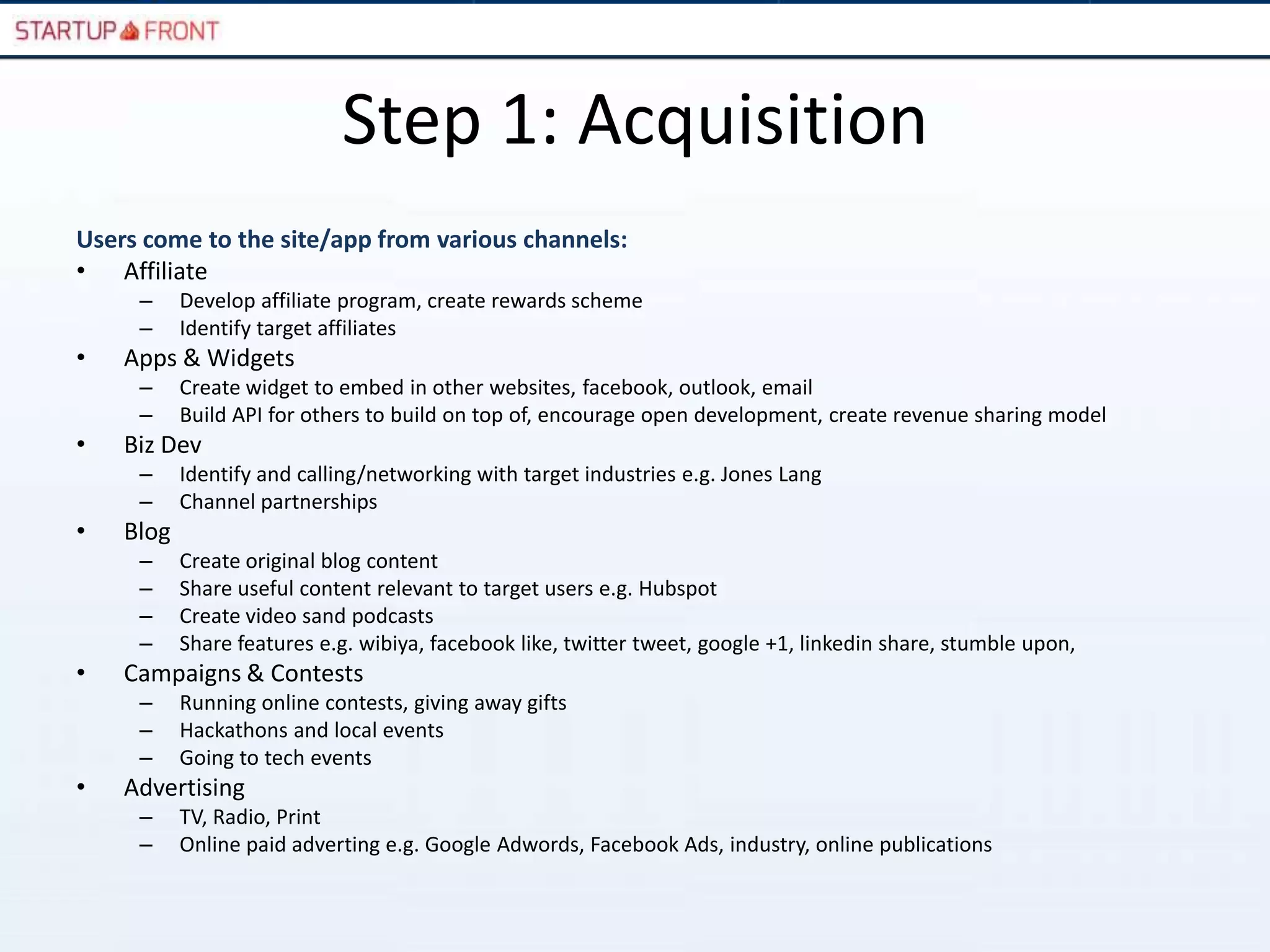
Step 1: Acquisition
Users come to the site/app from various channels:
• Affiliate
     –     Develop affiliate program, create rewards scheme
     –     Identify target affiliates
•   Apps & Widgets
     –     Create widget to embed in other websites, facebook, outlook, email
     –     Build API for others to build on top of, encourage open development, create revenue sharing model
•   Biz Dev
     –     Identify and calling/networking with target industries e.g. Jones Lang
     –     Channel partnerships
•   Blog
     –     Create original blog content
     –     Share useful content relevant to target users e.g. Hubspot
     –     Create video sand podcasts
     –     Share features e.g. wibiya, facebook like, twitter tweet, google +1, linkedin share, stumble upon,
•   Campaigns & Contests
     –     Running online contests, giving away gifts
     –     Hackathons and local events
     –     Going to tech events
•   Advertising
     –     TV, Radio, Print
     –     Online paid adverting e.g. Google Adwords, Facebook Ads, industry, online publications
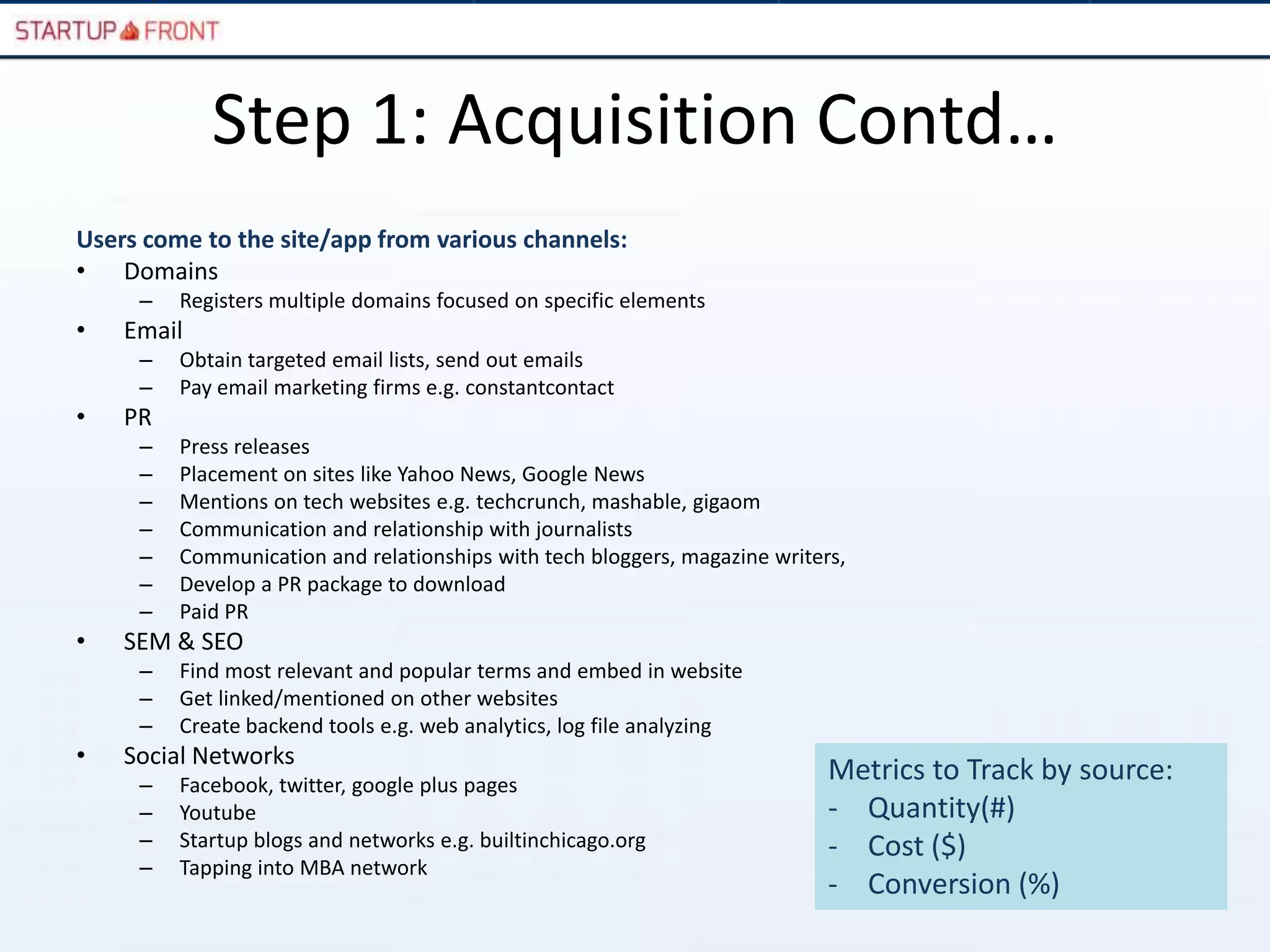
Step 1: Acquisition Contd…
Users come to the site/app from various channels:
• Domains
     –   Registers multiple domains focused on specific elements
•   Email
     –   Obtain targeted email lists, send out emails
     –   Pay email marketing firms e.g. constantcontact
•   PR
     –   Press releases
     –   Placement on sites like Yahoo News, Google News
     –   Mentions on tech websites e.g. techcrunch, mashable, gigaom
     –   Communication and relationship with journalists
     –   Communication and relationships with tech bloggers, magazine writers,
     –   Develop a PR package to download
     –   Paid PR
•   SEM & SEO
     –   Find most relevant and popular terms and embed in website
     –   Get linked/mentioned on other websites
     –   Create backend tools e.g. web analytics, log file analyzing
•   Social Networks
     –   Facebook, twitter, google plus pages
                                                                            Metrics to Track by source:
     –   Youtube                                                            - Quantity(#)
     –   Startup blogs and networks e.g. builtinchicago.org                 - Cost ($)
     –   Tapping into MBA network
                                                                            - Conversion (%)
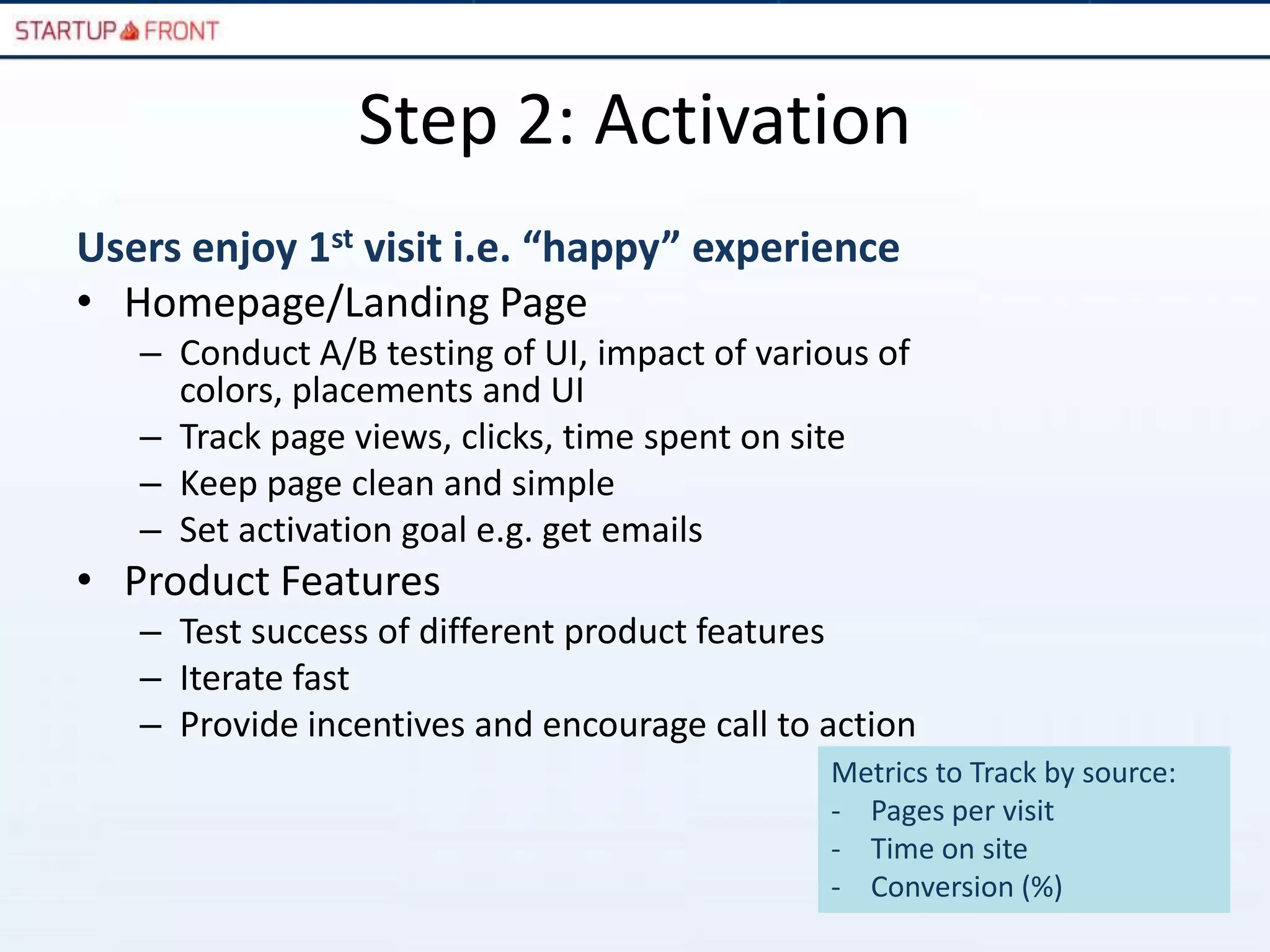
Step 2: Activation
Users enjoy 1st visit i.e. “happy” experience
• Homepage/Landing Page
   – Conduct A/B testing of UI, impact of various of
     colors, placements and UI
   – Track page views, clicks, time spent on site
   – Keep page clean and simple
   – Set activation goal e.g. get emails
• Product Features
   – Test success of different product features
   – Iterate fast
   – Provide incentives and encourage call to action
                                              Metrics to Track by source:
                                              - Pages per visit
                                              - Time on site
                                              - Conversion (%)
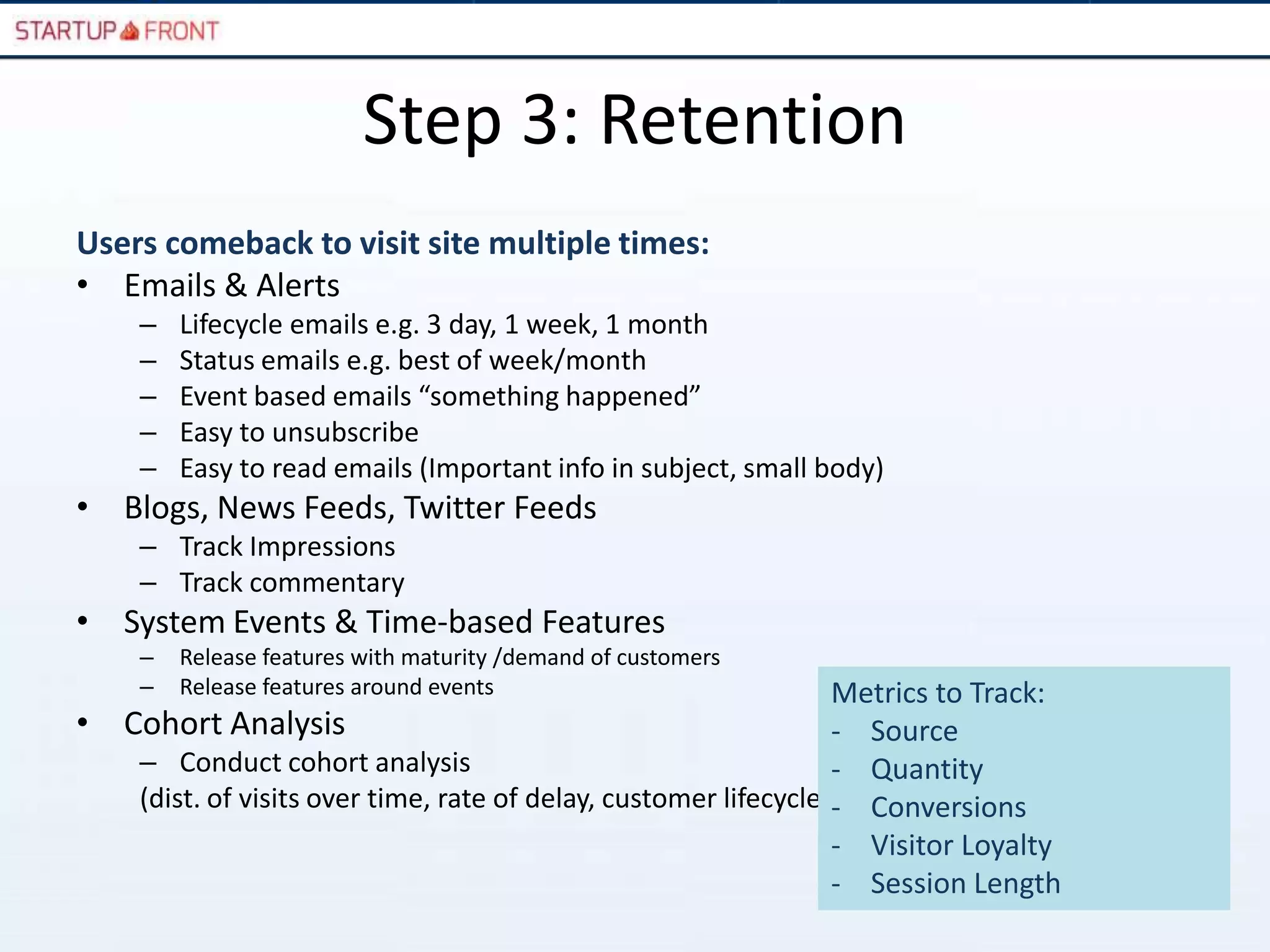
Step 3: Retention
Users comeback to visit site multiple times:
• Emails & Alerts
     –   Lifecycle emails e.g. 3 day, 1 week, 1 month
     –   Status emails e.g. best of week/month
     –   Event based emails “something happened”
     –   Easy to unsubscribe
     –   Easy to read emails (Important info in subject, small body)
• Blogs, News Feeds, Twitter Feeds
     – Track Impressions
     – Track commentary
• System Events & Time-based Features
     –   Release features with maturity /demand of customers
     –   Release features around events                            Metrics to Track:
•   Cohort Analysis                                                - Source
     – Conduct cohort analysis                                     - Quantity
     (dist. of visits over time, rate of delay, customer lifecycle)- Conversions
                                                                   - Visitor Loyalty
                                                                   - Session Length
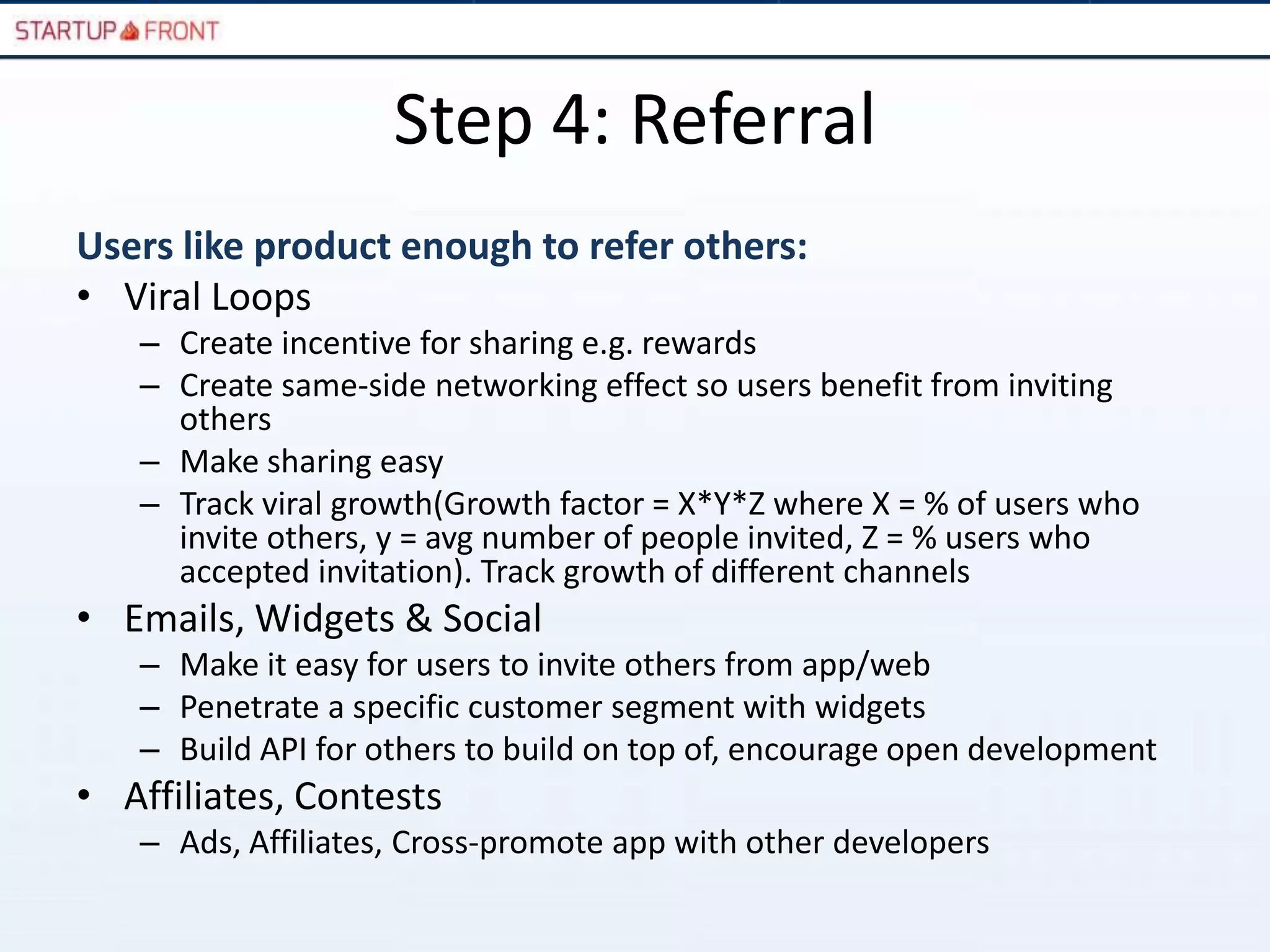
Step 4: Referral
Users like product enough to refer others:
• Viral Loops
   – Create incentive for sharing e.g. rewards
   – Create same-side networking effect so users benefit from inviting
     others
   – Make sharing easy
   – Track viral growth(Growth factor = X*Y*Z where X = % of users who
     invite others, y = avg number of people invited, Z = % users who
     accepted invitation). Track growth of different channels
• Emails, Widgets & Social
   – Make it easy for users to invite others from app/web
   – Penetrate a specific customer segment with widgets
   – Build API for others to build on top of, encourage open development
• Affiliates, Contests
   – Ads, Affiliates, Cross-promote app with other developers
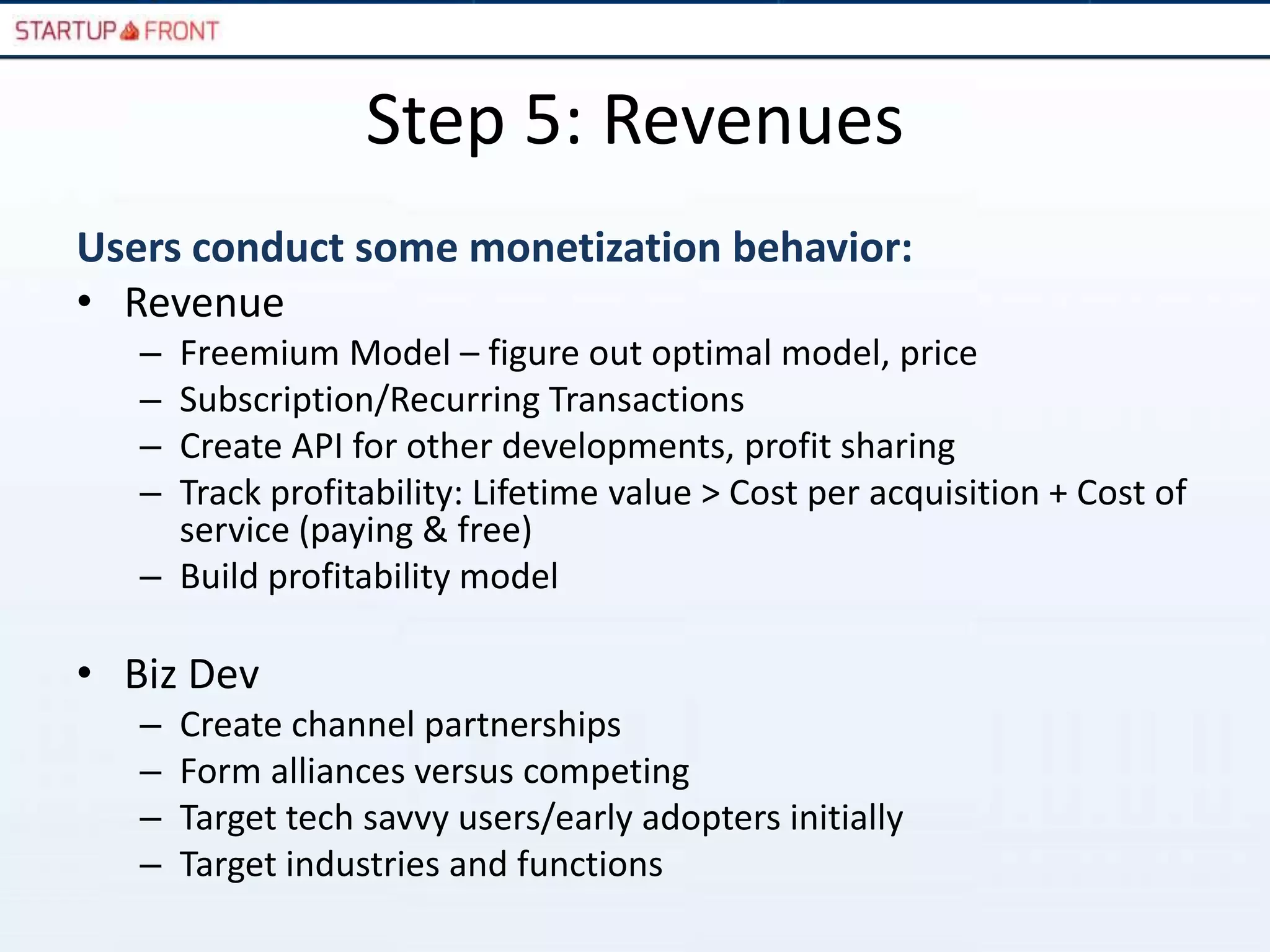
Step 5: Revenues
Users conduct some monetization behavior:
• Revenue
   – Freemium Model – figure out optimal model, price
   – Subscription/Recurring Transactions
   – Create API for other developments, profit sharing
   – Track profitability: Lifetime value > Cost per acquisition + Cost of
     service (paying & free)
   – Build profitability model

• Biz Dev
   –   Create channel partnerships
   –   Form alliances versus competing
   –   Target tech savvy users/early adopters initially
   –   Target industries and functions
Thanks 
• Want more info?
  – Kelly Schwedland
  – 219-405-5723
  – kellys@abdus.com


•   Sections of slidedeck taken from:
    Dave Mcclure’s http://slideshare.net/dmc500hats 500.co       (@DaveMcClure)
    David Skok http://www.slideshare.net/DavidSkok http://www.forentrepreneurs.com/ (@BostonVC)

SaaS and the quest for freemium

  • 1.
    Software as aServices and the Quest for Freemium What it takes to be Sticky, Viral and Touchless
  • 2.
    What makes Freemiumwork • Free: Lower friction = faster traction • Sticky: Grows more valuable the more its used. • Viral: Ecstatic customers + Incentives to share with friends. • Touchless: Guide users to become customers
  • 3.
    For Freemium towork Low CAC High LTV Source: David Skok, Matrix Partners
  • 4.
    Why Free? • ItOptimizes spread, • Creates large footprint, • Fast decisions Examples: – Started with free = Freshbooks, Dropbox, Evernote. – Added Free = MailChimp Source: David Skok, Matrix Partners
  • 5.
    When is Freemiuma good fit? Source Matt Brezina, Xobni
  • 6.
    Free- Caveats • Productis the salesperson • So you have Absolutes: – Ease of set up – Ease of use – Clear instruction – Fast proof product works Source: David Skok, Matrix Partners
  • 7.
    Sticky • Create aproduct that has a great long-term retention rate; • Make something whose value increases over time; (Evernote) • Hang on to older users by introducing new features (Evernote, Xobni, GIST) Source: Phil Libin, EverNote
  • 8.
    Sticky- Example byCohort : Evernote 35000 30000 25000 20000 # Users 15000 Convert % 10000 # Customers 5000 0 Month Month Month Month Month Month 1 Month 6 12 18 24 30 36 Oldest cohort now 20% paid Source: Phil Libin, EverNote
  • 9.
    Viral • Give usersbetter tools to spread the love • Referral program w/ 2-sided incentive (paypal, dropbox) • Surveys, split tests, landing page/signup flow optimizations, encourage sharing  big wins • Big investment in analytics • Test, measure, repeat Source: Drew Houston, Dropbox
  • 10.
    Viral- Example DropBox DropBox User Growth 4500000 4000000 4,000,000 3500000 3000000 2500000 2000000 Est users 1500000 1000000 500000 100,000 0 Dropbox grew from 100,000 to 4,000,000 users in 15 month. Roughly 25% CAGR, Sustaining 17% CAGR over the last 9 Mo. Source: Drew Houston, Dropbox
  • 11.
    Touchless • Move customersfrom trial to purchase without needing a sales force. • Customers like to sell themselves • Use a simpler sub-set of your product/service, then upsell • Easier to upsell an existing customer (Evernote, 37signals, Dropbox, Xobni, Freshbo oks, ProOnGo, ConstantContact, etc)
  • 12.
    Higher LTV -Monitization • Recurring Revenue • Scalable pricing • Upsell • Product line extensions • Lead gen for 3rd parties (API-platform)
  • 13.
    A Working FreemiumBusiness Model Source: David Skok, Matrix Partners
  • 14.
    Early Success Metrics • Visitor-to-trial conversion rate. it indicates if target audience is interested in the product and the ability to communicate the value of the product. • Trial-to-paying-account conversion rate. If people pay for product, that's the best sign that we're delivering real value to them. Higher conversion = lower CAC. • Engagement and retention of early users. look at usage metrics such as daily or weekly logins and various application- specific metrics to see if product is really used by customer. • Enthusiasm of your early users. These early VIP users are a strong signal that product is solving a real pain and hence a strong indicator of product/market fit (which is the basis for low CAC and high CLTV). • Team. Smart, dedicated, talented and results-driven. Excel at product. ”Get" modern SaaS –consumerized business applications that are powerful yet easy-to- use and can be sold online using a low-touch sales model. It’s in the DNA of the founder team. Source: Christoph Janz, Point 9 Ventures
  • 15.
    The Process: 5-StepModel - AARRR SEO Campaigns, Social SEM PR Contests Biz Networks Blogs Affiliate Dev Apps & s Direct, T Widgets Email el, TV Domains ACQUISITION Viral Loops Homepage / Emails & Landing Page widgets Emails & Alerts Product Affiliates, C Features ontests Blogs, RSS, Ne ws Feeds System Events & Ads, Lead Biz Dev Time-based Features Gen, Subscriptio ns, ECommerce Website.com Source: David McClure, 500Hats
  • 16.
    Sample Conversion Metrics Stage Conversion Status Conv. Est. Value % (*not* cost) Acquisition Visitors -> Site/Widget/Landing Page 60% $.05 (2+ pages, 10+ sec, 1+ clicks = don’t abandon) Activation “Happy” 1st Visit; Usage/Signup 15% $.25 (clicks/time/pages, email/profile reg, feature usage) Retention Users Come Back; Multiple Visits 5% $1 (1-3x visits/mo; email/feed open rate / CTR) Referral Users Refer Others 1% $5 (cust sat >=8; viral K factor > 1; ) Revenue Users Pay / Generate $$$ 2% $50 (first txn, break-even, target profitability) Source: David McClure, 500Hats
  • 17.
    Step 1: Acquisition Userscome to the site/app from various channels: • Affiliate – Develop affiliate program, create rewards scheme – Identify target affiliates • Apps & Widgets – Create widget to embed in other websites, facebook, outlook, email – Build API for others to build on top of, encourage open development, create revenue sharing model • Biz Dev – Identify and calling/networking with target industries e.g. Jones Lang – Channel partnerships • Blog – Create original blog content – Share useful content relevant to target users e.g. Hubspot – Create video sand podcasts – Share features e.g. wibiya, facebook like, twitter tweet, google +1, linkedin share, stumble upon, • Campaigns & Contests – Running online contests, giving away gifts – Hackathons and local events – Going to tech events • Advertising – TV, Radio, Print – Online paid adverting e.g. Google Adwords, Facebook Ads, industry, online publications
  • 18.
    Step 1: AcquisitionContd… Users come to the site/app from various channels: • Domains – Registers multiple domains focused on specific elements • Email – Obtain targeted email lists, send out emails – Pay email marketing firms e.g. constantcontact • PR – Press releases – Placement on sites like Yahoo News, Google News – Mentions on tech websites e.g. techcrunch, mashable, gigaom – Communication and relationship with journalists – Communication and relationships with tech bloggers, magazine writers, – Develop a PR package to download – Paid PR • SEM & SEO – Find most relevant and popular terms and embed in website – Get linked/mentioned on other websites – Create backend tools e.g. web analytics, log file analyzing • Social Networks – Facebook, twitter, google plus pages Metrics to Track by source: – Youtube - Quantity(#) – Startup blogs and networks e.g. builtinchicago.org - Cost ($) – Tapping into MBA network - Conversion (%)
  • 19.
    Step 2: Activation Usersenjoy 1st visit i.e. “happy” experience • Homepage/Landing Page – Conduct A/B testing of UI, impact of various of colors, placements and UI – Track page views, clicks, time spent on site – Keep page clean and simple – Set activation goal e.g. get emails • Product Features – Test success of different product features – Iterate fast – Provide incentives and encourage call to action Metrics to Track by source: - Pages per visit - Time on site - Conversion (%)
  • 20.
    Step 3: Retention Userscomeback to visit site multiple times: • Emails & Alerts – Lifecycle emails e.g. 3 day, 1 week, 1 month – Status emails e.g. best of week/month – Event based emails “something happened” – Easy to unsubscribe – Easy to read emails (Important info in subject, small body) • Blogs, News Feeds, Twitter Feeds – Track Impressions – Track commentary • System Events & Time-based Features – Release features with maturity /demand of customers – Release features around events Metrics to Track: • Cohort Analysis - Source – Conduct cohort analysis - Quantity (dist. of visits over time, rate of delay, customer lifecycle)- Conversions - Visitor Loyalty - Session Length
  • 21.
    Step 4: Referral Userslike product enough to refer others: • Viral Loops – Create incentive for sharing e.g. rewards – Create same-side networking effect so users benefit from inviting others – Make sharing easy – Track viral growth(Growth factor = X*Y*Z where X = % of users who invite others, y = avg number of people invited, Z = % users who accepted invitation). Track growth of different channels • Emails, Widgets & Social – Make it easy for users to invite others from app/web – Penetrate a specific customer segment with widgets – Build API for others to build on top of, encourage open development • Affiliates, Contests – Ads, Affiliates, Cross-promote app with other developers
  • 22.
    Step 5: Revenues Usersconduct some monetization behavior: • Revenue – Freemium Model – figure out optimal model, price – Subscription/Recurring Transactions – Create API for other developments, profit sharing – Track profitability: Lifetime value > Cost per acquisition + Cost of service (paying & free) – Build profitability model • Biz Dev – Create channel partnerships – Form alliances versus competing – Target tech savvy users/early adopters initially – Target industries and functions
  • 23.
    Thanks  • Wantmore info? – Kelly Schwedland – 219-405-5723 – kellys@abdus.com • Sections of slidedeck taken from: Dave Mcclure’s http://slideshare.net/dmc500hats 500.co (@DaveMcClure) David Skok http://www.slideshare.net/DavidSkok http://www.forentrepreneurs.com/ (@BostonVC)