SouthAsianAssociation for
RegionalCooperation
(SAARC): ProblemsandProspects
Stuti Sharma
Reg.No: 12101550
INTRODUCTION
 The South Asian Association for Regional Cooperation (SAARC) is
an organization of South Asian nations, which was established on
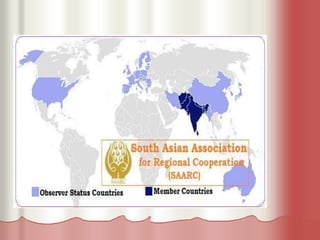
8 December 1985 when the government of Bangladesh, Bhutan,
India, Maldives, Nepal, Pakistan, and Sri Lanka formally adopted
its charter providing for the promotion of economic and social
progress, cultural development within the South Asia region and
also for friendship and cooperation with other developing
countries.
 Afghanistan joined the organization in 2007.
 It is headquartered in Kathmandu, Nepal.
 The meetings of the heads of the states are usually
scheduled
annually while the meetings of foreign secretaries , twice in a year.
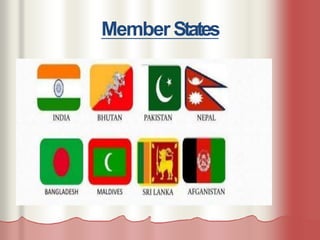
Member States
Objectives
The objectives of the Association as defined in the Charter
are :
 To promote the welfare of the people of South Asia and to
improve their quality of life;
 To accelerate economic growth, social progress and
cultural development in the region and to provide all
individuals the opportunity to live in dignity and to realize
their full potential;
 To promote and strengthen selective self-reliance among
the countries of SouthAsia;
 To contribute to mutual trust, understanding and
appreciation of one another’s problems;
 To promote active collaboration and mutual assistance in
the economic, social, cultural and technical and scientific
fields;
 To strengthen cooperation with other developing
countries;
 To strengthen cooperation among themselves in
international forums on matters of common interest; and
 To cooperate with international and regional
organizations with similar aims andpurposes.
Principlesof SAARC
 Respect for sovereignty, territorial integrity, political equality
and independence of all member states.
 Non- interference in the internal matters is one of its
objectives.
 Cooperation for mutualbenefit.
 All decisions to be taken unanimously and need a quorum
of all eight members.
 All bilateral issues to be kept aside and only multilateral
(involving many countries) issues to be discussed without
being prejudiced by bilateral issues.
Organizational structure
 Council of Ministers
 Standing Committee
 Technical Committee
 Programming
Committee
 Secretariat
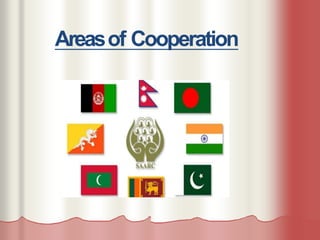
Areasof Cooperation
The areas of cooperation are as follows:
 Agriculture and Rural Development
 Investment and Commercial Dispute
Settlement
 Biotechnology
 Culture
 Economic and Trade
 Education
 Energy
 Environment
 Finance
 Food Security and SAARC FoodBank
 Information and Communication Technology
 Poverty Alleviation
 Science and Technology
 Security Aspects- Drug and Drug related
crimes Terrorism
Police matters
 Social Development
 Tourism
 Funding Mechanism
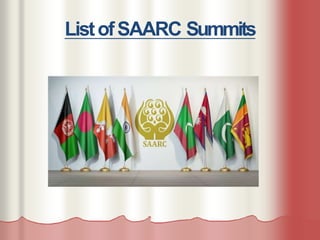
ListofSAARC Summits
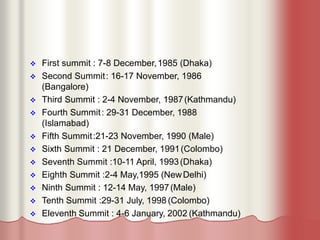
 First summit : 7-8 December,1985 (Dhaka)
 Second Summit: 16-17 November, 1986
(Bangalore)
 Third Summit : 2-4 November, 1987(Kathmandu)
 Fourth Summit: 29-31 December, 1988
(Islamabad)
 Fifth Summit:21-23 November, 1990 (Male)
 Sixth Summit : 21 December, 1991(Colombo)
 Seventh Summit :10-11 April, 1993(Dhaka)
 Eighth Summit :2-4 May,1995 (NewDelhi)
 Ninth Summit : 12-14 May, 1997(Male)
 Tenth Summit :29-31 July, 1998 (Colombo)
 Eleventh Summit : 4-6 January, 2002 (Kathmandu)
 Twelfth Summit : 2-6 January, 2004 (Islamabad)
 Thirteenth Summit : 12-13 November, 2005 (Dhaka)
 Fourteenth Summit : 3-4 April, 2007 (New Delhi)
 Fifteenth Summit : 1-3 August, 2008 (Colombo)
 Sixteenth Summit: 28-29 April, 2010 (Thimphu)
 Seventeenth Summit : 10-11 November,2011 (Maldives)
 Eighteenth Summit : 26-27 November, 2014 (Kathmandu)
 Nineteenth Summit :15-19 November,2016(Islamabad) –
[Cancelled]
SAARCSpecialized Bodies
 SAARC Development Fund
(SDF)
 South Asian University (SAU)
Standard
s
 SAARC Arbitration Council
 South Asian
Regional Organization
Problems
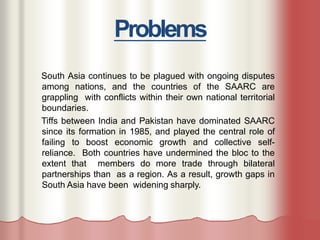
South Asia continues to be plagued with ongoing disputes
among nations, and the countries of the SAARC are
grappling with conflicts within their own national territorial
boundaries.
Tiffs between India and Pakistan have dominated SAARC
since its formation in 1985, and played the central role of
failing to boost economic growth and collective self-
reliance. Both countries have undermined the bloc to the
extent that members do more trade through bilateral
partnerships than as a region. As a result, growth gaps in
South Asia have been widening sharply.
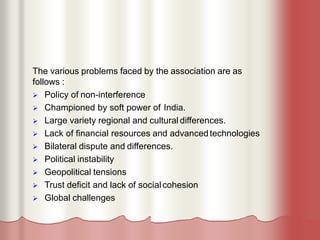
The various problems faced by the association are as
follows :
 Policy of non-interference
 Championed by soft power of India.
 Large variety regional and cultural differences.
 Lack of financial resources and advancedtechnologies
 Bilateral dispute and differences.
 Political instability
 Geopolitical tensions
 Trust deficit and lack of socialcohesion
 Global challenges
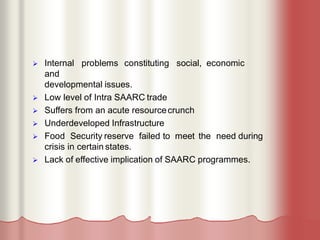
 Internal problems constituting social, economic
and
developmental issues.
 Low level of Intra SAARC trade
 Suffers from an acute resourcecrunch
 Underdeveloped Infrastructure
 Food Security reserve failed to meet the need during
crisis in certain states.
 Lack of effective implication of SAARC programmes.
Prospects
 SAARC, as an organization, reflects the South Asian identity
of the countries, historically and contemporarily. This is a
naturally made geographical identity. Equally, there is a
cultural, linguistic, religious and culinary affinity that defines
South Asia.
 South Asia needs increased co-operations among its
countries to face challenges posed by hikes in food prices,
energy prices, recurrent disasters and climate change due to
geographic, economic, cultural and other strategicreasons.
 South Asia has distinct advantages to cooperate in many
areas including cross border infrastructureand services.
 South Asia has shown impressive growth in the last decade.
 This growth is reflected in the growth of trade and investment
in
the region.
 India has been star performer among all South Asian countries.
 More global integration and South Asia’s proximity to the
growing Asian region (China, ASEAN) are explanatory factors of
this growth.
 Large human capital base combined with competition through
open economies is playing a crucial role in the growth process.
high
 Increased remittances and growing middle class with
purchasing power.
 Youth bulge in a perspective possible demographic
dividend.
 High growth in services with modern technology.
 In a region increasingly targeted by Chinese investment
and loans, SAARC could be a common platform to
demand more sustainable alternatives for development,
or to oppose trade tariffs together, or to demand better
terms for South Asian labour around the world.
 The potential of organization to maintain peace and
stability in the region should be explored by all the
member countries.
 SAARC should be allowed to progress naturally and the
people of South Asia , who make up a quarter of the
world’s population should be offered more people-to-
people contact and cultural cohesiveness.
Conclusion
 It has often been argued that a ‘SAARC Parliament could go
beyond the bureaucratic-technical parameters of the existing
organization and promote new political, moral and cultural
dimensions of regionalism in South Asia’.
 The situation with regard to South Asian regionalism has
been beautifully captured by Lawrence Saez, “South Asia
forms a unique regional security complex that enables
certain forms of regional cooperation and bars cooperation
on other issue areas”.
Thank you…

SAARC

  • 1.
  • 3.
    INTRODUCTION  The SouthAsian Association for Regional Cooperation (SAARC) is an organization of South Asian nations, which was established on 8 December 1985 when the government of Bangladesh, Bhutan, India, Maldives, Nepal, Pakistan, and Sri Lanka formally adopted its charter providing for the promotion of economic and social progress, cultural development within the South Asia region and also for friendship and cooperation with other developing countries.  Afghanistan joined the organization in 2007.  It is headquartered in Kathmandu, Nepal.  The meetings of the heads of the states are usually scheduled annually while the meetings of foreign secretaries , twice in a year.
  • 4.
  • 5.
    Objectives The objectives ofthe Association as defined in the Charter are :  To promote the welfare of the people of South Asia and to improve their quality of life;  To accelerate economic growth, social progress and cultural development in the region and to provide all individuals the opportunity to live in dignity and to realize their full potential;  To promote and strengthen selective self-reliance among the countries of SouthAsia;  To contribute to mutual trust, understanding and appreciation of one another’s problems;
  • 6.
     To promoteactive collaboration and mutual assistance in the economic, social, cultural and technical and scientific fields;  To strengthen cooperation with other developing countries;  To strengthen cooperation among themselves in international forums on matters of common interest; and  To cooperate with international and regional organizations with similar aims andpurposes.
  • 7.
    Principlesof SAARC  Respectfor sovereignty, territorial integrity, political equality and independence of all member states.  Non- interference in the internal matters is one of its objectives.  Cooperation for mutualbenefit.  All decisions to be taken unanimously and need a quorum of all eight members.  All bilateral issues to be kept aside and only multilateral (involving many countries) issues to be discussed without being prejudiced by bilateral issues.
  • 8.
    Organizational structure  Councilof Ministers  Standing Committee  Technical Committee  Programming Committee  Secretariat
  • 9.
  • 10.
    The areas ofcooperation are as follows:  Agriculture and Rural Development  Investment and Commercial Dispute Settlement  Biotechnology  Culture  Economic and Trade  Education  Energy  Environment  Finance  Food Security and SAARC FoodBank
  • 11.
     Information andCommunication Technology  Poverty Alleviation  Science and Technology  Security Aspects- Drug and Drug related crimes Terrorism Police matters  Social Development  Tourism  Funding Mechanism
  • 12.
  • 13.
     First summit: 7-8 December,1985 (Dhaka)  Second Summit: 16-17 November, 1986 (Bangalore)  Third Summit : 2-4 November, 1987(Kathmandu)  Fourth Summit: 29-31 December, 1988 (Islamabad)  Fifth Summit:21-23 November, 1990 (Male)  Sixth Summit : 21 December, 1991(Colombo)  Seventh Summit :10-11 April, 1993(Dhaka)  Eighth Summit :2-4 May,1995 (NewDelhi)  Ninth Summit : 12-14 May, 1997(Male)  Tenth Summit :29-31 July, 1998 (Colombo)  Eleventh Summit : 4-6 January, 2002 (Kathmandu)
  • 14.
     Twelfth Summit: 2-6 January, 2004 (Islamabad)  Thirteenth Summit : 12-13 November, 2005 (Dhaka)  Fourteenth Summit : 3-4 April, 2007 (New Delhi)  Fifteenth Summit : 1-3 August, 2008 (Colombo)  Sixteenth Summit: 28-29 April, 2010 (Thimphu)  Seventeenth Summit : 10-11 November,2011 (Maldives)  Eighteenth Summit : 26-27 November, 2014 (Kathmandu)  Nineteenth Summit :15-19 November,2016(Islamabad) – [Cancelled]
  • 15.
    SAARCSpecialized Bodies  SAARCDevelopment Fund (SDF)  South Asian University (SAU) Standard s  SAARC Arbitration Council  South Asian Regional Organization
  • 16.
    Problems South Asia continuesto be plagued with ongoing disputes among nations, and the countries of the SAARC are grappling with conflicts within their own national territorial boundaries. Tiffs between India and Pakistan have dominated SAARC since its formation in 1985, and played the central role of failing to boost economic growth and collective self- reliance. Both countries have undermined the bloc to the extent that members do more trade through bilateral partnerships than as a region. As a result, growth gaps in South Asia have been widening sharply.
  • 17.
    The various problemsfaced by the association are as follows :  Policy of non-interference  Championed by soft power of India.  Large variety regional and cultural differences.  Lack of financial resources and advancedtechnologies  Bilateral dispute and differences.  Political instability  Geopolitical tensions  Trust deficit and lack of socialcohesion  Global challenges
  • 18.
     Internal problemsconstituting social, economic and developmental issues.  Low level of Intra SAARC trade  Suffers from an acute resourcecrunch  Underdeveloped Infrastructure  Food Security reserve failed to meet the need during crisis in certain states.  Lack of effective implication of SAARC programmes.
  • 19.
    Prospects  SAARC, asan organization, reflects the South Asian identity of the countries, historically and contemporarily. This is a naturally made geographical identity. Equally, there is a cultural, linguistic, religious and culinary affinity that defines South Asia.  South Asia needs increased co-operations among its countries to face challenges posed by hikes in food prices, energy prices, recurrent disasters and climate change due to geographic, economic, cultural and other strategicreasons.  South Asia has distinct advantages to cooperate in many areas including cross border infrastructureand services.
  • 20.
     South Asiahas shown impressive growth in the last decade.  This growth is reflected in the growth of trade and investment in the region.  India has been star performer among all South Asian countries.  More global integration and South Asia’s proximity to the growing Asian region (China, ASEAN) are explanatory factors of this growth.  Large human capital base combined with competition through open economies is playing a crucial role in the growth process. high  Increased remittances and growing middle class with purchasing power.  Youth bulge in a perspective possible demographic dividend.  High growth in services with modern technology.
  • 21.
     In aregion increasingly targeted by Chinese investment and loans, SAARC could be a common platform to demand more sustainable alternatives for development, or to oppose trade tariffs together, or to demand better terms for South Asian labour around the world.  The potential of organization to maintain peace and stability in the region should be explored by all the member countries.  SAARC should be allowed to progress naturally and the people of South Asia , who make up a quarter of the world’s population should be offered more people-to- people contact and cultural cohesiveness.
  • 22.
    Conclusion  It hasoften been argued that a ‘SAARC Parliament could go beyond the bureaucratic-technical parameters of the existing organization and promote new political, moral and cultural dimensions of regionalism in South Asia’.  The situation with regard to South Asian regionalism has been beautifully captured by Lawrence Saez, “South Asia forms a unique regional security complex that enables certain forms of regional cooperation and bars cooperation on other issue areas”.
  • 23.