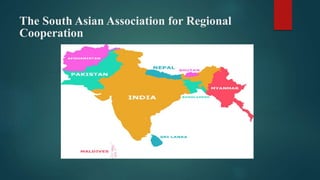
The South Asian Association for Regional Cooperation
Presented: Abdi Hamid M Isak
Lovely Professional University
WHAT IS SAARC
 The South Asian Association for Regional Cooperation is an economic
and geopolitical organization
 Number of Member Countries: 8
 Headquarters: Kathmandu, Nepal
 Founding Document: Charter of the SAARC
 Coverage: Goods & Services
 Date Signed: December 8, 1985
 Entry Into Force: December 8, 1985
. SAARC respects the principles of sovereign equality,
territorial integrity, and national independence as it strives to
attain sustainable economic growth.
SAARC established to promote socio-economic development,
stability, and welfare economics, and collective self-reliance
within its member nations.
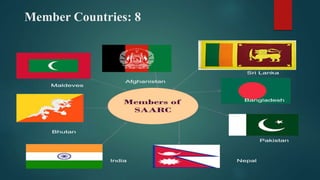
Member Countries: 8
The South Asian Association for Regional
Cooperation
South Asia: basic features
 3.5% of the world's land surface area.
 The population of South Asia is about 1.89 billion.
 One fourth of the world's population.
 The most densely populated geographical region in the world.
 Overall, it accounts for about 39.49% of Asia's population.
 24% of the world's population.
 South Asia has the world's largest population
of Hindus, Jains and Sikhs.
 It also has the largest population of Muslims in the Asia-Pacific region,
as well as over 35 million Christians and 25 million Buddhists.
INDO-CENTRIC REGION:
 Where India is central to its geographically and in
terms of the socio-cultural and economic
infrastructure of the region.
 India the major actor of South Asia
 India has a great role in South Asia in terms of
its promoting regionalism, power position , security,
hegemony.
 75 percent of the region's population.
 63 percent of its total area and 78 percent of its gross
domestic product.
 South Asia is an Indo-centric region.
 UNBALANCE AND ASYMMETRIC POWER STRUCTURE
The objectives of the SAARC
 The objectives of the Association as outlined in the SAARC Charter.
 To promote the welfare of the peoples of South Asia.
 To improve their quality of life
 To accelerate economic growth and cultural development in the region
 To provide all individuals the opportunity to live in dignity and to realize
their full potentials.
 To promote and strengthen collective self-reliance among the countries
of South Asia.
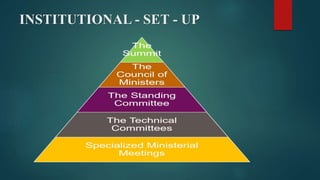
INSTITUTIONAL - SET - UP
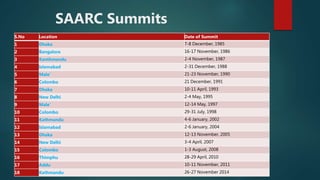
SAARC Summits
S.No Location Date of Summit
1 Dhaka 7-8 December, 1985
2 Bangalore 16-17 November, 1986
3 Kanthmandu 2-4 November, 1987
4 Islamabad 2-31 December, 1988
5 Male' 21-23 November, 1990
6 Colombo 21 December, 1991
7 Dhaka 10-11 April, 1993
8 New Delhi 2-4 May, 1995
9 Male' 12-14 May, 1997
10 Colombo 29-31 July, 1998
11 Kathmandu 4-6 January, 2002
12 Islamabad 2-6 January, 2004
13 Dhaka 12-13 November, 2005
14 New Delhi 3-4 April, 2007
15 Colombo 1-3 August, 2008
16 Thimphu 28-29 April, 2010
17 Addu 10-11 November, 2011
18 Kathmandu 26-27 November 2014
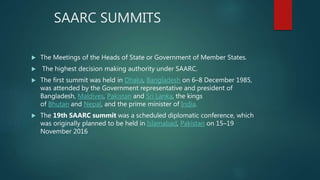
SAARC SUMMITS
 The Meetings of the Heads of State or Government of Member States.
 The highest decision making authority under SAARC.
 The first summit was held in Dhaka, Bangladesh on 6–8 December 1985,
was attended by the Government representative and president of
Bangladesh, Maldives, Pakistan and Sri Lanka, the kings
of Bhutan and Nepal, and the prime minister of India.
 The 19th SAARC summit was a scheduled diplomatic conference, which
was originally planned to be held in Islamabad, Pakistan on 15–19
November 2016
• Following the rising diplomatic tensions after
the Uri terrorist attack, India announced its boycott
of the summit, alleging Pakistan's involvement in
the attack.
Later, Bangladesh, Afghanistan, Bhutan, Sri
Lanka and Maldives also pulled out of the summit.
culminating in an indefinite postponement of the
summit.
SAARC REGIONAL INSTITUTIONS
1. SAARC AGRICULTURAL INFORMATION CENTRE (SAIC)
SAIC, ESTABLISHED IN DHAKA IN 1988.
2. SAARC TUBERCULOSIS CENTRE (STC)
LOCATED AT THIMI, BHAKTAPUR (NEPAL), STC BECAME OPERATIONAL IN
MID-JULY 1992.
3. SAARC DOCUMENTATION CENTER (SDC)
SDC HAS BEEN ESTABLISHED AT THE INDIAN NATIONAL SCIENTIFIC
DOCUMENTATION CENTER (INSDOC) IN NEW DELHI IN MAY 1994.
4. SAARC METEOROLOGICAL RESEARCH CENTRE (SMRC)
THE SMRC, ESTABLISHED IN DHAKA, WAS INAUGURATED ON 2 JANUARY 1995.
5. SAARC HUMAN RESOURCE DEVELOPMENT CENTRE (SHRDC)
SAARC HUMAN RESOURCES DEVELOPMENT CENTRE (SHRDC) IS BEING SET UP IN
ISLAMABAD.
Criticism/Failure
 In its 30 years of existence, SAARC failed to hold 11 annual
summits for political reasons.
 The intra-regional trade of SAARC amounted to $40.5 billion in
2011, which constitutes just 5% of member countries’ trade.
 While different regions of the world have progressed even to
monetary union, SAARC has failed to even come up with a free
trade agreement.
 Even in the Kathmandu Summit 2014, there were three
connectivity agreements on road, rail and energy, to be
endorsed by the eight SAARC leaders. Only one of these - on
energy - has been signed.
Reasons for failure
 Weak Cultural Identities
 The South Asian Region comprises countries sharing common history,
heritage and culture.
 Conflict between India and Pakistan
 Unresolved Border and Maritime Issues
 These unresolved borders have led to problems of Terrorism, Refugee Crisis,
Smuggling, Narco-Trade. The unresolved issues continue to mar cooperative relations.
 Role of External Powers, especially China
 The SAARC platform thus cannot be used to resolve bilateral issues; this has
undermined the scope and potential of SAARC.
INTEGRATED
PROGRAMME OF ACTION

SAARC: South Asia Association for Regional Cooperation

  • 1.
    The South AsianAssociation for Regional Cooperation Presented: Abdi Hamid M Isak Lovely Professional University
  • 2.
    WHAT IS SAARC The South Asian Association for Regional Cooperation is an economic and geopolitical organization  Number of Member Countries: 8  Headquarters: Kathmandu, Nepal  Founding Document: Charter of the SAARC  Coverage: Goods & Services  Date Signed: December 8, 1985  Entry Into Force: December 8, 1985
  • 3.
    . SAARC respectsthe principles of sovereign equality, territorial integrity, and national independence as it strives to attain sustainable economic growth. SAARC established to promote socio-economic development, stability, and welfare economics, and collective self-reliance within its member nations.
  • 4.
  • 5.
    The South AsianAssociation for Regional Cooperation
  • 6.
    South Asia: basicfeatures  3.5% of the world's land surface area.  The population of South Asia is about 1.89 billion.  One fourth of the world's population.  The most densely populated geographical region in the world.  Overall, it accounts for about 39.49% of Asia's population.  24% of the world's population.  South Asia has the world's largest population of Hindus, Jains and Sikhs.  It also has the largest population of Muslims in the Asia-Pacific region, as well as over 35 million Christians and 25 million Buddhists.
  • 7.
    INDO-CENTRIC REGION:  WhereIndia is central to its geographically and in terms of the socio-cultural and economic infrastructure of the region.  India the major actor of South Asia  India has a great role in South Asia in terms of its promoting regionalism, power position , security, hegemony.  75 percent of the region's population.  63 percent of its total area and 78 percent of its gross domestic product.  South Asia is an Indo-centric region.  UNBALANCE AND ASYMMETRIC POWER STRUCTURE
  • 8.
    The objectives ofthe SAARC  The objectives of the Association as outlined in the SAARC Charter.  To promote the welfare of the peoples of South Asia.  To improve their quality of life  To accelerate economic growth and cultural development in the region  To provide all individuals the opportunity to live in dignity and to realize their full potentials.  To promote and strengthen collective self-reliance among the countries of South Asia.
  • 9.
  • 10.
    SAARC Summits S.No LocationDate of Summit 1 Dhaka 7-8 December, 1985 2 Bangalore 16-17 November, 1986 3 Kanthmandu 2-4 November, 1987 4 Islamabad 2-31 December, 1988 5 Male' 21-23 November, 1990 6 Colombo 21 December, 1991 7 Dhaka 10-11 April, 1993 8 New Delhi 2-4 May, 1995 9 Male' 12-14 May, 1997 10 Colombo 29-31 July, 1998 11 Kathmandu 4-6 January, 2002 12 Islamabad 2-6 January, 2004 13 Dhaka 12-13 November, 2005 14 New Delhi 3-4 April, 2007 15 Colombo 1-3 August, 2008 16 Thimphu 28-29 April, 2010 17 Addu 10-11 November, 2011 18 Kathmandu 26-27 November 2014
  • 11.
    SAARC SUMMITS  TheMeetings of the Heads of State or Government of Member States.  The highest decision making authority under SAARC.  The first summit was held in Dhaka, Bangladesh on 6–8 December 1985, was attended by the Government representative and president of Bangladesh, Maldives, Pakistan and Sri Lanka, the kings of Bhutan and Nepal, and the prime minister of India.  The 19th SAARC summit was a scheduled diplomatic conference, which was originally planned to be held in Islamabad, Pakistan on 15–19 November 2016
  • 12.
    • Following therising diplomatic tensions after the Uri terrorist attack, India announced its boycott of the summit, alleging Pakistan's involvement in the attack. Later, Bangladesh, Afghanistan, Bhutan, Sri Lanka and Maldives also pulled out of the summit. culminating in an indefinite postponement of the summit.
  • 13.
    SAARC REGIONAL INSTITUTIONS 1.SAARC AGRICULTURAL INFORMATION CENTRE (SAIC) SAIC, ESTABLISHED IN DHAKA IN 1988. 2. SAARC TUBERCULOSIS CENTRE (STC) LOCATED AT THIMI, BHAKTAPUR (NEPAL), STC BECAME OPERATIONAL IN MID-JULY 1992. 3. SAARC DOCUMENTATION CENTER (SDC) SDC HAS BEEN ESTABLISHED AT THE INDIAN NATIONAL SCIENTIFIC DOCUMENTATION CENTER (INSDOC) IN NEW DELHI IN MAY 1994. 4. SAARC METEOROLOGICAL RESEARCH CENTRE (SMRC) THE SMRC, ESTABLISHED IN DHAKA, WAS INAUGURATED ON 2 JANUARY 1995. 5. SAARC HUMAN RESOURCE DEVELOPMENT CENTRE (SHRDC) SAARC HUMAN RESOURCES DEVELOPMENT CENTRE (SHRDC) IS BEING SET UP IN ISLAMABAD.
  • 14.
    Criticism/Failure  In its30 years of existence, SAARC failed to hold 11 annual summits for political reasons.  The intra-regional trade of SAARC amounted to $40.5 billion in 2011, which constitutes just 5% of member countries’ trade.  While different regions of the world have progressed even to monetary union, SAARC has failed to even come up with a free trade agreement.  Even in the Kathmandu Summit 2014, there were three connectivity agreements on road, rail and energy, to be endorsed by the eight SAARC leaders. Only one of these - on energy - has been signed.
  • 15.
    Reasons for failure Weak Cultural Identities  The South Asian Region comprises countries sharing common history, heritage and culture.  Conflict between India and Pakistan  Unresolved Border and Maritime Issues  These unresolved borders have led to problems of Terrorism, Refugee Crisis, Smuggling, Narco-Trade. The unresolved issues continue to mar cooperative relations.  Role of External Powers, especially China  The SAARC platform thus cannot be used to resolve bilateral issues; this has undermined the scope and potential of SAARC.
  • 18.