SAARC
Sheikh Abir Ahmed
Naushin tabasshum
Md.Habibur Rahman Habib
Humaira Tasnim Moon
Sayed Maksudur Rahman Turzo
Group Presentation
Group Members Group-4
Sheikh Abir Ahmed
Naushin Tabasshum
Sayed Maksudur Rahman Turzo
Md.Habibur Rahman Habib
Humaira Tasnim Moon
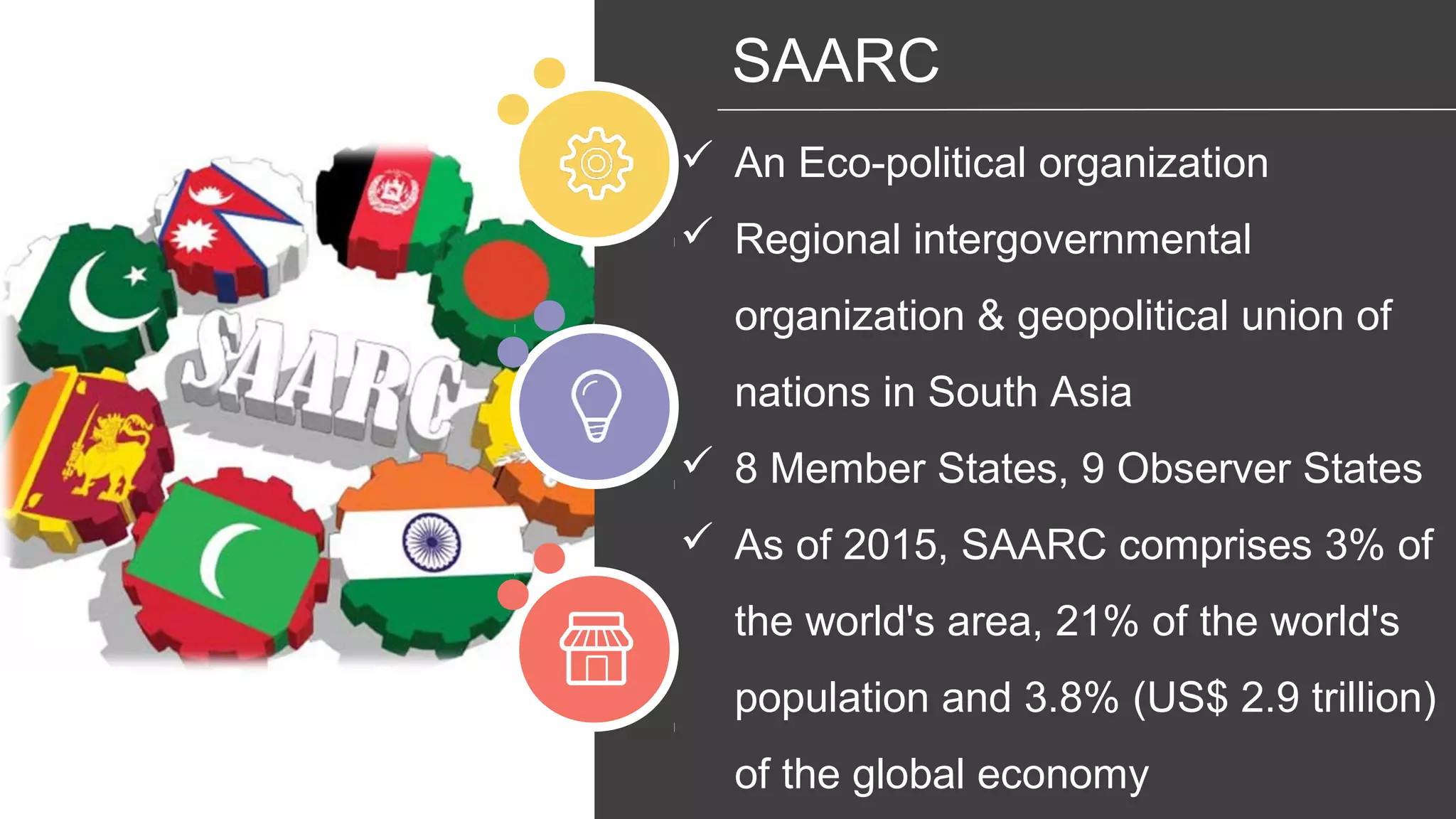
SAARC
 An Eco-political organization
 Regional intergovernmental
organization & geopolitical union of
nations in South Asia
 8 Member States, 9 Observer States
 As of 2015, SAARC comprises 3% of
the world's area, 21% of the world's
population and 3.8% (US$ 2.9 trillion)
of the global economy
 It promotes development of economic and
regional integration
 In 2006 launched SAFTA (South Asian Free
Trade Area)
 Maintains diplomatic relations with “UN” as an
observer and also good relations with “EU”
 It’s the Largest Regional Organization in the world
(Covers more than 2 million People)
Historical Background
Idea of regional cooperation in
South Asia was discussed in
at least 3 conferences
1. Asians Relations Conference
in New Delhi in April 1947
2. Baguio Conference in the
Philippines in May 1950
3. Colombo Powers Conference
in April 1954
Zia-ur-Rahman on May 2,1980
, first made the concrete
proposal for establishing a
framework for regional
cooperation in South Asia
Established in 8 December 1985
Abul Ahsan became the 1st Secretary General of
SAARC
Has No Official Anthem like ASEAN
1st SAARC summit held on 7-8 December, 1985
Member states: 7 founding members
Afghanistan's request to join approved in 13th summit of SAARC
in 2005, at Dhaka
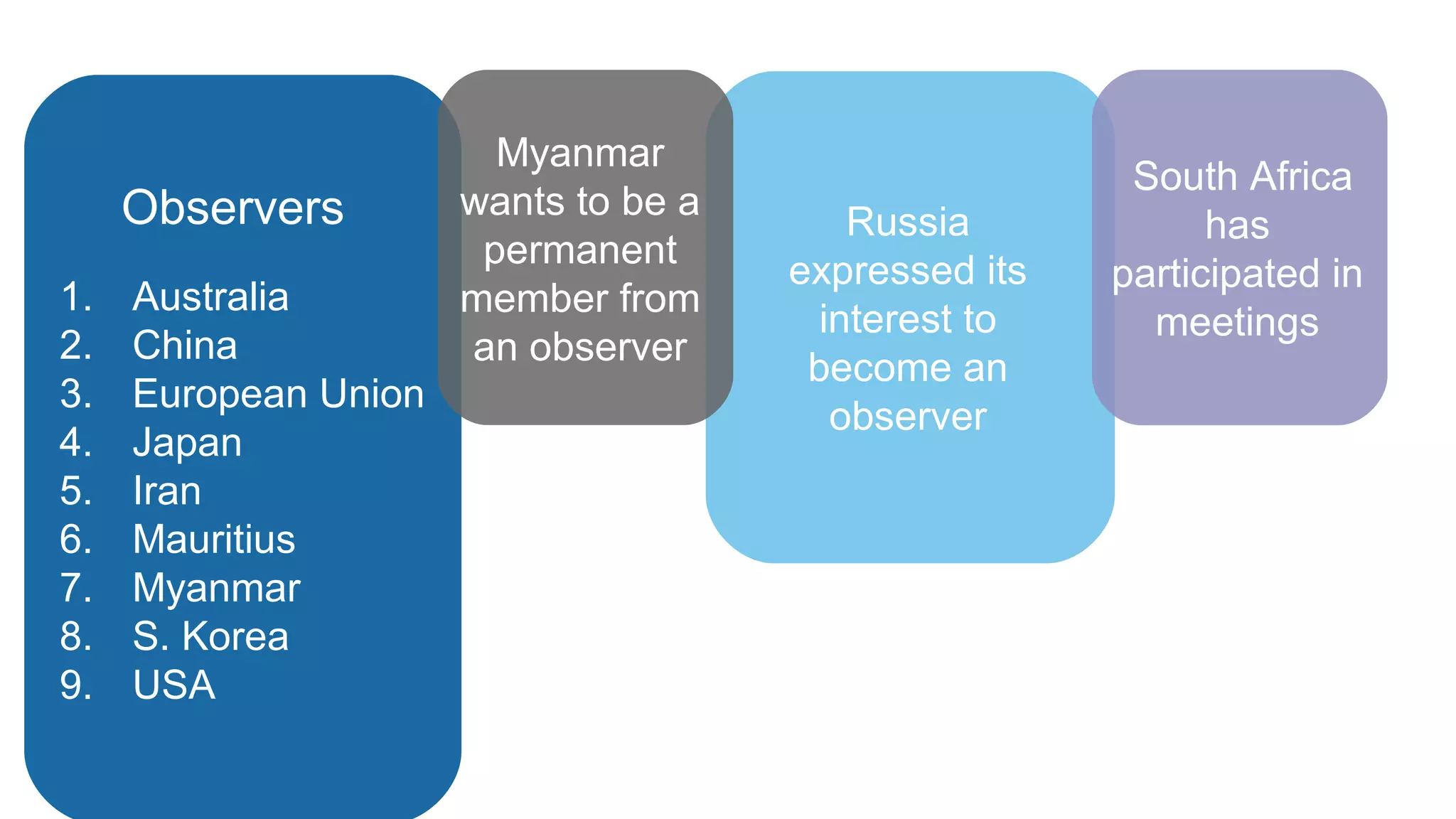
1. Australia
2. China
3. European Union
4. Japan
5. Iran
6. Mauritius
7. Myanmar
8. S. Korea
9. USA
Observers
Myanmar
wants to be a
permanent
member from
an observer
Russia
expressed its
interest to
become an
observer
South Africa
has
participated in
meetings
Aim of saarc
 Welfare
 Accelerate economic growth, social
progress
 Collective self-reliance
 Promote active collaboration and
mutual assistance in the economic,
social, cultural, technical and scientific
fields
Activity and Organs of SAARC
 South Asian Free
Trade
Area (SAFTA)
Six apex bodies
to ensure
regional
institution
Secretariat
At a glance
last (19th )
SAARC
summit
 Hosting country: Pakistan (Islamabad)
 India ,Bangladesh ,Bhutan, Afghanistan
didn’t join the summit
 Reasons behind it :
1. Uri issue
2. War crime trial
3. To keep alliance strong
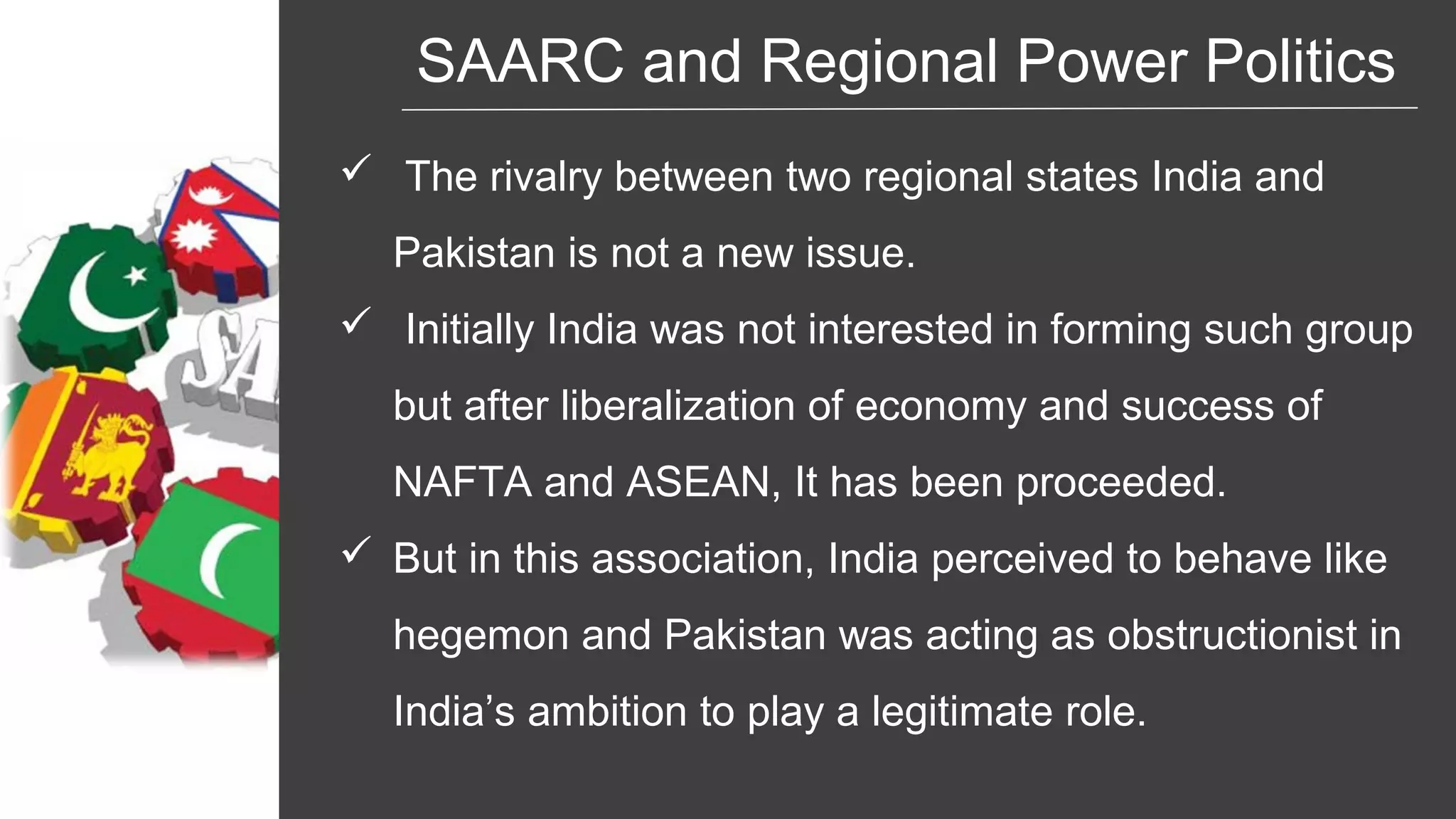
SAARC and Regional Power Politics
 The rivalry between two regional states India and
Pakistan is not a new issue.
 Initially India was not interested in forming such group
but after liberalization of economy and success of
NAFTA and ASEAN, It has been proceeded.
 But in this association, India perceived to behave like
hegemon and Pakistan was acting as obstructionist in
India’s ambition to play a legitimate role.
 Pakistan had that power and capabilities so it tried to play
China card over India and situation became conflictive.
 In recent summit of November 2014, Pakistan pushed for
enhanced role of China.
 So India cannot dream for becoming regional superpower
over Pakistan without making SAARC functional in
objective.
 India thus left the big brother role but the conflictive relation
between these two impeded the overall success of the
association.
15
Comparison between SAARC and
ASEAN
 Both are regional associations and yet
ASEAN met up it’s overall successful
steps towards trading while SAARC
failed.
 Couple of reasons are there behind the
failure of SAARC.
First of all, ASEAN states decided to
forget their internal clash but SAARC
states stated that conflict should be
resolved first.
16
 ASEAN moved to conflict avoidance
mechanisms where SAARC nations were
inclined to be warlike.
 ASEAN took no time in agreeing two types
of trade area (1997) while SAARC made an
heavy weather to deal with the same thing.
 SAARC had to suffer an Indo-Pakistan war
at Kargil started by Pakistan in 1999, which
prevented three SAARC summits from
taking place.
 So, nations of SAARC needs to improve its
trade conduct what ASEAN has already
made.
Economic Contribution
 SAPTA(SAARC preferential trading
arrangement)was signed on 7 December, 1995
 SAFTA(South Asian Free Trade Area) was signed
in Islamabad in January 2004
 SAARC chamber of commerce and industry (SCCI)
 SAARC constitutes South Asian Development
Fund(SADF)
 Signed an agreement of mutual assistance.
 Avoidance of double taxation were signed.
 Technical Committee was established in 1989
 Expert Group meetings and seminars are hold
annually on modernization of curriculum
 Teacher training is done in all the region by
SAARC
 By 2010 SAARC managed to establish a common
university named South Asian University in Delhi
Contribution to enrich Cultural
Co-operation
 Technical Committee was established in
1993 about cultural communications
 SAARC arranges study tours with students
from all the regions
 They hold a letter writing competition since
1985
 Later on the TC was merged with
educational sector
Hindrances in the path of SAARC
Large variety of
different political
system
They lack financial
resources and
advanced technologies
Large variety
regional and
cultural differences
India tries to dominate
the function and
activities of SAARC
Hindrances in the path of SAARC
Internal problems constituting
social economic and
developmental and growth issues
Food Security Reserve
failed to meet the need
of Bangladesh
Bilateral disputes
and differences
Involvement of
external actors
Hindrances in the path of SAARC
Suffers from
an acute
resource
crunch
Involvement of
external actors
Situation Analysis
Solution
 SAARC Successes
 SAARC Failures
 Current situation
 Why did it Fail?
 What to do?
&
24
Conclusio
n
25
Thank You

SAARC - Group Presentation

  • 1.
    SAARC Sheikh Abir Ahmed Naushintabasshum Md.Habibur Rahman Habib Humaira Tasnim Moon Sayed Maksudur Rahman Turzo Group Presentation
  • 2.
    Group Members Group-4 SheikhAbir Ahmed Naushin Tabasshum Sayed Maksudur Rahman Turzo Md.Habibur Rahman Habib Humaira Tasnim Moon
  • 4.
    SAARC  An Eco-politicalorganization  Regional intergovernmental organization & geopolitical union of nations in South Asia  8 Member States, 9 Observer States  As of 2015, SAARC comprises 3% of the world's area, 21% of the world's population and 3.8% (US$ 2.9 trillion) of the global economy
  • 5.
     It promotesdevelopment of economic and regional integration  In 2006 launched SAFTA (South Asian Free Trade Area)  Maintains diplomatic relations with “UN” as an observer and also good relations with “EU”  It’s the Largest Regional Organization in the world (Covers more than 2 million People)
  • 6.
    Historical Background Idea ofregional cooperation in South Asia was discussed in at least 3 conferences 1. Asians Relations Conference in New Delhi in April 1947 2. Baguio Conference in the Philippines in May 1950 3. Colombo Powers Conference in April 1954 Zia-ur-Rahman on May 2,1980 , first made the concrete proposal for establishing a framework for regional cooperation in South Asia
  • 7.
    Established in 8December 1985 Abul Ahsan became the 1st Secretary General of SAARC Has No Official Anthem like ASEAN 1st SAARC summit held on 7-8 December, 1985 Member states: 7 founding members
  • 8.
    Afghanistan's request tojoin approved in 13th summit of SAARC in 2005, at Dhaka
  • 9.
    1. Australia 2. China 3.European Union 4. Japan 5. Iran 6. Mauritius 7. Myanmar 8. S. Korea 9. USA Observers Myanmar wants to be a permanent member from an observer Russia expressed its interest to become an observer South Africa has participated in meetings
  • 10.
    Aim of saarc Welfare  Accelerate economic growth, social progress  Collective self-reliance  Promote active collaboration and mutual assistance in the economic, social, cultural, technical and scientific fields
  • 11.
    Activity and Organsof SAARC  South Asian Free Trade Area (SAFTA) Six apex bodies to ensure regional institution Secretariat
  • 12.
    At a glance last(19th ) SAARC summit  Hosting country: Pakistan (Islamabad)  India ,Bangladesh ,Bhutan, Afghanistan didn’t join the summit  Reasons behind it : 1. Uri issue 2. War crime trial 3. To keep alliance strong
  • 13.
    SAARC and RegionalPower Politics  The rivalry between two regional states India and Pakistan is not a new issue.  Initially India was not interested in forming such group but after liberalization of economy and success of NAFTA and ASEAN, It has been proceeded.  But in this association, India perceived to behave like hegemon and Pakistan was acting as obstructionist in India’s ambition to play a legitimate role.
  • 14.
     Pakistan hadthat power and capabilities so it tried to play China card over India and situation became conflictive.  In recent summit of November 2014, Pakistan pushed for enhanced role of China.  So India cannot dream for becoming regional superpower over Pakistan without making SAARC functional in objective.  India thus left the big brother role but the conflictive relation between these two impeded the overall success of the association.
  • 15.
    15 Comparison between SAARCand ASEAN  Both are regional associations and yet ASEAN met up it’s overall successful steps towards trading while SAARC failed.  Couple of reasons are there behind the failure of SAARC. First of all, ASEAN states decided to forget their internal clash but SAARC states stated that conflict should be resolved first.
  • 16.
    16  ASEAN movedto conflict avoidance mechanisms where SAARC nations were inclined to be warlike.  ASEAN took no time in agreeing two types of trade area (1997) while SAARC made an heavy weather to deal with the same thing.  SAARC had to suffer an Indo-Pakistan war at Kargil started by Pakistan in 1999, which prevented three SAARC summits from taking place.  So, nations of SAARC needs to improve its trade conduct what ASEAN has already made.
  • 17.
    Economic Contribution  SAPTA(SAARCpreferential trading arrangement)was signed on 7 December, 1995  SAFTA(South Asian Free Trade Area) was signed in Islamabad in January 2004  SAARC chamber of commerce and industry (SCCI)  SAARC constitutes South Asian Development Fund(SADF)  Signed an agreement of mutual assistance.  Avoidance of double taxation were signed.
  • 18.
     Technical Committeewas established in 1989  Expert Group meetings and seminars are hold annually on modernization of curriculum  Teacher training is done in all the region by SAARC  By 2010 SAARC managed to establish a common university named South Asian University in Delhi
  • 19.
    Contribution to enrichCultural Co-operation  Technical Committee was established in 1993 about cultural communications  SAARC arranges study tours with students from all the regions  They hold a letter writing competition since 1985  Later on the TC was merged with educational sector
  • 20.
    Hindrances in thepath of SAARC Large variety of different political system They lack financial resources and advanced technologies Large variety regional and cultural differences India tries to dominate the function and activities of SAARC
  • 21.
    Hindrances in thepath of SAARC Internal problems constituting social economic and developmental and growth issues Food Security Reserve failed to meet the need of Bangladesh Bilateral disputes and differences Involvement of external actors
  • 22.
    Hindrances in thepath of SAARC Suffers from an acute resource crunch Involvement of external actors
  • 23.
    Situation Analysis Solution  SAARCSuccesses  SAARC Failures  Current situation  Why did it Fail?  What to do? &
  • 24.
  • 25.