SET SMART
MARKETING
GOALS—
HOW TO
THE RIGHT WAY
WHY YOU SHOULD SET SMART GOALS
Workboard found that teams that are engaged and intentional about goal-setting
“return 28% higher same-year operating margin and 3x higher than companies that
failed to engage their employees in achievement.”
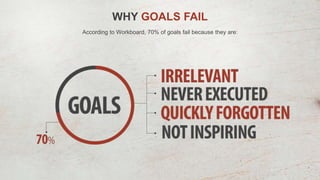
WHY GOALS FAIL
According to Workboard, 70% of goals fail because they are:
SETTING SMART GOALS
S (SPECIFIC)—DEFINE EXACTLY WHAT
YOU WANT TO ACCOMPLISH
Think about the five W’s: who, what, when, where (if applicable) and why.
For instance, instead of your goal being “increase ROI,” it could be “have my
team increase ROI by 10% by the end of the third quarter.”
M (MEASURABLE)—MAKE SURE THAT YOUR GOAL
CAN BE MEASURED
Otherwise, you will never know when you have achieved it.
Without having a way to measure the success of your
goal, it’s easy to slack off or let it fall by the wayside.
Define the metrics or KPIs (key performance indicators)
that you will use to evaluate the success of your goal.
For instance, if your goal is to increase lead generation
by 20% by the end of next quarter, your KPIs might be
the number of gated downloads and the number of
sales-qualified leads.
If not, you're likely to lose motivation (or not achieve your goal). Make sure that
your goal is something that you can actually achieve. It should be challenging…but
not so challenging that you can’t accomplish it.
A (ACHIEVABLE)—BE REALISTIC ABOUT
WHAT YOU CAN ACHIEVE
If your company is currently making $500,000 a
year in sales, it’s a little unrealistic for your goal
to be to make $10 million in sales in one year.
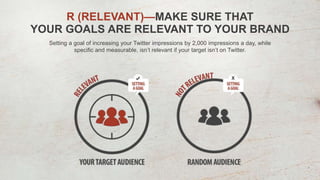
Setting a goal of increasing your Twitter impressions by 2,000 impressions a day, while
specific and measurable, isn’t relevant if your target isn’t on Twitter.
R (RELEVANT)—MAKE SURE THAT
YOUR GOALS ARE RELEVANT TO YOUR BRAND
And make sure that date is realistic, given what you want to achieve. Having a timeline in
place will help ensure that you meet your goals—and in a timely fashion.
T (TIMELY)—SET A SPECIFIC DATE FOR
WHEN YOU WANT TO ACHIEVE YOUR GOALS BY
WHAT STUDIES HAVE SHOWN
Forbes cited a 2011 meta-analysis which examined “the effect of goal setting on group
performance,” and found that there were 3 crucial characteristics to success:
Egocentric goals
actually proved to have
unfavorable outcomes
on group performance,
since competing
individuals were more
focused on their own
success, rather than
group success.
While achievable, they
should also be a challenge.
Setting specific goals
raises group performance
and increases the
likelihood that the goals
will be achieved.
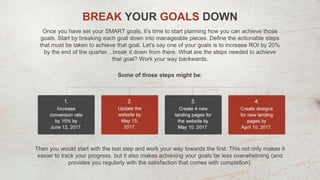
BREAK YOUR GOALS DOWN
Once you have set your SMART goals, it’s time to start planning how you can achieve those
goals. Start by breaking each goal down into manageable pieces. Define the actionable steps
that must be taken to achieve that goal. Let’s say one of your goals is to increase ROI by 20%
by the end of the quarter…break it down from there. What are the steps needed to achieve
that goal? Work your way backwards.
Then you would start with the last step and work your way towards the first. This not only makes it
easier to track your progress, but it also makes achieving your goals far less overwhelming (and
provides you regularly with the satisfaction that comes with completion).
Some of those steps might be:
MONITOR YOUR GOALS REGULARLY
Once you have defined your goals and broken them down, it’s time to implement them! Hold each
team member accountable for what they must achieve. In addition to writing down your goals, this
means that your team members should check in with one another on a regular basis to see what
progress has been made towards reaching those goals.
Why? In one study, noted by Forbes, it was discovered that monitoring goals every two weeks raised
performance; as soon as the feedback stopped, performance dropped.
NEED HELP SETTING YOUR
MARKETING GOALS?
https://www.incimages.com/uploaded_files/inlineimage/AchieveYourGoals_32950.pdf
https://www.forbes.com/sites/sebastianbailey/2012/10/02/the-truth-about-goals/#34cd97316914
http://psycnet.apa.org/journals/apl/96/6/1289
http://psycnet.apa.org/journals/apl/69/3/524/
SOURCES

How to Set SMART Marketing Goals—The Right Way

  • 1.
  • 2.
    WHY YOU SHOULDSET SMART GOALS Workboard found that teams that are engaged and intentional about goal-setting “return 28% higher same-year operating margin and 3x higher than companies that failed to engage their employees in achievement.”
  • 3.
    WHY GOALS FAIL Accordingto Workboard, 70% of goals fail because they are:
  • 4.
  • 5.
    S (SPECIFIC)—DEFINE EXACTLYWHAT YOU WANT TO ACCOMPLISH Think about the five W’s: who, what, when, where (if applicable) and why. For instance, instead of your goal being “increase ROI,” it could be “have my team increase ROI by 10% by the end of the third quarter.”
  • 6.
    M (MEASURABLE)—MAKE SURETHAT YOUR GOAL CAN BE MEASURED Otherwise, you will never know when you have achieved it. Without having a way to measure the success of your goal, it’s easy to slack off or let it fall by the wayside. Define the metrics or KPIs (key performance indicators) that you will use to evaluate the success of your goal. For instance, if your goal is to increase lead generation by 20% by the end of next quarter, your KPIs might be the number of gated downloads and the number of sales-qualified leads.
  • 7.
    If not, you'relikely to lose motivation (or not achieve your goal). Make sure that your goal is something that you can actually achieve. It should be challenging…but not so challenging that you can’t accomplish it. A (ACHIEVABLE)—BE REALISTIC ABOUT WHAT YOU CAN ACHIEVE If your company is currently making $500,000 a year in sales, it’s a little unrealistic for your goal to be to make $10 million in sales in one year.
  • 8.
    Setting a goalof increasing your Twitter impressions by 2,000 impressions a day, while specific and measurable, isn’t relevant if your target isn’t on Twitter. R (RELEVANT)—MAKE SURE THAT YOUR GOALS ARE RELEVANT TO YOUR BRAND
  • 9.
    And make surethat date is realistic, given what you want to achieve. Having a timeline in place will help ensure that you meet your goals—and in a timely fashion. T (TIMELY)—SET A SPECIFIC DATE FOR WHEN YOU WANT TO ACHIEVE YOUR GOALS BY
  • 10.
    WHAT STUDIES HAVESHOWN Forbes cited a 2011 meta-analysis which examined “the effect of goal setting on group performance,” and found that there were 3 crucial characteristics to success: Egocentric goals actually proved to have unfavorable outcomes on group performance, since competing individuals were more focused on their own success, rather than group success. While achievable, they should also be a challenge. Setting specific goals raises group performance and increases the likelihood that the goals will be achieved.
  • 11.
    BREAK YOUR GOALSDOWN Once you have set your SMART goals, it’s time to start planning how you can achieve those goals. Start by breaking each goal down into manageable pieces. Define the actionable steps that must be taken to achieve that goal. Let’s say one of your goals is to increase ROI by 20% by the end of the quarter…break it down from there. What are the steps needed to achieve that goal? Work your way backwards. Then you would start with the last step and work your way towards the first. This not only makes it easier to track your progress, but it also makes achieving your goals far less overwhelming (and provides you regularly with the satisfaction that comes with completion). Some of those steps might be:
  • 12.
    MONITOR YOUR GOALSREGULARLY Once you have defined your goals and broken them down, it’s time to implement them! Hold each team member accountable for what they must achieve. In addition to writing down your goals, this means that your team members should check in with one another on a regular basis to see what progress has been made towards reaching those goals. Why? In one study, noted by Forbes, it was discovered that monitoring goals every two weeks raised performance; as soon as the feedback stopped, performance dropped.
  • 13.
    NEED HELP SETTINGYOUR MARKETING GOALS?
  • 14.