What is your GOAL?
Goal Setting Process – Some Tips and Tricks
Agenda
• What is Goal Setting ?
• Is there anything called a bad Goal
• SMART Goals
• Steps to Effective Goal Setting
• 6 W’s of Goal Setting
• Group Activity
• Personal Goals
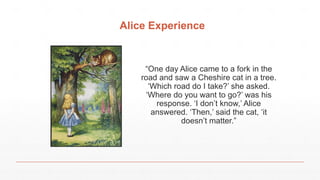
Alice Experience
“One day Alice came to a fork in the
road and saw a Cheshire cat in a tree.
‘Which road do I take?’ she asked.
‘Where do you want to go?’ was his
response. ‘I don’t know,’ Alice
answered. ‘Then,’ said the cat, ‘it
doesn’t matter.”
What is Goal Setting?
The process of creating a plan, or roadmap, for where you and your business can go in the
next month, year or 5 years.
Ask yourself these questions:
1. What exactly do you want to accomplish?
2. What achievement would be worth your very best effort?
3. What would you attempt if you knew it was impossible to fail?
4. What would you do for if you knew this was your very last chance?
Are you continuing your “Alice Experience” or do you have a plan to reach the next level?
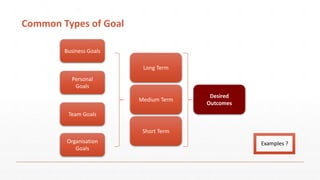
Common	Types	of	Goal	
Business	Goals		
Personal	
Goals		
Long	Term	
Short	Term	
Organisation	
Goals	
Team	Goals	
Desired	
Outcomes	
Medium	Term	
Examples	?
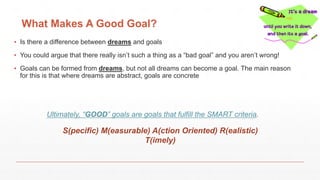
What Makes A Good Goal?
▪ Is there a difference between dreams and goals
▪ You could argue that there really isn’t such a thing as a “bad goal” and you aren’t wrong!
▪ Goals can be formed from dreams, but not all dreams can become a goal. The main reason
for this is that where dreams are abstract, goals are concrete
Ultimately, “GOOD” goals are goals that fulfill the SMART criteria.
S(pecific) M(easurable) A(ction Oriented) R(ealistic)
T(imely)
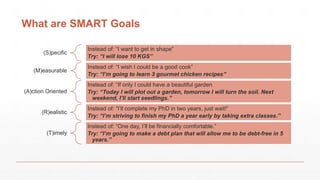
What are SMART Goals
(S)pecific
Instead of: “I want to get in shape”
Try: “I will lose 10 KGS”
(M)easurable
Instead of: “I wish I could be a good cook”
Try: “I’m going to learn 3 gourmet chicken recipes”
(A)ction Oriented
Instead of: “If only I could have a beautiful garden
Try: “Today I will plot out a garden, tomorrow I will turn the soil. Next
weekend, I’ll start seedlings.”
(R)ealistic
Instead of: “I’ll complete my PhD in two years, just wait!”
Try: “I’m striving to finish my PhD a year early by taking extra classes.”
(T)imely
Instead of: “One day, I’ll be financially comfortable.”
Try: “I’m going to make a debt plan that will allow me to be debt-free in 5
years.”
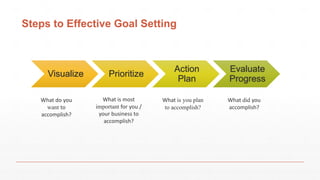
Steps to Effective Goal Setting
Visualize Prioritize
Action
Plan
Evaluate
Progress
What	do	you	
want to	
accomplish?	
What	is	most	
important for	you	/	
your	business	to	
accomplish?	
What	is you plan
to accomplish?
What	did you	
accomplish?
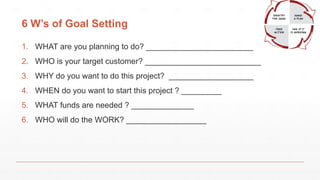
6 W’s of Goal Setting
1. WHAT are you planning to do? ________________________
2. WHO is your target customer? __________________________
3. WHY do you want to do this project? ___________________
4. WHEN do you want to start this project ? _________
5. WHAT funds are needed ? ______________
6. WHO will do the WORK? __________________
Group Activity – 10 + 5 Mins
Bangalore to Tower House
▪ Break into 2 / 3 Groups
▪ Your premises – Bus / Train / Air
▪ Air ?
▪ What are the details of the flight I have to take?
▪ What is the schedule ?
▪ How long is the walk to the taxi stand?
▪ How soon can I get an taxi ?
▪ Is this method of transport affordable?
▪ What if the flight is delayed?
Personal Goals
SMART GOAL WORKSHEET - HANDOUTS
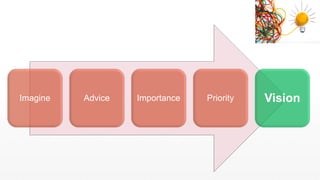
Imagine Advice Importance Priority Vision
Richard Branson’s 10-Step Plan
(1) “Write down every single idea you have. No idea is too small,
and no idea is too big either.
(2) Always carry a notebook. You need somewhere to write your
ideas down, and while using a folder on your phone is better than
nothing, a piece of paper is far more memorable.
(3) Find a list method that works for you. Doodles, bullet-points,
charts—what suits you best? I find a combination of short phrases
and scribbled pictures works best for me.
(4) Make a list of small, manageable tasks to complete every day.
Cut your day up into chunks, and you’ll get lots more done.
(5) Mark off every completed task. There are few more satisfying
things than ticking off a job well done.
(6) Set far off, outlandish goals. Resolutions shouldn’t just have
short-term endpoints. What do you want to have achieved in five
years’ time? How about 50 years?
(7) Make your goals measurable so you know if your plans are
working. There’s no point setting targets if you don’t know if you
are hitting them. [We advise you to use SMART goals,
i.e., Specific, Measurable, Achievable, Realistic, Time-Bound
goals.]
(8) Include personal goals in your lists, not just business. There’s
no real separation between work and life; it’s all just living. The
same goes for lists.
(9) Share your goals with others [for instance your coach]. You
can help motivate each other further and hold each other to
account. But remember that, in the end, you are doing this for
yourself.
(10) Celebrate your successes then make new lists of new goals.
The cycle should continue as you make more and more progress.
I have boxes and boxes of old notes, filled with old lists, and I’m
busy making more.” – Richard Branson, 2016
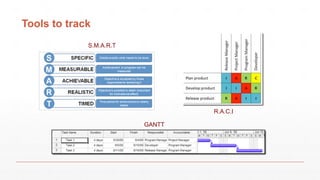
Tools to track
S.M.A.R.T
R.A.C.I
GANTT
Subbalakshmi K
subbav@yahoo.com
+91-98862-10090

Goal Setting Process Exercise

  • 1.
    What is yourGOAL? Goal Setting Process – Some Tips and Tricks
  • 2.
    Agenda • What isGoal Setting ? • Is there anything called a bad Goal • SMART Goals • Steps to Effective Goal Setting • 6 W’s of Goal Setting • Group Activity • Personal Goals
  • 3.
    Alice Experience “One dayAlice came to a fork in the road and saw a Cheshire cat in a tree. ‘Which road do I take?’ she asked. ‘Where do you want to go?’ was his response. ‘I don’t know,’ Alice answered. ‘Then,’ said the cat, ‘it doesn’t matter.”
  • 4.
    What is GoalSetting? The process of creating a plan, or roadmap, for where you and your business can go in the next month, year or 5 years. Ask yourself these questions: 1. What exactly do you want to accomplish? 2. What achievement would be worth your very best effort? 3. What would you attempt if you knew it was impossible to fail? 4. What would you do for if you knew this was your very last chance? Are you continuing your “Alice Experience” or do you have a plan to reach the next level?
  • 5.
  • 6.
    What Makes AGood Goal? ▪ Is there a difference between dreams and goals ▪ You could argue that there really isn’t such a thing as a “bad goal” and you aren’t wrong! ▪ Goals can be formed from dreams, but not all dreams can become a goal. The main reason for this is that where dreams are abstract, goals are concrete Ultimately, “GOOD” goals are goals that fulfill the SMART criteria. S(pecific) M(easurable) A(ction Oriented) R(ealistic) T(imely)
  • 7.
    What are SMARTGoals (S)pecific Instead of: “I want to get in shape” Try: “I will lose 10 KGS” (M)easurable Instead of: “I wish I could be a good cook” Try: “I’m going to learn 3 gourmet chicken recipes” (A)ction Oriented Instead of: “If only I could have a beautiful garden Try: “Today I will plot out a garden, tomorrow I will turn the soil. Next weekend, I’ll start seedlings.” (R)ealistic Instead of: “I’ll complete my PhD in two years, just wait!” Try: “I’m striving to finish my PhD a year early by taking extra classes.” (T)imely Instead of: “One day, I’ll be financially comfortable.” Try: “I’m going to make a debt plan that will allow me to be debt-free in 5 years.”
  • 8.
    Steps to EffectiveGoal Setting Visualize Prioritize Action Plan Evaluate Progress What do you want to accomplish? What is most important for you / your business to accomplish? What is you plan to accomplish? What did you accomplish?
  • 9.
    6 W’s ofGoal Setting 1. WHAT are you planning to do? ________________________ 2. WHO is your target customer? __________________________ 3. WHY do you want to do this project? ___________________ 4. WHEN do you want to start this project ? _________ 5. WHAT funds are needed ? ______________ 6. WHO will do the WORK? __________________
  • 10.
    Group Activity –10 + 5 Mins
  • 11.
    Bangalore to TowerHouse ▪ Break into 2 / 3 Groups ▪ Your premises – Bus / Train / Air ▪ Air ? ▪ What are the details of the flight I have to take? ▪ What is the schedule ? ▪ How long is the walk to the taxi stand? ▪ How soon can I get an taxi ? ▪ Is this method of transport affordable? ▪ What if the flight is delayed?
  • 12.
  • 13.
  • 14.
  • 15.
    Richard Branson’s 10-StepPlan (1) “Write down every single idea you have. No idea is too small, and no idea is too big either. (2) Always carry a notebook. You need somewhere to write your ideas down, and while using a folder on your phone is better than nothing, a piece of paper is far more memorable. (3) Find a list method that works for you. Doodles, bullet-points, charts—what suits you best? I find a combination of short phrases and scribbled pictures works best for me. (4) Make a list of small, manageable tasks to complete every day. Cut your day up into chunks, and you’ll get lots more done. (5) Mark off every completed task. There are few more satisfying things than ticking off a job well done. (6) Set far off, outlandish goals. Resolutions shouldn’t just have short-term endpoints. What do you want to have achieved in five years’ time? How about 50 years? (7) Make your goals measurable so you know if your plans are working. There’s no point setting targets if you don’t know if you are hitting them. [We advise you to use SMART goals, i.e., Specific, Measurable, Achievable, Realistic, Time-Bound goals.] (8) Include personal goals in your lists, not just business. There’s no real separation between work and life; it’s all just living. The same goes for lists. (9) Share your goals with others [for instance your coach]. You can help motivate each other further and hold each other to account. But remember that, in the end, you are doing this for yourself. (10) Celebrate your successes then make new lists of new goals. The cycle should continue as you make more and more progress. I have boxes and boxes of old notes, filled with old lists, and I’m busy making more.” – Richard Branson, 2016
  • 16.
  • 17.