Local e-commerce issues –  where ICANN's jurisdiction ends and e-commerce begins Theresa Swinehart Counsel for International Legal Affairs  ICANN 19 July 2002
Where does e-commerce begin… E-commerce, whether indirect or direct, is a layer (or several) above the actual infrastructure. It can consist of any range of activities unique to the needs or demands of specific consumer or user groups.  E.g., On-line business activities  E.g., On-line information sources
Why care about emerging legal and regulatory frameworks? There is an expression that arose from old western movies – “where the pavement ends and the West begins” The Internet and emerging e-commerce has created new and emerging business and legal challenges Dot ‘com’ companies challenged traditional business models E-commerce, whether direct or indirect challenges legal and regulatory frameworks in which they’re developing Have seen much activity in Europe, and beginning to see more in other regions of the world.
Why care?…. Local policy and regulatory issues impact operations on the Internet Each country or distinct economy has unique issues, distinct to respective laws, cultures, perspectives. Legal frameworks impact current and future use and functionality of the Internet and and the benefits of e-commerce That is, the laws in tangible world apply on-line, and often new ones for on-line are created.
Interest by industry and legislators  Impact is on all aspects relating to e-commerce, that is conducting some for of business on-line.  Impacts consumers, and operational costs. Perpetuated by Internet explosion Social awareness Consumer demands Solutions to challenges – some technical, much private sector, and some legislative  National, international, regional. The recipe to allow continued development and use
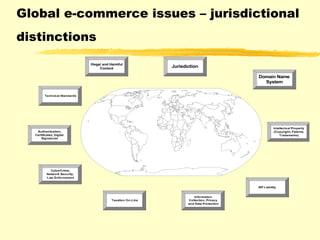
Global e-commerce issues – jurisdictional  distinctions
Issue areas -- examples Authentication Privacy and data protection liability and responsibility for illegal acts, including content issues Cybercrime Others
Authentication Authentication of users E.g, signing, certificates  Uses include  verification of source in communication authentication of data holders for data protection purposes Issues include:  Mutual recognition and inter-operability Responsibilities and Liabilities Varying legal recognitions of online authentication Opportunity for any business or one national source
Data Protection [Privacy] Protection of individuals with regard to the processing of personal data and on the free movement of such data.  Personal data ranges from name, address, other.  Collection, use and transmission of personally identifiable data –  Collection on websites, customers, users, employees. Use for purposes other than intended Transferred by company, customers, or others to another party our third country.
Data Protection cont. Transfer of data to a third country Impact on companies, consumers, users Marketing Customer service Employees Solutions  Safe harbor areas (abide by mutually approved principles) Opt-in versus opt-out
International Copyright Protection International is Copyright protection on-line WIPO Copyright Treaties National Implementation Digital Millennium Copyright Act EU E-Commerce and Copyright Directives Responsibilities and Liabilities Transmitting content Caching content Hosting of content
International Copyright Protection cont…  Main criteria in determining responsibilities and liabilities  Threshold of knowledge or control  Where did the content come from Model – Notice and Takedown Transmission – merely relay it. Can’t monitor Hosting – if proven to have knowledge, then take down Notice indemnification
Content – transmissions and hosting Related to the international copyright debate came the discussion of illegal or harmful content.  But problem – what is legal in one jurisdiction, may be illegal in another. E.g., Yahoo case, Google case Or advertising --  Lands End in Germany  Attempted solutions:  Companies part of connection – either ISP, registry, often sought to monitor Introducing a gTLD that is only for one content area, such as .kids – not feasible, what is one parent’s view as appropriate for their child may not be that of another.
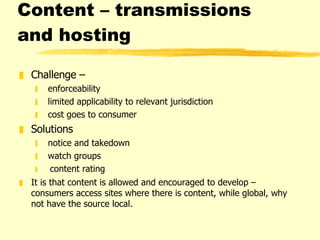
Content – transmissions and hosting Challenge –  enforceability limited applicability to relevant jurisdiction cost goes to consumer Solutions  notice and takedown watch groups content rating  It is that content is allowed and encouraged to develop – consumers access sites where there is content, while global, why not have the source local.
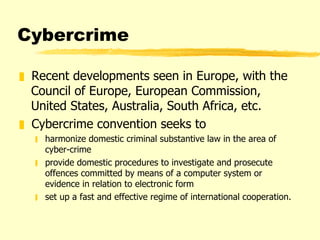
Cybercrime Recent developments seen in Europe, with the Council of Europe, European Commission, United States, Australia, South Africa, etc. Cybercrime convention seeks to harmonize domestic criminal substantive law in the area of cyber-crime provide domestic procedures to investigate and prosecute offences committed by means of a computer system or evidence in relation to electronic form set up a fast and effective regime of international cooperation.
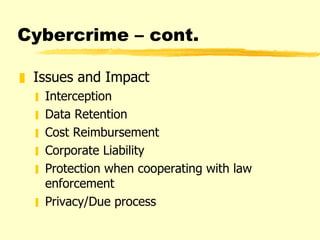
Cybercrime – cont. Issues and Impact Interception Data Retention Cost Reimbursement Corporate Liability Protection when cooperating with law enforcement Privacy/Due process
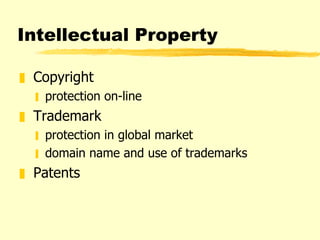
Intellectual Property Copyright protection on-line Trademark protection in global market domain name and use of trademarks  Patents
Conclusions... Industries (current and emerging), Internet, e-commerce, opportunities, and consumers impacted Main challenges to substantive issues Avoid patchwork of laws, policies, etc.  self regulatory v. legislative solutions Technical reality …
Conclusions cont. These are new and emerging areas in the e-commerce legal field, they have to do with the outcome of using the Internet for all it has to offer.

S719a

  • 1.
    Local e-commerce issues– where ICANN's jurisdiction ends and e-commerce begins Theresa Swinehart Counsel for International Legal Affairs ICANN 19 July 2002
  • 2.
    Where does e-commercebegin… E-commerce, whether indirect or direct, is a layer (or several) above the actual infrastructure. It can consist of any range of activities unique to the needs or demands of specific consumer or user groups. E.g., On-line business activities E.g., On-line information sources
  • 3.
    Why care aboutemerging legal and regulatory frameworks? There is an expression that arose from old western movies – “where the pavement ends and the West begins” The Internet and emerging e-commerce has created new and emerging business and legal challenges Dot ‘com’ companies challenged traditional business models E-commerce, whether direct or indirect challenges legal and regulatory frameworks in which they’re developing Have seen much activity in Europe, and beginning to see more in other regions of the world.
  • 4.
    Why care?…. Localpolicy and regulatory issues impact operations on the Internet Each country or distinct economy has unique issues, distinct to respective laws, cultures, perspectives. Legal frameworks impact current and future use and functionality of the Internet and and the benefits of e-commerce That is, the laws in tangible world apply on-line, and often new ones for on-line are created.
  • 5.
    Interest by industryand legislators Impact is on all aspects relating to e-commerce, that is conducting some for of business on-line. Impacts consumers, and operational costs. Perpetuated by Internet explosion Social awareness Consumer demands Solutions to challenges – some technical, much private sector, and some legislative National, international, regional. The recipe to allow continued development and use
  • 6.
    Global e-commerce issues– jurisdictional distinctions
  • 7.
    Issue areas --examples Authentication Privacy and data protection liability and responsibility for illegal acts, including content issues Cybercrime Others
  • 8.
    Authentication Authentication ofusers E.g, signing, certificates Uses include verification of source in communication authentication of data holders for data protection purposes Issues include: Mutual recognition and inter-operability Responsibilities and Liabilities Varying legal recognitions of online authentication Opportunity for any business or one national source
  • 9.
    Data Protection [Privacy]Protection of individuals with regard to the processing of personal data and on the free movement of such data. Personal data ranges from name, address, other. Collection, use and transmission of personally identifiable data – Collection on websites, customers, users, employees. Use for purposes other than intended Transferred by company, customers, or others to another party our third country.
  • 10.
    Data Protection cont.Transfer of data to a third country Impact on companies, consumers, users Marketing Customer service Employees Solutions Safe harbor areas (abide by mutually approved principles) Opt-in versus opt-out
  • 11.
    International Copyright ProtectionInternational is Copyright protection on-line WIPO Copyright Treaties National Implementation Digital Millennium Copyright Act EU E-Commerce and Copyright Directives Responsibilities and Liabilities Transmitting content Caching content Hosting of content
  • 12.
    International Copyright Protectioncont… Main criteria in determining responsibilities and liabilities Threshold of knowledge or control Where did the content come from Model – Notice and Takedown Transmission – merely relay it. Can’t monitor Hosting – if proven to have knowledge, then take down Notice indemnification
  • 13.
    Content – transmissionsand hosting Related to the international copyright debate came the discussion of illegal or harmful content. But problem – what is legal in one jurisdiction, may be illegal in another. E.g., Yahoo case, Google case Or advertising -- Lands End in Germany Attempted solutions: Companies part of connection – either ISP, registry, often sought to monitor Introducing a gTLD that is only for one content area, such as .kids – not feasible, what is one parent’s view as appropriate for their child may not be that of another.
  • 14.
    Content – transmissionsand hosting Challenge – enforceability limited applicability to relevant jurisdiction cost goes to consumer Solutions notice and takedown watch groups content rating It is that content is allowed and encouraged to develop – consumers access sites where there is content, while global, why not have the source local.
  • 15.
    Cybercrime Recent developmentsseen in Europe, with the Council of Europe, European Commission, United States, Australia, South Africa, etc. Cybercrime convention seeks to harmonize domestic criminal substantive law in the area of cyber-crime provide domestic procedures to investigate and prosecute offences committed by means of a computer system or evidence in relation to electronic form set up a fast and effective regime of international cooperation.
  • 16.
    Cybercrime – cont.Issues and Impact Interception Data Retention Cost Reimbursement Corporate Liability Protection when cooperating with law enforcement Privacy/Due process
  • 17.
    Intellectual Property Copyrightprotection on-line Trademark protection in global market domain name and use of trademarks Patents
  • 18.
    Conclusions... Industries (currentand emerging), Internet, e-commerce, opportunities, and consumers impacted Main challenges to substantive issues Avoid patchwork of laws, policies, etc. self regulatory v. legislative solutions Technical reality …
  • 19.
    Conclusions cont. Theseare new and emerging areas in the e-commerce legal field, they have to do with the outcome of using the Internet for all it has to offer.