Presented By-
Akshay Sharma
Scheme of Presentation.
 Introduction
 Growth of E-Commerce.
 E-contract
 Jurisdiction issues in E-Commerce.
 Role of International bodies and framework for E-
commerce.
 Consumer Protection.
 Case Study-Flipkart Big Billion Sale
 Conclusion
INTRODUCTION
What is E-commerce???
Integration of Web and telecommunications
technologies for purpose of selling and buying products or
services.
E-Commerce classification
 B2B/B2G (Eg. Mcmaster, Fastenal )
 B2C (Eg. Flipkart, Jabong etc)
 C2C (Eg. Olx.com)
 C2B (Eg. Elance.com)
Growth of E-Commerce
 From 1995, global electronic commerce is
estimated to reach $236 billion USD in
2007, which got a huge hike in 2012 at the
sales passed $521 billion.
 The total business expectation till 2018 is
$1200 billion USD.
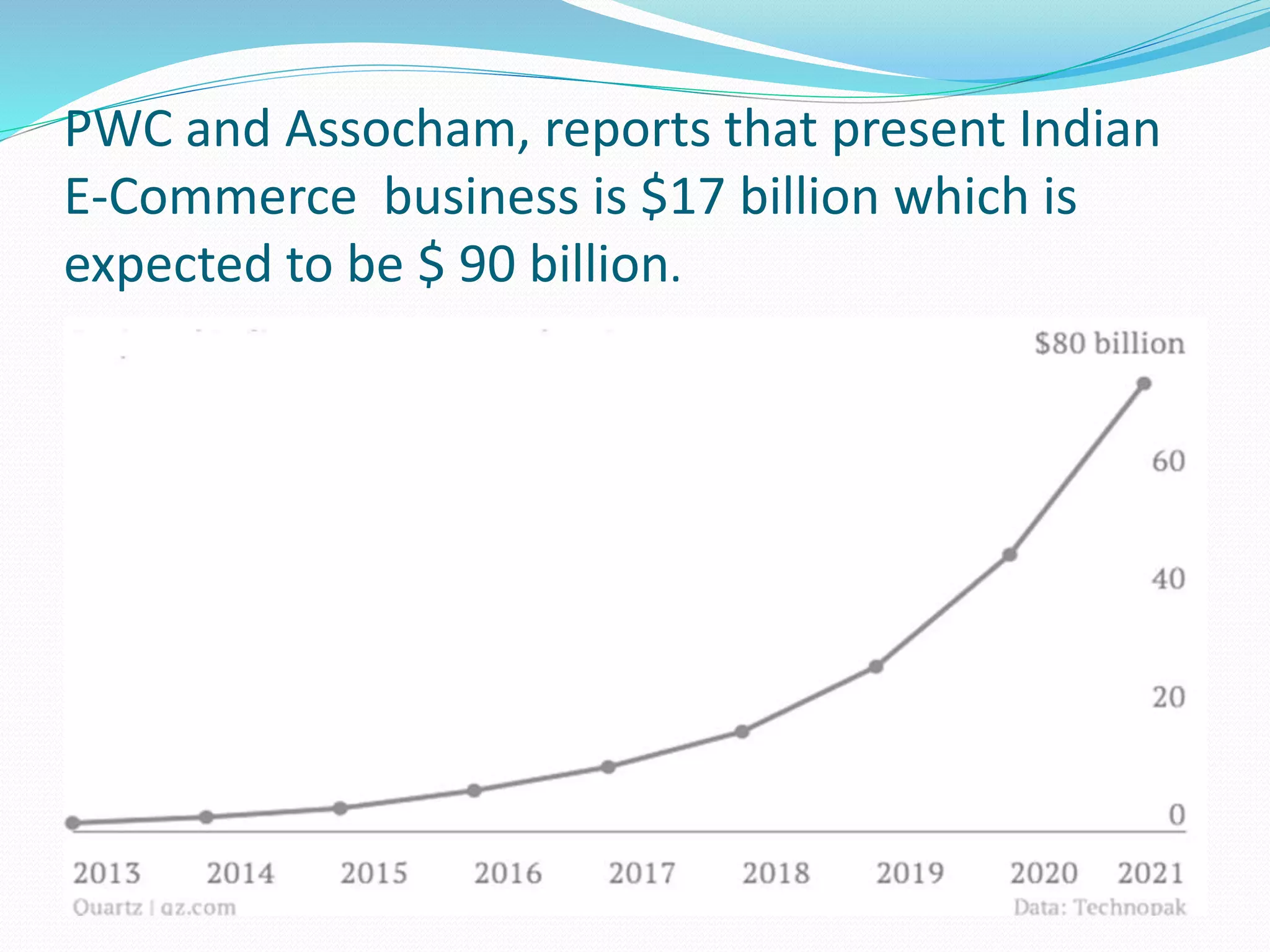
 Since 2007 online revenue growth has
averaged 17% compound per annum.
PWC and Assocham, reports that present Indian
E-Commerce business is $17 billion which is
expected to be $ 90 billion.
E-CONTRACT
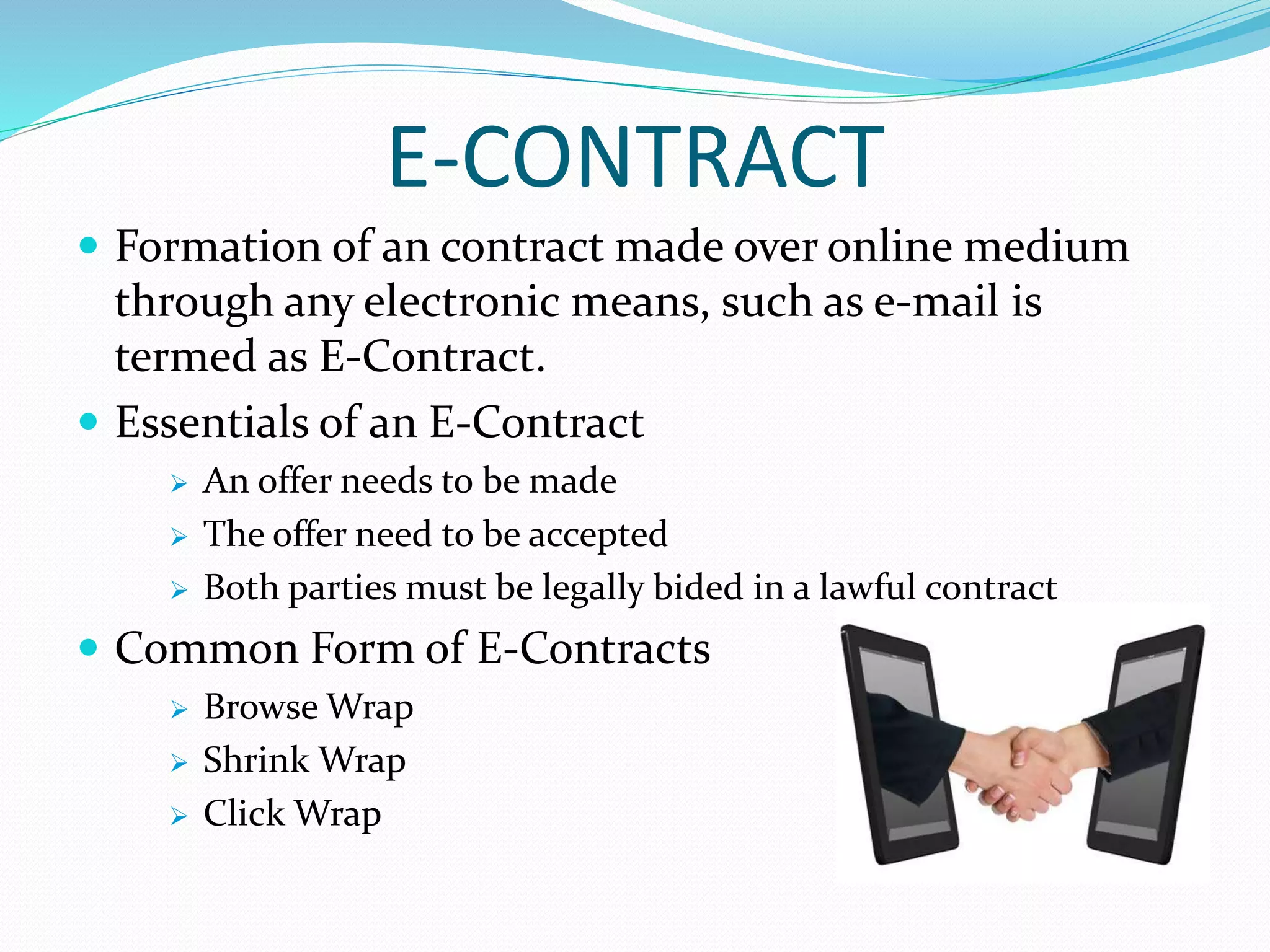
 Formation of an contract made over online medium
through any electronic means, such as e-mail is
termed as E-Contract.
 Essentials of an E-Contract
 An offer needs to be made
 The offer need to be accepted
 Both parties must be legally bided in a lawful contract
 Common Form of E-Contracts
 Browse Wrap
 Shrink Wrap
 Click Wrap
Laws Apply on E-Contract in India
Indian Contract Act, 1872
Information Technology Act, 2000
Indian Evidence Act, 1872
Disputes in E-Commerce
 Contractual Dispute
 Business-to-business (B2B)
 Business-to-consumer (B2C)
 Consumer-to-consumer (C2C)
 Internet Service Provider (ISP)
 Non Contractual Dispute
 Copyright
 Right of free expression
 Domain name disputes
Jurisdiction Issue in E-Commerce.
Ecommerce exists in a borderless environment.
Hence, create concern- whose jurisdiction, where
to take action, what test & laws to be followed
when individual resides outside jurisdictional
area. This calls for single jurisdiction.
o Cross-Border Issues.
o Intellectual Property Rights.
o Digital Products – Services or goods? (Bespoke &
Off-the-Peg)
o Contract with Minors.
o Taxation.
Cross Border Issue.
 The 3 main concerns prevail –
1. Forum Jurisdiction.
2. Choice of Law.
3. Enforcement.
Traditional principles like-
1. Personal jurisdiction
General Jurisdiction.
Specific Jurisdiction.
2. Long arm statue.
 1.) Personal Jurisdiction. ( Applied in U.S)
It require determination of whether person is subject to
the court in which the case is filled.
 1.1 ) General Jurisdiction.
 General jurisdiction refers ‘continuous and
systematic ‘contact to forum state or domicile of
person .
 1.2) Specific Jurisdiction.
 It subjects to ‘minimum contacts’. The greater the
degree of interactivity between the website and a
particular State, the greater is the likelihood of a
court of that State being able to assert jurisdiction
over the website operator.
 An e-commerce , may exits in form of -
 Passive Websites :-
 It provides only information and not at all aims at
soliciting the business, hence personal jurisdiction
does not exit.
 Interactive Websites :-
 It provides information as well as facilitates
purposeful solicit business. As this represents
revenue model hence personal jurisdiction may exist
depending upon minimum contact test or
purposeful availment test. (Cody v. War 1997)
Purposeful Availment Test:-
It is one of the criteria for establishing minimum contact
with forum state in order to get privilege of doing business
in particular state. (EDIAS Software International v. BASIS
International Ltd 1996). The test consist of –
a) contract with plaintiff.
b) communication with plaintiff.
c) sales of software products to plaintiff.
Sliding Scale Approach:-
It classifies the website on the basis of interactivity and
commercial nature of the exchange of information that
occurs on website. (Zippo.com case 1997).
Effect test:-
It categories on basis of extent of harm defendant suffered.in
forum state. (PurCo Fleet Services, Inc. v. Towers 1999)
Jurisdiction in Indian
 Section -75 of Information Technology Act, 2000 amended 2008,
provides Indian judiciary to enact laws outside India.
Section 75 provides for punishment for commission of any offence
or contravention by a person outside India irrespective of his
nationality if the act or conduct constituting the offence or
contravention involves a computer, computer system or computer
network located in India.
 As per ITAA 2008, Section 75 is given as follows:
 Act to apply for offence or contraventions committed outside India:
 (1) Subject to the provisions of sub-section (2), the provisions of this
Act shall apply also to any offence or contravention committed outside
India by any person irrespective of his nationality.
 (2) For the purposes of sub-section (1), this Act shall apply to an offence
or contravention committed outside India by any person if the act or
conduct constituting the offence or contravention involves a
computer, computer system or computer network located in India.
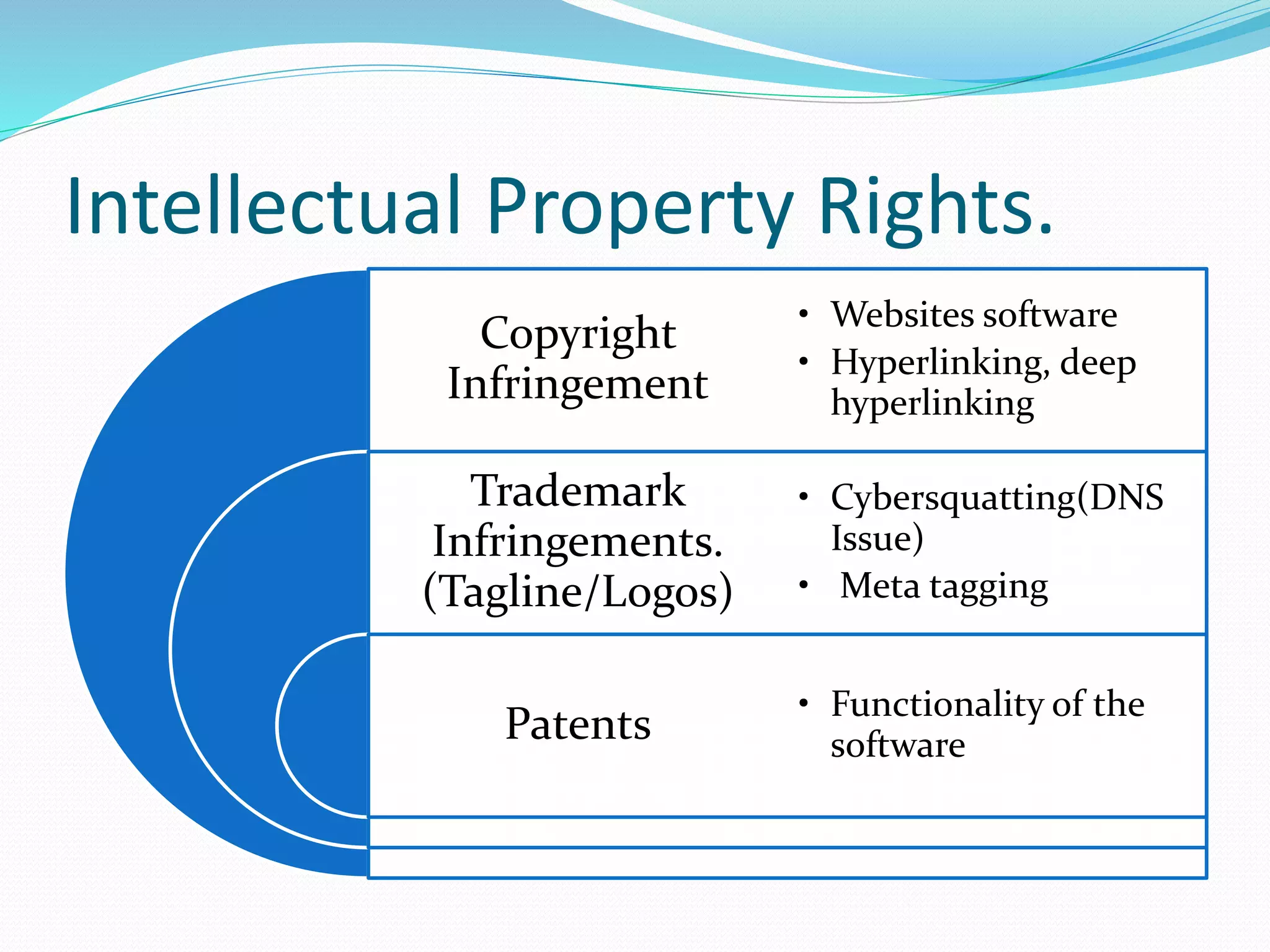
Intellectual Property Rights.
Copyright
Infringement
Trademark
Infringements.
(Tagline/Logos)
Patents
• Websites software
• Hyperlinking, deep
hyperlinking
• Cybersquatting(DNS
Issue)
• Meta tagging
• Functionality of the
software
Digitalized product- Goods or
Services???
 Digitised product fulfilled condition for tangible
item, it is best characterised as goods while
intangible constitute services.
 The second distinction, runs on the basis of
supplied in physical form or those supplied
digitally- internet download. “Bespoke" and "off-
the-peg" products.
 The "bespoke" product has more in common with
the contract for professional services, such as a
contract of sales of goods.
Contract with Minor
 Due to nature of e-commerce it is virtually
impossible to check the age of anyone who is
transacting online. This may pose serious
problems and liabilities for e-commerce
platforms.
 Having regard to sections 2, 10 and 11 of the
Contract Act, that the Act makes it essential that
the contracting parties should be competent to
contract and that a minor’s contract is void.
Taxation
 In context to taxation of income generated by nonresidents
from e-commerce transactions, primarily, there are two
main issues.
 1.) characterization of income:- whether income earned is
sale of goods is royalty or business income.
 2.) permanent establishment:- Establishment of server
within national boundaries.
Role of international bodies and
framework for e-commerce.
 E-commence is predominantly driven by the private
sector.
 Introduction of harmonization process has through the
adoption of multilateral treaties.
 Different Framework:-
 UNICTRAL
 OECD
 UNCITRAL, OECD and ICC “Guidelines on
Advertising and Marketing on the Internet”
ICC- International Chamber of Commerce.
 Introduction of new convention regulating
international jurisdiction.
 Hague Convention
 Rome Convention.
International treaties.
 Berne Convention
 Paris Convention
 TRIPS Agreement.
 International Safe Harbor.
Indian initiative:-
 Indian the Ministry of Consumer affairs proposed
amendments to Consumer Protection Act , 1986
Consumer Presentation
 1.) Legal aspect.
 Privacy Issues.
 Fake use of brand names. (WebTrust)
 Settlement of disputes.
 2.) Technical aspect.
 Cryptographic tools.
 SSL
 SET
 PET
 Digital signature for Authentication.
Flipkart Big Billion Day
 On 6th October 2014, flipkart announced the ‘Big
Billion Day’ Sale on their website.
 As the sale ended many issues arises in the e-
commerce market.
 Technical Failure
 Predatory Pricing
 Misleading Consumers
 Taxation Issue
 Flipkart Policies
Conclusion & Suggestion
 Evolution of E-commerce from B2B till C2C, evidently
implies for introduction of framework.
 Contracts between different countries, with different
sovereign calls for single jurisdiction.
 Stringent technical obligation to seek privacy and
protection from fraud.
Thank you!!!!

Jurisdictional issues of e commerce and consumer protection

  • 1.
  • 2.
    Scheme of Presentation. Introduction  Growth of E-Commerce.  E-contract  Jurisdiction issues in E-Commerce.  Role of International bodies and framework for E- commerce.  Consumer Protection.  Case Study-Flipkart Big Billion Sale  Conclusion
  • 3.
    INTRODUCTION What is E-commerce??? Integrationof Web and telecommunications technologies for purpose of selling and buying products or services. E-Commerce classification  B2B/B2G (Eg. Mcmaster, Fastenal )  B2C (Eg. Flipkart, Jabong etc)  C2C (Eg. Olx.com)  C2B (Eg. Elance.com)
  • 4.
    Growth of E-Commerce From 1995, global electronic commerce is estimated to reach $236 billion USD in 2007, which got a huge hike in 2012 at the sales passed $521 billion.  The total business expectation till 2018 is $1200 billion USD.  Since 2007 online revenue growth has averaged 17% compound per annum.
  • 5.
    PWC and Assocham,reports that present Indian E-Commerce business is $17 billion which is expected to be $ 90 billion.
  • 6.
    E-CONTRACT  Formation ofan contract made over online medium through any electronic means, such as e-mail is termed as E-Contract.  Essentials of an E-Contract  An offer needs to be made  The offer need to be accepted  Both parties must be legally bided in a lawful contract  Common Form of E-Contracts  Browse Wrap  Shrink Wrap  Click Wrap
  • 7.
    Laws Apply onE-Contract in India Indian Contract Act, 1872 Information Technology Act, 2000 Indian Evidence Act, 1872
  • 8.
    Disputes in E-Commerce Contractual Dispute  Business-to-business (B2B)  Business-to-consumer (B2C)  Consumer-to-consumer (C2C)  Internet Service Provider (ISP)  Non Contractual Dispute  Copyright  Right of free expression  Domain name disputes
  • 9.
    Jurisdiction Issue inE-Commerce. Ecommerce exists in a borderless environment. Hence, create concern- whose jurisdiction, where to take action, what test & laws to be followed when individual resides outside jurisdictional area. This calls for single jurisdiction. o Cross-Border Issues. o Intellectual Property Rights. o Digital Products – Services or goods? (Bespoke & Off-the-Peg) o Contract with Minors. o Taxation.
  • 10.
    Cross Border Issue. The 3 main concerns prevail – 1. Forum Jurisdiction. 2. Choice of Law. 3. Enforcement. Traditional principles like- 1. Personal jurisdiction General Jurisdiction. Specific Jurisdiction. 2. Long arm statue.
  • 11.
     1.) PersonalJurisdiction. ( Applied in U.S) It require determination of whether person is subject to the court in which the case is filled.  1.1 ) General Jurisdiction.  General jurisdiction refers ‘continuous and systematic ‘contact to forum state or domicile of person .  1.2) Specific Jurisdiction.  It subjects to ‘minimum contacts’. The greater the degree of interactivity between the website and a particular State, the greater is the likelihood of a court of that State being able to assert jurisdiction over the website operator.
  • 12.
     An e-commerce, may exits in form of -  Passive Websites :-  It provides only information and not at all aims at soliciting the business, hence personal jurisdiction does not exit.  Interactive Websites :-  It provides information as well as facilitates purposeful solicit business. As this represents revenue model hence personal jurisdiction may exist depending upon minimum contact test or purposeful availment test. (Cody v. War 1997)
  • 13.
    Purposeful Availment Test:- Itis one of the criteria for establishing minimum contact with forum state in order to get privilege of doing business in particular state. (EDIAS Software International v. BASIS International Ltd 1996). The test consist of – a) contract with plaintiff. b) communication with plaintiff. c) sales of software products to plaintiff. Sliding Scale Approach:- It classifies the website on the basis of interactivity and commercial nature of the exchange of information that occurs on website. (Zippo.com case 1997). Effect test:- It categories on basis of extent of harm defendant suffered.in forum state. (PurCo Fleet Services, Inc. v. Towers 1999)
  • 14.
    Jurisdiction in Indian Section -75 of Information Technology Act, 2000 amended 2008, provides Indian judiciary to enact laws outside India. Section 75 provides for punishment for commission of any offence or contravention by a person outside India irrespective of his nationality if the act or conduct constituting the offence or contravention involves a computer, computer system or computer network located in India.  As per ITAA 2008, Section 75 is given as follows:  Act to apply for offence or contraventions committed outside India:  (1) Subject to the provisions of sub-section (2), the provisions of this Act shall apply also to any offence or contravention committed outside India by any person irrespective of his nationality.  (2) For the purposes of sub-section (1), this Act shall apply to an offence or contravention committed outside India by any person if the act or conduct constituting the offence or contravention involves a computer, computer system or computer network located in India.
  • 15.
    Intellectual Property Rights. Copyright Infringement Trademark Infringements. (Tagline/Logos) Patents •Websites software • Hyperlinking, deep hyperlinking • Cybersquatting(DNS Issue) • Meta tagging • Functionality of the software
  • 16.
    Digitalized product- Goodsor Services???  Digitised product fulfilled condition for tangible item, it is best characterised as goods while intangible constitute services.  The second distinction, runs on the basis of supplied in physical form or those supplied digitally- internet download. “Bespoke" and "off- the-peg" products.  The "bespoke" product has more in common with the contract for professional services, such as a contract of sales of goods.
  • 17.
    Contract with Minor Due to nature of e-commerce it is virtually impossible to check the age of anyone who is transacting online. This may pose serious problems and liabilities for e-commerce platforms.  Having regard to sections 2, 10 and 11 of the Contract Act, that the Act makes it essential that the contracting parties should be competent to contract and that a minor’s contract is void.
  • 18.
    Taxation  In contextto taxation of income generated by nonresidents from e-commerce transactions, primarily, there are two main issues.  1.) characterization of income:- whether income earned is sale of goods is royalty or business income.  2.) permanent establishment:- Establishment of server within national boundaries.
  • 19.
    Role of internationalbodies and framework for e-commerce.  E-commence is predominantly driven by the private sector.  Introduction of harmonization process has through the adoption of multilateral treaties.  Different Framework:-  UNICTRAL  OECD  UNCITRAL, OECD and ICC “Guidelines on Advertising and Marketing on the Internet” ICC- International Chamber of Commerce.
  • 20.
     Introduction ofnew convention regulating international jurisdiction.  Hague Convention  Rome Convention. International treaties.  Berne Convention  Paris Convention  TRIPS Agreement.  International Safe Harbor. Indian initiative:-  Indian the Ministry of Consumer affairs proposed amendments to Consumer Protection Act , 1986
  • 21.
    Consumer Presentation  1.)Legal aspect.  Privacy Issues.  Fake use of brand names. (WebTrust)  Settlement of disputes.  2.) Technical aspect.  Cryptographic tools.  SSL  SET  PET  Digital signature for Authentication.
  • 22.
    Flipkart Big BillionDay  On 6th October 2014, flipkart announced the ‘Big Billion Day’ Sale on their website.  As the sale ended many issues arises in the e- commerce market.  Technical Failure  Predatory Pricing  Misleading Consumers  Taxation Issue  Flipkart Policies
  • 23.
    Conclusion & Suggestion Evolution of E-commerce from B2B till C2C, evidently implies for introduction of framework.  Contracts between different countries, with different sovereign calls for single jurisdiction.  Stringent technical obligation to seek privacy and protection from fraud.
  • 24.