Space and Time Can Warp Your Mind
Space What is space? Gridwork for measuring distances Everything – planets, stars, galaxies, and the universe Is space infinite?
Time What is time? The constant drumbeat of existence “ Time is what happens when nothing else does.” Measured with atomic clocks to one part in 10 15 One second since the demise of the dinosaurs Does time have a beginning? An end?
Motion Change of position in space over time Change in space Change in time Motion through space variable Motion through time constant Change within fixed framework
Motion is Relative Motion measured compared to fixed frame of reference Which frame is fixed? Which is moving? Why you can’t sit still Earth’s rotation – 800 mph Earth’s orbit – 65,000 mph Sun’s orbit – 450,000 mph Milky Way’s motion – 1,300,000 mph
Speed of Light
Speed of Light Finite 186,000 miles per second 670 million mph Light travel distances Earth-Sun distance is 93 million miles 500 seconds of light travel time 1 light-year = 6 trillion miles
Time-Warped View Proxima Centauri – 4.2 ly Center of Milky Way – 27 thousand ly Andromeda galaxy – 2.5 million ly Fornax cluster – 65 million ly Most distant objects – 13 billion ly Looking out in space = back in time
 
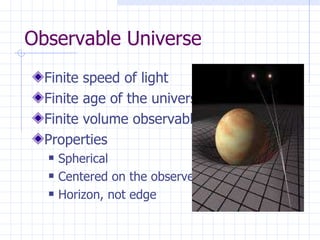
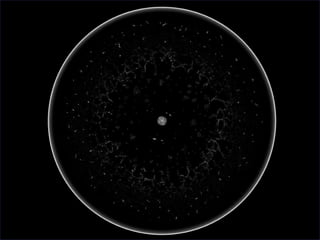
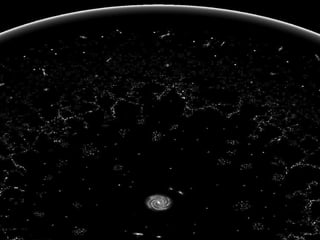
Observable Universe Finite speed of light Finite age of the universe Finite volume observable Properties Spherical Centered on the observer Horizon, not edge
 
 
Special Theory of Relativity
Special Theory of Relativity Speed of light is an absolute - c Physics is the same to all observers Observer at rest Observer in motion Inertial reference frame Our reference frame has considerable motion
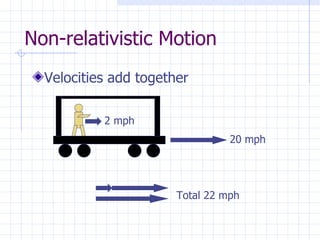
Non-relativistic Motion Velocities add together 20 mph 2 mph Total 22 mph
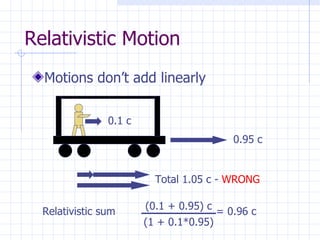
Relativistic Motion Motions don’t add linearly 0.95 c 0.1 c Total 1.05 c -  WRONG Relativistic sum  = 0.96 c (0.1 + 0.95) c (1 + 0.1*0.95)
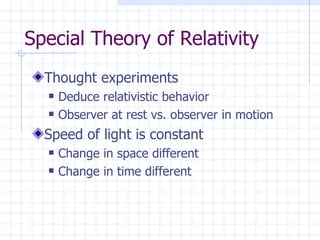
Special Theory of Relativity Thought experiments Deduce relativistic behavior Observer at rest vs. observer in motion Speed of light is constant Change in space different Change in time different
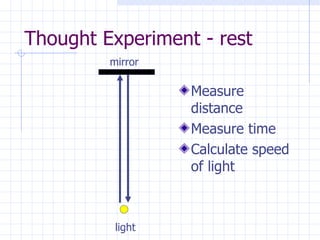
Thought Experiment - rest light mirror Measure distance Measure time Calculate speed of light
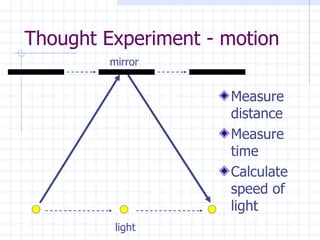
Thought Experiment - motion mirror light Measure distance Measure time Calculate speed of light
Shrinking Space Length contraction The length of an object appears shorter when measured by a moving observer Spaceship pilot flying at 0.99c would measure football field as 14 yards long Crowd would measure spaceship to be 1/7 as long as pilot thinks Relativistic diet tip: If you move fast, other people think you’re thinner
Stretching Time Time dialation Time appears to slow down when measured by a moving observer Travel to Proxima Centauri at 0.99 c would take 4.25 years Pilot would only age (4.25/7) years, about 7 months One way time travel to the future
Light doesn’t exist? At speed of light, lengths go to zero At speed of light, time stands still Photon of light doesn’t experience space or time  Emitted Instantaneously crosses any amount of space Absorbed In its own frame of reference, light doesn’t exist in space or time
Special Theory of Relativity One’s view of space and time depends on one’s motion
General Theory of Relativity
General Theory of Relativity Matter warps space Re-interpret gravity as geometry Straight paths, but in curved space Geodesic Extends special relativity to handle  non-inertial frames of reference
Warped Space
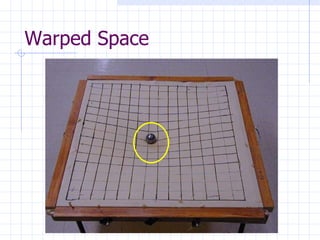
Warped Space Matter tells space how to curve Curved space tells matter how to move
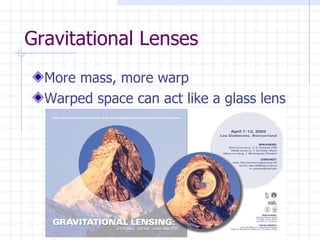
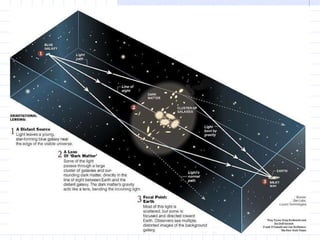
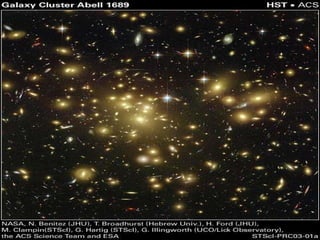
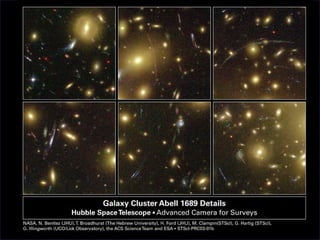
Gravitational Lenses More mass, more warp Warped space can act like a glass lens


Slowing Time Gravitational time dilation Clocks run slower in a larger gravitational field Tested by flying atomic clock in plane Slower due to special relativity Faster due to general relativity Today’s atomic clocks can measure altitude difference of 1 yard
General Theory of Relativity One’s view of space and time depends on how much matter is around and how it is distributed
Expansion of Space
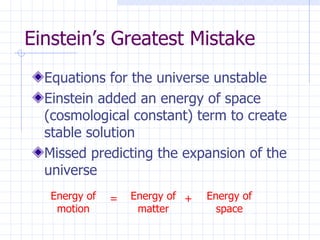
Einstein’s Greatest Mistake Equations for the universe unstable Einstein added an energy of space (cosmological constant) term to create stable solution Missed predicting the expansion of the universe Energy of motion Energy of matter Energy of space = +
Expansion of Space Hubble measured motions of galaxies All appear to move away from us Cosmic cooties? Expansion through space -  WRONG Galaxies moving away from center No measurements show a center Copernican hypothesis underlies astronomy, and all science
Expansion of Space Expansion  of  space Galaxies at rest Space between galaxies expanding All galaxies see every other galaxy moving away No center Different kind of relative motion Observers at rest Reference frame in motion
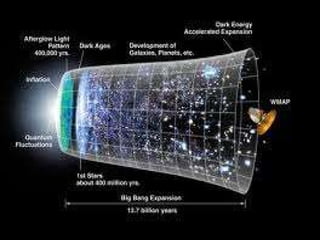
Big Bang The Universe has expanded … from small to big from hot to cold from dense to rarified Standard framework of cosmology Only hypothesis that fits observations Scientific theory
Big Bang Observation Cosmic Microwave Background Remnant glow from hot early universe Seen in every direction on the sky\ Perfect thermal spectrum Time: half a million years after big bang Temperature: 3000 degrees Size: 1/1000 th  present size Observational evidence that the universe was smaller, denser, and hotter in the past
Expansion of Space One’s view of space and time depends on when in the history of the universe one is observing
SOME say the world will end in fire, Some say in ice. From what I’ve tasted of desire I hold with those who favor fire. But if it had to perish twice, I think I know enough of hate To know that for destruction ice Is also great And would suffice. Fire and Ice - Robert Frost
“ Thank You”

General_relativity

  • 1.
    Space and TimeCan Warp Your Mind
  • 2.
    Space What isspace? Gridwork for measuring distances Everything – planets, stars, galaxies, and the universe Is space infinite?
  • 3.
    Time What istime? The constant drumbeat of existence “ Time is what happens when nothing else does.” Measured with atomic clocks to one part in 10 15 One second since the demise of the dinosaurs Does time have a beginning? An end?
  • 4.
    Motion Change ofposition in space over time Change in space Change in time Motion through space variable Motion through time constant Change within fixed framework
  • 5.
    Motion is RelativeMotion measured compared to fixed frame of reference Which frame is fixed? Which is moving? Why you can’t sit still Earth’s rotation – 800 mph Earth’s orbit – 65,000 mph Sun’s orbit – 450,000 mph Milky Way’s motion – 1,300,000 mph
  • 6.
  • 7.
    Speed of LightFinite 186,000 miles per second 670 million mph Light travel distances Earth-Sun distance is 93 million miles 500 seconds of light travel time 1 light-year = 6 trillion miles
  • 8.
    Time-Warped View ProximaCentauri – 4.2 ly Center of Milky Way – 27 thousand ly Andromeda galaxy – 2.5 million ly Fornax cluster – 65 million ly Most distant objects – 13 billion ly Looking out in space = back in time
  • 9.
  • 10.
    Observable Universe Finitespeed of light Finite age of the universe Finite volume observable Properties Spherical Centered on the observer Horizon, not edge
  • 11.
  • 12.
  • 13.
  • 14.
    Special Theory ofRelativity Speed of light is an absolute - c Physics is the same to all observers Observer at rest Observer in motion Inertial reference frame Our reference frame has considerable motion
  • 15.
    Non-relativistic Motion Velocitiesadd together 20 mph 2 mph Total 22 mph
  • 16.
    Relativistic Motion Motionsdon’t add linearly 0.95 c 0.1 c Total 1.05 c - WRONG Relativistic sum = 0.96 c (0.1 + 0.95) c (1 + 0.1*0.95)
  • 17.
    Special Theory ofRelativity Thought experiments Deduce relativistic behavior Observer at rest vs. observer in motion Speed of light is constant Change in space different Change in time different
  • 18.
    Thought Experiment -rest light mirror Measure distance Measure time Calculate speed of light
  • 19.
    Thought Experiment -motion mirror light Measure distance Measure time Calculate speed of light
  • 20.
    Shrinking Space Lengthcontraction The length of an object appears shorter when measured by a moving observer Spaceship pilot flying at 0.99c would measure football field as 14 yards long Crowd would measure spaceship to be 1/7 as long as pilot thinks Relativistic diet tip: If you move fast, other people think you’re thinner
  • 21.
    Stretching Time Timedialation Time appears to slow down when measured by a moving observer Travel to Proxima Centauri at 0.99 c would take 4.25 years Pilot would only age (4.25/7) years, about 7 months One way time travel to the future
  • 22.
    Light doesn’t exist?At speed of light, lengths go to zero At speed of light, time stands still Photon of light doesn’t experience space or time Emitted Instantaneously crosses any amount of space Absorbed In its own frame of reference, light doesn’t exist in space or time
  • 23.
    Special Theory ofRelativity One’s view of space and time depends on one’s motion
  • 24.
  • 25.
    General Theory ofRelativity Matter warps space Re-interpret gravity as geometry Straight paths, but in curved space Geodesic Extends special relativity to handle non-inertial frames of reference
  • 26.
  • 27.
    Warped Space Mattertells space how to curve Curved space tells matter how to move
  • 28.
    Gravitational Lenses Moremass, more warp Warped space can act like a glass lens
  • 29.
  • 30.
  • 31.
  • 32.
    Slowing Time Gravitationaltime dilation Clocks run slower in a larger gravitational field Tested by flying atomic clock in plane Slower due to special relativity Faster due to general relativity Today’s atomic clocks can measure altitude difference of 1 yard
  • 33.
    General Theory ofRelativity One’s view of space and time depends on how much matter is around and how it is distributed
  • 34.
  • 35.
    Einstein’s Greatest MistakeEquations for the universe unstable Einstein added an energy of space (cosmological constant) term to create stable solution Missed predicting the expansion of the universe Energy of motion Energy of matter Energy of space = +
  • 36.
    Expansion of SpaceHubble measured motions of galaxies All appear to move away from us Cosmic cooties? Expansion through space - WRONG Galaxies moving away from center No measurements show a center Copernican hypothesis underlies astronomy, and all science
  • 37.
    Expansion of SpaceExpansion of space Galaxies at rest Space between galaxies expanding All galaxies see every other galaxy moving away No center Different kind of relative motion Observers at rest Reference frame in motion
  • 38.
    Big Bang TheUniverse has expanded … from small to big from hot to cold from dense to rarified Standard framework of cosmology Only hypothesis that fits observations Scientific theory
  • 39.
    Big Bang ObservationCosmic Microwave Background Remnant glow from hot early universe Seen in every direction on the sky\ Perfect thermal spectrum Time: half a million years after big bang Temperature: 3000 degrees Size: 1/1000 th present size Observational evidence that the universe was smaller, denser, and hotter in the past
  • 40.
    Expansion of SpaceOne’s view of space and time depends on when in the history of the universe one is observing
  • 41.
    SOME say theworld will end in fire, Some say in ice. From what I’ve tasted of desire I hold with those who favor fire. But if it had to perish twice, I think I know enough of hate To know that for destruction ice Is also great And would suffice. Fire and Ice - Robert Frost
  • 42.