Sjögren’s Syndrome


       2009
Outline

History and Definition

Incidence and Etiology

Clinical findings

Diagnosis and Pathology

Prognosis and Treatment
History
Mikulicz - first description of Sjögren’s syndrome

Mikulicz’s syndrome-1892 described parotid and lacrimal
gland enlargement associated with a small round cell
infiltrate .

However, the term Mikulicz's syndrome could encompass
so many different entities including tuberculosis, other
infections, sarcoidosis, and lymphoma. Therefore not
given credit for discovery.

The term is still occasionally used to describe the
histological appearance of focal lymphocytic infiltrates on
salivary gland biopsies.
History
Henrick Sjögren 1899-1987 Sweden
1930-As ophthalmology resident discover women with
rheumatism and corneal abrasions who could not produce
tears when crying and could not dissolve a lump of sugar in
their mouths.
1933-Published his thesis paper on Keratoconjuctivitis
Sicca, describing 15 women with lacrimal gland dysfunction
leading to ulcerative lesions of the eyes. Was not well
received, did not acquire Docenti (Academic PhD).
1951-Sjögren published a series of papers describing 80
patients with the syndrome, in which the majority had arthritis.
Sjögren’s syndrome was then recognized in literature.
Definition

Sjögren’s (show-grin) syndrome - a
syndrome describing xerophthalmia (dry
eyes) and xerostomia (dry mouth)- (Sicca
complex)-due to immune-mediated
destruction of exocrine
glands, predominately of lacrimal and
salivary.
Definition

Primary Sjögren’s syndrome - characterized by
Sicca complex and extra-glandular symptoms
without any additional connective tissue disorder.
Secondary Sjögren’s syndrome occurs in
association with another autoimmune disorder
such as SLE, RA, or scleroderma
Incidence
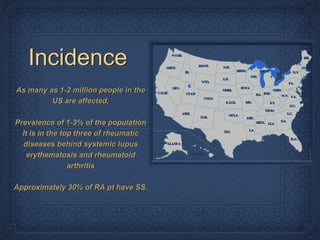
As many as 1-2 million people in the
         US are affected,

Prevalence of 1-3% of the population
  It is in the top three of rheumatic
  diseases behind systemic lupus
    erythematosis and rheumatoid
                 arthritis

Approximately 30% of RA pt have SS.
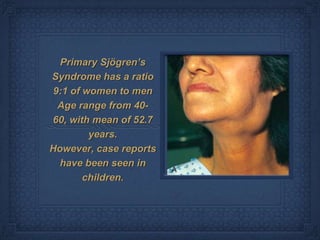
Primary Sjögren’s
Syndrome has a ratio
 9:1 of women to men
  Age range from 40-
60, with mean of 52.7
         years.
However, case reports
  have been seen in
        children.
Etiology
Pathogenesis of Sjögren’s syndrome is believed
to be multifactorial.

Known to be autoimmune, but studies suggest
that the disease process has
genetic, environmental and neuroendocrine
components
Etiology
There is a genetic predominance of HLA-DR
genotype in SS patients. HLA-DR is a major
histocompatibility complex, MHC class II cell surface
receptor. It is found on antigen presenting cells.

These genotypes may also produce dysfunctional
glands that secrete abnormal amounts of immune-
stimulatory chemokines. This is not seen in patients
without Sjögren’s disease.
Etiology
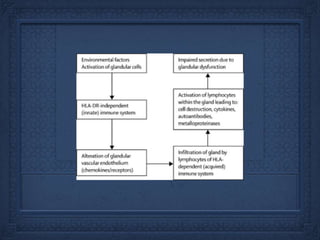
Autoimmunity involved in Sjögren’s disease is still poorly understood. It is
believed that genetically defective glandular tissue combined with
immunologic, environmental or neuroendocrine factors leads to loss of self
antigen awareness.

Environmental factors may have link to viruses (Epstein–Barr virus, hepatitis C
virus, human T-cell leukemia virus-1)

After the initial trigger, this glandular tissue autoimmune complex then becomes
infiltrated with lymphocytes, predominately CD4 T cell (attracted by MHC class II)

A cascade of events then occur with the CD4 T cell release of cytokine IL-
1, TNF, and interferon-gamma, which have destructive effects on the tissue and
interfere with acetylcholine release, causing dysfunctional glands.
Clinical Manifestations
Glandular    Sinus/nasal

Ocular       Hepatobiliary and gastrointestinal

Oral         Genitourinary

Otological   Musculoskeletal
Laryngeal
             Vascular
Thyroid
             Neurologic
Pulmonary
             Hematologic/lymphatic
Glandular
        manifestations
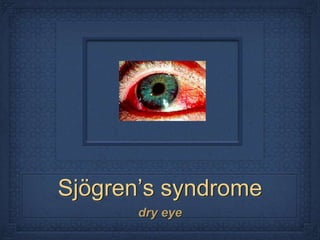
Decreased lacrimal flow

Corneal and conjunctiva epithelia damage

Leads to dry eyes, foreign body
sensation, irritation, photosensitivity, thick
secretions at inner canthus, and visual
impairment.
Sjögren’s syndrome
       dry eye
Glandular
          manifestations
Involvement of unilateral or bilateral major and minor salivary
glands

Decreased salivary secretions-loss of lubrication, buffering
and antimicrobial capacities of saliva.

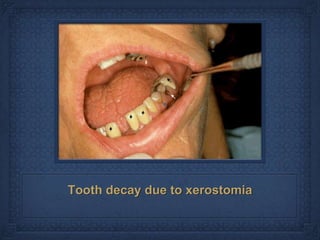
Most common complication is increase in dental
caries, especial root and incisor caries.

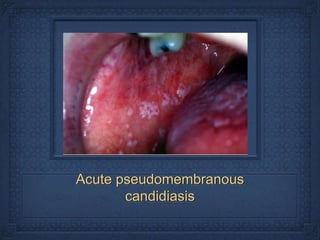
Frequent fungal infections

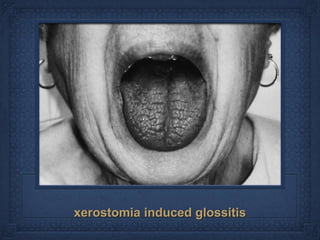
Tongue fissures

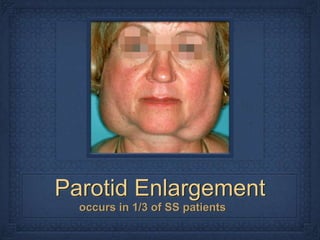
Persistent salivary enlargement.
Tooth decay due to xerostomia
Acute pseudomembranous
       candidiasis
Parotid Enlargement
  occurs in 1/3 of SS patients
Clinical Manifestations
SS patients typically demonstrate mild to moderate
sensorineural hearing loss in high frequencies.

An association with anti-cardiolipin antibodies has
been demonstrated, but no cochlear or vestibular
pathology has been found.

May be caused by immune complexes in the stria
vascularis of the basal turn of the cochlea.
Clinical Manifestations
Granulomatous and non-granulomatous
laryngeal nodes have been described.

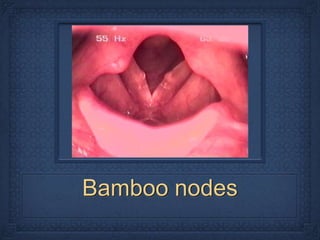
Bamboo nodes - whitish or yellowish transverse
submucosal lesions localized to middle third of
vocal fold.

However, hoarseness is rare first symptom
Bamboo nodes
Clinical Manifestations
thyroid abnormalities such as Hashimotos’s
thyroiditis are associated with SS

Antibodies to thyroglobulin can be found in up to
1/2 of SS patients

10-15% of Primary SS are clinically hypothyroid

Therefore, all patients with SS should undergo
routine evaluation of thyroid function
Clinical Manifestations
Epistaxis and nasal crusting are common findings in
SS, with 50% having nasal mucosa hypertrophy and
up to 13% have septal perforations

Xerotrachea (dry cough) and dyspnea are common
pulmonary symptoms.
Esophageal spasm and dysmotility are also seen, but
may be secondary to absence of saliva

Atrophic gastritis, celiac disease
Clinical Manifestations
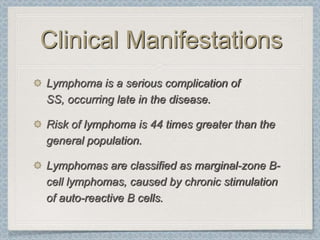
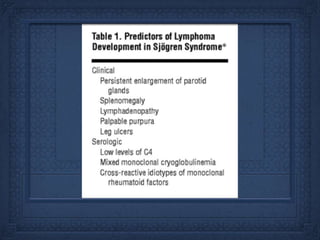
Lymphoma is a serious complication of
SS, occurring late in the disease.

Risk of lymphoma is 44 times greater than the
general population.

Lymphomas are classified as marginal-zone B-
cell lymphomas, caused by chronic stimulation
of auto-reactive B cells.
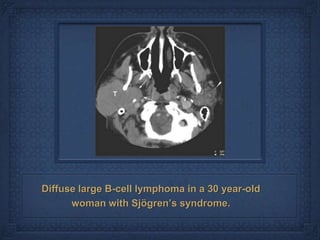
Diffuse large B-cell lymphoma in a 30 year-old
      woman with Sjögren’s syndrome.
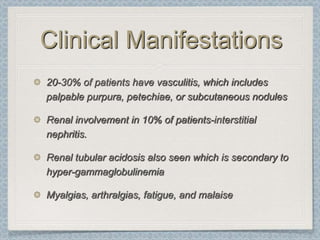
Clinical Manifestations
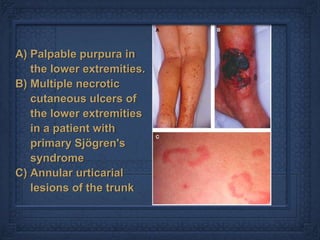
20-30% of patients have vasculitis, which includes
palpable purpura, petechiae, or subcutaneous nodules

Renal involvement in 10% of patients-interstitial
nephritis.

Renal tubular acidosis also seen which is secondary to
hyper-gammaglobulinemia

Myalgias, arthralgias, fatigue, and malaise
A) Palpable purpura in
   the lower extremities.
B) Multiple necrotic
   cutaneous ulcers of
   the lower extremities
   in a patient with
   primary Sjögren's
   syndrome
C) Annular urticarial
   lesions of the trunk
Criteria for Sjögren’s syndrome
2002

 US and European diagnosis criteria differed so
 much that there were ten times as many
 diagnosis in Europe than in US.
 Caused problems with clinical trials and
 publication reports
 2002 American-European Consensus Group
 developed criteria for Sjögren syndrome.
Criteria for Sjögren’s syndrome
2002

 Ocular symptoms
 Oral symptoms
 Objective evidence of dry eyes
 Objective evidence of salivary-gland
 involvement
 Laboratory abnormality
Criteria for Sjögren’s
syndrome
1. Ocular Symptoms (at least one must be present)
Persistent dry eyes every day for more than 3 months
Recurrent sensation of sand or gravel in eyes
Use of tear substitute more than three time a day

2. Oral symptoms (at least one present)
Feeling of dry mouth every day for 3 months
Recurrent swollen salivary glands as an adult
Need to drink liquids to aid in swallowing of dry foods.
xerostomia induced glossitis
Criteria for Sjögren’s
syndrome
3. Objective evidence of dry eyes (one must be
present)
Schirmer Test
Rose-Bengal

4. Lacrimal-gland biopsy
Focal lymphocytic sialoadenitis in minor salivary glands-
containing more than 50 lymphocytes per 4 mm of glandular
tissue.
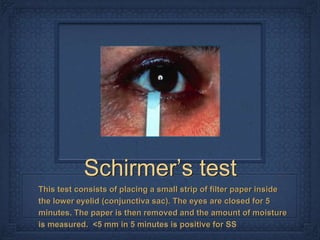
Schirmer’s test
This test consists of placing a small strip of filter paper inside
the lower eyelid (conjunctiva sac). The eyes are closed for 5
minutes. The paper is then removed and the amount of moisture
is measured. <5 mm in 5 minutes is positive for SS
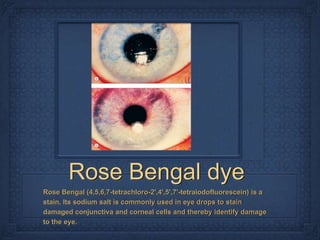
Rose Bengal dye
Rose Bengal (4,5,6,7-tetrachloro-2',4',5',7'-tetraiodofluorescein) is a
stain. Its sodium salt is commonly used in eye drops to stain
damaged conjunctiva and corneal cells and thereby identify damage
to the eye.
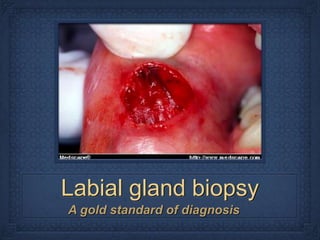
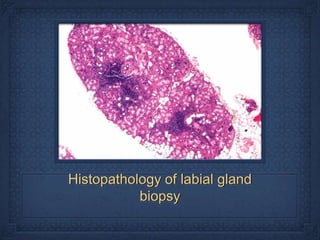
Labial gland biopsy
A gold standard of diagnosis
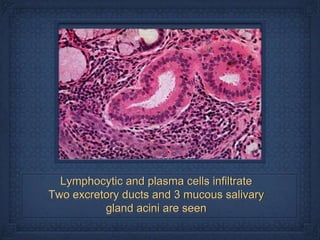
Histopathology of labial gland
           biopsy
Lymphocytic and plasma cells infiltrate
Two excretory ducts and 3 mucous salivary
          gland acini are seen
Criteria for Sjögren’s
syndrome
5. Objective evidence of salivary gland
involvement(one must be present)
Salivary-gland scintigraphy
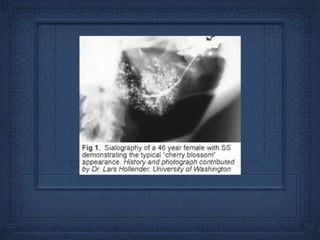
Parotid sialography
Unstimulated whole sialometry- < 1.5 ml in 15 min
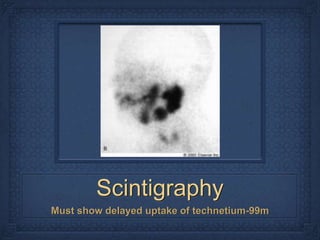
Scintigraphy
Must show delayed uptake of technetium-99m
Criteria for Sjögren’s
syndrome

 •6. Laboratory Abnormality (one must be
 present)
 •Anti-SS-A(Ro) or Anti SS-B(La)(more specific)
 •ANA
 •IgM rheumatoid factor
Laboratory
SS patients of both primary and secondary Sjögren’s
syndrome have marked hypergammaglobulinemia
(IgG>IgA>IgM), elevated total protein and sedimentation
rate, persistent rheumatoid factors, and a decreased WBC
count.
SS-A/Ro and SS-B/La (anti-RNA antibodies). Antibodies
occur in approximately 60% of patients with Sjögren's
syndrome and are associated with early disease onset, longer
disease duration, parotid gland enlargement, a higher
frequency of extra-glandular manifestations, and more intense
lymphocytic infiltration
These test are nonspecific, also seen in many autoimmune
inflammatory conditions.
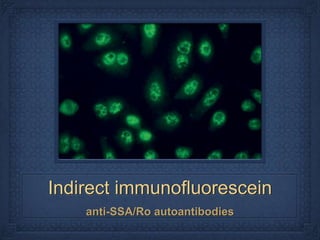
Indirect immunofluorescein
    anti-SSA/Ro autoantibodies
Criteria for Sjögren’s
syndrome
 Primary SS is defined
 as the presence of 4
 of the 6 diagnostic
 criteria present.
 Secondary SS is
 defined as presence of
 connective tissue
 disease with a positive
 category 1 or 2 and a
 positive result in 2 of
 the remaining 4
 criteria
Exclusion criteria
Past head and neck
radiation treatment
Hep C infection
AIDS
Pre-existing lymphoma
or sarcoidosis
Graft vs host disease
Anticholinergic drugs
Prognosis and
         Therapies
As with all autoimmune disease, there is no
cure, and so therapy is aimed at symptomatic
relief.

Sjögren’s syndrome is indolent in its course, but
one must be aware of the risk of lymphomas in
this patient population.
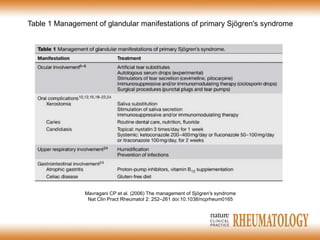
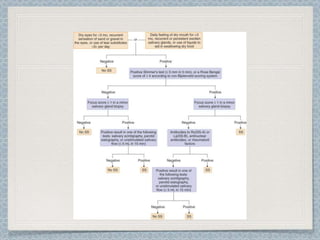
Table 1 Management of glandular manifestations of primary Sjögren's syndrome


                Mavragani CP et al. (2006) The management of Sjögren's syndrome
                 Nat Clin Pract Rheumatol 2: 252–261 doi:10.1038/ncprheum0165
Medications
Oral anti-muscarinic therapy proven useful for
xerostomia.

Pilocarpine-first muscarinic receptor antagonist
approved by FDA for use in Sjögren syndrome.
Dose 5mg qid.

Evoxac is next generation muscarinic receptor
with greater affinity, but less cardiac side effects
of anti-muscarinic therapy.
Medications

Extra-glandular disease such as muscular
pains, renal and pulmonary disease may benefit
from use of immune modulator such as systemic
steroids and anti-malarials.

However, these therapies have not been proven
to provide help with sicca symptoms.
Conclusion
Sjögren’s syndrome has early ENT
manifestations-that include dry mouth and
parotid enlargement.

Otolaryngologist, as part of a multidisciplinary
team, may prevent prolong delays in the disease
by having a high degree of suspicion.

Otolaryngologist play key role in diagnostic
evaluation, biopsy and treatment.
Sorry for the dry
lecture, but this is Sjögren’s
         syndrome.

        Questions?
References
Rehman, Habab-ur Sjögren’s syndrome Yonsei medical journal vol. 44, No. 6, pp 947-954, 2003

Fox PC. Autoimmune diseases and Sjogren’s syndrome: an autoimmune exocrinopathy. Ann N Y Acad Sci
2007;1098:15–21

Mavragani CP, Moutsopoulos NM, Moutsopoulos HM. The management of Sjögren's syndrome. Nat Clin
Pract Rheumatol. May 2006;2(5):252-61

Manoussakis MN, Moutsopoulos HM. Sjögren's syndrome. Otolaryngol Clin North Am 1999;32:843-60

Gutta R. McLain L. McGuff SH. Sjögren syndrome: a review for the maxillofacial surgeon. Oral Maxillofac
Surg Clin North Am. 2008 Nov;20(4):567-75

Clinical Manifestations and Early Diagnosis of Sjögren Syndrome Stuart S. Kassan and Haralampos M.
Moutsopoulos Arch Intern Med. 2004;164(12):1275-1284

Sjögren's disease. Elizabeth J Mahoney, Jeffrey H Spiegel Otolaryngol Clin North Am
Aug 2003 (Vol. 36, Issue 4, Pages 733-45)

Mavragani CP, Moutsopoulos HM
Conventional Therapy of Sjogren's Syndrome. [Journal Article]
Clin Rev Allergy Immunol 2007 Jun; 32(3):284-91

Fox RI. Sjögren's syndrome. Lancet. Jul 23-29 2005;366(9482):321-31

Srinivasan S, Slomovic AR Sjogren’s disease Compr Ophthalmol Update. 2007 Jul-Aug;8(4):205-12

S. sjogrens

  • 1.
  • 2.
    Outline History and Definition Incidenceand Etiology Clinical findings Diagnosis and Pathology Prognosis and Treatment
  • 3.
    History Mikulicz - firstdescription of Sjögren’s syndrome Mikulicz’s syndrome-1892 described parotid and lacrimal gland enlargement associated with a small round cell infiltrate . However, the term Mikulicz's syndrome could encompass so many different entities including tuberculosis, other infections, sarcoidosis, and lymphoma. Therefore not given credit for discovery. The term is still occasionally used to describe the histological appearance of focal lymphocytic infiltrates on salivary gland biopsies.
  • 4.
    History Henrick Sjögren 1899-1987Sweden 1930-As ophthalmology resident discover women with rheumatism and corneal abrasions who could not produce tears when crying and could not dissolve a lump of sugar in their mouths. 1933-Published his thesis paper on Keratoconjuctivitis Sicca, describing 15 women with lacrimal gland dysfunction leading to ulcerative lesions of the eyes. Was not well received, did not acquire Docenti (Academic PhD). 1951-Sjögren published a series of papers describing 80 patients with the syndrome, in which the majority had arthritis. Sjögren’s syndrome was then recognized in literature.
  • 5.
    Definition Sjögren’s (show-grin) syndrome- a syndrome describing xerophthalmia (dry eyes) and xerostomia (dry mouth)- (Sicca complex)-due to immune-mediated destruction of exocrine glands, predominately of lacrimal and salivary.
  • 6.
    Definition Primary Sjögren’s syndrome- characterized by Sicca complex and extra-glandular symptoms without any additional connective tissue disorder. Secondary Sjögren’s syndrome occurs in association with another autoimmune disorder such as SLE, RA, or scleroderma
  • 7.
    Incidence As many as1-2 million people in the US are affected, Prevalence of 1-3% of the population It is in the top three of rheumatic diseases behind systemic lupus erythematosis and rheumatoid arthritis Approximately 30% of RA pt have SS.
  • 8.
    Primary Sjögren’s Syndrome hasa ratio 9:1 of women to men Age range from 40- 60, with mean of 52.7 years. However, case reports have been seen in children.
  • 9.
    Etiology Pathogenesis of Sjögren’ssyndrome is believed to be multifactorial. Known to be autoimmune, but studies suggest that the disease process has genetic, environmental and neuroendocrine components
  • 10.
    Etiology There is agenetic predominance of HLA-DR genotype in SS patients. HLA-DR is a major histocompatibility complex, MHC class II cell surface receptor. It is found on antigen presenting cells. These genotypes may also produce dysfunctional glands that secrete abnormal amounts of immune- stimulatory chemokines. This is not seen in patients without Sjögren’s disease.
  • 11.
    Etiology Autoimmunity involved inSjögren’s disease is still poorly understood. It is believed that genetically defective glandular tissue combined with immunologic, environmental or neuroendocrine factors leads to loss of self antigen awareness. Environmental factors may have link to viruses (Epstein–Barr virus, hepatitis C virus, human T-cell leukemia virus-1) After the initial trigger, this glandular tissue autoimmune complex then becomes infiltrated with lymphocytes, predominately CD4 T cell (attracted by MHC class II) A cascade of events then occur with the CD4 T cell release of cytokine IL- 1, TNF, and interferon-gamma, which have destructive effects on the tissue and interfere with acetylcholine release, causing dysfunctional glands.
  • 13.
    Clinical Manifestations Glandular Sinus/nasal Ocular Hepatobiliary and gastrointestinal Oral Genitourinary Otological Musculoskeletal Laryngeal Vascular Thyroid Neurologic Pulmonary Hematologic/lymphatic
  • 14.
    Glandular manifestations Decreased lacrimal flow Corneal and conjunctiva epithelia damage Leads to dry eyes, foreign body sensation, irritation, photosensitivity, thick secretions at inner canthus, and visual impairment.
  • 15.
  • 16.
    Glandular manifestations Involvement of unilateral or bilateral major and minor salivary glands Decreased salivary secretions-loss of lubrication, buffering and antimicrobial capacities of saliva. Most common complication is increase in dental caries, especial root and incisor caries. Frequent fungal infections Tongue fissures Persistent salivary enlargement.
  • 17.
    Tooth decay dueto xerostomia
  • 18.
  • 19.
    Parotid Enlargement occurs in 1/3 of SS patients
  • 20.
    Clinical Manifestations SS patientstypically demonstrate mild to moderate sensorineural hearing loss in high frequencies. An association with anti-cardiolipin antibodies has been demonstrated, but no cochlear or vestibular pathology has been found. May be caused by immune complexes in the stria vascularis of the basal turn of the cochlea.
  • 21.
    Clinical Manifestations Granulomatous andnon-granulomatous laryngeal nodes have been described. Bamboo nodes - whitish or yellowish transverse submucosal lesions localized to middle third of vocal fold. However, hoarseness is rare first symptom
  • 22.
  • 23.
    Clinical Manifestations thyroid abnormalitiessuch as Hashimotos’s thyroiditis are associated with SS Antibodies to thyroglobulin can be found in up to 1/2 of SS patients 10-15% of Primary SS are clinically hypothyroid Therefore, all patients with SS should undergo routine evaluation of thyroid function
  • 24.
    Clinical Manifestations Epistaxis andnasal crusting are common findings in SS, with 50% having nasal mucosa hypertrophy and up to 13% have septal perforations Xerotrachea (dry cough) and dyspnea are common pulmonary symptoms. Esophageal spasm and dysmotility are also seen, but may be secondary to absence of saliva Atrophic gastritis, celiac disease
  • 25.
    Clinical Manifestations Lymphoma isa serious complication of SS, occurring late in the disease. Risk of lymphoma is 44 times greater than the general population. Lymphomas are classified as marginal-zone B- cell lymphomas, caused by chronic stimulation of auto-reactive B cells.
  • 26.
    Diffuse large B-celllymphoma in a 30 year-old woman with Sjögren’s syndrome.
  • 28.
    Clinical Manifestations 20-30% ofpatients have vasculitis, which includes palpable purpura, petechiae, or subcutaneous nodules Renal involvement in 10% of patients-interstitial nephritis. Renal tubular acidosis also seen which is secondary to hyper-gammaglobulinemia Myalgias, arthralgias, fatigue, and malaise
  • 29.
    A) Palpable purpurain the lower extremities. B) Multiple necrotic cutaneous ulcers of the lower extremities in a patient with primary Sjögren's syndrome C) Annular urticarial lesions of the trunk
  • 30.
    Criteria for Sjögren’ssyndrome 2002 US and European diagnosis criteria differed so much that there were ten times as many diagnosis in Europe than in US. Caused problems with clinical trials and publication reports 2002 American-European Consensus Group developed criteria for Sjögren syndrome.
  • 31.
    Criteria for Sjögren’ssyndrome 2002 Ocular symptoms Oral symptoms Objective evidence of dry eyes Objective evidence of salivary-gland involvement Laboratory abnormality
  • 32.
    Criteria for Sjögren’s syndrome 1.Ocular Symptoms (at least one must be present) Persistent dry eyes every day for more than 3 months Recurrent sensation of sand or gravel in eyes Use of tear substitute more than three time a day 2. Oral symptoms (at least one present) Feeling of dry mouth every day for 3 months Recurrent swollen salivary glands as an adult Need to drink liquids to aid in swallowing of dry foods.
  • 33.
  • 34.
    Criteria for Sjögren’s syndrome 3.Objective evidence of dry eyes (one must be present) Schirmer Test Rose-Bengal 4. Lacrimal-gland biopsy Focal lymphocytic sialoadenitis in minor salivary glands- containing more than 50 lymphocytes per 4 mm of glandular tissue.
  • 35.
    Schirmer’s test This testconsists of placing a small strip of filter paper inside the lower eyelid (conjunctiva sac). The eyes are closed for 5 minutes. The paper is then removed and the amount of moisture is measured. <5 mm in 5 minutes is positive for SS
  • 36.
    Rose Bengal dye RoseBengal (4,5,6,7-tetrachloro-2',4',5',7'-tetraiodofluorescein) is a stain. Its sodium salt is commonly used in eye drops to stain damaged conjunctiva and corneal cells and thereby identify damage to the eye.
  • 37.
    Labial gland biopsy Agold standard of diagnosis
  • 38.
  • 39.
    Lymphocytic and plasmacells infiltrate Two excretory ducts and 3 mucous salivary gland acini are seen
  • 40.
    Criteria for Sjögren’s syndrome 5.Objective evidence of salivary gland involvement(one must be present) Salivary-gland scintigraphy Parotid sialography Unstimulated whole sialometry- < 1.5 ml in 15 min
  • 41.
    Scintigraphy Must show delayeduptake of technetium-99m
  • 43.
    Criteria for Sjögren’s syndrome •6. Laboratory Abnormality (one must be present) •Anti-SS-A(Ro) or Anti SS-B(La)(more specific) •ANA •IgM rheumatoid factor
  • 44.
    Laboratory SS patients ofboth primary and secondary Sjögren’s syndrome have marked hypergammaglobulinemia (IgG>IgA>IgM), elevated total protein and sedimentation rate, persistent rheumatoid factors, and a decreased WBC count. SS-A/Ro and SS-B/La (anti-RNA antibodies). Antibodies occur in approximately 60% of patients with Sjögren's syndrome and are associated with early disease onset, longer disease duration, parotid gland enlargement, a higher frequency of extra-glandular manifestations, and more intense lymphocytic infiltration These test are nonspecific, also seen in many autoimmune inflammatory conditions.
  • 45.
    Indirect immunofluorescein anti-SSA/Ro autoantibodies
  • 46.
    Criteria for Sjögren’s syndrome Primary SS is defined as the presence of 4 of the 6 diagnostic criteria present. Secondary SS is defined as presence of connective tissue disease with a positive category 1 or 2 and a positive result in 2 of the remaining 4 criteria
  • 47.
    Exclusion criteria Past headand neck radiation treatment Hep C infection AIDS Pre-existing lymphoma or sarcoidosis Graft vs host disease Anticholinergic drugs
  • 48.
    Prognosis and Therapies As with all autoimmune disease, there is no cure, and so therapy is aimed at symptomatic relief. Sjögren’s syndrome is indolent in its course, but one must be aware of the risk of lymphomas in this patient population.
  • 49.
    Table 1 Managementof glandular manifestations of primary Sjögren's syndrome Mavragani CP et al. (2006) The management of Sjögren's syndrome Nat Clin Pract Rheumatol 2: 252–261 doi:10.1038/ncprheum0165
  • 50.
    Medications Oral anti-muscarinic therapyproven useful for xerostomia. Pilocarpine-first muscarinic receptor antagonist approved by FDA for use in Sjögren syndrome. Dose 5mg qid. Evoxac is next generation muscarinic receptor with greater affinity, but less cardiac side effects of anti-muscarinic therapy.
  • 51.
    Medications Extra-glandular disease suchas muscular pains, renal and pulmonary disease may benefit from use of immune modulator such as systemic steroids and anti-malarials. However, these therapies have not been proven to provide help with sicca symptoms.
  • 52.
    Conclusion Sjögren’s syndrome hasearly ENT manifestations-that include dry mouth and parotid enlargement. Otolaryngologist, as part of a multidisciplinary team, may prevent prolong delays in the disease by having a high degree of suspicion. Otolaryngologist play key role in diagnostic evaluation, biopsy and treatment.
  • 54.
    Sorry for thedry lecture, but this is Sjögren’s syndrome. Questions?
  • 55.
    References Rehman, Habab-ur Sjögren’ssyndrome Yonsei medical journal vol. 44, No. 6, pp 947-954, 2003 Fox PC. Autoimmune diseases and Sjogren’s syndrome: an autoimmune exocrinopathy. Ann N Y Acad Sci 2007;1098:15–21 Mavragani CP, Moutsopoulos NM, Moutsopoulos HM. The management of Sjögren's syndrome. Nat Clin Pract Rheumatol. May 2006;2(5):252-61 Manoussakis MN, Moutsopoulos HM. Sjögren's syndrome. Otolaryngol Clin North Am 1999;32:843-60 Gutta R. McLain L. McGuff SH. Sjögren syndrome: a review for the maxillofacial surgeon. Oral Maxillofac Surg Clin North Am. 2008 Nov;20(4):567-75 Clinical Manifestations and Early Diagnosis of Sjögren Syndrome Stuart S. Kassan and Haralampos M. Moutsopoulos Arch Intern Med. 2004;164(12):1275-1284 Sjögren's disease. Elizabeth J Mahoney, Jeffrey H Spiegel Otolaryngol Clin North Am Aug 2003 (Vol. 36, Issue 4, Pages 733-45) Mavragani CP, Moutsopoulos HM Conventional Therapy of Sjogren's Syndrome. [Journal Article] Clin Rev Allergy Immunol 2007 Jun; 32(3):284-91 Fox RI. Sjögren's syndrome. Lancet. Jul 23-29 2005;366(9482):321-31 Srinivasan S, Slomovic AR Sjogren’s disease Compr Ophthalmol Update. 2007 Jul-Aug;8(4):205-12