Sjögren's Syndrome
Clinical, Pathogenetic & Aspects
Athanasios G. Tzioufas, MD
Dept. of
Pathophysiology
Medical School
National University
of Athens
Greece
Alexandria, 1st
ELAR, April 2013
Sjögren's Syndrome - Autoimmune Epithelitis
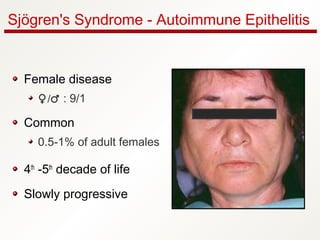
Female disease
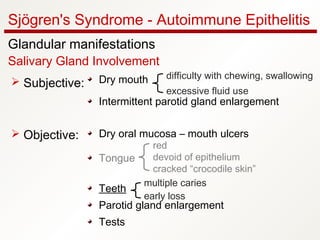
♀/♂ : 9/1
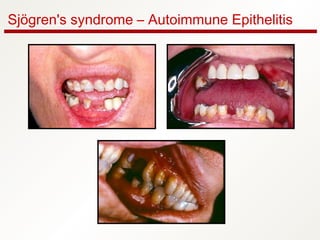
Common
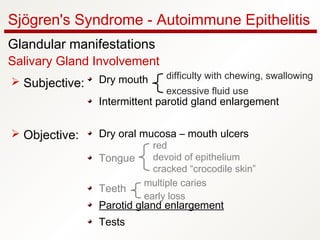
0.5-1% of adult females
4th
-5th
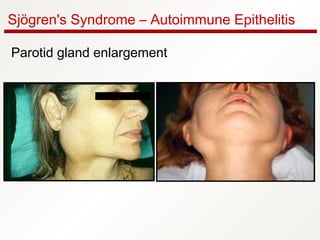
decade of life
Slowly progressive
Sjögren's Syndrome - Autoimmune Epithelitis
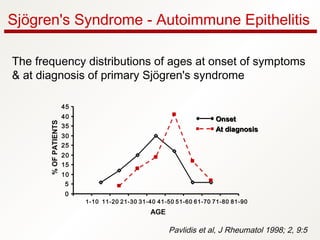
The frequency distributions of ages at onset of symptoms
& at diagnosis of primary Sjögren's syndrome
0
5
10
15
20
25
30
35
40
45
1-10 11-20 21-30 31-40 41-50 51-60 61-70 71-80 81-90
AGE
%OFPATIENTS
At diagnosisAt diagnosis
OnsetOnset
Pavlidis et al, J Rheumatol 1998; 2, 9:5
Sjögren's Syndrome - Autoimmune Epithelitis
Center of autoimmune disorders
alone (primary)
with other (secondary)
Wide clinical spectrum
organ-specific
systemic
neoplasia
Prototype autoimmune disease
humoral
cellular
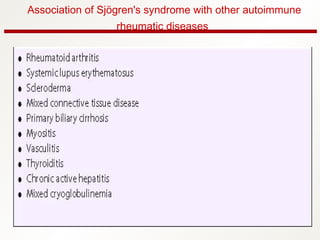
Association of Sjögren's syndrome with other autoimmune
rheumatic diseases
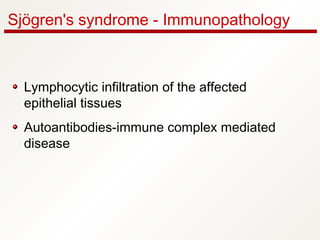
Sjögren's syndrome - Immunopathology
Lymphocytic infiltration of the affected
epithelial tissues
Autoantibodies-immune complex mediated
disease
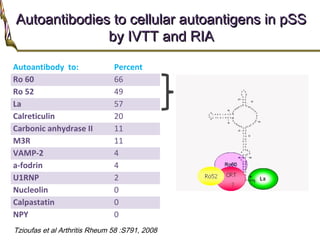
Autoantibodies to cellular autoantigens in pSSAutoantibodies to cellular autoantigens in pSS
by IVTT and RIAby IVTT and RIA
Autoantibody to: Percent
Ro 60 66
Ro 52 49
La 57
Calreticulin 20
Carbonic anhydrase II 11
M3R 11
VAMP-2 4
a-fodrin 4
U1RNP 2
Nucleolin 0
Calpastatin 0
NPY 0
Tzioufas et al Arthritis Rheum 58 :S791, 2008
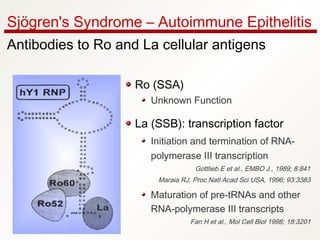
Ro (SSA)
Unknown Function
La (SSB): transcription factor
Initiation and termination of RNA-
polymerase III transcription
Gottlieb E et al., EMBO J., 1989; 8:841
Maraia RJ, Proc Natl Acad Sci USA, 1996; 93:3383
Maturation of pre-tRNAs and other
RNA-polymerase III transcripts
Fan H et al., Mol Cell Biol 1998; 18:3201
Sjögren's Syndrome – Autoimmune Epithelitis
Antibodies to Ro and La cellular antigens
Sjögren's Syndrome – Autoimmune Epithelitis
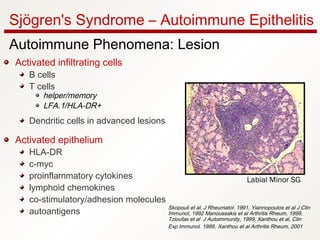
Autoimmune Phenomena: Lesion
Activated infiltrating cells
B cells
T cells
helper/memory
LFA.1/HLA-DR+
Dendritic cells in advanced lesions
Activated epithelium
HLA-DR
c-myc
proinflammatory cytokines
lymphoid chemokines
co-stimulatory/adhesion molecules
autoantigens
Skopouli et al, J Rheumatol. 1991, Yiannopoulos et al J Clin
Immunol, 1992 Manoussakis et al Arthritis Rheum, 1999,
Tzioufas et al J Autoimmunity, 1999, Xanthou et al, Clin
Exp Immunol. 1999, Xanthou et al Arthritis Rheum, 2001
Labial Minor SG
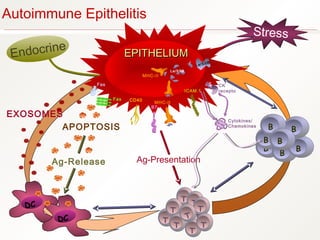
EPITHELIUMEPITHELIUM
Endocrine
StressStress
Autoimmune Epithelitis
EXOSOMES
DC
DC
Ag-Release
T
T
T
T
T
T
T
T
T
Ag-Presentation
B
B
B
B
BB
EPITHELIUMEPITHELIUM
Persistent Virus
Genetic Make-up
CD40
APOPTOSIS
Fas
Fas
L
B7
T
B
Cytokines/
Chemokines
ICAM.1
CK
recepto
r
EPITHELIUMEPITHELIUM
La/SSB
La/SSB
MHC-II
MHC-II
Sjögren's Syndrome - Autoimmune Epithelitis
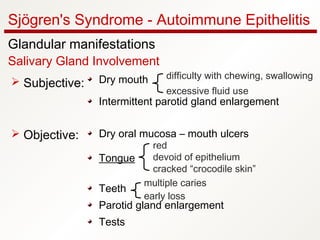
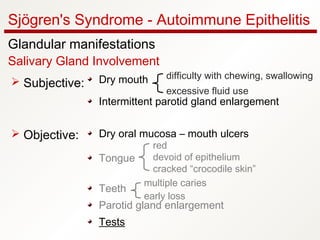
Glandular manifestations
Salivary Gland Involvement
Dry mouth
Intermittent parotid gland enlargement
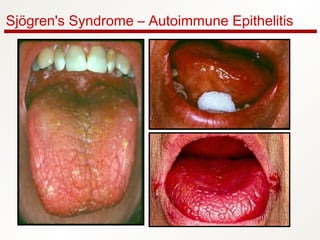
Dry oral mucosa – mouth ulcers
Tongue
Teeth
Parotid gland enlargement
Tests
 Subjective:
 Objective:
difficulty with chewing, swallowing
excessive fluid use
red
devoid of epithelium
cracked “crocodile skin”
multiple caries
early loss
Sjögren's Syndrome – Autoimmune Epithelitis
Sjögren's Syndrome - Autoimmune Epithelitis
Glandular manifestations
Salivary Gland Involvement
Dry mouth
Intermittent parotid gland enlargement
Dry oral mucosa – mouth ulcers
Tongue
Teeth
Parotid gland enlargement
Tests
 Subjective:
 Objective:
difficulty with chewing, swallowing
excessive fluid use
red
devoid of epithelium
cracked “crocodile skin”
multiple caries
early loss
Sjögren's syndrome – Autoimmune Epithelitis
Sjögren's Syndrome - Autoimmune Epithelitis
Glandular manifestations
Salivary Gland Involvement
Dry mouth
Intermittent parotid gland enlargement
Dry oral mucosa – mouth ulcers
Tongue
Teeth
Parotid gland enlargement
Tests
 Subjective:
 Objective:
difficulty with chewing, swallowing
excessive fluid use
red
devoid of epithelium
cracked “crocodile skin”
multiple caries
early loss
Sjögren's Syndrome – Autoimmune Epithelitis
Parotid gland enlargement
Sjögren's Syndrome - Autoimmune Epithelitis
Glandular manifestations
Salivary Gland Involvement
Dry mouth
Intermittent parotid gland enlargement
Dry oral mucosa – mouth ulcers
Tongue
Teeth
Parotid gland enlargement
Tests
 Subjective:
 Objective:
difficulty with chewing, swallowing
excessive fluid use
red
devoid of epithelium
cracked “crocodile skin”
multiple caries
early loss
Sjögren's Syndrome – Autoimmune Epithelitis
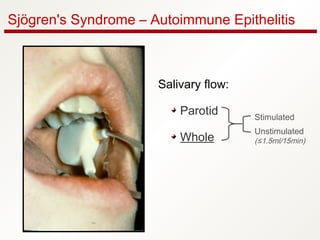
Salivary flow:
Parotid
Whole
Stimulated
Unstimulated
(≤1.5ml/15min)
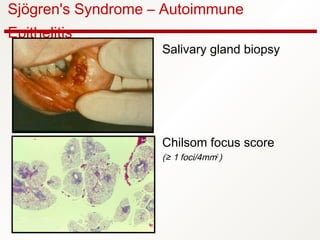
Sjögren's Syndrome – Autoimmune
Epithelitis
Salivary gland biopsy
Chilsom focus score
(≥ 1 foci/4mm2
)
Sjögren's Syndrome - Autoimmune Epithelitis
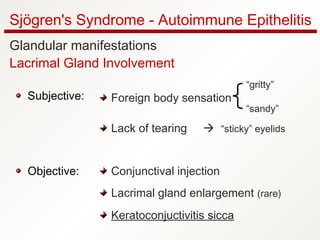
Glandular manifestations
Lacrimal Gland Involvement
Subjective:
Objective:
Foreign body sensation
Lack of tearing  “sticky” eyelids
Conjunctival injection
Lacrimal gland enlargement (rare)
Keratoconjuctivitis sicca
“gritty”
“sandy”
Sjögren's Syndrome -
Autoimmune Epithelitis
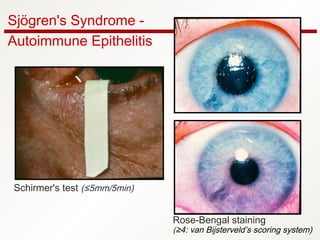
Schirmer's test (≤5mm/5min)
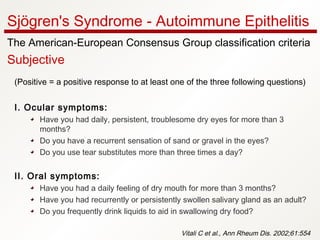
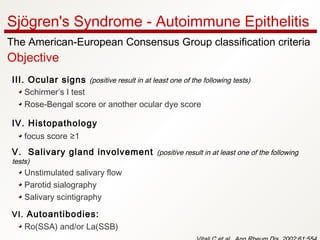
Rose-Bengal staining
(≥4: van Bijsterveld’s scoring system)
(Positive = a positive response to at least one of the three following questions)
I. Ocular symptoms:
Have you had daily, persistent, troublesome dry eyes for more than 3
months?
Do you have a recurrent sensation of sand or gravel in the eyes?
Do you use tear substitutes more than three times a day?
II. Oral symptoms:
Have you had a daily feeling of dry mouth for more than 3 months?
Have you had recurrently or persistently swollen salivary gland as an adult?
Do you frequently drink liquids to aid in swallowing dry food?
Vitali C et al., Ann Rheum Dis. 2002;61:554
Sjögren's Syndrome - Autoimmune Epithelitis
The American-European Consensus Group classification criteria
Subjective
III. Ocular signs (positive result in at least one of the following tests)
Schirmer’s I test
Rose-Bengal score or another ocular dye score
IV. Histopathology 
focus score ≥1
V.  Salivary gland involvement (positive result in at least one of the following
tests)
Unstimulated salivary flow
Parotid sialography
Salivary scintigraphy
VI. Autoantibodies:
Ro(SSA) and/or La(SSB)
Sjögren's Syndrome - Autoimmune Epithelitis
The American-European Consensus Group classification criteria
Objective
Rules for classification:
Definitive primary SS
presence of any four of the six items
in patients without any potentially associated disease
Secondary SS
item‑1 or item‑2 plus any two from items 3, 4, 5
in patients with a potentially associated disease
(another connective tissue disease)
Vitali C et al., Ann Rheum Dis. 2002;61:554
Sjögren's Syndrome - Autoimmune Epithelitis
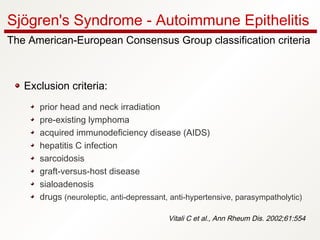
The American-European Consensus Group classification criteria
Exclusion criteria:
prior head and neck irradiation
pre-existing lymphoma
acquired immunodeficiency disease (AIDS)
hepatitis C infection
sarcoidosis
graft‑versus‑host disease
sialoadenosis
drugs (neuroleptic, anti‑depressant, anti‑hypertensive, parasympatholytic)
Vitali C et al., Ann Rheum Dis. 2002;61:554
Sjögren's Syndrome - Autoimmune Epithelitis
The American-European Consensus Group classification criteria
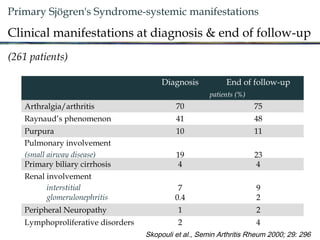
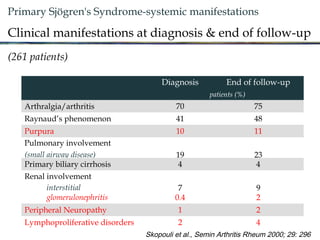
Primary Sjögren's Syndrome-systemic manifestations
Clinical manifestations at diagnosis & end of follow-up
(261 patients)
Skopouli et al., Semin Arthritis Rheum 2000; 29: 296
Diagnosis End of follow-up
patients (%)
Arthralgia/arthritis 70 75
Raynaud’s phenomenon 41 48
Purpura 10 11
Pulmonary involvement
(small airway disease) 19 23
Primary biliary cirrhosis 4 4
Renal involvement
interstitial 7 9
glomerulonephritis 0.4 2
Peripheral Neuropathy 1 2
Lymphoproliferative disorders 2 4
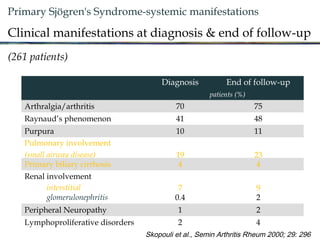
Primary Sjögren's Syndrome-systemic manifestations
Clinical manifestations at diagnosis & end of follow-up
(261 patients)
Skopouli et al., Semin Arthritis Rheum 2000; 29: 296
Diagnosis End of follow-up
patients (%)
Arthralgia/arthritis 70 75
Raynaud’s phenomenon 41 48
Purpura 10 11
Pulmonary involvement
(small airway disease) 19 23
Primary biliary cirrhosis 4 4
Renal involvement
interstitial 7 9
glomerulonephritis 0.4 2
Peripheral Neuropathy 1 2
Lymphoproliferative disorders 2 4
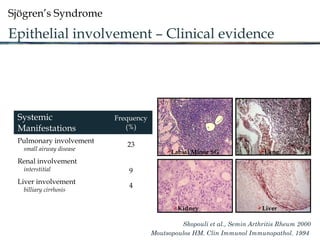
Sjögren’s Syndrome
Epithelial involvement – Clinical evidence
Systemic
Manifestations
Frequency
(%)
Pulmonary involvement
small airway disease
23
Renal involvement
interstitial 9
Liver involvement
billiary cirrhosis
4
Skopouli et al., Semin Arthritis Rheum 2000
Moutsopoulos HM. Clin Immunol Immunopathol. 1994
Labial Minor SG
Kidney Liver
Lung
Primary Sjögren's Syndrome-systemic manifestations
Clinical manifestations at diagnosis & end of follow-up
(261 patients)
Skopouli et al., Semin Arthritis Rheum 2000; 29: 296
Diagnosis End of follow-up
patients (%)
Arthralgia/arthritis 70 75
Raynaud’s phenomenon 41 48
Purpura 10 11
Pulmonary involvement
(small airway disease) 19 23
Primary biliary cirrhosis 4 4
Renal involvement
interstitial 7 9
glomerulonephritis 0.4 2
Peripheral Neuropathy 1 2
Lymphoproliferative disorders 2 4
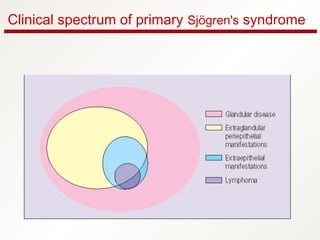
Clinical spectrum of primary Sjögren's syndrome
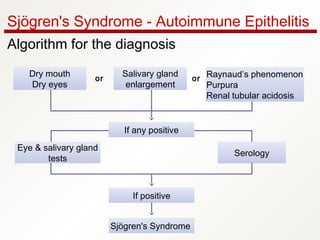
Sjögren's Syndrome - Autoimmune Epithelitis
Algorithm for the diagnosis
If positive
Sjögren's Syndrome
Dry mouth
Dry eyes
Salivary gland
enlargement
Raynaud’s phenomenon
Purpura
Renal tubular acidosis
or or
Eye & salivary gland
tests
Serology
If any positive
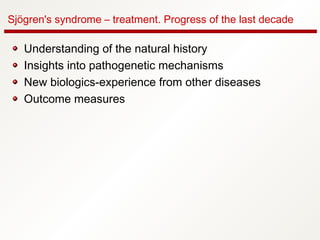
Sjögren's syndrome – treatment. Progress of the last decade
Understanding of the natural history
Insights into pathogenetic mechanisms
New biologics-experience from other diseases
Outcome measures
Sjögren’s Syndrome
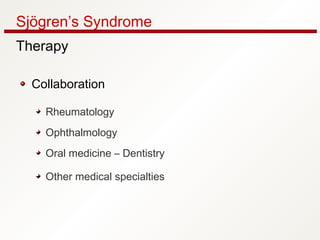
Therapy
Collaboration
Rheumatology
Ophthalmology
Oral medicine – Dentistry
Other medical specialties
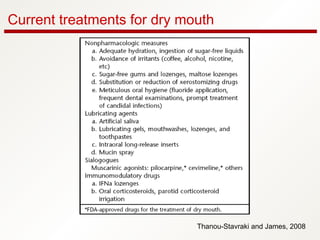
Current treatments for dry mouth
Thanou-Stavraki and James, 2008
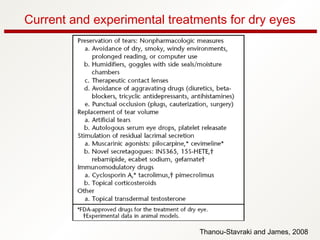
Current and experimental treatments for dry eyes
Thanou-Stavraki and James, 2008
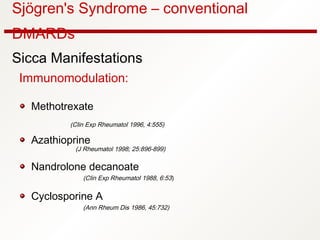
Sjögren's Syndrome – conventional
DMARDs
Sicca Manifestations
Immunomodulation:
Methotrexate
(Clin Exp Rheumatol 1996, 4:555)
Azathioprine
(J Rheumatol 1998; 25:896-899)
Nandrolone decanoate
(Clin Exp Rheumatol 1988, 6:53)
Cyclosporine A
(Ann Rheum Dis 1986, 45:732)
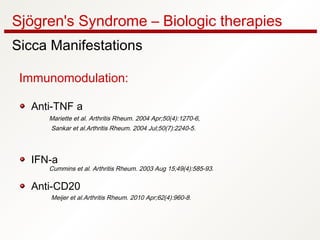
Sjögren's Syndrome – Biologic therapies
Sicca Manifestations
Immunomodulation:
Anti-TNF a
Mariette et al. Arthritis Rheum. 2004 Apr;50(4):1270-6,
Sankar et al.Arthritis Rheum. 2004 Jul;50(7):2240-5.
IFN-a
Cummins et al. Arthritis Rheum. 2003 Aug 15;49(4):585-93.
Anti-CD20
Meijer et al.Arthritis Rheum. 2010 Apr;62(4):960-8.
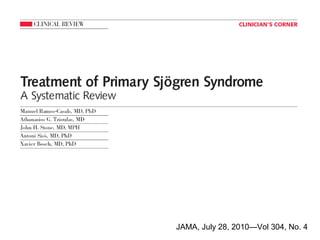
JAMA, July 28, 2010—Vol 304, No. 4
Treatment of Sjögren's syndrome
Empirical
Symptomatic
Therapeutic regimens used successfully in other systemic
diseases (particularly SLE and RA)
Lack of control trials
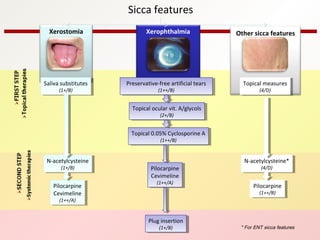
Sicca features
Xerostomia
Saliva substitutes
(1+/B)
Saliva substitutes
(1+/B)
N-acetylcysteine
(1+/B)
N-acetylcysteine
(1+/B)
Pilocarpine
Cevimeline
(1++/A)
Pilocarpine
Cevimeline
(1++/A)
Xerophthalmia
Preservative-free artificial tears
(1++/B)
Preservative-free artificial tears
(1++/B)
Topical ocular vit. A/glycols
(2+/B)
Topical ocular vit. A/glycols
(2+/B)
Topical 0.05% Cyclosporine A
(1++/B)
Topical 0.05% Cyclosporine A
(1++/B)
Pilocarpine
Cevimeline
(1++/A)
Pilocarpine
Cevimeline
(1++/A)
Other sicca features
Topical measures
(4/D)
Topical measures
(4/D)
N-acetylcysteine*
(4/D)
N-acetylcysteine*
(4/D)
Pilocarpine
(1++/B)
Pilocarpine
(1++/B)
Plug insertion
(1+/B)
Plug insertion
(1+/B) * For ENT sicca features
Sjögren's Syndrome -Therapy
Parenchymal organ involvement
Lungs, Kidneys, Liver
Slow process
Usually does not lead to organ failure
Skopouli et al., Semin Arthritis Rheum. 2000, 29:296
Lack of controlled therapeutic trials
Corticosteroids ineffective-dangerous?
Anecdotal reports with azathioprine, MMF, IVIG
Sjögren's Syndrome -Therapy
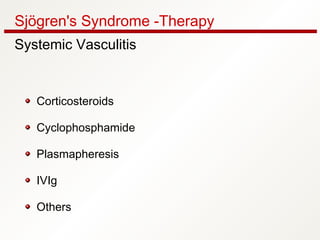
Systemic Vasculitis
Corticosteroids
Cyclophosphamide
Plasmapheresis
IVIg
Others
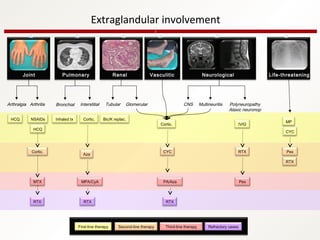
Joint Pulmonary Renal Vasculitic Neurological Life-threatening
Arthralgia Arthritis Bronchial Interstitial Tubular Glomerular CNS Multineuritis Polyneuropathy
Ataxic neuronop
HCQ NSAIDs
HCQ
Cortic.
MTX
RTX
Inhaled tx Cortic.
Aza
MPA/CyA
RTX
Bic/K replac.
Cortic.
CYC
PA/Aza
RTX
IVIG
RTX
MP
CYC
Pex
RTX
First-line therapy Second-line therapy Third-line therapy Refractory cases
Pex
Extraglandular involvement
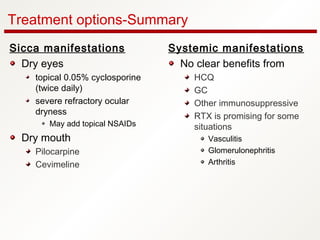
Treatment options-Summary
Systemic manifestations
No clear benefits from
HCQ
GC
Other immunosuppressive
RTX is promising for some
situations
Vasculitis
Glomerulonephritis
Arthritis
Sicca manifestations
Dry eyes
topical 0.05% cyclosporine
(twice daily)
severe refractory ocular
dryness
May add topical NSAIDs
Dry mouth
Pilocarpine
Cevimeline
Collaborators-Dept of Pathophysiology-UOA
E Kapsogeorgou
M Manoussakis
F Skopouli
M Voulgarelis
HM Moutsopoulos

Sjogren

  • 3.
    Sjögren's Syndrome Clinical, Pathogenetic& Aspects Athanasios G. Tzioufas, MD Dept. of Pathophysiology Medical School National University of Athens Greece Alexandria, 1st ELAR, April 2013
  • 4.
    Sjögren's Syndrome -Autoimmune Epithelitis Female disease ♀/♂ : 9/1 Common 0.5-1% of adult females 4th -5th decade of life Slowly progressive
  • 5.
    Sjögren's Syndrome -Autoimmune Epithelitis The frequency distributions of ages at onset of symptoms & at diagnosis of primary Sjögren's syndrome 0 5 10 15 20 25 30 35 40 45 1-10 11-20 21-30 31-40 41-50 51-60 61-70 71-80 81-90 AGE %OFPATIENTS At diagnosisAt diagnosis OnsetOnset Pavlidis et al, J Rheumatol 1998; 2, 9:5
  • 6.
    Sjögren's Syndrome -Autoimmune Epithelitis Center of autoimmune disorders alone (primary) with other (secondary) Wide clinical spectrum organ-specific systemic neoplasia Prototype autoimmune disease humoral cellular
  • 7.
    Association of Sjögren'ssyndrome with other autoimmune rheumatic diseases
  • 8.
    Sjögren's syndrome -Immunopathology Lymphocytic infiltration of the affected epithelial tissues Autoantibodies-immune complex mediated disease
  • 9.
    Autoantibodies to cellularautoantigens in pSSAutoantibodies to cellular autoantigens in pSS by IVTT and RIAby IVTT and RIA Autoantibody to: Percent Ro 60 66 Ro 52 49 La 57 Calreticulin 20 Carbonic anhydrase II 11 M3R 11 VAMP-2 4 a-fodrin 4 U1RNP 2 Nucleolin 0 Calpastatin 0 NPY 0 Tzioufas et al Arthritis Rheum 58 :S791, 2008
  • 10.
    Ro (SSA) Unknown Function La(SSB): transcription factor Initiation and termination of RNA- polymerase III transcription Gottlieb E et al., EMBO J., 1989; 8:841 Maraia RJ, Proc Natl Acad Sci USA, 1996; 93:3383 Maturation of pre-tRNAs and other RNA-polymerase III transcripts Fan H et al., Mol Cell Biol 1998; 18:3201 Sjögren's Syndrome – Autoimmune Epithelitis Antibodies to Ro and La cellular antigens
  • 11.
    Sjögren's Syndrome –Autoimmune Epithelitis Autoimmune Phenomena: Lesion Activated infiltrating cells B cells T cells helper/memory LFA.1/HLA-DR+ Dendritic cells in advanced lesions Activated epithelium HLA-DR c-myc proinflammatory cytokines lymphoid chemokines co-stimulatory/adhesion molecules autoantigens Skopouli et al, J Rheumatol. 1991, Yiannopoulos et al J Clin Immunol, 1992 Manoussakis et al Arthritis Rheum, 1999, Tzioufas et al J Autoimmunity, 1999, Xanthou et al, Clin Exp Immunol. 1999, Xanthou et al Arthritis Rheum, 2001 Labial Minor SG
  • 12.
    EPITHELIUMEPITHELIUM Endocrine StressStress Autoimmune Epithelitis EXOSOMES DC DC Ag-Release T T T T T T T T T Ag-Presentation B B B B BB EPITHELIUMEPITHELIUM Persistent Virus GeneticMake-up CD40 APOPTOSIS Fas Fas L B7 T B Cytokines/ Chemokines ICAM.1 CK recepto r EPITHELIUMEPITHELIUM La/SSB La/SSB MHC-II MHC-II
  • 13.
    Sjögren's Syndrome -Autoimmune Epithelitis Glandular manifestations Salivary Gland Involvement Dry mouth Intermittent parotid gland enlargement Dry oral mucosa – mouth ulcers Tongue Teeth Parotid gland enlargement Tests  Subjective:  Objective: difficulty with chewing, swallowing excessive fluid use red devoid of epithelium cracked “crocodile skin” multiple caries early loss
  • 14.
    Sjögren's Syndrome –Autoimmune Epithelitis
  • 15.
    Sjögren's Syndrome -Autoimmune Epithelitis Glandular manifestations Salivary Gland Involvement Dry mouth Intermittent parotid gland enlargement Dry oral mucosa – mouth ulcers Tongue Teeth Parotid gland enlargement Tests  Subjective:  Objective: difficulty with chewing, swallowing excessive fluid use red devoid of epithelium cracked “crocodile skin” multiple caries early loss
  • 16.
    Sjögren's syndrome –Autoimmune Epithelitis
  • 17.
    Sjögren's Syndrome -Autoimmune Epithelitis Glandular manifestations Salivary Gland Involvement Dry mouth Intermittent parotid gland enlargement Dry oral mucosa – mouth ulcers Tongue Teeth Parotid gland enlargement Tests  Subjective:  Objective: difficulty with chewing, swallowing excessive fluid use red devoid of epithelium cracked “crocodile skin” multiple caries early loss
  • 18.
    Sjögren's Syndrome –Autoimmune Epithelitis Parotid gland enlargement
  • 19.
    Sjögren's Syndrome -Autoimmune Epithelitis Glandular manifestations Salivary Gland Involvement Dry mouth Intermittent parotid gland enlargement Dry oral mucosa – mouth ulcers Tongue Teeth Parotid gland enlargement Tests  Subjective:  Objective: difficulty with chewing, swallowing excessive fluid use red devoid of epithelium cracked “crocodile skin” multiple caries early loss
  • 20.
    Sjögren's Syndrome –Autoimmune Epithelitis Salivary flow: Parotid Whole Stimulated Unstimulated (≤1.5ml/15min)
  • 21.
    Sjögren's Syndrome –Autoimmune Epithelitis Salivary gland biopsy Chilsom focus score (≥ 1 foci/4mm2 )
  • 22.
    Sjögren's Syndrome -Autoimmune Epithelitis Glandular manifestations Lacrimal Gland Involvement Subjective: Objective: Foreign body sensation Lack of tearing  “sticky” eyelids Conjunctival injection Lacrimal gland enlargement (rare) Keratoconjuctivitis sicca “gritty” “sandy”
  • 23.
    Sjögren's Syndrome - AutoimmuneEpithelitis Schirmer's test (≤5mm/5min) Rose-Bengal staining (≥4: van Bijsterveld’s scoring system)
  • 24.
    (Positive = apositive response to at least one of the three following questions) I. Ocular symptoms: Have you had daily, persistent, troublesome dry eyes for more than 3 months? Do you have a recurrent sensation of sand or gravel in the eyes? Do you use tear substitutes more than three times a day? II. Oral symptoms: Have you had a daily feeling of dry mouth for more than 3 months? Have you had recurrently or persistently swollen salivary gland as an adult? Do you frequently drink liquids to aid in swallowing dry food? Vitali C et al., Ann Rheum Dis. 2002;61:554 Sjögren's Syndrome - Autoimmune Epithelitis The American-European Consensus Group classification criteria Subjective
  • 25.
    III. Ocular signs(positive result in at least one of the following tests) Schirmer’s I test Rose-Bengal score or another ocular dye score IV. Histopathology  focus score ≥1 V.  Salivary gland involvement (positive result in at least one of the following tests) Unstimulated salivary flow Parotid sialography Salivary scintigraphy VI. Autoantibodies: Ro(SSA) and/or La(SSB) Sjögren's Syndrome - Autoimmune Epithelitis The American-European Consensus Group classification criteria Objective
  • 26.
    Rules for classification: Definitiveprimary SS presence of any four of the six items in patients without any potentially associated disease Secondary SS item‑1 or item‑2 plus any two from items 3, 4, 5 in patients with a potentially associated disease (another connective tissue disease) Vitali C et al., Ann Rheum Dis. 2002;61:554 Sjögren's Syndrome - Autoimmune Epithelitis The American-European Consensus Group classification criteria
  • 27.
    Exclusion criteria: prior headand neck irradiation pre-existing lymphoma acquired immunodeficiency disease (AIDS) hepatitis C infection sarcoidosis graft‑versus‑host disease sialoadenosis drugs (neuroleptic, anti‑depressant, anti‑hypertensive, parasympatholytic) Vitali C et al., Ann Rheum Dis. 2002;61:554 Sjögren's Syndrome - Autoimmune Epithelitis The American-European Consensus Group classification criteria
  • 28.
    Primary Sjögren's Syndrome-systemicmanifestations Clinical manifestations at diagnosis & end of follow-up (261 patients) Skopouli et al., Semin Arthritis Rheum 2000; 29: 296 Diagnosis End of follow-up patients (%) Arthralgia/arthritis 70 75 Raynaud’s phenomenon 41 48 Purpura 10 11 Pulmonary involvement (small airway disease) 19 23 Primary biliary cirrhosis 4 4 Renal involvement interstitial 7 9 glomerulonephritis 0.4 2 Peripheral Neuropathy 1 2 Lymphoproliferative disorders 2 4
  • 29.
    Primary Sjögren's Syndrome-systemicmanifestations Clinical manifestations at diagnosis & end of follow-up (261 patients) Skopouli et al., Semin Arthritis Rheum 2000; 29: 296 Diagnosis End of follow-up patients (%) Arthralgia/arthritis 70 75 Raynaud’s phenomenon 41 48 Purpura 10 11 Pulmonary involvement (small airway disease) 19 23 Primary biliary cirrhosis 4 4 Renal involvement interstitial 7 9 glomerulonephritis 0.4 2 Peripheral Neuropathy 1 2 Lymphoproliferative disorders 2 4
  • 30.
    Sjögren’s Syndrome Epithelial involvement– Clinical evidence Systemic Manifestations Frequency (%) Pulmonary involvement small airway disease 23 Renal involvement interstitial 9 Liver involvement billiary cirrhosis 4 Skopouli et al., Semin Arthritis Rheum 2000 Moutsopoulos HM. Clin Immunol Immunopathol. 1994 Labial Minor SG Kidney Liver Lung
  • 31.
    Primary Sjögren's Syndrome-systemicmanifestations Clinical manifestations at diagnosis & end of follow-up (261 patients) Skopouli et al., Semin Arthritis Rheum 2000; 29: 296 Diagnosis End of follow-up patients (%) Arthralgia/arthritis 70 75 Raynaud’s phenomenon 41 48 Purpura 10 11 Pulmonary involvement (small airway disease) 19 23 Primary biliary cirrhosis 4 4 Renal involvement interstitial 7 9 glomerulonephritis 0.4 2 Peripheral Neuropathy 1 2 Lymphoproliferative disorders 2 4
  • 32.
    Clinical spectrum ofprimary Sjögren's syndrome
  • 33.
    Sjögren's Syndrome -Autoimmune Epithelitis Algorithm for the diagnosis If positive Sjögren's Syndrome Dry mouth Dry eyes Salivary gland enlargement Raynaud’s phenomenon Purpura Renal tubular acidosis or or Eye & salivary gland tests Serology If any positive
  • 34.
    Sjögren's syndrome –treatment. Progress of the last decade Understanding of the natural history Insights into pathogenetic mechanisms New biologics-experience from other diseases Outcome measures
  • 35.
  • 36.
    Current treatments fordry mouth Thanou-Stavraki and James, 2008
  • 37.
    Current and experimentaltreatments for dry eyes Thanou-Stavraki and James, 2008
  • 38.
    Sjögren's Syndrome –conventional DMARDs Sicca Manifestations Immunomodulation: Methotrexate (Clin Exp Rheumatol 1996, 4:555) Azathioprine (J Rheumatol 1998; 25:896-899) Nandrolone decanoate (Clin Exp Rheumatol 1988, 6:53) Cyclosporine A (Ann Rheum Dis 1986, 45:732)
  • 39.
    Sjögren's Syndrome –Biologic therapies Sicca Manifestations Immunomodulation: Anti-TNF a Mariette et al. Arthritis Rheum. 2004 Apr;50(4):1270-6, Sankar et al.Arthritis Rheum. 2004 Jul;50(7):2240-5. IFN-a Cummins et al. Arthritis Rheum. 2003 Aug 15;49(4):585-93. Anti-CD20 Meijer et al.Arthritis Rheum. 2010 Apr;62(4):960-8.
  • 40.
    JAMA, July 28,2010—Vol 304, No. 4
  • 42.
    Treatment of Sjögren'ssyndrome Empirical Symptomatic Therapeutic regimens used successfully in other systemic diseases (particularly SLE and RA) Lack of control trials
  • 43.
    Sicca features Xerostomia Saliva substitutes (1+/B) Salivasubstitutes (1+/B) N-acetylcysteine (1+/B) N-acetylcysteine (1+/B) Pilocarpine Cevimeline (1++/A) Pilocarpine Cevimeline (1++/A) Xerophthalmia Preservative-free artificial tears (1++/B) Preservative-free artificial tears (1++/B) Topical ocular vit. A/glycols (2+/B) Topical ocular vit. A/glycols (2+/B) Topical 0.05% Cyclosporine A (1++/B) Topical 0.05% Cyclosporine A (1++/B) Pilocarpine Cevimeline (1++/A) Pilocarpine Cevimeline (1++/A) Other sicca features Topical measures (4/D) Topical measures (4/D) N-acetylcysteine* (4/D) N-acetylcysteine* (4/D) Pilocarpine (1++/B) Pilocarpine (1++/B) Plug insertion (1+/B) Plug insertion (1+/B) * For ENT sicca features
  • 44.
    Sjögren's Syndrome -Therapy Parenchymalorgan involvement Lungs, Kidneys, Liver Slow process Usually does not lead to organ failure Skopouli et al., Semin Arthritis Rheum. 2000, 29:296 Lack of controlled therapeutic trials Corticosteroids ineffective-dangerous? Anecdotal reports with azathioprine, MMF, IVIG
  • 45.
    Sjögren's Syndrome -Therapy SystemicVasculitis Corticosteroids Cyclophosphamide Plasmapheresis IVIg Others
  • 46.
    Joint Pulmonary RenalVasculitic Neurological Life-threatening Arthralgia Arthritis Bronchial Interstitial Tubular Glomerular CNS Multineuritis Polyneuropathy Ataxic neuronop HCQ NSAIDs HCQ Cortic. MTX RTX Inhaled tx Cortic. Aza MPA/CyA RTX Bic/K replac. Cortic. CYC PA/Aza RTX IVIG RTX MP CYC Pex RTX First-line therapy Second-line therapy Third-line therapy Refractory cases Pex Extraglandular involvement
  • 47.
    Treatment options-Summary Systemic manifestations Noclear benefits from HCQ GC Other immunosuppressive RTX is promising for some situations Vasculitis Glomerulonephritis Arthritis Sicca manifestations Dry eyes topical 0.05% cyclosporine (twice daily) severe refractory ocular dryness May add topical NSAIDs Dry mouth Pilocarpine Cevimeline
  • 48.
    Collaborators-Dept of Pathophysiology-UOA EKapsogeorgou M Manoussakis F Skopouli M Voulgarelis HM Moutsopoulos

Editor's Notes

  • #10 Τα αυτοαντισώματα έναντι ενός Ro/SSA και La/SSB απαντώνται κυρίως σε ασθενείς με σύνδρομο Sjögren, αλλά και σε ασθενείς με συστηματικό ερυθηματώδη λύκο και σπανιότερα σε ασθενείς με ρευματοειδή αρθρίτιδα και αδιαφοροποίητο αυτοάνοσο νόσημα. Οι πρωτεΐνες Ro/SSA και La/SSB ανευρίσκονται μαζί στα κυτταροπλασματικά ριβουνοκλεοπρωτεϊνικά σύμπλοκα Ro/La RNP. H απόκριση έναντι La/SSB θεωρείται ειδική για το σύνδρομο Sjögren.