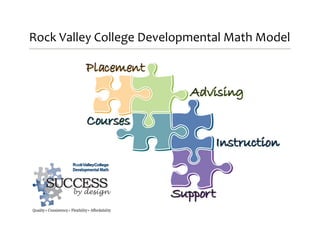
Rock Valley College Developmental Math Model
Quality                    Consistency                     Flexibility                  Affordability
              Cut scores and routing         Mandatory testing and         Students may retest once        Retests are $5. They
Placement

              methods are regularly          placement for all students    before starting the             allow students to skip
              validated. Accelerated         scoring 17 or less on the     sequence and again later        courses, if merited,
              courses require higher         ACT.                          with a B or better in a         saving time and money.
              placement scores.                                            math class. Two retests         MyMathTest is used for
              Minimum competency                                           maximum.                        placement test prep.
              required to start lowest
              course.

              Accurate information is        All entering students         Students are made aware         Timely information
Advising


              provided to all students in    receive program               of various options and          reduces time needed to
              a variety of ways to ensure    information in                paths best suited for           get to college level
              understanding of the           orientation. All DM           specific needs and              courses.
              program, its options, and      students receive regular      learning styles.
              student resources.             in-course advising.

              8 week modules reduce          Common final exam for         Every module is offered         Most students pass
              overlap of content with a      each course. Common           every 8 weeks. Qualifying       modules on their first
              gradual development and        MML capstone                  students can take an            attempt saving
Courses


              increased time on new          assignments for each          accelerated algebra course      students tuition and time.
              topics to encourage            part 2 module. Combined       to bypass 4 modules. 3          Repeating a course costs
              mastery. Review is done in     algebra course has same       options exist to satisfy        less since students only
              MML. Accelerated               book & content as             geometry requirement.           repeat the modules
              pathways exist for STEM        beginning & intermediate      Students can move               needed.
              and non-STEM majors.           algebra modules.              between pathways.

              Slower pacing includes         Common syllabi, course        Majority of courses are         MML access code is
              mid-chapter, unit test, and    policies, MML courses,        offered day and night.          required and includes
Instruction


              final exam review. Spiral      MML homework, pacing,         Many courses offered            e-book. Tier 1 modules use
              learning on homework and       and grading standards         computer-assisted or            same book. Tier 2 modules
              tests. Each course begins      exist for all courses.        online as alternatives to       use same book. Custom 3-
              with review in MML of          Attendance and MML            lecture- based, face-to-face    hole punched book
              previous module. MLCS          homework are required.        courses.                        bundles reduce costs.
              and geometry are activity      Minimum of 3 MML
              based.                         deadlines per week.

              Faculty and peer tutoring      All students have access to   Help is available online, in-   Online help is included
              available. Sessions offered    assistance through MML        person, by appointment,         with MML access code. All
              in RVC Math Lab on             help aids. The RVC Math       or on a drop-in basis.          other support services
Support


              calculators and final exam     Lab offers drop-in faculty    Students can get help from      offered are free. The RVC
              prep. Individualized           tutoring and resources for    their instructor or another     Math Lab offers computers
              remediation program            all DM students.              instructor in the RVC Math      for online homework.
              available to students who                                    Lab. Pearson phone
              lack minimum skills to start                                 tutoring is available for all
              DM program.                                                  students in program.
                       Abbreviations: DM = Developmental math           MML = MyMathLab
Rock Valley College Developmental Math Flowchart


Geometry (MTH 097) is required
for students placing into           MTH 097
MTH 086, 088, 091, or 096S who      Geometry
have not passed geometry in            3 CH,
high school. A competency test
                                  8 or 16 weeks
is available to bypass MTH 097.


    Key:
    CH = Credit hours
    MTH 115: General education math; MTH 220: Statistics
    MTH 100: Technical math; MTH 120: College Algebra; MTH 132: Precalculus; MTH 216: Math for Elementary Teachers

                                                                       3
Development of Content
Basic Math Skills     M-2              Beginning Algebra, Part 1         M-2               Intermediate Algebra, Part 2         M-2    Mathematical Literacy for College Students S-6
Whole numbers & positive fractions     Real numbers, solving equations &                   Linear inequalities, 3x3 systems,           Integrates numeracy, proportional reasoning,
(No calculators on unit tests)         inequalities, graphing linear equations             variation, radicals, complex numbers,       algebraic reasoning, functions, geometry,
                                       (No writing equations of lines)                     quadratic equations & graphs                statistics, and student success content

Prealgebra, Part 1      M-2                                                                Combined Beg & Int Algebra           S-6    M-2 = 2 credit module, 8 weeks in length
Integers, solving basic equations,     Beginning Algebra, Part 2        M-2                All content from four beginning &           S-3 = 3 credit semester length course
positive & negative fractions          2x2 systems of equations, polynomials &             intermediate algebra modules                S-6 = 6 credit semester length course
(No calculators on unit tests)         exponents, factoring, ratio & proportion,
                                       dimensional analysis                                Geometry                              S-3
Prealgebra, Part 2    M-2                                                                  Lines, angles, measurement,
Positive & negative decimals, ratio,   Intermediate Algebra, Part 1       M-2              polygons, right triangle trigonometry
proportion, percent, graphing linear   Factoring, rational expressions & equations,        (Focus on reasoning and critical
equations, geometry                    writing equations of lines, functions               thinking with reduced focus on
                                       (Includes “just in time” review before each unit)   2 column proofs)


                                                                                           4
Mathematical Literacy for College Students (MLCS)

The purpose of this course is to offer a new way of developing mathematical and college readiness for college level
coursework. This course does not aim to recreate high school mathematics but instead offer a unique experience for
the adult student.

The creation of this course mimics the majors/non-majors approach that biology, chemistry, and physics use in their
multiple pathways. This idea is also used with Technical Math and Business Calculus where similar content to a
traditional course is developed but with particular majors in mind. Additionally, it provides STEM-bound students a new
perspective and skill set than the ones provided in a traditional algebra course.

Development
                      Developed with national group of faculty through AMATYC’s New Life for Developmental Math
                      Carnegie Foundation and Gates Foundations along with others are funding a $14 million grant in
                       8 pilot schools of this course in a larger initiative called Quantway along with Statway.

Course
                      3 – 6 credit hours (varies based on state requirements and breadth desired)
                      Same initial placement as beginning algebra
                      Students need prerequisite knowledge in arithmetic (whole numbers, fractions, decimals, and
                       percents)

Content
                      Topics from beginning algebra, intermediate algebra, geometry, and statistics
                      Integrated student success/college readiness content
                      Carnegie grant schools are using materials developed through the UT-Austin Dana Center
                      Materials are being written by Kathleen Almy and Heather Foes at Rock Valley College that
                       will published by Pearson

Focus
                      Critical thinking, problem solving, reasoning, communication
                      Mathematical maturity

Rigor
                   •   The course can be as rigorous as needed depending on a state’s requirements. It can be
                       equivalent to a beginning algebra course in rigor or as intense as a combined algebra course but
                       with a different focus.
                   •   Development in IL is more rigorous than the Quantway approach which would be equivalent in
                       length and rigor to a beginning algebra course. The IL version of MLCS is equivalent to a
                       combined algebra course. This difference is needed to satisfy articulation agreements since IL is
                       a state that requires intermediate algebra for all college level courses.

Technology
                   •   Any calculator, Excel, MyMathLab homework for skill development


                                                           5
Assessment
                   •   Multiple and varied in-course assessments such as self-reflections, group activities, use of
                       technology, problem solving assessments, and skill assessments
                   •   Tracking assessment of students in subsequent courses (General Education Math, Introductory
                       Statistics, Combined Algebra, Intermediate Algebra)

Instructional Design

                   •   Each unit is integrated to develop some concepts and skills in each of the four areas: numeracy,
                       algebraic reasoning, proportional reasoning, and functions. The goal is depth over breadth.


Effects
                   •   The four follow-up courses listed above will not change.
                   •   Most students will take fewer semesters of developmental math. For those who change their
                       major, they will need 2 semesters of developmental math which is the current mean.

Incorporating MLCS into a developmental math program
                  • Can be used as an additional course option in the program sequence for non-STEM majors
                  • MLCS lessons can be used for once weekly face-to-face class sessions in an emporium model


                                                          6
Guide to Redesigning Your Developmental Math Program
Creating a system for success                                                                            Kathleen Almy
                                                                                                     Rock Valley College


Overall        Where do we start?
          1.   Find a faculty advocate and form a task force of faculty, administrators, and student service personnel
          2.   Get current pass rates and other program statistics to use as a baseline
          3.   Read research on developmental students and math redesigns

Placement      Who is in your class?
          1.   Learn how your placement system works including routing methods through the tests
          2.   Get data to assess your cut scores and routing methods
          3.   Meet as a department and evaluate placement policies with testing center personnel
          4.   Institute mandatory testing and placement
          5.   Consider refresher/placement prep methods such as MyMathTest

Advising       Are your students getting the information they need when they need it?
          1.   Advertise program information in key offices, online, through classes, and in new student orientation
          2.   Don’t rely on advisors alone
          3.   Assess your online registration system
          4.   Ensure students enrolled in special formats (online, hybrid, etc.) know what they’re getting


Courses        Do your classes serve your students?
          1.   Consider options beyond the traditional lecture model (hybrid, online) as well as non-STEM alternatives
          2.   Reduce level of complexity in certain topics (factoring, radicals, exponent rules)
          3.   Increase problem solving, teamwork, boardwork, and talking about math
          4.   Slow down….cover what really matters (which is not everything!) and give time to those topics
          5.   Form a succinct list of objectives for every course that every instructor receives
          6.   Consider combined books for cost savings and reducing overlap in courses


Instruction    What is going on in your developmental math classrooms?
          1.   Form a task force of faculty to write standard policies, grading, & pacing that are acceptable to all
          2.   Commit to using MyMathLab consistently in terms of usage, training, & support
          3.   Investigate best practices for MyMathLab (required for all, regular deadlines, etc.)
          4.   Consider departmental final exams to serve as a common assessment of courses, not faculty
          5.   Develop standard syllabi for adjuncts
          6.   Give adjuncts a list of expectations and evaluate their performance based on them
          7.   Create a way instructors can share successes and strategies from their classes


Support        Where and how can your students get help when they need it?
          1.   Require office hours of adjuncts
          2.   Consider faculty donated tutoring (a math lab) with resources for students including computers


      Assess program, pass rates, and final exams regularly. The process of improvement never ends.

                                                            7
Researching Redesigns


        Online resources

             Read about Achieving the Dream case schools

             Use the National Center for Academic Transformation website:
              www.thencat.org

             Visit our website: www.rockvalleycollege.edu/math


        Print resources

             Hunter Boylan’s What Works

             NADE journals

             AMATYC’s Beyond Crossroads section on developmental math

             Use Guide to Redesigning Your Developmental Math Program (included)

             Pearson White Papers


        Networking

             Talk to faculty in-state

             Use other schools as models


                                         8
Lessons Learned in Redesign
      1.      Changes must be mandatory.

      2.      Comprehensive: One large change will not be enough to produce a large effect.

      3.      Research: Learn from mistakes of others.

      4.      Assessment and data are necessary throughout the process.

      5.      Provide support, training, and communication often in multiple ways.

      6.      How is as important as what.

      7.      Commitment matters more than funding.

      8.      Redesign on your terms. One size does not fit all.


Results
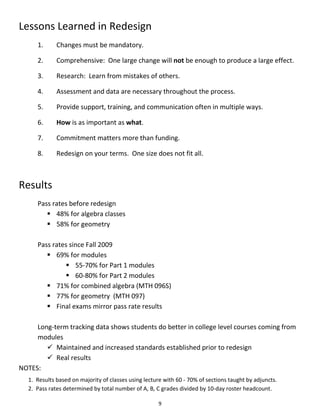
      Pass rates before redesign
          48% for algebra classes
          58% for geometry

      Pass rates since Fall 2009
          69% for modules
                55-70% for Part 1 modules
                60-80% for Part 2 modules
          71% for combined algebra (MTH 096S)
          77% for geometry (MTH 097)
          Final exams mirror pass rate results

     Long-term tracking data shows students do better in college level courses coming from
     modules
         Maintained and increased standards established prior to redesign
         Real results
NOTES:
   1. Results based on majority of classes using lecture with 60 - 70% of sections taught by adjuncts.
   2. Pass rates determined by total number of A, B, C grades divided by 10-day roster headcount.

                                                      9
Contact Information
   Kathleen Almy
    Rock Valley College, Rockford, IL
    Associate Professor of Mathematics

   Email: kathleenalmy@gmail.com

   Blog:    http://almydoesmath.blogspot.com

           Contains program manual and many other documents

           Provides weekly updates from the MLCS pilot including pictures and videos
    If you would like more information on MLCS or are interested in reviewing or class testing materials,
    please email me.


                                                  10

Rvc developmental math model packet 2013

  • 1.
    Rock Valley CollegeDevelopmental Math Model
  • 2.
    Quality Consistency Flexibility Affordability Cut scores and routing Mandatory testing and Students may retest once Retests are $5. They Placement methods are regularly placement for all students before starting the allow students to skip validated. Accelerated scoring 17 or less on the sequence and again later courses, if merited, courses require higher ACT. with a B or better in a saving time and money. placement scores. math class. Two retests MyMathTest is used for Minimum competency maximum. placement test prep. required to start lowest course. Accurate information is All entering students Students are made aware Timely information Advising provided to all students in receive program of various options and reduces time needed to a variety of ways to ensure information in paths best suited for get to college level understanding of the orientation. All DM specific needs and courses. program, its options, and students receive regular learning styles. student resources. in-course advising. 8 week modules reduce Common final exam for Every module is offered Most students pass overlap of content with a each course. Common every 8 weeks. Qualifying modules on their first gradual development and MML capstone students can take an attempt saving Courses increased time on new assignments for each accelerated algebra course students tuition and time. topics to encourage part 2 module. Combined to bypass 4 modules. 3 Repeating a course costs mastery. Review is done in algebra course has same options exist to satisfy less since students only MML. Accelerated book & content as geometry requirement. repeat the modules pathways exist for STEM beginning & intermediate Students can move needed. and non-STEM majors. algebra modules. between pathways. Slower pacing includes Common syllabi, course Majority of courses are MML access code is mid-chapter, unit test, and policies, MML courses, offered day and night. required and includes Instruction final exam review. Spiral MML homework, pacing, Many courses offered e-book. Tier 1 modules use learning on homework and and grading standards computer-assisted or same book. Tier 2 modules tests. Each course begins exist for all courses. online as alternatives to use same book. Custom 3- with review in MML of Attendance and MML lecture- based, face-to-face hole punched book previous module. MLCS homework are required. courses. bundles reduce costs. and geometry are activity Minimum of 3 MML based. deadlines per week. Faculty and peer tutoring All students have access to Help is available online, in- Online help is included available. Sessions offered assistance through MML person, by appointment, with MML access code. All in RVC Math Lab on help aids. The RVC Math or on a drop-in basis. other support services Support calculators and final exam Lab offers drop-in faculty Students can get help from offered are free. The RVC prep. Individualized tutoring and resources for their instructor or another Math Lab offers computers remediation program all DM students. instructor in the RVC Math for online homework. available to students who Lab. Pearson phone lack minimum skills to start tutoring is available for all DM program. students in program. Abbreviations: DM = Developmental math MML = MyMathLab
  • 3.
    Rock Valley CollegeDevelopmental Math Flowchart Geometry (MTH 097) is required for students placing into MTH 097 MTH 086, 088, 091, or 096S who Geometry have not passed geometry in 3 CH, high school. A competency test 8 or 16 weeks is available to bypass MTH 097. Key: CH = Credit hours MTH 115: General education math; MTH 220: Statistics MTH 100: Technical math; MTH 120: College Algebra; MTH 132: Precalculus; MTH 216: Math for Elementary Teachers 3
  • 4.
    Development of Content BasicMath Skills M-2 Beginning Algebra, Part 1 M-2 Intermediate Algebra, Part 2 M-2 Mathematical Literacy for College Students S-6 Whole numbers & positive fractions Real numbers, solving equations & Linear inequalities, 3x3 systems, Integrates numeracy, proportional reasoning, (No calculators on unit tests) inequalities, graphing linear equations variation, radicals, complex numbers, algebraic reasoning, functions, geometry, (No writing equations of lines) quadratic equations & graphs statistics, and student success content Prealgebra, Part 1 M-2 Combined Beg & Int Algebra S-6 M-2 = 2 credit module, 8 weeks in length Integers, solving basic equations, Beginning Algebra, Part 2 M-2 All content from four beginning & S-3 = 3 credit semester length course positive & negative fractions 2x2 systems of equations, polynomials & intermediate algebra modules S-6 = 6 credit semester length course (No calculators on unit tests) exponents, factoring, ratio & proportion, dimensional analysis Geometry S-3 Prealgebra, Part 2 M-2 Lines, angles, measurement, Positive & negative decimals, ratio, Intermediate Algebra, Part 1 M-2 polygons, right triangle trigonometry proportion, percent, graphing linear Factoring, rational expressions & equations, (Focus on reasoning and critical equations, geometry writing equations of lines, functions thinking with reduced focus on (Includes “just in time” review before each unit) 2 column proofs) 4
  • 5.
    Mathematical Literacy forCollege Students (MLCS) The purpose of this course is to offer a new way of developing mathematical and college readiness for college level coursework. This course does not aim to recreate high school mathematics but instead offer a unique experience for the adult student. The creation of this course mimics the majors/non-majors approach that biology, chemistry, and physics use in their multiple pathways. This idea is also used with Technical Math and Business Calculus where similar content to a traditional course is developed but with particular majors in mind. Additionally, it provides STEM-bound students a new perspective and skill set than the ones provided in a traditional algebra course. Development  Developed with national group of faculty through AMATYC’s New Life for Developmental Math  Carnegie Foundation and Gates Foundations along with others are funding a $14 million grant in 8 pilot schools of this course in a larger initiative called Quantway along with Statway. Course  3 – 6 credit hours (varies based on state requirements and breadth desired)  Same initial placement as beginning algebra  Students need prerequisite knowledge in arithmetic (whole numbers, fractions, decimals, and percents) Content  Topics from beginning algebra, intermediate algebra, geometry, and statistics  Integrated student success/college readiness content  Carnegie grant schools are using materials developed through the UT-Austin Dana Center  Materials are being written by Kathleen Almy and Heather Foes at Rock Valley College that will published by Pearson Focus  Critical thinking, problem solving, reasoning, communication  Mathematical maturity Rigor • The course can be as rigorous as needed depending on a state’s requirements. It can be equivalent to a beginning algebra course in rigor or as intense as a combined algebra course but with a different focus. • Development in IL is more rigorous than the Quantway approach which would be equivalent in length and rigor to a beginning algebra course. The IL version of MLCS is equivalent to a combined algebra course. This difference is needed to satisfy articulation agreements since IL is a state that requires intermediate algebra for all college level courses. Technology • Any calculator, Excel, MyMathLab homework for skill development 5
  • 6.
    Assessment • Multiple and varied in-course assessments such as self-reflections, group activities, use of technology, problem solving assessments, and skill assessments • Tracking assessment of students in subsequent courses (General Education Math, Introductory Statistics, Combined Algebra, Intermediate Algebra) Instructional Design • Each unit is integrated to develop some concepts and skills in each of the four areas: numeracy, algebraic reasoning, proportional reasoning, and functions. The goal is depth over breadth. Effects • The four follow-up courses listed above will not change. • Most students will take fewer semesters of developmental math. For those who change their major, they will need 2 semesters of developmental math which is the current mean. Incorporating MLCS into a developmental math program • Can be used as an additional course option in the program sequence for non-STEM majors • MLCS lessons can be used for once weekly face-to-face class sessions in an emporium model 6
  • 7.
    Guide to RedesigningYour Developmental Math Program Creating a system for success Kathleen Almy Rock Valley College Overall Where do we start? 1. Find a faculty advocate and form a task force of faculty, administrators, and student service personnel 2. Get current pass rates and other program statistics to use as a baseline 3. Read research on developmental students and math redesigns Placement Who is in your class? 1. Learn how your placement system works including routing methods through the tests 2. Get data to assess your cut scores and routing methods 3. Meet as a department and evaluate placement policies with testing center personnel 4. Institute mandatory testing and placement 5. Consider refresher/placement prep methods such as MyMathTest Advising Are your students getting the information they need when they need it? 1. Advertise program information in key offices, online, through classes, and in new student orientation 2. Don’t rely on advisors alone 3. Assess your online registration system 4. Ensure students enrolled in special formats (online, hybrid, etc.) know what they’re getting Courses Do your classes serve your students? 1. Consider options beyond the traditional lecture model (hybrid, online) as well as non-STEM alternatives 2. Reduce level of complexity in certain topics (factoring, radicals, exponent rules) 3. Increase problem solving, teamwork, boardwork, and talking about math 4. Slow down….cover what really matters (which is not everything!) and give time to those topics 5. Form a succinct list of objectives for every course that every instructor receives 6. Consider combined books for cost savings and reducing overlap in courses Instruction What is going on in your developmental math classrooms? 1. Form a task force of faculty to write standard policies, grading, & pacing that are acceptable to all 2. Commit to using MyMathLab consistently in terms of usage, training, & support 3. Investigate best practices for MyMathLab (required for all, regular deadlines, etc.) 4. Consider departmental final exams to serve as a common assessment of courses, not faculty 5. Develop standard syllabi for adjuncts 6. Give adjuncts a list of expectations and evaluate their performance based on them 7. Create a way instructors can share successes and strategies from their classes Support Where and how can your students get help when they need it? 1. Require office hours of adjuncts 2. Consider faculty donated tutoring (a math lab) with resources for students including computers Assess program, pass rates, and final exams regularly. The process of improvement never ends. 7
  • 8.
    Researching Redesigns  Online resources  Read about Achieving the Dream case schools  Use the National Center for Academic Transformation website: www.thencat.org  Visit our website: www.rockvalleycollege.edu/math  Print resources  Hunter Boylan’s What Works  NADE journals  AMATYC’s Beyond Crossroads section on developmental math  Use Guide to Redesigning Your Developmental Math Program (included)  Pearson White Papers  Networking  Talk to faculty in-state  Use other schools as models 8
  • 9.
    Lessons Learned inRedesign 1. Changes must be mandatory. 2. Comprehensive: One large change will not be enough to produce a large effect. 3. Research: Learn from mistakes of others. 4. Assessment and data are necessary throughout the process. 5. Provide support, training, and communication often in multiple ways. 6. How is as important as what. 7. Commitment matters more than funding. 8. Redesign on your terms. One size does not fit all. Results Pass rates before redesign  48% for algebra classes  58% for geometry Pass rates since Fall 2009  69% for modules  55-70% for Part 1 modules  60-80% for Part 2 modules  71% for combined algebra (MTH 096S)  77% for geometry (MTH 097)  Final exams mirror pass rate results Long-term tracking data shows students do better in college level courses coming from modules  Maintained and increased standards established prior to redesign  Real results NOTES: 1. Results based on majority of classes using lecture with 60 - 70% of sections taught by adjuncts. 2. Pass rates determined by total number of A, B, C grades divided by 10-day roster headcount. 9
  • 10.
    Contact Information  Kathleen Almy Rock Valley College, Rockford, IL Associate Professor of Mathematics  Email: kathleenalmy@gmail.com  Blog: http://almydoesmath.blogspot.com  Contains program manual and many other documents  Provides weekly updates from the MLCS pilot including pictures and videos If you would like more information on MLCS or are interested in reviewing or class testing materials, please email me. 10