Department Vocational Pedagogy 
Vocational Pedagogy CLASS: EM-6 AVP-2_Lesson Preparation 
AVP-2 – Lesson Preparation 
o Topic: Logic Circuits- Logic expressions and its representation using logic gates. 
o Date and Time: 22/10/2014
Department Vocational Pedagogy 
Vocational Pedagogy CLASS: EM-6 AVP-2_Lesson Preparation 
Table of Contents 
1. Didactic Reflection ............................................................................................................................... 1 
1.1 Curriculum Analysis .......................................................................................................................... 1 
1.2 Content Analysis ............................................................................................................................... 1 
1.3 Didactic Analysis ............................................................................................................................... 3 
2.1 General Learning Objectives: ......................................................................................................... 5 
2.2 Specific Learning Objectives:.......................................................................................................... 5 
2.3 Overview of the Intended Process ................................................................................................. 6 
2. Application of Didactic Principles....................................................................................................... 8 
3. List of attached teaching material...................................................................................................... 8 
4. References ............................................................................................................................................ 8 
Formal Requirements1 
 DIN A4, portrait. 
 Line spacing is: 1.5 (about 32 lines per page) 
 Font: Arial 
 Font size for “normal” text: 12 pt 
 Page margins: left and top 3 cm; right and bottom 2.5 cm 
 Page numbering starts after Table of Contents i.e. Didactic Reflection is page 1 
1 Based on the formal requirements of the Bachelor Thesis at TTC.
Department Vocational Pedagogy 
Vocational Pedagogy CLASS: EM-6 AVP-2_Lesson Preparation 
Page 1 of 7 
1. Didactic Reflection 
1.1 Curriculum Analysis 
- The name of the course is “programmable control technology “and the code is (ELT201). The 
contact hours for this course are 1 hour of lecture and 2 hours of practical. 
- This course presents applied and experimental study for the use of programmable logic 
controller. It also enables the trainee to draw the control circuits, and programs the PLC with 
needed program for industrial applications. This course has prerequisite which is Electrical 
Circuits-II. 
- The general objectives of this course is to train the trainees the construction of the PLC, the 
fundamentals of its operation. It also presents the application of PLC in different industrial areas. 
The specific objective of the course is to develop the knowledge of the trainees about the logic 
gates and the mathematical system which is boolean algebra. 
- The unit of our topic is logic circuits: logic expression and its representation using logic gates, 
and the specific objective of the course that relate to this unit is to recognize to logic gates and 
to transform them to digital systems. 
1.2 Content Analysis 
Mathematical rules are based on the defining limits we place on the particular numerical 
quantities dealt with. When we say that 1 + 1 = 2 or 3 + 4 = 7, we are implying the use of integer 
quantities: the same types of numbers we all learned to count in elementary education. What 
most people assume to be self-evident rules of arithmetic -- valid at all times and for all purposes 
-- actually depend on what we define a number to be. 
Logic is much like mathematics in this respect: the so-called "Laws" of logic depend on how we 
define what a proposition is. a system of logic based on only two types of propositions: true and 
false 
It should be clearly understood that Boolean numbers are not the same as binary numbers. 
Whereas Boolean numbers represent an entirely different system of mathematics from real 
numbers, binary is nothing more than an alternative notation for real numbers. The two are often 
confused because both Boolean math and binary notation use the same two ciphers: 1 and 0. 
The difference is that Boolean quantities are restricted to a single bit (either 1 or 0), whereas
Department Vocational Pedagogy 
Vocational Pedagogy CLASS: EM-6 AVP-2_Lesson Preparation 
binary numbers may be composed of many bits adding up in place-weighted form to a value of 
any finite size. The binary number 100112 ("nineteen") has no more place in the Boolean world 
than the decimal number 210 ("two") or the octal number 328 ("twenty-six"). 
Page 2 of 7 
Exploration of Boolean algebra by adding numbers together: 
The first three sums make perfect sense to anyone familiar with elementary addition. The last 
sum, though, is quite possibly responsible for more confusion than any other single statement in 
digital electronics, because it seems to run contrary to the basic principles of mathematics. Well, 
it does contradict principles of addition for real numbers, but not for Boolean numbers. 
Remember that in the world of Boolean algebra, there are only two possible values for any 
quantity and for any arithmetic operation: 1 or 0. There is no such thing as "2" within the scope 
of Boolean values. Since the sum "1 + 1" certainly isn't 0, it must be 1 by process of elimination. 
It is the same pattern of 1's and 0's as seen in the truth table for an OR gate. In other words, 
Boolean addition corresponds to the logical function of an "OR" gate, as well as to parallel 
switch contacts: 
Multiplication is valid in Boolean algebra, and thankfully it is the same as in real-number algebra: 
anything multiplied by 0 is 0, and anything multiplied by 1 remains unchanged:
Department Vocational Pedagogy 
Vocational Pedagogy CLASS: EM-6 AVP-2_Lesson Preparation 
It is the same pattern found in the truth table for an AND gate. In other words, Boolean 
multiplication corresponds to the logical function of an "AND" gate, as well as to series switch 
contacts: 
Opposite of values if variable "A" has a value of 0, then the complement of A has a value of 1. 
Boolean notation uses a bar above the variable character to denote complementation, like this: 
Boolean complementation finds equivalency in the form of the NOT gate, or a normally-closed 
switch or relay contact: 
The basic definition of Boolean quantities has led to the simple rules of addition and 
multiplication, and has excluded both subtraction and division as valid arithmetic operations. We 
have a symbology for denoting Boolean variables, and their complements. In the next section 
we will proceed to develop Boolean identities. 
1.3 Didactic Analysis 
- I want to make our lesson interesting from the beginning, I will use the inductive approach by 
drawing symbols that relating to the topic of the lesson and ask the trainees after that about 
them. I like this approach and I will use it in the beginning of any lesson because it will make the 
lesson active and by this approach I will take the attention from the trainees to the lesson from 
the beginning. Also with this approach the trainees will think and participate and that’s what I 
want. Making trainees busy is very important and that’s my goal. 
Page 3 of 7
Department Vocational Pedagogy 
Vocational Pedagogy CLASS: EM-6 AVP-2_Lesson Preparation 
- I want to get the interest of the trainees so I will use the didactic principle of motivation by 
asking question and choose some trainees to come up on the whiteboard and answer my 
questions and that’s great and it will develop the self-confidence of the trainees. I want the 
trainees to work, communicate and talk with each other to answer the questions so I will make a 
group work. In the group work it’s very important the trainees who have highest knowledge to 
support and help the trainees who have lowest knowledge. 
- making a lesson vivid it will make my lesson easy to understand so I will use this principle by 
using different colors, nice PowerPoint designing and pictures so the trainees can understand 
the logic gates in order to the symbols, truth tables, timing diagram clearly. Making the lesson 
vivid is a significant point because it will make the trainees ready to learn and it will make them 
also like the lesson. 
- The trainer must think of the level of the trainees by give them particular task to solve it and the 
reason of that is to develop their levels of thinking and make their skills better on the future, so 
for that I will use the principle of self-activity during the lesson by asking each student to put two 
carts on the right position of the truth tables of the three gates. 
- I link the new content to already taught and learned content by complete the answers of the 
examples of star and delta transformation with series-parallel combination. 
- I will use didactic reduction by mention and, or and not gates without nand, nor and xnor 
gates. 
Page 4 of 7
Department Vocational Pedagogy 
Vocational Pedagogy CLASS: EM-6 AVP-2_Lesson Preparation 
Page 5 of 7 
Lesson Plan 
2.1 General Learning Objectives: 
The Trainees 
1. practice their English language. (Cognitive) 
2. develop their knowledge about the programmable control technology. (Cognitive) 
3. participate with the trainer. (Affective) 
4. write notes. (Cognitive) 
5. answer the questions. (Cognitive) 
2.2 Specific Learning Objectives: 
The Trainees 
1. complete the truth table by putting the number of 1 and 0 in the right position.. 
(Reproduction / Cognitive) 
2. make the timing diagram of and gate, or gate and not gate (Reproduction / Cognitive) 
3. answer the questions of the worksheet. ( Reproduction / Cognitive)
Department Vocational Pedagogy 
Vocational Pedagogy CLASS: EM-6 AVP-2_Lesson Preparation 
Page 6 of 7 
2.3 Overview of the Intended Process 
Opening / Entrance / Motivation 
Methodology 
Media 
Time 
Expected Trainer-action Expected Trainee-action Minutes 
Trainer draws three symbols 
of logic gates and asks the 
trainees what is these? 
Trainees look to the symbols 
to recognize to them and then 
answer the questions of the 
trainer. 
Inductive 
Approach 
PowerPoint 
Slide (2) 
2 
Body (Information / Elaboration) 
Methodology 
Media 
Time 
Expected Trainer-action Expected Trainee-action Minutes 
Trainer gives the trainees 
introduction about the 
lesson. 
Trainees listen to the trainer 
to find out what is the lesson 
talk about. 
Lecture 
PowerPoint 
Slide (3) 
1 
Trainer gives information 
about the denotation of 
three logic gates. 
Trainees listen to the trainer. 
Lecture 
PowerPoint 
Slide (4) 
1 
Trainer writes some 
notation examples and 
asks the trainees what is 
the correct way to read 
them. 
Trainees participate with the 
trainer and answer the 
questions. 
Classroom 
Conversation 
PowerPoint 
Slide (5) 
3 
Trainer asks the trainees to 
fill in the truth table of the 
three logic gates by putting 
the carts which contain 
number of 1 and 0 in the 
right position. 
Trainees complete the truth 
table by putting the number 
of 1 and 0 in the right 
position. 
Classroom 
Conversation 
PowerPoint 
Slide (6) 
Whiteboard 
5 
Trainer divides the trainees 
to three groups and asks 
them to make an 
Trainees make the 
experiment and complete the 
table on the papers which 
Experiment 
PowerPoint 
Slides (7) 
(8) 
20
Department Vocational Pedagogy 
Vocational Pedagogy CLASS: EM-6 AVP-2_Lesson Preparation 
Page 7 of 7 
experiment about logic 
gates and after that writing 
the results on the papers 
which delivered by the 
trainer. 
Trainer presents to the 
trainees on the PowerPoint 
slides the correct model. 
giving by the trainer. 
Trainer puts the trainees in 
several groups to answer 
the example of logic using 
the switches. 
Trainer presents the 
correct answer to the 
whole class. 
Trainees sit in groups to 
answers the question. 
Trainees put their answer in 
the whiteboard. 
Partner Work 
PowerPoint 
Slide (9) 
Whiteboard 
4 
Trainer asks three trainees 
to make the timing diagram 
of and gate, or gate and 
not gate. 
Trainer presents the 
correct answer to the 
whole class. 
Trainees make the timing 
diagram of and gate, or gate 
and not gate. 
Classroom 
Conversation 
PowerPoint 
Slides (10) 
Whiteboard 
4
Department Vocational Pedagogy 
Vocational Pedagogy CLASS: EM-6 AVP-2_Lesson Preparation 
Page 8 of 7 
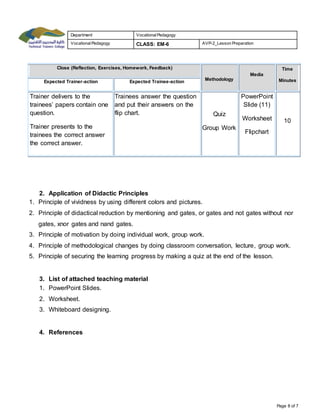
Close (Reflection, Exercises, Homework, Feedback) 
Methodology 
Media 
Time 
Expected Trainer-action Expected Trainee-action Minutes 
Trainer delivers to the 
trainees’ papers contain one 
question. 
Trainer presents to the 
trainees the correct answer 
the correct answer. 
Trainees answer the question 
and put their answers on the 
flip chart. Quiz 
Group Work 
PowerPoint 
Slide (11) 
Worksheet 
Flipchart 
10 
2. Application of Didactic Principles 
1. Principle of vividness by using different colors and pictures. 
2. Principle of didactical reduction by mentioning and gates, or gates and not gates without nor 
gates, xnor gates and nand gates. 
3. Principle of motivation by doing individual work, group work. 
4. Principle of methodological changes by doing classroom conversation, lecture, group work. 
5. Principle of securing the learning progress by making a quiz at the end of the lesson. 
3. List of attached teaching material 
1. PowerPoint Slides. 
2. Worksheet. 
3. Whiteboard designing. 
4. References

S aleh logic gates --

  • 1.
    Department Vocational Pedagogy Vocational Pedagogy CLASS: EM-6 AVP-2_Lesson Preparation AVP-2 – Lesson Preparation o Topic: Logic Circuits- Logic expressions and its representation using logic gates. o Date and Time: 22/10/2014
  • 2.
    Department Vocational Pedagogy Vocational Pedagogy CLASS: EM-6 AVP-2_Lesson Preparation Table of Contents 1. Didactic Reflection ............................................................................................................................... 1 1.1 Curriculum Analysis .......................................................................................................................... 1 1.2 Content Analysis ............................................................................................................................... 1 1.3 Didactic Analysis ............................................................................................................................... 3 2.1 General Learning Objectives: ......................................................................................................... 5 2.2 Specific Learning Objectives:.......................................................................................................... 5 2.3 Overview of the Intended Process ................................................................................................. 6 2. Application of Didactic Principles....................................................................................................... 8 3. List of attached teaching material...................................................................................................... 8 4. References ............................................................................................................................................ 8 Formal Requirements1  DIN A4, portrait.  Line spacing is: 1.5 (about 32 lines per page)  Font: Arial  Font size for “normal” text: 12 pt  Page margins: left and top 3 cm; right and bottom 2.5 cm  Page numbering starts after Table of Contents i.e. Didactic Reflection is page 1 1 Based on the formal requirements of the Bachelor Thesis at TTC.
  • 3.
    Department Vocational Pedagogy Vocational Pedagogy CLASS: EM-6 AVP-2_Lesson Preparation Page 1 of 7 1. Didactic Reflection 1.1 Curriculum Analysis - The name of the course is “programmable control technology “and the code is (ELT201). The contact hours for this course are 1 hour of lecture and 2 hours of practical. - This course presents applied and experimental study for the use of programmable logic controller. It also enables the trainee to draw the control circuits, and programs the PLC with needed program for industrial applications. This course has prerequisite which is Electrical Circuits-II. - The general objectives of this course is to train the trainees the construction of the PLC, the fundamentals of its operation. It also presents the application of PLC in different industrial areas. The specific objective of the course is to develop the knowledge of the trainees about the logic gates and the mathematical system which is boolean algebra. - The unit of our topic is logic circuits: logic expression and its representation using logic gates, and the specific objective of the course that relate to this unit is to recognize to logic gates and to transform them to digital systems. 1.2 Content Analysis Mathematical rules are based on the defining limits we place on the particular numerical quantities dealt with. When we say that 1 + 1 = 2 or 3 + 4 = 7, we are implying the use of integer quantities: the same types of numbers we all learned to count in elementary education. What most people assume to be self-evident rules of arithmetic -- valid at all times and for all purposes -- actually depend on what we define a number to be. Logic is much like mathematics in this respect: the so-called "Laws" of logic depend on how we define what a proposition is. a system of logic based on only two types of propositions: true and false It should be clearly understood that Boolean numbers are not the same as binary numbers. Whereas Boolean numbers represent an entirely different system of mathematics from real numbers, binary is nothing more than an alternative notation for real numbers. The two are often confused because both Boolean math and binary notation use the same two ciphers: 1 and 0. The difference is that Boolean quantities are restricted to a single bit (either 1 or 0), whereas
  • 4.
    Department Vocational Pedagogy Vocational Pedagogy CLASS: EM-6 AVP-2_Lesson Preparation binary numbers may be composed of many bits adding up in place-weighted form to a value of any finite size. The binary number 100112 ("nineteen") has no more place in the Boolean world than the decimal number 210 ("two") or the octal number 328 ("twenty-six"). Page 2 of 7 Exploration of Boolean algebra by adding numbers together: The first three sums make perfect sense to anyone familiar with elementary addition. The last sum, though, is quite possibly responsible for more confusion than any other single statement in digital electronics, because it seems to run contrary to the basic principles of mathematics. Well, it does contradict principles of addition for real numbers, but not for Boolean numbers. Remember that in the world of Boolean algebra, there are only two possible values for any quantity and for any arithmetic operation: 1 or 0. There is no such thing as "2" within the scope of Boolean values. Since the sum "1 + 1" certainly isn't 0, it must be 1 by process of elimination. It is the same pattern of 1's and 0's as seen in the truth table for an OR gate. In other words, Boolean addition corresponds to the logical function of an "OR" gate, as well as to parallel switch contacts: Multiplication is valid in Boolean algebra, and thankfully it is the same as in real-number algebra: anything multiplied by 0 is 0, and anything multiplied by 1 remains unchanged:
  • 5.
    Department Vocational Pedagogy Vocational Pedagogy CLASS: EM-6 AVP-2_Lesson Preparation It is the same pattern found in the truth table for an AND gate. In other words, Boolean multiplication corresponds to the logical function of an "AND" gate, as well as to series switch contacts: Opposite of values if variable "A" has a value of 0, then the complement of A has a value of 1. Boolean notation uses a bar above the variable character to denote complementation, like this: Boolean complementation finds equivalency in the form of the NOT gate, or a normally-closed switch or relay contact: The basic definition of Boolean quantities has led to the simple rules of addition and multiplication, and has excluded both subtraction and division as valid arithmetic operations. We have a symbology for denoting Boolean variables, and their complements. In the next section we will proceed to develop Boolean identities. 1.3 Didactic Analysis - I want to make our lesson interesting from the beginning, I will use the inductive approach by drawing symbols that relating to the topic of the lesson and ask the trainees after that about them. I like this approach and I will use it in the beginning of any lesson because it will make the lesson active and by this approach I will take the attention from the trainees to the lesson from the beginning. Also with this approach the trainees will think and participate and that’s what I want. Making trainees busy is very important and that’s my goal. Page 3 of 7
  • 6.
    Department Vocational Pedagogy Vocational Pedagogy CLASS: EM-6 AVP-2_Lesson Preparation - I want to get the interest of the trainees so I will use the didactic principle of motivation by asking question and choose some trainees to come up on the whiteboard and answer my questions and that’s great and it will develop the self-confidence of the trainees. I want the trainees to work, communicate and talk with each other to answer the questions so I will make a group work. In the group work it’s very important the trainees who have highest knowledge to support and help the trainees who have lowest knowledge. - making a lesson vivid it will make my lesson easy to understand so I will use this principle by using different colors, nice PowerPoint designing and pictures so the trainees can understand the logic gates in order to the symbols, truth tables, timing diagram clearly. Making the lesson vivid is a significant point because it will make the trainees ready to learn and it will make them also like the lesson. - The trainer must think of the level of the trainees by give them particular task to solve it and the reason of that is to develop their levels of thinking and make their skills better on the future, so for that I will use the principle of self-activity during the lesson by asking each student to put two carts on the right position of the truth tables of the three gates. - I link the new content to already taught and learned content by complete the answers of the examples of star and delta transformation with series-parallel combination. - I will use didactic reduction by mention and, or and not gates without nand, nor and xnor gates. Page 4 of 7
  • 7.
    Department Vocational Pedagogy Vocational Pedagogy CLASS: EM-6 AVP-2_Lesson Preparation Page 5 of 7 Lesson Plan 2.1 General Learning Objectives: The Trainees 1. practice their English language. (Cognitive) 2. develop their knowledge about the programmable control technology. (Cognitive) 3. participate with the trainer. (Affective) 4. write notes. (Cognitive) 5. answer the questions. (Cognitive) 2.2 Specific Learning Objectives: The Trainees 1. complete the truth table by putting the number of 1 and 0 in the right position.. (Reproduction / Cognitive) 2. make the timing diagram of and gate, or gate and not gate (Reproduction / Cognitive) 3. answer the questions of the worksheet. ( Reproduction / Cognitive)
  • 8.
    Department Vocational Pedagogy Vocational Pedagogy CLASS: EM-6 AVP-2_Lesson Preparation Page 6 of 7 2.3 Overview of the Intended Process Opening / Entrance / Motivation Methodology Media Time Expected Trainer-action Expected Trainee-action Minutes Trainer draws three symbols of logic gates and asks the trainees what is these? Trainees look to the symbols to recognize to them and then answer the questions of the trainer. Inductive Approach PowerPoint Slide (2) 2 Body (Information / Elaboration) Methodology Media Time Expected Trainer-action Expected Trainee-action Minutes Trainer gives the trainees introduction about the lesson. Trainees listen to the trainer to find out what is the lesson talk about. Lecture PowerPoint Slide (3) 1 Trainer gives information about the denotation of three logic gates. Trainees listen to the trainer. Lecture PowerPoint Slide (4) 1 Trainer writes some notation examples and asks the trainees what is the correct way to read them. Trainees participate with the trainer and answer the questions. Classroom Conversation PowerPoint Slide (5) 3 Trainer asks the trainees to fill in the truth table of the three logic gates by putting the carts which contain number of 1 and 0 in the right position. Trainees complete the truth table by putting the number of 1 and 0 in the right position. Classroom Conversation PowerPoint Slide (6) Whiteboard 5 Trainer divides the trainees to three groups and asks them to make an Trainees make the experiment and complete the table on the papers which Experiment PowerPoint Slides (7) (8) 20
  • 9.
    Department Vocational Pedagogy Vocational Pedagogy CLASS: EM-6 AVP-2_Lesson Preparation Page 7 of 7 experiment about logic gates and after that writing the results on the papers which delivered by the trainer. Trainer presents to the trainees on the PowerPoint slides the correct model. giving by the trainer. Trainer puts the trainees in several groups to answer the example of logic using the switches. Trainer presents the correct answer to the whole class. Trainees sit in groups to answers the question. Trainees put their answer in the whiteboard. Partner Work PowerPoint Slide (9) Whiteboard 4 Trainer asks three trainees to make the timing diagram of and gate, or gate and not gate. Trainer presents the correct answer to the whole class. Trainees make the timing diagram of and gate, or gate and not gate. Classroom Conversation PowerPoint Slides (10) Whiteboard 4
  • 10.
    Department Vocational Pedagogy Vocational Pedagogy CLASS: EM-6 AVP-2_Lesson Preparation Page 8 of 7 Close (Reflection, Exercises, Homework, Feedback) Methodology Media Time Expected Trainer-action Expected Trainee-action Minutes Trainer delivers to the trainees’ papers contain one question. Trainer presents to the trainees the correct answer the correct answer. Trainees answer the question and put their answers on the flip chart. Quiz Group Work PowerPoint Slide (11) Worksheet Flipchart 10 2. Application of Didactic Principles 1. Principle of vividness by using different colors and pictures. 2. Principle of didactical reduction by mentioning and gates, or gates and not gates without nor gates, xnor gates and nand gates. 3. Principle of motivation by doing individual work, group work. 4. Principle of methodological changes by doing classroom conversation, lecture, group work. 5. Principle of securing the learning progress by making a quiz at the end of the lesson. 3. List of attached teaching material 1. PowerPoint Slides. 2. Worksheet. 3. Whiteboard designing. 4. References