RURAL MARKETING
PGDM (IIM Raipur)
Bakhresa FMCG (South Africa)
Relationship Manager (HDFC Bank)
MD- Shyam Hospital
Faculty(MBA)- GLA University, Mathura
Swarit Yadav
 The consumer buying behavior model
 What influences consumer behavior?
 Cultural Factors
 Culture
 Most fundamental determinant
 Person grows up with values, perception and preferences
 Changes in culture should be analyzed
 Change towards education and joint family system
 Social customs
 Socially accepted norms in practice
 Tends to follow age old customs
 Touching other body with feet
 Traditions
 Long standing beliefs that are accepted true
 Effects the way humans behave
 ‘Atithi devo bhava’- Guests equivalent to gods
 Subculture
 Caste
 Homes/fields and drinking water will be different
 Harijan basti/dom para
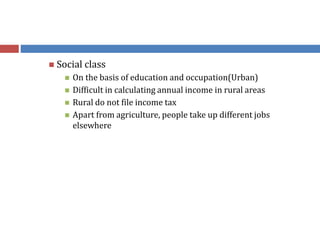
 Social class
 On the basis of education and occupation(Urban)
 Difficult in calculating annual income in rural areas
 Rural do not file income tax
 Apart from agriculture, people take up different jobs
elsewhere
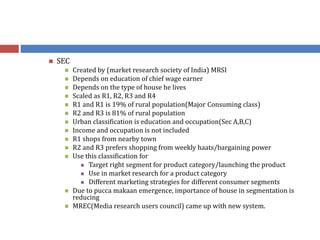
 SEC
 Created by (market research society of India) MRSI
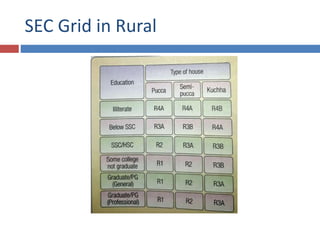
 Depends on education of chief wage earner
 Depends on the type of house he lives
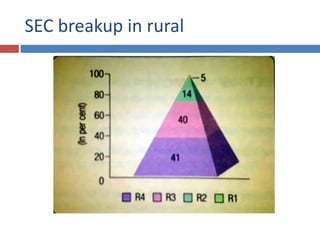
 Scaled as R1, R2, R3 and R4
 R1 and R1 is 19% of rural population(Major Consuming class)
 R2 and R3 is 81% of rural population
 Urban classification is education and occupation(Sec A,B,C)
 Income and occupation is not included
 R1 shops from nearby town
 R2 and R3 prefers shopping from weekly haats/bargaining power
 Use this classification for
 Target right segment for product category/launching the product
 Use in market research for a product category
 Different marketing strategies for different consumer segments
 Due to pucca makaan emergence, importance of house in segmentation is
reducing
 MREC(Media research users council) came up with new system.
SEC Grid in Rural
SEC breakup in rural
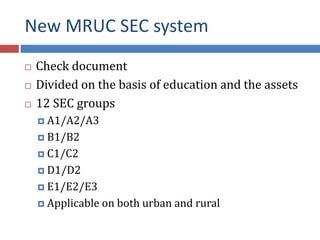
New MRUC SEC system
 Check document
 Divided on the basis of education and the assets
 12 SEC groups
 A1/A2/A3
 B1/B2
 C1/C2
 D1/D2
 E1/E2/E3
 Applicable on both urban and rural
 Social Factors
 Close net affinity is present
 Formal and informal groups are easy to make
 Reference groups
 Informational
 Trial of products used by other in the village
 Normative
 The need to belong
 New form of influencer as professionals
 Anganwadi workers
 Nurses and ASHA members
 SHGs
 Agri-cooperative society
 Funds from NABARD
 Opinion leaders
 Whose words formally or informally influences the action and
attitude of the consumer
 Usually informal
 Comes from social status/power/success in public life
 Gram pradhan/sarpanch is still a greatest influencer
 After independence teacher became influencer
 Now with increasing education, teacher as a influencer is
limited
 Rural educated youth is now the opinion leader
 Influencer for TV/refrigerator/motorcycle etc.
 Male family head is still a decision maker with high involvement
products
 At age 20-22 the rural youth is additional bread earner
 His/her opinion now matters
 Youth is driving the change in rural behavior and practices
 Sociability
 Spend more time with family and friends
 Village choupal and community meetings
 Women meet fetching water, visiting temples or washing
clothes at the pond
 Neighbors are the extension of the family/some times active
participant in family decisions
 Each product is discussed/deliberated/evaluated with
neighbor to increase acceptability
 Example of declining soft drink consumption in rural youths
 Family
 Joint family is disintegrating
 Reasons are education and profession
 They live in same compound but with separate kitchens
 Individualized joint family
 National census records each chulha separately
 Take separate decisions for FMCG and durables
 Lives under the parent family with same values system
 Choice sets for brands will be different in a family
 Comes together on social events and festivals
 Roles and status
 Caste defines social status
 Sarpanch/caste leaders/medical practitioner/retired
military personnel/priest enjoys high status
 These constitute upper level society in village regardless of
economic status
 Their purchase decision do influence
 A progressive farmer is respected for being knowlegable
 The role of rural women
 Used to remain in pardah and ghungat
 Always accompanied by male members
 Mobility was restricted
 Didn’t play significant role in purchase decisions
 Status is changing now
 Now educated and aware about education and health of
family
 Education/health services/social services/functions and
festivals
 Women are empowered today
 Involvement in decision making is increasing
 Personal factors
 Age and stages of lifecycle
 Occupation and income
 Economic situation
 Lifestyle
 Products and status symbol
 Personality and self concept
 Motivation
 Perception
 Learning
 Beliefs and attitudes
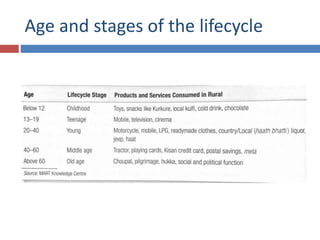
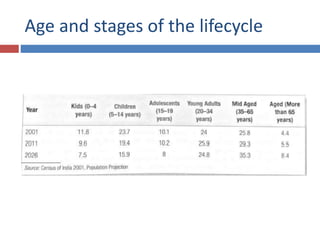
Age and stages of the lifecycle
 Personal factors
 Age and stages of lifecycle
 Occupation and income
 Different occupations have different product needs
 Farmers/potters/teacher/retailers
 Rural has more than one income source
 Rural behavior should not be on the basis of income alone
 Head of the household occupation is important
 Economic situation
 Depends on disposable income/savings and debts/credit
worthiness/attitude towards spending and savings
 Farmers dependent on monsoons
 Reluctant to go for credit due to the risk of status dilution and
reputation
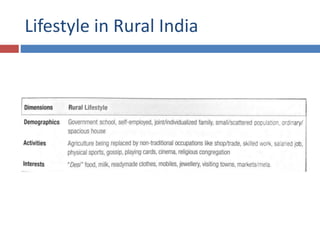
 Lifestyle
 Activities
 Interests
 Opinions
 Demographics
 Changed lifestyle due to change in literacy level and
exposure to TV
 Stylish bikes and trendy mobile phones came in rural
Lifestyle in Rural India
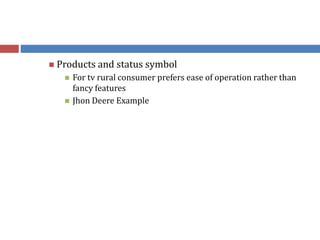
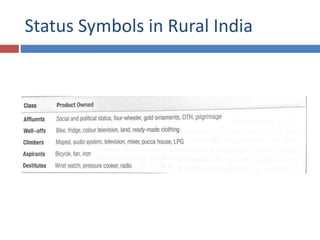
 Products and status symbol
 For tv rural consumer prefers ease of operation rather than
fancy features
 Jhon Deere Example
Status Symbols in Rural India
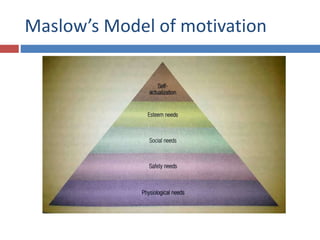
Maslow’s Model of motivation
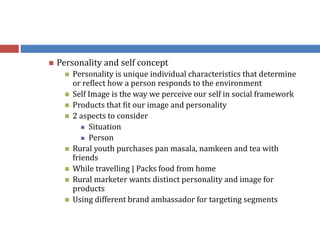
 Personality and self concept
 Personality is unique individual characteristics that determine
or reflect how a person responds to the environment
 Self Image is the way we perceive our self in social framework
 Products that fit our image and personality
 2 aspects to consider
 Situation
 Person
 Rural youth purchases pan masala, namkeen and tea with
friends
 While travelling | Packs food from home
 Rural marketer wants distinct personality and image for
products
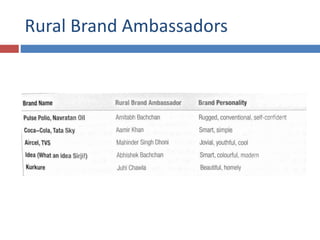
 Using different brand ambassador for targeting segments
Rural Brand Ambassadors
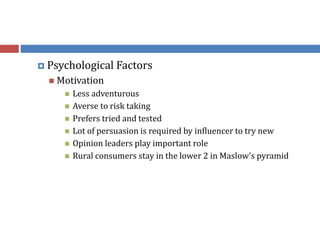
 Psychological Factors
 Motivation
 Less adventurous
 Averse to risk taking
 Prefers tried and tested
 Lot of persuasion is required by influencer to try new
 Opinion leaders play important role
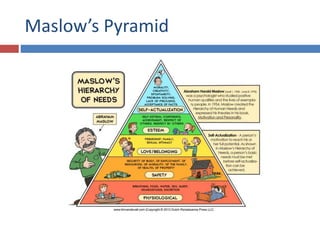
 Rural consumers stay in the lower 2 in Maslow's pyramid
Maslow’s Pyramid
 Perception
 Retailer play important role in FMCG selection
 Connect with small town rural audience with new upcoming
player from rural towns | Example airtel
 Learnings
 Beliefs and attitudes
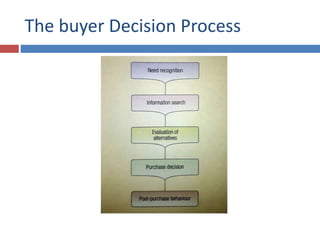
The buyer Decision Process
 The buyer decision process
 Need recognition
 Information search
 Personal sources
 Depends less on Commercial sources
 Depends on experiential sources | Touch and feel |
Demonstration
 Marketer should reduce search time | Introduce product
trials
 BTL activities are effective
 The evaluation of alternatives
 High involvement product- takes time
 Low involvement product- impulse buying
 The purchase decision
 Perceived risk and influencer is important
 Need to address perceived risk by showcasing previous
customer experiences
 Post-purchase behavior
 Positive v/s negative word of mouth
 Dissatisfied customer will never report to the company
about it
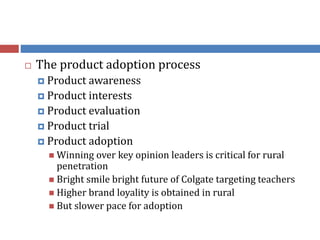
 The product adoption process
 Product awareness
 Product interests
 Product evaluation
 Product trial
 Product adoption
 Winning over key opinion leaders is critical for rural
penetration
 Bright smile bright future of Colgate targeting teachers
 Higher brand loyality is obtained in rural
 But slower pace for adoption
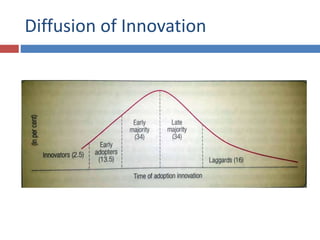
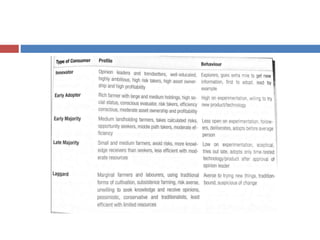
Diffusion of Innovation
Rural marketing 3

Rural marketing 3

  • 1.
  • 2.
    PGDM (IIM Raipur) BakhresaFMCG (South Africa) Relationship Manager (HDFC Bank) MD- Shyam Hospital Faculty(MBA)- GLA University, Mathura Swarit Yadav
  • 3.
     The consumerbuying behavior model  What influences consumer behavior?  Cultural Factors  Culture  Most fundamental determinant  Person grows up with values, perception and preferences  Changes in culture should be analyzed  Change towards education and joint family system
  • 4.
     Social customs Socially accepted norms in practice  Tends to follow age old customs  Touching other body with feet  Traditions  Long standing beliefs that are accepted true  Effects the way humans behave  ‘Atithi devo bhava’- Guests equivalent to gods  Subculture  Caste  Homes/fields and drinking water will be different  Harijan basti/dom para
  • 5.
     Social class On the basis of education and occupation(Urban)  Difficult in calculating annual income in rural areas  Rural do not file income tax  Apart from agriculture, people take up different jobs elsewhere
  • 6.
     SEC  Createdby (market research society of India) MRSI  Depends on education of chief wage earner  Depends on the type of house he lives  Scaled as R1, R2, R3 and R4  R1 and R1 is 19% of rural population(Major Consuming class)  R2 and R3 is 81% of rural population  Urban classification is education and occupation(Sec A,B,C)  Income and occupation is not included  R1 shops from nearby town  R2 and R3 prefers shopping from weekly haats/bargaining power  Use this classification for  Target right segment for product category/launching the product  Use in market research for a product category  Different marketing strategies for different consumer segments  Due to pucca makaan emergence, importance of house in segmentation is reducing  MREC(Media research users council) came up with new system.
  • 7.
  • 8.
  • 9.
    New MRUC SECsystem  Check document  Divided on the basis of education and the assets  12 SEC groups  A1/A2/A3  B1/B2  C1/C2  D1/D2  E1/E2/E3  Applicable on both urban and rural
  • 10.
     Social Factors Close net affinity is present  Formal and informal groups are easy to make  Reference groups  Informational  Trial of products used by other in the village  Normative  The need to belong  New form of influencer as professionals  Anganwadi workers  Nurses and ASHA members  SHGs  Agri-cooperative society  Funds from NABARD
  • 11.
     Opinion leaders Whose words formally or informally influences the action and attitude of the consumer  Usually informal  Comes from social status/power/success in public life  Gram pradhan/sarpanch is still a greatest influencer  After independence teacher became influencer  Now with increasing education, teacher as a influencer is limited  Rural educated youth is now the opinion leader  Influencer for TV/refrigerator/motorcycle etc.  Male family head is still a decision maker with high involvement products  At age 20-22 the rural youth is additional bread earner  His/her opinion now matters  Youth is driving the change in rural behavior and practices
  • 12.
     Sociability  Spendmore time with family and friends  Village choupal and community meetings  Women meet fetching water, visiting temples or washing clothes at the pond  Neighbors are the extension of the family/some times active participant in family decisions  Each product is discussed/deliberated/evaluated with neighbor to increase acceptability  Example of declining soft drink consumption in rural youths
  • 13.
     Family  Jointfamily is disintegrating  Reasons are education and profession  They live in same compound but with separate kitchens  Individualized joint family  National census records each chulha separately  Take separate decisions for FMCG and durables  Lives under the parent family with same values system  Choice sets for brands will be different in a family  Comes together on social events and festivals
  • 14.
     Roles andstatus  Caste defines social status  Sarpanch/caste leaders/medical practitioner/retired military personnel/priest enjoys high status  These constitute upper level society in village regardless of economic status  Their purchase decision do influence  A progressive farmer is respected for being knowlegable
  • 15.
     The roleof rural women  Used to remain in pardah and ghungat  Always accompanied by male members  Mobility was restricted  Didn’t play significant role in purchase decisions  Status is changing now  Now educated and aware about education and health of family  Education/health services/social services/functions and festivals  Women are empowered today  Involvement in decision making is increasing
  • 16.
     Personal factors Age and stages of lifecycle  Occupation and income  Economic situation  Lifestyle  Products and status symbol  Personality and self concept  Motivation  Perception  Learning  Beliefs and attitudes
  • 17.
    Age and stagesof the lifecycle
  • 18.
    Age and stagesof the lifecycle
  • 19.
     Personal factors Age and stages of lifecycle  Occupation and income  Different occupations have different product needs  Farmers/potters/teacher/retailers  Rural has more than one income source  Rural behavior should not be on the basis of income alone  Head of the household occupation is important  Economic situation  Depends on disposable income/savings and debts/credit worthiness/attitude towards spending and savings  Farmers dependent on monsoons  Reluctant to go for credit due to the risk of status dilution and reputation
  • 20.
     Lifestyle  Activities Interests  Opinions  Demographics  Changed lifestyle due to change in literacy level and exposure to TV  Stylish bikes and trendy mobile phones came in rural
  • 21.
  • 22.
     Products andstatus symbol  For tv rural consumer prefers ease of operation rather than fancy features  Jhon Deere Example
  • 23.
    Status Symbols inRural India
  • 24.
  • 25.
     Personality andself concept  Personality is unique individual characteristics that determine or reflect how a person responds to the environment  Self Image is the way we perceive our self in social framework  Products that fit our image and personality  2 aspects to consider  Situation  Person  Rural youth purchases pan masala, namkeen and tea with friends  While travelling | Packs food from home  Rural marketer wants distinct personality and image for products  Using different brand ambassador for targeting segments
  • 26.
  • 27.
     Psychological Factors Motivation  Less adventurous  Averse to risk taking  Prefers tried and tested  Lot of persuasion is required by influencer to try new  Opinion leaders play important role  Rural consumers stay in the lower 2 in Maslow's pyramid
  • 28.
  • 29.
     Perception  Retailerplay important role in FMCG selection  Connect with small town rural audience with new upcoming player from rural towns | Example airtel  Learnings  Beliefs and attitudes
  • 30.
  • 31.
     The buyerdecision process  Need recognition  Information search  Personal sources  Depends less on Commercial sources  Depends on experiential sources | Touch and feel | Demonstration  Marketer should reduce search time | Introduce product trials  BTL activities are effective
  • 32.
     The evaluationof alternatives  High involvement product- takes time  Low involvement product- impulse buying  The purchase decision  Perceived risk and influencer is important  Need to address perceived risk by showcasing previous customer experiences  Post-purchase behavior  Positive v/s negative word of mouth  Dissatisfied customer will never report to the company about it
  • 33.
     The productadoption process  Product awareness  Product interests  Product evaluation  Product trial  Product adoption  Winning over key opinion leaders is critical for rural penetration  Bright smile bright future of Colgate targeting teachers  Higher brand loyality is obtained in rural  But slower pace for adoption
  • 34.