Experiments = Startup Momentum
Sam Rye - Lifehack & Enspiral
@samrye_enspiral
Why
Run Experiments?
Experiments
… are where the action’s at.
They are entrepreneurial currency.
Experiments give you (in)validated learnings;
de-risk your business model, drive internal
culture, and provide evidence to yourself and
investors that you have the rigour to succeed.
Experiments
… in short experiments save you time,
energy and money.
They teach you things quickly so you don’t
waste your life building something no one
wants or something no one will buy.
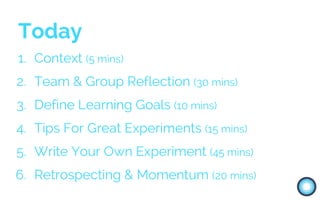
Today
1. Context (5 mins)
2. Team & Group Reflection (30 mins)
3. Define Learning Goals (10 mins)
4. Tips For Great Experiments (15 mins)
5. Write Your Own Experiment (45 mins)
6. Retrospecting & Momentum (20 mins)
Context
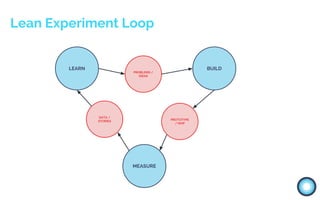
Lean Experiment Loop
BUILDLEARN
MEASURE
PROTOTYPE
/ MVP
DATA /
STORIES
PROBLEMS /
IDEAS
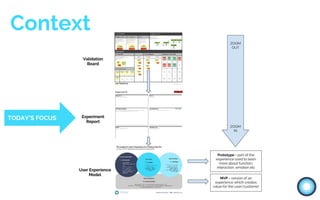
Context
TODAY’S FOCUS
Looking Within
team reflection
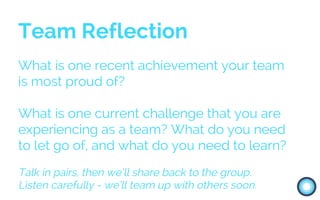
Team Reflection
What is one recent achievement your team
is most proud of?
What is one current challenge that you are
experiencing as a team? What do you need
to let go of, and what do you need to learn?
Talk in pairs, then we’ll share back to the group.
Listen carefully - we’ll team up with others soon.
Reframing Your Challenge
group reflection
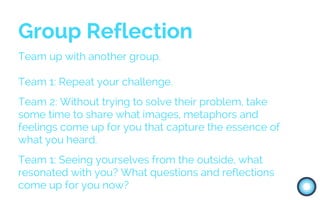
Group Reflection
Team up with another group.
Team 1: Repeat your challenge.
Team 2: Without trying to solve their problem, take
some time to share what images, metaphors and
feelings come up for you that capture the essence of
what you heard.
Team 1: Seeing yourselves from the outside, what
resonated with you? What questions and reflections
come up for you now?
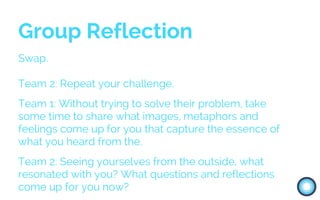
Group Reflection
Swap.
Team 2: Repeat your challenge.
Team 1: Without trying to solve their problem, take
some time to share what images, metaphors and
feelings come up for you that capture the essence of
what you heard from the.
Team 2: Seeing yourselves from the outside, what
resonated with you? What questions and reflections
come up for you now?
Ensuring Focus & Intention
defining a learning goal
Focus & Intention
Pause to reflect. Think about what you just heard.
Now, what is the real challenge that you need to solve
in the next 10 days to move your venture forward?
Is it internal or external?
Is it business model or product?
Is it to do with your user or customer?
If you could learn one thing in the next 10 days,
what would it be?
This is your learning goal
share it in one sentence with the group
write it down, we’ll be using it in a moment
Pitfalls & Possibilities
tips for great experiments
Pitfalls and possibilities
Experiments are additive not standalone
● Experiments aren’t standalone.
● Don’t expect to de-risk your business model in one go.
● Incrementally mitigate risks through a series of small
experiments.
● Evolve complexity on top of simplicity.
Pitfalls and possibilities
Experiments are additive not standalone
Example:
● First experiment might be to do a customer survey +
gain an insight into your value proposition.
● Second experiment might be to write one page of
marketing copy + get customer reactions.
● Third experiment might be to create a landing page for
your service with a sign up form.
● Fourth experiment might be to print flyers, deliver them
to customers + have a pre-order page online.
Pitfalls and possibilities
Every experiment needs to be falsifiable and
time-boxed
● Experiments need to be falsifiable (written as
statements that can be clearly proven wrong) in order
to clearly declare them validated or invalidated.
● Outside of the accelerator, time is the scarcest resource
in a startup.
● You’re more likely to fail because you run out of money,
than because your idea sucks.
Pitfalls and possibilities
Every experiment needs to be falsifiable and
time-boxed
Example:
● If I write a blog, I will get > 20 new signups to my email
newsletter in 5 days.
Pitfalls and possibilities
Breakthrough insights are usually hidden
within failed experiments
● “There is no such thing as a failed experiment, only
experiments with unexpected outcomes.” -
Buckminster Fuller
● Learning reflection is absolutely vital to entrepreneurial
process.
Pitfalls and possibilities
Breakthrough insights are usually hidden
within failed experiments
Example:
● At Lifehack, we experimented with advertising our
event in a local paper on the West Coast. We had one
response to the ad who wasn’t our target audience.
● We learnt that using existing networks, word of mouth
& posters were more powerful for our audience than
advertising in local press for the Coast.
Pitfalls and possibilities
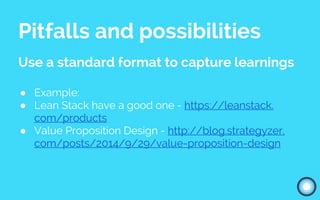
Use a standard format to capture learnings
● Crystalise and visualizing your thinking, share with
teams & advisors.
● Cuts out the noise. Archive the learning.
● Playback experiments through these reports -
communicate learning to new team members &
advisors, helps demonstrate rigour to investors.
● Keep up the momentum.
Pitfalls and possibilities
Use a standard format to capture learnings
● Example:
● Lean Stack have a good one - https://leanstack.
com/products
● Value Proposition Design - http://blog.strategyzer.
com/posts/2014/9/29/value-proposition-design
Build | Measure | Learn
write your own experiment
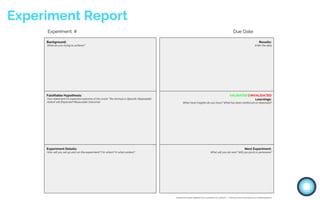
Experiment Report
Background:
What are you trying to achieve or learn?
[insert learning goal here]
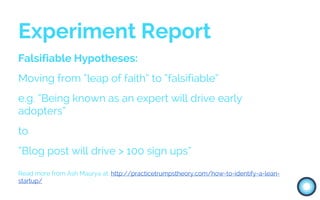
Experiment Report
Falsifiable Hypotheses:
Moving from “leap of faith” to “falsifiable”
e.g. “Being known as an expert will drive early
adopters”
to
“Blog post will drive > 100 sign ups”
Read more from Ash Maurya at: http://practicetrumpstheory.com/how-to-identify-a-lean-
startup/
Experiment Report
Falsifiable Hypotheses:
I believe [target market] will [do this action / use this
solution] for [this reason].
Write it down.
Get more granular. Which segment of the target
market?
Can you measure each part of this statement? Can
you validate or invalidate it?
Experiment Report
Experiment Details:
How will you set up your experiment to achieve your
learning goal?
Keep it simple, but don’t be afraid to be creative.
Can you learn about a “digital product” through an
analog experience; think 3D prototypes.
What will you record? How will you record it?
Experiment Report
Build | Measure | Learn
building momentum & complexity
with experiment retrospectives
Results:
The hard data & the stories.
Learnings:
What did you learn from the outcomes, as well as the
process?
Next Experiment:
What is the next step? Run again with tweaks? Run
something completely different? What do this mean?
Experiment Reflection
After Reflecting:
Make sure you update your value proposition canvas,
your experiment board, and if you’ve de-risked
something major - your lean canvas.
Schedule time with your team/advisors to do this
process EVERY WEEK
Save the experiment sheet:
Set up a google drive for photos or documents.
Share with your team in Slack.
Experiment Reflection
Build | Measure | Learn
this is where you build momentum,
learning is the currency of entrepreneurship
Reflections on today
What did you learn today? What will you be
taking away?
What will you change about what you have
been doing?
How could we do this workshop differently or
better?
Thanks!
@samrye_enspiral
@lifehackhq

Running Lean Startup Experiments

  • 1.
    Experiments = StartupMomentum Sam Rye - Lifehack & Enspiral @samrye_enspiral
  • 2.
  • 3.
    Experiments … are wherethe action’s at. They are entrepreneurial currency. Experiments give you (in)validated learnings; de-risk your business model, drive internal culture, and provide evidence to yourself and investors that you have the rigour to succeed.
  • 4.
    Experiments … in shortexperiments save you time, energy and money. They teach you things quickly so you don’t waste your life building something no one wants or something no one will buy.
  • 5.
    Today 1. Context (5mins) 2. Team & Group Reflection (30 mins) 3. Define Learning Goals (10 mins) 4. Tips For Great Experiments (15 mins) 5. Write Your Own Experiment (45 mins) 6. Retrospecting & Momentum (20 mins)
  • 6.
  • 7.
    Lean Experiment Loop BUILDLEARN MEASURE PROTOTYPE /MVP DATA / STORIES PROBLEMS / IDEAS
  • 8.
  • 9.
  • 10.
    Team Reflection What isone recent achievement your team is most proud of? What is one current challenge that you are experiencing as a team? What do you need to let go of, and what do you need to learn? Talk in pairs, then we’ll share back to the group. Listen carefully - we’ll team up with others soon.
  • 11.
  • 12.
    Group Reflection Team upwith another group. Team 1: Repeat your challenge. Team 2: Without trying to solve their problem, take some time to share what images, metaphors and feelings come up for you that capture the essence of what you heard. Team 1: Seeing yourselves from the outside, what resonated with you? What questions and reflections come up for you now?
  • 13.
    Group Reflection Swap. Team 2:Repeat your challenge. Team 1: Without trying to solve their problem, take some time to share what images, metaphors and feelings come up for you that capture the essence of what you heard from the. Team 2: Seeing yourselves from the outside, what resonated with you? What questions and reflections come up for you now?
  • 14.
    Ensuring Focus &Intention defining a learning goal
  • 15.
    Focus & Intention Pauseto reflect. Think about what you just heard. Now, what is the real challenge that you need to solve in the next 10 days to move your venture forward? Is it internal or external? Is it business model or product? Is it to do with your user or customer? If you could learn one thing in the next 10 days, what would it be?
  • 16.
    This is yourlearning goal share it in one sentence with the group write it down, we’ll be using it in a moment
  • 17.
    Pitfalls & Possibilities tipsfor great experiments
  • 18.
    Pitfalls and possibilities Experimentsare additive not standalone ● Experiments aren’t standalone. ● Don’t expect to de-risk your business model in one go. ● Incrementally mitigate risks through a series of small experiments. ● Evolve complexity on top of simplicity.
  • 19.
    Pitfalls and possibilities Experimentsare additive not standalone Example: ● First experiment might be to do a customer survey + gain an insight into your value proposition. ● Second experiment might be to write one page of marketing copy + get customer reactions. ● Third experiment might be to create a landing page for your service with a sign up form. ● Fourth experiment might be to print flyers, deliver them to customers + have a pre-order page online.
  • 20.
    Pitfalls and possibilities Everyexperiment needs to be falsifiable and time-boxed ● Experiments need to be falsifiable (written as statements that can be clearly proven wrong) in order to clearly declare them validated or invalidated. ● Outside of the accelerator, time is the scarcest resource in a startup. ● You’re more likely to fail because you run out of money, than because your idea sucks.
  • 21.
    Pitfalls and possibilities Everyexperiment needs to be falsifiable and time-boxed Example: ● If I write a blog, I will get > 20 new signups to my email newsletter in 5 days.
  • 22.
    Pitfalls and possibilities Breakthroughinsights are usually hidden within failed experiments ● “There is no such thing as a failed experiment, only experiments with unexpected outcomes.” - Buckminster Fuller ● Learning reflection is absolutely vital to entrepreneurial process.
  • 23.
    Pitfalls and possibilities Breakthroughinsights are usually hidden within failed experiments Example: ● At Lifehack, we experimented with advertising our event in a local paper on the West Coast. We had one response to the ad who wasn’t our target audience. ● We learnt that using existing networks, word of mouth & posters were more powerful for our audience than advertising in local press for the Coast.
  • 24.
    Pitfalls and possibilities Usea standard format to capture learnings ● Crystalise and visualizing your thinking, share with teams & advisors. ● Cuts out the noise. Archive the learning. ● Playback experiments through these reports - communicate learning to new team members & advisors, helps demonstrate rigour to investors. ● Keep up the momentum.
  • 25.
    Pitfalls and possibilities Usea standard format to capture learnings ● Example: ● Lean Stack have a good one - https://leanstack. com/products ● Value Proposition Design - http://blog.strategyzer. com/posts/2014/9/29/value-proposition-design
  • 26.
    Build | Measure| Learn write your own experiment
  • 27.
  • 28.
    Background: What are youtrying to achieve or learn? [insert learning goal here] Experiment Report
  • 29.
    Falsifiable Hypotheses: Moving from“leap of faith” to “falsifiable” e.g. “Being known as an expert will drive early adopters” to “Blog post will drive > 100 sign ups” Read more from Ash Maurya at: http://practicetrumpstheory.com/how-to-identify-a-lean- startup/ Experiment Report
  • 30.
    Falsifiable Hypotheses: I believe[target market] will [do this action / use this solution] for [this reason]. Write it down. Get more granular. Which segment of the target market? Can you measure each part of this statement? Can you validate or invalidate it? Experiment Report
  • 31.
    Experiment Details: How willyou set up your experiment to achieve your learning goal? Keep it simple, but don’t be afraid to be creative. Can you learn about a “digital product” through an analog experience; think 3D prototypes. What will you record? How will you record it? Experiment Report
  • 32.
    Build | Measure| Learn building momentum & complexity with experiment retrospectives
  • 33.
    Results: The hard data& the stories. Learnings: What did you learn from the outcomes, as well as the process? Next Experiment: What is the next step? Run again with tweaks? Run something completely different? What do this mean? Experiment Reflection
  • 34.
    After Reflecting: Make sureyou update your value proposition canvas, your experiment board, and if you’ve de-risked something major - your lean canvas. Schedule time with your team/advisors to do this process EVERY WEEK Save the experiment sheet: Set up a google drive for photos or documents. Share with your team in Slack. Experiment Reflection
  • 35.
    Build | Measure| Learn this is where you build momentum, learning is the currency of entrepreneurship
  • 36.
    Reflections on today Whatdid you learn today? What will you be taking away? What will you change about what you have been doing? How could we do this workshop differently or better?
  • 37.