Running head: PROJECT MANAGEMENT
1
PROJECT MANAGEMENT
7
Project Management
William Fiedler
Columbia Southern University
Project Management
Statement of the Customer’s Needs
The project is in line with the company’s efforts to construct
more homes for the public. Currently, the firm is facing stiff
competition from other businesses in the construction industry.
For instance, some construction firms have adopted strategies
such as advertising to attract customers. Equally, other firms
have been in the market for a more extended time which gives
them an advantage (Hesterly & Barney, 2008). As a result, the
company has few customers for its products. Also, the
construction industry is facing a challenge of limited land. The
increase in population has put a lot of pressure on the available
land which has reduced the land available for construction. As a
result, the available land is too expensive to purchase.
Assumptions
One of the assumptions of the project is that the competition in
the construction industry will continue to increase. The other
assumption is that the value of land in the market will keep on
appreciating. Another assumption is that the construction
company will keep losing its customers if it does come up with
an effective strategy as soon as possible. Also, it is assumed
that there is a high demand for houses in the market and that
minimum costs are incurred in the construction industry.
The Project Scope
The proposed solution is to construct modern residential
apartments since they occupy less space on land. The solution
will benefit the firm in various ways. For instance, the
apartments will save on land since they will occupy more
vertical space as compared to horizontal space. Equally, less
land will be purchased which will help the company to save
money. Another benefit that a construction industry can reap
from implementing this solution is that the apartment will make
the firm a lot of profit. The apartment will home many people
who will generate a lot of profit for the company once it sells or
leases these apartments.
Based on this solution, research will be conducted on the best
modern designs that will be used in the construction of these
apartments. Information will be collected through observing the
other apartments in the area to get a glimpse of what the
company needs to do and what to avoid. Equally, construction
experts such as architects will be consulted on the same to help
come up with the best modern designs. Additionally, the land
available for construction will be investigated and the
information generated analyzed to determine if it is suitable for
construction. Consequently, this measure will prevent issues
such as the collapse of the flats after completion. The
construction materials will be researched to aid in selecting the
best resources to use to ensure that quality apartments are
constructed. Modern flats are attractive in the market since they
meet the needs of the contemporary public. In the process, these
apartments will generate profits for construction industries.
Therefore, this project will be geared towards attracting more
clients for the company and making profits for the firm, a
solution that best addresses the issues being faced by the
construction company.
Deliverables
The deliverables in this construction project include an architect
who will be responsible for designing the apartments and
providing the design drawings. As a result, the client will be
able to see how the buildings will appear. Another deliverable
that will be provided is an engineering report and a site
investigation report. The other deliverables include personnel
that will be responsible for decorating the apartments. The final
deliverable will the apartments.
Resources
The construction project will require resources to ensure its
success. They will be categorized into two parts, resources
provided by the construction company and the resources that we
will provide for the client. The latter includes resources such as
materials for construction, land, and capital while the former
will provide labor, the construction experts such as engineers
and architects, designs of the apartments, and the manual
workers.
Scheduling
The project will take two years to complete. The first step will
be a site investigation which will take two weeks. The architects
will the take a month to design the apartments and present the
design drawings for approval. From there, the required
materials and the equipment will be purchased and availed at
the site which will take a month. The following ten months will
be used to construct the apartments from the ground up to the
last floor. The final year will be used for finishing the
apartments which will include activities such as painting,
installing sanitation equipment, and decorating the apartments
Pricing
The costs that will be incurred include;
Contractor $ 205, 000
Subcontractors $ 100, 463
Materials $ 500, 000
Labor $ 50, 000
Equipment $ 300,000
Expected Benefits $ 20,000
Total = $ 1, 175, 463
Risks
One of the risks that may be encountered in the construction
project is an unfavorable climate such as rainy seasons. As a
result, the construction will be delayed. Nonetheless, measures
will be taken to ensure that the construction proceeds during the
rainy season Smith, Merna & Jobling, 2009). Another risk that
may be encountered is expensive materials and equipment.
However, this risk will be addressed by using the alternatives
for these items.
Expected Benefits
One of the benefits of this project is that the apartments will
have a parking lot which will attract clients for the construction
company. Most people are drawn to homes that have a place
where they can park their vehicles. The other benefit is a
building advertisement which will be placed on one side of the
apartment to help market the apartments.
References
Hesterly, B., & Barney, J. (2008). Strategic management and
competitive advantage. England: Pearson Prentice Hall.
Smith, N. J., Merna, T., & Jobling, P. (2009). Managing risk: in
construction projects. John Wiley & Sons.
Student Version
How Organizations and Environments Interact
Environments
Organization Environment Interface
Organizations
Change and Complexity
Competitive Forces
Turbulence
Information Management
Strategic Response
Mergers, Takeovers, Acquisitions, Alliances
Organization Design and Flexibility
Direct Influence
© 2016 Cengage Learning. All rights reserved. May not be
copied, scanned, or duplicated, in whole or in part, except for
use as permitted in a license distributed with a certain product
or service or otherwise on a password-protected website for
classroom use.
2–2
2
Five-Forces Analysis (Porter)
Performance of organizations in an industry
Power of
Buyers
Level of
Rivalry
Power of
Suppliers
Threat of
New Entrants
Threat of
Substitute Products
© 2016 Cengage Learning. All rights reserved. May not be
copied, scanned, or duplicated, in whole or in part, except for
use as permitted in a license distributed with a certain product
or service or otherwise on a password-protected website for
classroom use.
2–3
3
Determinants of Individual Ethics
Family
Influences
Situational
Factors
Values and
Morals
Experiences
Peer
Influences
Individual Ethics
© 2016 Cengage Learning. All rights reserved. May not be
copied, scanned, or duplicated, in whole or in part, except for
use as permitted in a license distributed with a certain product
or service or otherwise on a password-protected website for
classroom use.
2–4
4
Managerial Ethics
Employees
Organization
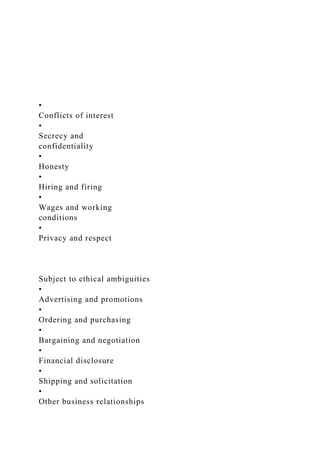
•
Conflicts of interest
•
Secrecy and
confidentiality
•
Honesty
•
Hiring and firing
•
Wages and working
conditions
•
Privacy and respect
Subject to ethical ambiguities
•
Advertising and promotions
•
Ordering and purchasing
•
Bargaining and negotiation
•
Financial disclosure
•
Shipping and solicitation
•
Other business relationships
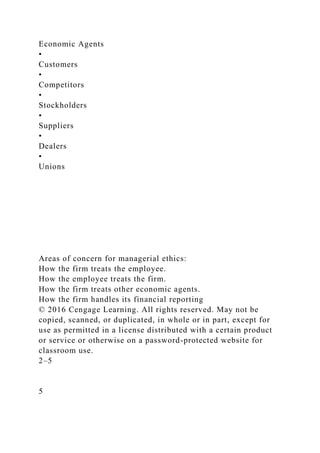
Economic Agents
•
Customers
•
Competitors
•
Stockholders
•
Suppliers
•
Dealers
•
Unions
Areas of concern for managerial ethics:
How the firm treats the employee.
How the employee treats the firm.
How the firm treats other economic agents.
How the firm handles its financial reporting
© 2016 Cengage Learning. All rights reserved. May not be
copied, scanned, or duplicated, in whole or in part, except for
use as permitted in a license distributed with a certain product
or service or otherwise on a password-protected website for
classroom use.
2–5
5
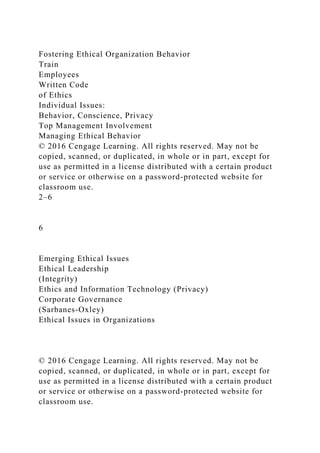
Fostering Ethical Organization Behavior
Train
Employees
Written Code
of Ethics
Individual Issues:
Behavior, Conscience, Privacy
Top Management Involvement
Managing Ethical Behavior
© 2016 Cengage Learning. All rights reserved. May not be
copied, scanned, or duplicated, in whole or in part, except for
use as permitted in a license distributed with a certain product
or service or otherwise on a password-protected website for
classroom use.
2–6
6
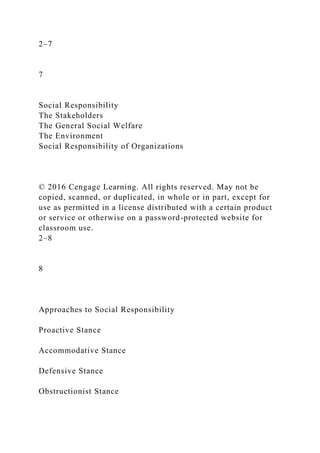
Emerging Ethical Issues
Ethical Leadership
(Integrity)
Ethics and Information Technology (Privacy)
Corporate Governance
(Sarbanes-Oxley)
Ethical Issues in Organizations
© 2016 Cengage Learning. All rights reserved. May not be
copied, scanned, or duplicated, in whole or in part, except for
use as permitted in a license distributed with a certain product
or service or otherwise on a password-protected website for
classroom use.
2–7
7
Social Responsibility
The Stakeholders
The General Social Welfare
The Environment
Social Responsibility of Organizations
© 2016 Cengage Learning. All rights reserved. May not be
copied, scanned, or duplicated, in whole or in part, except for
use as permitted in a license distributed with a certain product
or service or otherwise on a password-protected website for
classroom use.
2–8
8
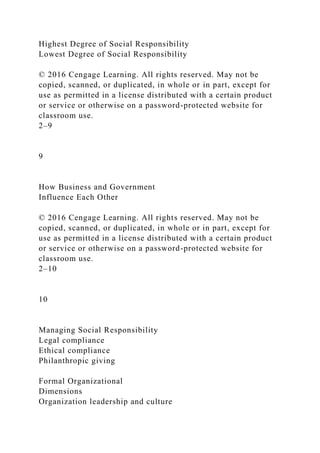
Approaches to Social Responsibility
Proactive Stance
Accommodative Stance
Defensive Stance
Obstructionist Stance
Highest Degree of Social Responsibility
Lowest Degree of Social Responsibility
© 2016 Cengage Learning. All rights reserved. May not be
copied, scanned, or duplicated, in whole or in part, except for
use as permitted in a license distributed with a certain product
or service or otherwise on a password-protected website for
classroom use.
2–9
9
How Business and Government
Influence Each Other
© 2016 Cengage Learning. All rights reserved. May not be
copied, scanned, or duplicated, in whole or in part, except for
use as permitted in a license distributed with a certain product
or service or otherwise on a password-protected website for
classroom use.
2–10
10
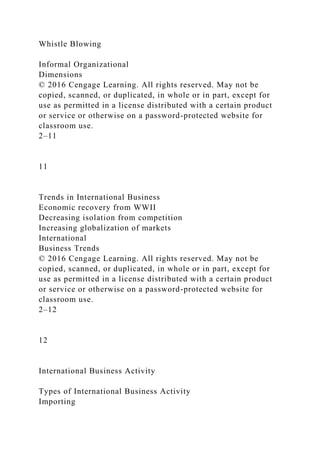
Managing Social Responsibility
Legal compliance
Ethical compliance
Philanthropic giving
Formal Organizational
Dimensions
Organization leadership and culture
Whistle Blowing
Informal Organizational
Dimensions
© 2016 Cengage Learning. All rights reserved. May not be
copied, scanned, or duplicated, in whole or in part, except for
use as permitted in a license distributed with a certain product
or service or otherwise on a password-protected website for
classroom use.
2–11
11
Trends in International Business
Economic recovery from WWII
Decreasing isolation from competition
Increasing globalization of markets
International
Business Trends
© 2016 Cengage Learning. All rights reserved. May not be
copied, scanned, or duplicated, in whole or in part, except for
use as permitted in a license distributed with a certain product
or service or otherwise on a password-protected website for
classroom use.
2–12
12
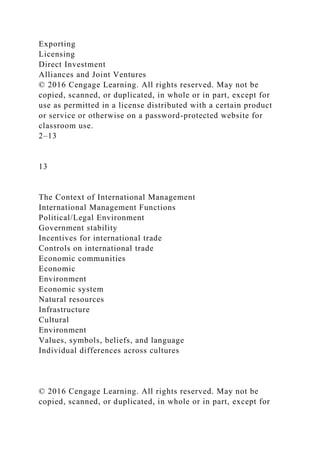
International Business Activity
Types of International Business Activity
Importing
Exporting
Licensing
Direct Investment
Alliances and Joint Ventures
© 2016 Cengage Learning. All rights reserved. May not be
copied, scanned, or duplicated, in whole or in part, except for
use as permitted in a license distributed with a certain product
or service or otherwise on a password-protected website for
classroom use.
2–13
13
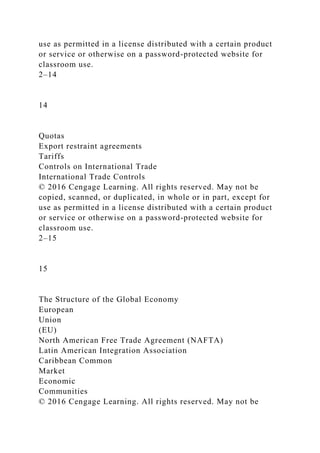
The Context of International Management
International Management Functions
Political/Legal Environment
Government stability
Incentives for international trade
Controls on international trade
Economic communities
Economic
Environment
Economic system
Natural resources
Infrastructure
Cultural
Environment
Values, symbols, beliefs, and language
Individual differences across cultures
© 2016 Cengage Learning. All rights reserved. May not be
copied, scanned, or duplicated, in whole or in part, except for
use as permitted in a license distributed with a certain product
or service or otherwise on a password-protected website for
classroom use.
2–14
14
Quotas
Export restraint agreements
Tariffs
Controls on International Trade
International Trade Controls
© 2016 Cengage Learning. All rights reserved. May not be
copied, scanned, or duplicated, in whole or in part, except for
use as permitted in a license distributed with a certain product
or service or otherwise on a password-protected website for
classroom use.
2–15
15
The Structure of the Global Economy
European
Union
(EU)
North American Free Trade Agreement (NAFTA)
Latin American Integration Association
Caribbean Common
Market
Economic
Communities
© 2016 Cengage Learning. All rights reserved. May not be
copied, scanned, or duplicated, in whole or in part, except for
use as permitted in a license distributed with a certain product
or service or otherwise on a password-protected website for
classroom use.
2–16
16
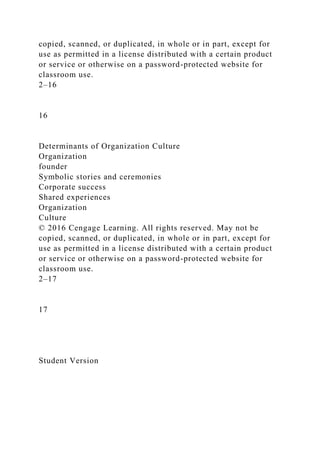
Determinants of Organization Culture
Organization
founder
Symbolic stories and ceremonies
Corporate success
Shared experiences
Organization
Culture
© 2016 Cengage Learning. All rights reserved. May not be
copied, scanned, or duplicated, in whole or in part, except for
use as permitted in a license distributed with a certain product
or service or otherwise on a password-protected website for
classroom use.
2–17
17
Student Version
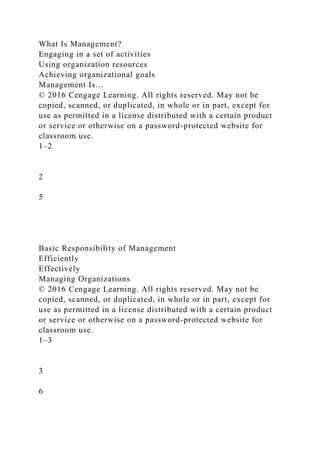
What Is Management?
Engaging in a set of activities
Using organization resources
Achieving organizational goals
Management Is…
© 2016 Cengage Learning. All rights reserved. May not be
copied, scanned, or duplicated, in whole or in part, except for
use as permitted in a license distributed with a certain product
or service or otherwise on a password-protected website for
classroom use.
1–2
2
5
Basic Responsibility of Management
Efficiently
Effectively
Managing Organizations
© 2016 Cengage Learning. All rights reserved. May not be
copied, scanned, or duplicated, in whole or in part, except for
use as permitted in a license distributed with a certain product
or service or otherwise on a password-protected website for
classroom use.
1–3
3
6
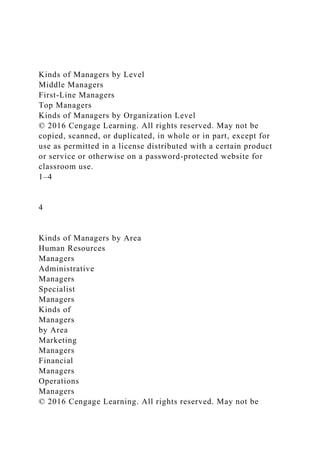
Kinds of Managers by Level
Middle Managers
First-Line Managers
Top Managers
Kinds of Managers by Organization Level
© 2016 Cengage Learning. All rights reserved. May not be
copied, scanned, or duplicated, in whole or in part, except for
use as permitted in a license distributed with a certain product
or service or otherwise on a password-protected website for
classroom use.
1–4
4
Kinds of Managers by Area
Human Resources
Managers
Administrative
Managers
Specialist
Managers
Kinds of
Managers
by Area
Marketing
Managers
Financial
Managers
Operations
Managers
© 2016 Cengage Learning. All rights reserved. May not be
copied, scanned, or duplicated, in whole or in part, except for
use as permitted in a license distributed with a certain product
or service or otherwise on a password-protected website for
classroom use.
1–5
5
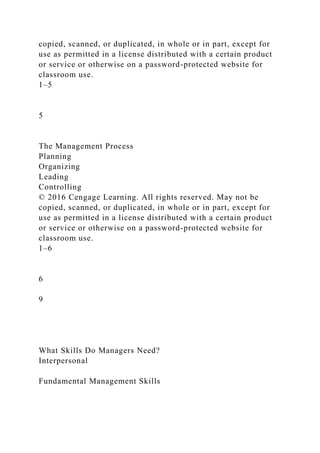
The Management Process
Planning
Organizing
Leading
Controlling
© 2016 Cengage Learning. All rights reserved. May not be
copied, scanned, or duplicated, in whole or in part, except for
use as permitted in a license distributed with a certain product
or service or otherwise on a password-protected website for
classroom use.
1–6
6
9
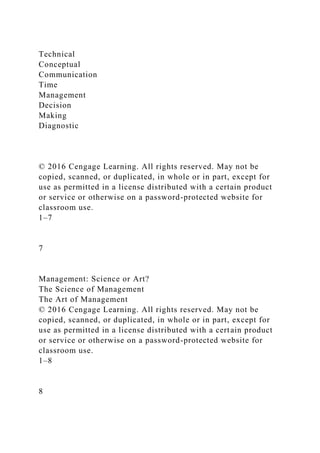
What Skills Do Managers Need?
Interpersonal
Fundamental Management Skills
Technical
Conceptual
Communication
Time
Management
Decision
Making
Diagnostic
© 2016 Cengage Learning. All rights reserved. May not be
copied, scanned, or duplicated, in whole or in part, except for
use as permitted in a license distributed with a certain product
or service or otherwise on a password-protected website for
classroom use.
1–7
7
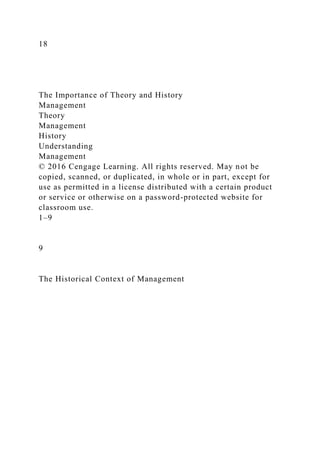
Management: Science or Art?
The Science of Management
The Art of Management
© 2016 Cengage Learning. All rights reserved. May not be
copied, scanned, or duplicated, in whole or in part, except for
use as permitted in a license distributed with a certain product
or service or otherwise on a password-protected website for
classroom use.
1–8
8
18
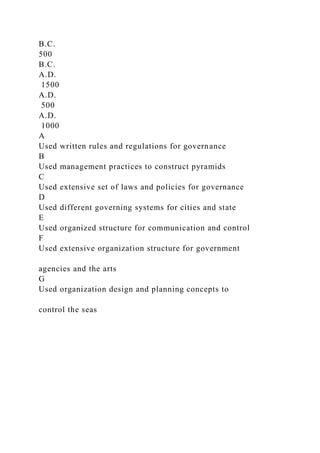
The Importance of Theory and History
Management
Theory
Management
History
Understanding
Management
© 2016 Cengage Learning. All rights reserved. May not be
copied, scanned, or duplicated, in whole or in part, except for
use as permitted in a license distributed with a certain product
or service or otherwise on a password-protected website for
classroom use.
1–9
9
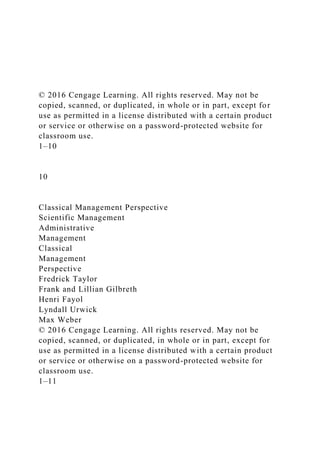
The Historical Context of Management
3000
B.C.
2500
B.C.
A
Sumerians
F
Chinese
B
Egyptians
C
Babylonians
D
Greeks
G
Venetians
E
Romans
2000
B.C.
1500
B.C.
1000
B.C.
500
B.C.
A.D.
1500
A.D.
500
A.D.
1000
A
Used written rules and regulations for governance
B
Used management practices to construct pyramids
C
Used extensive set of laws and policies for governance
D
Used different governing systems for cities and state
E
Used organized structure for communication and control
F
Used extensive organization structure for government
agencies and the arts
G
Used organization design and planning concepts to
control the seas
© 2016 Cengage Learning. All rights reserved. May not be
copied, scanned, or duplicated, in whole or in part, except for
use as permitted in a license distributed with a certain product
or service or otherwise on a password-protected website for
classroom use.
1–10
10
Classical Management Perspective
Scientific Management
Administrative
Management
Classical
Management
Perspective
Fredrick Taylor
Frank and Lillian Gilbreth
Henri Fayol
Lyndall Urwick
Max Weber
© 2016 Cengage Learning. All rights reserved. May not be
copied, scanned, or duplicated, in whole or in part, except for
use as permitted in a license distributed with a certain product
or service or otherwise on a password-protected website for
classroom use.
1–11
11
5
Behavioral Management Perspective
Hugo Munsterberg
Mary Parker Follett
Behavioral
Management
Perspective
© 2016 Cengage Learning. All rights reserved. May not be
copied, scanned, or duplicated, in whole or in part, except for
use as permitted in a license distributed with a certain product
or service or otherwise on a password-protected website for
classroom use.
1–12
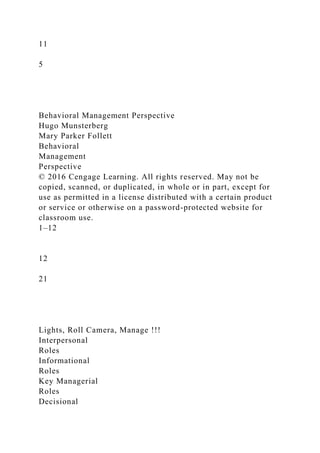
12
21
Lights, Roll Camera, Manage !!!
Interpersonal
Roles
Informational
Roles
Key Managerial
Roles
Decisional
Roles
© 2016 Cengage Learning. All rights reserved. May not be
copied, scanned, or duplicated, in whole or in part, except for
use as permitted in a license distributed with a certain product
or service or otherwise on a password-protected website for
classroom use.
1–13
13
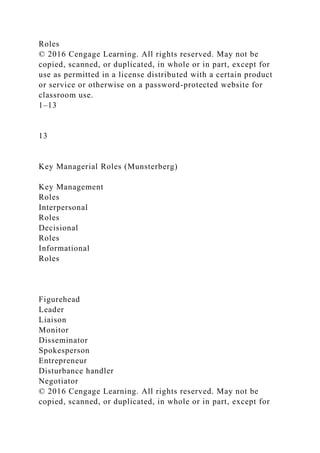
Key Managerial Roles (Munsterberg)
Key Management
Roles
Interpersonal
Roles
Decisional
Roles
Informational
Roles
Figurehead
Leader
Liaison
Monitor
Disseminator
Spokesperson
Entrepreneur
Disturbance handler
Negotiator
© 2016 Cengage Learning. All rights reserved. May not be
copied, scanned, or duplicated, in whole or in part, except for
use as permitted in a license distributed with a certain product
or service or otherwise on a password-protected website for
classroom use.
1–14
14
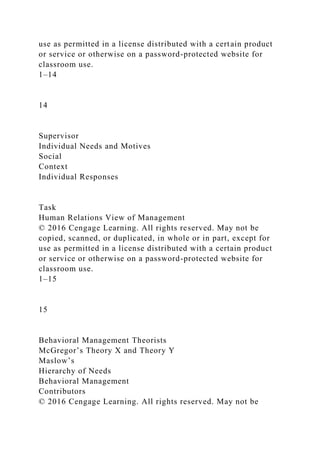
Supervisor
Individual Needs and Motives
Social
Context
Individual Responses
Task
Human Relations View of Management
© 2016 Cengage Learning. All rights reserved. May not be
copied, scanned, or duplicated, in whole or in part, except for
use as permitted in a license distributed with a certain product
or service or otherwise on a password-protected website for
classroom use.
1–15
15
Behavioral Management Theorists
McGregor’s Theory X and Theory Y
Maslow’s
Hierarchy of Needs
Behavioral Management
Contributors
© 2016 Cengage Learning. All rights reserved. May not be
copied, scanned, or duplicated, in whole or in part, except for
use as permitted in a license distributed with a certain product
or service or otherwise on a password-protected website for
classroom use.
1–16
16
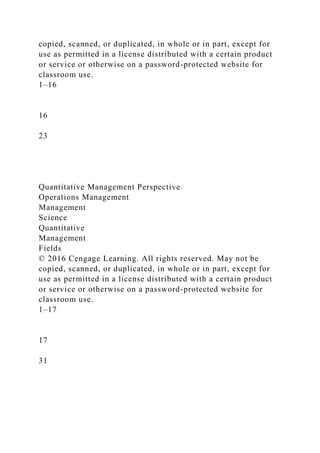
23
Quantitative Management Perspective
Operations Management
Management
Science
Quantitative
Management
Fields
© 2016 Cengage Learning. All rights reserved. May not be
copied, scanned, or duplicated, in whole or in part, except for
use as permitted in a license distributed with a certain product
or service or otherwise on a password-protected website for
classroom use.
1–17
17
31
The Systems Perspective
Open Systems
Closed Systems
Subsystems
Organizational
Systems Concepts
© 2016 Cengage Learning. All rights reserved. May not be
copied, scanned, or duplicated, in whole or in part, except for
use as permitted in a license distributed with a certain product
or service or otherwise on a password-protected website for
classroom use.
1–18
18
37
The Contingency Perspective
Universal Perspectives
Contingency Perspective
Management of
Organizations
© 2016 Cengage Learning. All rights reserved. May not be
copied, scanned, or duplicated, in whole or in part, except for
use as permitted in a license distributed with a certain product
or service or otherwise on a password-protected website for
classroom use.
1–19
19
The Contingency Perspective Process
Problem or Situation
Solution
or Action
B

Running head PROJECT MANAGEMENT .docx

  • 1.
    Running head: PROJECTMANAGEMENT 1 PROJECT MANAGEMENT 7 Project Management William Fiedler Columbia Southern University Project Management Statement of the Customer’s Needs The project is in line with the company’s efforts to construct more homes for the public. Currently, the firm is facing stiff competition from other businesses in the construction industry. For instance, some construction firms have adopted strategies such as advertising to attract customers. Equally, other firms have been in the market for a more extended time which gives them an advantage (Hesterly & Barney, 2008). As a result, the company has few customers for its products. Also, the
  • 2.
    construction industry isfacing a challenge of limited land. The increase in population has put a lot of pressure on the available land which has reduced the land available for construction. As a result, the available land is too expensive to purchase. Assumptions One of the assumptions of the project is that the competition in the construction industry will continue to increase. The other assumption is that the value of land in the market will keep on appreciating. Another assumption is that the construction company will keep losing its customers if it does come up with an effective strategy as soon as possible. Also, it is assumed that there is a high demand for houses in the market and that minimum costs are incurred in the construction industry. The Project Scope The proposed solution is to construct modern residential apartments since they occupy less space on land. The solution will benefit the firm in various ways. For instance, the apartments will save on land since they will occupy more vertical space as compared to horizontal space. Equally, less land will be purchased which will help the company to save money. Another benefit that a construction industry can reap from implementing this solution is that the apartment will make the firm a lot of profit. The apartment will home many people who will generate a lot of profit for the company once it sells or leases these apartments. Based on this solution, research will be conducted on the best modern designs that will be used in the construction of these apartments. Information will be collected through observing the other apartments in the area to get a glimpse of what the company needs to do and what to avoid. Equally, construction experts such as architects will be consulted on the same to help come up with the best modern designs. Additionally, the land available for construction will be investigated and the information generated analyzed to determine if it is suitable for construction. Consequently, this measure will prevent issues such as the collapse of the flats after completion. The
  • 3.
    construction materials willbe researched to aid in selecting the best resources to use to ensure that quality apartments are constructed. Modern flats are attractive in the market since they meet the needs of the contemporary public. In the process, these apartments will generate profits for construction industries. Therefore, this project will be geared towards attracting more clients for the company and making profits for the firm, a solution that best addresses the issues being faced by the construction company. Deliverables The deliverables in this construction project include an architect who will be responsible for designing the apartments and providing the design drawings. As a result, the client will be able to see how the buildings will appear. Another deliverable that will be provided is an engineering report and a site investigation report. The other deliverables include personnel that will be responsible for decorating the apartments. The final deliverable will the apartments. Resources The construction project will require resources to ensure its success. They will be categorized into two parts, resources provided by the construction company and the resources that we will provide for the client. The latter includes resources such as materials for construction, land, and capital while the former will provide labor, the construction experts such as engineers and architects, designs of the apartments, and the manual workers. Scheduling The project will take two years to complete. The first step will be a site investigation which will take two weeks. The architects will the take a month to design the apartments and present the design drawings for approval. From there, the required materials and the equipment will be purchased and availed at the site which will take a month. The following ten months will be used to construct the apartments from the ground up to the last floor. The final year will be used for finishing the
  • 4.
    apartments which willinclude activities such as painting, installing sanitation equipment, and decorating the apartments Pricing The costs that will be incurred include; Contractor $ 205, 000 Subcontractors $ 100, 463 Materials $ 500, 000 Labor $ 50, 000 Equipment $ 300,000 Expected Benefits $ 20,000 Total = $ 1, 175, 463 Risks One of the risks that may be encountered in the construction project is an unfavorable climate such as rainy seasons. As a result, the construction will be delayed. Nonetheless, measures will be taken to ensure that the construction proceeds during the rainy season Smith, Merna & Jobling, 2009). Another risk that may be encountered is expensive materials and equipment. However, this risk will be addressed by using the alternatives for these items. Expected Benefits One of the benefits of this project is that the apartments will have a parking lot which will attract clients for the construction company. Most people are drawn to homes that have a place where they can park their vehicles. The other benefit is a building advertisement which will be placed on one side of the apartment to help market the apartments. References Hesterly, B., & Barney, J. (2008). Strategic management and
  • 5.
    competitive advantage. England:Pearson Prentice Hall. Smith, N. J., Merna, T., & Jobling, P. (2009). Managing risk: in construction projects. John Wiley & Sons. Student Version How Organizations and Environments Interact
  • 6.
    Environments Organization Environment Interface Organizations Changeand Complexity Competitive Forces Turbulence Information Management Strategic Response Mergers, Takeovers, Acquisitions, Alliances Organization Design and Flexibility Direct Influence © 2016 Cengage Learning. All rights reserved. May not be copied, scanned, or duplicated, in whole or in part, except for use as permitted in a license distributed with a certain product or service or otherwise on a password-protected website for classroom use. 2–2 2 Five-Forces Analysis (Porter) Performance of organizations in an industry Power of
  • 7.
    Buyers Level of Rivalry Power of Suppliers Threatof New Entrants Threat of Substitute Products © 2016 Cengage Learning. All rights reserved. May not be copied, scanned, or duplicated, in whole or in part, except for use as permitted in a license distributed with a certain product or service or otherwise on a password-protected website for classroom use. 2–3 3 Determinants of Individual Ethics Family Influences Situational Factors Values and Morals Experiences Peer Influences Individual Ethics
  • 8.
    © 2016 CengageLearning. All rights reserved. May not be copied, scanned, or duplicated, in whole or in part, except for use as permitted in a license distributed with a certain product or service or otherwise on a password-protected website for classroom use. 2–4 4 Managerial Ethics Employees Organization
  • 9.
    • Conflicts of interest • Secrecyand confidentiality • Honesty • Hiring and firing • Wages and working conditions • Privacy and respect Subject to ethical ambiguities • Advertising and promotions • Ordering and purchasing • Bargaining and negotiation • Financial disclosure • Shipping and solicitation • Other business relationships
  • 10.
    Economic Agents • Customers • Competitors • Stockholders • Suppliers • Dealers • Unions Areas ofconcern for managerial ethics: How the firm treats the employee. How the employee treats the firm. How the firm treats other economic agents. How the firm handles its financial reporting © 2016 Cengage Learning. All rights reserved. May not be copied, scanned, or duplicated, in whole or in part, except for use as permitted in a license distributed with a certain product or service or otherwise on a password-protected website for classroom use. 2–5 5
  • 11.
    Fostering Ethical OrganizationBehavior Train Employees Written Code of Ethics Individual Issues: Behavior, Conscience, Privacy Top Management Involvement Managing Ethical Behavior © 2016 Cengage Learning. All rights reserved. May not be copied, scanned, or duplicated, in whole or in part, except for use as permitted in a license distributed with a certain product or service or otherwise on a password-protected website for classroom use. 2–6 6 Emerging Ethical Issues Ethical Leadership (Integrity) Ethics and Information Technology (Privacy) Corporate Governance (Sarbanes-Oxley) Ethical Issues in Organizations © 2016 Cengage Learning. All rights reserved. May not be copied, scanned, or duplicated, in whole or in part, except for use as permitted in a license distributed with a certain product or service or otherwise on a password-protected website for classroom use.
  • 12.
    2–7 7 Social Responsibility The Stakeholders TheGeneral Social Welfare The Environment Social Responsibility of Organizations © 2016 Cengage Learning. All rights reserved. May not be copied, scanned, or duplicated, in whole or in part, except for use as permitted in a license distributed with a certain product or service or otherwise on a password-protected website for classroom use. 2–8 8 Approaches to Social Responsibility Proactive Stance Accommodative Stance Defensive Stance Obstructionist Stance
  • 13.
    Highest Degree ofSocial Responsibility Lowest Degree of Social Responsibility © 2016 Cengage Learning. All rights reserved. May not be copied, scanned, or duplicated, in whole or in part, except for use as permitted in a license distributed with a certain product or service or otherwise on a password-protected website for classroom use. 2–9 9 How Business and Government Influence Each Other © 2016 Cengage Learning. All rights reserved. May not be copied, scanned, or duplicated, in whole or in part, except for use as permitted in a license distributed with a certain product or service or otherwise on a password-protected website for classroom use. 2–10 10 Managing Social Responsibility Legal compliance Ethical compliance Philanthropic giving Formal Organizational Dimensions Organization leadership and culture
  • 14.
    Whistle Blowing Informal Organizational Dimensions ©2016 Cengage Learning. All rights reserved. May not be copied, scanned, or duplicated, in whole or in part, except for use as permitted in a license distributed with a certain product or service or otherwise on a password-protected website for classroom use. 2–11 11 Trends in International Business Economic recovery from WWII Decreasing isolation from competition Increasing globalization of markets International Business Trends © 2016 Cengage Learning. All rights reserved. May not be copied, scanned, or duplicated, in whole or in part, except for use as permitted in a license distributed with a certain product or service or otherwise on a password-protected website for classroom use. 2–12 12 International Business Activity Types of International Business Activity Importing
  • 15.
    Exporting Licensing Direct Investment Alliances andJoint Ventures © 2016 Cengage Learning. All rights reserved. May not be copied, scanned, or duplicated, in whole or in part, except for use as permitted in a license distributed with a certain product or service or otherwise on a password-protected website for classroom use. 2–13 13 The Context of International Management International Management Functions Political/Legal Environment Government stability Incentives for international trade Controls on international trade Economic communities Economic Environment Economic system Natural resources Infrastructure Cultural Environment Values, symbols, beliefs, and language Individual differences across cultures © 2016 Cengage Learning. All rights reserved. May not be copied, scanned, or duplicated, in whole or in part, except for
  • 16.
    use as permittedin a license distributed with a certain product or service or otherwise on a password-protected website for classroom use. 2–14 14 Quotas Export restraint agreements Tariffs Controls on International Trade International Trade Controls © 2016 Cengage Learning. All rights reserved. May not be copied, scanned, or duplicated, in whole or in part, except for use as permitted in a license distributed with a certain product or service or otherwise on a password-protected website for classroom use. 2–15 15 The Structure of the Global Economy European Union (EU) North American Free Trade Agreement (NAFTA) Latin American Integration Association Caribbean Common Market Economic Communities © 2016 Cengage Learning. All rights reserved. May not be
  • 17.
    copied, scanned, orduplicated, in whole or in part, except for use as permitted in a license distributed with a certain product or service or otherwise on a password-protected website for classroom use. 2–16 16 Determinants of Organization Culture Organization founder Symbolic stories and ceremonies Corporate success Shared experiences Organization Culture © 2016 Cengage Learning. All rights reserved. May not be copied, scanned, or duplicated, in whole or in part, except for use as permitted in a license distributed with a certain product or service or otherwise on a password-protected website for classroom use. 2–17 17 Student Version
  • 18.
    What Is Management? Engagingin a set of activities Using organization resources Achieving organizational goals Management Is… © 2016 Cengage Learning. All rights reserved. May not be copied, scanned, or duplicated, in whole or in part, except for use as permitted in a license distributed with a certain product or service or otherwise on a password-protected website for classroom use. 1–2 2 5 Basic Responsibility of Management Efficiently Effectively Managing Organizations © 2016 Cengage Learning. All rights reserved. May not be copied, scanned, or duplicated, in whole or in part, except for use as permitted in a license distributed with a certain product or service or otherwise on a password-protected website for classroom use. 1–3 3 6
  • 19.
    Kinds of Managersby Level Middle Managers First-Line Managers Top Managers Kinds of Managers by Organization Level © 2016 Cengage Learning. All rights reserved. May not be copied, scanned, or duplicated, in whole or in part, except for use as permitted in a license distributed with a certain product or service or otherwise on a password-protected website for classroom use. 1–4 4 Kinds of Managers by Area Human Resources Managers Administrative Managers Specialist Managers Kinds of Managers by Area Marketing Managers Financial Managers Operations Managers © 2016 Cengage Learning. All rights reserved. May not be
  • 20.
    copied, scanned, orduplicated, in whole or in part, except for use as permitted in a license distributed with a certain product or service or otherwise on a password-protected website for classroom use. 1–5 5 The Management Process Planning Organizing Leading Controlling © 2016 Cengage Learning. All rights reserved. May not be copied, scanned, or duplicated, in whole or in part, except for use as permitted in a license distributed with a certain product or service or otherwise on a password-protected website for classroom use. 1–6 6 9 What Skills Do Managers Need? Interpersonal Fundamental Management Skills
  • 21.
    Technical Conceptual Communication Time Management Decision Making Diagnostic © 2016 CengageLearning. All rights reserved. May not be copied, scanned, or duplicated, in whole or in part, except for use as permitted in a license distributed with a certain product or service or otherwise on a password-protected website for classroom use. 1–7 7 Management: Science or Art? The Science of Management The Art of Management © 2016 Cengage Learning. All rights reserved. May not be copied, scanned, or duplicated, in whole or in part, except for use as permitted in a license distributed with a certain product or service or otherwise on a password-protected website for classroom use. 1–8 8
  • 22.
    18 The Importance ofTheory and History Management Theory Management History Understanding Management © 2016 Cengage Learning. All rights reserved. May not be copied, scanned, or duplicated, in whole or in part, except for use as permitted in a license distributed with a certain product or service or otherwise on a password-protected website for classroom use. 1–9 9 The Historical Context of Management
  • 23.
  • 24.
    B.C. 500 B.C. A.D. 1500 A.D. 500 A.D. 1000 A Used written rulesand regulations for governance B Used management practices to construct pyramids C Used extensive set of laws and policies for governance D Used different governing systems for cities and state E Used organized structure for communication and control F Used extensive organization structure for government agencies and the arts G Used organization design and planning concepts to control the seas
  • 25.
    © 2016 CengageLearning. All rights reserved. May not be copied, scanned, or duplicated, in whole or in part, except for use as permitted in a license distributed with a certain product or service or otherwise on a password-protected website for classroom use. 1–10 10 Classical Management Perspective Scientific Management Administrative Management Classical Management Perspective Fredrick Taylor Frank and Lillian Gilbreth Henri Fayol Lyndall Urwick Max Weber © 2016 Cengage Learning. All rights reserved. May not be copied, scanned, or duplicated, in whole or in part, except for use as permitted in a license distributed with a certain product or service or otherwise on a password-protected website for classroom use. 1–11
  • 26.
    11 5 Behavioral Management Perspective HugoMunsterberg Mary Parker Follett Behavioral Management Perspective © 2016 Cengage Learning. All rights reserved. May not be copied, scanned, or duplicated, in whole or in part, except for use as permitted in a license distributed with a certain product or service or otherwise on a password-protected website for classroom use. 1–12 12 21 Lights, Roll Camera, Manage !!! Interpersonal Roles Informational Roles Key Managerial Roles Decisional
  • 27.
    Roles © 2016 CengageLearning. All rights reserved. May not be copied, scanned, or duplicated, in whole or in part, except for use as permitted in a license distributed with a certain product or service or otherwise on a password-protected website for classroom use. 1–13 13 Key Managerial Roles (Munsterberg) Key Management Roles Interpersonal Roles Decisional Roles Informational Roles Figurehead Leader Liaison Monitor Disseminator Spokesperson Entrepreneur Disturbance handler Negotiator © 2016 Cengage Learning. All rights reserved. May not be copied, scanned, or duplicated, in whole or in part, except for
  • 28.
    use as permittedin a license distributed with a certain product or service or otherwise on a password-protected website for classroom use. 1–14 14 Supervisor Individual Needs and Motives Social Context Individual Responses Task Human Relations View of Management © 2016 Cengage Learning. All rights reserved. May not be copied, scanned, or duplicated, in whole or in part, except for use as permitted in a license distributed with a certain product or service or otherwise on a password-protected website for classroom use. 1–15 15 Behavioral Management Theorists McGregor’s Theory X and Theory Y Maslow’s Hierarchy of Needs Behavioral Management Contributors © 2016 Cengage Learning. All rights reserved. May not be
  • 29.
    copied, scanned, orduplicated, in whole or in part, except for use as permitted in a license distributed with a certain product or service or otherwise on a password-protected website for classroom use. 1–16 16 23 Quantitative Management Perspective Operations Management Management Science Quantitative Management Fields © 2016 Cengage Learning. All rights reserved. May not be copied, scanned, or duplicated, in whole or in part, except for use as permitted in a license distributed with a certain product or service or otherwise on a password-protected website for classroom use. 1–17 17 31
  • 30.
    The Systems Perspective OpenSystems Closed Systems Subsystems Organizational Systems Concepts © 2016 Cengage Learning. All rights reserved. May not be copied, scanned, or duplicated, in whole or in part, except for use as permitted in a license distributed with a certain product or service or otherwise on a password-protected website for classroom use. 1–18 18 37 The Contingency Perspective Universal Perspectives Contingency Perspective Management of Organizations © 2016 Cengage Learning. All rights reserved. May not be copied, scanned, or duplicated, in whole or in part, except for use as permitted in a license distributed with a certain product or service or otherwise on a password-protected website for classroom use. 1–19 19
  • 31.
    The Contingency PerspectiveProcess Problem or Situation Solution or Action B