
Captiks
Run, Change of Direction, Acceleration and Deceleration studied with
Inertial Sensors
HUMAN MOTION ANALYSIS
«One of the society's mission is to promote the study and clinical applications of the MOTION ANALYSIS methods
in order to improve the assessment of motor disorders, to increase the effectiveness of treatments through
quantitative data analysis and a more focused treatment planning, and also to quantify the results of current
therapies.» http://www.siamoc.it/it-it/home.aspx
Captiks
HUMAN MOTION ANALYSIS
Captiks
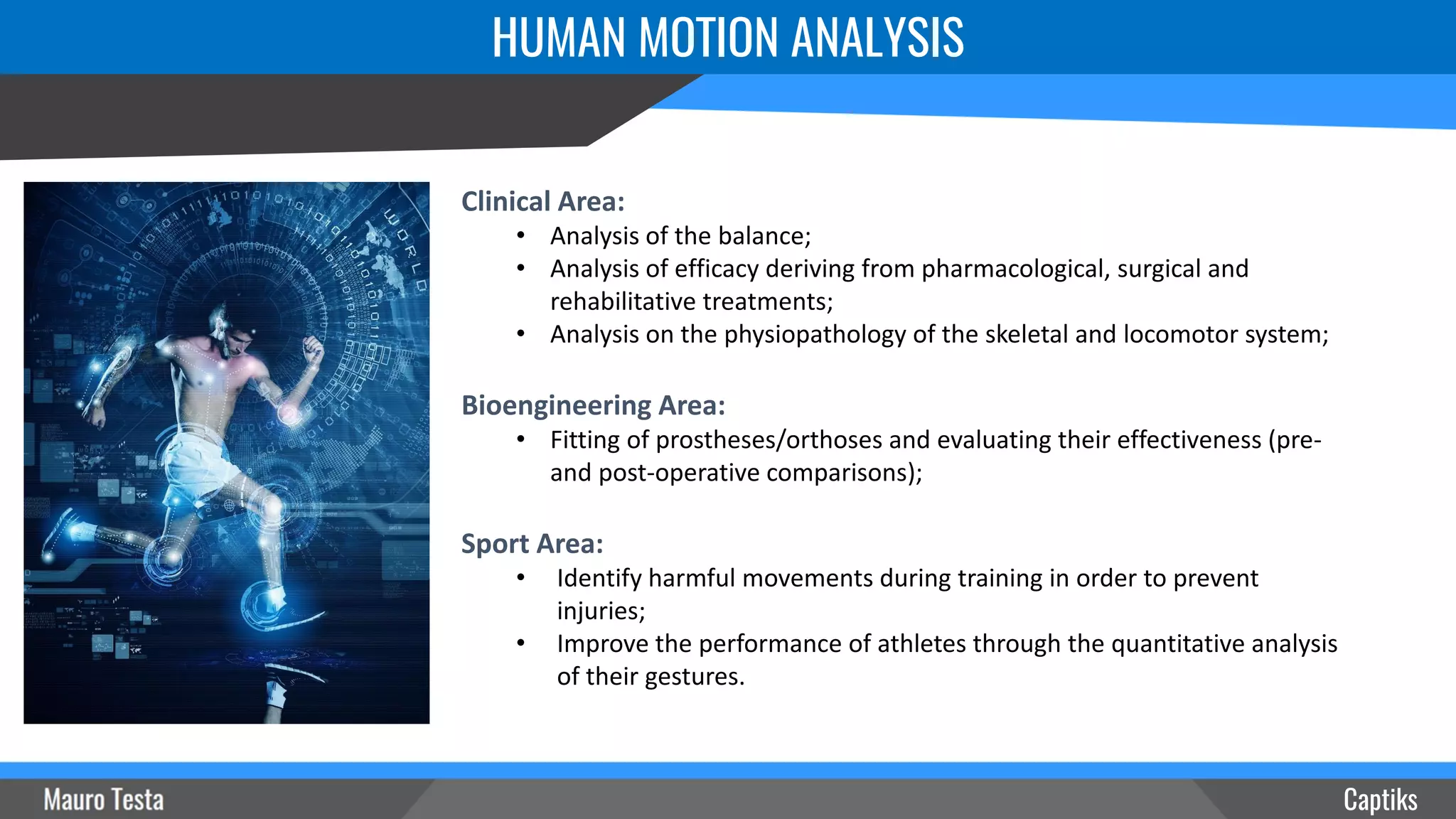
Clinical Area:
• Analysis of the balance;
• Analysis of efficacy deriving from pharmacological, surgical and
rehabilitative treatments;
• Analysis on the physiopathology of the skeletal and locomotor system;
Bioengineering Area:
• Fitting of prostheses/orthoses and evaluating their effectiveness (pre-
and post-operative comparisons);
Sport Area:
• Identify harmful movements during training in order to prevent
injuries;
• Improve the performance of athletes through the quantitative analysis
of their gestures.
MOTION ANALYSIS LAB
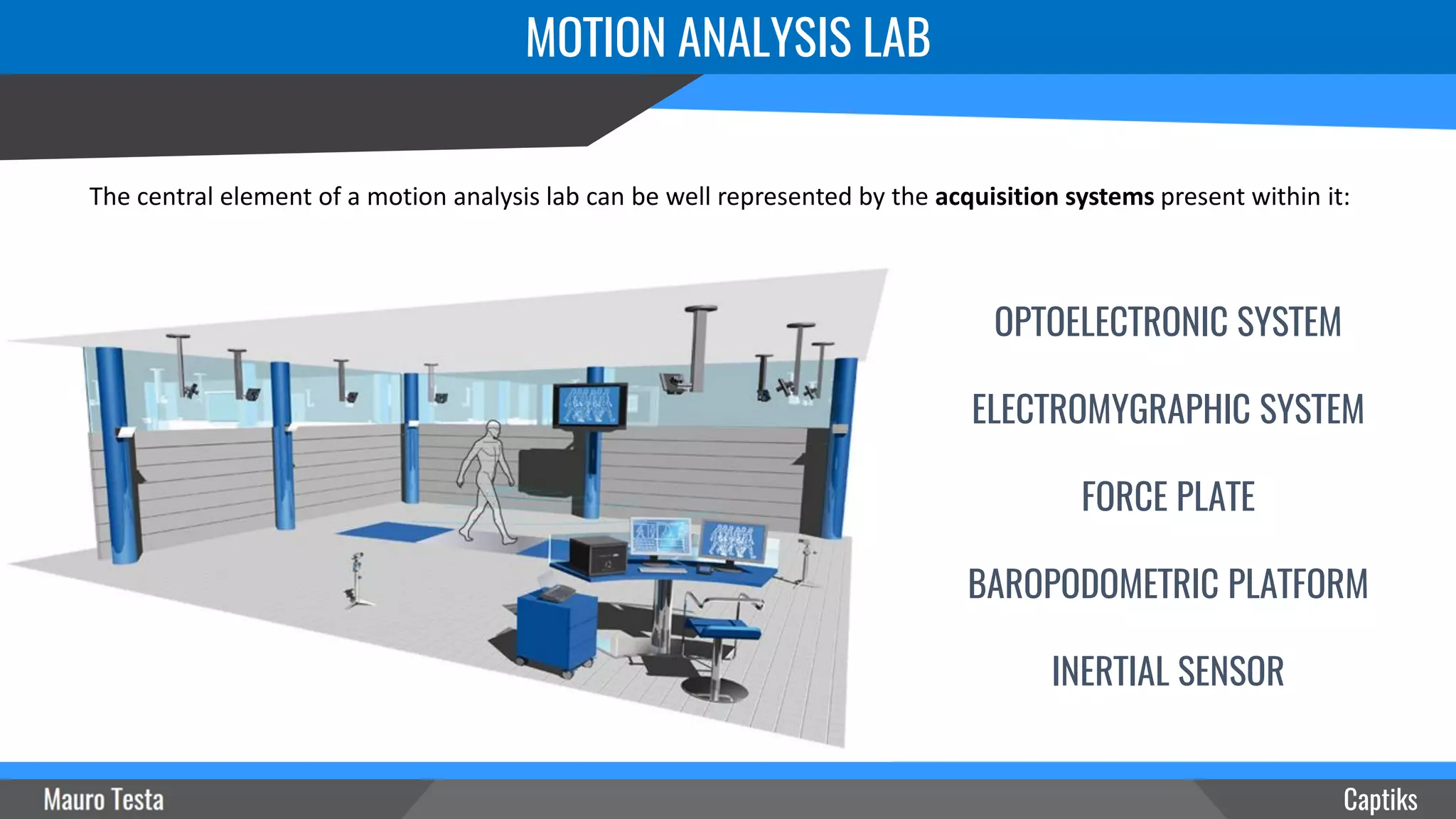
The central element of a motion analysis lab can be well represented by the acquisition systems present within it:
Captiks
OPTOELECTRONIC SYSTEM
ELECTROMYGRAPHIC SYSTEM
FORCE PLATE
BAROPODOMETRIC PLATFORM
INERTIAL SENSOR
MOTION ANALYSIS LAB
Captiks
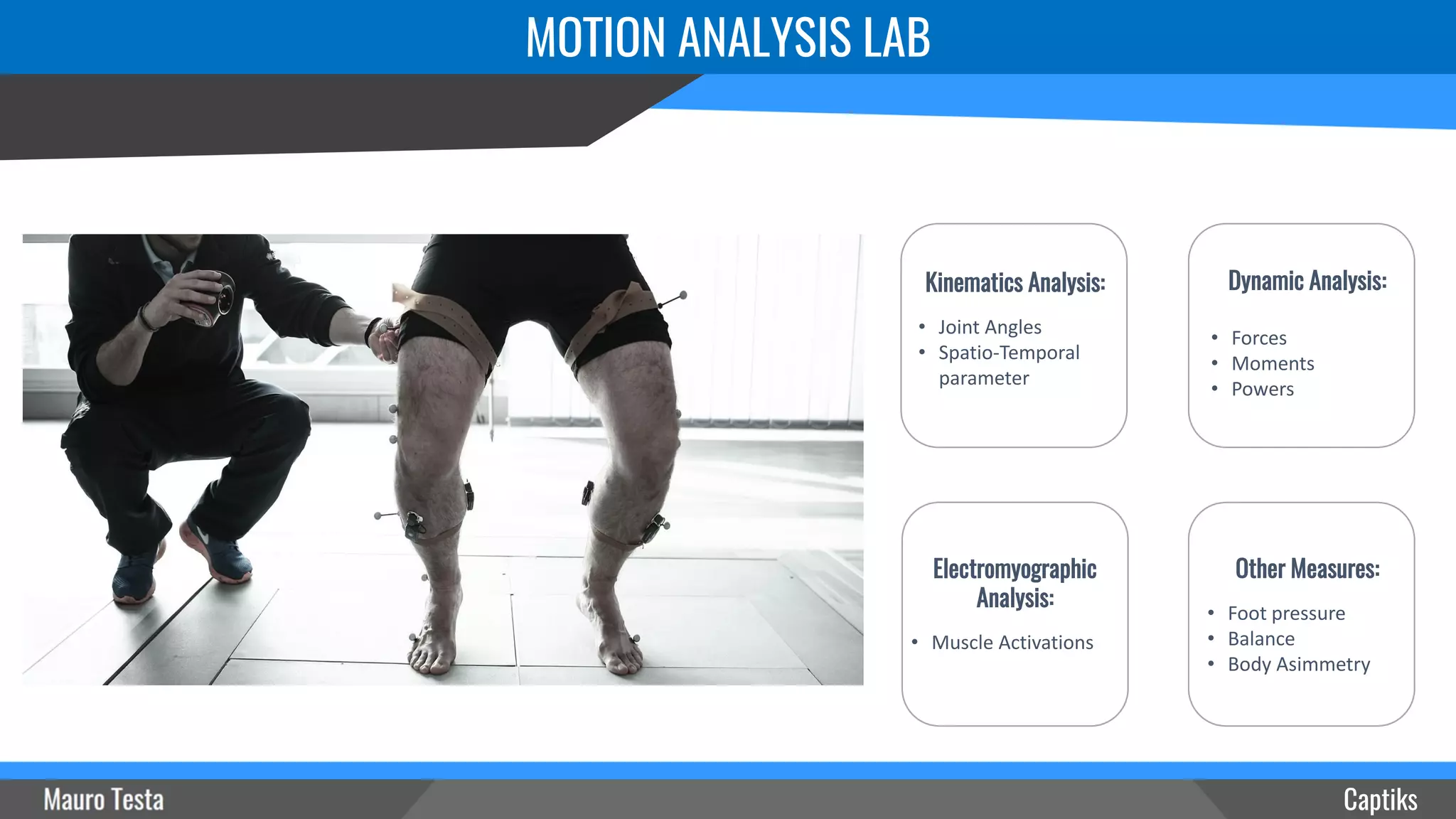
Other Measures:
• Foot pressure
• Balance
• Body Asimmetry
Electromyographic
Analysis:
• Muscle Activations
Dynamic Analysis:
• Forces
• Moments
• Powers
Kinematics Analysis:
• Joint Angles
• Spatio-Temporal
parameter
MOTION ANALYSIS LAB
Captiks
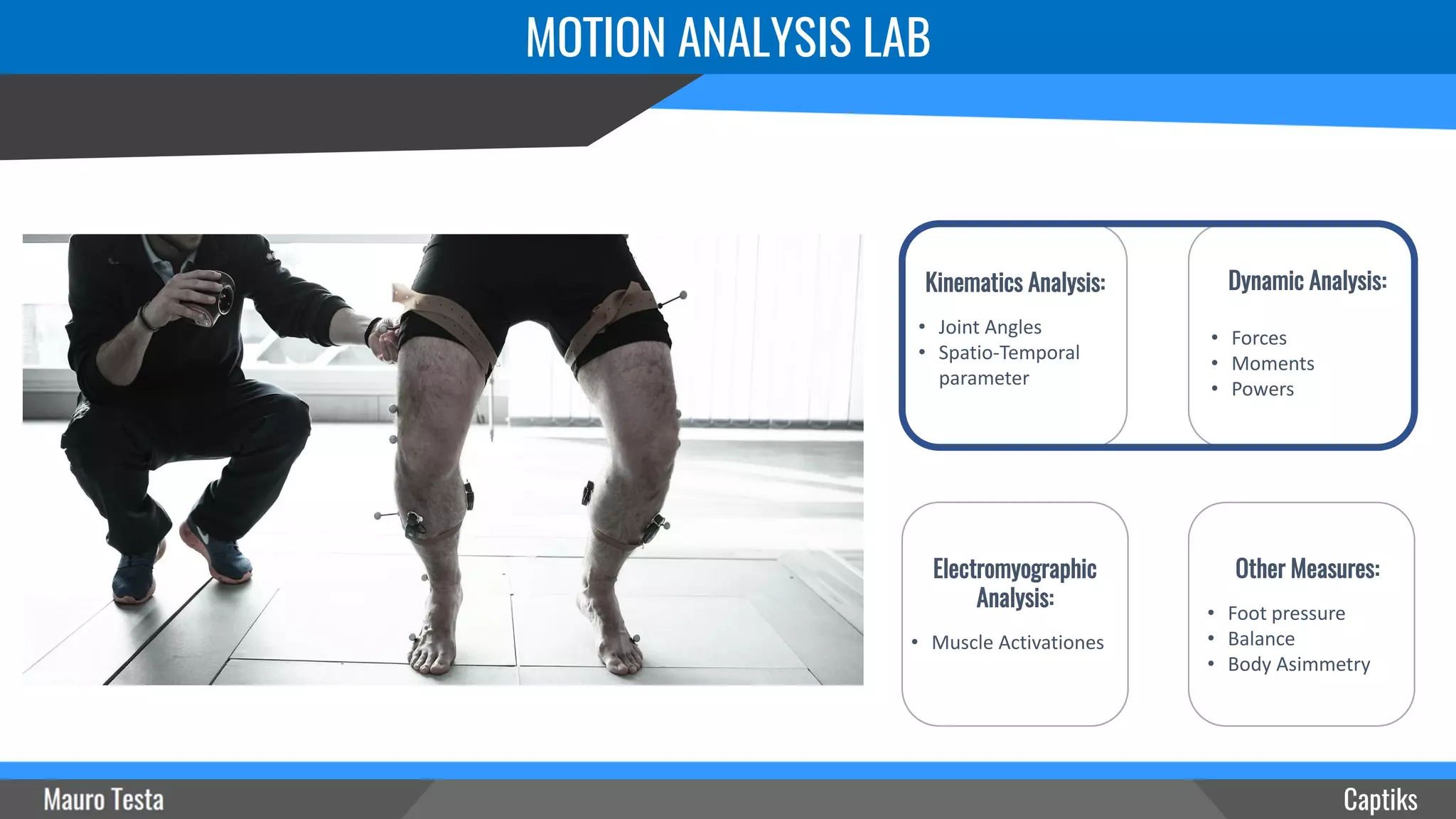
Other Measures:
• Foot pressure
• Balance
• Body Asimmetry
Electromyographic
Analysis:
• Muscle Activationes
Dynamic Analysis:
• Forces
• Moments
• Powers
Kinematics Analysis:
• Joint Angles
• Spatio-Temporal
parameter
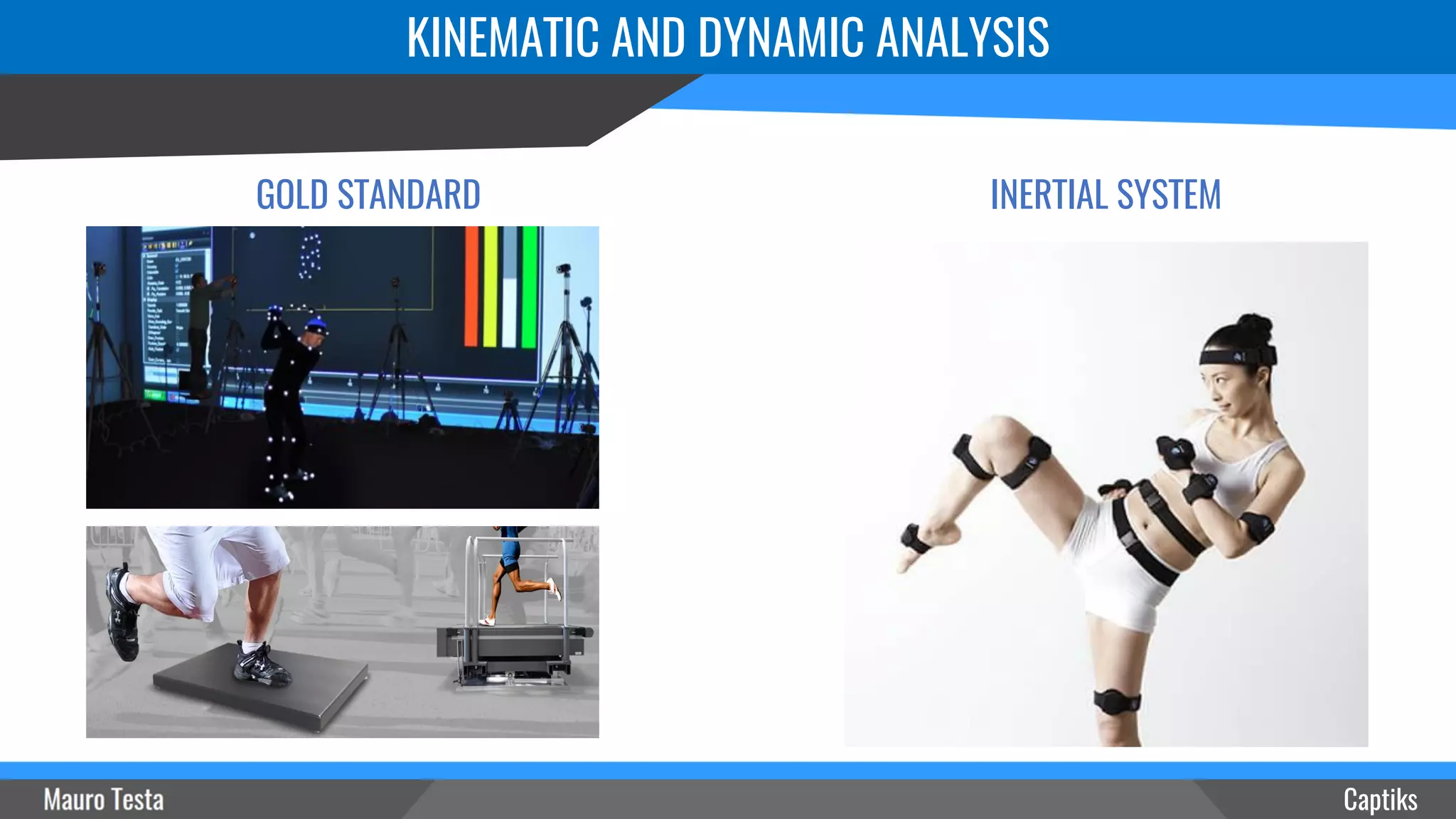
KINEMATIC AND DYNAMIC ANALYSIS
Captiks
INERTIAL SYSTEMGOLD STANDARD
INERTIAL SYSTEM
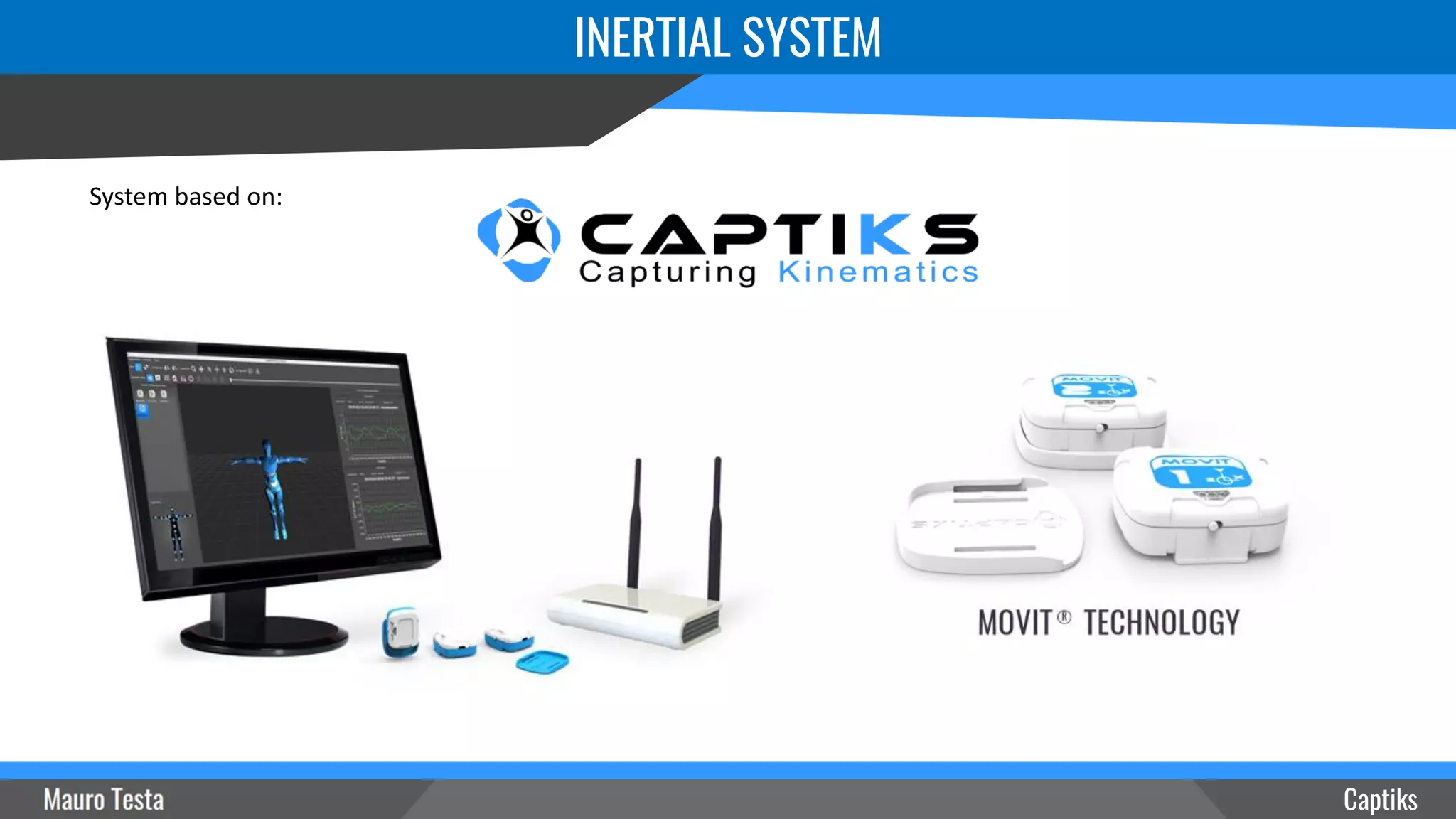
System based on:
Captiks
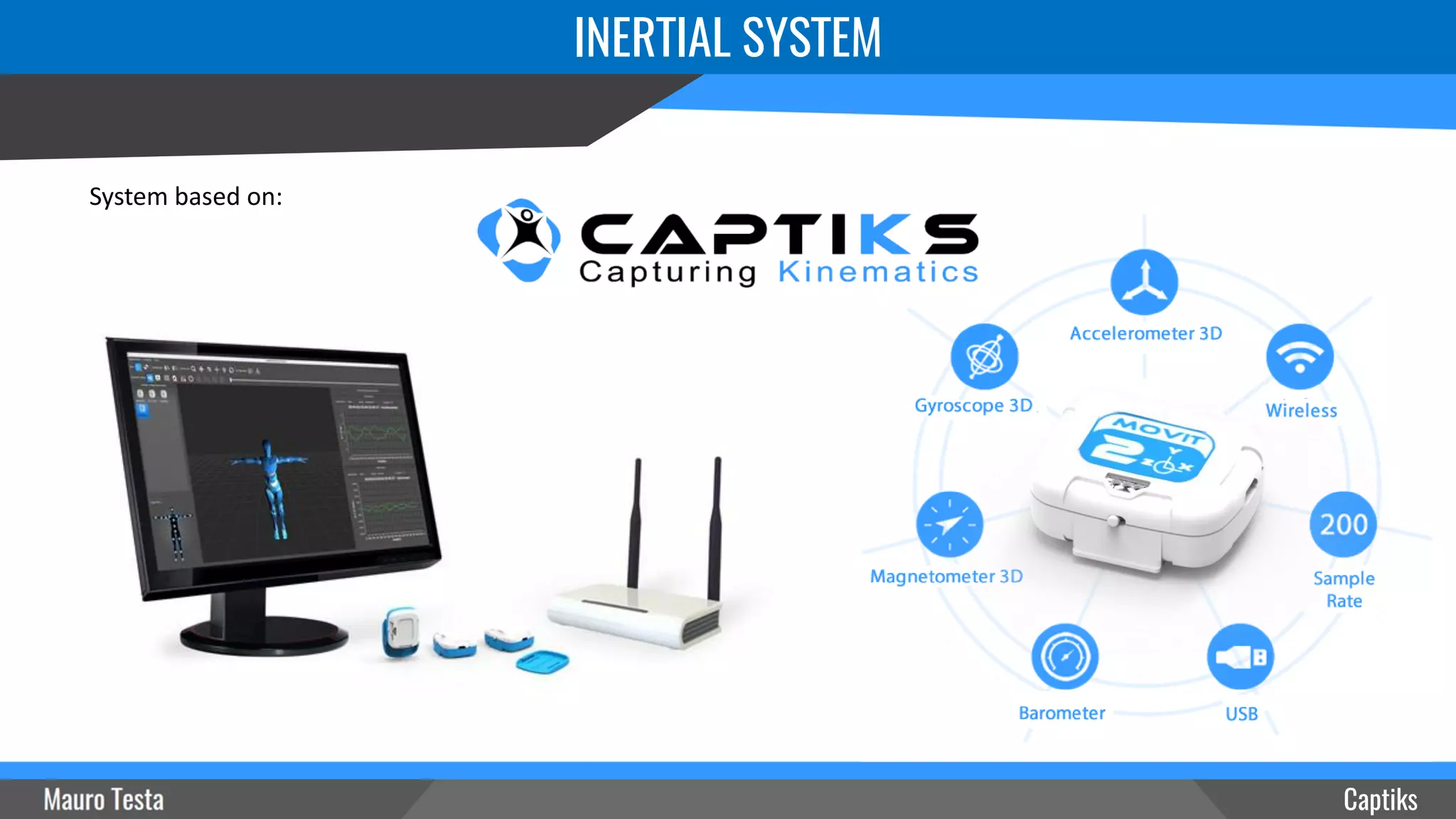
INERTIAL SYSTEM
Captiks
System based on:
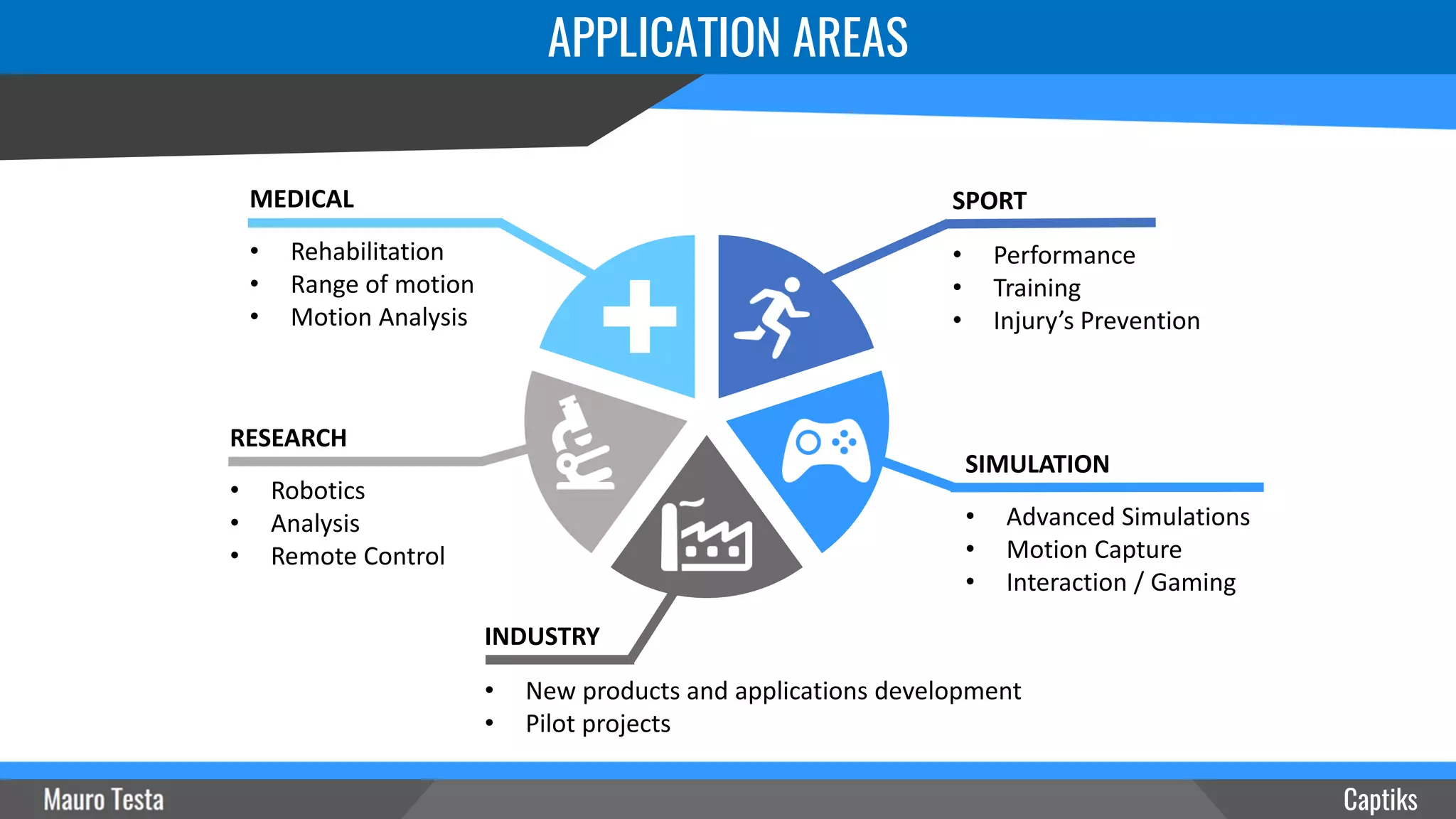
APPLICATION AREAS
Captiks
INDUSTRY
• New products and applications development
• Pilot projects
SIMULATION
• Advanced Simulations
• Motion Capture
• Interaction / Gaming
SPORT
• Performance
• Training
• Injury’s Prevention
MEDICAL
• Rehabilitation
• Range of motion
• Motion Analysis
RESEARCH
• Robotics
• Analysis
• Remote Control
Captiks
Sistema INERZIALE
MOTION CAPTURE
Captiks
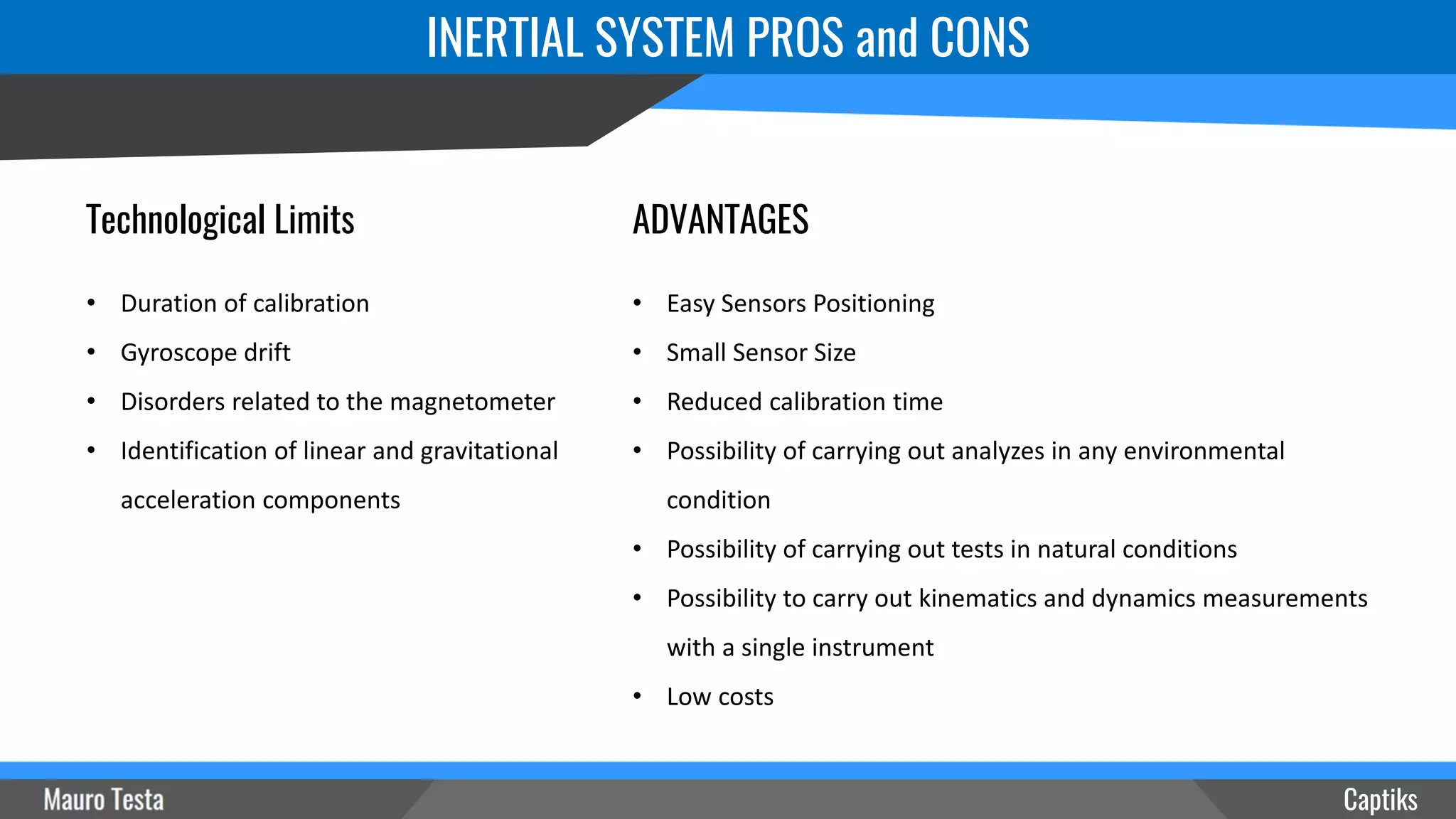
INERTIAL SYSTEM PROS and CONS
Captiks
ADVANTAGES
• Easy Sensors Positioning
• Small Sensor Size
• Reduced calibration time
• Possibility of carrying out analyzes in any environmental
condition
• Possibility of carrying out tests in natural conditions
• Possibility to carry out kinematics and dynamics measurements
with a single instrument
• Low costs
Technological Limits
• Duration of calibration
• Gyroscope drift
• Disorders related to the magnetometer
• Identification of linear and gravitational
acceleration components
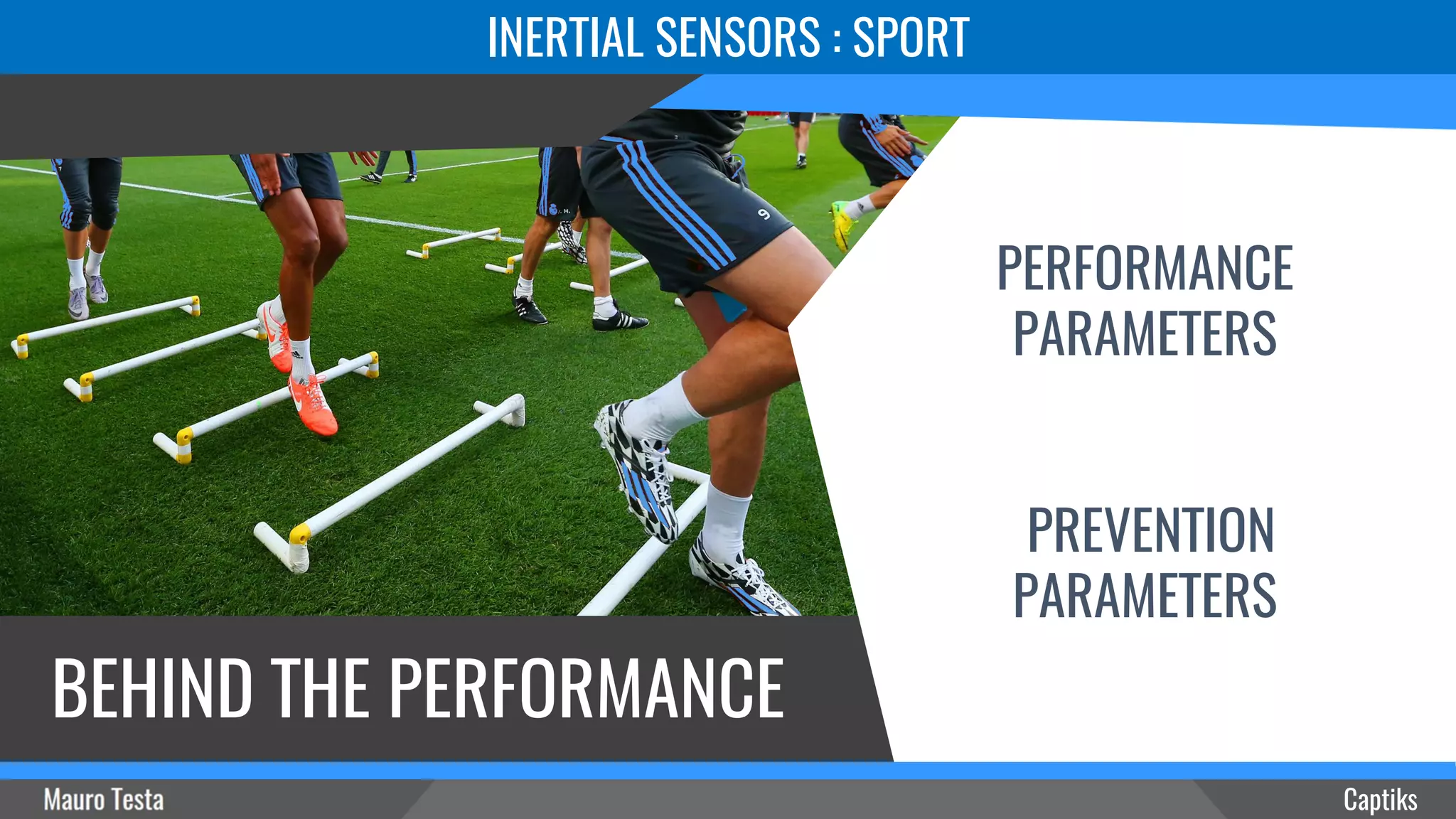
INERTIAL SENSORS : SPORT
BEHIND THE PERFORMANCE
Captiks
PERFORMANCE
PARAMETERS
PREVENTION
PARAMETERS
PREVENTION PARAMETERS
Captiks
GRF
BMC
SPECTRAL
COMPONENT
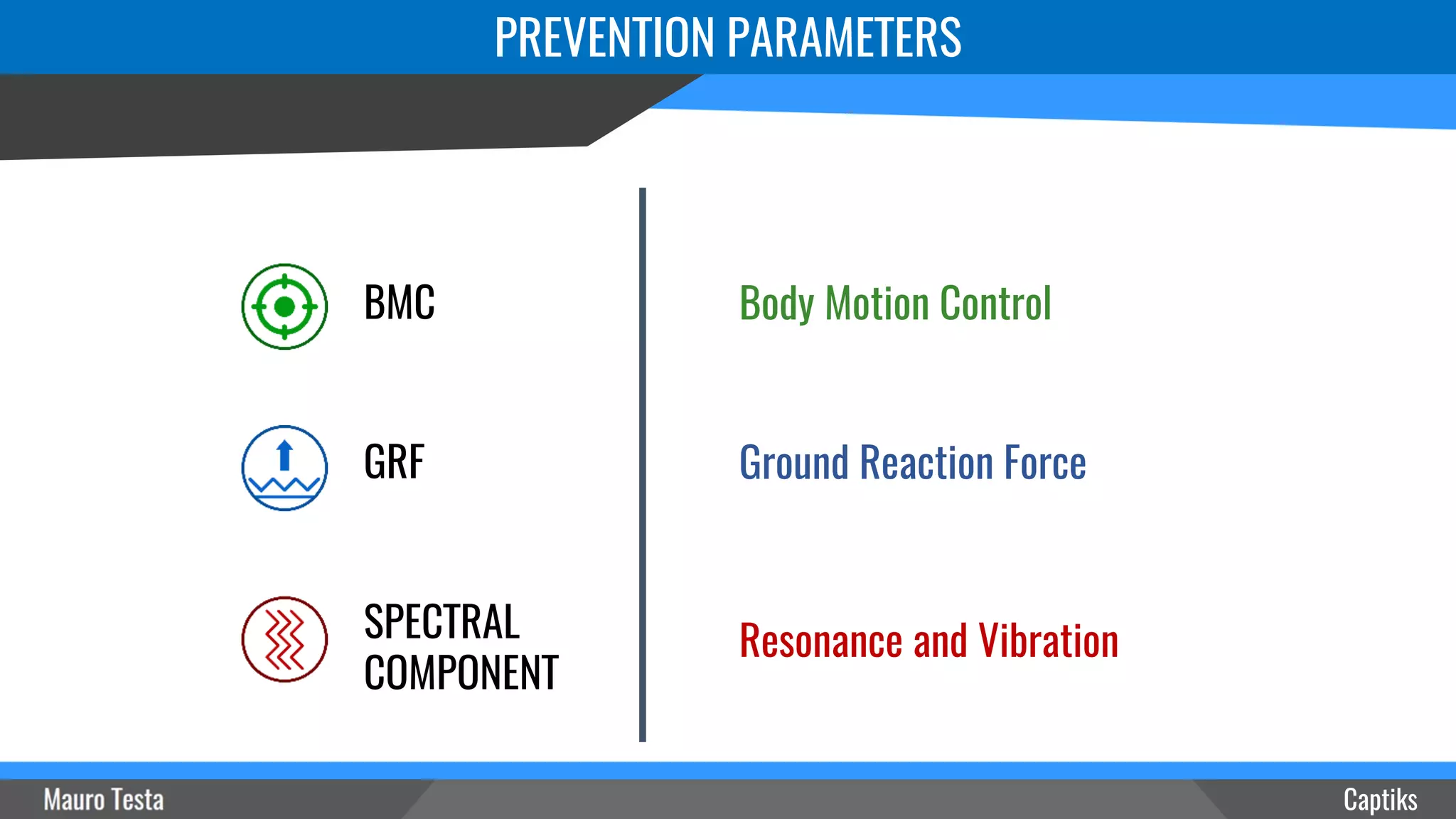
Ground Reaction Force
Body Motion Control
Resonance and Vibration
PREVENTION PARAMETERS
Captiks
GRF
BMC
SPECTRAL
COMPONENT
It represents the average of the module vector obtained
from the accelerations along the three directions.
Captiks
GRF
BMC
SPECTRAL
COMPONENT
* Daniel W.T. Wundersitza, Kevin J. Nettoab , Brad Aisbetta & Paul B. Gastina. «Validity
of an upper-body-mounted accelerometer to measure peak vertical and resultant force
during running and change-of-direction tasks.» Sports Biomechanics (2014).
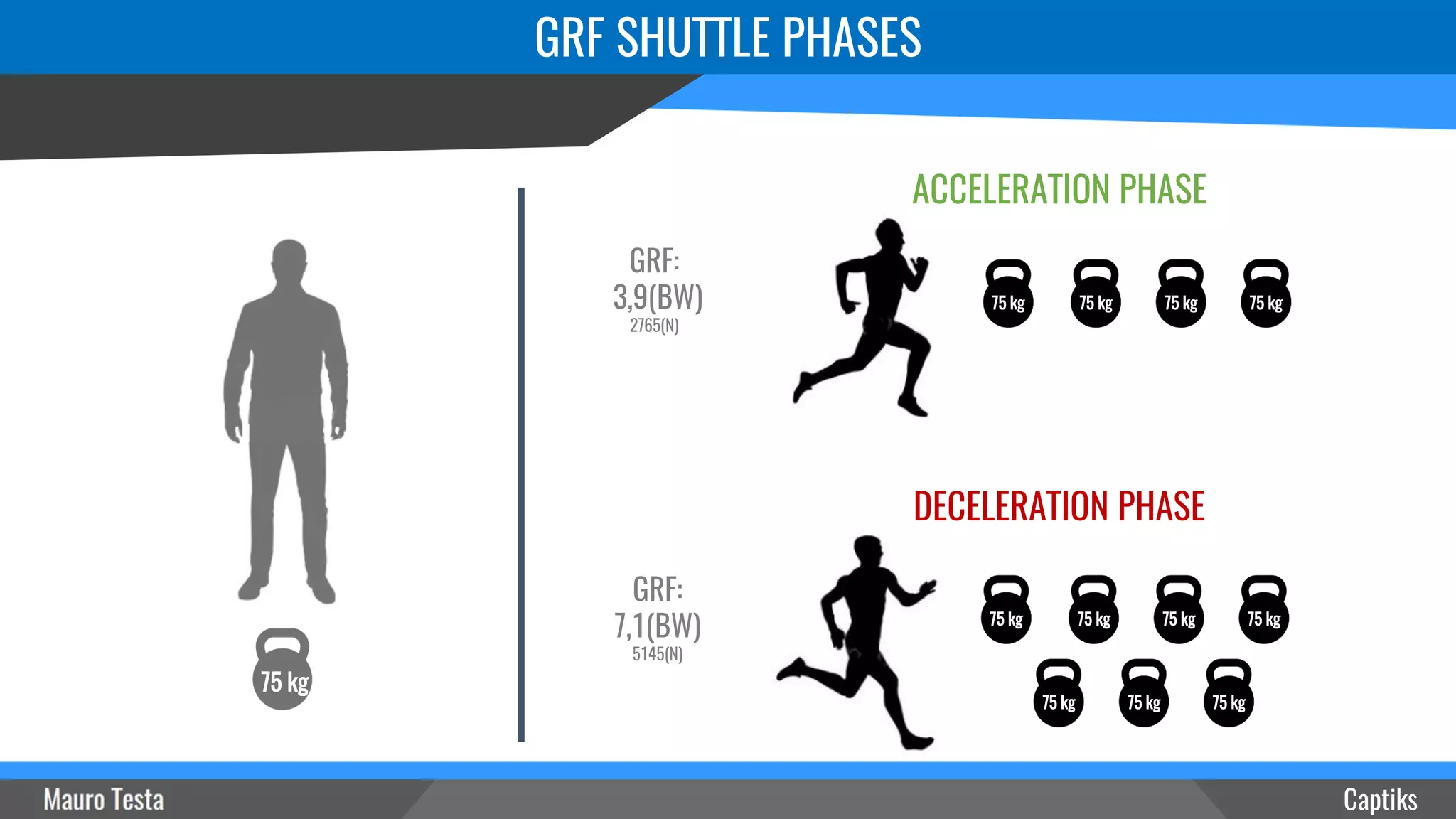
It represents the force exerted by the ground on the whole
body with which it is in contact. It is expressed in Newton or
in Body Weight.
PREVENTION PARAMETERS
Captiks
GRF
BMC
SPECTRAL
COMPONENT
* Winslow, Martyn R. Shorten and Darcy S. «Spectral Analysis of impact Shock During
Running.» (1992).
PREVENTION PARAMETERS
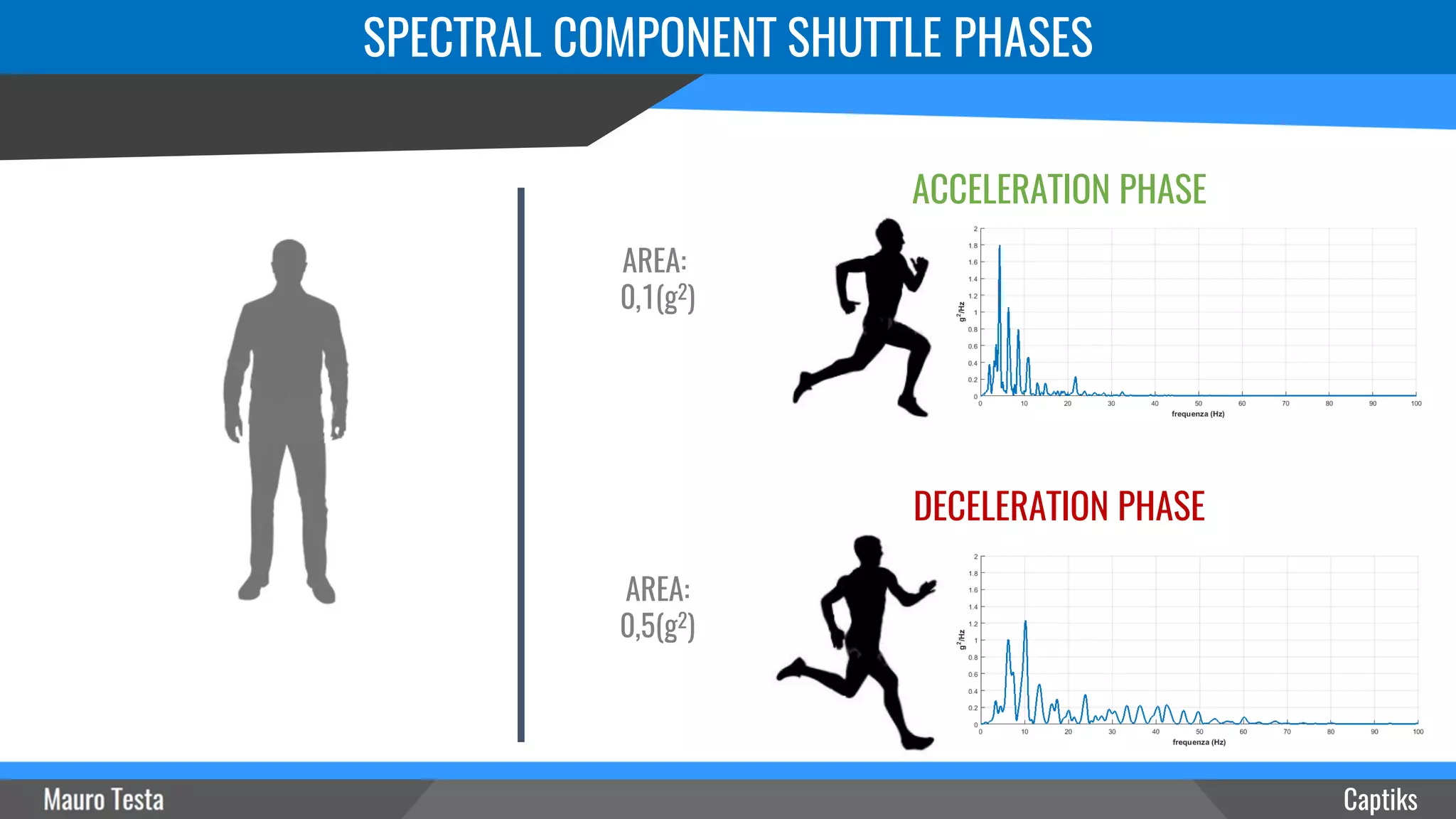
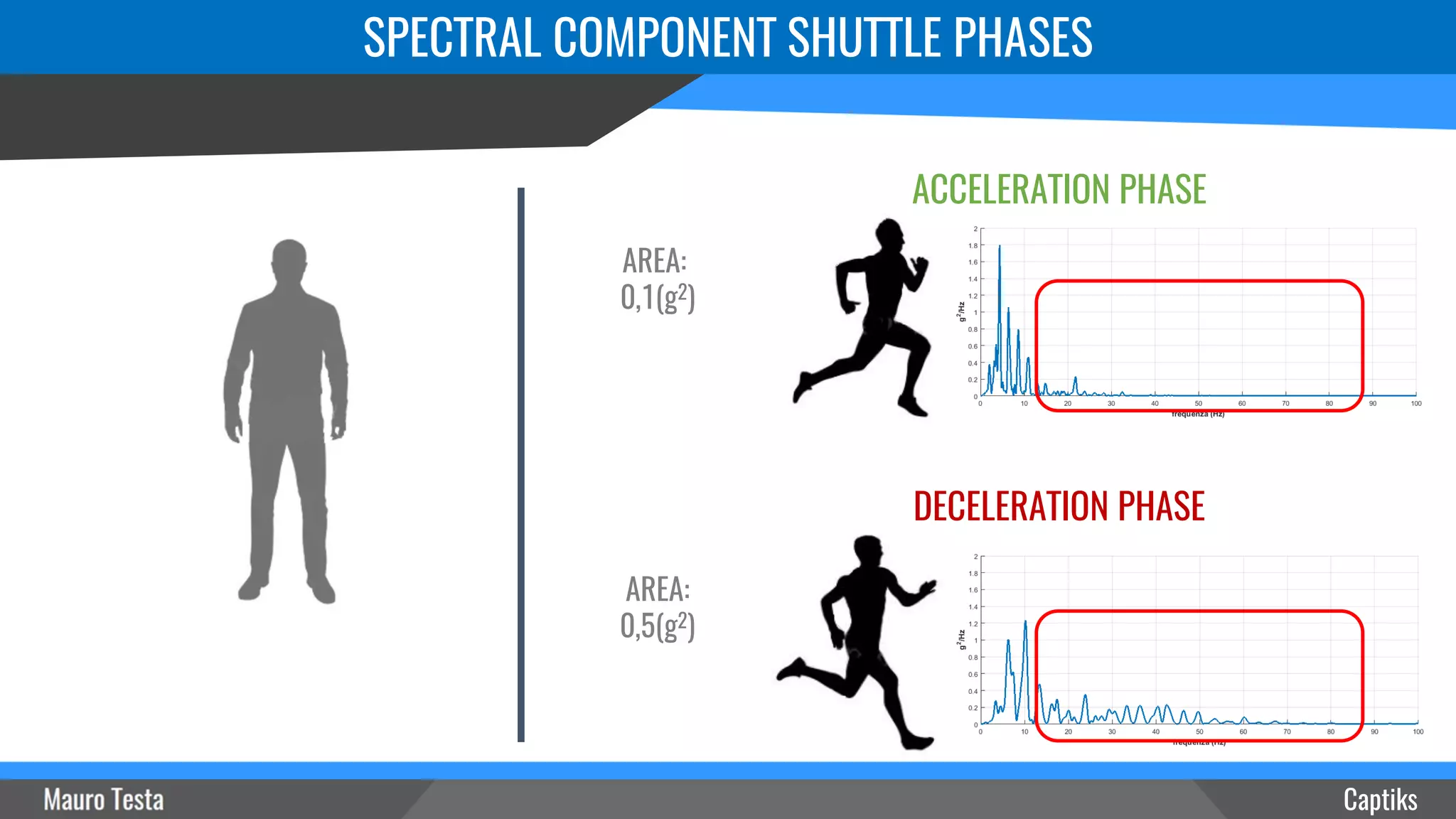
It represents the harmonic content of the accelerometric
signal. It allows analyzing data according to the distribution
of energy at different frequencies. Signals that show greater
spectral content at high frequencies are those that most
weigh on the athlete from the point of view of the vibrations
arising from the impact.
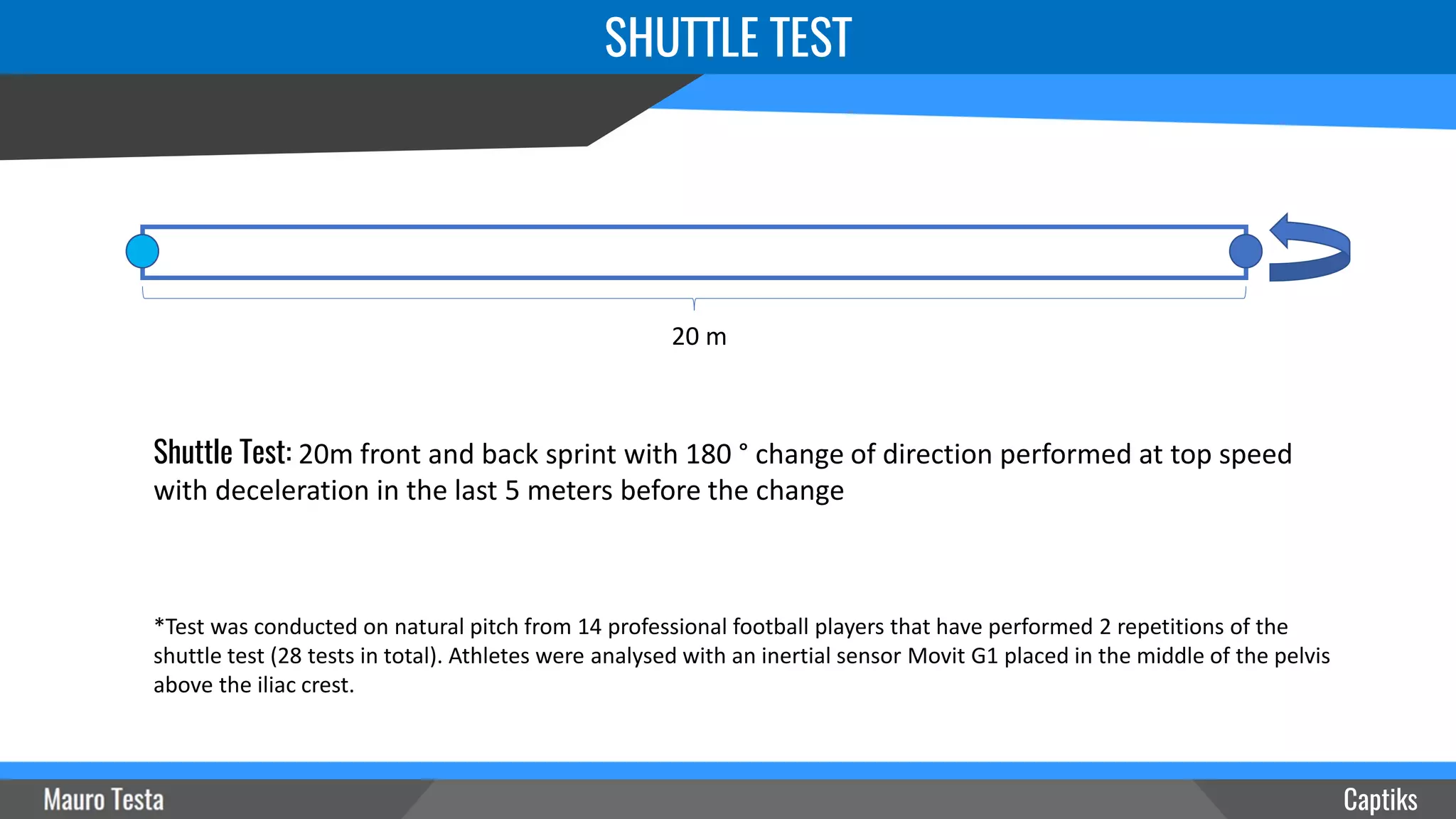
SHUTTLE TEST
Captiks
20 m
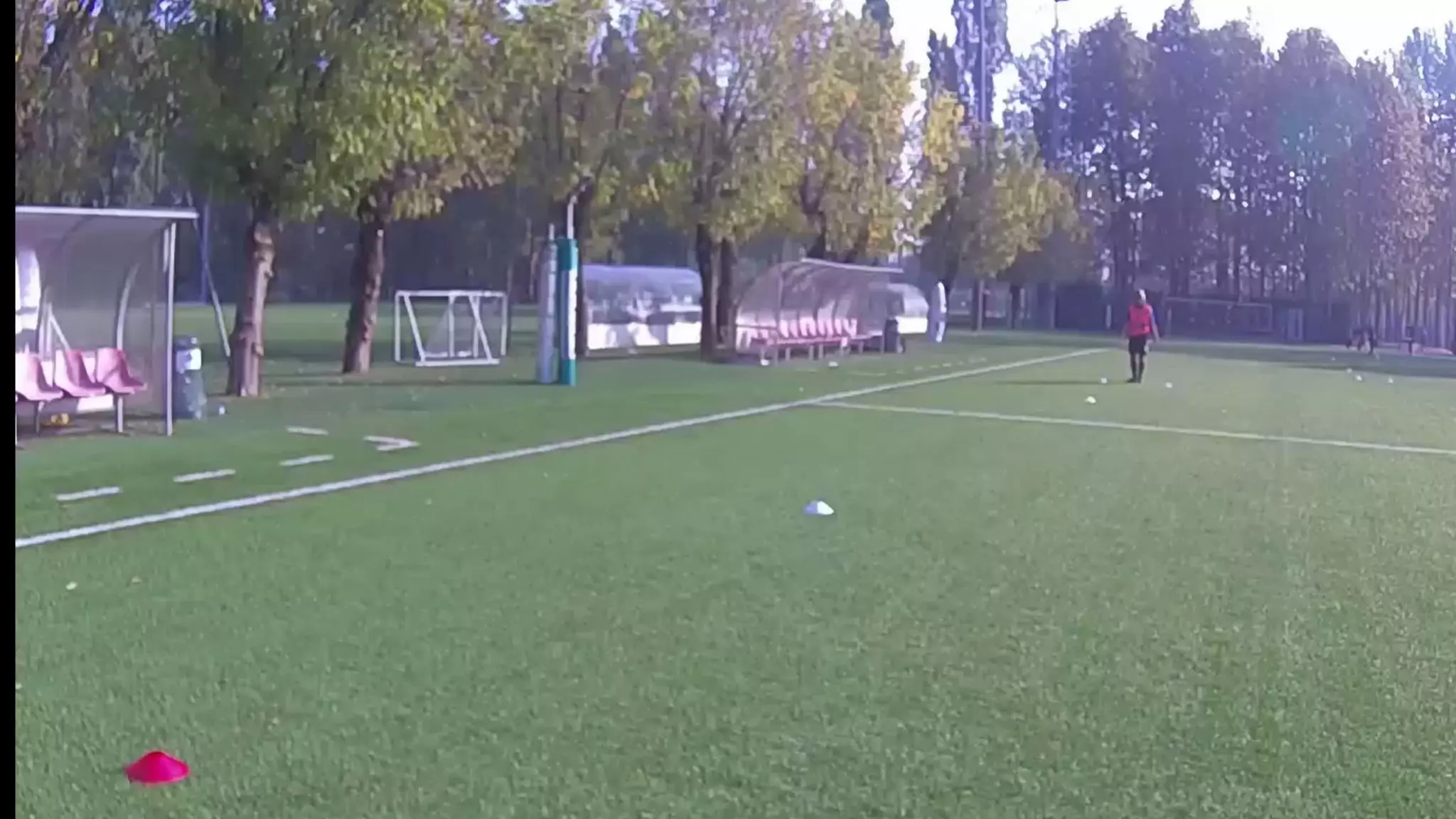
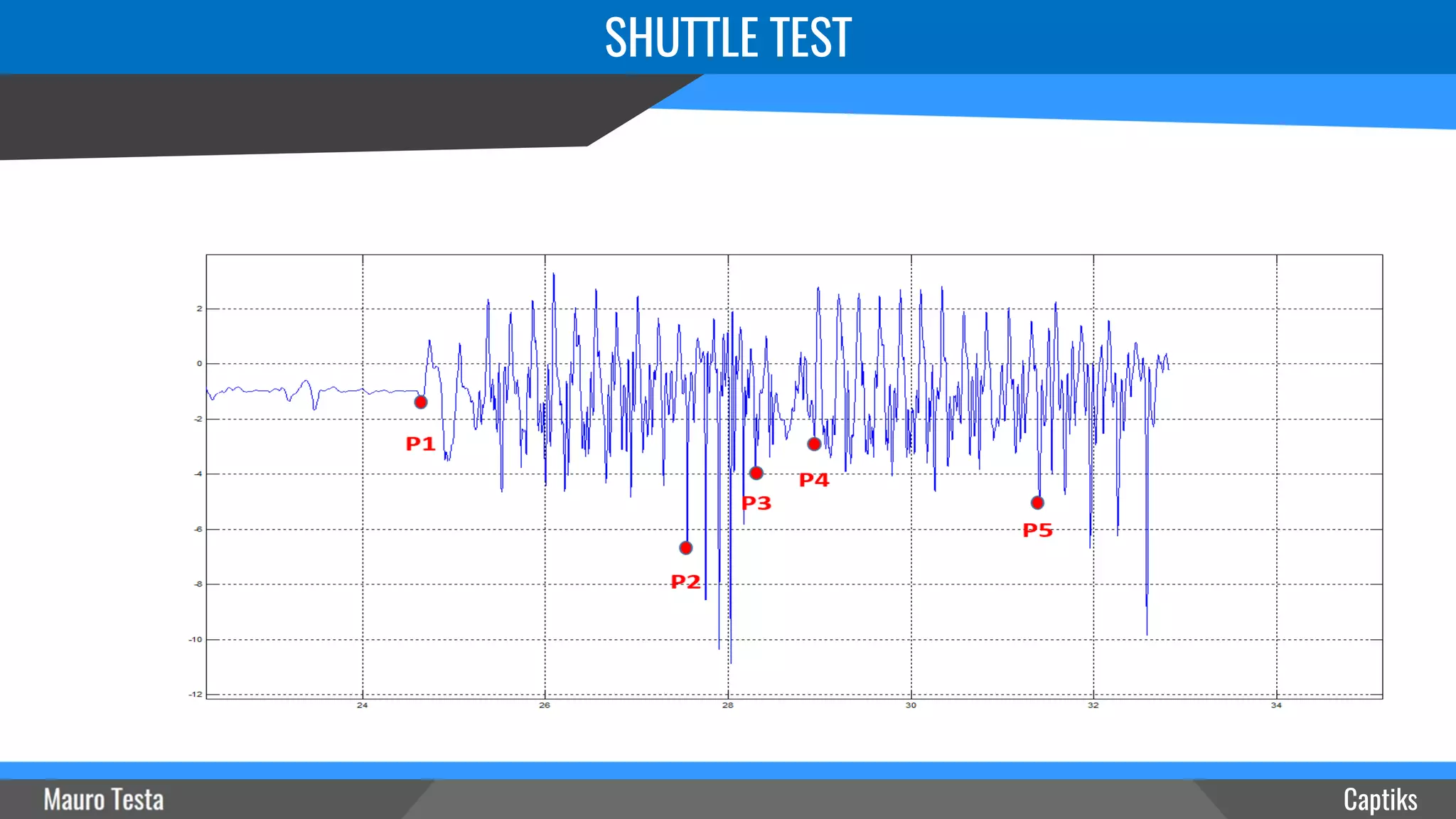
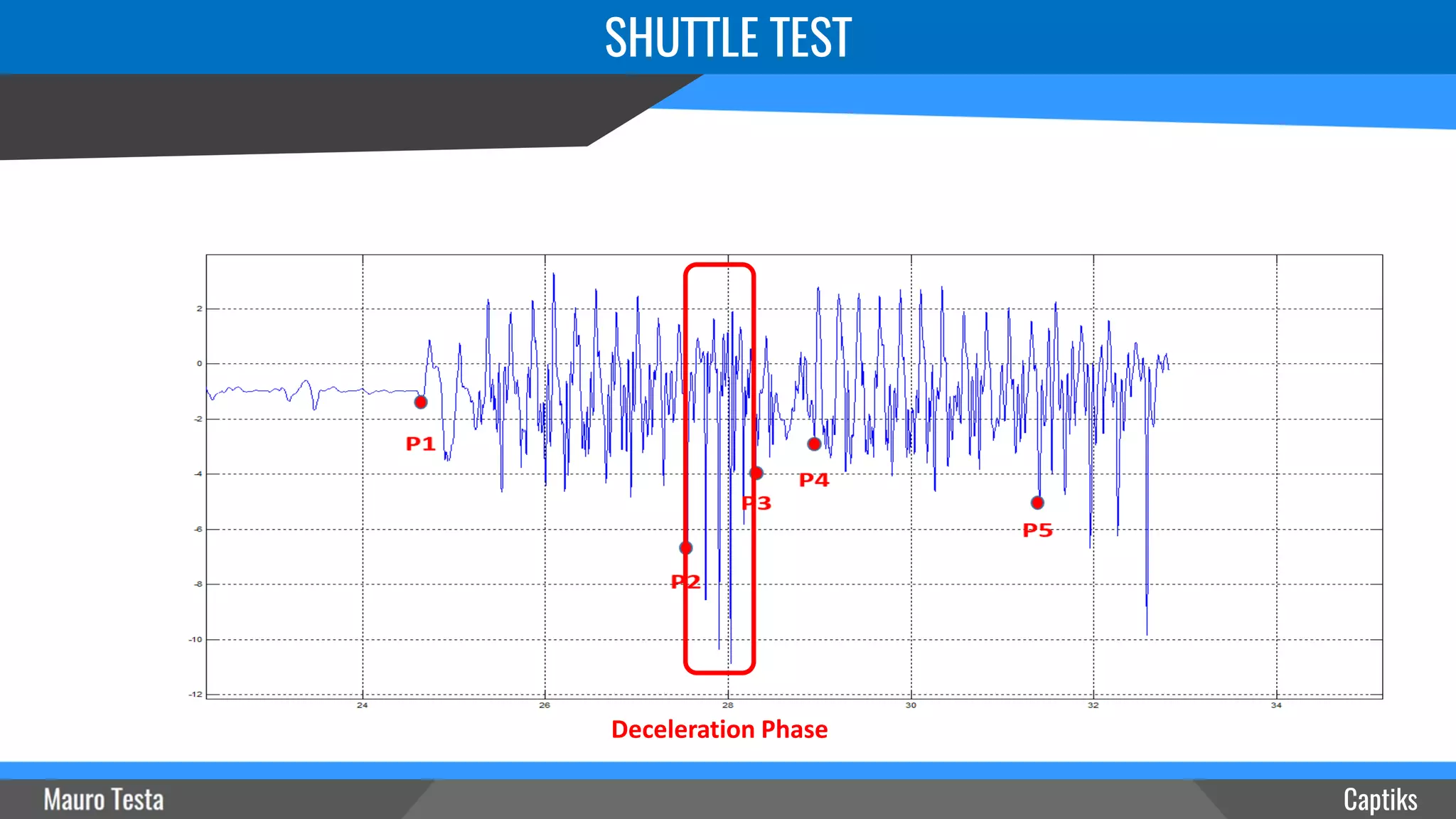
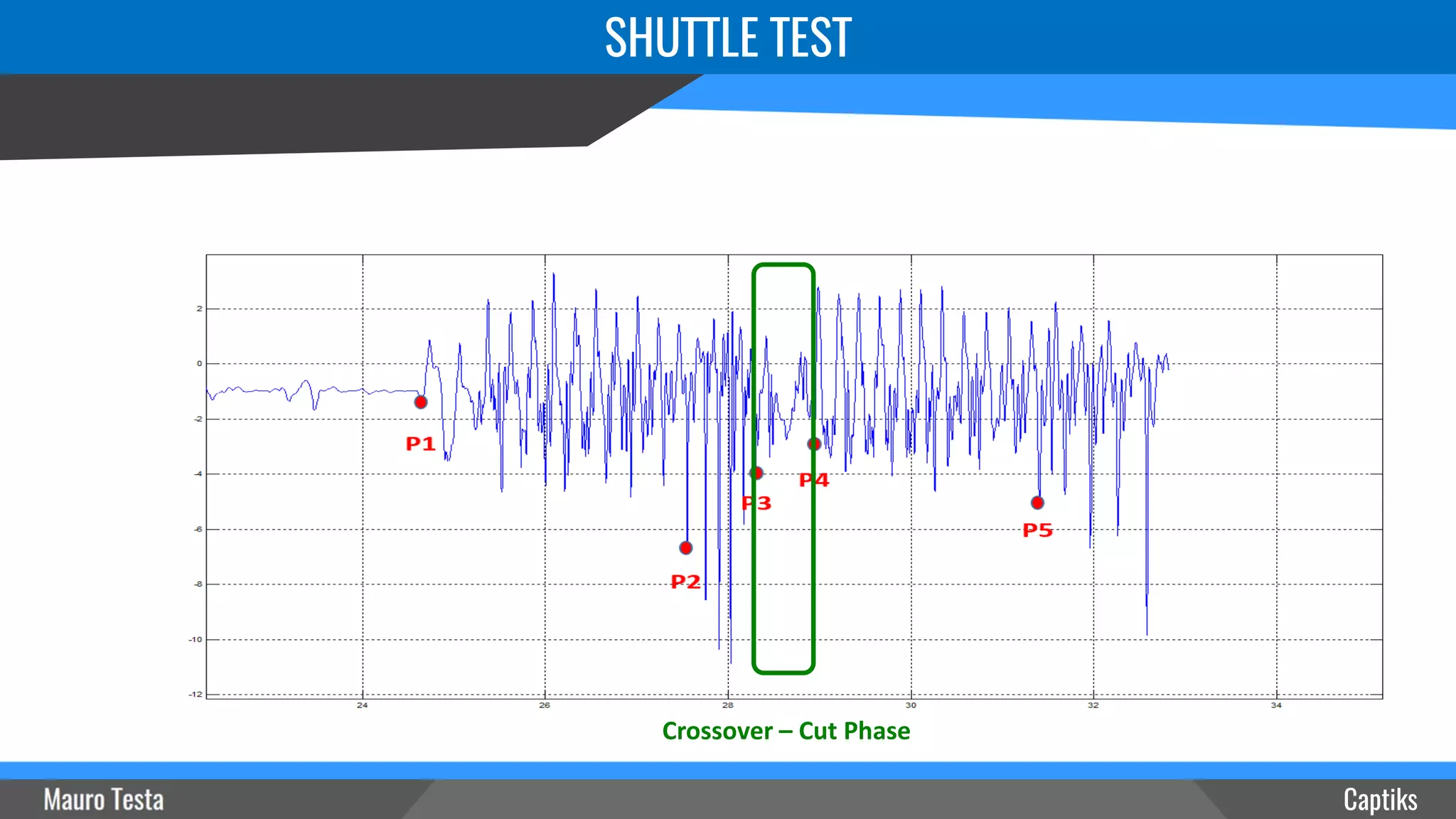
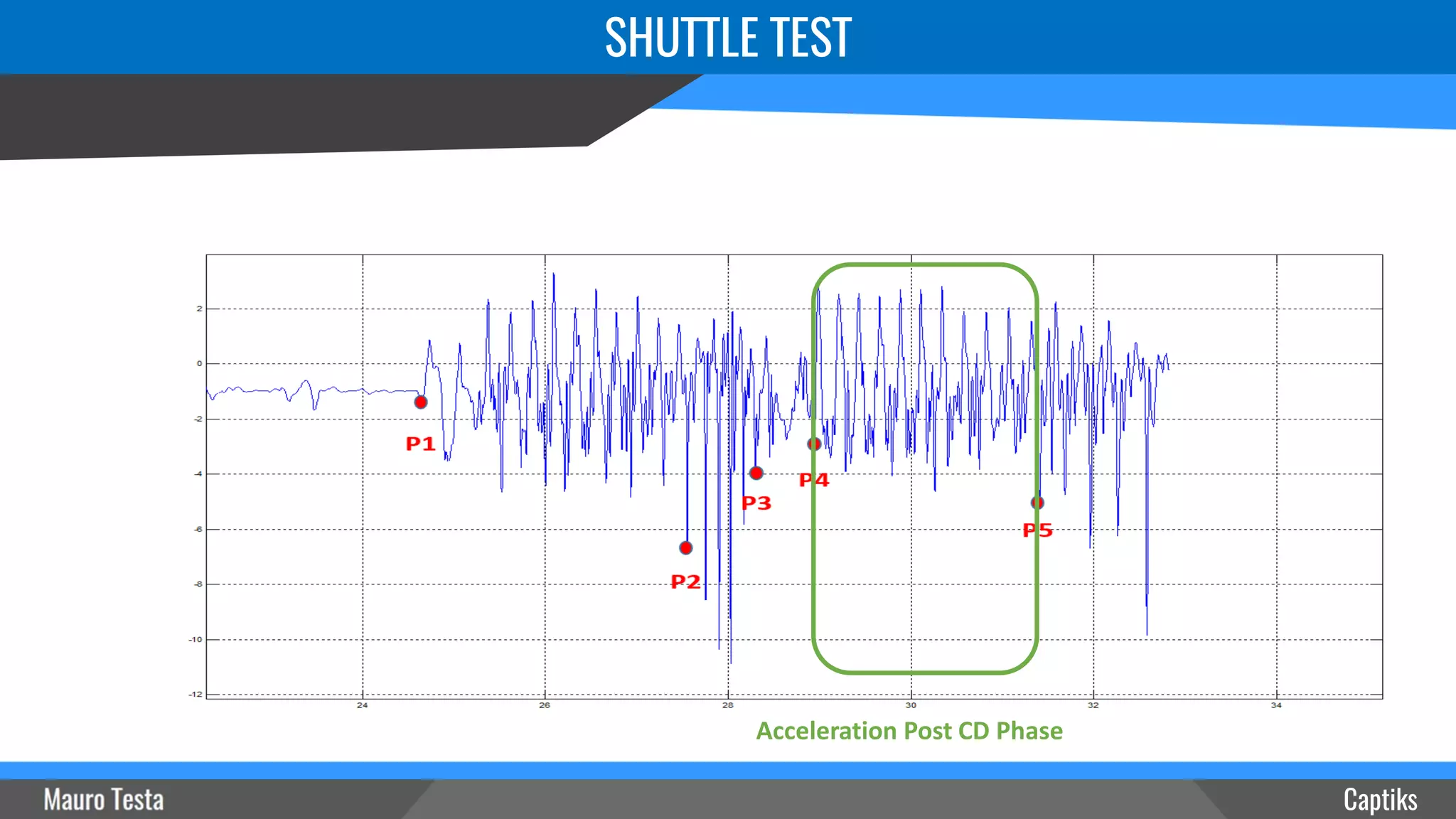
Shuttle Test: 20m front and back sprint with 180 ° change of direction performed at top speed
with deceleration in the last 5 meters before the change
*Test was conducted on natural pitch from 14 professional football players that have performed 2 repetitions of the
shuttle test (28 tests in total). Athletes were analysed with an inertial sensor Movit G1 placed in the middle of the pelvis
above the iliac crest.
SHUTTLE TEST
Captiks
SHUTTLE TEST
Captiks
SHUTTLE TEST
Captiks
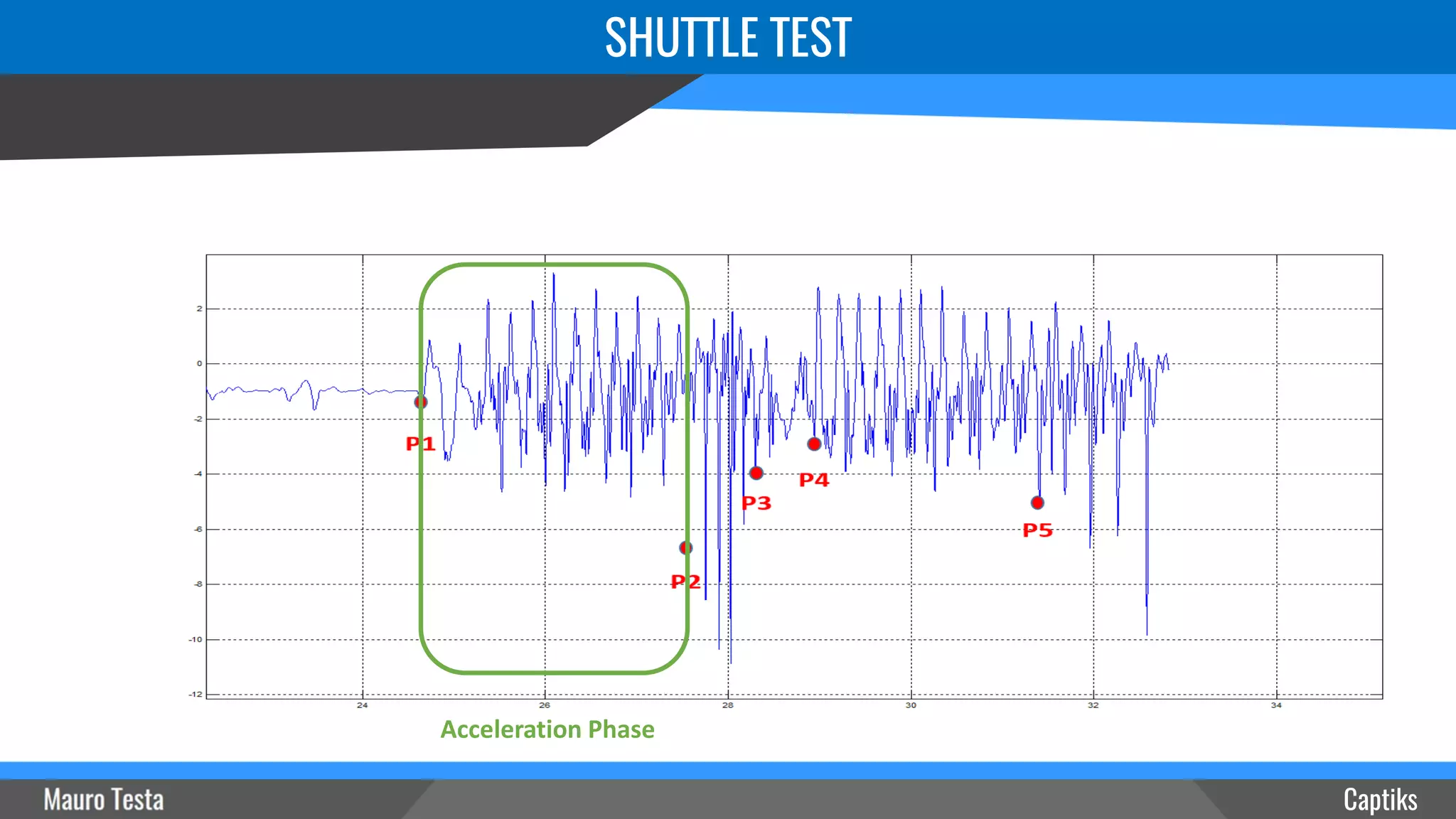
Acceleration Phase
SHUTTLE TEST
Captiks
Deceleration Phase
SHUTTLE TEST
Captiks
Crossover – Cut Phase
SHUTTLE TEST
Captiks
Acceleration Post CD Phase
RESULTS
Captiks
The inertial sensor Movit G1 has been set with: Fs: 200Hz, Acc FSR: 16g, GyroFSR: 2000dps
*Test conducted by 14 professional football players on natural turf that have performed 2 repetitions of the shuttle test (28 tests in total)
Acceleration Phase Deceleration Phase Crossover-Cut Phase Acceleration post CD Phase
BMC 2,1 ± 0,3 [g] 3,0 ± 0,5 [g] 1,6 ± 0,2 [g] 2,2 ± 0,4 [g]
SPECTRAL COMPONENT 0,1 ± 0,08[g2] 0,5 ± 0,2 [g2] 0,07 ± 0,03 [g2] 0,1 ± 0,07 [g2]
GRF 3,9 ± 1,3 [BW]
2765 [N]
7,3 ± 1,9 [BW]
5145 [N]
2,8 ± 1,3 [BW]
1998 [N]
3,9 ± 1,2 [BW]
2739 [N]
RESULTS
Captiks
The inertial sensor Movit G1 has been set with: Fs: 200Hz, Acc FSR: 16g, GyroFSR: 2000dps
*Test conducted by 14 professional football players on natural turf that have performed 2 repetitions of the shuttle test (28 tests in total)
Acceleration Phase Deceleration Phase Crossover-Cut Phase Acceleration post CD Phase
BMC 2,1 ± 0,3 [g] 3,0 ± 0,5 [g] 1,6 ± 0,2 [g] 2,2 ± 0,4 [g]
SPECTRAL COMPONENT 0,1 ± 0,08[g2] 0,5 ± 0,2 [g2] 0,07 ± 0,03 [g2] 0,1 ± 0,07 [g2]
GRF 3,9 ± 1,3 [BW]
2765 [N]
7,3 ± 1,9 [BW]
5145 [N]
2,8 ± 1,3 [BW]
1998 [N]
3,9 ± 1,2 [BW]
2739 [N]
p_value= 0,6
RESULTS
Captiks
The inertial sensor Movit G1 has been set with: Fs: 200Hz, Acc FSR: 16g, GyroFSR: 2000dps
*Test conducted by 14 professional football players on natural turf that have performed 2 repetitions of the shuttle test (28 tests in total)
Acceleration Phase Deceleration Phase Crossover-Cut Phase Acceleration post CD Phase
BMC 2,1 ± 0,3 [g] 3,0 ± 0,5 [g] 1,6 ± 0,2 [g] 2,2 ± 0,4 [g]
SPECTRAL COMPONENT 0,1 ± 0,08[g2] 0,5 ± 0,2 [g2] 0,07 ± 0,03 [g2] 0,1 ± 0,07 [g2]
GRF 3,9 ± 1,3 [BW]
2765 [N]
7,3 ± 1,9 [BW]
5145 [N]
2,8 ± 1,3 [BW]
1998 [N]
3,9 ± 1,2 [BW]
2739 [N]
p_value << 0,05
RESULTS
Captiks
Acceleration Phase Deceleration Phase Crossover-Cut Phase Acceleration post CD Phase
BMC 2,1 ± 0,3 [g] 3,0 ± 0,5 [g] 1,6 ± 0,2 [g] 2,2 ± 0,4 [g]
SPECTRAL COMPONENT 0,1 ± 0,08[g2] 0,5 ± 0,2 [g2] 0,07 ± 0,03 [g2] 0,1 ± 0,07 [g2]
GRF 3,9 ± 1,3 [BW]
2765 [N]
7,3 ± 1,9 [BW]
5145 [N]
2,8 ± 1,3 [BW]
1998 [N]
3,9 ± 1,2 [BW]
2739 [N]
The inertial sensor Movit G1 has been set with: Fs: 200Hz, Acc FSR: 16g, GyroFSR: 2000dps
*Test conducted by 14 professional football players on natural turf that have performed 2 repetitions of the shuttle test (28 tests in total)
SPECTRAL COMPONENT SHUTTLE PHASES
Captiks
ACCELERATION PHASE
DECELERATION PHASE
AREA:
0,1(g2)
AREA:
0,5(g2)
SPECTRAL COMPONENT SHUTTLE PHASES
Captiks
ACCELERATION PHASE
DECELERATION PHASE
AREA:
0,1(g2)
AREA:
0,5(g2)
Captiks
Acceleration Phase Deceleration Phase Crossover-Cut Phase Acceleration post CD Phase
BMC 2,1 ± 0,3 [g] 3,0 ± 0,5 [g] 1,6 ± 0,2 [g] 2,2 ± 0,4 [g]
SPECTRAL COMPONENT 0,1 ± 0,08[g2] 0,5 ± 0,2 [g2] 0,07 ± 0,03 [g2] 0,1 ± 0,07 [g2]
GRF 3,9 ± 1,3 [BW]
2765 [N]
7,3 ± 1,9 [BW]
5145 [N]
2,8 ± 1,3 [BW]
1998 [N]
3,9 ± 1,2 [BW]
2739 [N]
The inertial sensor Movit G1 has been set with: Fs: 200Hz, Acc FSR: 16g, GyroFSR: 2000dps
*Test conducted by 14 professional football players on natural turf that have performed 2 repetitions of the shuttle test (28 tests in total)
RESULTS
GRF SHUTTLE PHASES
Captiks
75 kg
75 kg 75 kg75 kg75 kg
ACCELERATION PHASE
75 kg 75 kg75 kg75 kg
75 kg75 kg75 kg
DECELERATION PHASE
GRF:
3,9(BW)
2765(N)
GRF:
7,1(BW)
5145(N)
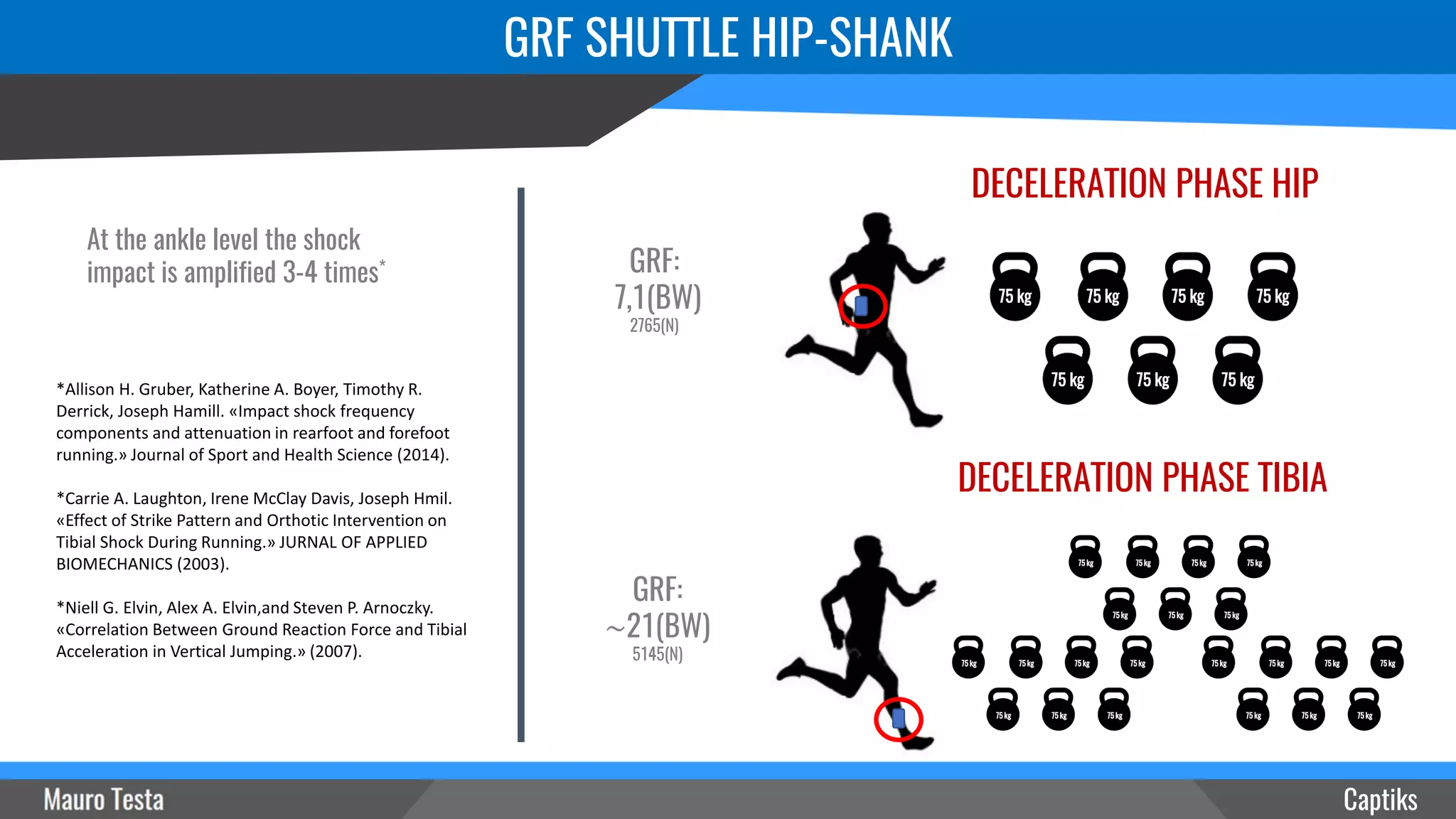
GRF SHUTTLE HIP-SHANK
Captiks
75 kg 75 kg75 kg75 kg
75 kg75 kg75 kg
DECELERATION PHASE HIP
75 kg 75 kg75 kg75 kg
75 kg75 kg75 kg
DECELERATION PHASE TIBIA
75 kg 75 kg75 kg75 kg
75 kg75 kg75 kg
75 kg 75 kg75 kg75 kg
75 kg75 kg75 kg
At the ankle level the shock
impact is amplified 3-4 times*
*Allison H. Gruber, Katherine A. Boyer, Timothy R.
Derrick, Joseph Hamill. «Impact shock frequency
components and attenuation in rearfoot and forefoot
running.» Journal of Sport and Health Science (2014).
*Carrie A. Laughton, Irene McClay Davis, Joseph Hmil.
«Effect of Strike Pattern and Orthotic Intervention on
Tibial Shock During Running.» JURNAL OF APPLIED
BIOMECHANICS (2003).
*Niell G. Elvin, Alex A. Elvin,and Steven P. Arnoczky.
«Correlation Between Ground Reaction Force and Tibial
Acceleration in Vertical Jumping.» (2007).
GRF:
7,1(BW)
2765(N)
GRF:
∼21(BW)
5145(N)
Captiks
Acceleration Phase Deceleration Phase Crossover-Cut Phase Acceleration post CD Phase
BMC 2,1 ± 0,3 [g] 3,0 ± 0,5 [g] 1,6 ± 0,2 [g] 2,2 ± 0,4 [g]
SPECTRAL COMPONENT 0,1 ± 0,08[g2] 0,5 ± 0,2 [g2] 0,07 ± 0,03 [g2] 0,1 ± 0,07 [g2]
GRF 3,9 ± 1,3 [BW]
2765 [N]
7,3 ± 1,9 [BW]
5145 [N]
2,8 ± 1,3 [BW]
1998 [N]
3,9 ± 1,2 [BW]
2739 [N]
The inertial sensor Movit G1 has been set with: Fs: 200Hz, Acc FSR: 16g, GyroFSR: 2000dps
*Test conducted by 14 professional football players on natural turf that have performed 2 repetitions of the shuttle test (28 tests in total)
RESULTS
Captiks
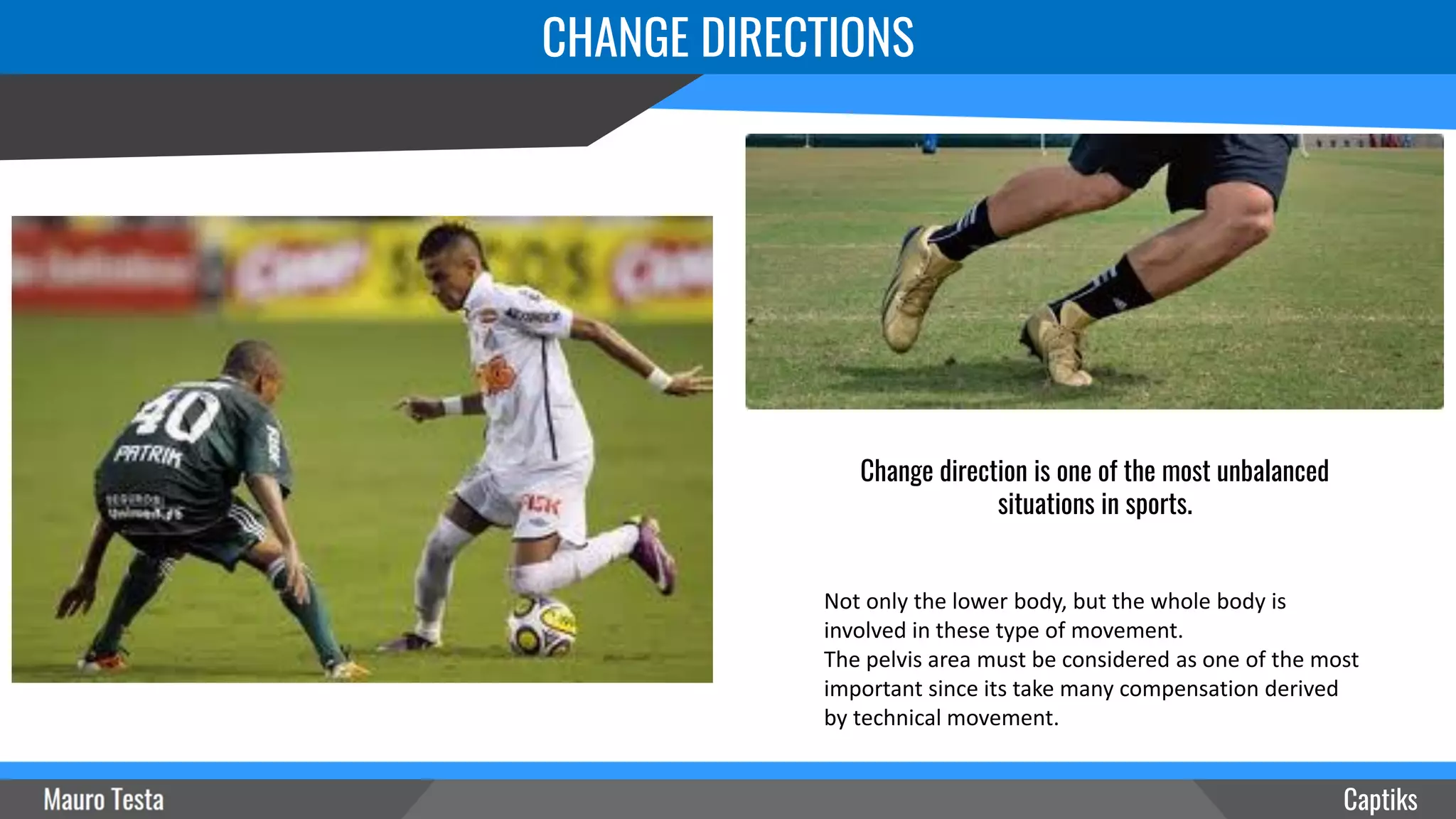
Change direction is one of the most unbalanced
situations in sports.
Not only the lower body, but the whole body is
involved in these type of movement.
The pelvis area must be considered as one of the most
important since its take many compensation derived
by technical movement.
CHANGE DIRECTIONS
Captiks
CHANGE DIRECTIONS
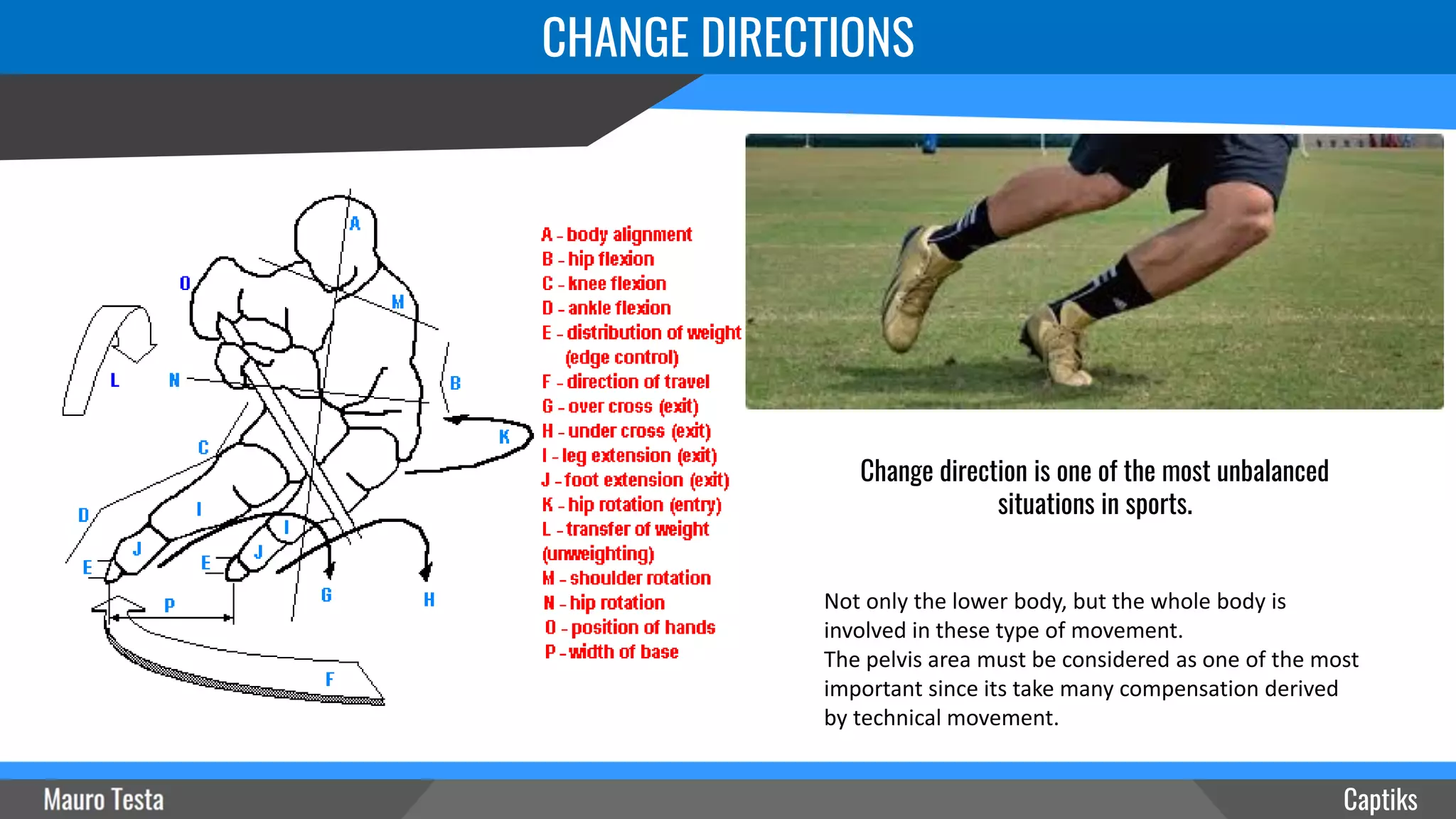
Change direction is one of the most unbalanced
situations in sports.
Not only the lower body, but the whole body is
involved in these type of movement.
The pelvis area must be considered as one of the most
important since its take many compensation derived
by technical movement.
Captiks
THE FOOT’S BIOMECHANIC IN CHANGE DIRECTION
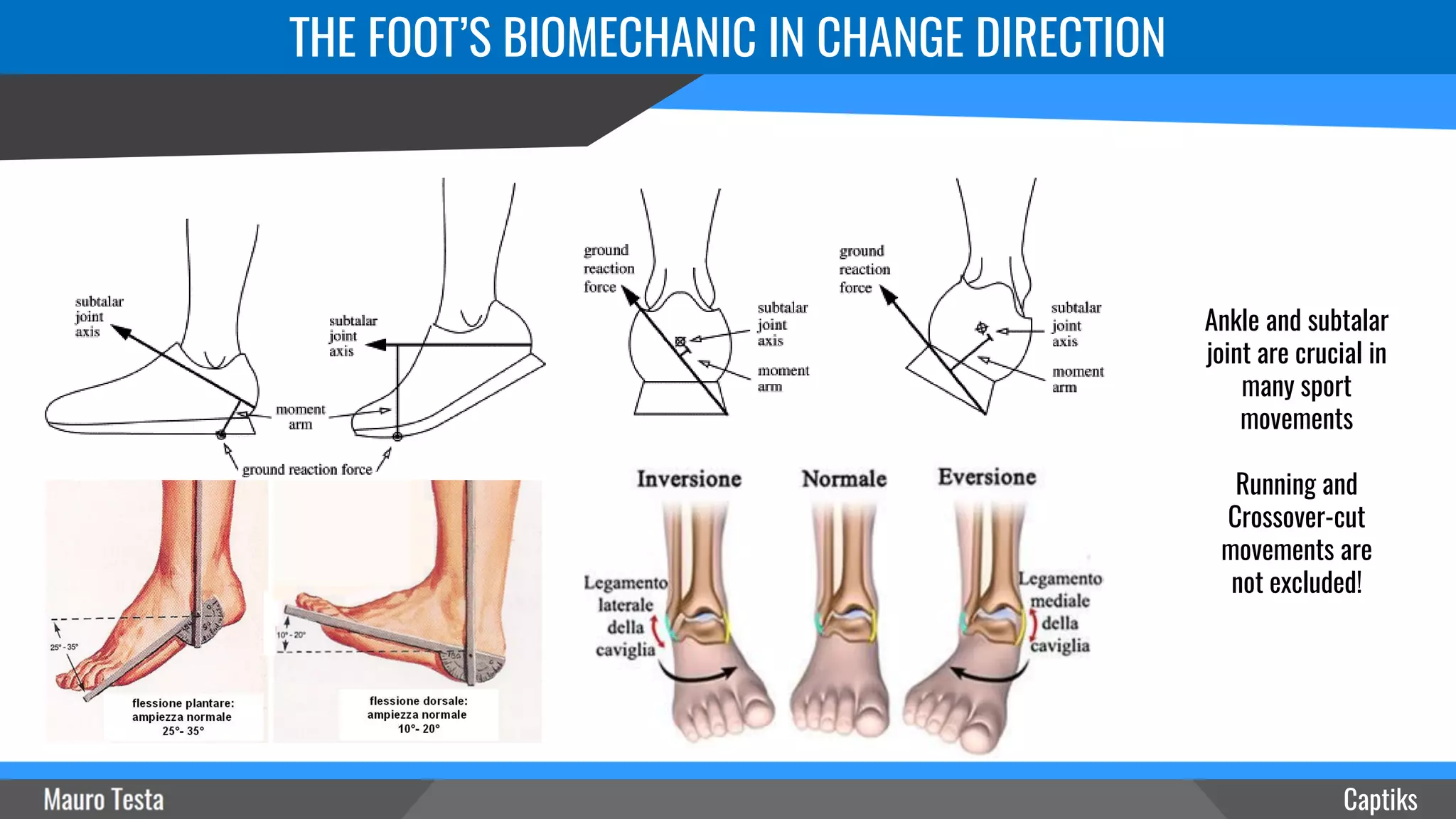
Ankle and subtalar
joint are crucial in
many sport
movements
Running and
Crossover-cut
movements are
not excluded!
Captiks
THE FOOT’S BIOMECHANIC IN CHANGE DIRECTION
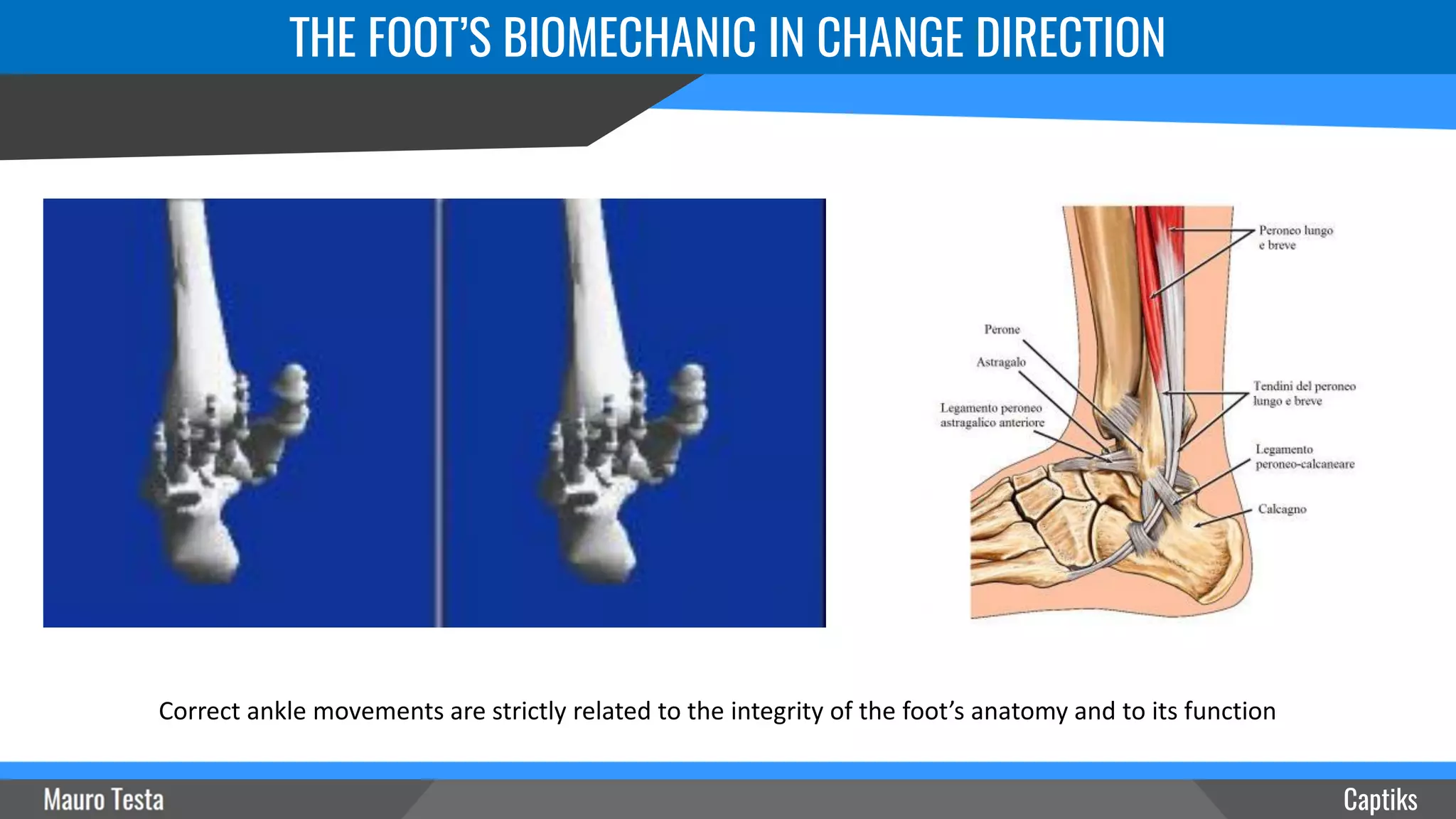
Correct ankle movements are strictly related to the integrity of the foot’s anatomy and to its function
Captiks
THE FOOT’S BIOMECHANIC IN CHANGE DIRECTION
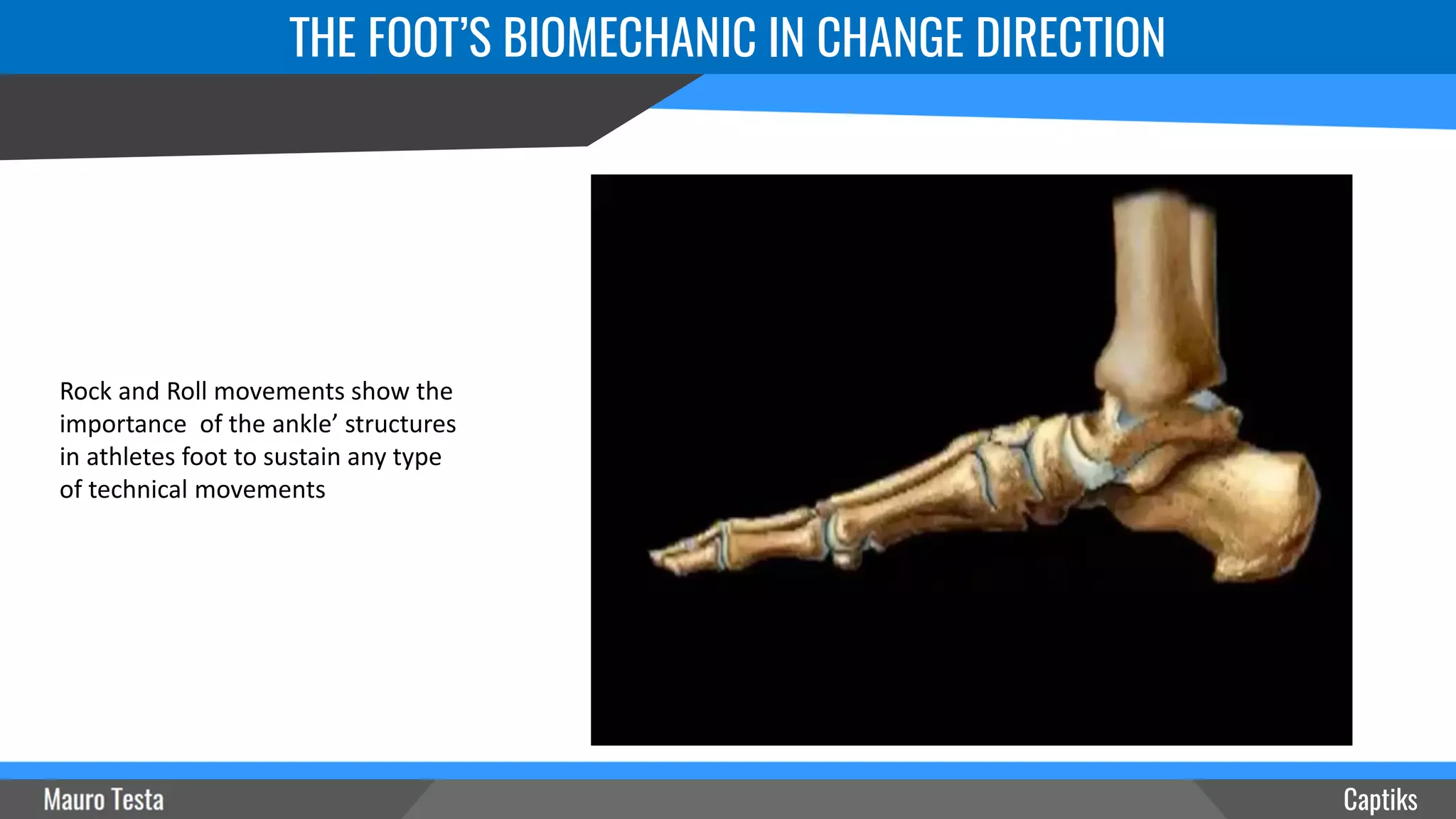
Rock and Roll movements show the
importance of the ankle’ structures
in athletes foot to sustain any type
of technical movements
Captiks
THE FOOT’S BIOMECHANIC IN CHANGE DIRECTION
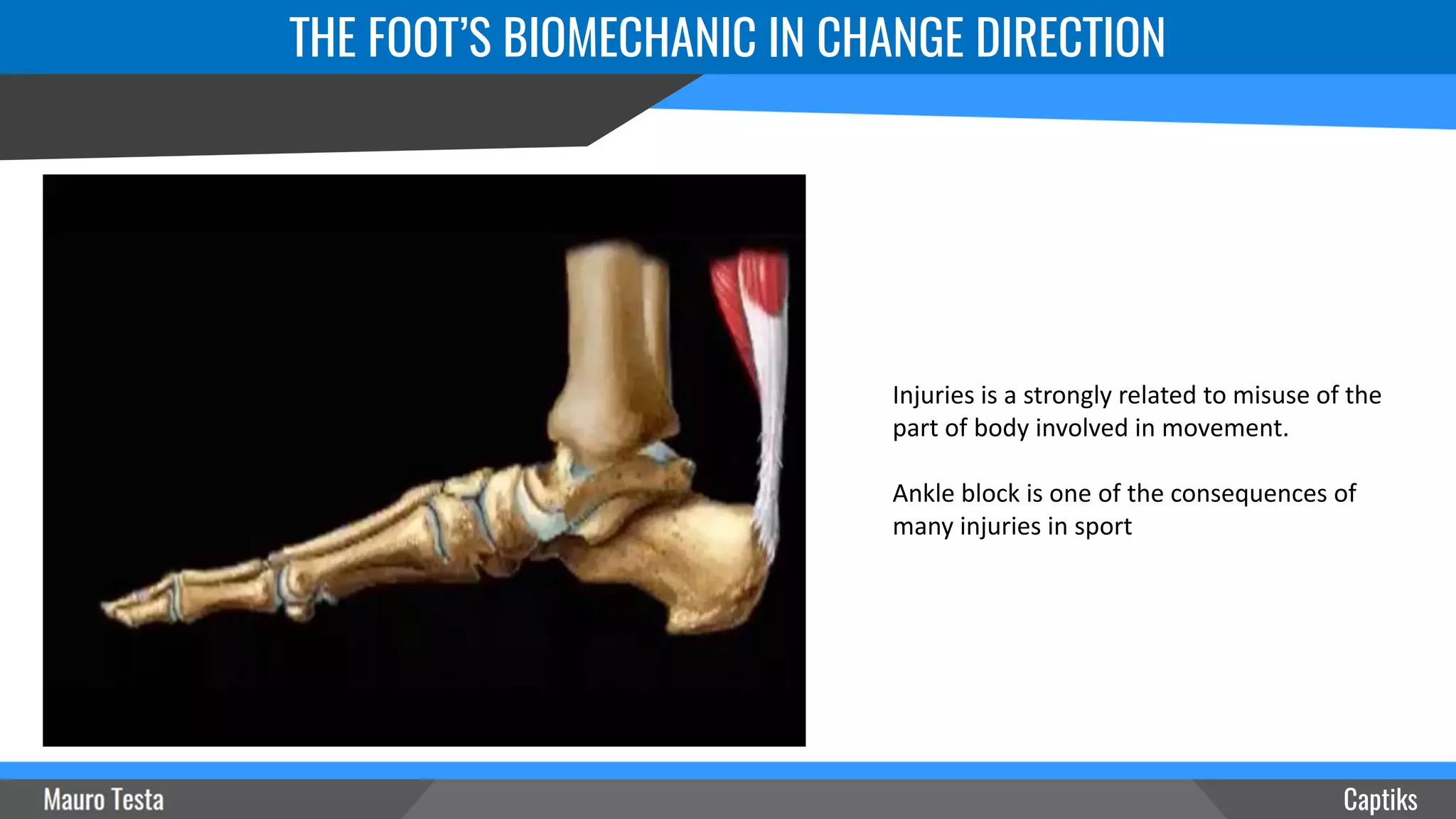
Injuries is a strongly related to misuse of the
part of body involved in movement.
Ankle block is one of the consequences of
many injuries in sport
Captiks
THE FOOT’S BIOMECHANIC IN CHANGE DIRECTION
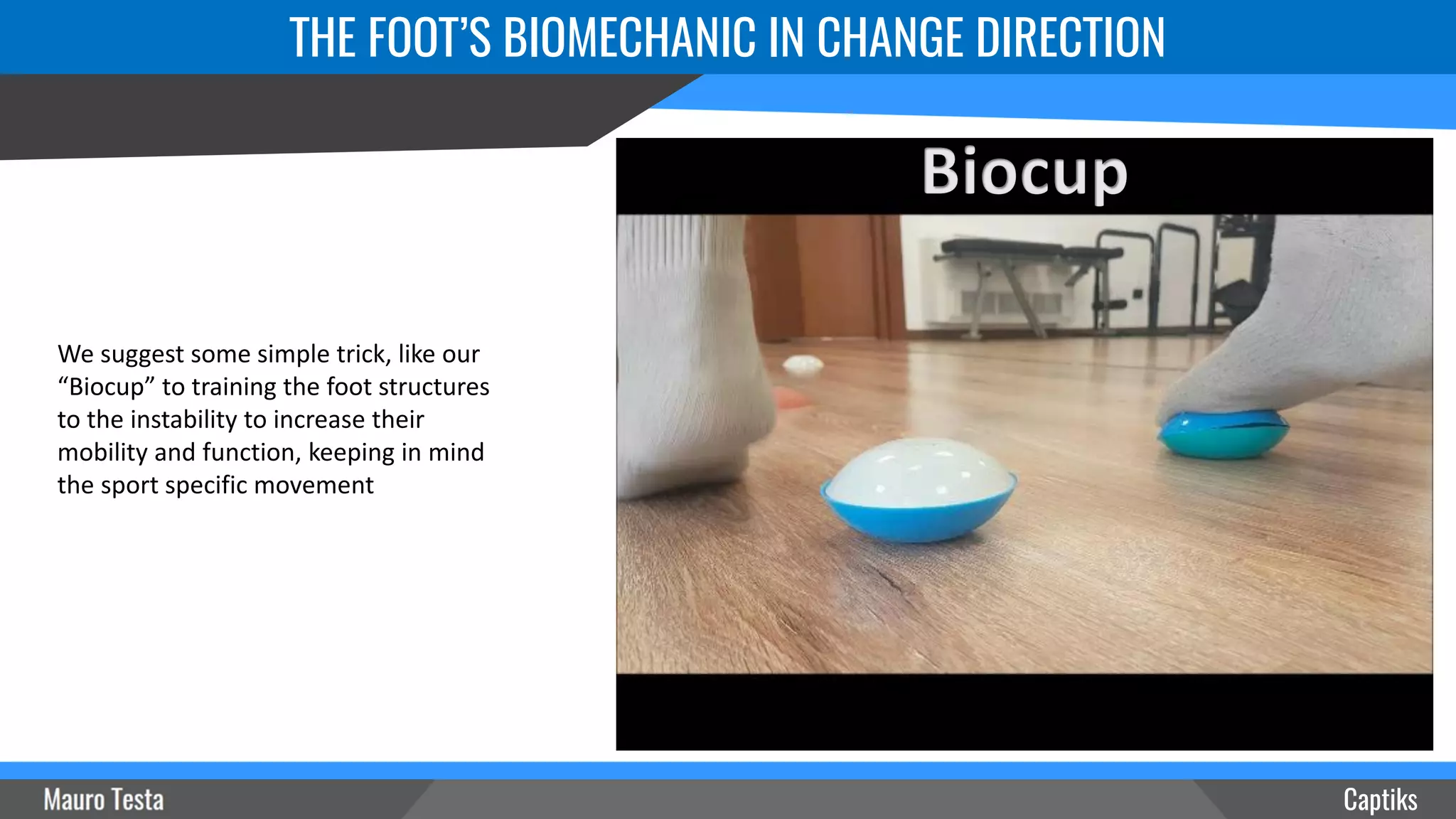
We suggest some simple trick, like our
“Biocup” to training the foot structures
to the instability to increase their
mobility and function, keeping in mind
the sport specific movement
www.biomoove.com
www.captiks.com
info@captiks.com
Captiks
THANK YOU FOR
YOUR ATTENTION

Run, Change of Direction, Acceleration and Deceleration studied with Inertial Sensors

  • 1.
    Captiks Run, Change ofDirection, Acceleration and Deceleration studied with Inertial Sensors
  • 2.
    HUMAN MOTION ANALYSIS «Oneof the society's mission is to promote the study and clinical applications of the MOTION ANALYSIS methods in order to improve the assessment of motor disorders, to increase the effectiveness of treatments through quantitative data analysis and a more focused treatment planning, and also to quantify the results of current therapies.» http://www.siamoc.it/it-it/home.aspx Captiks
  • 3.
    HUMAN MOTION ANALYSIS Captiks ClinicalArea: • Analysis of the balance; • Analysis of efficacy deriving from pharmacological, surgical and rehabilitative treatments; • Analysis on the physiopathology of the skeletal and locomotor system; Bioengineering Area: • Fitting of prostheses/orthoses and evaluating their effectiveness (pre- and post-operative comparisons); Sport Area: • Identify harmful movements during training in order to prevent injuries; • Improve the performance of athletes through the quantitative analysis of their gestures.
  • 4.
    MOTION ANALYSIS LAB Thecentral element of a motion analysis lab can be well represented by the acquisition systems present within it: Captiks OPTOELECTRONIC SYSTEM ELECTROMYGRAPHIC SYSTEM FORCE PLATE BAROPODOMETRIC PLATFORM INERTIAL SENSOR
  • 5.
    MOTION ANALYSIS LAB Captiks OtherMeasures: • Foot pressure • Balance • Body Asimmetry Electromyographic Analysis: • Muscle Activations Dynamic Analysis: • Forces • Moments • Powers Kinematics Analysis: • Joint Angles • Spatio-Temporal parameter
  • 6.
    MOTION ANALYSIS LAB Captiks OtherMeasures: • Foot pressure • Balance • Body Asimmetry Electromyographic Analysis: • Muscle Activationes Dynamic Analysis: • Forces • Moments • Powers Kinematics Analysis: • Joint Angles • Spatio-Temporal parameter
  • 7.
    KINEMATIC AND DYNAMICANALYSIS Captiks INERTIAL SYSTEMGOLD STANDARD
  • 8.
  • 9.
  • 10.
    APPLICATION AREAS Captiks INDUSTRY • Newproducts and applications development • Pilot projects SIMULATION • Advanced Simulations • Motion Capture • Interaction / Gaming SPORT • Performance • Training • Injury’s Prevention MEDICAL • Rehabilitation • Range of motion • Motion Analysis RESEARCH • Robotics • Analysis • Remote Control
  • 11.
  • 12.
  • 13.
    INERTIAL SYSTEM PROSand CONS Captiks ADVANTAGES • Easy Sensors Positioning • Small Sensor Size • Reduced calibration time • Possibility of carrying out analyzes in any environmental condition • Possibility of carrying out tests in natural conditions • Possibility to carry out kinematics and dynamics measurements with a single instrument • Low costs Technological Limits • Duration of calibration • Gyroscope drift • Disorders related to the magnetometer • Identification of linear and gravitational acceleration components
  • 14.
    INERTIAL SENSORS :SPORT BEHIND THE PERFORMANCE Captiks PERFORMANCE PARAMETERS PREVENTION PARAMETERS
  • 15.
    PREVENTION PARAMETERS Captiks GRF BMC SPECTRAL COMPONENT Ground ReactionForce Body Motion Control Resonance and Vibration
  • 16.
    PREVENTION PARAMETERS Captiks GRF BMC SPECTRAL COMPONENT It representsthe average of the module vector obtained from the accelerations along the three directions.
  • 17.
    Captiks GRF BMC SPECTRAL COMPONENT * Daniel W.T.Wundersitza, Kevin J. Nettoab , Brad Aisbetta & Paul B. Gastina. «Validity of an upper-body-mounted accelerometer to measure peak vertical and resultant force during running and change-of-direction tasks.» Sports Biomechanics (2014). It represents the force exerted by the ground on the whole body with which it is in contact. It is expressed in Newton or in Body Weight. PREVENTION PARAMETERS
  • 18.
    Captiks GRF BMC SPECTRAL COMPONENT * Winslow, MartynR. Shorten and Darcy S. «Spectral Analysis of impact Shock During Running.» (1992). PREVENTION PARAMETERS It represents the harmonic content of the accelerometric signal. It allows analyzing data according to the distribution of energy at different frequencies. Signals that show greater spectral content at high frequencies are those that most weigh on the athlete from the point of view of the vibrations arising from the impact.
  • 19.
    SHUTTLE TEST Captiks 20 m ShuttleTest: 20m front and back sprint with 180 ° change of direction performed at top speed with deceleration in the last 5 meters before the change *Test was conducted on natural pitch from 14 professional football players that have performed 2 repetitions of the shuttle test (28 tests in total). Athletes were analysed with an inertial sensor Movit G1 placed in the middle of the pelvis above the iliac crest.
  • 20.
  • 21.
  • 22.
  • 23.
  • 24.
  • 25.
  • 26.
    RESULTS Captiks The inertial sensorMovit G1 has been set with: Fs: 200Hz, Acc FSR: 16g, GyroFSR: 2000dps *Test conducted by 14 professional football players on natural turf that have performed 2 repetitions of the shuttle test (28 tests in total) Acceleration Phase Deceleration Phase Crossover-Cut Phase Acceleration post CD Phase BMC 2,1 ± 0,3 [g] 3,0 ± 0,5 [g] 1,6 ± 0,2 [g] 2,2 ± 0,4 [g] SPECTRAL COMPONENT 0,1 ± 0,08[g2] 0,5 ± 0,2 [g2] 0,07 ± 0,03 [g2] 0,1 ± 0,07 [g2] GRF 3,9 ± 1,3 [BW] 2765 [N] 7,3 ± 1,9 [BW] 5145 [N] 2,8 ± 1,3 [BW] 1998 [N] 3,9 ± 1,2 [BW] 2739 [N]
  • 27.
    RESULTS Captiks The inertial sensorMovit G1 has been set with: Fs: 200Hz, Acc FSR: 16g, GyroFSR: 2000dps *Test conducted by 14 professional football players on natural turf that have performed 2 repetitions of the shuttle test (28 tests in total) Acceleration Phase Deceleration Phase Crossover-Cut Phase Acceleration post CD Phase BMC 2,1 ± 0,3 [g] 3,0 ± 0,5 [g] 1,6 ± 0,2 [g] 2,2 ± 0,4 [g] SPECTRAL COMPONENT 0,1 ± 0,08[g2] 0,5 ± 0,2 [g2] 0,07 ± 0,03 [g2] 0,1 ± 0,07 [g2] GRF 3,9 ± 1,3 [BW] 2765 [N] 7,3 ± 1,9 [BW] 5145 [N] 2,8 ± 1,3 [BW] 1998 [N] 3,9 ± 1,2 [BW] 2739 [N] p_value= 0,6
  • 28.
    RESULTS Captiks The inertial sensorMovit G1 has been set with: Fs: 200Hz, Acc FSR: 16g, GyroFSR: 2000dps *Test conducted by 14 professional football players on natural turf that have performed 2 repetitions of the shuttle test (28 tests in total) Acceleration Phase Deceleration Phase Crossover-Cut Phase Acceleration post CD Phase BMC 2,1 ± 0,3 [g] 3,0 ± 0,5 [g] 1,6 ± 0,2 [g] 2,2 ± 0,4 [g] SPECTRAL COMPONENT 0,1 ± 0,08[g2] 0,5 ± 0,2 [g2] 0,07 ± 0,03 [g2] 0,1 ± 0,07 [g2] GRF 3,9 ± 1,3 [BW] 2765 [N] 7,3 ± 1,9 [BW] 5145 [N] 2,8 ± 1,3 [BW] 1998 [N] 3,9 ± 1,2 [BW] 2739 [N] p_value << 0,05
  • 29.
    RESULTS Captiks Acceleration Phase DecelerationPhase Crossover-Cut Phase Acceleration post CD Phase BMC 2,1 ± 0,3 [g] 3,0 ± 0,5 [g] 1,6 ± 0,2 [g] 2,2 ± 0,4 [g] SPECTRAL COMPONENT 0,1 ± 0,08[g2] 0,5 ± 0,2 [g2] 0,07 ± 0,03 [g2] 0,1 ± 0,07 [g2] GRF 3,9 ± 1,3 [BW] 2765 [N] 7,3 ± 1,9 [BW] 5145 [N] 2,8 ± 1,3 [BW] 1998 [N] 3,9 ± 1,2 [BW] 2739 [N] The inertial sensor Movit G1 has been set with: Fs: 200Hz, Acc FSR: 16g, GyroFSR: 2000dps *Test conducted by 14 professional football players on natural turf that have performed 2 repetitions of the shuttle test (28 tests in total)
  • 30.
    SPECTRAL COMPONENT SHUTTLEPHASES Captiks ACCELERATION PHASE DECELERATION PHASE AREA: 0,1(g2) AREA: 0,5(g2)
  • 31.
    SPECTRAL COMPONENT SHUTTLEPHASES Captiks ACCELERATION PHASE DECELERATION PHASE AREA: 0,1(g2) AREA: 0,5(g2)
  • 32.
    Captiks Acceleration Phase DecelerationPhase Crossover-Cut Phase Acceleration post CD Phase BMC 2,1 ± 0,3 [g] 3,0 ± 0,5 [g] 1,6 ± 0,2 [g] 2,2 ± 0,4 [g] SPECTRAL COMPONENT 0,1 ± 0,08[g2] 0,5 ± 0,2 [g2] 0,07 ± 0,03 [g2] 0,1 ± 0,07 [g2] GRF 3,9 ± 1,3 [BW] 2765 [N] 7,3 ± 1,9 [BW] 5145 [N] 2,8 ± 1,3 [BW] 1998 [N] 3,9 ± 1,2 [BW] 2739 [N] The inertial sensor Movit G1 has been set with: Fs: 200Hz, Acc FSR: 16g, GyroFSR: 2000dps *Test conducted by 14 professional football players on natural turf that have performed 2 repetitions of the shuttle test (28 tests in total) RESULTS
  • 33.
    GRF SHUTTLE PHASES Captiks 75kg 75 kg 75 kg75 kg75 kg ACCELERATION PHASE 75 kg 75 kg75 kg75 kg 75 kg75 kg75 kg DECELERATION PHASE GRF: 3,9(BW) 2765(N) GRF: 7,1(BW) 5145(N)
  • 34.
    GRF SHUTTLE HIP-SHANK Captiks 75kg 75 kg75 kg75 kg 75 kg75 kg75 kg DECELERATION PHASE HIP 75 kg 75 kg75 kg75 kg 75 kg75 kg75 kg DECELERATION PHASE TIBIA 75 kg 75 kg75 kg75 kg 75 kg75 kg75 kg 75 kg 75 kg75 kg75 kg 75 kg75 kg75 kg At the ankle level the shock impact is amplified 3-4 times* *Allison H. Gruber, Katherine A. Boyer, Timothy R. Derrick, Joseph Hamill. «Impact shock frequency components and attenuation in rearfoot and forefoot running.» Journal of Sport and Health Science (2014). *Carrie A. Laughton, Irene McClay Davis, Joseph Hmil. «Effect of Strike Pattern and Orthotic Intervention on Tibial Shock During Running.» JURNAL OF APPLIED BIOMECHANICS (2003). *Niell G. Elvin, Alex A. Elvin,and Steven P. Arnoczky. «Correlation Between Ground Reaction Force and Tibial Acceleration in Vertical Jumping.» (2007). GRF: 7,1(BW) 2765(N) GRF: ∼21(BW) 5145(N)
  • 35.
    Captiks Acceleration Phase DecelerationPhase Crossover-Cut Phase Acceleration post CD Phase BMC 2,1 ± 0,3 [g] 3,0 ± 0,5 [g] 1,6 ± 0,2 [g] 2,2 ± 0,4 [g] SPECTRAL COMPONENT 0,1 ± 0,08[g2] 0,5 ± 0,2 [g2] 0,07 ± 0,03 [g2] 0,1 ± 0,07 [g2] GRF 3,9 ± 1,3 [BW] 2765 [N] 7,3 ± 1,9 [BW] 5145 [N] 2,8 ± 1,3 [BW] 1998 [N] 3,9 ± 1,2 [BW] 2739 [N] The inertial sensor Movit G1 has been set with: Fs: 200Hz, Acc FSR: 16g, GyroFSR: 2000dps *Test conducted by 14 professional football players on natural turf that have performed 2 repetitions of the shuttle test (28 tests in total) RESULTS
  • 36.
    Captiks Change direction isone of the most unbalanced situations in sports. Not only the lower body, but the whole body is involved in these type of movement. The pelvis area must be considered as one of the most important since its take many compensation derived by technical movement. CHANGE DIRECTIONS
  • 37.
    Captiks CHANGE DIRECTIONS Change directionis one of the most unbalanced situations in sports. Not only the lower body, but the whole body is involved in these type of movement. The pelvis area must be considered as one of the most important since its take many compensation derived by technical movement.
  • 38.
    Captiks THE FOOT’S BIOMECHANICIN CHANGE DIRECTION Ankle and subtalar joint are crucial in many sport movements Running and Crossover-cut movements are not excluded!
  • 39.
    Captiks THE FOOT’S BIOMECHANICIN CHANGE DIRECTION Correct ankle movements are strictly related to the integrity of the foot’s anatomy and to its function
  • 40.
    Captiks THE FOOT’S BIOMECHANICIN CHANGE DIRECTION Rock and Roll movements show the importance of the ankle’ structures in athletes foot to sustain any type of technical movements
  • 41.
    Captiks THE FOOT’S BIOMECHANICIN CHANGE DIRECTION Injuries is a strongly related to misuse of the part of body involved in movement. Ankle block is one of the consequences of many injuries in sport
  • 42.
    Captiks THE FOOT’S BIOMECHANICIN CHANGE DIRECTION We suggest some simple trick, like our “Biocup” to training the foot structures to the instability to increase their mobility and function, keeping in mind the sport specific movement
  • 43.