1
Subject-Verb Agreement
How many parts of sentence in English?
A Sentence in English has three parts;
i) Subject
ii) Verb
iii) Object
What is Verb?
Verb is a part of sentence and a part of speech.
Note: Remember that only nouns and pronouns are used at the subject and object positions of sentence.
What is meant by S-V Agreement?
S-V Agreement, means that a singular subject (singular noun or singular pronoun) of a sentence takes a singular verb and a plural
subject (plural noun or plural pronoun) takes a plural verb.
Examples:
i) He helps them. (Singular subject “He” and singular verb “helps”)
ii) We help him. (Plural subject “We” and plural verb “help”)
iii) Some teachers bunk classes. (Plural subject “Some teachers” and plural verb “bunk”)
iv) Nangyal bunks several lectures. (Singular subject “Nangyal” and singular verb “bunk”)
2
Identification of Verbs:
First, let us try to know which verbs are singular and which verbs are plural.
i) In Future Tense which is usually identified by “shall/will”, there is no concept of singularity and plurality of verbs.
ii) In Past Tense which is identified by the second form of verb, there is no concept of singularity and plurality of verbs. There
is only one second form of verb, “was”, which is singular and its plural is “were”.
iii) In Present Tense which is identified by first forms of verb, that singular and plural verbs are a very common topic.
Singular primary helping verbs:
As regards verbs, singular primary helping verbs are “is”, “has” and “was”.
Plural primary helping verbs:
Plural primary helping verbs are “are”, “have” and “were”.
How first form of verb become Singular?
The first forms of all main verbs are plural and become singular by taking ‘s’ or ‘es’ as suffix.
For example:
Read, write, speak, listen, study, stand, sit, go and do are considered plural verbs. They become singular by taking “s” or “es” as
suffix—reads, writes, speaks, listens, studies, stands, sits, goes, and does.
Note: First form is correctly called base or root forms.
3
The below table can provides a good understanding of singular and plural verbs.
SINGULAR VERBS PLURAL VERBS
Is are
Has have
Was were
Does do
Goes go
Reads read
Writes write
Studies study
Speaks speak
“Am” is used only with “I” as subject of a sentence.
Rule:
All first forms of main verbs are plural; they become singular by taking the prefix “s” or “es”.
4
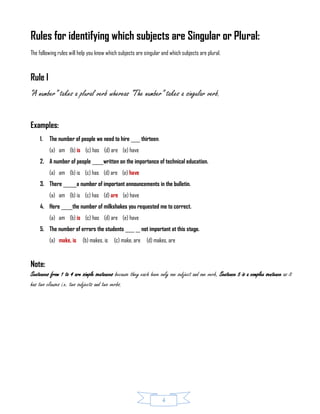
Rules for identifying which subjects are Singular or Plural:
The following rules will help you know which subjects are singular and which subjects are plural.
Rule I
“A number” takes a plural verb whereas “The number” takes a singular verb.
Examples:
1. The number of people we need to hire ____ thirteen.
(a) am (b) is (c) has (d) are (e) have
2. A number of people _____written on the importance of technical education.
(a) am (b) is (c) has (d) are (e) have
3. There ______a number of important announcements in the bulletin.
(a) am (b) is (c) has (d) are (e) have
4. Here _____the number of milkshakes you requested me to correct.
(a) am (b) is (c) has (d) are (e) have
5. The number of errors the students ____ __ not important at this stage.
(a) make, is (b) makes, is (c) make, are (d) makes, are
Note:
Sentences from 1 to 4 are simple sentences because they each have only one subject and one verb. Sentence 5 is a complex sentence as it
has two clauses i.e. two subjects and two verbs.
5
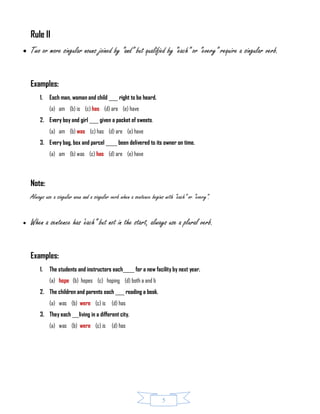
Rule II
 Two or more singular nouns joined by “and” but qualified by “each” or “every” require a singular verb.
Examples:
1. Each man, woman and child ____ right to be heard.
(a) am (b) is (c) has (d) are (e) have
2. Every boy and girl ____ given a packet of sweets.
(a) am (b) was (c) has (d) are (e) have
3. Every bag, box and parcel _____ been delivered to its owner on time.
(a) am (b) was (c) has (d) are (e) have
Note:
Always use a singular noun and a singular verb when a sentence begins with “each” or “every”.
 When a sentence has ‘each” but not in the start, always use a plural verb.
Examples:
1. The students and instructors each_____ for a new facility by next year.
(a) hope (b) hopes (c) hoping (d) both a and b
2. The children and parents each ____ reading a book.
(a) was (b) were (c) is (d) has
3. They each ___living in a different city.
(a) was (b) were (c) is (d) has
6
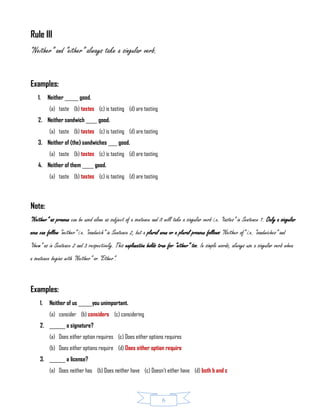
Rule III
“Neither” and “either” always take a singular verb.
Examples:
1. Neither ______ good.
(a) taste (b) tastes (c) is tasting (d) are tasting
2. Neither sandwich _____ good.
(a) taste (b) tastes (c) is tasting (d) are tasting
3. Neither of (the) sandwiches ____ good.
(a) taste (b) tastes (c) is tasting (d) are tasting
4. Neither of them _____ good.
(a) taste (b) tastes (c) is tasting (d) are tasting
Note:
“Neither” as pronoun can be used alone as subject of a sentence and it will take a singular verb i.e. “tastes” in Sentence 1. Only a singular
noun can follow “neither” i.e. “sandwich” in Sentence 2, but a plural noun or a plural pronoun follows “Neither of” i.e. “sandwiches” and
“them” as in Sentence 2 and 3 respectively. This explanation holds true for “either” too. In simple words, always use a singular verb when
a sentence begins with “Neither” or “Either”.
Examples:
1. Neither of us ______you unimportant.
(a) consider (b) considers (c) considering
2. _______ a signature?
(a) Does either option requires (c) Does either options requires
(b) Does either options require (d) Does either option require
3. _______ a license?
(a) Does neither has (b) Does neither have (c) Doesn’t either have (d) both b and c
7
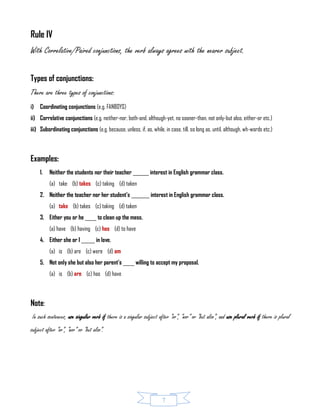
Rule IV
With Correlative/Paired conjunctions, the verb always agrees with the nearer subject.
Types of conjunctions:
There are three types of conjunctions:
i) Coordinating conjunctions (e.g. FANBOYS)
ii) Correlative conjunctions (e.g. neither-nor, both-and, although-yet, no sooner-than, not only-but also, either-or etc.)
iii) Subordinating conjunctions (e.g. because, unless, if, as, while, in case, till, so long as, until, although, wh-words etc.)
Examples:
1. Neither the students nor their teacher _______ interest in English grammar class.
(a) take (b) takes (c) taking (d) taken
2. Neither the teacher nor her student’s ________ interest in English grammar class.
(a) take (b) takes (c) taking (d) taken
3. Either you or he _____ to clean up the mess.
(a) have (b) having (c) has (d) to have
4. Either she or I ______ in love.
(a) is (b) are (c) were (d) am
5. Not only she but also her parent’s _____ willing to accept my proposal.
(a) is (b) are (c) has (d) have
Note:
In such sentences, use singular verb if there is a singular subject after “or”, “nor” or “but also”, and use plural verb if there is plural
subject after “or”, “nor” or “but also”.
8
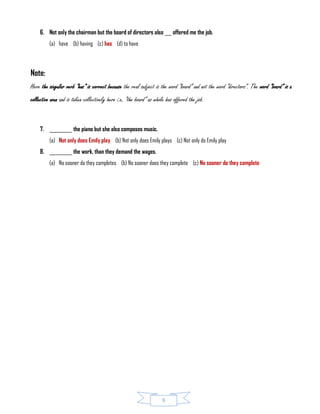
6. Not only the chairman but the board of directors also ___ offered me the job.
(a) have (b) having (c) has (d) to have
Note:
Here the singular verb “has” is correct because the real subject is the word “board” and not the word “directors”. The word “board” is a
collective noun and is taken collectively here i.e. “the board” as whole has offered the job.
7. __________ the piano but she also composes music.
(a) Not only does Emily play (b) Not only does Emily plays (c) Not only do Emily play
8. __________ the work, than they demand the wages.
(a) No sooner do they completes (b) No sooner does they complete (c) No sooner do they complete
9
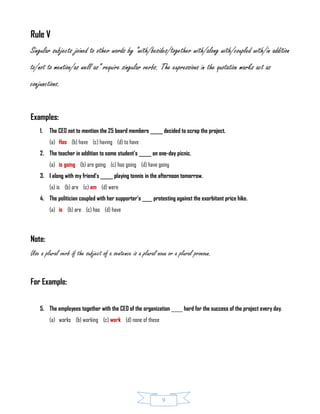
Rule V
Singular subjects joined to other words by “with/besides/together with/along with/coupled with/in addition
to/not to mention/as well as” require singular verbs. The expressions in the quotation marks act as
conjunctions.
Examples:
1. The CEO not to mention the 25 board members _____ decided to scrap the project.
(a) Has (b) have (c) having (d) to have
2. The teacher in addition to some student’s _____ on one-day picnic.
(a) is going (b) are going (c) has going (d) have going
3. I along with my friend’s _____ playing tennis in the afternoon tomorrow.
(a) is (b) are (c) am (d) were
4. The politician coupled with her supporter’s ____ protesting against the exorbitant price hike.
(a) is (b) are (c) has (d) have
Note:
Use a plural verb if the subject of a sentence is a plural noun or a plural pronoun.
For Example:
5. The employees together with the CEO of the organization _____ hard for the success of the project every day.
(a) works (b) working (c) work (d) none of these
10
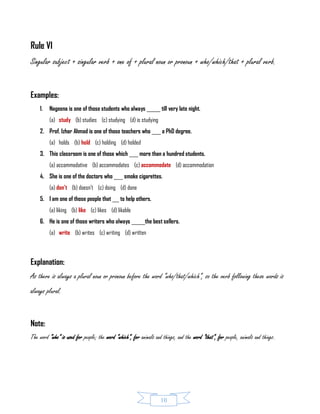
Rule VI
Singular subject + singular verb + one of + plural noun or pronoun + who/which/that + plural verb.
Examples:
1. Nageena is one of those students who always ______ till very late night.
(a) study (b) studies (c) studying (d) is studying
2. Prof. Izhar Ahmad is one of those teachers who ____ a PhD degree.
(a) holds (b) hold (c) holding (d) holded
3. This classroom is one of those which ____ more than a hundred students.
(a) accommodative (b) accommodates (c) accommodate (d) accommodation
4. She is one of the doctors who ____ smoke cigarettes.
(a) don’t (b) doesn’t (c) doing (d) done
5. I am one of those people that ___ to help others.
(a) liking (b) like (c) likes (d) likable
6. He is one of those writers who always ______the best sellers.
(a) write (b) writes (c) writing (d) written
Explanation:
As there is always a plural noun or pronoun before the word “who/that/which”, so the verb following these words is
always plural.
Note:
The word “who” is used for people; the word “which”, for animals and things, and the word “that”, for people, animals and things.
11
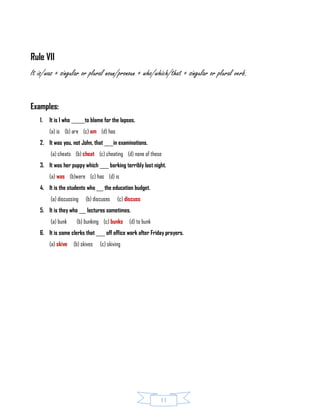
Rule VII
It is/was + singular or plural noun/pronoun + who/which/that + singular or plural verb.
Examples:
1. It is I who ______to blame for the lapses.
(a) is (b) are (c) am (d) has
2. It was you, not John, that ____in examinations.
(a) cheats (b) cheat (c) cheating (d) none of these
3. It was her puppy which ____ barking terribly last night.
(a) was (b)were (c) has (d) is
4. It is the students who ___ the education budget.
(a) discussing (b) discuses (c) discuss
5. It is they who ___ lectures sometimes.
(a) bunk (b) bunking (c) bunks (d) to bunk
6. It is some clerks that ____ off office work after Friday prayers.
(a) skive (b) skives (c) skiving
12
Rule VIII
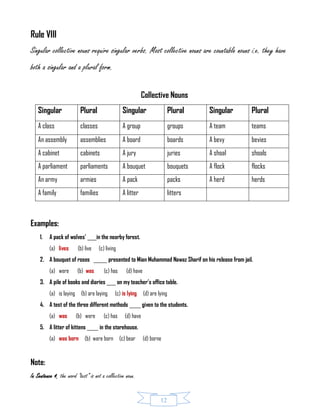
Singular collective nouns require singular verbs. Most collective nouns are countable nouns i.e. they have
both a singular and a plural form.
Collective Nouns
Singular Plural Singular Plural Singular Plural
A class classes A group groups A team teams
An assembly assemblies A board boards A bevy bevies
A cabinet cabinets A jury juries A shoal shoals
A parliament parliaments A bouquet bouquets A flock flocks
An army armies A pack packs A herd herds
A family families A litter litters
Examples:
1. A pack of wolves’ ____in the nearby forest.
(a) lives (b) live (c) living
2. A bouquet of roses ______ presented to Mian Muhammad Nawaz Sharif on his release from jail.
(a) were (b) was (c) has (d) have
3. A pile of books and diaries ____ on my teacher’s office table.
(a) is laying (b) are laying (c) is lying (d) are lying
4. A test of the three different methods _____ given to the students.
(a) was (b) were (c) has (d) have
5. A litter of kittens _____ in the storehouse.
(a) was born (b) were born (c) bear (d) borne
Note:
In Sentence 4, the word “test” is not a collective noun.
13
Rule IX
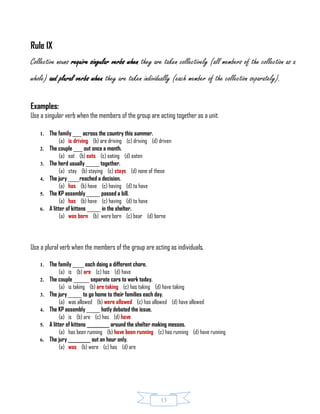
Collective nouns require singular verbs when they are taken collectively (all members of the collection as a
whole) and plural verbs when they are taken individually (each member of the collection separately).
Examples:
Use a singular verb when the members of the group are acting together as a unit.
1. The family ____ across the country this summer.
(a) is driving (b) are driving (c) driving (d) driven
2. The couple ____ out once a month.
(a) eat (b) eats (c) eating (d) eaten
3. The herd usually ______ together.
(a) stay (b) staying (c) stays (d) none of these
4. The jury _____reached a decision.
(a) has (b) have (c) having (d) to have
5. The KP assembly ______ passed a bill.
(a) has (b) have (c) having (d) to have
6. A litter of kittens ______ in the shelter.
(a) was born (b) were born (c) bear (d) borne
Use a plural verb when the members of the group are acting as individuals.
1. The family _____ each doing a different chore.
(a) is (b) are (c) has (d) have
2. The couple _______ separate cars to work today.
(a) is taking (b) are taking (c) has taking (d) have taking
3. The jury ______ to go home to their families each day.
(a) was allowed (b) were allowed (c) has allowed (d) have allowed
4. The KP assembly ______ hotly debated the issue.
(a) is (b) are (c) has (d) have
5. A litter of kittens _________ around the shelter making messes.
(a) has been running (b) have been running (c) has running (d) have running
6. The jury _________ out an hour only.
(a) was (b) were (c) has (d) are
14
Rule X
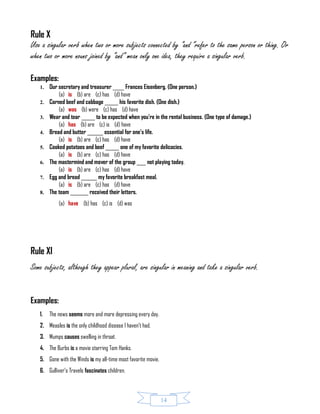
Use a singular verb when two or more subjects connected by “and” refer to the same person or thing. Or
when two or more nouns joined by “and” mean only one idea, they require a singular verb.
Examples:
1. Our secretary and treasurer _____ Frances Eisenberg. (One person.)
(a) is (b) are (c) has (d) have
2. Corned beef and cabbage ______ his favorite dish. (One dish.)
(a) was (b) were (c) has (d) have
3. Wear and tear ______ to be expected when you're in the rental business. (One type of damage.)
(a) has (b) are (c) is (d) have
4. Bread and butter _______ essential for one’s life.
(a) is (b) are (c) has (d) have
5. Cooked potatoes and beef ______ one of my favorite delicacies.
(a) is (b) are (c) has (d) have
6. The mastermind and mover of the group ____ not playing today.
(a) is (b) are (c) has (d) have
7. Egg and bread _______ my favorite breakfast meal.
(a) is (b) are (c) has (d) have
8. The team ________ received their letters.
(a) have (b) has (c) is (d) was
Rule XI
Some subjects, although they appear plural, are singular in meaning and take a singular verb.
Examples:
1. The news seems more and more depressing every day.
2. Measles is the only childhood disease I haven’t had.
3. Mumps causes swelling in throat.
4. The Burbs is a movie starring Tom Hanks.
5. Gone with the Winds is my all-time most favorite movie.
6. Gulliver’s Travels fascinates children.
15
Rule XII
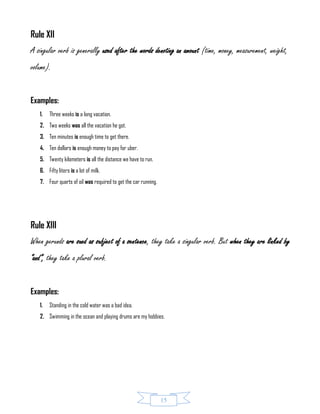
A singular verb is generally used after the words denoting an amount (time, money, measurement, weight,
volume).
Examples:
1. Three weeks is a long vacation.
2. Two weeks was all the vacation he got.
3. Ten minutes is enough time to get there.
4. Ten dollars is enough money to pay for uber.
5. Twenty kilometers is all the distance we have to run.
6. Fifty liters is a lot of milk.
7. Four quarts of oil was required to get the car running.
Rule XIII
When gerunds are sued as subject of a sentence, they take a singular verb. But when they are linked by
“and”, they take a plural verb.
Examples:
1. Standing in the cold water was a bad idea.
2. Swimming in the ocean and playing drums are my hobbies.
16
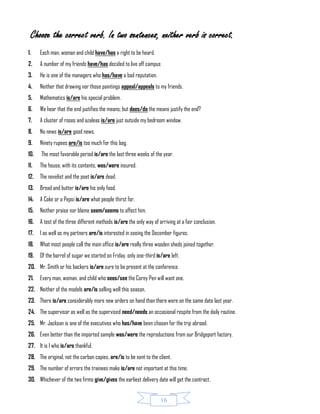
Choose the correct verb. In two sentences, neither verb is correct.
1. Each man, woman and child have/has a right to be heard.
2. A number of my friends have/has decided to live off campus
3. He is one of the managers who has/have a bad reputation.
4. Neither that drawing nor those paintings appeal/appeals to my friends.
5. Mathematics is/are his special problem.
6. We hear that the end justifies the means; but does/do the means justify the end?
7. A cluster of roses and azaleas is/are just outside my bedroom window.
8. No news is/are good news.
9. Ninety rupees are/is too much for this bag.
10. The most favorable period is/are the last three weeks of the year.
11. The house, with its contents, was/were insured.
12. The novelist and the poet is/are dead.
13. Bread and butter is/are his only food.
14. A Coke or a Pepsi is/are what people thirst for.
15. Neither praise nor blame seem/seems to affect him.
16. A test of the three different methods is/are the only way of arriving at a fair conclusion.
17. I as well as my partners are/is interested in seeing the December figures.
18. What most people call the main office is/are really three wooden sheds joined together.
19. Of the barrel of sugar we started on Friday, only one-third is/are left.
20. Mr. Smith or his backers is/are sure to be present at the conference.
21. Every man, woman, and child who sees/see the Corey Pen will want one.
22. Neither of the models are/is selling well this season.
23. There is/are considerably more new orders on hand than there were on the same date last year.
24. The supervisor as well as the supervised need/needs an occasional respite from the daily routine.
25. Mr. Jackson is one of the executives who has/have been chosen for the trip abroad.
26. Even better than the imported sample was/were the reproductions from our Bridgeport factory.
27. It is I who is/are thankful.
28. The original, not the carbon copies, are/is to be sent to the client.
29. The number of errors the trainees make is/are not important at this time.
30. Whichever of the two firms give/gives the earliest delivery date will get the contract.
17
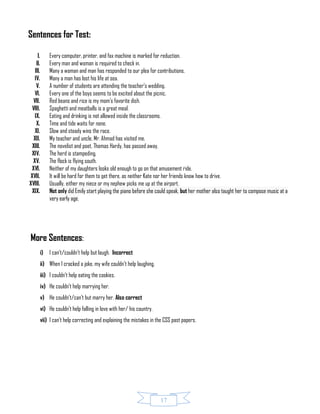
Sentences for Test:
I. Every computer, printer, and fax machine is marked for reduction.
II. Every man and woman is required to check in.
III. Many a woman and man has responded to our plea for contributions.
IV. Many a man has lost his life at sea.
V. A number of students are attending the teacher’s wedding.
VI. Every one of the boys seems to be excited about the picnic.
VII. Red beans and rice is my mom’s favorite dish.
VIII. Spaghetti and meatballs is a great meal.
IX. Eating and drinking is not allowed inside the classrooms.
X. Time and tide waits for none.
XI. Slow and steady wins the race.
XII. My teacher and uncle, Mr. Ahmad has visited me.
XIII. The novelist and poet, Thomas Hardy, has passed away.
XIV. The herd is stampeding.
XV. The flock is flying south.
XVI. Neither of my daughters looks old enough to go on that amusement ride.
XVII. It will be hard for them to get there, as neither Kate nor her friends know how to drive.
XVIII. Usually, either my niece or my nephew picks me up at the airport.
XIX. Not only did Emily start playing the piano before she could speak, but her mother also taught her to compose music at a
very early age.
More Sentences:
i) I can’t/couldn’t help but laugh. Incorrect
ii) When I cracked a joke, my wife couldn’t help laughing.
iii) I couldn’t help eating the cookies.
iv) He couldn’t help marrying her.
v) He couldn’t/can’t but marry her. Also correct
vi) He couldn’t help falling in love with her/ his country.
vii) I can’t help correcting and explaining the mistakes in the CSS past papers.

Subject-Verb Agreement

  • 1.
    1 Subject-Verb Agreement How manyparts of sentence in English? A Sentence in English has three parts; i) Subject ii) Verb iii) Object What is Verb? Verb is a part of sentence and a part of speech. Note: Remember that only nouns and pronouns are used at the subject and object positions of sentence. What is meant by S-V Agreement? S-V Agreement, means that a singular subject (singular noun or singular pronoun) of a sentence takes a singular verb and a plural subject (plural noun or plural pronoun) takes a plural verb. Examples: i) He helps them. (Singular subject “He” and singular verb “helps”) ii) We help him. (Plural subject “We” and plural verb “help”) iii) Some teachers bunk classes. (Plural subject “Some teachers” and plural verb “bunk”) iv) Nangyal bunks several lectures. (Singular subject “Nangyal” and singular verb “bunk”)
  • 2.
    2 Identification of Verbs: First,let us try to know which verbs are singular and which verbs are plural. i) In Future Tense which is usually identified by “shall/will”, there is no concept of singularity and plurality of verbs. ii) In Past Tense which is identified by the second form of verb, there is no concept of singularity and plurality of verbs. There is only one second form of verb, “was”, which is singular and its plural is “were”. iii) In Present Tense which is identified by first forms of verb, that singular and plural verbs are a very common topic. Singular primary helping verbs: As regards verbs, singular primary helping verbs are “is”, “has” and “was”. Plural primary helping verbs: Plural primary helping verbs are “are”, “have” and “were”. How first form of verb become Singular? The first forms of all main verbs are plural and become singular by taking ‘s’ or ‘es’ as suffix. For example: Read, write, speak, listen, study, stand, sit, go and do are considered plural verbs. They become singular by taking “s” or “es” as suffix—reads, writes, speaks, listens, studies, stands, sits, goes, and does. Note: First form is correctly called base or root forms.
  • 3.
    3 The below tablecan provides a good understanding of singular and plural verbs. SINGULAR VERBS PLURAL VERBS Is are Has have Was were Does do Goes go Reads read Writes write Studies study Speaks speak “Am” is used only with “I” as subject of a sentence. Rule: All first forms of main verbs are plural; they become singular by taking the prefix “s” or “es”.
  • 4.
    4 Rules for identifyingwhich subjects are Singular or Plural: The following rules will help you know which subjects are singular and which subjects are plural. Rule I “A number” takes a plural verb whereas “The number” takes a singular verb. Examples: 1. The number of people we need to hire ____ thirteen. (a) am (b) is (c) has (d) are (e) have 2. A number of people _____written on the importance of technical education. (a) am (b) is (c) has (d) are (e) have 3. There ______a number of important announcements in the bulletin. (a) am (b) is (c) has (d) are (e) have 4. Here _____the number of milkshakes you requested me to correct. (a) am (b) is (c) has (d) are (e) have 5. The number of errors the students ____ __ not important at this stage. (a) make, is (b) makes, is (c) make, are (d) makes, are Note: Sentences from 1 to 4 are simple sentences because they each have only one subject and one verb. Sentence 5 is a complex sentence as it has two clauses i.e. two subjects and two verbs.
  • 5.
    5 Rule II  Twoor more singular nouns joined by “and” but qualified by “each” or “every” require a singular verb. Examples: 1. Each man, woman and child ____ right to be heard. (a) am (b) is (c) has (d) are (e) have 2. Every boy and girl ____ given a packet of sweets. (a) am (b) was (c) has (d) are (e) have 3. Every bag, box and parcel _____ been delivered to its owner on time. (a) am (b) was (c) has (d) are (e) have Note: Always use a singular noun and a singular verb when a sentence begins with “each” or “every”.  When a sentence has ‘each” but not in the start, always use a plural verb. Examples: 1. The students and instructors each_____ for a new facility by next year. (a) hope (b) hopes (c) hoping (d) both a and b 2. The children and parents each ____ reading a book. (a) was (b) were (c) is (d) has 3. They each ___living in a different city. (a) was (b) were (c) is (d) has
  • 6.
    6 Rule III “Neither” and“either” always take a singular verb. Examples: 1. Neither ______ good. (a) taste (b) tastes (c) is tasting (d) are tasting 2. Neither sandwich _____ good. (a) taste (b) tastes (c) is tasting (d) are tasting 3. Neither of (the) sandwiches ____ good. (a) taste (b) tastes (c) is tasting (d) are tasting 4. Neither of them _____ good. (a) taste (b) tastes (c) is tasting (d) are tasting Note: “Neither” as pronoun can be used alone as subject of a sentence and it will take a singular verb i.e. “tastes” in Sentence 1. Only a singular noun can follow “neither” i.e. “sandwich” in Sentence 2, but a plural noun or a plural pronoun follows “Neither of” i.e. “sandwiches” and “them” as in Sentence 2 and 3 respectively. This explanation holds true for “either” too. In simple words, always use a singular verb when a sentence begins with “Neither” or “Either”. Examples: 1. Neither of us ______you unimportant. (a) consider (b) considers (c) considering 2. _______ a signature? (a) Does either option requires (c) Does either options requires (b) Does either options require (d) Does either option require 3. _______ a license? (a) Does neither has (b) Does neither have (c) Doesn’t either have (d) both b and c
  • 7.
    7 Rule IV With Correlative/Pairedconjunctions, the verb always agrees with the nearer subject. Types of conjunctions: There are three types of conjunctions: i) Coordinating conjunctions (e.g. FANBOYS) ii) Correlative conjunctions (e.g. neither-nor, both-and, although-yet, no sooner-than, not only-but also, either-or etc.) iii) Subordinating conjunctions (e.g. because, unless, if, as, while, in case, till, so long as, until, although, wh-words etc.) Examples: 1. Neither the students nor their teacher _______ interest in English grammar class. (a) take (b) takes (c) taking (d) taken 2. Neither the teacher nor her student’s ________ interest in English grammar class. (a) take (b) takes (c) taking (d) taken 3. Either you or he _____ to clean up the mess. (a) have (b) having (c) has (d) to have 4. Either she or I ______ in love. (a) is (b) are (c) were (d) am 5. Not only she but also her parent’s _____ willing to accept my proposal. (a) is (b) are (c) has (d) have Note: In such sentences, use singular verb if there is a singular subject after “or”, “nor” or “but also”, and use plural verb if there is plural subject after “or”, “nor” or “but also”.
  • 8.
    8 6. Not onlythe chairman but the board of directors also ___ offered me the job. (a) have (b) having (c) has (d) to have Note: Here the singular verb “has” is correct because the real subject is the word “board” and not the word “directors”. The word “board” is a collective noun and is taken collectively here i.e. “the board” as whole has offered the job. 7. __________ the piano but she also composes music. (a) Not only does Emily play (b) Not only does Emily plays (c) Not only do Emily play 8. __________ the work, than they demand the wages. (a) No sooner do they completes (b) No sooner does they complete (c) No sooner do they complete
  • 9.
    9 Rule V Singular subjectsjoined to other words by “with/besides/together with/along with/coupled with/in addition to/not to mention/as well as” require singular verbs. The expressions in the quotation marks act as conjunctions. Examples: 1. The CEO not to mention the 25 board members _____ decided to scrap the project. (a) Has (b) have (c) having (d) to have 2. The teacher in addition to some student’s _____ on one-day picnic. (a) is going (b) are going (c) has going (d) have going 3. I along with my friend’s _____ playing tennis in the afternoon tomorrow. (a) is (b) are (c) am (d) were 4. The politician coupled with her supporter’s ____ protesting against the exorbitant price hike. (a) is (b) are (c) has (d) have Note: Use a plural verb if the subject of a sentence is a plural noun or a plural pronoun. For Example: 5. The employees together with the CEO of the organization _____ hard for the success of the project every day. (a) works (b) working (c) work (d) none of these
  • 10.
    10 Rule VI Singular subject+ singular verb + one of + plural noun or pronoun + who/which/that + plural verb. Examples: 1. Nageena is one of those students who always ______ till very late night. (a) study (b) studies (c) studying (d) is studying 2. Prof. Izhar Ahmad is one of those teachers who ____ a PhD degree. (a) holds (b) hold (c) holding (d) holded 3. This classroom is one of those which ____ more than a hundred students. (a) accommodative (b) accommodates (c) accommodate (d) accommodation 4. She is one of the doctors who ____ smoke cigarettes. (a) don’t (b) doesn’t (c) doing (d) done 5. I am one of those people that ___ to help others. (a) liking (b) like (c) likes (d) likable 6. He is one of those writers who always ______the best sellers. (a) write (b) writes (c) writing (d) written Explanation: As there is always a plural noun or pronoun before the word “who/that/which”, so the verb following these words is always plural. Note: The word “who” is used for people; the word “which”, for animals and things, and the word “that”, for people, animals and things.
  • 11.
    11 Rule VII It is/was+ singular or plural noun/pronoun + who/which/that + singular or plural verb. Examples: 1. It is I who ______to blame for the lapses. (a) is (b) are (c) am (d) has 2. It was you, not John, that ____in examinations. (a) cheats (b) cheat (c) cheating (d) none of these 3. It was her puppy which ____ barking terribly last night. (a) was (b)were (c) has (d) is 4. It is the students who ___ the education budget. (a) discussing (b) discuses (c) discuss 5. It is they who ___ lectures sometimes. (a) bunk (b) bunking (c) bunks (d) to bunk 6. It is some clerks that ____ off office work after Friday prayers. (a) skive (b) skives (c) skiving
  • 12.
    12 Rule VIII Singular collectivenouns require singular verbs. Most collective nouns are countable nouns i.e. they have both a singular and a plural form. Collective Nouns Singular Plural Singular Plural Singular Plural A class classes A group groups A team teams An assembly assemblies A board boards A bevy bevies A cabinet cabinets A jury juries A shoal shoals A parliament parliaments A bouquet bouquets A flock flocks An army armies A pack packs A herd herds A family families A litter litters Examples: 1. A pack of wolves’ ____in the nearby forest. (a) lives (b) live (c) living 2. A bouquet of roses ______ presented to Mian Muhammad Nawaz Sharif on his release from jail. (a) were (b) was (c) has (d) have 3. A pile of books and diaries ____ on my teacher’s office table. (a) is laying (b) are laying (c) is lying (d) are lying 4. A test of the three different methods _____ given to the students. (a) was (b) were (c) has (d) have 5. A litter of kittens _____ in the storehouse. (a) was born (b) were born (c) bear (d) borne Note: In Sentence 4, the word “test” is not a collective noun.
  • 13.
    13 Rule IX Collective nounsrequire singular verbs when they are taken collectively (all members of the collection as a whole) and plural verbs when they are taken individually (each member of the collection separately). Examples: Use a singular verb when the members of the group are acting together as a unit. 1. The family ____ across the country this summer. (a) is driving (b) are driving (c) driving (d) driven 2. The couple ____ out once a month. (a) eat (b) eats (c) eating (d) eaten 3. The herd usually ______ together. (a) stay (b) staying (c) stays (d) none of these 4. The jury _____reached a decision. (a) has (b) have (c) having (d) to have 5. The KP assembly ______ passed a bill. (a) has (b) have (c) having (d) to have 6. A litter of kittens ______ in the shelter. (a) was born (b) were born (c) bear (d) borne Use a plural verb when the members of the group are acting as individuals. 1. The family _____ each doing a different chore. (a) is (b) are (c) has (d) have 2. The couple _______ separate cars to work today. (a) is taking (b) are taking (c) has taking (d) have taking 3. The jury ______ to go home to their families each day. (a) was allowed (b) were allowed (c) has allowed (d) have allowed 4. The KP assembly ______ hotly debated the issue. (a) is (b) are (c) has (d) have 5. A litter of kittens _________ around the shelter making messes. (a) has been running (b) have been running (c) has running (d) have running 6. The jury _________ out an hour only. (a) was (b) were (c) has (d) are
  • 14.
    14 Rule X Use asingular verb when two or more subjects connected by “and” refer to the same person or thing. Or when two or more nouns joined by “and” mean only one idea, they require a singular verb. Examples: 1. Our secretary and treasurer _____ Frances Eisenberg. (One person.) (a) is (b) are (c) has (d) have 2. Corned beef and cabbage ______ his favorite dish. (One dish.) (a) was (b) were (c) has (d) have 3. Wear and tear ______ to be expected when you're in the rental business. (One type of damage.) (a) has (b) are (c) is (d) have 4. Bread and butter _______ essential for one’s life. (a) is (b) are (c) has (d) have 5. Cooked potatoes and beef ______ one of my favorite delicacies. (a) is (b) are (c) has (d) have 6. The mastermind and mover of the group ____ not playing today. (a) is (b) are (c) has (d) have 7. Egg and bread _______ my favorite breakfast meal. (a) is (b) are (c) has (d) have 8. The team ________ received their letters. (a) have (b) has (c) is (d) was Rule XI Some subjects, although they appear plural, are singular in meaning and take a singular verb. Examples: 1. The news seems more and more depressing every day. 2. Measles is the only childhood disease I haven’t had. 3. Mumps causes swelling in throat. 4. The Burbs is a movie starring Tom Hanks. 5. Gone with the Winds is my all-time most favorite movie. 6. Gulliver’s Travels fascinates children.
  • 15.
    15 Rule XII A singularverb is generally used after the words denoting an amount (time, money, measurement, weight, volume). Examples: 1. Three weeks is a long vacation. 2. Two weeks was all the vacation he got. 3. Ten minutes is enough time to get there. 4. Ten dollars is enough money to pay for uber. 5. Twenty kilometers is all the distance we have to run. 6. Fifty liters is a lot of milk. 7. Four quarts of oil was required to get the car running. Rule XIII When gerunds are sued as subject of a sentence, they take a singular verb. But when they are linked by “and”, they take a plural verb. Examples: 1. Standing in the cold water was a bad idea. 2. Swimming in the ocean and playing drums are my hobbies.
  • 16.
    16 Choose the correctverb. In two sentences, neither verb is correct. 1. Each man, woman and child have/has a right to be heard. 2. A number of my friends have/has decided to live off campus 3. He is one of the managers who has/have a bad reputation. 4. Neither that drawing nor those paintings appeal/appeals to my friends. 5. Mathematics is/are his special problem. 6. We hear that the end justifies the means; but does/do the means justify the end? 7. A cluster of roses and azaleas is/are just outside my bedroom window. 8. No news is/are good news. 9. Ninety rupees are/is too much for this bag. 10. The most favorable period is/are the last three weeks of the year. 11. The house, with its contents, was/were insured. 12. The novelist and the poet is/are dead. 13. Bread and butter is/are his only food. 14. A Coke or a Pepsi is/are what people thirst for. 15. Neither praise nor blame seem/seems to affect him. 16. A test of the three different methods is/are the only way of arriving at a fair conclusion. 17. I as well as my partners are/is interested in seeing the December figures. 18. What most people call the main office is/are really three wooden sheds joined together. 19. Of the barrel of sugar we started on Friday, only one-third is/are left. 20. Mr. Smith or his backers is/are sure to be present at the conference. 21. Every man, woman, and child who sees/see the Corey Pen will want one. 22. Neither of the models are/is selling well this season. 23. There is/are considerably more new orders on hand than there were on the same date last year. 24. The supervisor as well as the supervised need/needs an occasional respite from the daily routine. 25. Mr. Jackson is one of the executives who has/have been chosen for the trip abroad. 26. Even better than the imported sample was/were the reproductions from our Bridgeport factory. 27. It is I who is/are thankful. 28. The original, not the carbon copies, are/is to be sent to the client. 29. The number of errors the trainees make is/are not important at this time. 30. Whichever of the two firms give/gives the earliest delivery date will get the contract.
  • 17.
    17 Sentences for Test: I.Every computer, printer, and fax machine is marked for reduction. II. Every man and woman is required to check in. III. Many a woman and man has responded to our plea for contributions. IV. Many a man has lost his life at sea. V. A number of students are attending the teacher’s wedding. VI. Every one of the boys seems to be excited about the picnic. VII. Red beans and rice is my mom’s favorite dish. VIII. Spaghetti and meatballs is a great meal. IX. Eating and drinking is not allowed inside the classrooms. X. Time and tide waits for none. XI. Slow and steady wins the race. XII. My teacher and uncle, Mr. Ahmad has visited me. XIII. The novelist and poet, Thomas Hardy, has passed away. XIV. The herd is stampeding. XV. The flock is flying south. XVI. Neither of my daughters looks old enough to go on that amusement ride. XVII. It will be hard for them to get there, as neither Kate nor her friends know how to drive. XVIII. Usually, either my niece or my nephew picks me up at the airport. XIX. Not only did Emily start playing the piano before she could speak, but her mother also taught her to compose music at a very early age. More Sentences: i) I can’t/couldn’t help but laugh. Incorrect ii) When I cracked a joke, my wife couldn’t help laughing. iii) I couldn’t help eating the cookies. iv) He couldn’t help marrying her. v) He couldn’t/can’t but marry her. Also correct vi) He couldn’t help falling in love with her/ his country. vii) I can’t help correcting and explaining the mistakes in the CSS past papers.