This Is NFHS RULE 4  JEOPARDY
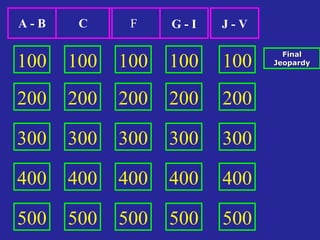
100 200 300 400 500 100 200 300 400 500 100 200 300 400 500 100 200 300 400 500 Final Jeopardy 100 200 300 400 500 G - I J - V A - B F   C
Rule 4 A-B for 100 _________is a player who has released the ball on a try for a goal has  not  returned to the floor.
Rule 4 A-B for 100 AIRBORNE SHOOTER
Rule 4 A-B for 200 ______________is a device located at the scorer’s table which is used to indicate the direction of a team’s basket for the alternating-possession procedure.
Rule 4 A-B for 200 ALTERNATING POSSESSION ARROW
Rule 4 A-B for 300 If the officials permit a team to go the wrong direction, when discovered all points scored, fouls committed, and time consumed shall __________ as if each team had gone the proper direction.  Play shall resume with each team going the proper direction based on bench location.
Rule 4 A-B for 300 Count
Rule 4 A-B for 400 4.1.1 SITUATION:  A1 is in the air  on a jump shot in the lane. While in the air,  A1 releases  the ball on a try and is fouled by B1 who is attempting to block the shot. A1’s try is: (a) successful.  The official rules that the A1 is not an air-borne shooter and awards the ball to  team A out of bounds nearest the spot of the foul. Is the official correct? If no, explain
Rule 4 A-B for 400 NO, A1 is an airborne shooter when the ball is released until one foot returns  to the floor. An airborne shooter is in the act of shooting. B1 has fouled A1 in the act of shooting. A1 is awarded one free throw
Rule 4 A-B for 500 _____ is the call when the ball  is on the rim and the ball or net  is touched by a player
Rule 4 A-B for 500 Offensive or Defensive  Basket Interference
Rule 4 C for 100 occurs when a player in control of the ball in his/her team’s frontcourt, is  guarded by any opponent who is within six feet of the player who is holding or dribbling the ball.  The distance shall be measured from the forward ______of the defender to the forward  ________  of the ball handler.
Rule 4 C for 100 Closely Guarded, foot, foot
Rule 4 C for 200 _________begins when the habitual throwing movement starts a try or with the touching on a tap and ends when the ball is clearly in flight.
Rule 4 C for 200 Continuous Motion
Rule 4 C for 300 .A  team is in control  of the ball: While a live ball is being passed among teammates. During an i__________ dribble. AND  Team control  continues  until: The ball is in flight during a try or tap  for a _________
Rule 4 C for 300 Interrupted , Goal
Rule 4 C for 400 A1 is dribbling in A’s backcourt when the ball strikes his ankle and bounces away. During the interrupted dribble, A1 fouls B1 in attempting to continue the dribble.  The official rules this a  team and player control foul  on A1. Is the official correct? Explain.
Rule 4 C for 400 NO, this foul is a team control foul but  not  a player control foul
Rule 4 C for 500 During a throw-in by A1 from the end line by A’s basket the throw-in is touched by A2 before it goes across the division line where it is recovered by A3. The official rules that this is not a backcourt violation. Is the official correct? Explain.
Rule 4 C for 500 Yes, there is no player or team control when A2 touched the ball. Team A does not have control  until  A3 gains control the ball
Rule 4 F for 100 Fighting is an attempt to strike, punch or kick by using a fist, hands, arms, legs or feet regardless of whether _________ is made.
Rule 4 F for 100 Contact
Rule 4 F for 200 A1 dunks over B1 and then taunts B1. B1 retaliates and punches A1.  The official charges  both A1 and B1 with a flagrant technical foul  for fighting and are disqualified.  Is the official correct? Explain.
Rule 4 F for 200 Yes, A1’s action is defined as fighting  when the taunting caused  B1 to retaliate by fighting.
Rule 4 F for 300 ________  fouls may or may  not be premeditated and are  not based solely on the severity of the _______.
Rule 4 F for 300 Intentional , act / foul
Rule 4 F for 400 A1 and B1 foul one another at  approximately the same time . The contact occurs during: (a) a live-ball situation; or (b) a dead-ball situation. The official rules this a double personal foul in both cases. Is the official correct? Explain.
Rule 4 F for 400 NO, In (a), it is a double personal foul and in (b), it is a double technical foul. No free throws are awarded in (a) or (b) and play resumes at the point of interruption
Rule 4 F for 500 3 substitutes of Team B leave their bench and come onto the court during a fight. The officials do the following:  3 substitutes are each charged with a technical foul & disqualified Team B head coach is also charged directly with a technical foul.  Team B is charged with three fouls toward reaching the bonus. Is the official correct? Explain.
Rule 4 F for 500 NO, it is an indirect technical foul on the Head Coach, not  a direct technical
Rule 4 G-I for 100 It is not legal to swing arms and elbows excessively. This occurs  when: a. Arms and elbows are swung about …… and the speed of the extended arms and elbows is in excess of the rest of the ________ as it rotates on the hips…
Rule 4 G-I for 100 Body
Rule 4 G-I for 200 _______ contact is contact  with an opponent which is permitted and which  does  not  constitute a foul.
Rule 4 G-I for 200 Incidental
Rule 4 G-I for 300 Guarding an opponent with the ball or a stationary opponent  without  the ball: No time or ______ is required to obtain an initial legal position. If the opponent with the ball is airborne,  the guard must have obtained legal position _____ the opponent left the floor.
Rule 4 G-I for 300 Distance , Before
Rule 4 G-I for 400 B1 has legal guarding position on A1 and moves to maintain it. A1 moves laterally and contacts defender B1 but  does not   get his/her head and shoulders past the  torso of B1. Contact occurs on the side  of B1’s torso.  The official calls a player-control foul  on A1. Is the official correct? Explain
Rule 4 G-I for 400 Yes, A1 created the contact on B1  who had legal guarding position
Rule 4 G-I for 500 A1 jumps to try for goal or to pass the ball. B1 leaps or reaches and is able to put his/her hands on the ball and keep A1 from releasing it. A1 returns to the floor with the ball. The official calls a violation of traveling. Is the official correct? Explain.
Rule 4 G-I for 500 No, this should have been ruled  held (jump) ball.  The alternating possession arrow would be used to determine which team is administered the throw-in
Rule 4 J-V for 100 Kicking the ball is the  _____ striking of the ball with any part of the ______ or foot.
Rule 4 J-V for 100 Intentional, Leg
Rule 4 J-V for 200 _______ personnel are all individuals who are part of or affiliated with a team, including, but not limited to: substitutes, coaches, manager(s) and statistician(s).
Rule 4 J-V for 200 Bench
Rule 4 J-V for 300 A1 attempts a try after ending the dribble. The try does not touch the backboard, the rim or any other player. A1 runs and is able to catch the ball before it strikes the floor. Is this traveling? Explain
Rule 4 J-V for 300 RULING: No. When A1 recovered his/her own try, A1 could either dribble, pass or try again. There was  no team control  after the ball was released on a try.
Rule 4 J-V for 400 A1 becomes confused and throws the ball at the wrong basket. A1 is fouled by B1 and the ball goes into the basket. A1 missed, would A1 be awarded two free throws for the foul by B1? Explain.
Rule 4 J-V for 400 RULING: No free throw will be awarded. The ball became dead when the foul occurred. When a player throws at the opponent’s basket, it  is  not a try .
Rule 4 J-V for 500 A1 receives a pass and establishes the right foot as the pivot. While faking a pass or try, A1 lifts the pivot foot and stands on the left foot alone while undecided as to what to do.  The official calls this a traveling violation. Is the official correct? Explain.
Rule 4 J-V for 500 NO , the pivot foot CAN be lifted off the floor, but can’t be placed back on the ground. A1 can shoot, pass or call timeout.
FINAL JEOPARDY A1 dives for a loose ball and slides after gaining control. A1 is in a position either on his/her back or stomach. What 4 things can A1 do without violating? What else can A1 do if lying on their back without violating?
FINAL JEOPARDY ANSWER A1 may pass, shoot, start a dribble or call a time-out.  If flat on his/her back, A1 may sit up without violating.

Rule 4 jeopardy

  • 1.
    This Is NFHSRULE 4 JEOPARDY
  • 2.
    100 200 300400 500 100 200 300 400 500 100 200 300 400 500 100 200 300 400 500 Final Jeopardy 100 200 300 400 500 G - I J - V A - B F C
  • 3.
    Rule 4 A-Bfor 100 _________is a player who has released the ball on a try for a goal has not returned to the floor.
  • 4.
    Rule 4 A-Bfor 100 AIRBORNE SHOOTER
  • 5.
    Rule 4 A-Bfor 200 ______________is a device located at the scorer’s table which is used to indicate the direction of a team’s basket for the alternating-possession procedure.
  • 6.
    Rule 4 A-Bfor 200 ALTERNATING POSSESSION ARROW
  • 7.
    Rule 4 A-Bfor 300 If the officials permit a team to go the wrong direction, when discovered all points scored, fouls committed, and time consumed shall __________ as if each team had gone the proper direction. Play shall resume with each team going the proper direction based on bench location.
  • 8.
    Rule 4 A-Bfor 300 Count
  • 9.
    Rule 4 A-Bfor 400 4.1.1 SITUATION: A1 is in the air on a jump shot in the lane. While in the air, A1 releases the ball on a try and is fouled by B1 who is attempting to block the shot. A1’s try is: (a) successful. The official rules that the A1 is not an air-borne shooter and awards the ball to team A out of bounds nearest the spot of the foul. Is the official correct? If no, explain
  • 10.
    Rule 4 A-Bfor 400 NO, A1 is an airborne shooter when the ball is released until one foot returns to the floor. An airborne shooter is in the act of shooting. B1 has fouled A1 in the act of shooting. A1 is awarded one free throw
  • 11.
    Rule 4 A-Bfor 500 _____ is the call when the ball is on the rim and the ball or net is touched by a player
  • 12.
    Rule 4 A-Bfor 500 Offensive or Defensive Basket Interference
  • 13.
    Rule 4 Cfor 100 occurs when a player in control of the ball in his/her team’s frontcourt, is guarded by any opponent who is within six feet of the player who is holding or dribbling the ball. The distance shall be measured from the forward ______of the defender to the forward ________ of the ball handler.
  • 14.
    Rule 4 Cfor 100 Closely Guarded, foot, foot
  • 15.
    Rule 4 Cfor 200 _________begins when the habitual throwing movement starts a try or with the touching on a tap and ends when the ball is clearly in flight.
  • 16.
    Rule 4 Cfor 200 Continuous Motion
  • 17.
    Rule 4 Cfor 300 .A team is in control of the ball: While a live ball is being passed among teammates. During an i__________ dribble. AND Team control continues until: The ball is in flight during a try or tap for a _________
  • 18.
    Rule 4 Cfor 300 Interrupted , Goal
  • 19.
    Rule 4 Cfor 400 A1 is dribbling in A’s backcourt when the ball strikes his ankle and bounces away. During the interrupted dribble, A1 fouls B1 in attempting to continue the dribble. The official rules this a team and player control foul on A1. Is the official correct? Explain.
  • 20.
    Rule 4 Cfor 400 NO, this foul is a team control foul but not a player control foul
  • 21.
    Rule 4 Cfor 500 During a throw-in by A1 from the end line by A’s basket the throw-in is touched by A2 before it goes across the division line where it is recovered by A3. The official rules that this is not a backcourt violation. Is the official correct? Explain.
  • 22.
    Rule 4 Cfor 500 Yes, there is no player or team control when A2 touched the ball. Team A does not have control until A3 gains control the ball
  • 23.
    Rule 4 Ffor 100 Fighting is an attempt to strike, punch or kick by using a fist, hands, arms, legs or feet regardless of whether _________ is made.
  • 24.
    Rule 4 Ffor 100 Contact
  • 25.
    Rule 4 Ffor 200 A1 dunks over B1 and then taunts B1. B1 retaliates and punches A1. The official charges both A1 and B1 with a flagrant technical foul for fighting and are disqualified. Is the official correct? Explain.
  • 26.
    Rule 4 Ffor 200 Yes, A1’s action is defined as fighting when the taunting caused B1 to retaliate by fighting.
  • 27.
    Rule 4 Ffor 300 ________ fouls may or may not be premeditated and are not based solely on the severity of the _______.
  • 28.
    Rule 4 Ffor 300 Intentional , act / foul
  • 29.
    Rule 4 Ffor 400 A1 and B1 foul one another at approximately the same time . The contact occurs during: (a) a live-ball situation; or (b) a dead-ball situation. The official rules this a double personal foul in both cases. Is the official correct? Explain.
  • 30.
    Rule 4 Ffor 400 NO, In (a), it is a double personal foul and in (b), it is a double technical foul. No free throws are awarded in (a) or (b) and play resumes at the point of interruption
  • 31.
    Rule 4 Ffor 500 3 substitutes of Team B leave their bench and come onto the court during a fight. The officials do the following: 3 substitutes are each charged with a technical foul & disqualified Team B head coach is also charged directly with a technical foul. Team B is charged with three fouls toward reaching the bonus. Is the official correct? Explain.
  • 32.
    Rule 4 Ffor 500 NO, it is an indirect technical foul on the Head Coach, not a direct technical
  • 33.
    Rule 4 G-Ifor 100 It is not legal to swing arms and elbows excessively. This occurs when: a. Arms and elbows are swung about …… and the speed of the extended arms and elbows is in excess of the rest of the ________ as it rotates on the hips…
  • 34.
    Rule 4 G-Ifor 100 Body
  • 35.
    Rule 4 G-Ifor 200 _______ contact is contact with an opponent which is permitted and which does not constitute a foul.
  • 36.
    Rule 4 G-Ifor 200 Incidental
  • 37.
    Rule 4 G-Ifor 300 Guarding an opponent with the ball or a stationary opponent without the ball: No time or ______ is required to obtain an initial legal position. If the opponent with the ball is airborne, the guard must have obtained legal position _____ the opponent left the floor.
  • 38.
    Rule 4 G-Ifor 300 Distance , Before
  • 39.
    Rule 4 G-Ifor 400 B1 has legal guarding position on A1 and moves to maintain it. A1 moves laterally and contacts defender B1 but does not get his/her head and shoulders past the torso of B1. Contact occurs on the side of B1’s torso. The official calls a player-control foul on A1. Is the official correct? Explain
  • 40.
    Rule 4 G-Ifor 400 Yes, A1 created the contact on B1 who had legal guarding position
  • 41.
    Rule 4 G-Ifor 500 A1 jumps to try for goal or to pass the ball. B1 leaps or reaches and is able to put his/her hands on the ball and keep A1 from releasing it. A1 returns to the floor with the ball. The official calls a violation of traveling. Is the official correct? Explain.
  • 42.
    Rule 4 G-Ifor 500 No, this should have been ruled held (jump) ball. The alternating possession arrow would be used to determine which team is administered the throw-in
  • 43.
    Rule 4 J-Vfor 100 Kicking the ball is the _____ striking of the ball with any part of the ______ or foot.
  • 44.
    Rule 4 J-Vfor 100 Intentional, Leg
  • 45.
    Rule 4 J-Vfor 200 _______ personnel are all individuals who are part of or affiliated with a team, including, but not limited to: substitutes, coaches, manager(s) and statistician(s).
  • 46.
    Rule 4 J-Vfor 200 Bench
  • 47.
    Rule 4 J-Vfor 300 A1 attempts a try after ending the dribble. The try does not touch the backboard, the rim or any other player. A1 runs and is able to catch the ball before it strikes the floor. Is this traveling? Explain
  • 48.
    Rule 4 J-Vfor 300 RULING: No. When A1 recovered his/her own try, A1 could either dribble, pass or try again. There was no team control after the ball was released on a try.
  • 49.
    Rule 4 J-Vfor 400 A1 becomes confused and throws the ball at the wrong basket. A1 is fouled by B1 and the ball goes into the basket. A1 missed, would A1 be awarded two free throws for the foul by B1? Explain.
  • 50.
    Rule 4 J-Vfor 400 RULING: No free throw will be awarded. The ball became dead when the foul occurred. When a player throws at the opponent’s basket, it is not a try .
  • 51.
    Rule 4 J-Vfor 500 A1 receives a pass and establishes the right foot as the pivot. While faking a pass or try, A1 lifts the pivot foot and stands on the left foot alone while undecided as to what to do. The official calls this a traveling violation. Is the official correct? Explain.
  • 52.
    Rule 4 J-Vfor 500 NO , the pivot foot CAN be lifted off the floor, but can’t be placed back on the ground. A1 can shoot, pass or call timeout.
  • 53.
    FINAL JEOPARDY A1dives for a loose ball and slides after gaining control. A1 is in a position either on his/her back or stomach. What 4 things can A1 do without violating? What else can A1 do if lying on their back without violating?
  • 54.
    FINAL JEOPARDY ANSWERA1 may pass, shoot, start a dribble or call a time-out. If flat on his/her back, A1 may sit up without violating.