Bill Lewis
MCBOA Vice President
Legal Guarding
Legal GuardingPosition
Position
&&
Block / Charge
Block / Charge
1. The defensive player MUSTMUST have both feet
on the court.
2. The front of the defensive player’s torso
MUSTMUST be facing the offensive player.
Legal Guarding PositionLegal Guarding Position
Rule 4 Sect. 23 Art. 3
• The defender can have one or both feet on the
court OR be airborne.
• Defender is NOT required to continue facing
the offensive player.
• Player can move any direction EXCEPT
toward the offensive player.
Legal Guarding Position -Legal Guarding Position -
after LGP is established
Legal Guarding Position & Block / Charge Play #1Legal Guarding Position & Block / Charge Play #1
Legal Guarding Position & Block / Charge Play #2Legal Guarding Position & Block / Charge Play #2
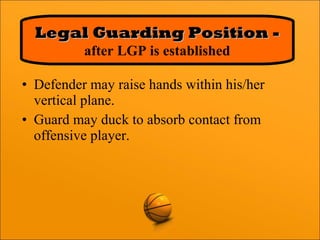
• Defender may raise hands within his/her
vertical plane.
• Guard may duck to absorb contact from
offensive player.
Legal Guarding Position -Legal Guarding Position -
after LGP is established
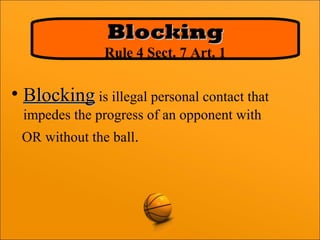
• BlockingBlocking is illegal personal contact that
impedes the progress of an opponent with
OR without the ball.
BlockingBlocking
Rule 4 Sect. 7 Art. 1
Block / Charge Play #3Block / Charge Play #3
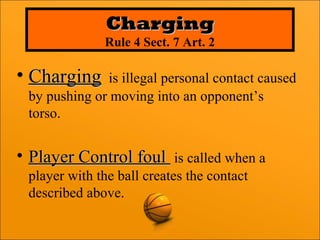
• ChargingCharging is illegal personal contact caused
by pushing or moving into an opponent’s
torso.
• Player Control foulPlayer Control foul is called when a
player with the ball creates the contact
described above.
ChargingCharging
Rule 4 Sect. 7 Art. 2
Legal Guarding Position & Block / Charge Play #3Legal Guarding Position & Block / Charge Play #3
Legal Guarding Position & Block / Charge Play #4Legal Guarding Position & Block / Charge Play #4
Pass & Crash Block / Charge Play #2Pass & Crash Block / Charge Play #2
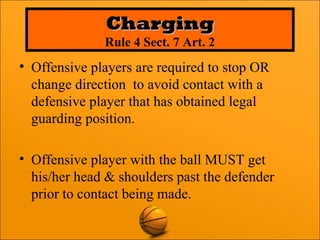
• Offensive players are required to stop OR
change direction to avoid contact with a
defensive player that has obtained legal
guarding position.
• Offensive player with the ball MUST get
his/her head & shoulders past the defender
prior to contact being made.
ChargingCharging
Rule 4 Sect. 7 Art. 2
PowerPoint adapted from presentation by IAABO
Executive Director Tom Lopes

LGP

  • 1.
    Bill Lewis MCBOA VicePresident Legal Guarding Legal GuardingPosition Position && Block / Charge Block / Charge
  • 2.
    1. The defensiveplayer MUSTMUST have both feet on the court. 2. The front of the defensive player’s torso MUSTMUST be facing the offensive player. Legal Guarding PositionLegal Guarding Position Rule 4 Sect. 23 Art. 3
  • 3.
    • The defendercan have one or both feet on the court OR be airborne. • Defender is NOT required to continue facing the offensive player. • Player can move any direction EXCEPT toward the offensive player. Legal Guarding Position -Legal Guarding Position - after LGP is established
  • 4.
    Legal Guarding Position& Block / Charge Play #1Legal Guarding Position & Block / Charge Play #1 Legal Guarding Position & Block / Charge Play #2Legal Guarding Position & Block / Charge Play #2
  • 5.
    • Defender mayraise hands within his/her vertical plane. • Guard may duck to absorb contact from offensive player. Legal Guarding Position -Legal Guarding Position - after LGP is established
  • 6.
    • BlockingBlocking isillegal personal contact that impedes the progress of an opponent with OR without the ball. BlockingBlocking Rule 4 Sect. 7 Art. 1
  • 7.
    Block / ChargePlay #3Block / Charge Play #3
  • 8.
    • ChargingCharging isillegal personal contact caused by pushing or moving into an opponent’s torso. • Player Control foulPlayer Control foul is called when a player with the ball creates the contact described above. ChargingCharging Rule 4 Sect. 7 Art. 2
  • 9.
    Legal Guarding Position& Block / Charge Play #3Legal Guarding Position & Block / Charge Play #3 Legal Guarding Position & Block / Charge Play #4Legal Guarding Position & Block / Charge Play #4 Pass & Crash Block / Charge Play #2Pass & Crash Block / Charge Play #2
  • 10.
    • Offensive playersare required to stop OR change direction to avoid contact with a defensive player that has obtained legal guarding position. • Offensive player with the ball MUST get his/her head & shoulders past the defender prior to contact being made. ChargingCharging Rule 4 Sect. 7 Art. 2
  • 11.
    PowerPoint adapted frompresentation by IAABO Executive Director Tom Lopes