PE4 TEAM SPORTS
BASKETBALL
BASKETBALL
- game played between two
teams of five players each on
a rectangular court, usually
indoors.
HISTORY
• Basketball was invented by James
Naismith in Springfield,
Massachusetts, in 1891.
• In the early 1890s Naismith found
himself tasked with developing a new
game when he worked for the YMCA.
He turned to a game from his
childhood known as “Duck on a
Rock”.
 Soccer ball -the first ball that
was used was a until 1840
when an actual “basketball “
was invented. The ball was
slightly smaller, about thirty
inches in diameter.
 The first game used
peached baskets nailed
to the wall for rims.
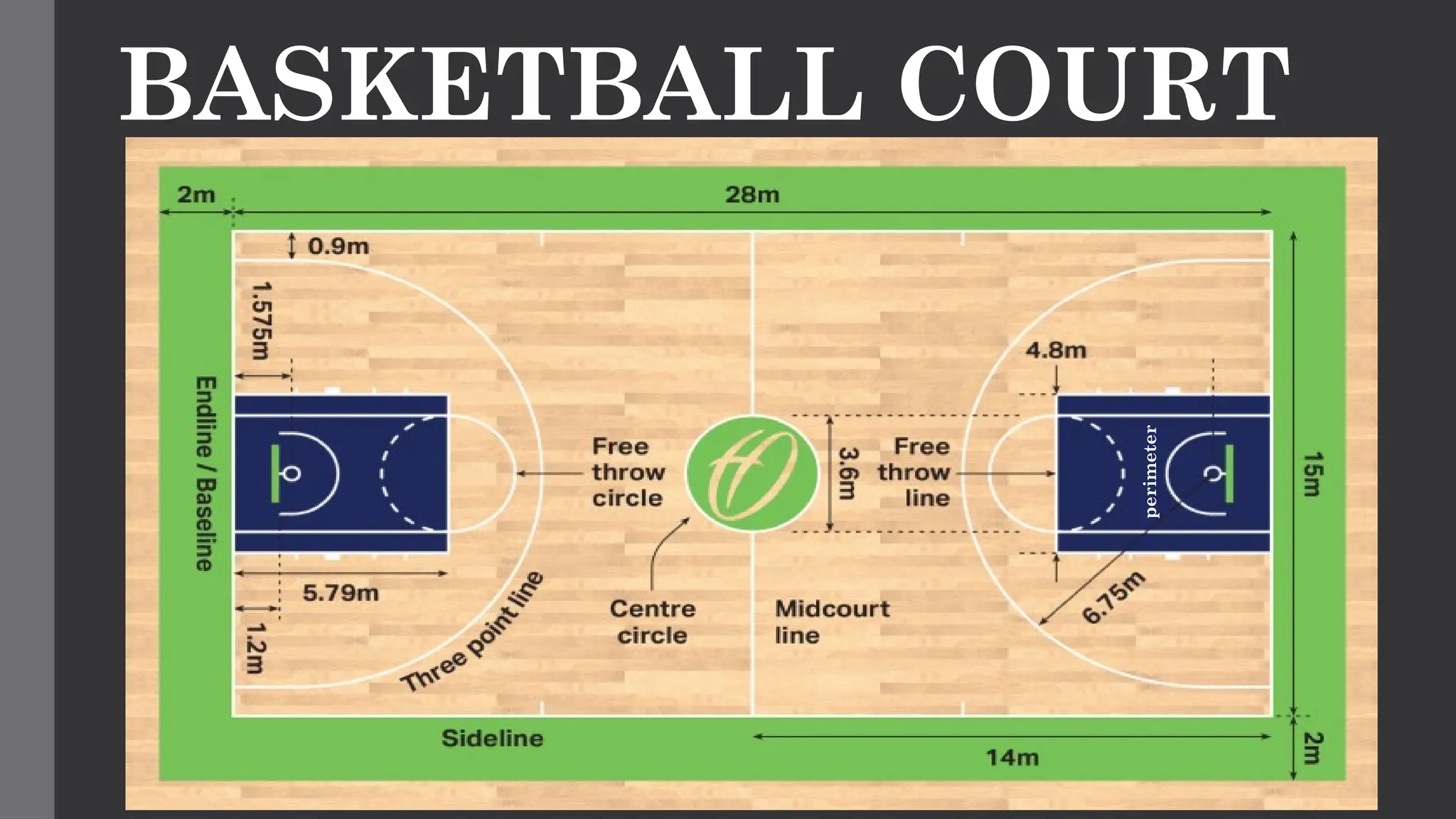
BASKETBALL COURT
perimeter
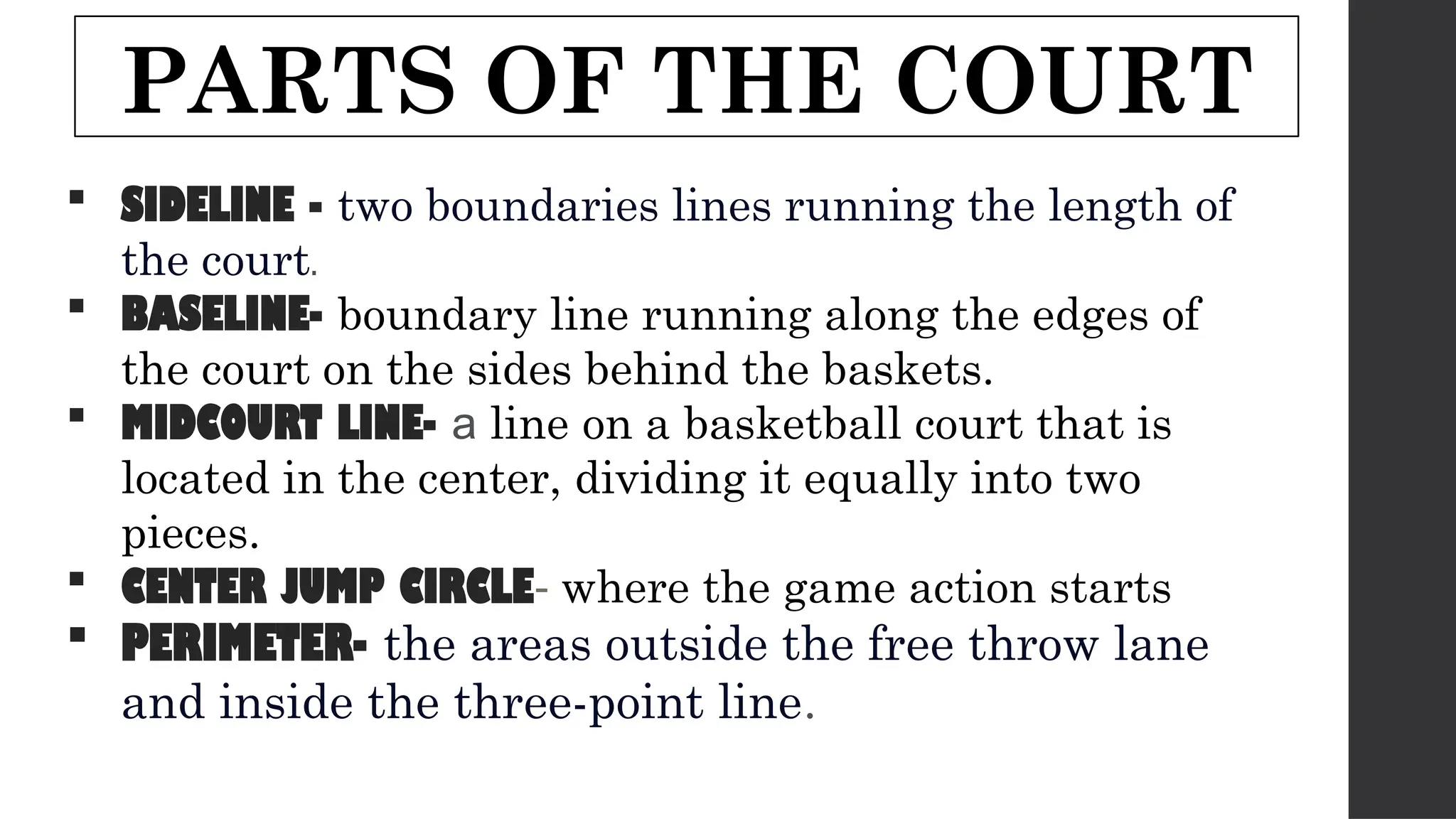
PARTS OF THE COURT
 SIDELINE - two boundaries lines running the length of
the court.
 BASELINE- boundary line running along the edges of
the court on the sides behind the baskets.
 MIDCOURT LINE- a line on a basketball court that is
located in the center, dividing it equally into two
pieces.
 CENTER JUMP CIRCLE- where the game action starts
 PERIMETER- the areas outside the free throw lane
and inside the three-point line.
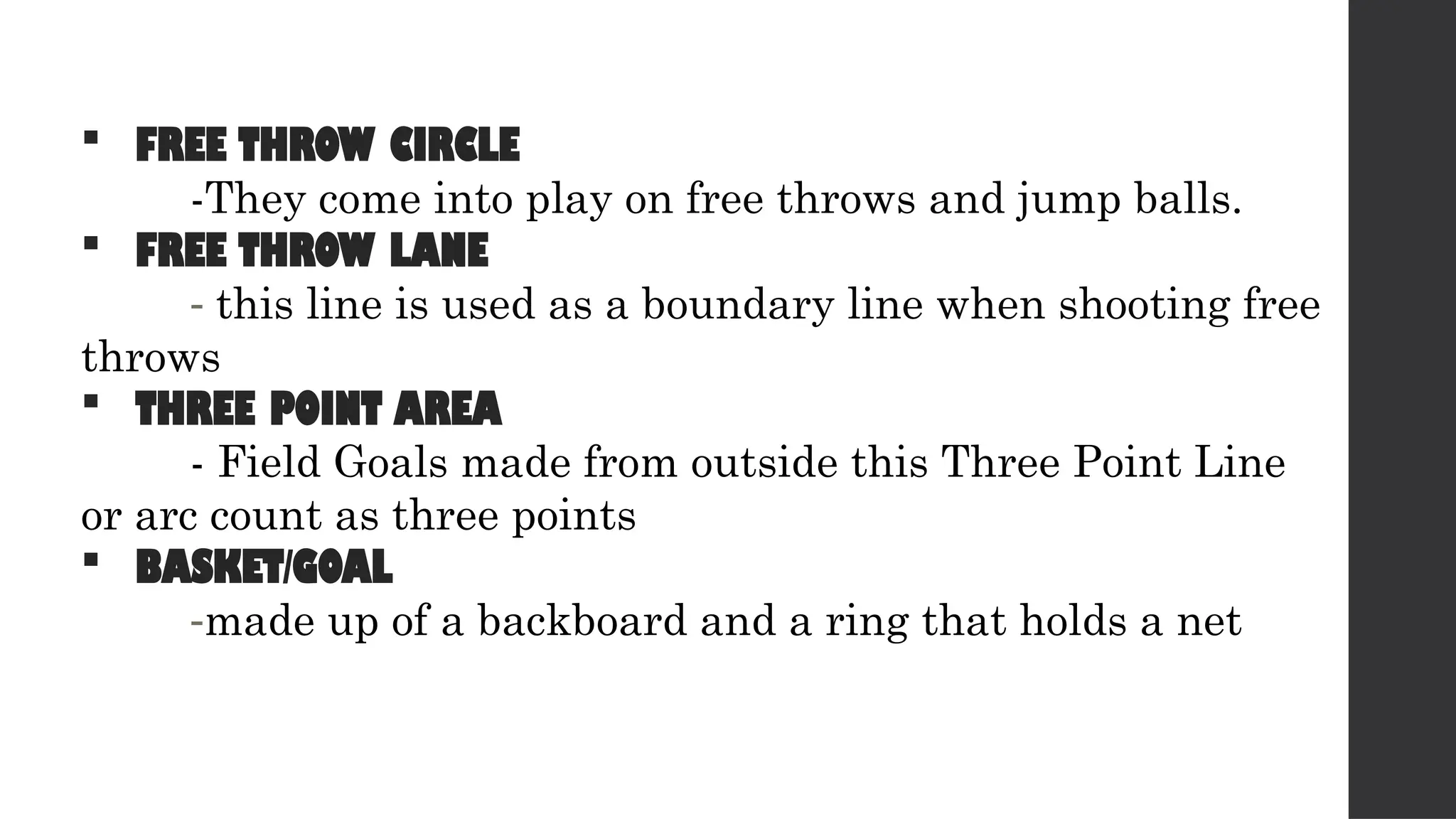
 FREE THROW CIRCLE
-They come into play on free throws and jump balls.
 FREE THROW LANE
- this line is used as a boundary line when shooting free
throws
 THREE POINT AREA
- Field Goals made from outside this Three Point Line
or arc count as three points
 BASKET/GOAL
-made up of a backboard and a ring that holds a net
RULES AND REGULATIONS
THE GAME
 Each team shall consist of 12 members entitled to play, including a team
captain.
 5 players from each team shall be on the playing court during playing time
and may be substituted.
BASKET: OPPONENT/OWN
 The basket attacked by a team is the opponent basket, and the basket
which is defended by the team own’s the basket.
WINNER OF THE GAME
 Team that has the greater number of the points at the end of the playing
time shall be the winner.
PLAYING REGULATIONS
 The game shall consists of 4 quarters, 10 minutes each.
 There shall be intervals of play of 3 minutes between
the 1st
and 2nd
period (First half), between the 3rd
and 4th
quarter (Second Half) and before extra period.
 There shall be a half time interval of play of 15
minutes.
 Jump ball and alternating position.
 Make a goal/score
VIOLATION
 THREE SECONDS
An offensive player cannot be inside of or in contact with the
free throw lane for more than three seconds while the ball is in
his/her team's front court. Penalty: Turnover.
 FIVE SECONDS VIOLATION
If a player is closely guarded (within six feet) in the front court
and holds the ball for more than five seconds, or dribbles the
ball for more than five seconds then a violation will be called.
Penalty: Turnover.
 EIGHT SECONDS
A team shall not be in continuous possession of a ball which is
in its backcourt for more than 8 consecutive seconds.
Penalty: Turnover.
 TWENTY-FOUR SECONDS VIOLATION
If the shot clock reaches zero before the team attempts a field
goal, the team has committed a shot clock violation, which is
penalized with a loss of possession. Penalty: Turnover.
FOUL
 A player shall be allowed 5 personal fouls per game. On
the fifth personal, that player shall be removed from
the game.
 A personal fouls is a player foul that involves illegal
contact with an opponent while the ball is live.
 An intentional foul is a personal or technical foul
that may or may not be premeditated and is solely
based on the severity of the act.
TYPES OF DRIBBLING
 OFFENSIVE DRIBBLING
Bounce the ball directly in front of your
body. Pushing with the right hand, then the left
hand etc. (using natural running motion).
 DEFENSIVE DRIBBLING
Dribble the ball near the back knee with
your body turned to the side to defend it from
stealing.
PASSING AND CATCHING
TECHNIQUE
 CHEST PASS
- This is a type of pass in basketball where the player in possession
of the ball throws a two-handed pass from their chest, and in a straight
line, to the chest of the player receiving the ball.
 BOUNCE PASS
- the ball bounces on the floor, typically midway between the passer
and receiving player.
PASSING AND CATCHING
TECHNIQUES
 OVERHEAD PASS
type of pass in basketball where the player holds the ball over
their head with both hands and then tosses the ball to a teammate.
 LOB PASS
pass consists of offensive action that occurs when a player in
possession of the basketball throws it into the air with a high arc, usually
over at least one defender, to a teammate who could catch the ball and
potentially score.
PASSING AND CATCHING
TECHNIQUES
 BASEBALL PASS
a one-handed pass that uses the same motion as a baseball
throw. This is often used to make long passes.
THANKYOU!

BASKETBALL HISTORY......................

  • 1.
  • 2.
    BASKETBALL - game playedbetween two teams of five players each on a rectangular court, usually indoors.
  • 3.
    HISTORY • Basketball wasinvented by James Naismith in Springfield, Massachusetts, in 1891. • In the early 1890s Naismith found himself tasked with developing a new game when he worked for the YMCA. He turned to a game from his childhood known as “Duck on a Rock”.
  • 4.
     Soccer ball-the first ball that was used was a until 1840 when an actual “basketball “ was invented. The ball was slightly smaller, about thirty inches in diameter.  The first game used peached baskets nailed to the wall for rims.
  • 5.
  • 6.
    PARTS OF THECOURT  SIDELINE - two boundaries lines running the length of the court.  BASELINE- boundary line running along the edges of the court on the sides behind the baskets.  MIDCOURT LINE- a line on a basketball court that is located in the center, dividing it equally into two pieces.  CENTER JUMP CIRCLE- where the game action starts  PERIMETER- the areas outside the free throw lane and inside the three-point line.
  • 7.
     FREE THROWCIRCLE -They come into play on free throws and jump balls.  FREE THROW LANE - this line is used as a boundary line when shooting free throws  THREE POINT AREA - Field Goals made from outside this Three Point Line or arc count as three points  BASKET/GOAL -made up of a backboard and a ring that holds a net
  • 8.
    RULES AND REGULATIONS THEGAME  Each team shall consist of 12 members entitled to play, including a team captain.  5 players from each team shall be on the playing court during playing time and may be substituted. BASKET: OPPONENT/OWN  The basket attacked by a team is the opponent basket, and the basket which is defended by the team own’s the basket. WINNER OF THE GAME  Team that has the greater number of the points at the end of the playing time shall be the winner.
  • 9.
    PLAYING REGULATIONS  Thegame shall consists of 4 quarters, 10 minutes each.  There shall be intervals of play of 3 minutes between the 1st and 2nd period (First half), between the 3rd and 4th quarter (Second Half) and before extra period.  There shall be a half time interval of play of 15 minutes.  Jump ball and alternating position.  Make a goal/score
  • 10.
    VIOLATION  THREE SECONDS Anoffensive player cannot be inside of or in contact with the free throw lane for more than three seconds while the ball is in his/her team's front court. Penalty: Turnover.  FIVE SECONDS VIOLATION If a player is closely guarded (within six feet) in the front court and holds the ball for more than five seconds, or dribbles the ball for more than five seconds then a violation will be called. Penalty: Turnover.
  • 11.
     EIGHT SECONDS Ateam shall not be in continuous possession of a ball which is in its backcourt for more than 8 consecutive seconds. Penalty: Turnover.  TWENTY-FOUR SECONDS VIOLATION If the shot clock reaches zero before the team attempts a field goal, the team has committed a shot clock violation, which is penalized with a loss of possession. Penalty: Turnover.
  • 12.
    FOUL  A playershall be allowed 5 personal fouls per game. On the fifth personal, that player shall be removed from the game.  A personal fouls is a player foul that involves illegal contact with an opponent while the ball is live.  An intentional foul is a personal or technical foul that may or may not be premeditated and is solely based on the severity of the act.
  • 13.
    TYPES OF DRIBBLING OFFENSIVE DRIBBLING Bounce the ball directly in front of your body. Pushing with the right hand, then the left hand etc. (using natural running motion).  DEFENSIVE DRIBBLING Dribble the ball near the back knee with your body turned to the side to defend it from stealing.
  • 14.
    PASSING AND CATCHING TECHNIQUE CHEST PASS - This is a type of pass in basketball where the player in possession of the ball throws a two-handed pass from their chest, and in a straight line, to the chest of the player receiving the ball.  BOUNCE PASS - the ball bounces on the floor, typically midway between the passer and receiving player.
  • 15.
    PASSING AND CATCHING TECHNIQUES OVERHEAD PASS type of pass in basketball where the player holds the ball over their head with both hands and then tosses the ball to a teammate.  LOB PASS pass consists of offensive action that occurs when a player in possession of the basketball throws it into the air with a high arc, usually over at least one defender, to a teammate who could catch the ball and potentially score.
  • 16.
    PASSING AND CATCHING TECHNIQUES BASEBALL PASS a one-handed pass that uses the same motion as a baseball throw. This is often used to make long passes.
  • 17.