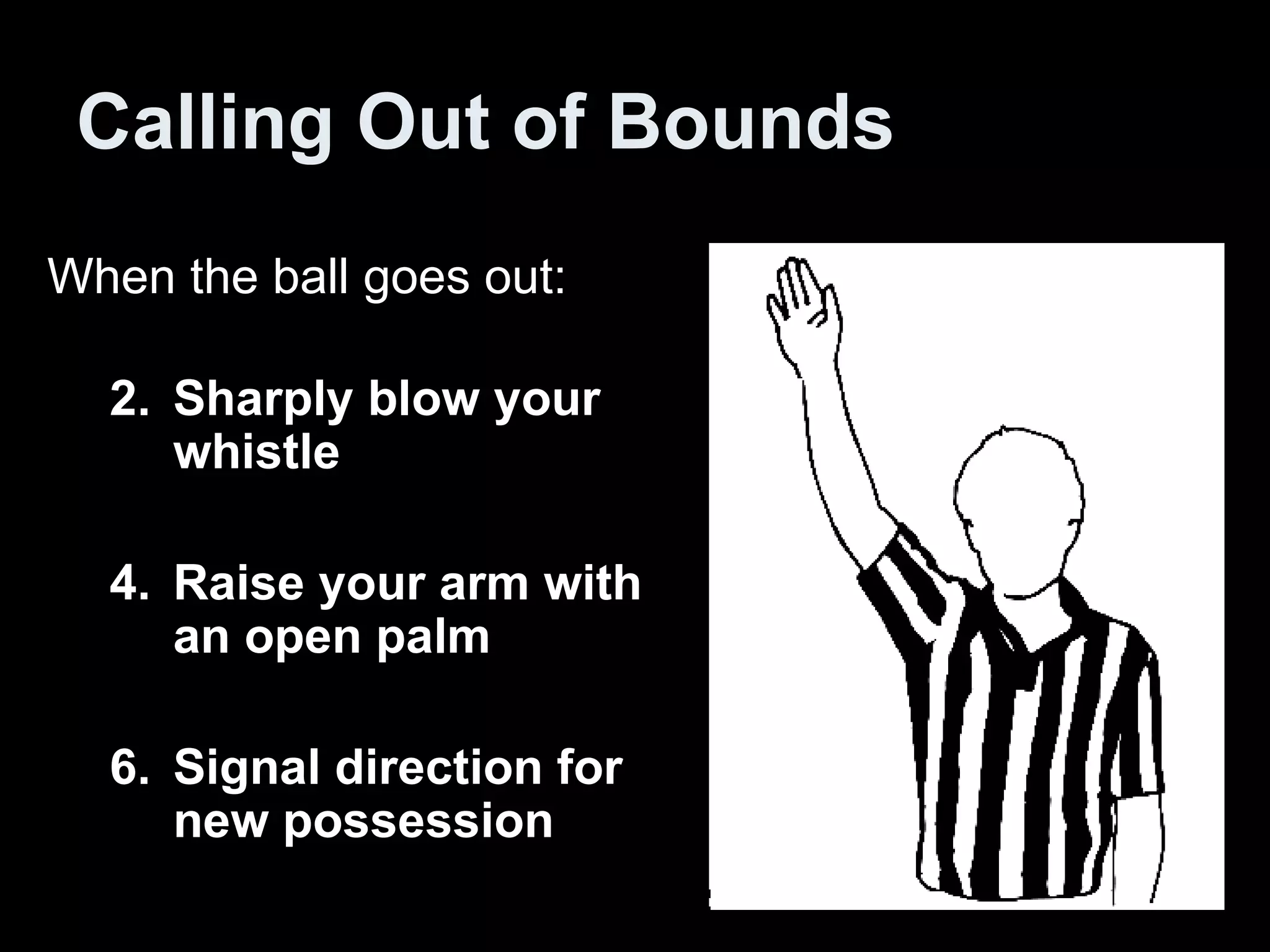
Calling Out of Bounds When the ball goes out:  Sharply blow your whistle  Raise your arm with an open palm  Signal direction for new possession
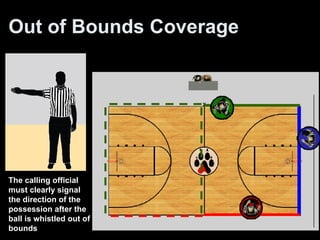
Out of Bounds Coverage The calling official must clearly signal the direction of the possession after the ball is whistled out of bounds
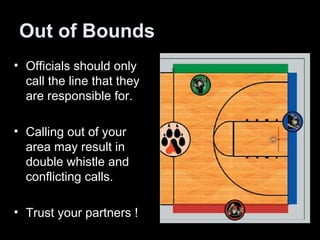
Out of Bounds Officials should only call the line that they are responsible for.  Calling out of your area may result in double whistle and conflicting calls.  Trust your partners !
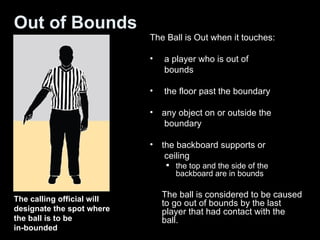
Out of Bounds The Ball is Out when it touches: a player who is out of    bounds the floor past the boundary any object on or outside the    boundary the backboard supports or    ceiling the top and the side of the backboard are in bounds The ball is considered to be caused to go out of bounds by the last player that had contact with the ball. The calling official will designate the spot where the ball is to be  in-bounded
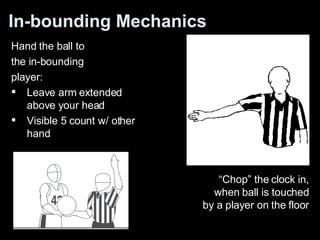
In-bounding Mechanics Hand the ball to the in-bounding player:  Leave arm extended above your head  Visible 5 count w/ other hand  “ Chop” the clock in, when ball is touched by a player on the floor
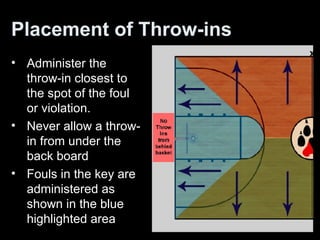
Placement of Throw-ins Administer the throw-in closest to the spot of the foul or violation.  Never allow a throw-in from under the back board Fouls in the key are administered as shown in the blue highlighted area
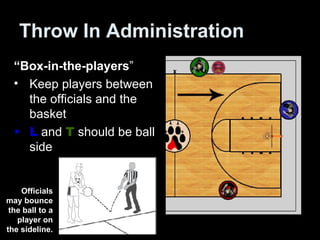
Throw In Administration “ Box-in-the-players ” Keep players between the officials and the basket L   and  T   should be ball side Officials may bounce the ball to a player on the sideline.
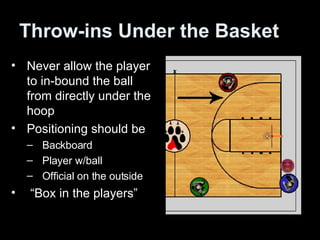
Throw-ins Under the Basket Never allow the player to in-bound the ball from directly under the hoop Positioning should be Backboard Player w/ball Official on the outside “ Box in the players”
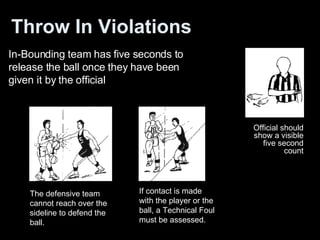
Throw In Violations In-Bounding team has five seconds to  release the ball once they have been given it by the official The defensive team cannot reach over the sideline to defend the ball.  If contact is made with the player or the ball, a Technical Foul must be assessed. Official should show a visible five second count

Throwinsoutofbounds

  • 1.
    Calling Out ofBounds When the ball goes out: Sharply blow your whistle Raise your arm with an open palm Signal direction for new possession
  • 2.
    Out of BoundsCoverage The calling official must clearly signal the direction of the possession after the ball is whistled out of bounds
  • 3.
    Out of BoundsOfficials should only call the line that they are responsible for. Calling out of your area may result in double whistle and conflicting calls. Trust your partners !
  • 4.
    Out of BoundsThe Ball is Out when it touches: a player who is out of bounds the floor past the boundary any object on or outside the boundary the backboard supports or ceiling the top and the side of the backboard are in bounds The ball is considered to be caused to go out of bounds by the last player that had contact with the ball. The calling official will designate the spot where the ball is to be in-bounded
  • 5.
    In-bounding Mechanics Handthe ball to the in-bounding player: Leave arm extended above your head Visible 5 count w/ other hand “ Chop” the clock in, when ball is touched by a player on the floor
  • 6.
    Placement of Throw-insAdminister the throw-in closest to the spot of the foul or violation. Never allow a throw-in from under the back board Fouls in the key are administered as shown in the blue highlighted area
  • 7.
    Throw In Administration“ Box-in-the-players ” Keep players between the officials and the basket L and T should be ball side Officials may bounce the ball to a player on the sideline.
  • 8.
    Throw-ins Under theBasket Never allow the player to in-bound the ball from directly under the hoop Positioning should be Backboard Player w/ball Official on the outside “ Box in the players”
  • 9.
    Throw In ViolationsIn-Bounding team has five seconds to release the ball once they have been given it by the official The defensive team cannot reach over the sideline to defend the ball. If contact is made with the player or the ball, a Technical Foul must be assessed. Official should show a visible five second count

Editor's Notes

  • #2 Switch refers to a dead-ball situation created by an official who calls a violation or foul. After a violation is called or a foul is reported to the table, there may be a change in position of the officials. The switch will normally involve the calling official moving to a new position on the court.