Strategy
Formulation:
Corporate
Strategy
Mario P. Ponce Jr.
STRATEGY FORMATION
Is the process by which an
organization chooses the most
appropriate courses of action to
achieve its defined goals. This
process is essential to an
organization’s success, because
it provides the framework for the
action that will lead to the
anticipated results.
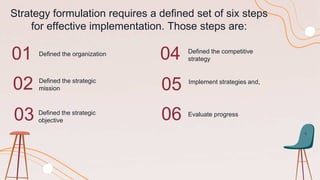
01
05
03
04
Defined the organization
Defined the strategic
mission
Defined the competitive
strategy
Implement strategies and,
Strategy formulation requires a defined set of six steps
for effective implementation. Those steps are:
02
Defined the strategic
objective 06 Evaluate progress
WHAT IS A CORPORATE
STRATEGY?
A corporation strategy entails a
clearly defined, long-term vision that
organizations set, seeking to create
corporate value and motivate the
workforce implement the proper
actions to achieve customer
satisfaction.
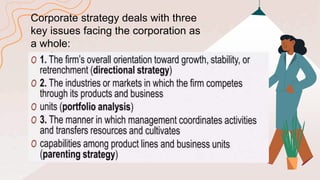
Corporate strategy deals with three
key issues facing the corporation as
a whole:
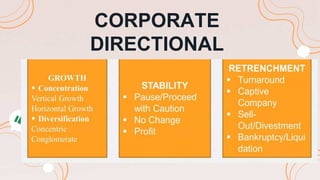
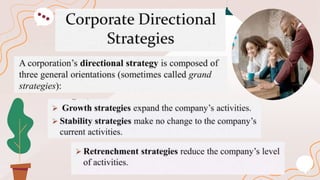
CORPORATE
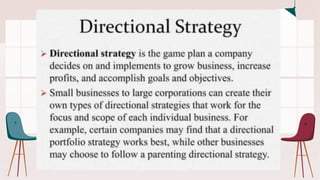
DIRECTIONAL
STRATEGIES:
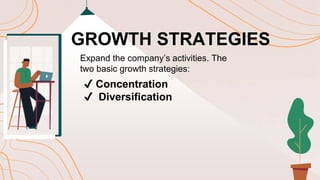
GROWTH STRATEGIES
Expand the company’s activities. The
two basic growth strategies:
✔️ Concentration
✔️ Diversification
Concentration
✔️ If a company’s current product lines have real
growth potential, concentration of resources on
those product lines makes sense as a strategy for
growth.
The two basic concentration strategies are:
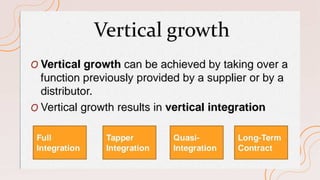
1) vertical growth
2) Horizontal growth.
✔️ Full Integration: Under full integration, a firm
internally makes 100% of its key supplies and
completely controls its distributors.
✔️ Tapper Integration: With taper integration, a firm
internally produces less than half of its own
requirements and buys the rest from outside suppliers.
✔️Quasi-Integration: With quasi-integration, a
company does not make any of its key supplies
but purchases most of its requirements from outside
suppliers that are under its partial control.
✔️ Long-Term Contract: Are agreements between
two firms to provide agreed-upon goods and
services to each other for a specified period of
Horizontal Growth.
A firm can achieve horizontal growth by expanding its
operations into other geographic locations and/or by
increasing the range of products and services
offered to current markets.
Horizontal growth results in horizontal integration—the
degree to which a firm operates in multiple geographic
locations at the same point on
an industry’s value chain
International Entry Options for Horizontal Growth
🖤 Research indicates that growing internationally is
positively associated with firm profitability. Some of the
most popular options for international entry are as
follows:
🖤Exporting: A good way to minimize risk and
experiment with a specific product is exporting,
🖤Franchising: Under a franchising agreement, the
franchiser grants rights to another company to open a
retail store using the franchiser’s name and operating
system.
🖤 Licensing: Under a licensing agreement, the licensing firm grants
rights to another firm in the host country to produce and/or sell a
product.
🖤 Joint Ventures: Forming a joint venture between a foreign
corporation and a domestic company is the most popular strategy used
to enter a new country.
🖤 Acquisitions: A relatively quick way to move into an international
area is through acquisitions purchasing another company already
operating in that area.
🖤 Green-Field Development: If a company doesn’t want to purchase
another company’s problems along with its assets, it may choose
green-field development and build its own manufacturing
plant and distribution system.
🖤Production Sharing: Coined by Peter Dracker, the term
production sharing means the process of combining the higher labor
skills and technology available in developed countries with the
lowercost labor available in developing countries.
🖤 Turnkey operations: are typically contracts for the construction
of operating facilities in exchange for a fee. The facilities are
transferred to the host country or firm when they are complete.
🖤 BOT Concept: The BOT (Build, Operate, Transfer) concept is a
variation of the turnkey operation.
🖤 Management contracts offer a means through which a
corporation can use some of its personnel to assist a firm in a host
country for a specified fee and period of time.
DIVERSIFICATIO
N
SRATEGY
Diversification Strategies:
🟠According to strategist Richard Rumelt, companies
begin thinking about diversification when their growth
has plateaued and opportunities for growth in the
original business have been depleted.
🟠Concentric (Related) Diversification. Growth through
concentric diversification into a related industry may
be a very appropriate corporate strategy when a firm
has a strong competitive position but industry
attractiveness is low
🟠Conglomerate (Unrelated) Diversification. When
management realizes that the current industry is
unattractive and that the firm lacks outstanding abilities
or skills that it could easily transfer to related products
or services in other industries, the most likely strategy
is conglomerate diversification—diversifying into an
industry unrelated to its current one.
CONTROVERSIES IN DIRECTIONAL
GROWTH STRATEGIES
🟠Research reveals that companies following a
related diversification strategy appear to be higher
performers and survive longer than do companies
with narrower scope following a pure concentration
strategy.42 Although the research is not in
complete agreement, growth into areas related to a
company’s current product lines is generally more
successful than is growth into completely unrelated
areas.
GE BUSINESS SCREEN
🟠 General Electric, with the
assistance of the McKinsey &
Company consulting firm, developed
a more complicated matrix. GE
Business Screen includes nine cells
based on long-term industry
attractiveness and business strength
competitive position.
CREDITS: This presentation template was created
by Slidesgo, including icon by Flaticon, and
infographics & images from Freepik

mario report.22.pptx

  • 1.
  • 2.
    STRATEGY FORMATION Is theprocess by which an organization chooses the most appropriate courses of action to achieve its defined goals. This process is essential to an organization’s success, because it provides the framework for the action that will lead to the anticipated results.
  • 3.
    01 05 03 04 Defined the organization Definedthe strategic mission Defined the competitive strategy Implement strategies and, Strategy formulation requires a defined set of six steps for effective implementation. Those steps are: 02 Defined the strategic objective 06 Evaluate progress
  • 4.
    WHAT IS ACORPORATE STRATEGY? A corporation strategy entails a clearly defined, long-term vision that organizations set, seeking to create corporate value and motivate the workforce implement the proper actions to achieve customer satisfaction.
  • 5.
    Corporate strategy dealswith three key issues facing the corporation as a whole:
  • 7.
  • 9.
    GROWTH STRATEGIES Expand thecompany’s activities. The two basic growth strategies: ✔️ Concentration ✔️ Diversification
  • 10.
    Concentration ✔️ If acompany’s current product lines have real growth potential, concentration of resources on those product lines makes sense as a strategy for growth. The two basic concentration strategies are: 1) vertical growth 2) Horizontal growth.
  • 12.
    ✔️ Full Integration:Under full integration, a firm internally makes 100% of its key supplies and completely controls its distributors. ✔️ Tapper Integration: With taper integration, a firm internally produces less than half of its own requirements and buys the rest from outside suppliers. ✔️Quasi-Integration: With quasi-integration, a company does not make any of its key supplies but purchases most of its requirements from outside suppliers that are under its partial control. ✔️ Long-Term Contract: Are agreements between two firms to provide agreed-upon goods and services to each other for a specified period of
  • 13.
    Horizontal Growth. A firmcan achieve horizontal growth by expanding its operations into other geographic locations and/or by increasing the range of products and services offered to current markets. Horizontal growth results in horizontal integration—the degree to which a firm operates in multiple geographic locations at the same point on an industry’s value chain
  • 14.
    International Entry Optionsfor Horizontal Growth 🖤 Research indicates that growing internationally is positively associated with firm profitability. Some of the most popular options for international entry are as follows: 🖤Exporting: A good way to minimize risk and experiment with a specific product is exporting, 🖤Franchising: Under a franchising agreement, the franchiser grants rights to another company to open a retail store using the franchiser’s name and operating system.
  • 15.
    🖤 Licensing: Undera licensing agreement, the licensing firm grants rights to another firm in the host country to produce and/or sell a product. 🖤 Joint Ventures: Forming a joint venture between a foreign corporation and a domestic company is the most popular strategy used to enter a new country. 🖤 Acquisitions: A relatively quick way to move into an international area is through acquisitions purchasing another company already operating in that area. 🖤 Green-Field Development: If a company doesn’t want to purchase another company’s problems along with its assets, it may choose green-field development and build its own manufacturing plant and distribution system.
  • 16.
    🖤Production Sharing: Coinedby Peter Dracker, the term production sharing means the process of combining the higher labor skills and technology available in developed countries with the lowercost labor available in developing countries. 🖤 Turnkey operations: are typically contracts for the construction of operating facilities in exchange for a fee. The facilities are transferred to the host country or firm when they are complete. 🖤 BOT Concept: The BOT (Build, Operate, Transfer) concept is a variation of the turnkey operation. 🖤 Management contracts offer a means through which a corporation can use some of its personnel to assist a firm in a host country for a specified fee and period of time.
  • 17.
  • 18.
    Diversification Strategies: 🟠According tostrategist Richard Rumelt, companies begin thinking about diversification when their growth has plateaued and opportunities for growth in the original business have been depleted. 🟠Concentric (Related) Diversification. Growth through concentric diversification into a related industry may be a very appropriate corporate strategy when a firm has a strong competitive position but industry attractiveness is low
  • 19.
    🟠Conglomerate (Unrelated) Diversification.When management realizes that the current industry is unattractive and that the firm lacks outstanding abilities or skills that it could easily transfer to related products or services in other industries, the most likely strategy is conglomerate diversification—diversifying into an industry unrelated to its current one.
  • 20.
    CONTROVERSIES IN DIRECTIONAL GROWTHSTRATEGIES 🟠Research reveals that companies following a related diversification strategy appear to be higher performers and survive longer than do companies with narrower scope following a pure concentration strategy.42 Although the research is not in complete agreement, growth into areas related to a company’s current product lines is generally more successful than is growth into completely unrelated areas.
  • 21.
    GE BUSINESS SCREEN 🟠General Electric, with the assistance of the McKinsey & Company consulting firm, developed a more complicated matrix. GE Business Screen includes nine cells based on long-term industry attractiveness and business strength competitive position.
  • 24.
    CREDITS: This presentationtemplate was created by Slidesgo, including icon by Flaticon, and infographics & images from Freepik