Response to Intervention RTI
PLC:  RTI Smart goal Research RtI instruction See how it could be applied in our school district Determining what resources are already in place
What Is RTI? A multi-tiered model of instruction which provides  early intervention  At each Tier, interventions are provided with increasing intensity to bring the student’s deficient skills up to grade level At each Tier, students are monitored frequently to determine the effectiveness of an intervention
The RtI Steps Define –  Analyze –  Implement – Evaluate –
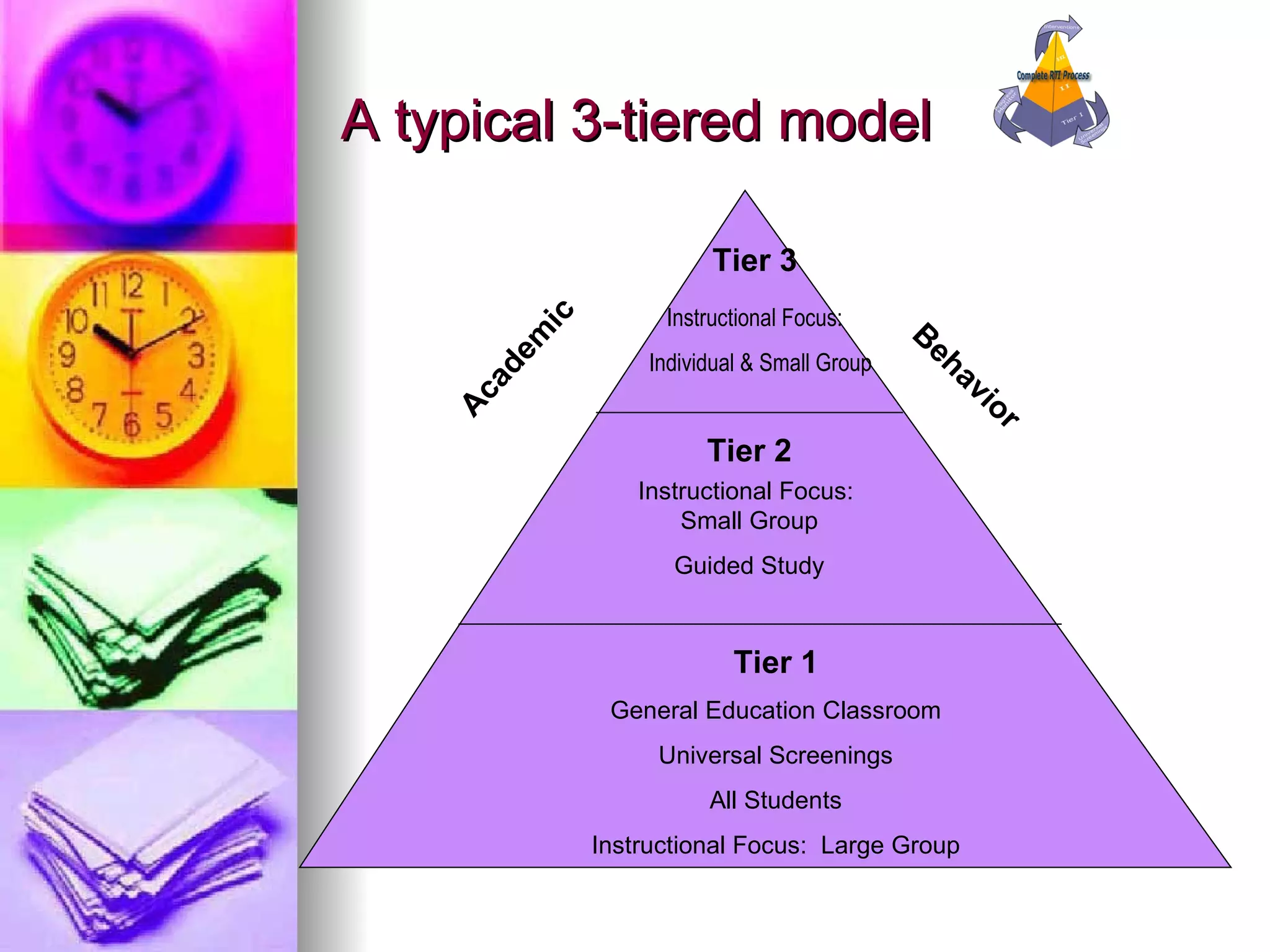
A typical 3-tiered model Tier 1 Tier 2 Tier 3 General Education Classroom Universal Screenings All Students Instructional Focus:  Large Group Instructional Focus:  Small Group Guided Study Instructional Focus: Individual & Small Group Academic Behavior
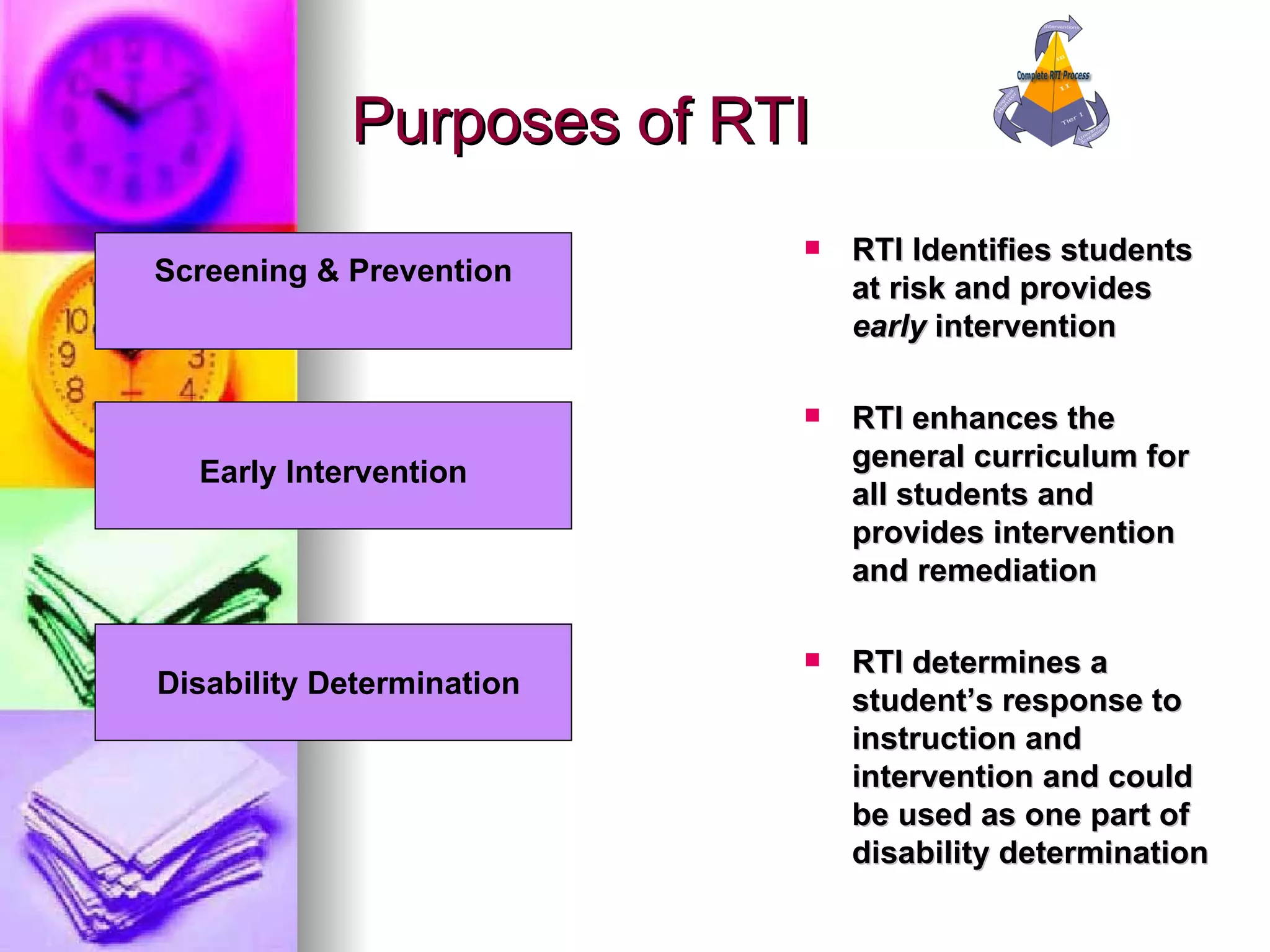
Purposes of RTI RTI Identifies students at risk and provides  early  intervention RTI enhances the general curriculum for all students and provides intervention and remediation RTI determines a student’s response to instruction and intervention and could be used as one part of disability determination Screening & Prevention Early Intervention Disability Determination
Tier 1 Interventions are provided in the general education classroom  Often at this level, decisions about specific interventions are determined by the classroom teacher
Progress Monitoring Progress Monitoring Conducted frequently  Can judge in  weeks  rather than  months  whether intervention plan is effective Decision Based on Data Progress – intervention can be discontinued If not making sufficient progress  can be modified or Tier 3 could be referred All data is documented
Tier 2 Interventions are individualized and tailored to the unique needs of struggling learners Reserved for students who have failed to respond successfully to Tier 1 strategies. Interventions may become more frequent Interventions are typically conducted within a small group setting RTI Team involvement will occur at this level Written parent notification is done at this level
Tier 3 Interventions are the most intensive Interventions become more frequent Interventions can be in a small group or individually
RTI Team Team is comprised of classroom teachers, administrators, psychologists, etc. – anyone I-S wants to include. Team helps to identify the student’s specific skill deficits Team helps to identify the appropriate research-based interventions Team helps to decide when a student needs to move to the next Tier
RtI and ISSD  Response to Intervention seems like a program which will fit well in our School District but  what form it will take is unclear at this time.

Rti overview

  • 1.
  • 2.
    PLC: RTISmart goal Research RtI instruction See how it could be applied in our school district Determining what resources are already in place
  • 3.
    What Is RTI?A multi-tiered model of instruction which provides early intervention At each Tier, interventions are provided with increasing intensity to bring the student’s deficient skills up to grade level At each Tier, students are monitored frequently to determine the effectiveness of an intervention
  • 4.
    The RtI StepsDefine – Analyze – Implement – Evaluate –
  • 5.
    A typical 3-tieredmodel Tier 1 Tier 2 Tier 3 General Education Classroom Universal Screenings All Students Instructional Focus: Large Group Instructional Focus: Small Group Guided Study Instructional Focus: Individual & Small Group Academic Behavior
  • 6.
    Purposes of RTIRTI Identifies students at risk and provides early intervention RTI enhances the general curriculum for all students and provides intervention and remediation RTI determines a student’s response to instruction and intervention and could be used as one part of disability determination Screening & Prevention Early Intervention Disability Determination
  • 7.
    Tier 1 Interventionsare provided in the general education classroom Often at this level, decisions about specific interventions are determined by the classroom teacher
  • 8.
    Progress Monitoring ProgressMonitoring Conducted frequently Can judge in weeks rather than months whether intervention plan is effective Decision Based on Data Progress – intervention can be discontinued If not making sufficient progress can be modified or Tier 3 could be referred All data is documented
  • 9.
    Tier 2 Interventionsare individualized and tailored to the unique needs of struggling learners Reserved for students who have failed to respond successfully to Tier 1 strategies. Interventions may become more frequent Interventions are typically conducted within a small group setting RTI Team involvement will occur at this level Written parent notification is done at this level
  • 10.
    Tier 3 Interventionsare the most intensive Interventions become more frequent Interventions can be in a small group or individually
  • 11.
    RTI Team Teamis comprised of classroom teachers, administrators, psychologists, etc. – anyone I-S wants to include. Team helps to identify the student’s specific skill deficits Team helps to identify the appropriate research-based interventions Team helps to decide when a student needs to move to the next Tier
  • 12.
    RtI and ISSD Response to Intervention seems like a program which will fit well in our School District but what form it will take is unclear at this time.