Tool for Rocket
Propulsion
Analysis
Alexander Ponomarenko
contact@propulsion-analysis.com
www.propulsion-analysis.com
Cologne, Germany
RPA Overview
Tool for rocket propulsion analysis
RPA is a multiplatform computational package
intended for use in conceptual and preliminary
design of liquid-propellant rocket engines
RPA – Tool for Rocket Propulsion Analysis www.propulsion-analysis.com
RPA Overview
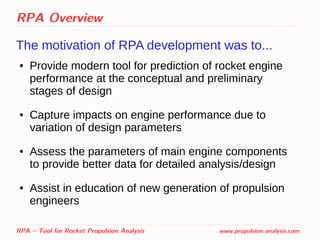
The motivation of RPA development was to...
● Provide modern tool for prediction of rocket engine
performance at the conceptual and preliminary
stages of design
● Capture impacts on engine performance due to
variation of design parameters
● Assess the parameters of main engine components
to provide better data for detailed analysis/design
● Assist in education of new generation of propulsion
engineers
RPA – Tool for Rocket Propulsion Analysis www.propulsion-analysis.com
RPA Overview
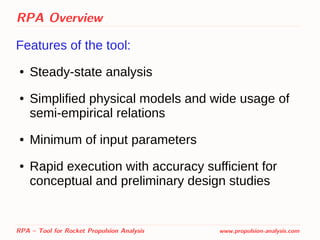
Features of the tool:
● Steady-state analysis
● Simplified physical models and wide usage of
semi-empirical relations
● Minimum of input parameters
● Rapid execution with accuracy sufficient for
conceptual and preliminary design studies
RPA – Tool for Rocket Propulsion Analysis www.propulsion-analysis.com
RPA Overview
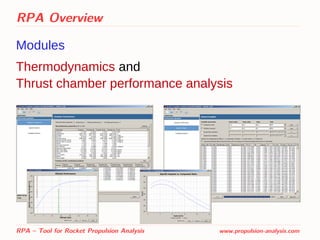
Modules
Thermodynamics and
Thrust chamber performance analysis
RPA – Tool for Rocket Propulsion Analysis www.propulsion-analysis.com
RPA Overview
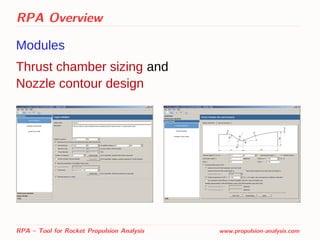
Modules
Thrust chamber sizing and
Nozzle contour design
RPA – Tool for Rocket Propulsion Analysis www.propulsion-analysis.com
RPA Overview
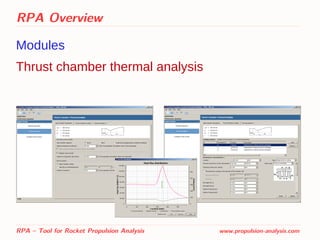
Modules
Thrust chamber thermal analysis
RPA – Tool for Rocket Propulsion Analysis www.propulsion-analysis.com
RPA Overview
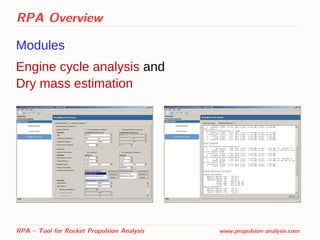
Modules
Engine cycle analysis and
Dry mass estimation
RPA – Tool for Rocket Propulsion Analysis www.propulsion-analysis.com
Thermodynamics
Properties of reactants and reaction products
● Expandable thermodynamic data library based on
NASA Glenn thermodynamic database (also used by
CEA)
● Includes data for such propellant components as (but
not limited to):
– liquid hydrogen H2(L), liquid methane CH4(L), RP-1, RG-1,
synthine, MMH, UDMH, methyl alcohol
– liquid oxygen O2(L), nitrogen tetra-oxide N2O4, hydrogen
peroxide H2O2
● User may add own propellant components and
products of reaction
RPA – Tool for Rocket Propulsion Analysis www.propulsion-analysis.com
Thermodynamics
Used methods
Gibbs free energy minimization for problems p=const
● (p,T) = const
● (p,I) = const
● (p,S) = const
Helmholtz free energy minimization for problems V=const
● (V,T) = const
● (V,U) = const
● (V,S) = const
RPA – Tool for Rocket Propulsion Analysis www.propulsion-analysis.com
Performance Analysis
Assumptions:
● Ideal gas law is applied to all processes
● Adiabatic, isobaric, isenthalpic combustion in
combustion chamber at injector face
● Adiabatic, isentropic quasi-one-dimensional
nozzle flow for both shifting and frozen equilibrium
models
RPA – Tool for Rocket Propulsion Analysis www.propulsion-analysis.com
Performance Analysis
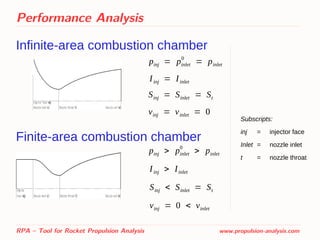
Infinite-area combustion chamber
RPA – Tool for Rocket Propulsion Analysis www.propulsion-analysis.com
pinj = pinlet
0
= pinlet
Iinj = Iinlet
Sinj = Sinlet = St
vinj = vinlet = 0
Subscripts:
inj = injector face
Inlet = nozzle inlet
t = nozzle throat
Finite-area combustion chamber
pinj > pinlet
0
> pinlet
Iinj > Iinlet
Sinj < Sinlet = St
vinj = 0 < vinlet
Performance Analysis
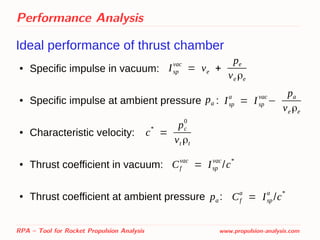
Ideal performance of thrust chamber
● Specific impulse in vacuum:
● Specific impulse at ambient pressure :
● Characteristic velocity:
● Thrust coefficient in vacuum:
● Thrust coefficient at ambient pressure :
RPA – Tool for Rocket Propulsion Analysis www.propulsion-analysis.com
Isp
vac
= ve +
pe
ve ρe
Isp
a
= Isp
vac
−
pa
ve ρe
Cf
vac
= Isp
vac
/c*
Cf
a
= Isp
a
/c*
c*
=
pc
0
vt ρt
pa
pa
Performance Analysis
Delivered performance of thrust chamber
● Specific impulse in vacuum:
● Specific impulse at ambient pressure :
● Characteristic velocity:
● Thrust coefficient in vacuum:
● Thrust coefficient at ambient pressure :
Correction factors are obtained from semi-empirical relations [1]
[1] For more details see: Ponomarenko, A. RPA: Tool for Rocket Propulsion Analysis. Assessment of
Delivered Performance of Thrust Chamber. March 2013.
RPA – Tool for Rocket Propulsion Analysis www.propulsion-analysis.com
(Isp
vac
)d = ζc ζn Isp
vac
(Isp
a
)d=(Isp
vac
)d−
pa
ve ρe
(Cf
vac
)d = ζn Cf
vac
(Cf
a
)d = ζn Cf
a
(c*
)d = ζc c*
pa
pa
Performance Analysis
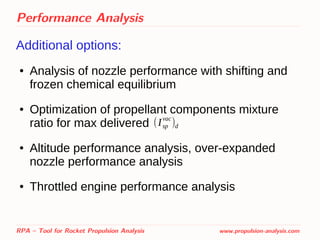
Additional options:
● Analysis of nozzle performance with shifting and
frozen chemical equilibrium
● Optimization of propellant components mixture
ratio for max delivered
● Altitude performance analysis, over-expanded
nozzle performance analysis
● Throttled engine performance analysis
RPA – Tool for Rocket Propulsion Analysis www.propulsion-analysis.com
(Isp
vac
)d
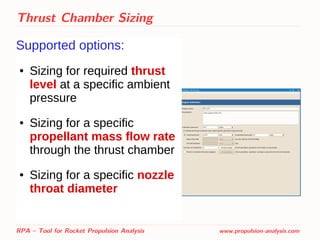
Thrust Chamber Sizing
Supported options:
● Sizing for required thrust
level at a specific ambient
pressure
● Sizing for a specific
propellant mass flow rate
through the thrust chamber
● Sizing for a specific nozzle
throat diameter
RPA – Tool for Rocket Propulsion Analysis www.propulsion-analysis.com
Thrust Chamber Sizing
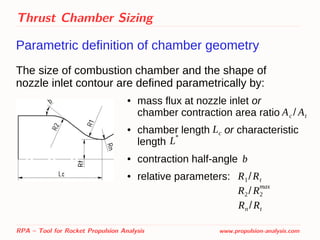
Parametric definition of chamber geometry
The size of combustion chamber and the shape of
nozzle inlet contour are defined parametrically by:
RPA – Tool for Rocket Propulsion Analysis www.propulsion-analysis.com
● mass flux at nozzle inlet or
chamber contraction area ratio
● chamber length or characteristic
length
● contraction half-angle
● relative parameters:
Ac / At
Lc
L*
R1/Rt
R2/ R2
max
Rn /Rt
b
Nozzle Contour Design
Supported options:
● Cone nozzle with a specified exit half-angle
● Parabolic nozzle contour with specified or
automatically assessed initial and/or exit half-angle
● Truncated ideal contour (TIC) with fixed expansion
area ratioand nozzle length (design method: axisymmetric
MOC)
● TIC with maximum thrust at fixed expansion area
ratio (design method: axisymmetric MOC)
● TIC with maximum thrust at fixed nozzle length (design
method: axisymmetric MOC)
RPA – Tool for Rocket Propulsion Analysis www.propulsion-analysis.com
Nozzle Contour Design
Direct optimization of nozzle contour
RPA – Tool for Rocket Propulsion Analysis www.propulsion-analysis.com
Cf = (Cf )2D (1−ζf ) → max
(Cf )2D = 2
Ae
At
∫
0
1
(1−
γ−1
γ+1
λ
2
)
1
γ−1
[1+λ
2 γ(2cos
2
β−1)+1
γ+1 ]̄r d̄r
To obtain the contour with the
maximum thrust coefficient at
specified conditions (area
ratio or nozzle length)
ζf = 1 −
2̄δe
**
1 +
1
γ Me
2
δ**
=
( 2
γ−1)
0.1
Rew0
0.2
(
0.015
̄Tw
0.5
)
0.8 (1+
γ−1
2
Mwe
2
)
γ+1
2(γ−1)
Mw
ν+1
̄S0.2
̄re
2
[∫
0
̄S
̄r1.25
M1+1.25ν
(1+
γ−1
2
Mw
2
)
1.36 γ−0.36
γ−1
d ̄S
]
0.8
Thrust Chamber Thermal Analysis
Supported methods to obtain gas-side heat flux:
● Radiation heat transfer:
● Convective heat transfer

Bartz method:

Ievlev method[1,2]
:
1. Lebedinsky E.V., Kalmykov G.P., et al. Working processes in liquid-propellant rocket engine and their simulation. Moscow,
Mashinostroenie, 2008
2. Vasiliev A.P., Kudryavtsev V.M. et al. Basics of theory and analysis of liquid-propellant rocket engines, vol.2. 4th Edition. Moscow,
Vyschaja Schkola, 1993
RPA – Tool for Rocket Propulsion Analysis www.propulsion-analysis.com
qr=εe σ(εr
T ∞
T∞
4
− εr
T w
Tw
4
)
εe=εw /[1−(1−εw)(1−εr
T w
)]
qw = αT (Taw−Tw) αT =
[0.026
Dt
0.2
(μ∞
0
)0.2
cp∞
0
(Pr∞
0
)
0.6 (pc
0
c
* )
0.8
(Dt
R )
0.1
] (At
A )
0.9
σ
σ=
[1
2
Tw
Tc
0 (1+
γ−1
2
M
2
)+
1
2]
−0.68
[1+
γ−1
2
M
2
]
−0.12
Taw=Tc
0
[1+Pr1/3
(γ−1
2 )M2
1+(γ−1
2 )M2
]
qw = αT ρx v∞(I∞
0
−Iw) αT =
( z
zT
)
0.089 Pr−0.56
(1−0.21
1−Pr
Pr
4/3
β
2
1− ̄Tw
)
0.9225
(307.8+54.8 log
2
( Pr
19.5))Pr
0.45
z
0.08
−650
Thrust Chamber Thermal Analysis
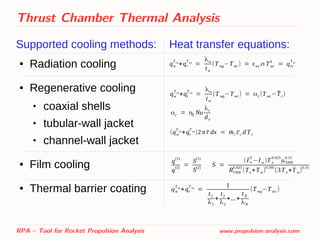
Supported cooling methods: Heat transfer equations:
● Radiation cooling
● Regenerative cooling
 coaxial shells
 tubular-wall jacket
 channel-wall jacket
● Film cooling
● Thermal barrier coating
RPA – Tool for Rocket Propulsion Analysis www.propulsion-analysis.com
qw
Twg
+qr
T wg
=
λw
tw
(T wg−Twc) = εwc σ Twc
4
= qrc
T wc
qw
Twg
+qr
T wg
=
̄λw
tw
(T wg−Twc) = αc (Twc−̄Tc)
αc = ηf Nu
λc
de
(qw
T wg
+qr
Twg
)2 π̄r dx = ˙mc ̄cc d Tc
q
(1)
q
(2)
=
S
(1)
S
(2)
S =
(I∞
0
−Iw)T e
0.425
μ1000
0.15
R1500
0.425
(Te+Tw)
0.595
(3T e+T w)
0.15
qw
Twg
+qr
T wg
=
1
t1
λ1
+
t2
λ2
+...+
tN
λN
(Twg−T wc )
Thrust Chamber Thermal Analysis
Regenerative cooling: coolant-side heat transfer
RPA – Tool for Rocket Propulsion Analysis www.propulsion-analysis.com
Nu = 0.021Rec
0.8
Prc
0.4
(0.64+0.36
T c
Twc
) for kerosene
[1]
for liquid hydrogen
[1]
for methane
[1]
for other coolants
[2]
Nu = 0.033Rec
0.8
Prc
0.4
(Tc
Twc
)
0.57
Nu = 0.0185 Rec
0.8
Prc
0.4
(Tc
T wc
)
0.1
Nu = 0.023Rec
0.8
Prc
0.4
1. Lebedinsky E.V., Kalmykov G.P., et al. Working processes in liquid-propellant rocket engine and their simulation. Moscow,
Mashinostroenie, 2008
2. Vasiliev A.P., Kudryavtsev V.M. et al. Basics of theory and analysis of liquid-propellant rocket engines, vol.2. 4th Edition. Moscow,
Vyschaja Schkola, 1993
Thrust Chamber Thermal Analysis
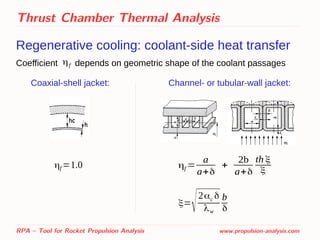
Regenerative cooling: coolant-side heat transfer
Coefficient depends on geometric shape of the coolant passages
RPA – Tool for Rocket Propulsion Analysis www.propulsion-analysis.com
ηf
Coaxial-shell jacket: Channel- or tubular-wall jacket:
ηf =1.0 ηf =
a
a+δ
+
2b
a+δ
th ξ
ξ
ξ=
√2αc δ
λw
b
δ
Thrust Chamber Thermal Analysis
Gaseous film cooling
RPA – Tool for Rocket Propulsion Analysis www.propulsion-analysis.com
BLC
Core (O/F)core
, Tcore
(O/F)f
, Tf[(O/F)b
, Tb
]1
mf
.
[(O/F)b
, Tb
]2
Wall
Combustion,Mixing
At each point downstream of
injection point, the mixing rate is
a function of distance from the
injection point and the relative
mass flow rate of the film.
Thrust Chamber Thermal Analysis
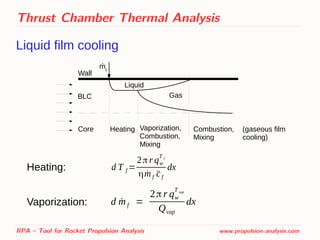
Liquid film cooling
RPA – Tool for Rocket Propulsion Analysis www.propulsion-analysis.com
d T f =
2π r qw
T f
η ˙m f ̄cf
dx
d ˙mf =
2π r qw
T vap
Qvap
dx
Heating:
Vaporization:
.
Core
BLC
mf
Wall
Heating Vaporization,
Combustion,
Mixing
Combustion,
Mixing
Liquid
Gas
(gaseous film
cooling)
Engine Cycle Analysis
Supported options:
● Staged combustion cycle (SC)
● Full flow staged combustion (FFSC)
● Gas generator cycle (GG)
Allowed variations of the flow diagram:
● Number of combustion devices (gas generators or
preburners)
● Number of turbopumps
● Arrangement of turbines (serial or parallel)
● Availability of booster pumps
● Availability of kick pumps
● Availability of tap-off branches
RPA – Tool for Rocket Propulsion Analysis www.propulsion-analysis.com
Engine Cycle Analysis
Top-level input parameters:
● Type of combustion devices:
 oxidizer-rich
 fuel-rich
● Number of independent turbopumps,
● Number of gas generators/preburners
Component-specific input parameters:
● Efficiency of pumps and turbines
● Pressure drop in all components (valves, injectors, etc.)
● Temperature in combustion devices
● Turbines pressure ratios (for GG cycle)
RPA – Tool for Rocket Propulsion Analysis www.propulsion-analysis.com
Engine Cycle Analysis
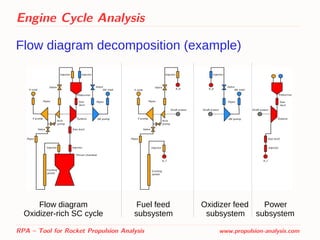
Flow diagram decomposition (example)
RPA – Tool for Rocket Propulsion Analysis www.propulsion-analysis.com
Flow diagram Fuel feed Oxidizer feed Power
Oxidizer-rich SC cycle subsystem subsystem subsystem
Engine Cycle Analysis
Parameters of components
The pump shaft power:
The power developed by
gas turbine:
The power developed by
hydraulic turbine:
RPA – Tool for Rocket Propulsion Analysis www.propulsion-analysis.com
Np =
˙m
ηp
( pout− pin)
ρ
Nt = ˙mt ηt
γ
γ−1
R0
Tt in
0
[1−(1
δt
)
γ−1
γ
]
Nt = ˙mt ηt
( pout−pin)
ρ
Engine Cycle Analysis
Solving the analysis problem for
Gas-generator cycle:
for given thrust chamber pressure, find such a mass
flow rate through the turbines that the power of turbines
with specified pressure ratios is sufficient for developing
the required discharge pressure of pumps
Staged-combustion cycle:
for given thrust chamber pressure, find such a pressure
in preburners and turbine pressure ratios that for
specified temperature in preburners the power of
turbines is sufficient for developing the required
discharge pressure of pumps
RPA – Tool for Rocket Propulsion Analysis www.propulsion-analysis.com
Engine Dry Mass Estimation
● Based on the set of semi-empirical equations for
each major type of engines: gas generator, staged
combustion and expander cycles
● Initially developed at Moscow Aviation Institute
● RPA utilizes this method with slightly modified
coefficients to better fit the available data on
historic engines
● Results of chamber sizing and cycle analysis are
used as an input parameters of engine weight
estimation
RPA – Tool for Rocket Propulsion Analysis www.propulsion-analysis.com
Test cases
Thermodynamics
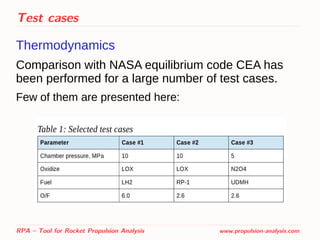
Comparison with NASA equilibrium code CEA has
been performed for a large number of test cases.
Few of them are presented here:
RPA – Tool for Rocket Propulsion Analysis www.propulsion-analysis.com
Test cases
Thermodynamics
RPA – Tool for Rocket Propulsion Analysis www.propulsion-analysis.com
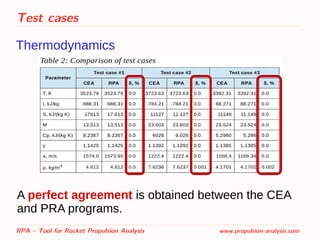
A perfect agreement is obtained between the CEA
and PRA programs.
Test cases
Engine performance analysis
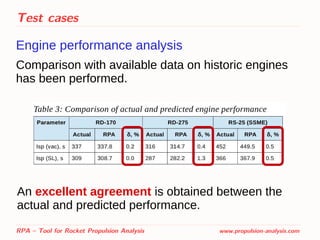
Comparison with available data on historic engines
has been performed.
RPA – Tool for Rocket Propulsion Analysis www.propulsion-analysis.com
An excellent agreement is obtained between the
actual and predicted performance.
Test cases
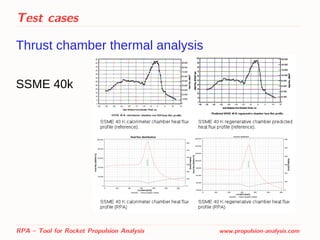
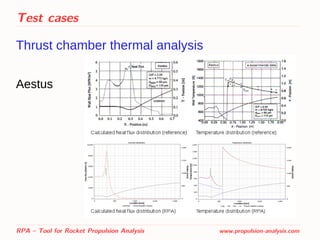
Thrust chamber thermal analysis
Comparison with available reference data has been
performed:
– SSME 40k [1]
– Aestus [2]
RPA – Tool for Rocket Propulsion Analysis www.propulsion-analysis.com
[1] Scaling Techniques for Design, Development, and Test.
Carol E. Dexter, Mark F. Fisher, James R. Hulka, Konstantin P. Denisov,
Alexander A. Shibanov, and Anatoliy F. Agarkov
[2] Simulation and Analysis of Thrust Chamber Flowfields: Storable Propellant Rockets.
Dieter Preclik, Oliver Knab, Denis Estublier, and Dag Wennerberg
Test cases
Thrust chamber thermal analysis
SSME 40k
RPA – Tool for Rocket Propulsion Analysis www.propulsion-analysis.com
Test cases
Thrust chamber thermal analysis
Aestus
RPA – Tool for Rocket Propulsion Analysis www.propulsion-analysis.com
Test cases
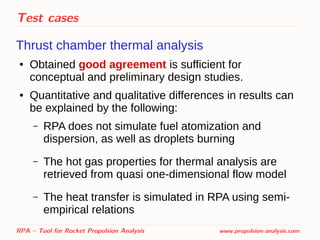
Thrust chamber thermal analysis
● Obtained good agreement is sufficient for
conceptual and preliminary design studies.
● Quantitative and qualitative differences in results can
be explained by the following:
– RPA does not simulate fuel atomization and
dispersion, as well as droplets burning
– The hot gas properties for thermal analysis are
retrieved from quasi one-dimensional flow model
– The heat transfer is simulated in RPA using semi-
empirical relations
RPA – Tool for Rocket Propulsion Analysis www.propulsion-analysis.com
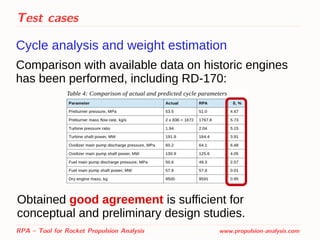
Test cases
Cycle analysis and weight estimation
Comparison with available data on historic engines
has been performed, including RD-170:
RPA – Tool for Rocket Propulsion Analysis www.propulsion-analysis.com
Obtained good agreement is sufficient for
conceptual and preliminary design studies.
Future development
Future development of RPA
● Design of thrust optimized nozzle contour (TOC),
● Improved options for thermal analysis (e.g., support
of jackets with bi-directional channels, support of BLC
formed by injector, designing the cooling jackets,
further validation including film cooling model),
● Improved options for modeling feed systems (e.g.
estimation of pressure drop in a hydraulic
components and efficiencies of the pumps and
turbines),
● Support of additional engine cycles (e.g. expander
cycle).
RPA – Tool for Rocket Propulsion Analysis www.propulsion-analysis.com
RPA - Tool for Rocket Propulsion Analysis
Thank you for your attention!
RPA – Tool for Rocket Propulsion Analysis www.propulsion-analysis.com

RPA - Tool for Rocket Propulsion Analysis

  • 1.
    Tool for Rocket Propulsion Analysis AlexanderPonomarenko contact@propulsion-analysis.com www.propulsion-analysis.com Cologne, Germany
  • 2.
    RPA Overview Tool forrocket propulsion analysis RPA is a multiplatform computational package intended for use in conceptual and preliminary design of liquid-propellant rocket engines RPA – Tool for Rocket Propulsion Analysis www.propulsion-analysis.com
  • 3.
    RPA Overview The motivationof RPA development was to... ● Provide modern tool for prediction of rocket engine performance at the conceptual and preliminary stages of design ● Capture impacts on engine performance due to variation of design parameters ● Assess the parameters of main engine components to provide better data for detailed analysis/design ● Assist in education of new generation of propulsion engineers RPA – Tool for Rocket Propulsion Analysis www.propulsion-analysis.com
  • 4.
    RPA Overview Features ofthe tool: ● Steady-state analysis ● Simplified physical models and wide usage of semi-empirical relations ● Minimum of input parameters ● Rapid execution with accuracy sufficient for conceptual and preliminary design studies RPA – Tool for Rocket Propulsion Analysis www.propulsion-analysis.com
  • 5.
    RPA Overview Modules Thermodynamics and Thrustchamber performance analysis RPA – Tool for Rocket Propulsion Analysis www.propulsion-analysis.com
  • 6.
    RPA Overview Modules Thrust chambersizing and Nozzle contour design RPA – Tool for Rocket Propulsion Analysis www.propulsion-analysis.com
  • 7.
    RPA Overview Modules Thrust chamberthermal analysis RPA – Tool for Rocket Propulsion Analysis www.propulsion-analysis.com
  • 8.
    RPA Overview Modules Engine cycleanalysis and Dry mass estimation RPA – Tool for Rocket Propulsion Analysis www.propulsion-analysis.com
  • 9.
    Thermodynamics Properties of reactantsand reaction products ● Expandable thermodynamic data library based on NASA Glenn thermodynamic database (also used by CEA) ● Includes data for such propellant components as (but not limited to): – liquid hydrogen H2(L), liquid methane CH4(L), RP-1, RG-1, synthine, MMH, UDMH, methyl alcohol – liquid oxygen O2(L), nitrogen tetra-oxide N2O4, hydrogen peroxide H2O2 ● User may add own propellant components and products of reaction RPA – Tool for Rocket Propulsion Analysis www.propulsion-analysis.com
  • 10.
    Thermodynamics Used methods Gibbs freeenergy minimization for problems p=const ● (p,T) = const ● (p,I) = const ● (p,S) = const Helmholtz free energy minimization for problems V=const ● (V,T) = const ● (V,U) = const ● (V,S) = const RPA – Tool for Rocket Propulsion Analysis www.propulsion-analysis.com
  • 11.
    Performance Analysis Assumptions: ● Idealgas law is applied to all processes ● Adiabatic, isobaric, isenthalpic combustion in combustion chamber at injector face ● Adiabatic, isentropic quasi-one-dimensional nozzle flow for both shifting and frozen equilibrium models RPA – Tool for Rocket Propulsion Analysis www.propulsion-analysis.com
  • 12.
    Performance Analysis Infinite-area combustionchamber RPA – Tool for Rocket Propulsion Analysis www.propulsion-analysis.com pinj = pinlet 0 = pinlet Iinj = Iinlet Sinj = Sinlet = St vinj = vinlet = 0 Subscripts: inj = injector face Inlet = nozzle inlet t = nozzle throat Finite-area combustion chamber pinj > pinlet 0 > pinlet Iinj > Iinlet Sinj < Sinlet = St vinj = 0 < vinlet
  • 13.
    Performance Analysis Ideal performanceof thrust chamber ● Specific impulse in vacuum: ● Specific impulse at ambient pressure : ● Characteristic velocity: ● Thrust coefficient in vacuum: ● Thrust coefficient at ambient pressure : RPA – Tool for Rocket Propulsion Analysis www.propulsion-analysis.com Isp vac = ve + pe ve ρe Isp a = Isp vac − pa ve ρe Cf vac = Isp vac /c* Cf a = Isp a /c* c* = pc 0 vt ρt pa pa
  • 14.
    Performance Analysis Delivered performanceof thrust chamber ● Specific impulse in vacuum: ● Specific impulse at ambient pressure : ● Characteristic velocity: ● Thrust coefficient in vacuum: ● Thrust coefficient at ambient pressure : Correction factors are obtained from semi-empirical relations [1] [1] For more details see: Ponomarenko, A. RPA: Tool for Rocket Propulsion Analysis. Assessment of Delivered Performance of Thrust Chamber. March 2013. RPA – Tool for Rocket Propulsion Analysis www.propulsion-analysis.com (Isp vac )d = ζc ζn Isp vac (Isp a )d=(Isp vac )d− pa ve ρe (Cf vac )d = ζn Cf vac (Cf a )d = ζn Cf a (c* )d = ζc c* pa pa
  • 15.
    Performance Analysis Additional options: ●Analysis of nozzle performance with shifting and frozen chemical equilibrium ● Optimization of propellant components mixture ratio for max delivered ● Altitude performance analysis, over-expanded nozzle performance analysis ● Throttled engine performance analysis RPA – Tool for Rocket Propulsion Analysis www.propulsion-analysis.com (Isp vac )d
  • 16.
    Thrust Chamber Sizing Supportedoptions: ● Sizing for required thrust level at a specific ambient pressure ● Sizing for a specific propellant mass flow rate through the thrust chamber ● Sizing for a specific nozzle throat diameter RPA – Tool for Rocket Propulsion Analysis www.propulsion-analysis.com
  • 17.
    Thrust Chamber Sizing Parametricdefinition of chamber geometry The size of combustion chamber and the shape of nozzle inlet contour are defined parametrically by: RPA – Tool for Rocket Propulsion Analysis www.propulsion-analysis.com ● mass flux at nozzle inlet or chamber contraction area ratio ● chamber length or characteristic length ● contraction half-angle ● relative parameters: Ac / At Lc L* R1/Rt R2/ R2 max Rn /Rt b
  • 18.
    Nozzle Contour Design Supportedoptions: ● Cone nozzle with a specified exit half-angle ● Parabolic nozzle contour with specified or automatically assessed initial and/or exit half-angle ● Truncated ideal contour (TIC) with fixed expansion area ratioand nozzle length (design method: axisymmetric MOC) ● TIC with maximum thrust at fixed expansion area ratio (design method: axisymmetric MOC) ● TIC with maximum thrust at fixed nozzle length (design method: axisymmetric MOC) RPA – Tool for Rocket Propulsion Analysis www.propulsion-analysis.com
  • 19.
    Nozzle Contour Design Directoptimization of nozzle contour RPA – Tool for Rocket Propulsion Analysis www.propulsion-analysis.com Cf = (Cf )2D (1−ζf ) → max (Cf )2D = 2 Ae At ∫ 0 1 (1− γ−1 γ+1 λ 2 ) 1 γ−1 [1+λ 2 γ(2cos 2 β−1)+1 γ+1 ]̄r d̄r To obtain the contour with the maximum thrust coefficient at specified conditions (area ratio or nozzle length) ζf = 1 − 2̄δe ** 1 + 1 γ Me 2 δ** = ( 2 γ−1) 0.1 Rew0 0.2 ( 0.015 ̄Tw 0.5 ) 0.8 (1+ γ−1 2 Mwe 2 ) γ+1 2(γ−1) Mw ν+1 ̄S0.2 ̄re 2 [∫ 0 ̄S ̄r1.25 M1+1.25ν (1+ γ−1 2 Mw 2 ) 1.36 γ−0.36 γ−1 d ̄S ] 0.8
  • 20.
    Thrust Chamber ThermalAnalysis Supported methods to obtain gas-side heat flux: ● Radiation heat transfer: ● Convective heat transfer  Bartz method:  Ievlev method[1,2] : 1. Lebedinsky E.V., Kalmykov G.P., et al. Working processes in liquid-propellant rocket engine and their simulation. Moscow, Mashinostroenie, 2008 2. Vasiliev A.P., Kudryavtsev V.M. et al. Basics of theory and analysis of liquid-propellant rocket engines, vol.2. 4th Edition. Moscow, Vyschaja Schkola, 1993 RPA – Tool for Rocket Propulsion Analysis www.propulsion-analysis.com qr=εe σ(εr T ∞ T∞ 4 − εr T w Tw 4 ) εe=εw /[1−(1−εw)(1−εr T w )] qw = αT (Taw−Tw) αT = [0.026 Dt 0.2 (μ∞ 0 )0.2 cp∞ 0 (Pr∞ 0 ) 0.6 (pc 0 c * ) 0.8 (Dt R ) 0.1 ] (At A ) 0.9 σ σ= [1 2 Tw Tc 0 (1+ γ−1 2 M 2 )+ 1 2] −0.68 [1+ γ−1 2 M 2 ] −0.12 Taw=Tc 0 [1+Pr1/3 (γ−1 2 )M2 1+(γ−1 2 )M2 ] qw = αT ρx v∞(I∞ 0 −Iw) αT = ( z zT ) 0.089 Pr−0.56 (1−0.21 1−Pr Pr 4/3 β 2 1− ̄Tw ) 0.9225 (307.8+54.8 log 2 ( Pr 19.5))Pr 0.45 z 0.08 −650
  • 21.
    Thrust Chamber ThermalAnalysis Supported cooling methods: Heat transfer equations: ● Radiation cooling ● Regenerative cooling  coaxial shells  tubular-wall jacket  channel-wall jacket ● Film cooling ● Thermal barrier coating RPA – Tool for Rocket Propulsion Analysis www.propulsion-analysis.com qw Twg +qr T wg = λw tw (T wg−Twc) = εwc σ Twc 4 = qrc T wc qw Twg +qr T wg = ̄λw tw (T wg−Twc) = αc (Twc−̄Tc) αc = ηf Nu λc de (qw T wg +qr Twg )2 π̄r dx = ˙mc ̄cc d Tc q (1) q (2) = S (1) S (2) S = (I∞ 0 −Iw)T e 0.425 μ1000 0.15 R1500 0.425 (Te+Tw) 0.595 (3T e+T w) 0.15 qw Twg +qr T wg = 1 t1 λ1 + t2 λ2 +...+ tN λN (Twg−T wc )
  • 22.
    Thrust Chamber ThermalAnalysis Regenerative cooling: coolant-side heat transfer RPA – Tool for Rocket Propulsion Analysis www.propulsion-analysis.com Nu = 0.021Rec 0.8 Prc 0.4 (0.64+0.36 T c Twc ) for kerosene [1] for liquid hydrogen [1] for methane [1] for other coolants [2] Nu = 0.033Rec 0.8 Prc 0.4 (Tc Twc ) 0.57 Nu = 0.0185 Rec 0.8 Prc 0.4 (Tc T wc ) 0.1 Nu = 0.023Rec 0.8 Prc 0.4 1. Lebedinsky E.V., Kalmykov G.P., et al. Working processes in liquid-propellant rocket engine and their simulation. Moscow, Mashinostroenie, 2008 2. Vasiliev A.P., Kudryavtsev V.M. et al. Basics of theory and analysis of liquid-propellant rocket engines, vol.2. 4th Edition. Moscow, Vyschaja Schkola, 1993
  • 23.
    Thrust Chamber ThermalAnalysis Regenerative cooling: coolant-side heat transfer Coefficient depends on geometric shape of the coolant passages RPA – Tool for Rocket Propulsion Analysis www.propulsion-analysis.com ηf Coaxial-shell jacket: Channel- or tubular-wall jacket: ηf =1.0 ηf = a a+δ + 2b a+δ th ξ ξ ξ= √2αc δ λw b δ
  • 24.
    Thrust Chamber ThermalAnalysis Gaseous film cooling RPA – Tool for Rocket Propulsion Analysis www.propulsion-analysis.com BLC Core (O/F)core , Tcore (O/F)f , Tf[(O/F)b , Tb ]1 mf . [(O/F)b , Tb ]2 Wall Combustion,Mixing At each point downstream of injection point, the mixing rate is a function of distance from the injection point and the relative mass flow rate of the film.
  • 25.
    Thrust Chamber ThermalAnalysis Liquid film cooling RPA – Tool for Rocket Propulsion Analysis www.propulsion-analysis.com d T f = 2π r qw T f η ˙m f ̄cf dx d ˙mf = 2π r qw T vap Qvap dx Heating: Vaporization: . Core BLC mf Wall Heating Vaporization, Combustion, Mixing Combustion, Mixing Liquid Gas (gaseous film cooling)
  • 26.
    Engine Cycle Analysis Supportedoptions: ● Staged combustion cycle (SC) ● Full flow staged combustion (FFSC) ● Gas generator cycle (GG) Allowed variations of the flow diagram: ● Number of combustion devices (gas generators or preburners) ● Number of turbopumps ● Arrangement of turbines (serial or parallel) ● Availability of booster pumps ● Availability of kick pumps ● Availability of tap-off branches RPA – Tool for Rocket Propulsion Analysis www.propulsion-analysis.com
  • 27.
    Engine Cycle Analysis Top-levelinput parameters: ● Type of combustion devices:  oxidizer-rich  fuel-rich ● Number of independent turbopumps, ● Number of gas generators/preburners Component-specific input parameters: ● Efficiency of pumps and turbines ● Pressure drop in all components (valves, injectors, etc.) ● Temperature in combustion devices ● Turbines pressure ratios (for GG cycle) RPA – Tool for Rocket Propulsion Analysis www.propulsion-analysis.com
  • 28.
    Engine Cycle Analysis Flowdiagram decomposition (example) RPA – Tool for Rocket Propulsion Analysis www.propulsion-analysis.com Flow diagram Fuel feed Oxidizer feed Power Oxidizer-rich SC cycle subsystem subsystem subsystem
  • 29.
    Engine Cycle Analysis Parametersof components The pump shaft power: The power developed by gas turbine: The power developed by hydraulic turbine: RPA – Tool for Rocket Propulsion Analysis www.propulsion-analysis.com Np = ˙m ηp ( pout− pin) ρ Nt = ˙mt ηt γ γ−1 R0 Tt in 0 [1−(1 δt ) γ−1 γ ] Nt = ˙mt ηt ( pout−pin) ρ
  • 30.
    Engine Cycle Analysis Solvingthe analysis problem for Gas-generator cycle: for given thrust chamber pressure, find such a mass flow rate through the turbines that the power of turbines with specified pressure ratios is sufficient for developing the required discharge pressure of pumps Staged-combustion cycle: for given thrust chamber pressure, find such a pressure in preburners and turbine pressure ratios that for specified temperature in preburners the power of turbines is sufficient for developing the required discharge pressure of pumps RPA – Tool for Rocket Propulsion Analysis www.propulsion-analysis.com
  • 31.
    Engine Dry MassEstimation ● Based on the set of semi-empirical equations for each major type of engines: gas generator, staged combustion and expander cycles ● Initially developed at Moscow Aviation Institute ● RPA utilizes this method with slightly modified coefficients to better fit the available data on historic engines ● Results of chamber sizing and cycle analysis are used as an input parameters of engine weight estimation RPA – Tool for Rocket Propulsion Analysis www.propulsion-analysis.com
  • 32.
    Test cases Thermodynamics Comparison withNASA equilibrium code CEA has been performed for a large number of test cases. Few of them are presented here: RPA – Tool for Rocket Propulsion Analysis www.propulsion-analysis.com
  • 33.
    Test cases Thermodynamics RPA –Tool for Rocket Propulsion Analysis www.propulsion-analysis.com A perfect agreement is obtained between the CEA and PRA programs.
  • 34.
    Test cases Engine performanceanalysis Comparison with available data on historic engines has been performed. RPA – Tool for Rocket Propulsion Analysis www.propulsion-analysis.com An excellent agreement is obtained between the actual and predicted performance.
  • 35.
    Test cases Thrust chamberthermal analysis Comparison with available reference data has been performed: – SSME 40k [1] – Aestus [2] RPA – Tool for Rocket Propulsion Analysis www.propulsion-analysis.com [1] Scaling Techniques for Design, Development, and Test. Carol E. Dexter, Mark F. Fisher, James R. Hulka, Konstantin P. Denisov, Alexander A. Shibanov, and Anatoliy F. Agarkov [2] Simulation and Analysis of Thrust Chamber Flowfields: Storable Propellant Rockets. Dieter Preclik, Oliver Knab, Denis Estublier, and Dag Wennerberg
  • 36.
    Test cases Thrust chamberthermal analysis SSME 40k RPA – Tool for Rocket Propulsion Analysis www.propulsion-analysis.com
  • 37.
    Test cases Thrust chamberthermal analysis Aestus RPA – Tool for Rocket Propulsion Analysis www.propulsion-analysis.com
  • 38.
    Test cases Thrust chamberthermal analysis ● Obtained good agreement is sufficient for conceptual and preliminary design studies. ● Quantitative and qualitative differences in results can be explained by the following: – RPA does not simulate fuel atomization and dispersion, as well as droplets burning – The hot gas properties for thermal analysis are retrieved from quasi one-dimensional flow model – The heat transfer is simulated in RPA using semi- empirical relations RPA – Tool for Rocket Propulsion Analysis www.propulsion-analysis.com
  • 39.
    Test cases Cycle analysisand weight estimation Comparison with available data on historic engines has been performed, including RD-170: RPA – Tool for Rocket Propulsion Analysis www.propulsion-analysis.com Obtained good agreement is sufficient for conceptual and preliminary design studies.
  • 40.
    Future development Future developmentof RPA ● Design of thrust optimized nozzle contour (TOC), ● Improved options for thermal analysis (e.g., support of jackets with bi-directional channels, support of BLC formed by injector, designing the cooling jackets, further validation including film cooling model), ● Improved options for modeling feed systems (e.g. estimation of pressure drop in a hydraulic components and efficiencies of the pumps and turbines), ● Support of additional engine cycles (e.g. expander cycle). RPA – Tool for Rocket Propulsion Analysis www.propulsion-analysis.com
  • 41.
    RPA - Toolfor Rocket Propulsion Analysis Thank you for your attention! RPA – Tool for Rocket Propulsion Analysis www.propulsion-analysis.com