Coaxial Swirl Injector PDR
Liquid Propulsion Laboratory
By: Nicholas Ilibasic
Michael Mastrangelo
Ryan George
March 4nd, 2020
• Introduction
• Motivation
• Trade Study
• Requirements
Agenda
Coaxial Swirl Injector
• Design process
• CAD model
• Injector sizing parameters
• Machining
• Testing Procedure
• Budget
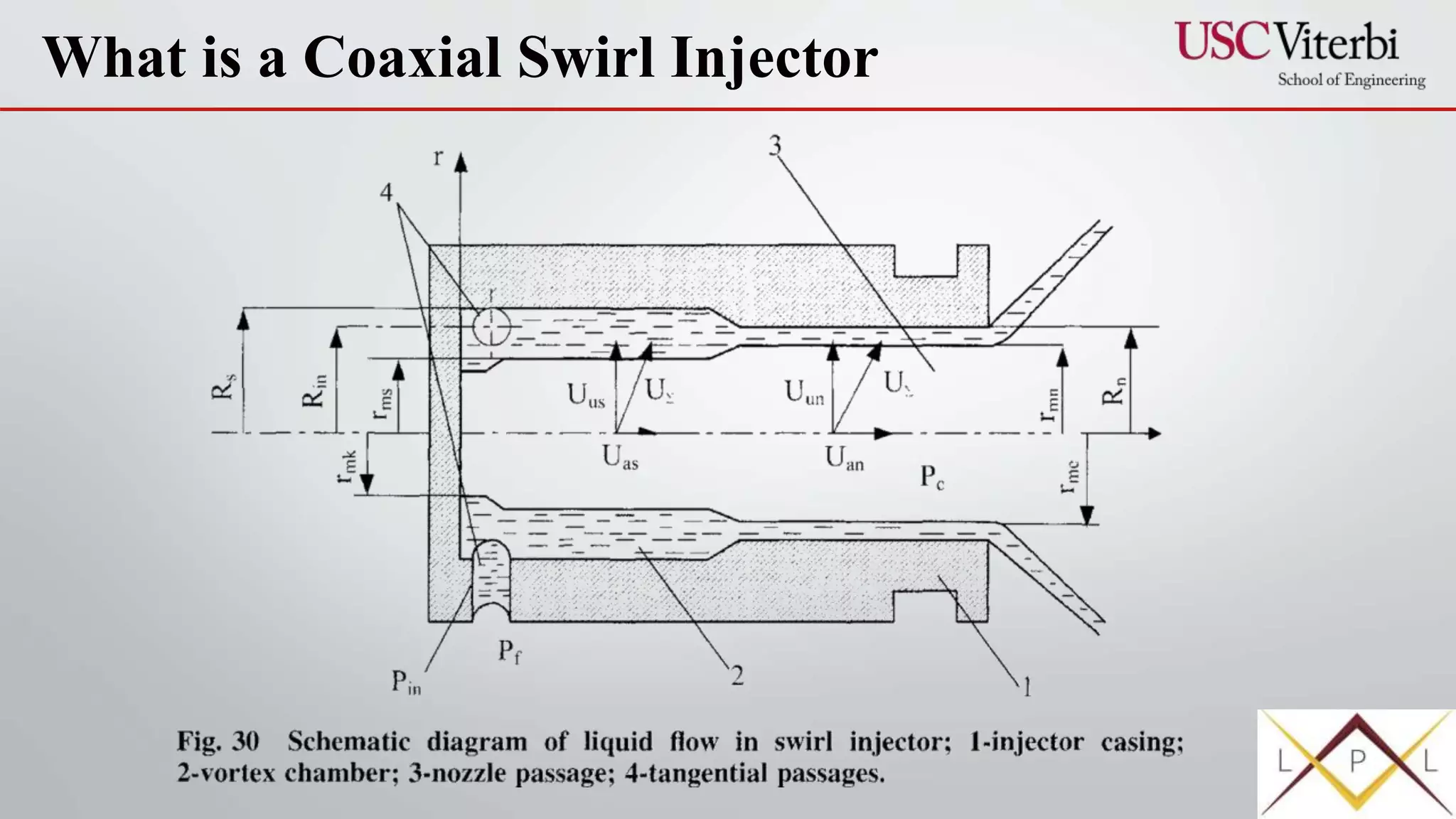
What is a Coaxial Swirl Injector
Why do we need a new design?
• Provide the lab with new knowledge on injector types
• Minimal design change from gas-liquid to liquid-liquid
• Improved atomization, has reached 99% efficiency in tests
• Easy to iterate
Major changes:
• J&J injector will consist of a single coaxial swirl element
• Phenolic resin to cool injector face
Motivation
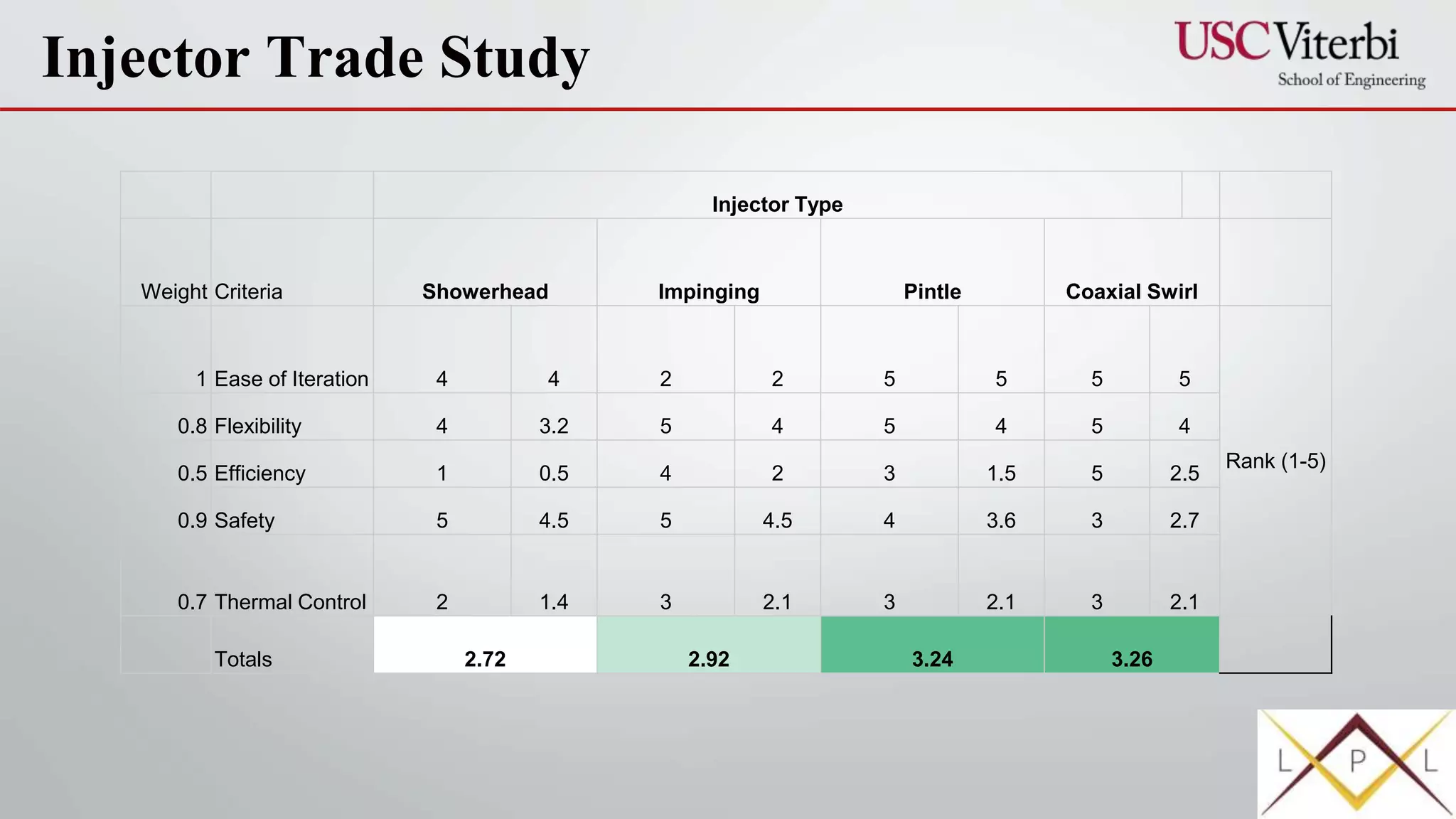
Injector Trade Study
Injector Type
Weight Criteria Showerhead Impinging Pintle Coaxial Swirl
1 Ease of Iteration 4 4 2 2 5 5 5 5
Rank (1-5)
0.8 Flexibility 4 3.2 5 4 5 4 5 4
0.5 Efficiency 1 0.5 4 2 3 1.5 5 2.5
0.9 Safety 5 4.5 5 4.5 4 3.6 3 2.7
0.7 Thermal Control 2 1.4 3 2.1 3 2.1 3 2.1
Totals 2.72 2.92 3.24 3.26
R1 Injector Requirements
1.1 Ability to be machined
1.2 Provide 400 psi of chamber pressure
1.3 Provide total mass flow of .4 kg/s
1.4 Combustion stability
Requirements
R2 Safety
2.1 Characterize oscillating waves
2.2 20% stiffness over injector
2.3 Thermal control
R3 Reliability
3.1 Multiple test cases
3.2 Ability for throttling
Firing Parameters
Propellant GOX/ RP-1 (Kerosene)
Chamber Pressure 400 psi
Chamber Temperature 3100 - 3350 K
Injector Pressure 480 psi
Total mass flow rate 0.4 kg/s
Burn time 6 seconds
O/F Ratio 2
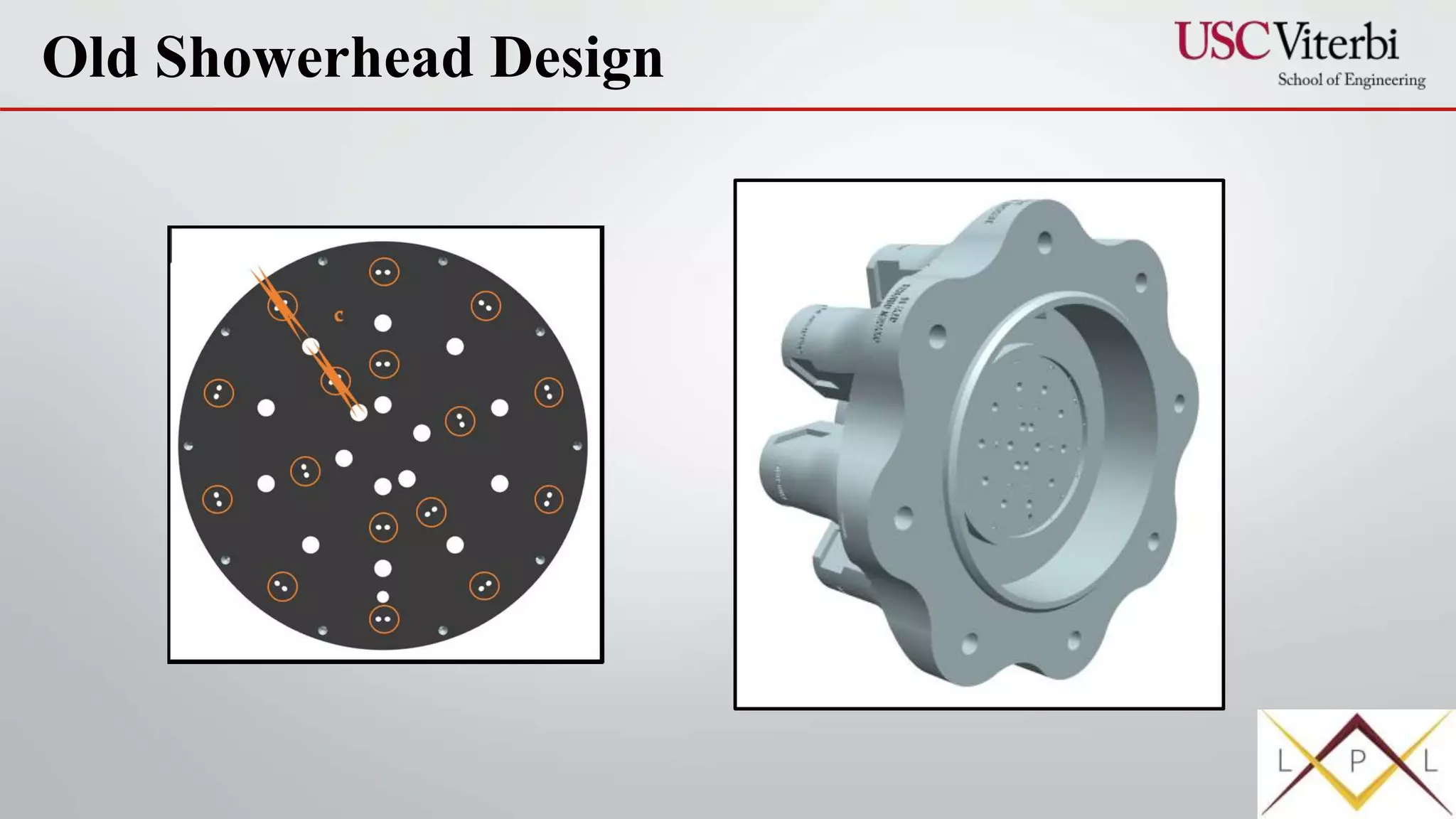
Old Showerhead Design
• To build and test a shower head injector, the entire part must be printed
and machined
• A coaxial swirl injector's efficiency is directly linked the element's design
Overall design strategy is:
Design Strategy
Hot Fire Engine
Resasses Feasibility Switch GOX to LOX
Integrate Specific Element to Complete Injector
CAD Full Injector Implement Thermocontrol
Charaterize Element Flow
Design Swirl Element Design Test Article
Design I
• Heavlily inspired by the RD-0110 (upper stage
of Soyuz family)
• Note this design does not use a vortex chamber on the
fuel side
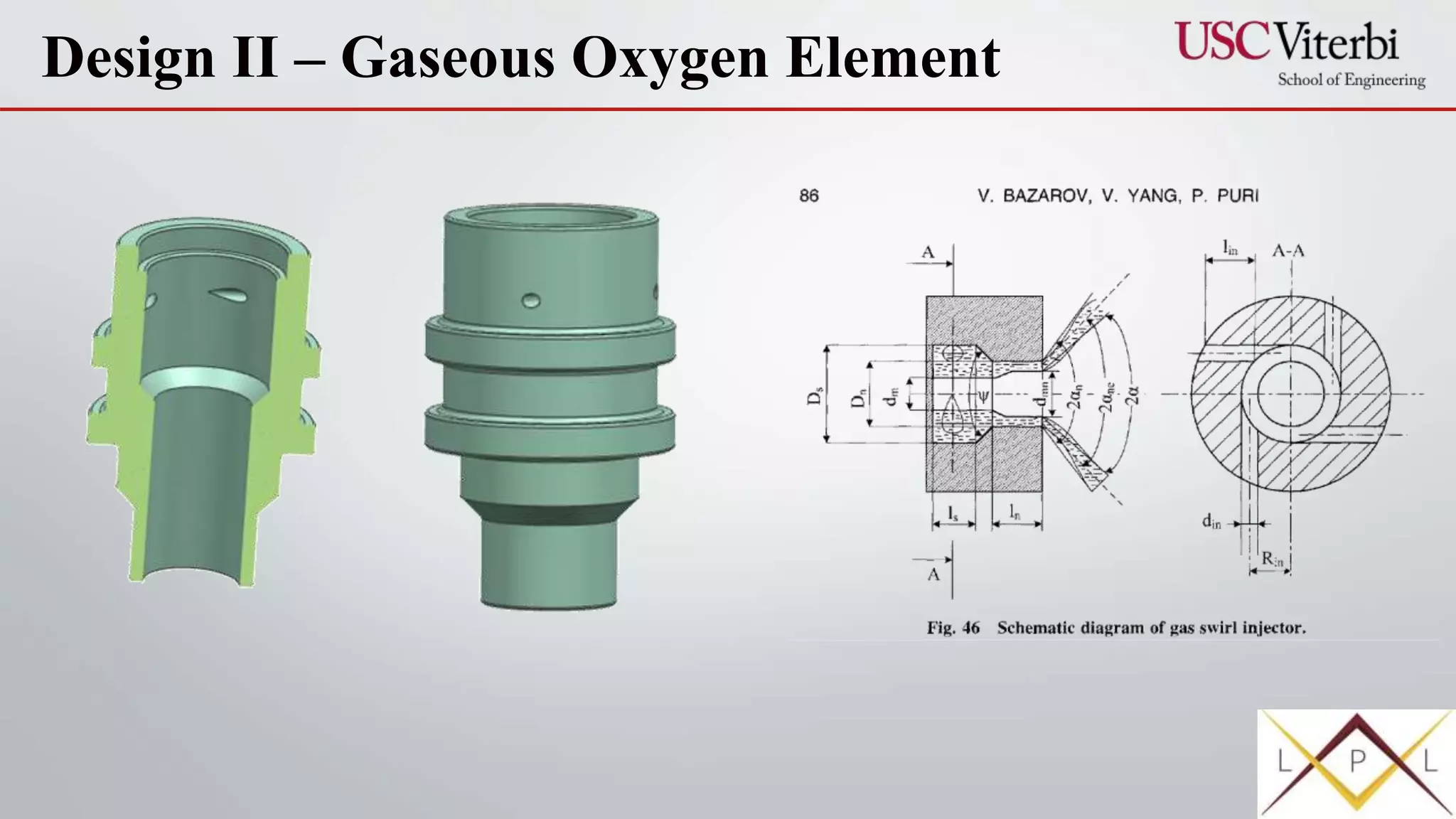
Design II – Gaseous Oxygen Element
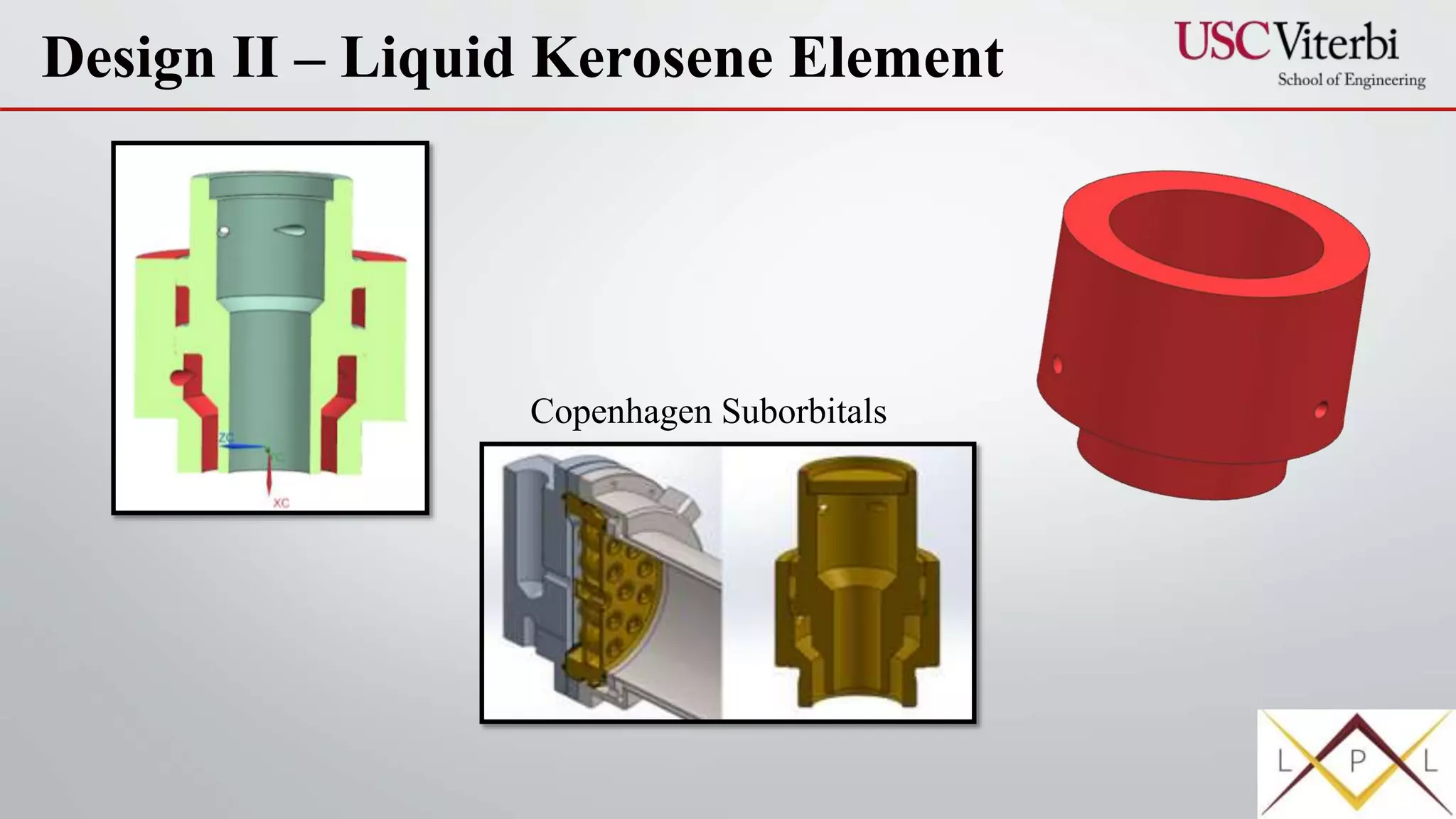
Design II – Liquid Kerosene Element
Copenhagen Suborbitals
• First, look at the pressure
drop across the inlets to verify
stiffnesss
• Then, look at numerical results
for tangenetial velocity and
axial velocity
Figures: "Study of internal flow
of a bipropellant swirl injector of
a rocket engine"
CFD Analysis on Designs
Testing Article
Liquid kerosene swirl in center with impinging jet gaseous oxygen on side
Design III
GOX/RP-1 Coaxial Swirl Injector Uncertainty
Coaxial Swirl Method
Pros
● Increased efficiency
● Similar design for BASE 11/Spaceshot
Injector design
● Easy iteration
Cons
● Gaseous oxygen swirl more difficult to model
than liquid
● Gaseous oxygen flows along the walls of the
vortex chamber
● Few papers discussing design process
Kerosene Swirl with GOX Jet
impinging Method
Pros
● Easier to model
● Can still learn from using single kerosene
swirler element
Cons
● Lower efficiency
● More work needed to move towards coaxial
swirl injector
Testing Procedure
Calculate
injector
geometry
Machine
injector
element
Inspection
Run WFTS/
Nitrogen gas
cold flow
Analysis of
testing data
Set Injector
parameters (mass
flow rate, Pc, ΔP)
Feasibility
assessment
Design
Optimization
Injector Sizing Equations - Fuel
Radius of nozzle (mm) 17.14
Radius of inlet channel (mm) 3.94
Length of nozzle (mm) 34.26
Length of inlet channel (mm) 11.8
Radius of swirl vortex (mm) 29.34
MATLAB simulation on G drive
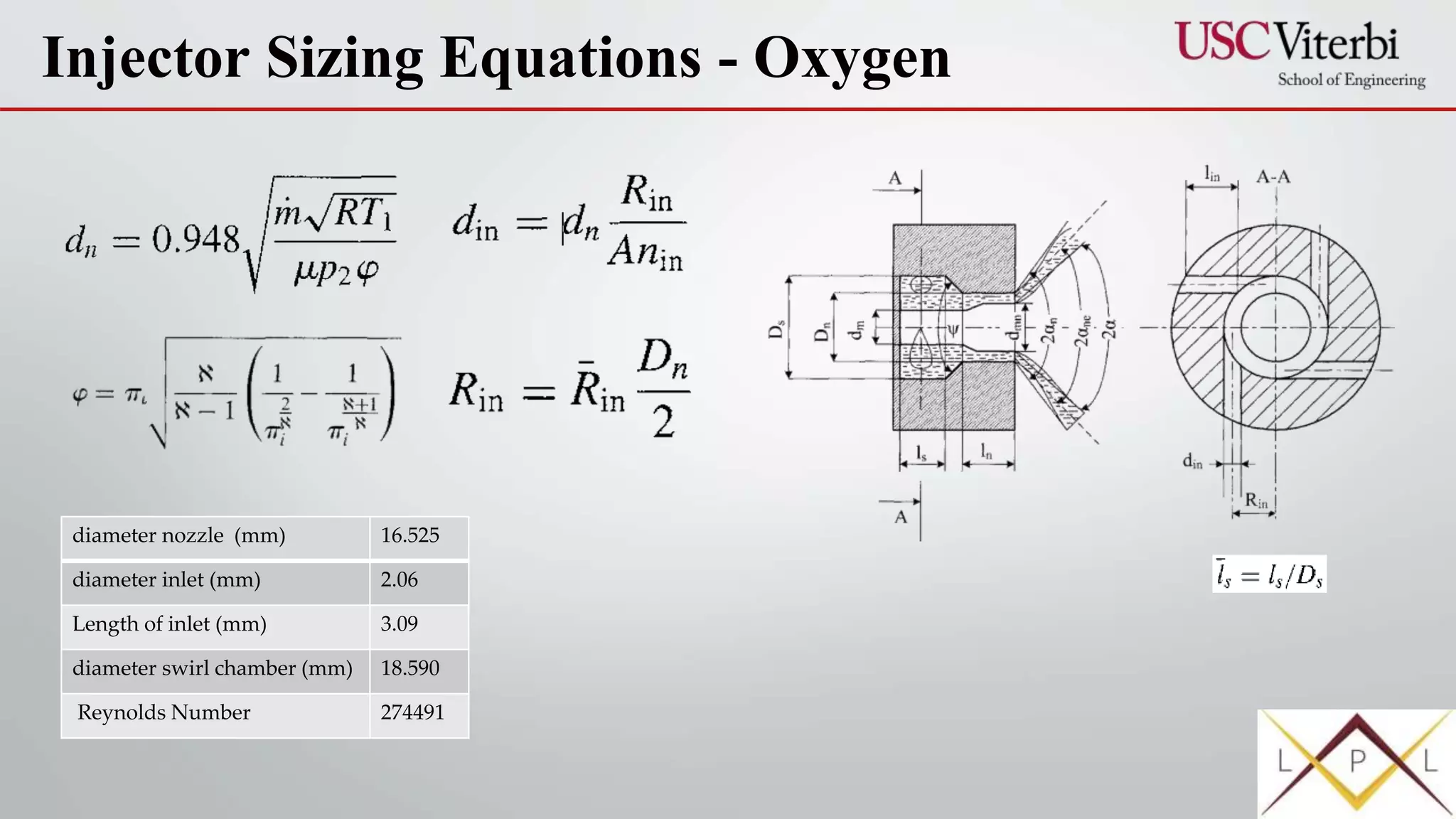
Injector Sizing Equations - Oxygen
diameter nozzle (mm) 16.525
diameter inlet (mm) 2.06
Length of inlet (mm) 3.09
diameter swirl chamber (mm) 18.590
Reynolds Number 274491
Interface with WFTS:
• ¾ inch swage
• Pressure transducers to measure pressure in the vortex chamber
• High speed camera to image cone angle and spray oscillations
• Use dye to distinguish between two cones
Testing Campaign
Machining
• Machine 20 elements
using different inlet and
nozzle radii.
• Testing article made of
aluminum parts. Held
together using fasteners and
O-rings to prevent leaks.
• Swirl elements placed inside
testing article
• Induction welding:
SILVER BRAZING PASTE
FLUX - Superior No. 6JB
Only for nonferrous
metals such as brass.
• MIG welding equipment
(USC facilities)
Welding
• Testing article: $100
• Welding: Free
• Elements: $40 for 20 elements
• Fasteners and sealing: $20 (8 Screws,
8 Nuts, 8 Washers) Assess the extra
already in lab
• Final injector design: $1200
1. Additively manufactured and post
machining: $1200 ($800 +$400)
Maraging steel (same material as J&J)
2. Machined
Labor $$
Budget
1. Study oscillating waves formed at different cone angles.
2. How do we test and validate the design works?
3. Final injector design to be machined or additively manufactured?
Questions
• Finalize CAD of swirler elements
• Select sealing
• Order Parts
• Begin Machining
• Begin testing campaign on WFTS
• Send injector drawings to Machine Shop (current lead time ~ 3 weeks)
Next Steps

Coaxial Bi-Swirl Fuel Injector

  • 1.
    Coaxial Swirl InjectorPDR Liquid Propulsion Laboratory By: Nicholas Ilibasic Michael Mastrangelo Ryan George March 4nd, 2020
  • 2.
    • Introduction • Motivation •Trade Study • Requirements Agenda Coaxial Swirl Injector • Design process • CAD model • Injector sizing parameters • Machining • Testing Procedure • Budget
  • 3.
    What is aCoaxial Swirl Injector
  • 4.
    Why do weneed a new design? • Provide the lab with new knowledge on injector types • Minimal design change from gas-liquid to liquid-liquid • Improved atomization, has reached 99% efficiency in tests • Easy to iterate Major changes: • J&J injector will consist of a single coaxial swirl element • Phenolic resin to cool injector face Motivation
  • 5.
    Injector Trade Study InjectorType Weight Criteria Showerhead Impinging Pintle Coaxial Swirl 1 Ease of Iteration 4 4 2 2 5 5 5 5 Rank (1-5) 0.8 Flexibility 4 3.2 5 4 5 4 5 4 0.5 Efficiency 1 0.5 4 2 3 1.5 5 2.5 0.9 Safety 5 4.5 5 4.5 4 3.6 3 2.7 0.7 Thermal Control 2 1.4 3 2.1 3 2.1 3 2.1 Totals 2.72 2.92 3.24 3.26
  • 6.
    R1 Injector Requirements 1.1Ability to be machined 1.2 Provide 400 psi of chamber pressure 1.3 Provide total mass flow of .4 kg/s 1.4 Combustion stability Requirements R2 Safety 2.1 Characterize oscillating waves 2.2 20% stiffness over injector 2.3 Thermal control R3 Reliability 3.1 Multiple test cases 3.2 Ability for throttling
  • 7.
    Firing Parameters Propellant GOX/RP-1 (Kerosene) Chamber Pressure 400 psi Chamber Temperature 3100 - 3350 K Injector Pressure 480 psi Total mass flow rate 0.4 kg/s Burn time 6 seconds O/F Ratio 2
  • 8.
  • 9.
    • To buildand test a shower head injector, the entire part must be printed and machined • A coaxial swirl injector's efficiency is directly linked the element's design Overall design strategy is: Design Strategy Hot Fire Engine Resasses Feasibility Switch GOX to LOX Integrate Specific Element to Complete Injector CAD Full Injector Implement Thermocontrol Charaterize Element Flow Design Swirl Element Design Test Article
  • 10.
    Design I • Heavlilyinspired by the RD-0110 (upper stage of Soyuz family) • Note this design does not use a vortex chamber on the fuel side
  • 11.
    Design II –Gaseous Oxygen Element
  • 12.
    Design II –Liquid Kerosene Element Copenhagen Suborbitals
  • 13.
    • First, lookat the pressure drop across the inlets to verify stiffnesss • Then, look at numerical results for tangenetial velocity and axial velocity Figures: "Study of internal flow of a bipropellant swirl injector of a rocket engine" CFD Analysis on Designs
  • 14.
  • 15.
    Liquid kerosene swirlin center with impinging jet gaseous oxygen on side Design III
  • 16.
    GOX/RP-1 Coaxial SwirlInjector Uncertainty Coaxial Swirl Method Pros ● Increased efficiency ● Similar design for BASE 11/Spaceshot Injector design ● Easy iteration Cons ● Gaseous oxygen swirl more difficult to model than liquid ● Gaseous oxygen flows along the walls of the vortex chamber ● Few papers discussing design process Kerosene Swirl with GOX Jet impinging Method Pros ● Easier to model ● Can still learn from using single kerosene swirler element Cons ● Lower efficiency ● More work needed to move towards coaxial swirl injector
  • 17.
    Testing Procedure Calculate injector geometry Machine injector element Inspection Run WFTS/ Nitrogengas cold flow Analysis of testing data Set Injector parameters (mass flow rate, Pc, ΔP) Feasibility assessment Design Optimization
  • 18.
    Injector Sizing Equations- Fuel Radius of nozzle (mm) 17.14 Radius of inlet channel (mm) 3.94 Length of nozzle (mm) 34.26 Length of inlet channel (mm) 11.8 Radius of swirl vortex (mm) 29.34 MATLAB simulation on G drive
  • 19.
    Injector Sizing Equations- Oxygen diameter nozzle (mm) 16.525 diameter inlet (mm) 2.06 Length of inlet (mm) 3.09 diameter swirl chamber (mm) 18.590 Reynolds Number 274491
  • 20.
    Interface with WFTS: •¾ inch swage • Pressure transducers to measure pressure in the vortex chamber • High speed camera to image cone angle and spray oscillations • Use dye to distinguish between two cones Testing Campaign
  • 21.
    Machining • Machine 20elements using different inlet and nozzle radii. • Testing article made of aluminum parts. Held together using fasteners and O-rings to prevent leaks. • Swirl elements placed inside testing article
  • 22.
    • Induction welding: SILVERBRAZING PASTE FLUX - Superior No. 6JB Only for nonferrous metals such as brass. • MIG welding equipment (USC facilities) Welding
  • 23.
    • Testing article:$100 • Welding: Free • Elements: $40 for 20 elements • Fasteners and sealing: $20 (8 Screws, 8 Nuts, 8 Washers) Assess the extra already in lab • Final injector design: $1200 1. Additively manufactured and post machining: $1200 ($800 +$400) Maraging steel (same material as J&J) 2. Machined Labor $$ Budget
  • 24.
    1. Study oscillatingwaves formed at different cone angles. 2. How do we test and validate the design works? 3. Final injector design to be machined or additively manufactured? Questions
  • 25.
    • Finalize CADof swirler elements • Select sealing • Order Parts • Begin Machining • Begin testing campaign on WFTS • Send injector drawings to Machine Shop (current lead time ~ 3 weeks) Next Steps