Prof. Mahmoud Youssef
Mansoura University
ROYAL
CONTROL
MANSOURA . 2021
 Mrs. MW is a 50 year old male.
 He works at an IT company with extended hours of work.
 He regularly exercises.
 He has no special habits of medical importance.
 No family history of importance.
 Presenting with increasing shortness of breath and palpitations.
Case Presentation
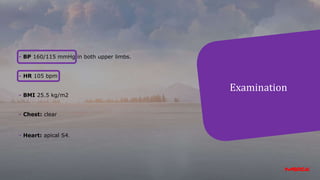
- BP 160/115 mmHg in both upper limbs.
- HR 105 bpm
- BMI 25.5 kg/m2
- Chest: clear
- Heart: apical S4.
Examination
A. ECG.
B. Chest X-ray.
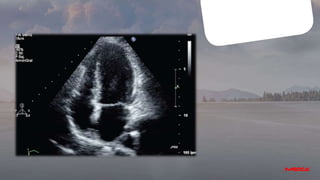
C. Echocardiogram.
D. Laboratory.
E. All of the above.
?
What investigations would you
do?
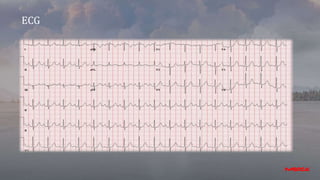
ECG
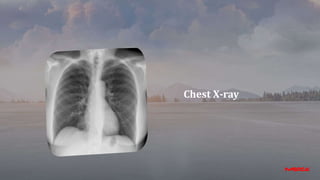
Chest X-ray
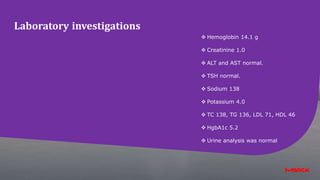
Laboratory investigations
 Hemoglobin 14.1 g
 Creatinine 1.0
 ALT and AST normal.
 TSH normal.
 Sodium 138
 Potassium 4.0
 TC 138, TG 136, LDL 71, HDL 46
 HgbA1c 5.2
 Urine analysis was normal
?
Would you want further investigations?
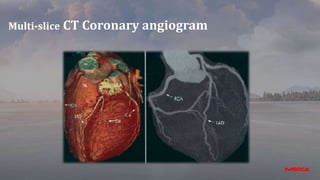
A. Coronary CT
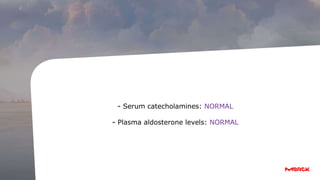
B. Serum catecholamines
C. Plasma aldosterone levels
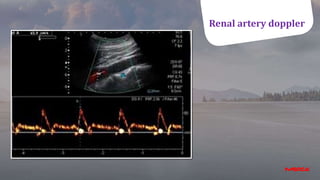
D. Renal artery doppler
Multi-slice CT Coronary angiogram
Plasma
aldosterone
levels:
NORMAL
- Serum catecholamines: NORMAL
- Plasma aldosterone levels: NORMAL
Renal artery doppler
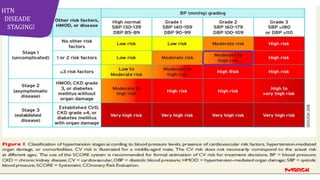
A. Low risk.
B. Moderate risk.
C. High risk.
D. Very high risk.
?
What is the risk category of the
patient?
HTN
DISEADE
STAGING!
?
You decide on treatment. What is your
strategy?
A. Lifestyle changes alone.
B. Immediate medical therapy in addition to lifestyle changes.
Renal artery doppler
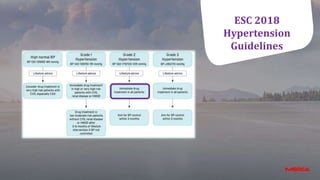
ESC 2018
Hypertension
Guidelines
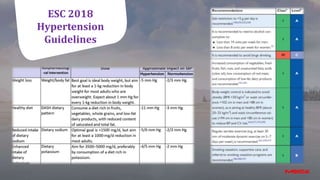
ESC 2018
Hypertension
Guidelines
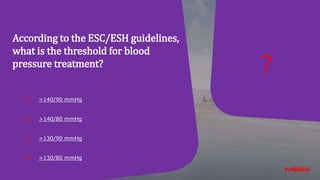
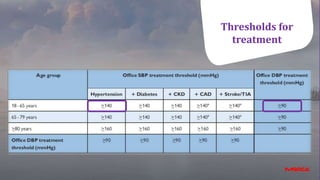
A. >140/90 mmHg
B. >140/80 mmHg
C. >130/90 mmHg
D. >130/80 mmHg
?
According to the ESC/ESH guidelines,
what is the threshold for blood
pressure treatment?
Thresholds for
treatment
?
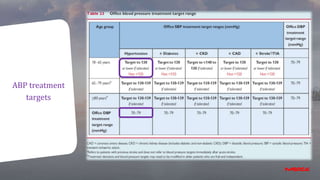
According to the ESC/ESH guidelines,
what is the target for blood pressure
treatment?
A. 130-139/80-89 mmHg
B. 130-139/70-79 mmHg
C. 120-129/80-89 mmHg
D. 120-129/70-79 mmHg
ABP treatment
targets
A. One.
B. Two.
C. Three.
D. More than three.
?
What number of medications would
you start with?
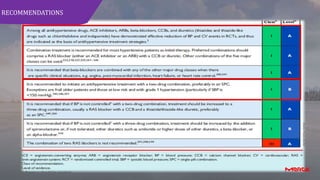
RECOMMENDATIONS
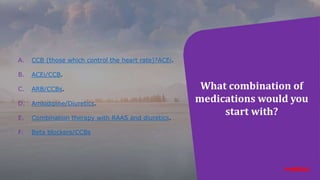
What combination of
medications would you
start with?
A. CCB (those which control the heart rate)?ACEi.
B. ACEi/CCB.
C. ARB/CCBs.
D. Amlodipine/Diuretics.
E. Combination therapy with RAAS and diuretics.
F. Beta blockers/CCBs
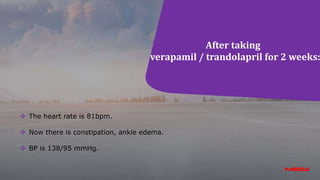
After taking
verapamil / trandolapril for 2 weeks:
 The heart rate is 81bpm.
 Now there is constipation, ankle edema.
 BP is 138/95 mmHg.
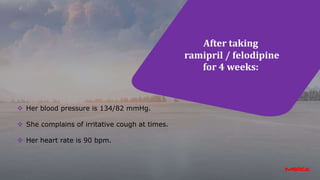
After taking
ramipril / felodipine
for 4 weeks:
 Her blood pressure is 134/82 mmHg.
 She complains of irritative cough at times.
 Her heart rate is 90 bpm.
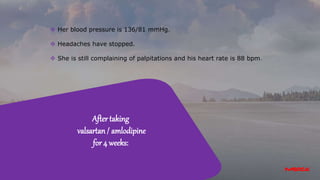
After taking
valsartan / amlodipine
for 4 weeks:
 Her blood pressure is 136/81 mmHg.
 Headaches have stopped.
 She is still complaining of palpitations and his heart rate is 88 bpm.
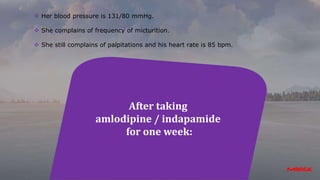
After taking
amlodipine / indapamide
for one week:
 Her blood pressure is 131/80 mmHg.
 She complains of frequency of micturition.
 She still complains of palpitations and his heart rate is 85 bpm.
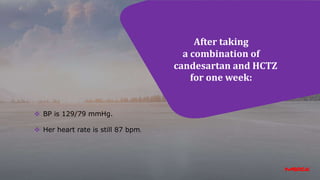
After taking
a combination of
candesartan and HCTZ
for one week:
 BP is 129/79 mmHg.
 Her heart rate is still 87 bpm.
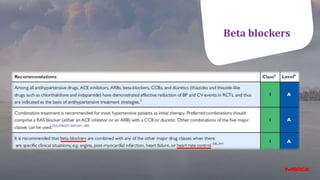
Beta blockers
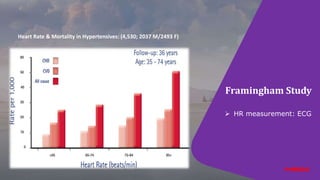
Framingham Study
Heart Rate & Mortality in Hypertensives: (4,530; 2037 M/2493 F)
 HR measurement: ECG
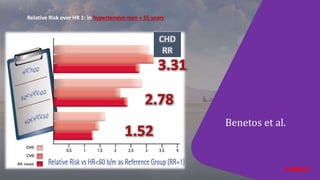
Benetos et al.
Relative Risk over HR 1: in hypertensive men < 55 years
80 b/m
Bisoprolol / CCBs
 BP is 125/74 mmHg.
 HR 62 bpm.
 Chest is normal.
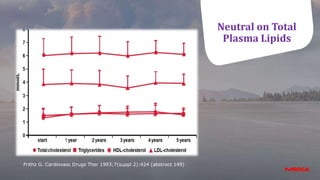
 Follow up of lipids and blood sugar is normal.
Neutral on Total
Plasma Lipids
Frithz G. Cardiovasc Drugs Ther 1993;7(suppl 2):424 (abstract 149)
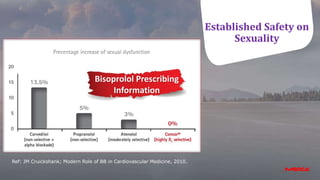
Established Safety on
Sexuality
Bisoprolol Prescribing
Information
Ref: JM Cruickshank; Modern Role of BB in Cardiovascular Medicine, 2010.
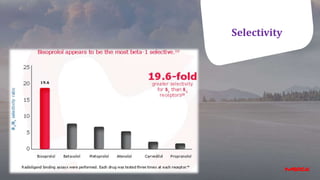
Selectivity
Plasma
aldosterone
levels:
NORMAL
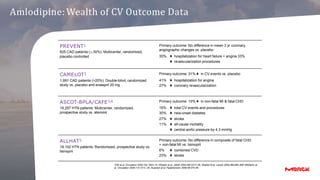
Amlodipine: Wealth of CV Outcome Data
Primary outcome: No difference in composite of fatal CHD
+ non-fatal MI vs. lisinopril
6% � combined CVD
23% � stroke
ALLHAT5
18,102 HTN patients: Randomized, prospective study vs.
lisinopril
Primary outcome: 10% � in non-fatal MI & fatal CHD
16% � total CV events and procedures
30% � new-onset diabetes
27% � stroke
11% � all-cause mortality
� central aortic pressure by 4.3 mmHg
ASCOT-BPLA/CAFE3,4
19,257 HTN patients: Multicenter, randomized,
prospective study vs. atenolol
Primary outcome: 31% � in CV events vs. placebo
41% � hospitalization for angina
27% � coronary revascularization
CAMELOT2
1,991 CAD patients (>20%): Double-blind, randomized
study vs. placebo and enalapril 20 mg
Primary outcome: No difference in mean 3 yr coronary
angiographic changes vs. placebo
35% � hospitalization for heart failure + angina 33%
� revascularization procedures
PREVENT1
825 CAD patients (≥30%): Multicenter, randomized,
placebo controlled
1Pitt et al. Circulation 2000;102:1503–10; 2Nissen et al. JAMA 2004;292:2217–26; 3Dahlof et al. Lancet 2005;366:895–906 4Williams et
al. Circulation 2006;113:1213 –25; 5Leenen et al. Hypertension 2006;48:374–84
Advantages of
Combination therapy
 Complimentary mode of action for optimal BP control.
 Inhibits the body’s counter regulatory responses when
using one anti-HTN agent.
 More effective in moderate and severe HTN (10-15% of
HTN population, and are at high CV risk).
 Decreases BP variability more than single agent (stroke
reduction).
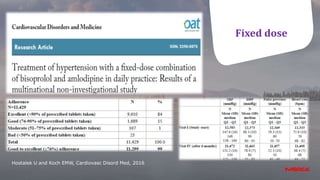
Fixed dose
Hostalek U and Koch EMW, Cardiovasc Disord Med, 2016
Plasma
aldosterone
levels:
NORMAL
Benefits of bisoprolol/amlodipine combination
 Any case of HTN, specially with a heart rate of 80 bpm or more.
 Two anti-ischemic agents in one pill.
 Contains the therapeutic doses of bisoprolol (5, 10 mg) (not subtherapeutic).
 Can be given at any level of eGFR.
 Can be given regardless of the liver function.
 Metabolically neutral.
Take home messages
 Hypertension is the most prevalent risk factor for
cardiovascular disease.
 We should assess our patients thoroughly.
 Choosing the correct class of medications is of utmost
importance for the sake of both efficacy and safety.
 Not all beta blockers are the same, as they differ in potency to
control heart rate and incidence of side effects.
 Bisoprolol/Amlodipine : Complimentary mode of action for
optimal BP control.
Thank You

Royal control in hypertension

  • 2.
    Prof. Mahmoud Youssef MansouraUniversity ROYAL CONTROL
  • 3.
  • 4.
     Mrs. MWis a 50 year old male.  He works at an IT company with extended hours of work.  He regularly exercises.  He has no special habits of medical importance.  No family history of importance.  Presenting with increasing shortness of breath and palpitations. Case Presentation
  • 5.
    - BP 160/115mmHg in both upper limbs. - HR 105 bpm - BMI 25.5 kg/m2 - Chest: clear - Heart: apical S4. Examination
  • 6.
    A. ECG. B. ChestX-ray. C. Echocardiogram. D. Laboratory. E. All of the above. ? What investigations would you do?
  • 7.
  • 8.
  • 10.
    Laboratory investigations  Hemoglobin14.1 g  Creatinine 1.0  ALT and AST normal.  TSH normal.  Sodium 138  Potassium 4.0  TC 138, TG 136, LDL 71, HDL 46  HgbA1c 5.2  Urine analysis was normal
  • 11.
    ? Would you wantfurther investigations? A. Coronary CT B. Serum catecholamines C. Plasma aldosterone levels D. Renal artery doppler
  • 12.
  • 13.
    Plasma aldosterone levels: NORMAL - Serum catecholamines:NORMAL - Plasma aldosterone levels: NORMAL
  • 14.
  • 15.
    A. Low risk. B.Moderate risk. C. High risk. D. Very high risk. ? What is the risk category of the patient?
  • 16.
  • 17.
    ? You decide ontreatment. What is your strategy? A. Lifestyle changes alone. B. Immediate medical therapy in addition to lifestyle changes.
  • 18.
    Renal artery doppler ESC2018 Hypertension Guidelines
  • 19.
  • 20.
    A. >140/90 mmHg B.>140/80 mmHg C. >130/90 mmHg D. >130/80 mmHg ? According to the ESC/ESH guidelines, what is the threshold for blood pressure treatment?
  • 21.
  • 22.
    ? According to theESC/ESH guidelines, what is the target for blood pressure treatment? A. 130-139/80-89 mmHg B. 130-139/70-79 mmHg C. 120-129/80-89 mmHg D. 120-129/70-79 mmHg
  • 23.
  • 24.
    A. One. B. Two. C.Three. D. More than three. ? What number of medications would you start with?
  • 25.
  • 26.
    What combination of medicationswould you start with? A. CCB (those which control the heart rate)?ACEi. B. ACEi/CCB. C. ARB/CCBs. D. Amlodipine/Diuretics. E. Combination therapy with RAAS and diuretics. F. Beta blockers/CCBs
  • 27.
    After taking verapamil /trandolapril for 2 weeks:  The heart rate is 81bpm.  Now there is constipation, ankle edema.  BP is 138/95 mmHg.
  • 28.
    After taking ramipril /felodipine for 4 weeks:  Her blood pressure is 134/82 mmHg.  She complains of irritative cough at times.  Her heart rate is 90 bpm.
  • 29.
    After taking valsartan /amlodipine for 4 weeks:  Her blood pressure is 136/81 mmHg.  Headaches have stopped.  She is still complaining of palpitations and his heart rate is 88 bpm.
  • 30.
    After taking amlodipine /indapamide for one week:  Her blood pressure is 131/80 mmHg.  She complains of frequency of micturition.  She still complains of palpitations and his heart rate is 85 bpm.
  • 31.
    After taking a combinationof candesartan and HCTZ for one week:  BP is 129/79 mmHg.  Her heart rate is still 87 bpm.
  • 32.
  • 33.
    Framingham Study Heart Rate& Mortality in Hypertensives: (4,530; 2037 M/2493 F)  HR measurement: ECG
  • 34.
    Benetos et al. RelativeRisk over HR 1: in hypertensive men < 55 years
  • 35.
  • 36.
    Bisoprolol / CCBs BP is 125/74 mmHg.  HR 62 bpm.  Chest is normal.  Follow up of lipids and blood sugar is normal.
  • 37.
    Neutral on Total PlasmaLipids Frithz G. Cardiovasc Drugs Ther 1993;7(suppl 2):424 (abstract 149)
  • 38.
    Established Safety on Sexuality BisoprololPrescribing Information Ref: JM Cruickshank; Modern Role of BB in Cardiovascular Medicine, 2010.
  • 39.
  • 40.
    Plasma aldosterone levels: NORMAL Amlodipine: Wealth ofCV Outcome Data Primary outcome: No difference in composite of fatal CHD + non-fatal MI vs. lisinopril 6% � combined CVD 23% � stroke ALLHAT5 18,102 HTN patients: Randomized, prospective study vs. lisinopril Primary outcome: 10% � in non-fatal MI & fatal CHD 16% � total CV events and procedures 30% � new-onset diabetes 27% � stroke 11% � all-cause mortality � central aortic pressure by 4.3 mmHg ASCOT-BPLA/CAFE3,4 19,257 HTN patients: Multicenter, randomized, prospective study vs. atenolol Primary outcome: 31% � in CV events vs. placebo 41% � hospitalization for angina 27% � coronary revascularization CAMELOT2 1,991 CAD patients (>20%): Double-blind, randomized study vs. placebo and enalapril 20 mg Primary outcome: No difference in mean 3 yr coronary angiographic changes vs. placebo 35% � hospitalization for heart failure + angina 33% � revascularization procedures PREVENT1 825 CAD patients (≥30%): Multicenter, randomized, placebo controlled 1Pitt et al. Circulation 2000;102:1503–10; 2Nissen et al. JAMA 2004;292:2217–26; 3Dahlof et al. Lancet 2005;366:895–906 4Williams et al. Circulation 2006;113:1213 –25; 5Leenen et al. Hypertension 2006;48:374–84
  • 41.
    Advantages of Combination therapy Complimentary mode of action for optimal BP control.  Inhibits the body’s counter regulatory responses when using one anti-HTN agent.  More effective in moderate and severe HTN (10-15% of HTN population, and are at high CV risk).  Decreases BP variability more than single agent (stroke reduction).
  • 42.
    Fixed dose Hostalek Uand Koch EMW, Cardiovasc Disord Med, 2016
  • 43.
    Plasma aldosterone levels: NORMAL Benefits of bisoprolol/amlodipinecombination  Any case of HTN, specially with a heart rate of 80 bpm or more.  Two anti-ischemic agents in one pill.  Contains the therapeutic doses of bisoprolol (5, 10 mg) (not subtherapeutic).  Can be given at any level of eGFR.  Can be given regardless of the liver function.  Metabolically neutral.
  • 44.
    Take home messages Hypertension is the most prevalent risk factor for cardiovascular disease.  We should assess our patients thoroughly.  Choosing the correct class of medications is of utmost importance for the sake of both efficacy and safety.  Not all beta blockers are the same, as they differ in potency to control heart rate and incidence of side effects.  Bisoprolol/Amlodipine : Complimentary mode of action for optimal BP control.
  • 45.