Principles of Aquaculture
FMA2001 (2+1)
LU 12: Molluscs culture
Learning Outcomes
1.Preparation and management of mussels, cockles and
oyster culturing
Introduction
• Molluscs are important phylum of invertebrate animals
• They are mostly marine and near shallow waters
• Major class:
• Cephalopod  Squid, octopus, cuttlefish
• Gastropods  snails, slugs, abalone
• Bivalves  oyster, cockles, mussels
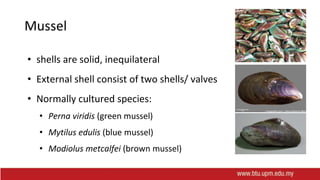
Mussel
• shells are solid, inequilateral
• External shell consist of two shells/ valves
• Normally cultured species:
• Perna viridis (green mussel)
• Mytilus edulis (blue mussel)
• Modiolus metcalfei (brown mussel)
• Found at the littoral zone / intertidal zone--> brackish to
marine species.
• Filter-feeder  plankton and detritus
• Very short food chain (one link only)
• Fast growth rate
• Reach sexual maturity within 1 year and spawn with rising
seawater temperature.
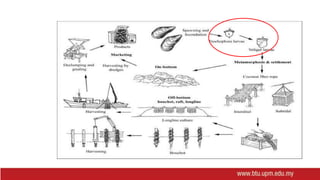
• Two phase in life cycle planktonic or larval stage (2 weeks) &
sessile adult stage.
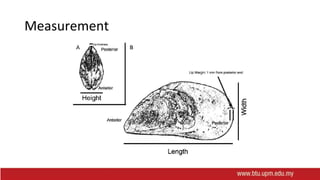
Measurement
Preparation for culture
Site selection:
• well protected/ sheltered bay protect from wind and waves
• Presence of natural mussel spatfall
• Not recommended: areas as catchment for excessive flood
waters. Water level, salinity and temperature not consistent.
Preparation for culture
Water quality
• Rich in plankton (greenish colour); not too rich (harmful algal
bloom)
• Free from pollution (avoid industrial or domestic area)
• Water depth 2 m
• Temperature 27-30 °C
• Salinity 27-35 ppt
Natural seed collection
• Seed depends on natural spat.
• collect using polyethylene and palm-coconut fibre ropes.
• Using ropes on rafts to collect seeds during peak spawning period. Can be
collected at natural mussel bed during low tide.
• Spat settled on ropes and grow to 30-40 mm
• Transplant to fresh ropes to avoid crowding.
• Rope 10m length and 70cm apart from other ropes.
• 18-24 months to harvest
Hatchery
• produce consistent seed supply at an acceptable cost.
• can produce polyploids, hybrids and selected strains.

• hatchery use algal food and temperature shock for inducing spawning.
• after spawning, larvae are fed ad libitum and allowed to grow until they are
ready to set onto ropes (2 weeks)
• mussels of 1 mm size are transferred to nursery to grow until they reach 10
mm size
• then move outdoors into grow out system
Culture method
Mainly three types of culture method
• Bottom culture (at the natural intertidal zone. Firm bottom)
• Off bottom culture (at Inter-tidal and shallow water)
• Deep water culture
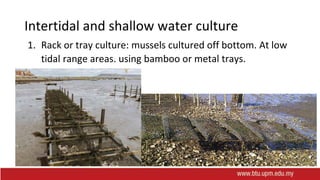
Intertidal and shallow water culture
1. Rack or tray culture: mussels cultured off bottom. At low
tidal range areas. using bamboo or metal trays.
Intertidal and shallow water culture
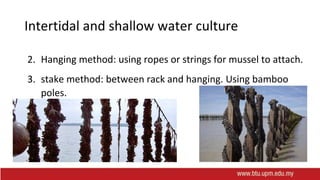
2. Hanging method: using ropes or strings for mussel to attach.
3. stake method: between rack and hanging. Using bamboo
poles.
Deep water culture
Long line or raft
Harvest
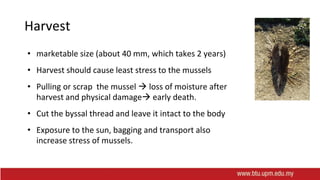
• marketable size (about 40 mm, which takes 2 years)
• Harvest should cause least stress to the mussels
• Pulling or scrap the mussel  loss of moisture after
harvest and physical damage early death.
• Cut the byssal thread and leave it intact to the body
• Exposure to the sun, bagging and transport also
increase stress of mussels.
Depurification
• Mussels are filter feeders
• Stomach filled with mud, sand, bacteria.
• Keep in clean, sterilized and filtered seawater for 2 days to
2 weeks depending on harvesting location.
• Ozone used for sterilization of water powerful oxidizing
agent to kill bacteria and virus.
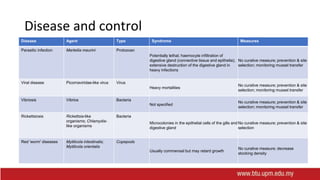
Disease and control
Disease Agent Type Syndrome Measures
Parasitic infection Marteilia maurini Protozoan
Potentially lethal; haemocyte infiltration of
digestive gland (connective tissue and epithelia);
extensive destruction of the digestive gland in
heavy infections
No curative measure; prevention & site
selection; monitoring mussel transfer
Viral disease Picornaviridae-like virus Virus
Heavy mortalities
No curative measure; prevention & site
selection; monitoring mussel transfer
Vibriosis Vibrios Bacteria
Not specified
No curative measure; prevention & site
selection; monitoring mussel transfer
Rickettsiosis Rickettsia-like
organisms; Chlamydia-
like organisms
Bacteria
Microcolonies in the epithelial cells of the gills and
digestive gland
No curative measure; prevention & site
selection
Red 'worm' diseases Mytilicola intestinalis;
Mytilicola orientalis
Copepods
Usually commensal but may retard growth
No curative measure; decrease
stocking density
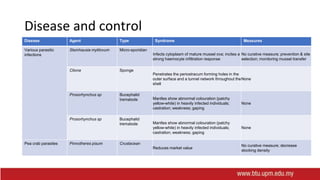
Disease and control
Disease Agent Type Syndrome Measures
Various parasitic
infections
Steinhausia mytilovum Micro-sporidian
Infects cytoplasm of mature mussel ova; incites a
strong haemocyte infiltration response
No curative measure; prevention & site
selection; monitoring mussel transfer
Cliona Sponge
Penetrates the periostracum forming holes in the
outer surface and a tunnel network throughout the
shell
None
Prosorhynchus sp Bucephalid
trematode Mantles show abnormal colouration (patchy
yellow-white) in heavily infected individuals;
castration; weakness; gaping
None
Prosorhynchus sp Bucephalid
trematode Mantles show abnormal colouration (patchy
yellow-white) in heavily infected individuals;
castration; weakness; gaping
None
Pea crab parasites Pinnotheres pisum Crustacean
Reduces market value
No curative measure; decrease
stocking density
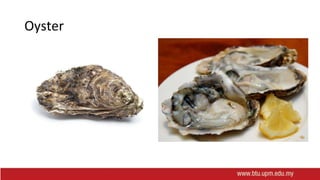
Oyster
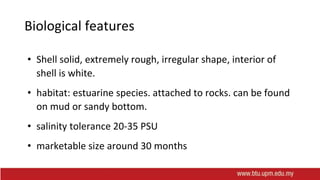
Biological features
• Shell solid, extremely rough, irregular shape, interior of
shell is white.
• habitat: estuarine species. attached to rocks. can be found
on mud or sandy bottom.
• salinity tolerance 20-35 PSU
• marketable size around 30 months
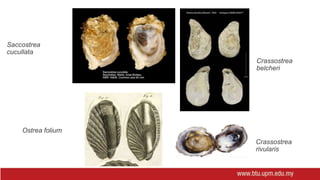
Crassostrea
belcheri
Crassostrea
rivularis
Saccostrea
cucullata
Ostrea folium
Seed supply
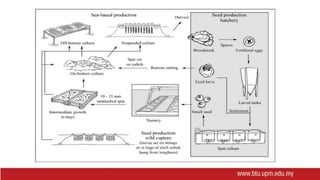
• normally from natural spat.
Hatchery
• Broodstock from commercial growout facility--> maintained at best possible condition
• group of adults are collected during natural spawning season.
• cultured in algae supplemented seawater. after 6 weeks in hatchery condition, induce
spawning by thermal shock
• larvae are grown in hatchery for 2-3 weeks using phytoplankton (Isochrysis
galbana or Pavlova lutherii, Chaetoceros calcitrans or Thalassiosira pseudonana,
Tetraselmis sp)
Nursery
• supplied with algae-rich water
• density can be 100kg/m3
• from 1 mm to 15 mm then transferred to grow-out
• Yields of 10- 15mm seeds for grow-out can reach 3 tonnes/ ha
Grow-out
• Entirely sea-based
• Method: bottom, off-bottom, suspended culture method (depending on
environment)
• Growth best at 25°C & 30 PSU.
• Depends greatly on natural phytoplankton availability
• Takes around 2 years to reach market size (with shell 100g)
• Extensive system with mixed growing phase will yield around 25
tonnes/ha/year
• Separated growth phase farm can yield up to 70 tonnes/ha/year
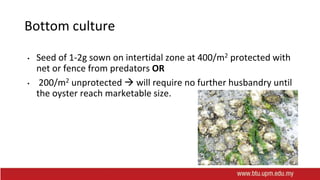
Bottom culture
• Seed of 1-2g sown on intertidal zone at 400/m2 protected with
net or fence from predators OR
• 200/m2 unprotected  will require no further husbandry until
the oyster reach marketable size.
Suspended culture
• Long lines & rafts
• Attached to strings, wires, ropes, nets, mesh bags, plastic trays and
suspended in the water vertically.
• Normally used in deeper waters.
• Need to check for fouling often, lines may sink due to fouling organisms
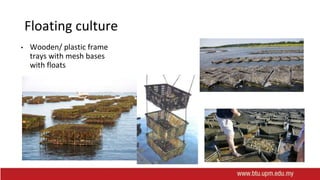
Floating culture
• Wooden/ plastic frame
trays with mesh bases
with floats
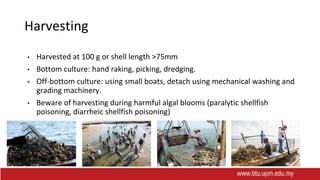
Harvesting
• Harvested at 100 g or shell length >75mm
• Bottom culture: hand raking, picking, dredging.
• Off-bottom culture: using small boats, detach using mechanical washing and
grading machinery.
• Beware of harvesting during harmful algal blooms (paralytic shellfish
poisoning, diarrheic shellfish poisoning)
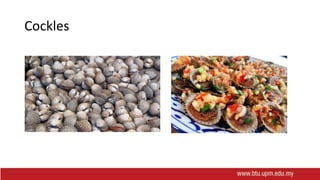
Cockles
Site selection
• Shallow bay, sheltered from strong wind and strong wave action
• Substrate: 6-10 inches depth mud flat with clay or silty clay substrate and
mangrove forest cover
• Water depth range around 1-2 meter (highest tide and lowest tide)
• Land elevation: gradient of 5-15 degree. If gradient too small, culture area
will be exposed during low tide and gradient too big cockles don’t grow well.
• Water movement: slow water current 0.1 m/sec
• Salinity: from 23 -30 PSU
Seed preparation
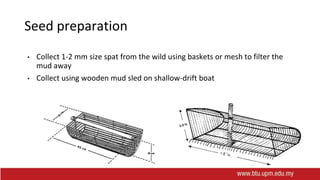
• Collect 1-2 mm size spat from the wild using baskets or mesh to filter the
mud away
• Collect using wooden mud sled on shallow-drift boat
Culture techniques
• Stocking density: for spat of 5000pcs/ kg 2000 pcs/m2
• As cockles grow, population will be thinned down
• Larger cockles will be removed and resown at 300 pcs/m2
• After 4 months cockles should reach 480pcs/kg
• Harvesting around 18 months after seeding or 50pcs/kg (4cm)
Challenges and issues
1. Seed shortages – over harvest of spat from the wild
2. Predation - birds
3. Water quality – pollution from industrial waste
4. Biotoxins – harmful algal bloom – Paralytic shellfish poisoning & diarrhetic
shellfish poisoning
FMA2001 L12 Molluscs.pptx

FMA2001 L12 Molluscs.pptx

  • 1.
    Principles of Aquaculture FMA2001(2+1) LU 12: Molluscs culture
  • 2.
    Learning Outcomes 1.Preparation andmanagement of mussels, cockles and oyster culturing
  • 3.
    Introduction • Molluscs areimportant phylum of invertebrate animals • They are mostly marine and near shallow waters • Major class: • Cephalopod  Squid, octopus, cuttlefish • Gastropods  snails, slugs, abalone • Bivalves  oyster, cockles, mussels
  • 4.
    Mussel • shells aresolid, inequilateral • External shell consist of two shells/ valves • Normally cultured species: • Perna viridis (green mussel) • Mytilus edulis (blue mussel) • Modiolus metcalfei (brown mussel)
  • 5.
    • Found atthe littoral zone / intertidal zone--> brackish to marine species. • Filter-feeder  plankton and detritus • Very short food chain (one link only) • Fast growth rate • Reach sexual maturity within 1 year and spawn with rising seawater temperature. • Two phase in life cycle planktonic or larval stage (2 weeks) & sessile adult stage.
  • 6.
  • 7.
    Preparation for culture Siteselection: • well protected/ sheltered bay protect from wind and waves • Presence of natural mussel spatfall • Not recommended: areas as catchment for excessive flood waters. Water level, salinity and temperature not consistent.
  • 8.
    Preparation for culture Waterquality • Rich in plankton (greenish colour); not too rich (harmful algal bloom) • Free from pollution (avoid industrial or domestic area) • Water depth 2 m • Temperature 27-30 °C • Salinity 27-35 ppt
  • 9.
    Natural seed collection •Seed depends on natural spat. • collect using polyethylene and palm-coconut fibre ropes. • Using ropes on rafts to collect seeds during peak spawning period. Can be collected at natural mussel bed during low tide. • Spat settled on ropes and grow to 30-40 mm • Transplant to fresh ropes to avoid crowding. • Rope 10m length and 70cm apart from other ropes. • 18-24 months to harvest
  • 10.
    Hatchery • produce consistentseed supply at an acceptable cost. • can produce polyploids, hybrids and selected strains. • hatchery use algal food and temperature shock for inducing spawning. • after spawning, larvae are fed ad libitum and allowed to grow until they are ready to set onto ropes (2 weeks) • mussels of 1 mm size are transferred to nursery to grow until they reach 10 mm size • then move outdoors into grow out system
  • 11.
    Culture method Mainly threetypes of culture method • Bottom culture (at the natural intertidal zone. Firm bottom) • Off bottom culture (at Inter-tidal and shallow water) • Deep water culture
  • 12.
    Intertidal and shallowwater culture 1. Rack or tray culture: mussels cultured off bottom. At low tidal range areas. using bamboo or metal trays.
  • 13.
    Intertidal and shallowwater culture 2. Hanging method: using ropes or strings for mussel to attach. 3. stake method: between rack and hanging. Using bamboo poles.
  • 14.
  • 16.
    Harvest • marketable size(about 40 mm, which takes 2 years) • Harvest should cause least stress to the mussels • Pulling or scrap the mussel  loss of moisture after harvest and physical damage early death. • Cut the byssal thread and leave it intact to the body • Exposure to the sun, bagging and transport also increase stress of mussels.
  • 17.
    Depurification • Mussels arefilter feeders • Stomach filled with mud, sand, bacteria. • Keep in clean, sterilized and filtered seawater for 2 days to 2 weeks depending on harvesting location. • Ozone used for sterilization of water powerful oxidizing agent to kill bacteria and virus.
  • 18.
    Disease and control DiseaseAgent Type Syndrome Measures Parasitic infection Marteilia maurini Protozoan Potentially lethal; haemocyte infiltration of digestive gland (connective tissue and epithelia); extensive destruction of the digestive gland in heavy infections No curative measure; prevention & site selection; monitoring mussel transfer Viral disease Picornaviridae-like virus Virus Heavy mortalities No curative measure; prevention & site selection; monitoring mussel transfer Vibriosis Vibrios Bacteria Not specified No curative measure; prevention & site selection; monitoring mussel transfer Rickettsiosis Rickettsia-like organisms; Chlamydia- like organisms Bacteria Microcolonies in the epithelial cells of the gills and digestive gland No curative measure; prevention & site selection Red 'worm' diseases Mytilicola intestinalis; Mytilicola orientalis Copepods Usually commensal but may retard growth No curative measure; decrease stocking density
  • 19.
    Disease and control DiseaseAgent Type Syndrome Measures Various parasitic infections Steinhausia mytilovum Micro-sporidian Infects cytoplasm of mature mussel ova; incites a strong haemocyte infiltration response No curative measure; prevention & site selection; monitoring mussel transfer Cliona Sponge Penetrates the periostracum forming holes in the outer surface and a tunnel network throughout the shell None Prosorhynchus sp Bucephalid trematode Mantles show abnormal colouration (patchy yellow-white) in heavily infected individuals; castration; weakness; gaping None Prosorhynchus sp Bucephalid trematode Mantles show abnormal colouration (patchy yellow-white) in heavily infected individuals; castration; weakness; gaping None Pea crab parasites Pinnotheres pisum Crustacean Reduces market value No curative measure; decrease stocking density
  • 20.
  • 21.
    Biological features • Shellsolid, extremely rough, irregular shape, interior of shell is white. • habitat: estuarine species. attached to rocks. can be found on mud or sandy bottom. • salinity tolerance 20-35 PSU • marketable size around 30 months
  • 23.
  • 25.
    Seed supply • normallyfrom natural spat. Hatchery • Broodstock from commercial growout facility--> maintained at best possible condition • group of adults are collected during natural spawning season. • cultured in algae supplemented seawater. after 6 weeks in hatchery condition, induce spawning by thermal shock • larvae are grown in hatchery for 2-3 weeks using phytoplankton (Isochrysis galbana or Pavlova lutherii, Chaetoceros calcitrans or Thalassiosira pseudonana, Tetraselmis sp)
  • 26.
    Nursery • supplied withalgae-rich water • density can be 100kg/m3 • from 1 mm to 15 mm then transferred to grow-out • Yields of 10- 15mm seeds for grow-out can reach 3 tonnes/ ha
  • 27.
    Grow-out • Entirely sea-based •Method: bottom, off-bottom, suspended culture method (depending on environment) • Growth best at 25°C & 30 PSU. • Depends greatly on natural phytoplankton availability • Takes around 2 years to reach market size (with shell 100g) • Extensive system with mixed growing phase will yield around 25 tonnes/ha/year • Separated growth phase farm can yield up to 70 tonnes/ha/year
  • 28.
    Bottom culture • Seedof 1-2g sown on intertidal zone at 400/m2 protected with net or fence from predators OR • 200/m2 unprotected  will require no further husbandry until the oyster reach marketable size.
  • 29.
    Suspended culture • Longlines & rafts • Attached to strings, wires, ropes, nets, mesh bags, plastic trays and suspended in the water vertically. • Normally used in deeper waters. • Need to check for fouling often, lines may sink due to fouling organisms
  • 30.
    Floating culture • Wooden/plastic frame trays with mesh bases with floats
  • 31.
    Harvesting • Harvested at100 g or shell length >75mm • Bottom culture: hand raking, picking, dredging. • Off-bottom culture: using small boats, detach using mechanical washing and grading machinery. • Beware of harvesting during harmful algal blooms (paralytic shellfish poisoning, diarrheic shellfish poisoning)
  • 32.
  • 33.
    Site selection • Shallowbay, sheltered from strong wind and strong wave action • Substrate: 6-10 inches depth mud flat with clay or silty clay substrate and mangrove forest cover • Water depth range around 1-2 meter (highest tide and lowest tide) • Land elevation: gradient of 5-15 degree. If gradient too small, culture area will be exposed during low tide and gradient too big cockles don’t grow well. • Water movement: slow water current 0.1 m/sec • Salinity: from 23 -30 PSU
  • 34.
    Seed preparation • Collect1-2 mm size spat from the wild using baskets or mesh to filter the mud away • Collect using wooden mud sled on shallow-drift boat
  • 35.
    Culture techniques • Stockingdensity: for spat of 5000pcs/ kg 2000 pcs/m2 • As cockles grow, population will be thinned down • Larger cockles will be removed and resown at 300 pcs/m2 • After 4 months cockles should reach 480pcs/kg • Harvesting around 18 months after seeding or 50pcs/kg (4cm)
  • 36.
    Challenges and issues 1.Seed shortages – over harvest of spat from the wild 2. Predation - birds 3. Water quality – pollution from industrial waste 4. Biotoxins – harmful algal bloom – Paralytic shellfish poisoning & diarrhetic shellfish poisoning