A seminar on
Reactive oxygen species and anti-oxidants
Presented by-
Sritam Padhan
P.G.-- 4th Semester
P.G.—21—ZOO--016
panchayat college , bargarh
Contents-
Introduction
Sources of ROS
Functions of ROS
Role of anti-oxidants
Conclusion
References
Introduction:
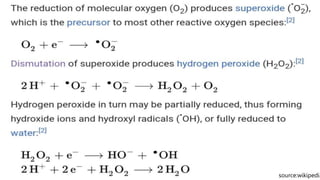
-Reactive oxygen species are highly reactive molecules formed from diatomic
oxygen(O₂)
-These are free radicals containing oxygen and are highly unstable in nature.
-at certain amount these are beneficial to the body( signaling , immune
reaction, homeostasis etc.)but after a minimum level they can cause harmful
effects(apoptosis,heart attacks,nucleic acid damage etc.)
-ROS has both +ve and –ve roles depending upon the balance between ROS
production and disposal at right time and place.
-antioxidant system(certain enzymes and vitamins) plays an important role in
the disposal of these ROS in the cells.
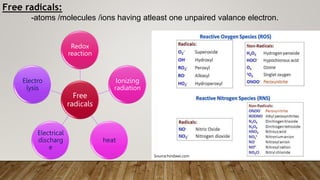
Free
radicals
Redox
reaction
Ionizing
radiation
heat
Electrical
discharg
e
Electro
lysis
Free radicals:
-atoms /molecules /ions having atleast one unpaired valance electron.
Source:hindawi.com
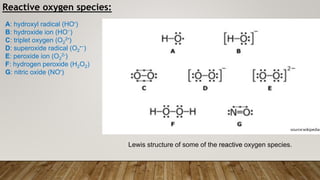
Reactive oxygen species:
A: hydroxyl radical (HO•)
B: hydroxide ion (HO−)
C: triplet oxygen (O2
2•)
D: superoxide radical (O2
•−)
E: peroxide ion (O2
2-)
F: hydrogen peroxide (H2O2)
G: nitric oxide (NO•)
Lewis structure of some of the reactive oxygen species.
source:wikipedia
source:wikipedi
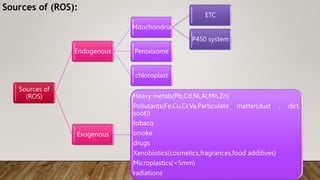
Sources of (ROS):
Sources of
(ROS)
Endogenous
Mitochondria
ETC
P450 system
Peroxisome
chloroplast
Exogenous
Heavy metals(Pb,Cd,Ni,Al,Mn,Zn)
Pollutants(Fe,Cu,Cr,Va,Particulate matter(dust , dirt,
soot))
tobaco
smoke
drugs
Xenobiotics(cosmetics,fragrances,food additives)
Microplastics(<5mm)
radiations
Endogenous sources
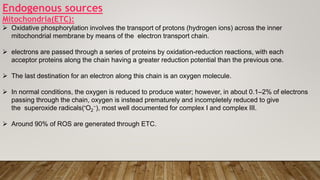
Mitochondria(ETC):
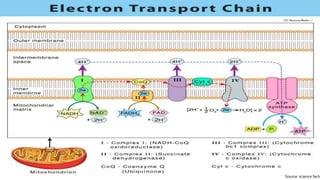
 Oxidative phosphorylation involves the transport of protons (hydrogen ions) across the inner
mitochondrial membrane by means of the electron transport chain.
 electrons are passed through a series of proteins by oxidation-reduction reactions, with each
acceptor proteins along the chain having a greater reduction potential than the previous one.
 The last destination for an electron along this chain is an oxygen molecule.
 In normal conditions, the oxygen is reduced to produce water; however, in about 0.1–2% of electrons
passing through the chain, oxygen is instead prematurely and incompletely reduced to give
the superoxide radicals(•O2
−), most well documented for complex I and complex III.
 Around 90% of ROS are generated through ETC.
Source: science facts
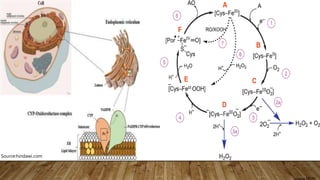
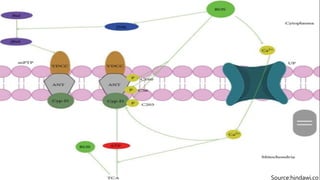
• Another source of ROS production in animal cells is the electron transfer reactions catalyzed by
the mitochondrial P450 systems in steroidogenic tissues(adrenal gland,testis,ovary).
• The term "P450" is derived from the spectrophotometric peak at the wavelength of the absorption
maximum of the enzyme (450 nm) when it is in the reduced state and complexed with carbon
monoxide.
• located either in the inner membrane of mitochondria or in the endoplasmic reticulum of cells.
• Cytochromes P450 (CYPs) are a superfamily of enzymes containing heme(iron) as
a cofactor that function as monooxygenases.
• These P450 systems are dependent on the transfer of electrons from NADPH to P450.
• During this process, some electrons "leak" and react with O2 producing superoxide.
• However to cope with this natural source of ROS, the steroidogenic tissues have a large
concentration of antioxidants such as vitamin C (ascorbate) and β-carotene and anti-oxidant
enzymes.
Mitochondrial P450 system:
Source:hindawi.com
ROS in peroxisome:
source:wikipedi
a
Immune cells NOX pathway:
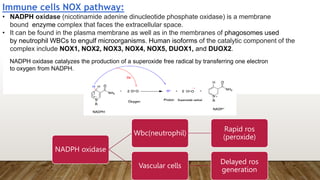
• NADPH oxidase (nicotinamide adenine dinucleotide phosphate oxidase) is a membrane
bound enzyme complex that faces the extracellular space.
• It can be found in the plasma membrane as well as in the membranes of phagosomes used
by neutrophil WBCs to engulf microorganisms. Human isoforms of the catalytic component of the
complex include NOX1, NOX2, NOX3, NOX4, NOX5, DUOX1, and DUOX2.
NADPH oxidase catalyzes the production of a superoxide free radical by transferring one electron
to oxygen from NADPH.
NADPH oxidase
Wbc(neutrophil)
Rapid ros
(peroxide)
Vascular cells
Delayed ros
generation
Exogenous sources:
ROS stimulated by-
1. Heavy metals 5.Drugs
2. Pollutants 6.Xenobiotics
3. Tobaco 7.Microplastics
4. Smoke 8.Radiations.
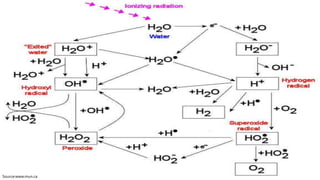
• Ionizing radiation can generate damaging intermediates through the interaction with water, a process
termed radiolysis.(55–60% of the human body is water)
• The hydroxyl radical is extremely reactive and immediately removes electrons from any molecule in its
path, turning that molecule into a free radical and thus propagating a chain reaction.
• However, hydrogen peroxide is actually more damaging to DNA than the hydroxyl radical, since the
lower reactivity of hydrogen peroxide provides enough time for the molecule to travel into the nucleus of
the cell, subsequently reacting with macromolecules such as DNA.
water e-
hydroxyl
radical (•OH)
hydrogen
peroxide (H₂O₂)
superoxide
radical (•O−
2)
oxygen (O2)
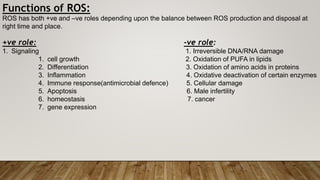
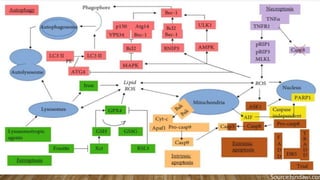
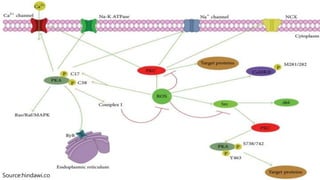
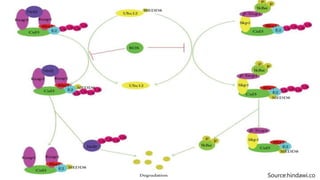
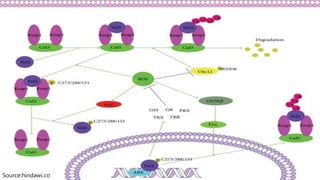
Functions of ROS:
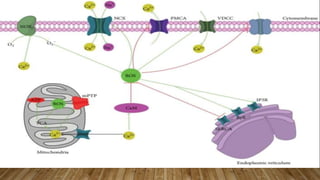
ROS has both +ve and –ve roles depending upon the balance between ROS production and disposal at
right time and place.
+ve role: -ve role:
1. Signaling 1. Irreversible DNA/RNA damage
1. cell growth 2. Oxidation of PUFA in lipids
2. Differentiation 3. Oxidation of amino acids in proteins
3. Inflammation 4. Oxidative deactivation of certain enzymes
4. Immune response(antimicrobial defence) 5. Cellular damage
5. Apoptosis 6. Male infertility
6. homeostasis 7. cancer
7. gene expression
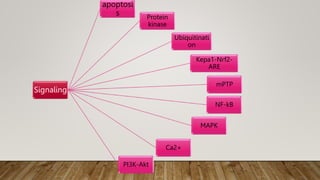
Signaling
apoptosi
s Protein
kinase
Ubiquitinati
on
Kepa1-Nrf2-
ARE
mPTP
NF-kB
MAPK
Ca2+
PI3K-Akt
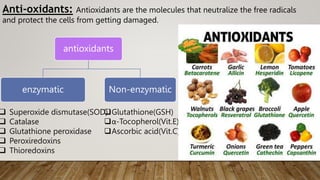
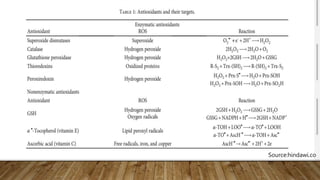
Anti-oxidants: Antioxidants are the molecules that neutralize the free radicals
and protect the cells from getting damaged.
antioxidants
enzymatic Non-enzymatic
 Superoxide dismutase(SOD)
 Catalase
 Glutathione peroxidase
 Peroxiredoxins
 Thioredoxins
Glutathione(GSH)
α-Tocopherol(Vit.E)
Ascorbic acid(Vit.C)
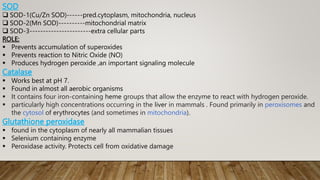
SOD
 SOD-1(Cu/Zn SOD)------pred.cytoplasm, mitochondria, nucleus
 SOD-2(Mn SOD)----------mitochondrial matrix
 SOD-3-----------------------extra cellular parts
ROLE:
 Prevents accumulation of superoxides
 Prevents reaction to Nitric Oxide (NO)
 Produces hydrogen peroxide ,an important signaling molecule
Catalase
 Works best at pH 7.
 Found in almost all aerobic organisms
 It contains four iron-containing heme groups that allow the enzyme to react with hydrogen peroxide.
 particularly high concentrations occurring in the liver in mammals . Found primarily in peroxisomes and
the cytosol of erythrocytes (and sometimes in mitochondria).
Glutathione peroxidase
 found in the cytoplasm of nearly all mammalian tissues
 Selenium containing enzyme
 Peroxidase activity. Protects cell from oxidative damage
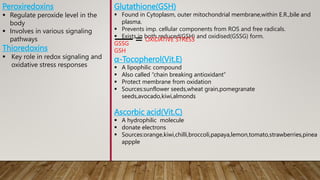
Glutathione(GSH)
 Found in Cytoplasm, outer mitochondrial membrane,within E.R.,bile and
plasma.
 Prevents imp. cellular components from ROS and free radicals.
 Exists in both reduced(GSH) and oxidised(GSSG) form.
GSSG
GSH
α-Tocopherol(Vit.E)
 A lipophilic compound
 Also called “chain breaking antioxidant”
 Protect membrane from oxidation
 Sources:sunflower seeds,wheat grain,pomegranate
seeds,avocado,kiwi,almonds
Ascorbic acid(Vit.C)
 A hydrophilic molecule
 donate electrons
 Sources:orange,kiwi,chilli,broccoli,papaya,lemon,tomato,strawberries,pinea
appple
Peroxiredoxins
 Regulate peroxide level in the
body
 Involves in various signaling
pathways
Thioredoxins
 Key role in redox signaling and
oxidative stress responses
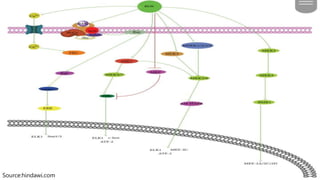
OXIDATIVE STRESS
Source:hindawi.co
m
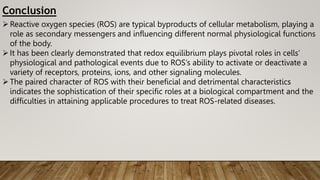
Conclusion
Reactive oxygen species (ROS) are typical byproducts of cellular metabolism, playing a
role as secondary messengers and influencing different normal physiological functions
of the body.
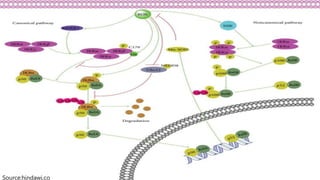
It has been clearly demonstrated that redox equilibrium plays pivotal roles in cells’
physiological and pathological events due to ROS’s ability to activate or deactivate a
variety of receptors, proteins, ions, and other signaling molecules.
The paired character of ROS with their beneficial and detrimental characteristics
indicates the sophistication of their specific roles at a biological compartment and the
difficulties in attaining applicable procedures to treat ROS-related diseases.
References:
• Hindawi Oxidative Medicine and Cellular Longevity Volume 2021, Article ID 9912436, 17 pages
https://doi.org/10.1155/2021/9912436
• Hindawi Publishing Corporation Oxidative Medicine and Cellular Longevity Volume 2016, Article ID
4350965, 18 pages http://dx.doi.org/10.1155/2016/4350965
• Bardaweel SK, Gul M, Alzweiri M, Ishaqat A, AlSalamat HA, Bashatwah RM. Reactive Oxygen Species: the
Dual Role in Physiological and Pathological Conditions of the Human Body. Eurasian J Med 2018; 50(3):
193- 201.
• Plant Cell Physiol. 57(7): 1364–1376 (2016) doi:10.1093/pcp/pcw076, Advance Access publication on 14
April 2016,
• www.pcp.oxfordjournals.org
• www.hindawi.com
• www.wikipedia.org
Source:hindawi.com
Source:hindawi.co
Source:hindawi.co
Source:hindawi.co
Source:hindawi.co
Source:hindawi.co
Source:hindawi.com
Source:www.mun.ca
ros [].pptx

ros [].pptx

  • 1.
    A seminar on Reactiveoxygen species and anti-oxidants Presented by- Sritam Padhan P.G.-- 4th Semester P.G.—21—ZOO--016 panchayat college , bargarh
  • 2.
    Contents- Introduction Sources of ROS Functionsof ROS Role of anti-oxidants Conclusion References
  • 3.
    Introduction: -Reactive oxygen speciesare highly reactive molecules formed from diatomic oxygen(O₂) -These are free radicals containing oxygen and are highly unstable in nature. -at certain amount these are beneficial to the body( signaling , immune reaction, homeostasis etc.)but after a minimum level they can cause harmful effects(apoptosis,heart attacks,nucleic acid damage etc.) -ROS has both +ve and –ve roles depending upon the balance between ROS production and disposal at right time and place. -antioxidant system(certain enzymes and vitamins) plays an important role in the disposal of these ROS in the cells.
  • 4.
  • 5.
    Reactive oxygen species: A:hydroxyl radical (HO•) B: hydroxide ion (HO−) C: triplet oxygen (O2 2•) D: superoxide radical (O2 •−) E: peroxide ion (O2 2-) F: hydrogen peroxide (H2O2) G: nitric oxide (NO•) Lewis structure of some of the reactive oxygen species. source:wikipedia
  • 6.
  • 7.
    Sources of (ROS): Sourcesof (ROS) Endogenous Mitochondria ETC P450 system Peroxisome chloroplast Exogenous Heavy metals(Pb,Cd,Ni,Al,Mn,Zn) Pollutants(Fe,Cu,Cr,Va,Particulate matter(dust , dirt, soot)) tobaco smoke drugs Xenobiotics(cosmetics,fragrances,food additives) Microplastics(<5mm) radiations
  • 8.
    Endogenous sources Mitochondria(ETC):  Oxidativephosphorylation involves the transport of protons (hydrogen ions) across the inner mitochondrial membrane by means of the electron transport chain.  electrons are passed through a series of proteins by oxidation-reduction reactions, with each acceptor proteins along the chain having a greater reduction potential than the previous one.  The last destination for an electron along this chain is an oxygen molecule.  In normal conditions, the oxygen is reduced to produce water; however, in about 0.1–2% of electrons passing through the chain, oxygen is instead prematurely and incompletely reduced to give the superoxide radicals(•O2 −), most well documented for complex I and complex III.  Around 90% of ROS are generated through ETC.
  • 9.
  • 10.
    • Another sourceof ROS production in animal cells is the electron transfer reactions catalyzed by the mitochondrial P450 systems in steroidogenic tissues(adrenal gland,testis,ovary). • The term "P450" is derived from the spectrophotometric peak at the wavelength of the absorption maximum of the enzyme (450 nm) when it is in the reduced state and complexed with carbon monoxide. • located either in the inner membrane of mitochondria or in the endoplasmic reticulum of cells. • Cytochromes P450 (CYPs) are a superfamily of enzymes containing heme(iron) as a cofactor that function as monooxygenases. • These P450 systems are dependent on the transfer of electrons from NADPH to P450. • During this process, some electrons "leak" and react with O2 producing superoxide. • However to cope with this natural source of ROS, the steroidogenic tissues have a large concentration of antioxidants such as vitamin C (ascorbate) and β-carotene and anti-oxidant enzymes. Mitochondrial P450 system:
  • 11.
  • 12.
  • 13.
    Immune cells NOXpathway: • NADPH oxidase (nicotinamide adenine dinucleotide phosphate oxidase) is a membrane bound enzyme complex that faces the extracellular space. • It can be found in the plasma membrane as well as in the membranes of phagosomes used by neutrophil WBCs to engulf microorganisms. Human isoforms of the catalytic component of the complex include NOX1, NOX2, NOX3, NOX4, NOX5, DUOX1, and DUOX2. NADPH oxidase catalyzes the production of a superoxide free radical by transferring one electron to oxygen from NADPH. NADPH oxidase Wbc(neutrophil) Rapid ros (peroxide) Vascular cells Delayed ros generation
  • 14.
    Exogenous sources: ROS stimulatedby- 1. Heavy metals 5.Drugs 2. Pollutants 6.Xenobiotics 3. Tobaco 7.Microplastics 4. Smoke 8.Radiations. • Ionizing radiation can generate damaging intermediates through the interaction with water, a process termed radiolysis.(55–60% of the human body is water) • The hydroxyl radical is extremely reactive and immediately removes electrons from any molecule in its path, turning that molecule into a free radical and thus propagating a chain reaction. • However, hydrogen peroxide is actually more damaging to DNA than the hydroxyl radical, since the lower reactivity of hydrogen peroxide provides enough time for the molecule to travel into the nucleus of the cell, subsequently reacting with macromolecules such as DNA. water e- hydroxyl radical (•OH) hydrogen peroxide (H₂O₂) superoxide radical (•O− 2) oxygen (O2)
  • 15.
    Functions of ROS: ROShas both +ve and –ve roles depending upon the balance between ROS production and disposal at right time and place. +ve role: -ve role: 1. Signaling 1. Irreversible DNA/RNA damage 1. cell growth 2. Oxidation of PUFA in lipids 2. Differentiation 3. Oxidation of amino acids in proteins 3. Inflammation 4. Oxidative deactivation of certain enzymes 4. Immune response(antimicrobial defence) 5. Cellular damage 5. Apoptosis 6. Male infertility 6. homeostasis 7. cancer 7. gene expression
  • 16.
  • 17.
    Anti-oxidants: Antioxidants arethe molecules that neutralize the free radicals and protect the cells from getting damaged. antioxidants enzymatic Non-enzymatic  Superoxide dismutase(SOD)  Catalase  Glutathione peroxidase  Peroxiredoxins  Thioredoxins Glutathione(GSH) α-Tocopherol(Vit.E) Ascorbic acid(Vit.C)
  • 18.
    SOD  SOD-1(Cu/Zn SOD)------pred.cytoplasm,mitochondria, nucleus  SOD-2(Mn SOD)----------mitochondrial matrix  SOD-3-----------------------extra cellular parts ROLE:  Prevents accumulation of superoxides  Prevents reaction to Nitric Oxide (NO)  Produces hydrogen peroxide ,an important signaling molecule Catalase  Works best at pH 7.  Found in almost all aerobic organisms  It contains four iron-containing heme groups that allow the enzyme to react with hydrogen peroxide.  particularly high concentrations occurring in the liver in mammals . Found primarily in peroxisomes and the cytosol of erythrocytes (and sometimes in mitochondria). Glutathione peroxidase  found in the cytoplasm of nearly all mammalian tissues  Selenium containing enzyme  Peroxidase activity. Protects cell from oxidative damage
  • 19.
    Glutathione(GSH)  Found inCytoplasm, outer mitochondrial membrane,within E.R.,bile and plasma.  Prevents imp. cellular components from ROS and free radicals.  Exists in both reduced(GSH) and oxidised(GSSG) form. GSSG GSH α-Tocopherol(Vit.E)  A lipophilic compound  Also called “chain breaking antioxidant”  Protect membrane from oxidation  Sources:sunflower seeds,wheat grain,pomegranate seeds,avocado,kiwi,almonds Ascorbic acid(Vit.C)  A hydrophilic molecule  donate electrons  Sources:orange,kiwi,chilli,broccoli,papaya,lemon,tomato,strawberries,pinea appple Peroxiredoxins  Regulate peroxide level in the body  Involves in various signaling pathways Thioredoxins  Key role in redox signaling and oxidative stress responses OXIDATIVE STRESS
  • 20.
  • 21.
    Conclusion Reactive oxygen species(ROS) are typical byproducts of cellular metabolism, playing a role as secondary messengers and influencing different normal physiological functions of the body. It has been clearly demonstrated that redox equilibrium plays pivotal roles in cells’ physiological and pathological events due to ROS’s ability to activate or deactivate a variety of receptors, proteins, ions, and other signaling molecules. The paired character of ROS with their beneficial and detrimental characteristics indicates the sophistication of their specific roles at a biological compartment and the difficulties in attaining applicable procedures to treat ROS-related diseases.
  • 22.
    References: • Hindawi OxidativeMedicine and Cellular Longevity Volume 2021, Article ID 9912436, 17 pages https://doi.org/10.1155/2021/9912436 • Hindawi Publishing Corporation Oxidative Medicine and Cellular Longevity Volume 2016, Article ID 4350965, 18 pages http://dx.doi.org/10.1155/2016/4350965 • Bardaweel SK, Gul M, Alzweiri M, Ishaqat A, AlSalamat HA, Bashatwah RM. Reactive Oxygen Species: the Dual Role in Physiological and Pathological Conditions of the Human Body. Eurasian J Med 2018; 50(3): 193- 201. • Plant Cell Physiol. 57(7): 1364–1376 (2016) doi:10.1093/pcp/pcw076, Advance Access publication on 14 April 2016, • www.pcp.oxfordjournals.org • www.hindawi.com • www.wikipedia.org
  • 25.
  • 26.
  • 27.
  • 28.
  • 29.
  • 30.
  • 31.
  • 33.