2
TABLE OF CONTENTS
INTRODUCTION
EVOLU TIO N O F
R O O T BIO M O D IFIER S
C LIN IC A L EV ID E N C E
A N D EFF IC A C Y
A PP LIC ATIO N IN
GE N ER A L D EN T ISTRY
3.
3
IN TR OD U C TI O N
TIM ELIN E H IS TO RY
O F R O O T BIO M O D IF IER S
C LA SS IF IC ATIO N
M E C H A N IS M O F AC T IO N
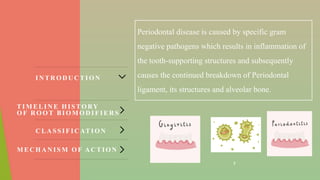
Periodontal disease is caused by specific gram
negative pathogens which results in inflammation of
the tooth-supporting structures and subsequently
causes the continued breakdown of Periodontal
ligament, its structures and alveolar bone.
4.
4
Goals of PeriodontalTherapy:
•Prevent disease progression.
•Restore structural and functional integrity of the
periodontium.
•Achieve new attachment and regeneration of tissues
.
Challenges in conventional approach:
Smear layers that inhibit cell attachment
IN TR O D U C TI O N
C LA SS IF IC ATIO N
M E C H A N IS M O F AC T IO N
TIM ELIN E H IS TO RY
O F R O O T BIO M O D IF IER S
5.
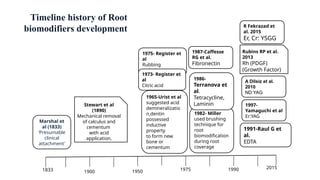
1833 1900 19501975 1990 2015
Stewart et al
(1890)
Mechanical removal
of calculus and
cementum
with acid
application.
1965-Urist et al
suggested acid
demineralizatio
n,dentin
possessed
inductive
property
to form new
bone or
cementum
1975- Register et
al
Rubbing
technique
1982- Miller
used brushing
technique for
root
biomodification
during root
coverage
1986-
Terranova et
al.
Tetracycline,
Laminin
1987-Caffesse
RG et al.
Fibronectin
Rubins RP et al.
2013
Rh (PDGF)
(Growth Factor)
1991-Raul G et
al.
EDTA
Marshal et
al (1833)
‘Presumable
clinical
attachment’
Timeline history of Root
biomodifiers development
1973- Register et
al
Citric acid
1997-
Yamaguchi et al
Er:YAG
R Fekrazad et
al. 2015
Er, Cr: YSGG
A Dilsiz et al.
2010
ND:YAG
6.
6
IN TR OD U C TI O N
C LA SS IF IC ATIO N
M E C H A N IS M O F AC T IO N
EVO LU T IO N O F R O O T
BIO M O D IE R S
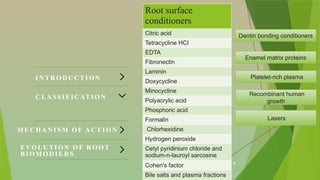
Root surface
conditioners
Citric acid
Tetracycline HCI
EDTA
Fibronectin
Laminin
Doxycycline
Minocycline
Polyacrylic acid
Phosphoric acid
Formalin
Chlorhexidine
Hydrogen peroxide
Cetyl pyridinium chloride and
sodium-n-lauroyl sarcosine
Cohen's factor
Bile salts and plasma fractions
Dentin bonding conditioners
Enamel matrix proteins
Platelet-rich plasma
Recombinant human
growth
Lasers
7.
2 0 22
7
IN TR O D U C TI O N
C LA SS IF IC ATIO N
M EC H A N ISM O F
A C T IO N
EVOLU TIO N O F R O O T
BIO M O D IFIE R S
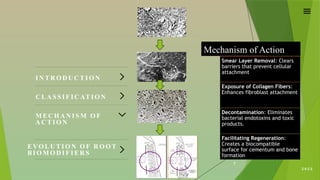
Mechanism of Action
Smear Layer Removal: Clears
barriers that prevent cellular
attachment
Exposure of Collagen Fibers:
Enhances fibroblast attachment
Decontamination: Eliminates
bacterial endotoxins and toxic
products.
Facilitating Regeneration:
Creates a biocompatible
surface for cementum and bone
formation
8.
2020
2015
2010
2005
2000
1990
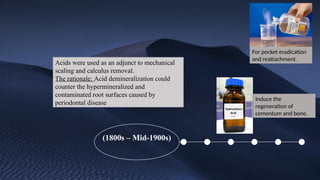
(1800s – Mid-1900s)
Acidswere used as an adjunct to mechanical
scaling and calculus removal.
The rationale: Acid demineralization could
counter the hypermineralized and
contaminated root surfaces caused by
periodontal disease
For pocket eradication
and reattachment.
Induce the
regeneration of
cementum and bone.
9.
2020
2015
2010
2005
2000
1970-1990
1980
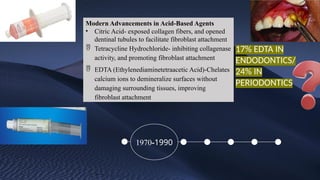
Modern Advancements inAcid-Based Agents
• Citric Acid- exposed collagen fibers, and opened
dentinal tubules to facilitate fibroblast attachment
Tetracycline Hydrochloride- inhibiting collagenase
activity, and promoting fibroblast attachment
EDTA (Ethylenediaminetetraacetic Acid)-Chelates
calcium ions to demineralize surfaces without
damaging surrounding tissues, improving
fibroblast attachment
17% EDTA IN
ENDODONTICS/
24% IN
PERIODONTICS
10.
2020
2015
2010
2005
1990-2000
1990
1980
Shift to BiologicalAgents (1990s – 2000s)
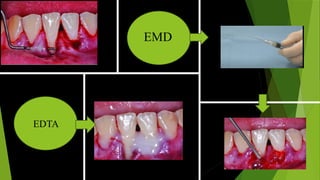
Enamel Matrix Derivatives (EMD)
Inspired by natural tooth development, EMD (e.g., Emdogain) became a
revolutionary biomodifier.Inspired by natural tooth development, EMD
(e.g., Emdogain) became a revolutionary biomodifier.
Application: Mimics enamel proteins to stimulate cementum and
periodontal ligament regeneration.
Growth Factors
Growth factors such as platelet-derived growth factor (PDGF) and bone
morphogenetic proteins (BMPs) were introduced.
Function: Stimulate fibroblast proliferation, angiogenesis, and bone
formation.
11.
2020
2015
2010
2000 – PRESENT
2000
1990
1980
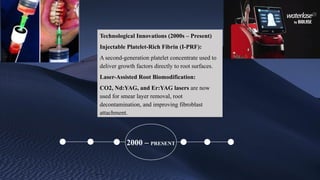
TechnologicalInnovations (2000s – Present)
Injectable Platelet-Rich Fibrin (I-PRF):
A second-generation platelet concentrate used to
deliver growth factors directly to root surfaces.
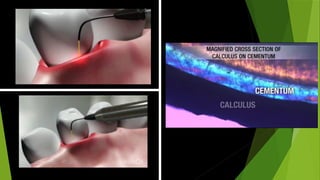
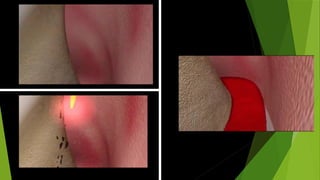
Laser-Assisted Root Biomodification:
CO2, Nd:YAG, and Er:YAG lasers are now
used for smear layer removal, root
decontamination, and improving fibroblast
attachment.
12.
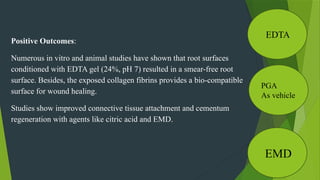
Positive Outcomes:
Numerous invitro and animal studies have shown that root surfaces
conditioned with EDTA gel (24%, pH 7) resulted in a smear-free root
surface. Besides, the exposed collagen fibrins provides a bio-compatible
surface for wound healing.
Studies show improved connective tissue attachment and cementum
regeneration with agents like citric acid and EMD.
EMD
PGA
As vehicle
EDTA
18
Enhanced Periodontal Procedures:
oRoot biomodification as an adjunct to scaling and root planing.
o Better outcomes in flap surgeries and guided tissue regeneration.
Improved Patient Outcomes:
o Faster healing, reduced post-surgical complications, and better
long-term prognosis.
19.
19
Periodontally diseasedroot surfaces hinder regeneration due to
unfavorable characteristics.
Demineralization improves cell and fiber attachment, aiding
wound healing. Proper root conditioning enhances protein
adsorption, clot adhesion, and collagen deposition.
While lasers and root canal irrigants show promise, more
randomized clinical trials are needed to confirm their efficacy in
regeneration.
Conclusion