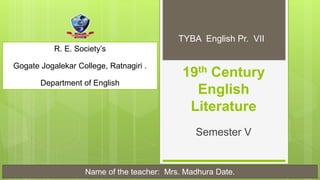
19th Century
English
Literature
Semester V
TYBA English Pr. VII
Name of the teacher: Mrs. Madhura Date.
R. E. Society’s
Gogate Jogalekar College, Ratnagiri .
Department of English
The Romantic Revival
 Unit 1:
 A] Background
 Romanticism as a reaction to Neo-classicism
 Influence of Rousseau and French Revolution
 Survey of Literature : Novel, poetry and prose (types
, trends and characteristics)
 Rise of women writers in the period.
The Romantic Revival
(1798 – 1832)
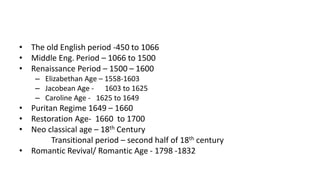
• The old English period -450 to 1066
• Middle Eng. Period – 1066 to 1500
• Renaissance Period – 1500 – 1600
– Elizabethan Age – 1558-1603
– Jacobean Age - 1603 to 1625
– Caroline Age - 1625 to 1649
• Puritan Regime 1649 – 1660
• Restoration Age- 1660 to 1700
• Neo classical age – 18th Century
Transitional period – second half of 18th century
• Romantic Revival/ Romantic Age - 1798 -1832
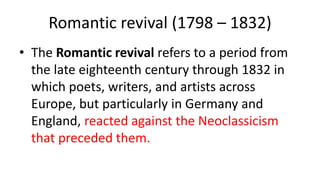
Romantic revival (1798 – 1832)
• The Romantic revival refers to a period from
the late eighteenth century through 1832 in
which poets, writers, and artists across
Europe, but particularly in Germany and
England, reacted against the Neoclassicism
that preceded them.
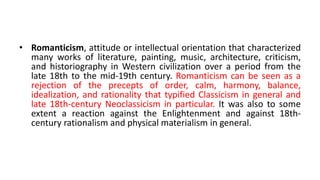
• Romanticism, attitude or intellectual orientation that characterized
many works of literature, painting, music, architecture, criticism,
and historiography in Western civilization over a period from the
late 18th to the mid-19th century. Romanticism can be seen as a
rejection of the precepts of order, calm, harmony, balance,
idealization, and rationality that typified Classicism in general and
late 18th-century Neoclassicism in particular. It was also to some
extent a reaction against the Enlightenment and against 18th-
century rationalism and physical materialism in general.
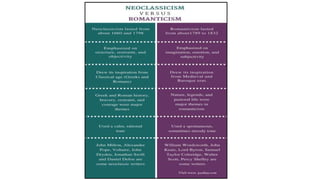
Characteristics of neoclassicism/ neoclassical literature in particular
• reason
• logic
• rationality
• reason and intellect to be emphasized instead of imagination and
emotions
• Elegance to be followed in literature ---- different diction, no common
subject matters
• Strict adherence to the rules and models of classical writing
• Social conventions and rules were strictly followed and free spirit or
individuality was thus subordinated
• Romanticism emphasized the individual, the
subjective, the irrational, the imaginative, the
personal, the spontaneous, the emotional, the
visionary, and the transcendental.
• ‘Romanticism is liberalism in literature’ -Victor
Hugo
• Romanticism is simply the expression of life as
seen by imagination, rather than by prosaic
‘common sense’ which was the central
doctrine of English philosophy in the 18th
Century.
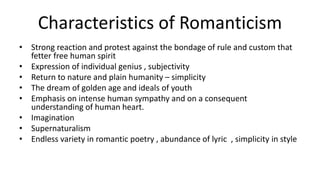
Characteristics of Romanticism
• Strong reaction and protest against the bondage of rule and custom that
fetter free human spirit
• Expression of individual genius , subjectivity
• Return to nature and plain humanity – simplicity
• The dream of golden age and ideals of youth
• Emphasis on intense human sympathy and on a consequent
understanding of human heart.
• Imagination
• Supernaturalism
• Endless variety in romantic poetry , abundance of lyric , simplicity in style
• https://www.britannica.com/art/Romanticism
• https://www.englishliterature.info/2021/04/romantic-revival-in-
literature.html
• https://www.youtube.com/watch?v=8Lw-pTh4DR8
• http://www.differencebetween.net/miscellaneous/politics/ideolog
y-politics/difference-between-enlightenment-and-romanticism/
• https://sites.google.com/site/nmeictproject/collections/3-1-1-the-
romantic-revival
• http://www.gwcollegenagbhid.ac.in/uploaded_files/B.A%20Sem%2
01%20ELT%20Romantic%20Movement.pdf

Romatic revival movement intro.pptx

  • 1.
    19th Century English Literature Semester V TYBAEnglish Pr. VII Name of the teacher: Mrs. Madhura Date. R. E. Society’s Gogate Jogalekar College, Ratnagiri . Department of English
  • 2.
    The Romantic Revival Unit 1:  A] Background  Romanticism as a reaction to Neo-classicism  Influence of Rousseau and French Revolution  Survey of Literature : Novel, poetry and prose (types , trends and characteristics)  Rise of women writers in the period.
  • 3.
  • 4.
    • The oldEnglish period -450 to 1066 • Middle Eng. Period – 1066 to 1500 • Renaissance Period – 1500 – 1600 – Elizabethan Age – 1558-1603 – Jacobean Age - 1603 to 1625 – Caroline Age - 1625 to 1649 • Puritan Regime 1649 – 1660 • Restoration Age- 1660 to 1700 • Neo classical age – 18th Century Transitional period – second half of 18th century • Romantic Revival/ Romantic Age - 1798 -1832
  • 5.
    Romantic revival (1798– 1832) • The Romantic revival refers to a period from the late eighteenth century through 1832 in which poets, writers, and artists across Europe, but particularly in Germany and England, reacted against the Neoclassicism that preceded them.
  • 6.
    • Romanticism, attitudeor intellectual orientation that characterized many works of literature, painting, music, architecture, criticism, and historiography in Western civilization over a period from the late 18th to the mid-19th century. Romanticism can be seen as a rejection of the precepts of order, calm, harmony, balance, idealization, and rationality that typified Classicism in general and late 18th-century Neoclassicism in particular. It was also to some extent a reaction against the Enlightenment and against 18th- century rationalism and physical materialism in general.
  • 7.
    Characteristics of neoclassicism/neoclassical literature in particular • reason • logic • rationality • reason and intellect to be emphasized instead of imagination and emotions • Elegance to be followed in literature ---- different diction, no common subject matters • Strict adherence to the rules and models of classical writing • Social conventions and rules were strictly followed and free spirit or individuality was thus subordinated
  • 9.
    • Romanticism emphasizedthe individual, the subjective, the irrational, the imaginative, the personal, the spontaneous, the emotional, the visionary, and the transcendental.
  • 10.
    • ‘Romanticism isliberalism in literature’ -Victor Hugo • Romanticism is simply the expression of life as seen by imagination, rather than by prosaic ‘common sense’ which was the central doctrine of English philosophy in the 18th Century.
  • 11.
    Characteristics of Romanticism •Strong reaction and protest against the bondage of rule and custom that fetter free human spirit • Expression of individual genius , subjectivity • Return to nature and plain humanity – simplicity • The dream of golden age and ideals of youth • Emphasis on intense human sympathy and on a consequent understanding of human heart. • Imagination • Supernaturalism • Endless variety in romantic poetry , abundance of lyric , simplicity in style
  • 12.
    • https://www.britannica.com/art/Romanticism • https://www.englishliterature.info/2021/04/romantic-revival-in- literature.html •https://www.youtube.com/watch?v=8Lw-pTh4DR8 • http://www.differencebetween.net/miscellaneous/politics/ideolog y-politics/difference-between-enlightenment-and-romanticism/ • https://sites.google.com/site/nmeictproject/collections/3-1-1-the- romantic-revival • http://www.gwcollegenagbhid.ac.in/uploaded_files/B.A%20Sem%2 01%20ELT%20Romantic%20Movement.pdf