The Art Production of
Neoclassical and
Romantic Periods
Neoclassicism and Romanticism were the
movements that spread in Western Europe and the
United States during the Rococo era, lasting
roughly from the late 18th to the 19th centuries.
NEOCLASSICISM, 1780 - 1840
In decorative and visual arts, the Western trend
that became popular from 1780 to 1840 was called
Neoclassicism. It also refers to literature, theater,
music and architecture which were inspired by
Ancient Greece and Rome's classical art and
culture. This is also known as the Age of
Enlightenment. The revived interest in Greek and
Roman classics has brought on the art form in
this time period
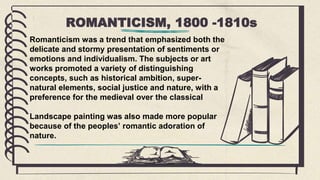
ROMANTICISM, 1800 -1810s
Romanticism was a trend that emphasized both the
delicate and stormy presentation of sentiments or
emotions and individualism. The subjects or art
works promoted a variety of distinguishing
concepts, such as historical ambition, super-
natural elements, social justice and nature, with a
preference for the medieval over the classical
Landscape painting was also made more popular
because of the peoples’ romantic adoration of
nature.
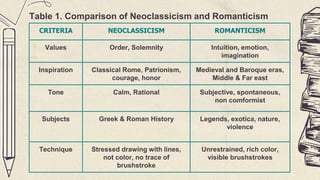
Table 1. Comparison of Neoclassicism and Romanticism
CRITERIA NEOCLASSICISM ROMANTICISM
Values Order, Solemnity Intuition, emotion,
imagination
Inspiration Classical Rome, Patrionism,
courage, honor
Medieval and Baroque eras,
Middle & Far east
Tone Calm, Rational Subjective, spontaneous,
non comformist
Subjects Greek & Roman History Legends, exotica, nature,
violence
Technique Stressed drawing with lines,
not color, no trace of
brushstroke
Unrestrained, rich color,
visible brushstrokes
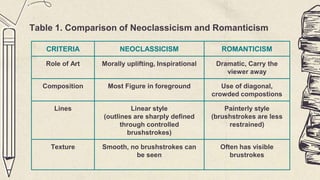
Table 1. Comparison of Neoclassicism and Romanticism
CRITERIA NEOCLASSICISM ROMANTICISM
Role of Art Morally uplifting, Inspirational Dramatic, Carry the
viewer away
Composition Most Figure in foreground Use of diagonal,
crowded compostions
Lines Linear style
(outlines are sharply defined
through controlled
brushstrokes)
Painterly style
(brushstrokes are less
restrained)
Texture Smooth, no brushstrokes can
be seen
Often has visible
brustrokes
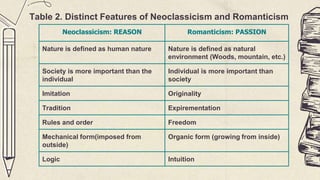
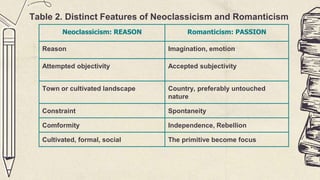
Table 2. Distinct Features of Neoclassicism and Romanticism
Neoclassicism: REASON Romanticism: PASSION
Nature is defined as human nature Nature is defined as natural
environment (Woods, mountain, etc.)
Society is more important than the
individual
Individual is more important than
society
Imitation Originality
Tradition Expirementation
Rules and order Freedom
Mechanical form(imposed from
outside)
Organic form (growing from inside)
Logic Intuition
Table 2. Distinct Features of Neoclassicism and Romanticism
Neoclassicism: REASON Romanticism: PASSION
Reason Imagination, emotion
Attempted objectivity Accepted subjectivity
Town or cultivated landscape Country, preferably untouched
nature
Constraint Spontaneity
Comformity Independence, Rebellion
Cultivated, formal, social The primitive become focus
Artist from Neoclassical
and Romantic Periods
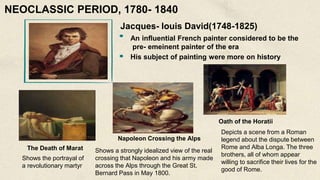
Jacques- louis David(1748-1825)
An influential French painter considered to be the
pre- emeinent painter of the era
His subject of painting were more on history
The Death of Marat
Shows the portrayal of
a revolutionary martyr
Napoleon Crossing the Alps
Shows a strongly idealized view of the real
crossing that Napoleon and his army made
across the Alps through the Great St.
Bernard Pass in May 1800.
Oath of the Horatii
Depicts a scene from a Roman
legend about the dispute between
Rome and Alba Longa. The three
brothers, all of whom appear
willing to sacrifice their lives for the
good of Rome.
NEOCLASSIC PERIOD, 1780- 1840
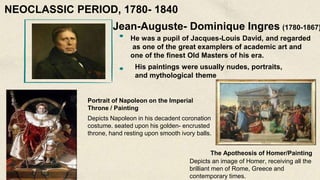
Jean-Auguste- Dominique Ingres (1780-1867)
He was a pupil of Jacques-Louis David, and regarded
as one of the great examplers of academic art and
one of the finest Old Masters of his era.
His paintings were usually nudes, portraits,
and mythological theme
Portrait of Napoleon on the Imperial
Throne / Painting
Depicts an image of Homer, receiving all the
brilliant men of Rome, Greece and
contemporary times.
The Apotheosis of Homer/Painting
Depicts Napoleon in his decadent coronation
costume. seated upon his golden- encrusted
throne, hand resting upon smooth ivory balls.
NEOCLASSIC PERIOD, 1780- 1840
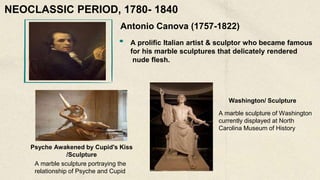
Antonio Canova (1757-1822)
A prolific Italian artist & sculptor who became famous
for his marble sculptures that delicately rendered
nude flesh.
Psyche Awakened by Cupid's Kiss
/Sculpture
A marble sculpture portraying the
relationship of Psyche and Cupid
Washington/ Sculpture
A marble sculpture of Washington
currently displayed at North
Carolina Museum of History
NEOCLASSIC PERIOD, 1780- 1840
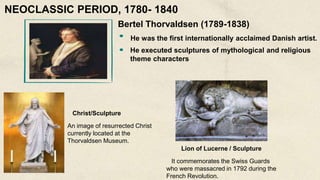
Bertel Thorvaldsen (1789-1838)
He was the first internationally acclaimed Danish artist.
He executed sculptures of mythological and religious
theme characters
Christ/Sculpture
An image of resurrected Christ
currently located at the
Thorvaldsen Museum.
Lion of Lucerne / Sculpture
It commemorates the Swiss Guards
who were massacred in 1792 during the
French Revolution.
NEOCLASSIC PERIOD, 1780- 1840
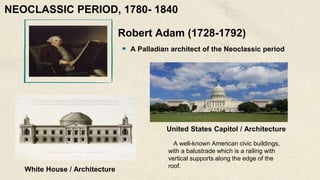
Robert Adam (1728-1792)
A Palladian architect of the Neoclassic period
White House / Architecture
United States Capitol / Architecture
A well-known American civic buildings,
with a balustrade which is a railing with
vertical supports along the edge of the
roof.
NEOCLASSIC PERIOD, 1780- 1840
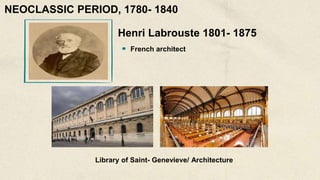
Henri Labrouste 1801- 1875
French architect
Library of Saint- Genevieve/ Architecture
NEOCLASSIC PERIOD, 1780- 1840
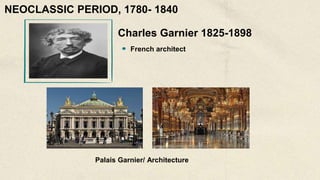
Charles Garnier 1825-1898
French architect
Palais Garnier/ Architecture
NEOCLASSIC PERIOD, 1780- 1840
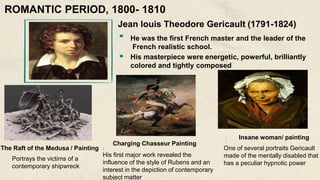
Jean louis Theodore Gericault (1791-1824)
He was the first French master and the leader of the
French realistic school.
His masterpiece were energetic, powerful, brilliantly
colored and tightly composed
The Raft of the Medusa / Painting
Portrays the victims of a
contemporary shipwreck
Charging Chasseur Painting
.
His first major work revealed the
influence of the style of Rubens and an
interest in the depiction of contemporary
subject matter
Insane woman/ painting
One of several portraits Gericault
made of the mentally disabled that
has a peculiar hypnotic power
ROMANTIC PERIOD, 1800- 1810
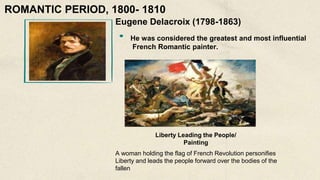
Eugene Delacroix (1798-1863)
He was considered the greatest and most influential
French Romantic painter.
A woman holding the flag of French Revolution personifies
Liberty and leads the people forward over the bodies of the
fallen
Liberty Leading the People/
Painting
ROMANTIC PERIOD, 1800- 1810
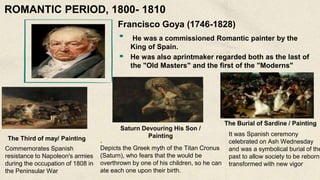
Francisco Goya (1746-1828)
He was a commissioned Romantic painter by the
King of Spain.
He was also aprintmaker regarded both as the last of
the "Old Masters" and the first of the "Moderns"
The Third of may/ Painting
Commemorates Spanish
resistance to Napoleon's armies
during the occupation of 1808 in
the Peninsular War
Saturn Devouring His Son /
Painting
.
Depicts the Greek myth of the Titan Cronus
(Saturn), who fears that the would be
overthrown by one of his children, so he can
ate each one upon their birth.
The Burial of Sardine / Painting
It was Spanish ceremony
celebrated on Ash Wednesday
and was a symbolical burial of the
past to allow society to be reborn,
transformed with new vigor
ROMANTIC PERIOD, 1800- 1810
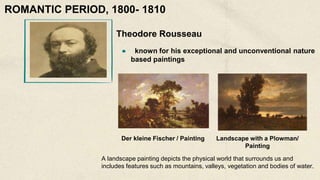
Theodore Rousseau
known for his exceptional and unconventional nature
based paintings
Der kleine Fischer / Painting Landscape with a Plowman/
Painting
A landscape painting depicts the physical world that surrounds us and
includes features such as mountains, valleys, vegetation and bodies of water.
ROMANTIC PERIOD, 1800- 1810
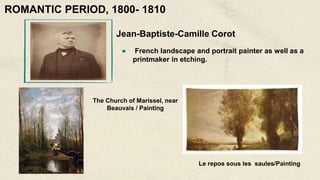
Jean-Baptiste-Camille Corot
French landscape and portrait painter as well as a
printmaker in etching.
The Church of Marissel, near
Beauvais / Painting
Le repos sous les saules/Painting
ROMANTIC PERIOD, 1800- 1810
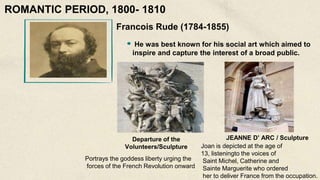
Francois Rude (1784-1855)
He was best known for his social art which aimed to
inspire and capture the interest of a broad public.
Departure of the Volunteers/
Sculpture
Departure of the
Volunteers/Sculpture
Portrays the goddess liberty urging the
forces of the French Revolution onward
ROMANTIC PERIOD, 1800- 1810
JEANNE D’ ARC / Sculpture
Joan is depicted at the age of
13, listeningto the voices of
Saint Michel, Catherine and
Sainte Marguerite who ordered
her to deliver France from the occupation.
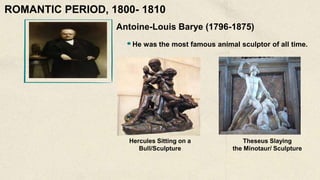
Antoine-Louis Barye (1796-1875)
He was the most famous animal sculptor of all time.
Hercules Sitting on a
Bull/Sculpture
ROMANTIC PERIOD, 1800- 1810
Theseus Slaying
the Minotaur/ Sculpture
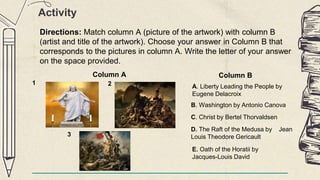
Activity
Directions: Match column A (picture of the artwork) with column B
(artist and title of the artwork). Choose your answer in Column B that
corresponds to the pictures in column A. Write the letter of your answer
on the space provided.
3
1 2
Column A Column B
A. Liberty Leading the People by
Eugene Delacroix
B. Washington by Antonio Canova
C. Christ by Bertel Thorvaldsen
D. The Raft of the Medusa by Jean
Louis Theodore Gericault
E. Oath of the Horatii by
Jacques-Louis David
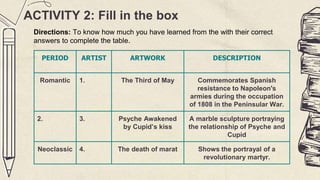
ACTIVITY 2: Fill in the box
PERIOD ARTIST ARTWORK DESCRIPTION
Romantic 1. The Third of May Commemorates Spanish
resistance to Napoleon's
armies during the occupation
of 1808 in the Peninsular War.
2. 3. Psyche Awakened
by Cupid’s kiss
A marble sculpture portraying
the relationship of Psyche and
Cupid
Neoclassic 4. The death of marat Shows the portrayal of a
revolutionary martyr.
Directions: To know how much you have learned from the with their correct
answers to complete the table.
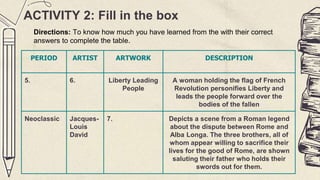
ACTIVITY 2: Fill in the box
PERIOD ARTIST ARTWORK DESCRIPTION
5. 6. Liberty Leading
People
A woman holding the flag of French
Revolution personifies Liberty and
leads the people forward over the
bodies of the fallen
Neoclassic Jacques-
Louis
David
7. Depicts a scene from a Roman legend
about the dispute between Rome and
Alba Longa. The three brothers, all of
whom appear willing to sacrifice their
lives for the good of Rome, are shown
saluting their father who holds their
swords out for them.
Directions: To know how much you have learned from the with their correct
answers to complete the table.
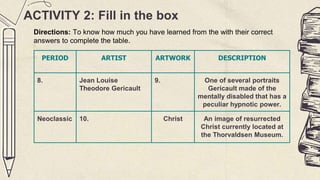
ACTIVITY 2: Fill in the box
PERIOD ARTIST ARTWORK DESCRIPTION
8. Jean Louise
Theodore Gericault
9. One of several portraits
Gericault made of the
mentally disabled that has a
peculiar hypnotic power.
Neoclassic 10. Christ An image of resurrected
Christ currently located at
the Thorvaldsen Museum.
Directions: To know how much you have learned from the with their correct
answers to complete the table.
Thanks!

NeoclassicalRomanticismGRADE9.pptx

  • 1.
    The Art Productionof Neoclassical and Romantic Periods
  • 2.
    Neoclassicism and Romanticismwere the movements that spread in Western Europe and the United States during the Rococo era, lasting roughly from the late 18th to the 19th centuries.
  • 3.
    NEOCLASSICISM, 1780 -1840 In decorative and visual arts, the Western trend that became popular from 1780 to 1840 was called Neoclassicism. It also refers to literature, theater, music and architecture which were inspired by Ancient Greece and Rome's classical art and culture. This is also known as the Age of Enlightenment. The revived interest in Greek and Roman classics has brought on the art form in this time period
  • 4.
    ROMANTICISM, 1800 -1810s Romanticismwas a trend that emphasized both the delicate and stormy presentation of sentiments or emotions and individualism. The subjects or art works promoted a variety of distinguishing concepts, such as historical ambition, super- natural elements, social justice and nature, with a preference for the medieval over the classical Landscape painting was also made more popular because of the peoples’ romantic adoration of nature.
  • 5.
    Table 1. Comparisonof Neoclassicism and Romanticism CRITERIA NEOCLASSICISM ROMANTICISM Values Order, Solemnity Intuition, emotion, imagination Inspiration Classical Rome, Patrionism, courage, honor Medieval and Baroque eras, Middle & Far east Tone Calm, Rational Subjective, spontaneous, non comformist Subjects Greek & Roman History Legends, exotica, nature, violence Technique Stressed drawing with lines, not color, no trace of brushstroke Unrestrained, rich color, visible brushstrokes
  • 6.
    Table 1. Comparisonof Neoclassicism and Romanticism CRITERIA NEOCLASSICISM ROMANTICISM Role of Art Morally uplifting, Inspirational Dramatic, Carry the viewer away Composition Most Figure in foreground Use of diagonal, crowded compostions Lines Linear style (outlines are sharply defined through controlled brushstrokes) Painterly style (brushstrokes are less restrained) Texture Smooth, no brushstrokes can be seen Often has visible brustrokes
  • 7.
    Table 2. DistinctFeatures of Neoclassicism and Romanticism Neoclassicism: REASON Romanticism: PASSION Nature is defined as human nature Nature is defined as natural environment (Woods, mountain, etc.) Society is more important than the individual Individual is more important than society Imitation Originality Tradition Expirementation Rules and order Freedom Mechanical form(imposed from outside) Organic form (growing from inside) Logic Intuition
  • 8.
    Table 2. DistinctFeatures of Neoclassicism and Romanticism Neoclassicism: REASON Romanticism: PASSION Reason Imagination, emotion Attempted objectivity Accepted subjectivity Town or cultivated landscape Country, preferably untouched nature Constraint Spontaneity Comformity Independence, Rebellion Cultivated, formal, social The primitive become focus
  • 9.
  • 10.
    Jacques- louis David(1748-1825) Aninfluential French painter considered to be the pre- emeinent painter of the era His subject of painting were more on history The Death of Marat Shows the portrayal of a revolutionary martyr Napoleon Crossing the Alps Shows a strongly idealized view of the real crossing that Napoleon and his army made across the Alps through the Great St. Bernard Pass in May 1800. Oath of the Horatii Depicts a scene from a Roman legend about the dispute between Rome and Alba Longa. The three brothers, all of whom appear willing to sacrifice their lives for the good of Rome. NEOCLASSIC PERIOD, 1780- 1840
  • 11.
    Jean-Auguste- Dominique Ingres(1780-1867) He was a pupil of Jacques-Louis David, and regarded as one of the great examplers of academic art and one of the finest Old Masters of his era. His paintings were usually nudes, portraits, and mythological theme Portrait of Napoleon on the Imperial Throne / Painting Depicts an image of Homer, receiving all the brilliant men of Rome, Greece and contemporary times. The Apotheosis of Homer/Painting Depicts Napoleon in his decadent coronation costume. seated upon his golden- encrusted throne, hand resting upon smooth ivory balls. NEOCLASSIC PERIOD, 1780- 1840
  • 12.
    Antonio Canova (1757-1822) Aprolific Italian artist & sculptor who became famous for his marble sculptures that delicately rendered nude flesh. Psyche Awakened by Cupid's Kiss /Sculpture A marble sculpture portraying the relationship of Psyche and Cupid Washington/ Sculpture A marble sculpture of Washington currently displayed at North Carolina Museum of History NEOCLASSIC PERIOD, 1780- 1840
  • 13.
    Bertel Thorvaldsen (1789-1838) Hewas the first internationally acclaimed Danish artist. He executed sculptures of mythological and religious theme characters Christ/Sculpture An image of resurrected Christ currently located at the Thorvaldsen Museum. Lion of Lucerne / Sculpture It commemorates the Swiss Guards who were massacred in 1792 during the French Revolution. NEOCLASSIC PERIOD, 1780- 1840
  • 14.
    Robert Adam (1728-1792) APalladian architect of the Neoclassic period White House / Architecture United States Capitol / Architecture A well-known American civic buildings, with a balustrade which is a railing with vertical supports along the edge of the roof. NEOCLASSIC PERIOD, 1780- 1840
  • 15.
    Henri Labrouste 1801-1875 French architect Library of Saint- Genevieve/ Architecture NEOCLASSIC PERIOD, 1780- 1840
  • 16.
    Charles Garnier 1825-1898 Frencharchitect Palais Garnier/ Architecture NEOCLASSIC PERIOD, 1780- 1840
  • 17.
    Jean louis TheodoreGericault (1791-1824) He was the first French master and the leader of the French realistic school. His masterpiece were energetic, powerful, brilliantly colored and tightly composed The Raft of the Medusa / Painting Portrays the victims of a contemporary shipwreck Charging Chasseur Painting . His first major work revealed the influence of the style of Rubens and an interest in the depiction of contemporary subject matter Insane woman/ painting One of several portraits Gericault made of the mentally disabled that has a peculiar hypnotic power ROMANTIC PERIOD, 1800- 1810
  • 18.
    Eugene Delacroix (1798-1863) Hewas considered the greatest and most influential French Romantic painter. A woman holding the flag of French Revolution personifies Liberty and leads the people forward over the bodies of the fallen Liberty Leading the People/ Painting ROMANTIC PERIOD, 1800- 1810
  • 19.
    Francisco Goya (1746-1828) Hewas a commissioned Romantic painter by the King of Spain. He was also aprintmaker regarded both as the last of the "Old Masters" and the first of the "Moderns" The Third of may/ Painting Commemorates Spanish resistance to Napoleon's armies during the occupation of 1808 in the Peninsular War Saturn Devouring His Son / Painting . Depicts the Greek myth of the Titan Cronus (Saturn), who fears that the would be overthrown by one of his children, so he can ate each one upon their birth. The Burial of Sardine / Painting It was Spanish ceremony celebrated on Ash Wednesday and was a symbolical burial of the past to allow society to be reborn, transformed with new vigor ROMANTIC PERIOD, 1800- 1810
  • 20.
    Theodore Rousseau known forhis exceptional and unconventional nature based paintings Der kleine Fischer / Painting Landscape with a Plowman/ Painting A landscape painting depicts the physical world that surrounds us and includes features such as mountains, valleys, vegetation and bodies of water. ROMANTIC PERIOD, 1800- 1810
  • 21.
    Jean-Baptiste-Camille Corot French landscapeand portrait painter as well as a printmaker in etching. The Church of Marissel, near Beauvais / Painting Le repos sous les saules/Painting ROMANTIC PERIOD, 1800- 1810
  • 22.
    Francois Rude (1784-1855) Hewas best known for his social art which aimed to inspire and capture the interest of a broad public. Departure of the Volunteers/ Sculpture Departure of the Volunteers/Sculpture Portrays the goddess liberty urging the forces of the French Revolution onward ROMANTIC PERIOD, 1800- 1810 JEANNE D’ ARC / Sculpture Joan is depicted at the age of 13, listeningto the voices of Saint Michel, Catherine and Sainte Marguerite who ordered her to deliver France from the occupation.
  • 23.
    Antoine-Louis Barye (1796-1875) Hewas the most famous animal sculptor of all time. Hercules Sitting on a Bull/Sculpture ROMANTIC PERIOD, 1800- 1810 Theseus Slaying the Minotaur/ Sculpture
  • 24.
    Activity Directions: Match columnA (picture of the artwork) with column B (artist and title of the artwork). Choose your answer in Column B that corresponds to the pictures in column A. Write the letter of your answer on the space provided. 3 1 2 Column A Column B A. Liberty Leading the People by Eugene Delacroix B. Washington by Antonio Canova C. Christ by Bertel Thorvaldsen D. The Raft of the Medusa by Jean Louis Theodore Gericault E. Oath of the Horatii by Jacques-Louis David
  • 25.
    ACTIVITY 2: Fillin the box PERIOD ARTIST ARTWORK DESCRIPTION Romantic 1. The Third of May Commemorates Spanish resistance to Napoleon's armies during the occupation of 1808 in the Peninsular War. 2. 3. Psyche Awakened by Cupid’s kiss A marble sculpture portraying the relationship of Psyche and Cupid Neoclassic 4. The death of marat Shows the portrayal of a revolutionary martyr. Directions: To know how much you have learned from the with their correct answers to complete the table.
  • 26.
    ACTIVITY 2: Fillin the box PERIOD ARTIST ARTWORK DESCRIPTION 5. 6. Liberty Leading People A woman holding the flag of French Revolution personifies Liberty and leads the people forward over the bodies of the fallen Neoclassic Jacques- Louis David 7. Depicts a scene from a Roman legend about the dispute between Rome and Alba Longa. The three brothers, all of whom appear willing to sacrifice their lives for the good of Rome, are shown saluting their father who holds their swords out for them. Directions: To know how much you have learned from the with their correct answers to complete the table.
  • 27.
    ACTIVITY 2: Fillin the box PERIOD ARTIST ARTWORK DESCRIPTION 8. Jean Louise Theodore Gericault 9. One of several portraits Gericault made of the mentally disabled that has a peculiar hypnotic power. Neoclassic 10. Christ An image of resurrected Christ currently located at the Thorvaldsen Museum. Directions: To know how much you have learned from the with their correct answers to complete the table.
  • 28.