Romans and their Numerals Marie Rodriguez-Wine Maria Barfield Gina Bruno Kalli Firestine
History Roman numerals, as the name suggests, originated in ancient Rome. No one is sure when roman numerals were first used, but they came before the middle ages.  It was used as the standard counting method until 900 AD when the Arabic system was introduced by the Hindu’s. This numbering system is commonly believed to have started with the ancient Etruscans.  The symbol for one (I) in the roman numeral system represents a single tally mark they would notch into wood or dirt to keep track of items. Not the letter I There is no symbol for “Zero” because it was not introduced until 1000 AD the Roman’s used the word nulla.
Roman Money The Uncia formed the basis of the early Roman currency, as Rome gradually emerged from a bartering economy. It was the twelfth of a Roman pound of bronze, hence it was a 'Roman ounce'. The smaller denominations of coins only played a part in the early part of the empire and later became obsolete with inflation. Under Augustus the base metal coinage appeared to change from bronze to brass. Other coinages existed at various times, but these appear as the major Roman coins.
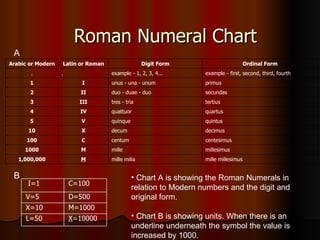
Roman Numeral Chart Chart A is showing the Roman Numerals in relation to Modern numbers and the digit and original form. Chart B is showing units. When there is an underline underneath the symbol the value is increased by 1000. A B mille millesimus mille milia M 1,000,000 millesimus mille M 1000 centesimus centum C 100 decimus decum X 10 quintus quinque V 5 quartus quattuor IV 4 tertius tres - tria III 3 secundas duo - duae - duo II 2 primus unus - una - unum I 1 example - first, second, third, fourth example - 1, 2, 3, 4... . . Ordinal Form Digit Form Latin or Roman Arabic or Modern X =10000 L=50 M=1000 X=10 D=500 V=5 C=100 I=1
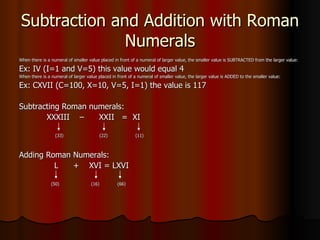
Subtraction and Addition with Roman Numerals When there is a numeral of smaller value placed in front of a numeral of larger value, the smaller value is SUBTRACTED from the larger value:  Ex: IV (I=1 and V=5) this value would equal 4 When there is a numeral of larger value placed in front of a numeral of smaller value, the larger value is ADDED to the smaller value: Ex: CXVII (C=100, X=10, V=5, I=1) the value is 117 Subtracting Roman numerals: XXXIII  –  XXII  =  XI (33)  (22)  (11) Adding Roman Numerals: L  +  XVI = LXVI (50)  (16)  (66)
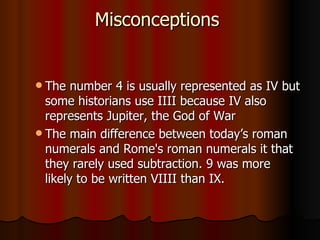
Misconceptions  The number 4 is usually represented as IV but some historians use IIII because IV also represents Jupiter, the God of War  The main difference between today’s roman numerals and Rome's roman numerals it that they rarely used subtraction. 9 was more likely to be written VIIII than IX.
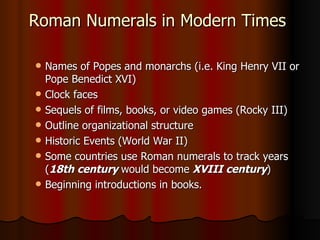
Roman Numerals in Modern Times  Names of Popes and monarchs (i.e. King Henry VII or Pope Benedict XVI)  Clock faces  Sequels of films, books, or video games (Rocky III)  Outline organizational structure  Historic Events (World War II)  Some countries use Roman numerals to track years ( 18th century  would become  XVIII century )  Beginning introductions in books.
References http://en.wikipedia.org/wiki/Roman_numerals http://www.legionxxiv.org/numerals/ Bassarear,Tom.  Mathematics for elementary school teachers . Houghton Mifflin company. Boston New York. 2008. pg 105.

Romans And Their Numerals

  • 1.
    Romans and theirNumerals Marie Rodriguez-Wine Maria Barfield Gina Bruno Kalli Firestine
  • 2.
    History Roman numerals,as the name suggests, originated in ancient Rome. No one is sure when roman numerals were first used, but they came before the middle ages. It was used as the standard counting method until 900 AD when the Arabic system was introduced by the Hindu’s. This numbering system is commonly believed to have started with the ancient Etruscans. The symbol for one (I) in the roman numeral system represents a single tally mark they would notch into wood or dirt to keep track of items. Not the letter I There is no symbol for “Zero” because it was not introduced until 1000 AD the Roman’s used the word nulla.
  • 3.
    Roman Money TheUncia formed the basis of the early Roman currency, as Rome gradually emerged from a bartering economy. It was the twelfth of a Roman pound of bronze, hence it was a 'Roman ounce'. The smaller denominations of coins only played a part in the early part of the empire and later became obsolete with inflation. Under Augustus the base metal coinage appeared to change from bronze to brass. Other coinages existed at various times, but these appear as the major Roman coins.
  • 4.
    Roman Numeral ChartChart A is showing the Roman Numerals in relation to Modern numbers and the digit and original form. Chart B is showing units. When there is an underline underneath the symbol the value is increased by 1000. A B mille millesimus mille milia M 1,000,000 millesimus mille M 1000 centesimus centum C 100 decimus decum X 10 quintus quinque V 5 quartus quattuor IV 4 tertius tres - tria III 3 secundas duo - duae - duo II 2 primus unus - una - unum I 1 example - first, second, third, fourth example - 1, 2, 3, 4... . . Ordinal Form Digit Form Latin or Roman Arabic or Modern X =10000 L=50 M=1000 X=10 D=500 V=5 C=100 I=1
  • 5.
    Subtraction and Additionwith Roman Numerals When there is a numeral of smaller value placed in front of a numeral of larger value, the smaller value is SUBTRACTED from the larger value: Ex: IV (I=1 and V=5) this value would equal 4 When there is a numeral of larger value placed in front of a numeral of smaller value, the larger value is ADDED to the smaller value: Ex: CXVII (C=100, X=10, V=5, I=1) the value is 117 Subtracting Roman numerals: XXXIII – XXII = XI (33) (22) (11) Adding Roman Numerals: L + XVI = LXVI (50) (16) (66)
  • 6.
    Misconceptions  The number4 is usually represented as IV but some historians use IIII because IV also represents Jupiter, the God of War The main difference between today’s roman numerals and Rome's roman numerals it that they rarely used subtraction. 9 was more likely to be written VIIII than IX.
  • 7.
    Roman Numerals inModern Times  Names of Popes and monarchs (i.e. King Henry VII or Pope Benedict XVI) Clock faces Sequels of films, books, or video games (Rocky III) Outline organizational structure Historic Events (World War II) Some countries use Roman numerals to track years ( 18th century would become XVIII century ) Beginning introductions in books.
  • 8.
    References http://en.wikipedia.org/wiki/Roman_numerals http://www.legionxxiv.org/numerals/Bassarear,Tom. Mathematics for elementary school teachers . Houghton Mifflin company. Boston New York. 2008. pg 105.