Roman
Numerals
Roman Numerals - Past and
Present
 Romans used them for trading and
commerce.
 When Romans learned to write they
needed a way to write their numbers.
 Roman Numerals are still used today in
many different ways.
Roman vs. Arabic Numerals
Arabic Numerals are the numbers that
we use today.
 1, 2, 3, 4, 5, 6, 7, 8, 9, 0
Roman Numerals are used today, but not
in everyday writing.
 I, V, X, L, C, D, M
Roman Numerals don’t have a symbol for
zero.
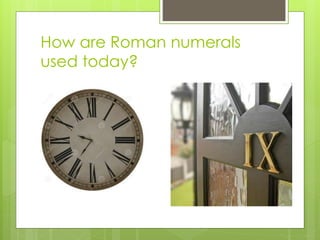
How are Roman numerals
used today?
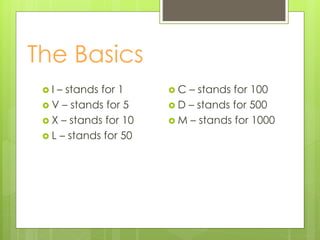
The Basics
 I – stands for 1
 V – stands for 5
 X – stands for 10
 L – stands for 50
 C – stands for 100
 D – stands for 500
 M – stands for 1000
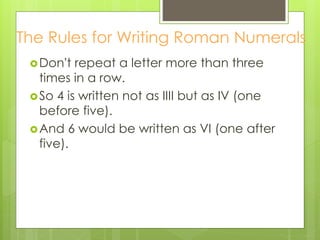
The Rules for Writing Roman Numerals
Don’t repeat a letter more than three
times in a row.
So 4 is written not as IIII but as IV (one
before five).
And 6 would be written as VI (one after
five).
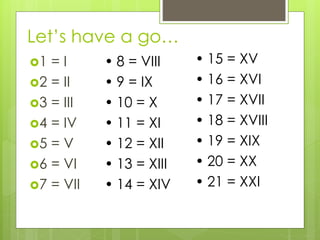
Let’s have a go…
1 = I
2 = II
3 = III
4 = IV
5 = V
6 = VI
7 = VII
• 8 = VIII
• 9 = IX
• 10 = X
• 11 = XI
• 12 = XII
• 13 = XIII
• 14 = XIV
• 15 = XV
• 16 = XVI
• 17 = XVII
• 18 = XVIII
• 19 = XIX
• 20 = XX
• 21 = XXI
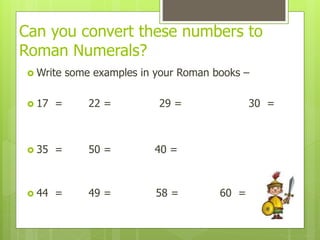
Can you convert these numbers to
Roman Numerals?
 Write some examples in your Roman books –
 17 = 22 = 29 = 30 =
 35 = 50 = 40 =
 44 = 49 = 58 = 60 =
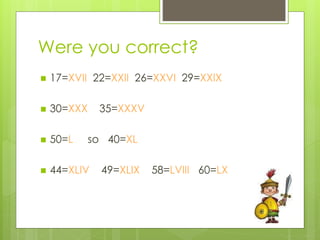
Were you correct?
 17=XVII 22=XXII 26=XXVI 29=XXIX
 30=XXX 35=XXXV
 50=L so 40=XL
 44=XLIV 49=XLIX 58=LVIII 60=LX
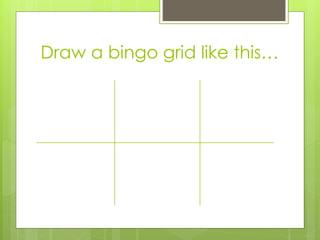
Draw a bingo grid like this…
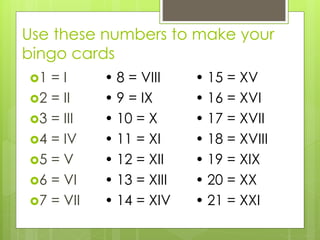
Use these numbers to make your
bingo cards
1 = I
2 = II
3 = III
4 = IV
5 = V
6 = VI
7 = VII
• 8 = VIII
• 9 = IX
• 10 = X
• 11 = XI
• 12 = XII
• 13 = XIII
• 14 = XIV
• 15 = XV
• 16 = XVI
• 17 = XVII
• 18 = XVIII
• 19 = XIX
• 20 = XX
• 21 = XXI

Roman-numeral-powerpoint.pdf

  • 1.
  • 2.
    Roman Numerals -Past and Present  Romans used them for trading and commerce.  When Romans learned to write they needed a way to write their numbers.  Roman Numerals are still used today in many different ways.
  • 3.
    Roman vs. ArabicNumerals Arabic Numerals are the numbers that we use today.  1, 2, 3, 4, 5, 6, 7, 8, 9, 0 Roman Numerals are used today, but not in everyday writing.  I, V, X, L, C, D, M Roman Numerals don’t have a symbol for zero.
  • 4.
    How are Romannumerals used today?
  • 5.
    The Basics  I– stands for 1  V – stands for 5  X – stands for 10  L – stands for 50  C – stands for 100  D – stands for 500  M – stands for 1000
  • 6.
    The Rules forWriting Roman Numerals Don’t repeat a letter more than three times in a row. So 4 is written not as IIII but as IV (one before five). And 6 would be written as VI (one after five).
  • 7.
    Let’s have ago… 1 = I 2 = II 3 = III 4 = IV 5 = V 6 = VI 7 = VII • 8 = VIII • 9 = IX • 10 = X • 11 = XI • 12 = XII • 13 = XIII • 14 = XIV • 15 = XV • 16 = XVI • 17 = XVII • 18 = XVIII • 19 = XIX • 20 = XX • 21 = XXI
  • 8.
    Can you convertthese numbers to Roman Numerals?  Write some examples in your Roman books –  17 = 22 = 29 = 30 =  35 = 50 = 40 =  44 = 49 = 58 = 60 =
  • 9.
    Were you correct? 17=XVII 22=XXII 26=XXVI 29=XXIX  30=XXX 35=XXXV  50=L so 40=XL  44=XLIV 49=XLIX 58=LVIII 60=LX
  • 10.
    Draw a bingogrid like this…
  • 11.
    Use these numbersto make your bingo cards 1 = I 2 = II 3 = III 4 = IV 5 = V 6 = VI 7 = VII • 8 = VIII • 9 = IX • 10 = X • 11 = XI • 12 = XII • 13 = XIII • 14 = XIV • 15 = XV • 16 = XVI • 17 = XVII • 18 = XVIII • 19 = XIX • 20 = XX • 21 = XXI