Let us Bring Europe Together for
heritage
Let's BET for heritage
ROMANIA ‘S HISTORY
COLEGIUL ECONOMIC BUZAU
25.11.2018
Romania’s history from origins to
present time
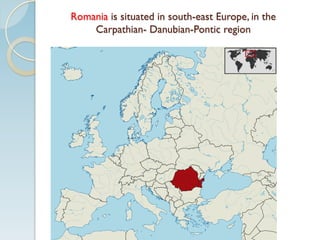
Romania is situated in south-east Europe, in the
Carpathian- Danubian-Pontic region
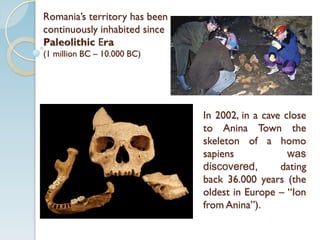
Romania’s territory has been
continuously inhabited since
Paleolithic Era
(1 million BC – 10.000 BC)
In 2002, in a cave close
to Anina Town the
skeleton of a homo
sapiens was
discovered, dating
back 36.000 years (the
oldest in Europe – “Ion
from Anina”).
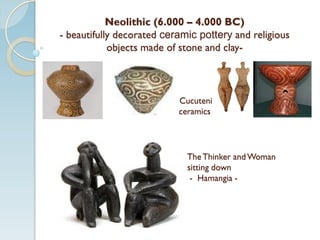
Neolithic (6.000 – 4.000 BC)
- beautifully decorated ceramic pottery and religious
objects made of stone and clay-
TheThinker andWoman
sitting down
- Hamangia -
Cucuteni
ceramics
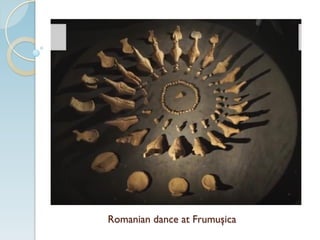
Romanian dance at Frumuşica
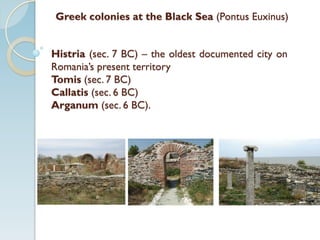
Histria (sec. 7 BC) – the oldest documented city on
Romania’s present territory
Tomis (sec. 7 BC)
Callatis (sec. 6 BC)
Arganum (sec. 6 BC).
Greek colonies at the Black Sea (Pontus Euxinus)
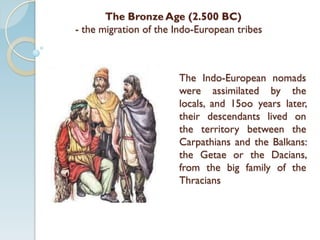
The Bronze Age (2.500 BC)
- the migration of the Indo-European tribes
The Indo-European nomads
were assimilated by the
locals, and 15oo years later,
their descendants lived on
the territory between the
Carpathians and the Balkans:
the Getae or the Dacians,
from the big family of the
Thracians
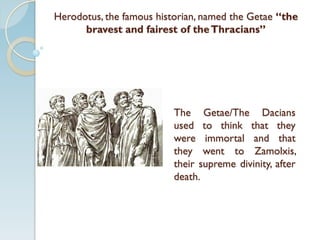
Herodotus, the famous historian, named the Getae “the
bravest and fairest of theThracians”
The Getae/The Dacians
used to think that they
were immortal and that
they went to Zamolxis,
their supreme divinity, after
death.
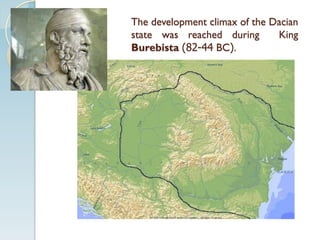
The development climax of the Dacian
state was reached during King
Burebista (82-44 BC).
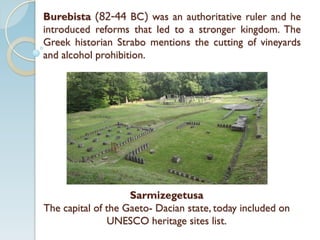
Burebista (82-44 BC) was an authoritative ruler and he
introduced reforms that led to a stronger kingdom. The
Greek historian Strabo mentions the cutting of vineyards
and alcohol prohibition.
Sarmizegetusa
The capital of the Gaeto- Dacian state, today included on
UNESCO heritage sites list.
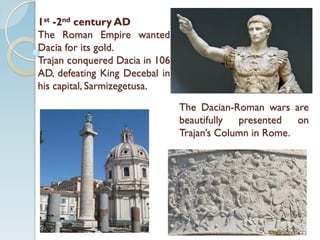
1st -2nd century AD
The Roman Empire wanted
Dacia for its gold.
Trajan conquered Dacia in 106
AD, defeating King Decebal in
his capital, Sarmizegetusa.
The Dacian-Roman wars are
beautifully presented on
Trajan’s Column in Rome.
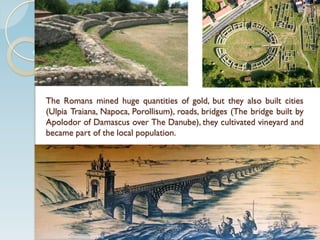
The Romans mined huge quantities of gold, but they also built cities
(Ulpia Traiana, Napoca, Porollisum), roads, bridges (The bridge built by
Apolodor of Damascus over The Danube), they cultivated vineyard and
became part of the local population.
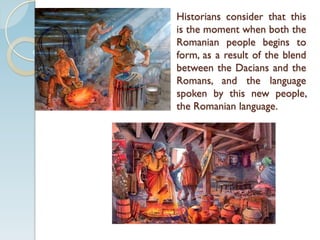
Historians consider that this
is the moment when both the
Romanian people begins to
form, as a result of the blend
between the Dacians and the
Romans, and the language
spoken by this new people,
the Romanian language.
The invasion of the
migratory peoples
The Goths (3rd – 4th century)
The Huns (4th century)
The Gepidae (5th century)
The Avars (6th century)
The Slavs (7th century)
The Hungarians (9th century)
The Petchenegs, the Cumans,
and the Alans (10th–11th
century)
TheTartars (13th century )
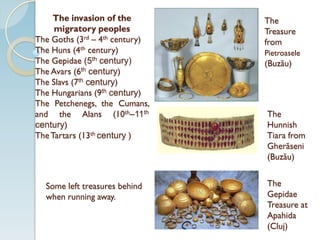
Some left treasures behind
when running away.
The
Treasure
from
Pietroasele
(Buzău)
The
Gepidae
Treasure at
Apahida
(Cluj)
The
Hunnish
Tiara from
Gherăseni
(Buzău)
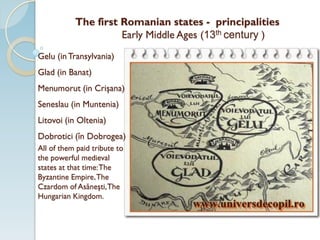
The first Romanian states - principalities
Early Middle Ages (13th century )
Gelu (inTransylvania)
Glad (in Banat)
Menumorut (in Crişana)
Seneslau (in Muntenia)
Litovoi (in Oltenia)
Dobrotici (în Dobrogea)
All of them paid tribute to
the powerful medieval
states at that time:The
Byzantine Empire,The
Czardom of Asăneşti,The
Hungarian Kingdom.
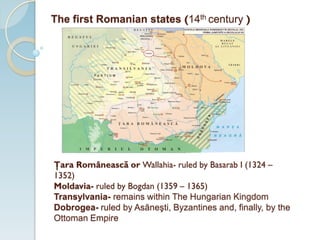
Ţara Românească or Wallahia- ruled by Basarab I (1324 –
1352)
Moldavia- ruled by Bogdan (1359 – 1365)
Transylvania- remains within The Hungarian Kingdom
Dobrogea- ruled by Asăneşti, Byzantines and, finally, by the
Ottoman Empire
The first Romanian states (14th century )
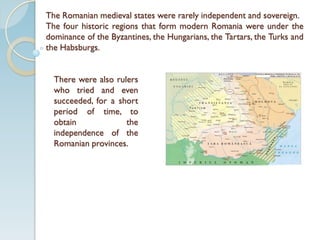
The Romanian medieval states were rarely independent and sovereign.
The four historic regions that form modern Romania were under the
dominance of the Byzantines, the Hungarians, the Tartars, the Turks and
the Habsburgs.
There were also rulers
who tried and even
succeeded, for a short
period of time, to
obtain the
independence of the
Romanian provinces.
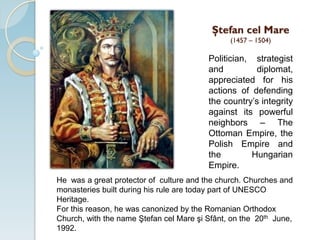
Ştefan cel Mare
(1457 – 1504)
Politician, strategist
and diplomat,
appreciated for his
actions of defending
the country’s integrity
against its powerful
neighbors – The
Ottoman Empire, the
Polish Empire and
the Hungarian
Empire.
He was a great protector of culture and the church. Churches and
monasteries built during his rule are today part of UNESCO
Heritage.
For this reason, he was canonized by the Romanian Orthodox
Church, with the name Ştefan cel Mare şi Sfânt, on the 20th June,
1992.
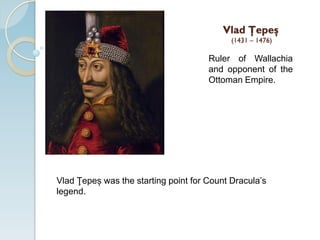
Vlad Ţepeş
(1431 – 1476)
Ruler of Wallachia
and opponent of the
Ottoman Empire.
Vlad Ţepeș was the starting point for Count Dracula’s
legend.
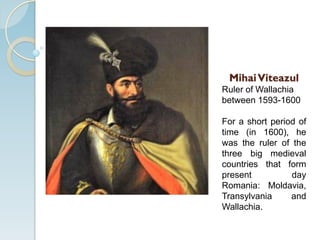
MihaiViteazul
Ruler of Wallachia
between 1593-1600
For a short period of
time (in 1600), he
was the ruler of the
three big medieval
countries that form
present day
Romania: Moldavia,
Transylvania and
Wallachia.
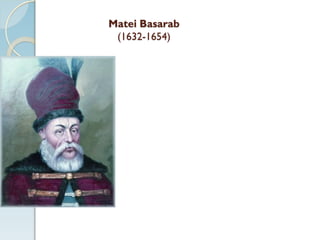
Matei Basarab
(1632-1654)
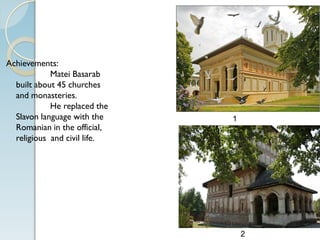
Achievements:
Matei Basarab
built about 45 churches
and monasteries.
He replaced the
Slavon language with the
Romanian in the official,
religious and civil life.
1
2
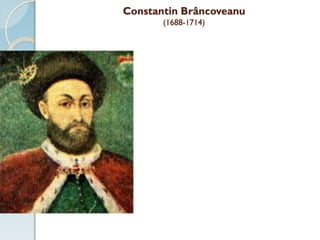
Constantin Brâncoveanu
(1688-1714)
1
2
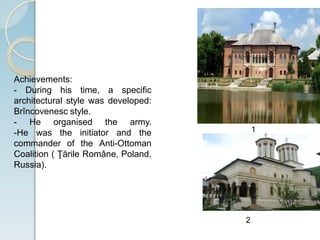
Achievements:
- During his time, a specific
architectural style was developed:
Brîncovenesc style.
- He organised the army.
-He was the initiator and the
commander of the Anti-Ottoman
Coalition ( Ţările Române, Poland,
Russia).
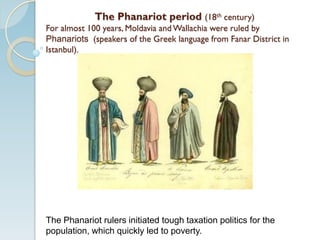
The Phanariot period (18th century)
For almost 100 years, Moldavia and Wallachia were ruled by
Phanariots (speakers of the Greek language from Fanar District in
Istanbul).
The Phanariot rulers initiated tough taxation politics for the
population, which quickly led to poverty.
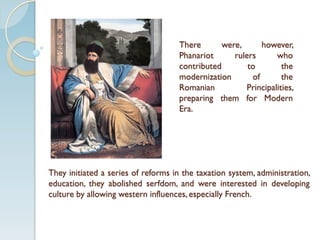
There were, however,
Phanariot rulers who
contributed to the
modernization of the
Romanian Principalities,
preparing them for Modern
Era.
They initiated a series of reforms in the taxation system, administration,
education, they abolished serfdom, and were interested in developing
culture by allowing western influences, especially French.
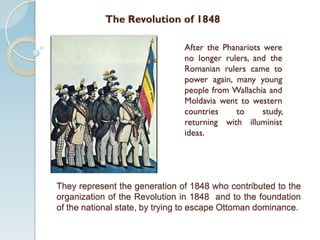
After the Phanariots were
no longer rulers, and the
Romanian rulers came to
power again, many young
people from Wallachia and
Moldavia went to western
countries to study,
returning with illuminist
ideas.
The Revolution of 1848
They represent the generation of 1848 who contributed to the
organization of the Revolution in 1848 and to the foundation
of the national state, by trying to escape Ottoman dominance.
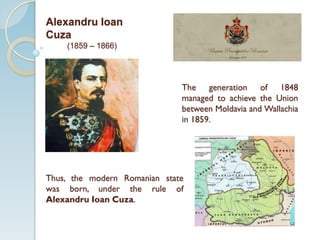
The generation of 1848
managed to achieve the Union
between Moldavia and Wallachia
in 1859.
Thus, the modern Romanian state
was born, under the rule of
Alexandru Ioan Cuza.
Alexandru Ioan
Cuza
(1859 – 1866)
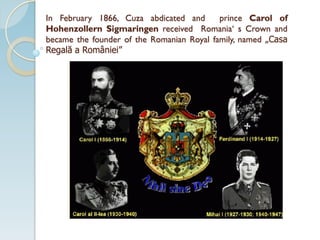
In February 1866, Cuza abdicated and prince Carol of
Hohenzollern Sigmaringen received Romania‘ s Crown and
became the founder of the Romanian Royal family, named „Casa
Regală a României”
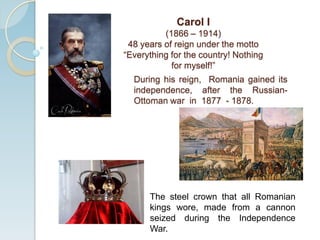
During his reign, Romania gained its
independence, after the Russian-
Ottoman war in 1877 - 1878.
Carol I
(1866 – 1914)
48 years of reign under the motto
“Everything for the country! Nothing
for myself!”
The steel crown that all Romanian
kings wore, made from a cannon
seized during the Independence
War.
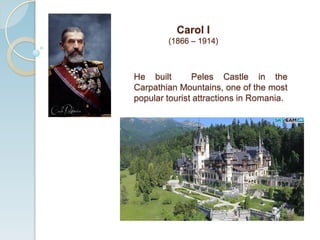
He built Peles Castle in the
Carpathian Mountains, one of the most
popular tourist attractions in Romania.
Carol I
(1866 – 1914)
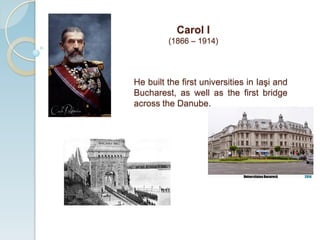
He built the first universities in Iaşi and
Bucharest, as well as the first bridge
across the Danube.
Carol I
(1866 – 1914)
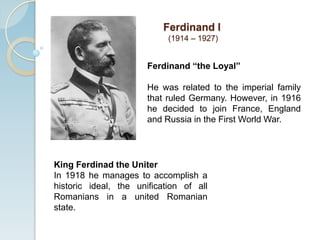
Ferdinand “the Loyal”
He was related to the imperial family
that ruled Germany. However, in 1916
he decided to join France, England
and Russia in the First World War.
King Ferdinad the Uniter
In 1918 he manages to accomplish a
historic ideal, the unification of all
Romanians in a united Romanian
state.
Ferdinand l
(1914 – 1927)
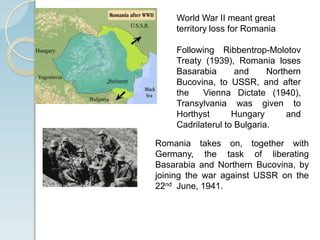
World War II meant great
territory loss for Romania
Following Ribbentrop-Molotov
Treaty (1939), Romania loses
Basarabia and Northern
Bucovina, to USSR, and after
the Vienna Dictate (1940),
Transylvania was given to
Horthyst Hungary and
Cadrilaterul to Bulgaria.
Romania takes on, together with
Germany, the task of liberating
Basarabia and Northern Bucovina, by
joining the war against USSR on the
22nd June, 1941.
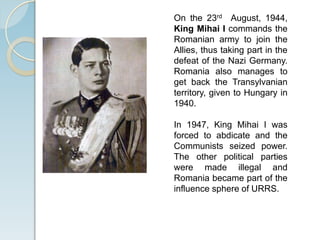
On the 23rd August, 1944,
King Mihai I commands the
Romanian army to join the
Allies, thus taking part in the
defeat of the Nazi Germany.
Romania also manages to
get back the Transylvanian
territory, given to Hungary in
1940.
In 1947, King Mihai I was
forced to abdicate and the
Communists seized power.
The other political parties
were made illegal and
Romania became part of the
influence sphere of URRS.
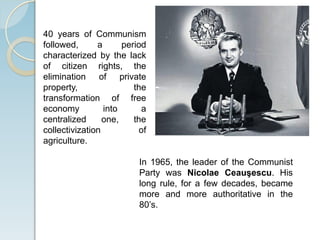
In 1965, the leader of the Communist
Party was Nicolae Ceauşescu. His
long rule, for a few decades, became
more and more authoritative in the
80’s.
40 years of Communism
followed, a period
characterized by the lack
of citizen rights, the
elimination of private
property, the
transformation of free
economy into a
centralized one, the
collectivization of
agriculture.
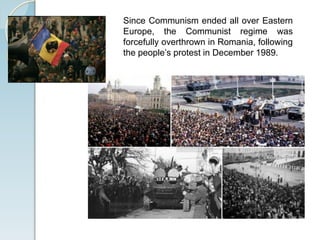
Since Communism ended all over Eastern
Europe, the Communist regime was
forcefully overthrown in Romania, following
the people’s protest in December 1989.
Romania returns to the democratic regime, based
on more parties. The Romanian state adopts a
state economy and becomes more and more
preoccupied with European reinstatement.
On the 1st January 2019, Romania will take over the presidency
the EU Council for a period of six months.
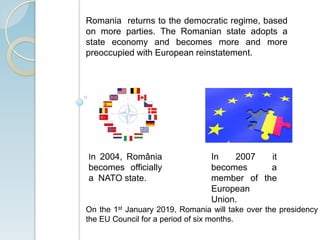
In 2004, România
becomes officially
a NATO state.
In 2007 it
becomes a
member of the
European
Union.
‘This project is financed with support from the European Commission. This
material only reflects the views of the authors, and the Commission cannot be
held responsible for any use which may be made of the information contained
therein.’

Romanian history

  • 1.
    Let us BringEurope Together for heritage Let's BET for heritage ROMANIA ‘S HISTORY COLEGIUL ECONOMIC BUZAU 25.11.2018
  • 2.
    Romania’s history fromorigins to present time
  • 3.
    Romania is situatedin south-east Europe, in the Carpathian- Danubian-Pontic region
  • 4.
    Romania’s territory hasbeen continuously inhabited since Paleolithic Era (1 million BC – 10.000 BC) In 2002, in a cave close to Anina Town the skeleton of a homo sapiens was discovered, dating back 36.000 years (the oldest in Europe – “Ion from Anina”).
  • 5.
    Neolithic (6.000 –4.000 BC) - beautifully decorated ceramic pottery and religious objects made of stone and clay- TheThinker andWoman sitting down - Hamangia - Cucuteni ceramics
  • 6.
  • 7.
    Histria (sec. 7BC) – the oldest documented city on Romania’s present territory Tomis (sec. 7 BC) Callatis (sec. 6 BC) Arganum (sec. 6 BC). Greek colonies at the Black Sea (Pontus Euxinus)
  • 8.
    The Bronze Age(2.500 BC) - the migration of the Indo-European tribes The Indo-European nomads were assimilated by the locals, and 15oo years later, their descendants lived on the territory between the Carpathians and the Balkans: the Getae or the Dacians, from the big family of the Thracians
  • 9.
    Herodotus, the famoushistorian, named the Getae “the bravest and fairest of theThracians” The Getae/The Dacians used to think that they were immortal and that they went to Zamolxis, their supreme divinity, after death.
  • 10.
    The development climaxof the Dacian state was reached during King Burebista (82-44 BC).
  • 11.
    Burebista (82-44 BC)was an authoritative ruler and he introduced reforms that led to a stronger kingdom. The Greek historian Strabo mentions the cutting of vineyards and alcohol prohibition. Sarmizegetusa The capital of the Gaeto- Dacian state, today included on UNESCO heritage sites list.
  • 12.
    1st -2nd centuryAD The Roman Empire wanted Dacia for its gold. Trajan conquered Dacia in 106 AD, defeating King Decebal in his capital, Sarmizegetusa. The Dacian-Roman wars are beautifully presented on Trajan’s Column in Rome.
  • 13.
    The Romans minedhuge quantities of gold, but they also built cities (Ulpia Traiana, Napoca, Porollisum), roads, bridges (The bridge built by Apolodor of Damascus over The Danube), they cultivated vineyard and became part of the local population.
  • 14.
    Historians consider thatthis is the moment when both the Romanian people begins to form, as a result of the blend between the Dacians and the Romans, and the language spoken by this new people, the Romanian language.
  • 15.
    The invasion ofthe migratory peoples The Goths (3rd – 4th century) The Huns (4th century) The Gepidae (5th century) The Avars (6th century) The Slavs (7th century) The Hungarians (9th century) The Petchenegs, the Cumans, and the Alans (10th–11th century) TheTartars (13th century ) Some left treasures behind when running away. The Treasure from Pietroasele (Buzău) The Gepidae Treasure at Apahida (Cluj) The Hunnish Tiara from Gherăseni (Buzău)
  • 16.
    The first Romanianstates - principalities Early Middle Ages (13th century ) Gelu (inTransylvania) Glad (in Banat) Menumorut (in Crişana) Seneslau (in Muntenia) Litovoi (in Oltenia) Dobrotici (în Dobrogea) All of them paid tribute to the powerful medieval states at that time:The Byzantine Empire,The Czardom of Asăneşti,The Hungarian Kingdom.
  • 17.
    Ţara Românească orWallahia- ruled by Basarab I (1324 – 1352) Moldavia- ruled by Bogdan (1359 – 1365) Transylvania- remains within The Hungarian Kingdom Dobrogea- ruled by Asăneşti, Byzantines and, finally, by the Ottoman Empire The first Romanian states (14th century )
  • 18.
    The Romanian medievalstates were rarely independent and sovereign. The four historic regions that form modern Romania were under the dominance of the Byzantines, the Hungarians, the Tartars, the Turks and the Habsburgs. There were also rulers who tried and even succeeded, for a short period of time, to obtain the independence of the Romanian provinces.
  • 19.
    Ştefan cel Mare (1457– 1504) Politician, strategist and diplomat, appreciated for his actions of defending the country’s integrity against its powerful neighbors – The Ottoman Empire, the Polish Empire and the Hungarian Empire. He was a great protector of culture and the church. Churches and monasteries built during his rule are today part of UNESCO Heritage. For this reason, he was canonized by the Romanian Orthodox Church, with the name Ştefan cel Mare şi Sfânt, on the 20th June, 1992.
  • 20.
    Vlad Ţepeş (1431 –1476) Ruler of Wallachia and opponent of the Ottoman Empire. Vlad Ţepeș was the starting point for Count Dracula’s legend.
  • 21.
    MihaiViteazul Ruler of Wallachia between1593-1600 For a short period of time (in 1600), he was the ruler of the three big medieval countries that form present day Romania: Moldavia, Transylvania and Wallachia.
  • 22.
  • 23.
    Achievements: Matei Basarab built about45 churches and monasteries. He replaced the Slavon language with the Romanian in the official, religious and civil life. 1 2
  • 24.
  • 25.
    1 2 Achievements: - During histime, a specific architectural style was developed: Brîncovenesc style. - He organised the army. -He was the initiator and the commander of the Anti-Ottoman Coalition ( Ţările Române, Poland, Russia).
  • 26.
    The Phanariot period(18th century) For almost 100 years, Moldavia and Wallachia were ruled by Phanariots (speakers of the Greek language from Fanar District in Istanbul). The Phanariot rulers initiated tough taxation politics for the population, which quickly led to poverty.
  • 27.
    There were, however, Phanariotrulers who contributed to the modernization of the Romanian Principalities, preparing them for Modern Era. They initiated a series of reforms in the taxation system, administration, education, they abolished serfdom, and were interested in developing culture by allowing western influences, especially French.
  • 28.
    After the Phanariotswere no longer rulers, and the Romanian rulers came to power again, many young people from Wallachia and Moldavia went to western countries to study, returning with illuminist ideas. The Revolution of 1848 They represent the generation of 1848 who contributed to the organization of the Revolution in 1848 and to the foundation of the national state, by trying to escape Ottoman dominance.
  • 29.
    The generation of1848 managed to achieve the Union between Moldavia and Wallachia in 1859. Thus, the modern Romanian state was born, under the rule of Alexandru Ioan Cuza. Alexandru Ioan Cuza (1859 – 1866)
  • 30.
    In February 1866,Cuza abdicated and prince Carol of Hohenzollern Sigmaringen received Romania‘ s Crown and became the founder of the Romanian Royal family, named „Casa Regală a României”
  • 31.
    During his reign,Romania gained its independence, after the Russian- Ottoman war in 1877 - 1878. Carol I (1866 – 1914) 48 years of reign under the motto “Everything for the country! Nothing for myself!” The steel crown that all Romanian kings wore, made from a cannon seized during the Independence War.
  • 32.
    He built PelesCastle in the Carpathian Mountains, one of the most popular tourist attractions in Romania. Carol I (1866 – 1914)
  • 33.
    He built thefirst universities in Iaşi and Bucharest, as well as the first bridge across the Danube. Carol I (1866 – 1914)
  • 34.
    Ferdinand “the Loyal” Hewas related to the imperial family that ruled Germany. However, in 1916 he decided to join France, England and Russia in the First World War. King Ferdinad the Uniter In 1918 he manages to accomplish a historic ideal, the unification of all Romanians in a united Romanian state. Ferdinand l (1914 – 1927)
  • 35.
    World War IImeant great territory loss for Romania Following Ribbentrop-Molotov Treaty (1939), Romania loses Basarabia and Northern Bucovina, to USSR, and after the Vienna Dictate (1940), Transylvania was given to Horthyst Hungary and Cadrilaterul to Bulgaria. Romania takes on, together with Germany, the task of liberating Basarabia and Northern Bucovina, by joining the war against USSR on the 22nd June, 1941.
  • 36.
    On the 23rdAugust, 1944, King Mihai I commands the Romanian army to join the Allies, thus taking part in the defeat of the Nazi Germany. Romania also manages to get back the Transylvanian territory, given to Hungary in 1940. In 1947, King Mihai I was forced to abdicate and the Communists seized power. The other political parties were made illegal and Romania became part of the influence sphere of URRS.
  • 37.
    In 1965, theleader of the Communist Party was Nicolae Ceauşescu. His long rule, for a few decades, became more and more authoritative in the 80’s. 40 years of Communism followed, a period characterized by the lack of citizen rights, the elimination of private property, the transformation of free economy into a centralized one, the collectivization of agriculture.
  • 38.
    Since Communism endedall over Eastern Europe, the Communist regime was forcefully overthrown in Romania, following the people’s protest in December 1989.
  • 39.
    Romania returns tothe democratic regime, based on more parties. The Romanian state adopts a state economy and becomes more and more preoccupied with European reinstatement. On the 1st January 2019, Romania will take over the presidency the EU Council for a period of six months. In 2004, România becomes officially a NATO state. In 2007 it becomes a member of the European Union.
  • 40.
    ‘This project isfinanced with support from the European Commission. This material only reflects the views of the authors, and the Commission cannot be held responsible for any use which may be made of the information contained therein.’