This project has been funded with support from the European Commission. This presentation reflects the views only of the author, and the Commission cannot be held responsible for any use which may be made of the information contained therein.
 
 
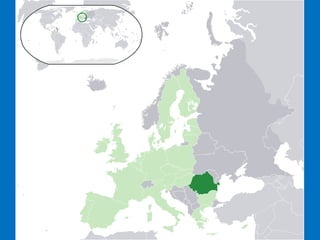
Capital:  Bucharest Official language:  Romanian Republic National day:  1 st   of December Currency:  Romanian leu (RON) Area:  238,391 km2 Population:  21.524.042
History   The oldest modern human remains in Europe were discovered in the “Cave with Bones” in present day in Romania.  The remains are approximately 42,000 years old and as Europe’s oldest remains of “Homo sapiens” they may represent the first people who had entered the continent.
The earliest written evidence of people living in the territory of the present-day Romania comes from Herodotus in book IV of his “Histories” written 440 BCE.  Herein he writes that the tribal confederation of the Getae were defeated by the Persian Emperor Darius the Great during his campaign against the Scythians.
Dacians, widely accepted as part of the Getae, were a branch of Thracians that inhabited Dacia (corresponding to Romania, Moldova and Northern Bulgaria). The Dacian kingdom reached its maximum expansion during King Burebista, around 82 BC.
The Dacians were eventually defeated by the Roman Empire under Emperor Traian. The Romans heavily colonized the province, brought with them Vulgar Latin and started a period of intense romanization (giving birth to Romanian language and Romanian people).
After centuries of social, political and military turmoil, the Kingdom of Romania emerged when the principalities of Moldavia and Wallachia were united under Prince Alexandru Ioan Cuza in 1859.  Independence from the Ottoman  Empire was declared on May 9, 1877.
At the end of World War I Transylvania, Bukovina and Bessarabia united with the Kingdom of Romania.  Greater Romania emerged into an era of progression and prosperity that would continue until World War II.
By the end of the World War II, many north-eastern areas of Romania's territories were occupied by the Soviet Union, and Romania forcibly became a socialist republic and a member of the Warsaw Pact.
With the fall of the Iron Curtain and the 1989 Revolution, Romania began to transition towards democracy and a capitalist market economy.
After a decade of post-revolution economic problems, extensive reforms fostered economic recovery and Romania joined NATO on 29 March 2004 and the European Union on 1 January 2007.
Sightseeing Romania
House of Parliament Bucharest
The Arch of Triumph Bucharest
The Athenaeum Bucharest
The Council Tower Sibiu
Peles Castle Sinaia
The Medieval Festival in Sighisoara
The Dome Timisoara
Brasov, a medieval city
Bran Castle
Carpathians Mountains
Toaca Peak (1900 m) – Durau Carpathians Mountains
Olt River
‘ The Sphinx’ Bucegi Mountains
Balea Lake
Slanic Moldova resort
Moeciu
Poiana Brasov resort
Retezat Mountains Bucura Lake
The Black Sea
Sturgeon on the Danube
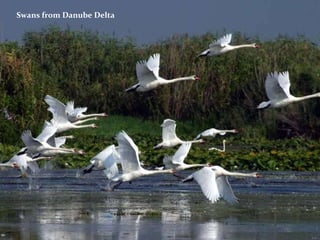
Swans from Danube Delta
Gura Portitei in the Danube Delta
Water lilies
Putna Monastery
Barsana Monastery
Wheat field
Countryside
Realized by the pupils of School number 1, Bicaz, Romania, for the Comenius Project “How schoolchildren can contribute to keeping our planet green and clean”

Romania

  • 1.
    This project hasbeen funded with support from the European Commission. This presentation reflects the views only of the author, and the Commission cannot be held responsible for any use which may be made of the information contained therein.
  • 2.
  • 3.
  • 4.
    Capital: BucharestOfficial language: Romanian Republic National day: 1 st of December Currency: Romanian leu (RON) Area: 238,391 km2 Population: 21.524.042
  • 5.
    History The oldest modern human remains in Europe were discovered in the “Cave with Bones” in present day in Romania. The remains are approximately 42,000 years old and as Europe’s oldest remains of “Homo sapiens” they may represent the first people who had entered the continent.
  • 6.
    The earliest writtenevidence of people living in the territory of the present-day Romania comes from Herodotus in book IV of his “Histories” written 440 BCE. Herein he writes that the tribal confederation of the Getae were defeated by the Persian Emperor Darius the Great during his campaign against the Scythians.
  • 7.
    Dacians, widely acceptedas part of the Getae, were a branch of Thracians that inhabited Dacia (corresponding to Romania, Moldova and Northern Bulgaria). The Dacian kingdom reached its maximum expansion during King Burebista, around 82 BC.
  • 8.
    The Dacians wereeventually defeated by the Roman Empire under Emperor Traian. The Romans heavily colonized the province, brought with them Vulgar Latin and started a period of intense romanization (giving birth to Romanian language and Romanian people).
  • 9.
    After centuries ofsocial, political and military turmoil, the Kingdom of Romania emerged when the principalities of Moldavia and Wallachia were united under Prince Alexandru Ioan Cuza in 1859. Independence from the Ottoman Empire was declared on May 9, 1877.
  • 10.
    At the endof World War I Transylvania, Bukovina and Bessarabia united with the Kingdom of Romania. Greater Romania emerged into an era of progression and prosperity that would continue until World War II.
  • 11.
    By the endof the World War II, many north-eastern areas of Romania's territories were occupied by the Soviet Union, and Romania forcibly became a socialist republic and a member of the Warsaw Pact.
  • 12.
    With the fallof the Iron Curtain and the 1989 Revolution, Romania began to transition towards democracy and a capitalist market economy.
  • 13.
    After a decadeof post-revolution economic problems, extensive reforms fostered economic recovery and Romania joined NATO on 29 March 2004 and the European Union on 1 January 2007.
  • 14.
  • 15.
  • 16.
    The Arch ofTriumph Bucharest
  • 17.
  • 18.
  • 19.
  • 20.
    The Medieval Festivalin Sighisoara
  • 21.
  • 22.
  • 23.
  • 24.
  • 25.
    Toaca Peak (1900m) – Durau Carpathians Mountains
  • 26.
  • 27.
    ‘ The Sphinx’Bucegi Mountains
  • 28.
  • 29.
  • 30.
  • 31.
  • 32.
  • 33.
  • 34.
  • 35.
  • 36.
    Gura Portitei inthe Danube Delta
  • 37.
  • 38.
  • 39.
  • 40.
  • 41.
  • 42.
    Realized by thepupils of School number 1, Bicaz, Romania, for the Comenius Project “How schoolchildren can contribute to keeping our planet green and clean”