
Servicing and Safetyof R-290 Air-ConditioningPROKLIMARolf Huehren for GIZ PROKLIMA
CurrentSituationR-290 Hydrocarbon units are launched on international scale
Design and installation of HC – RAC equipment according the specific standards (EN378)
Further, conversion of existing HCFC equipment for the operation with R-290
Conversion of CFC/HFC equipment for the operation with R-600a and R-290 or mixtures of both
Service of R-600a equipmentGoals and ChallengesThe new HC R-290 Air-Conditioning Systems provide an intrinsic safe system having GS, CE marking, VDE certifications!Specific features: New optimised R-290 compressor
Optimised heat exchanger
Intelligent control system
Specific other construction materials for the use with R-290 Goals and ChallengesService and RepairIt is essential to know about the importance to keep the system in the original design conditionTo rely on already introduced „Best Installation and Service Practices“To have „Code of Practice“ in place To follow strictly the inaugurated safety regulationsTo provide a hermetically sealed systemTo keep the system tight1.- Leak check;    2.- Leak Test;    3.- Strength test  To use OFDN  (oxygen free and dry nitrogen) for service act.To have OEM spare parts availableTo have professional tools availableNot to waste HC refrigerant
Training Objective Training is a learning process that involves the acquisition of knowledge, development and sharpening of skills, concepts, rules, or changing of attitudes and behaviors to enhance the performance of employees.
Training Driven by RAC Business Needs (some important examples)To comply with laws, regulations and standards that force changes in the sectorsTo improve demand on installation, service and maintenance quality in order to reduce costs (refrigerant, replacement parts, number of call-outs) and to maintain best possible system energy efficiency To meet increasingly sophisticated requirements from the sectors (AC, food processing, retail, construction...)      To compete with local & international competition To find employment and to optimise career path
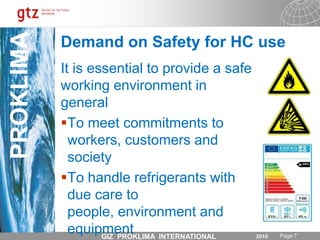
Demand on Safety for HC use It is essential to provide a safe working environment in generalTo meet commitments to workers, customers and society
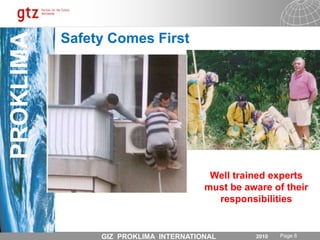
To handle refrigerants with due care to people, environment and equipment Safety Comes FirstWell trained experts must be aware of their responsibilities
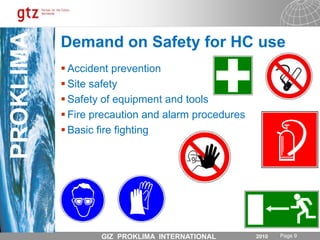
Demand on Safety for HC use Accident preventionSite safetySafety of equipment and toolsFire precaution and alarm proceduresBasic fire fighting
Who should be trained?Involved personnel dealing with HC appliances and systems - from their conception to destruction - needs to develop knowledge and skills to apply best practices including strategic risk assessment schemes for system installation, servicing, retrofitting and conversion to HC refrigerants. This will imply: Training activities in theory and practical matters. The scope of training is related to the actual work responsibilities of employers, constructors, observers, manufacturing lines assemblers, sales staff,  installation companies or workshop owners and practical service engineers and technicians.
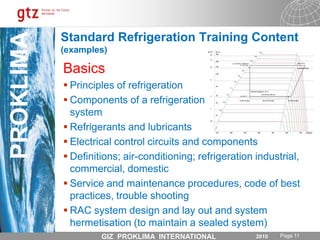
Standard Refrigeration Training Content (examples)BasicsPrinciples of refrigerationComponents of a refrigeration                            systemRefrigerants and lubricantsElectrical control circuits and componentsDefinitions; air-conditioning; refrigeration industrial, commercial, domestic Service and maintenance procedures, code of best practices, trouble shooting RAC system design and lay out and system hermetisation(to maintain a sealed system)
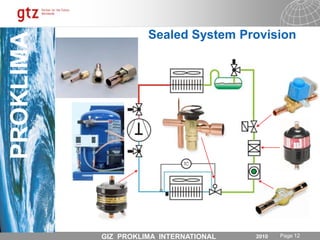
Sealed System Provision
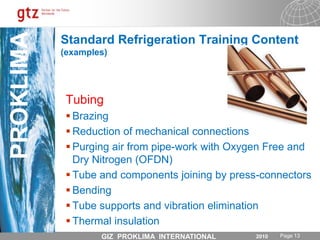
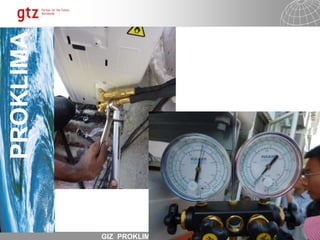
Standard Refrigeration Training Content (examples)Tubing BrazingReduction of mechanical connectionsPurging air from pipe-work with Oxygen Free and Dry Nitrogen (OFDN)Tube and components joining by press-connectors BendingTube supports and vibration elimination Thermal insulation
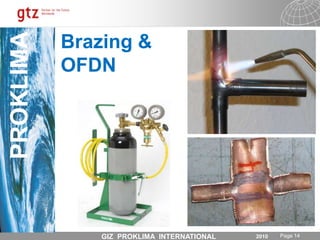
Brazing &OFDN
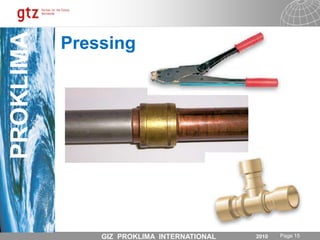
Pressing
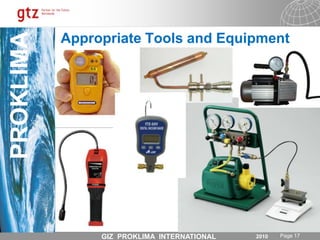
Standard Refrigeration Training Content (examples)HC - RACThermodynamic properties and significant differences compared with CFCs, HCFCs and HFCsSafety and risk assessment (SOI, etc.)Design of systems using HCs as refrigerant, standards and regulationsSpecific tools and system componentsCylinder properties, storage and transport Safe refrigerant handling including charging and recoveryLeakage control and strength testing (again OFDN)System / Appliance decommissioning
Appropriate Tools and Equipment

Servicing and Safety of R-290 Air-Conditioning

  • 1.
    Servicing and SafetyofR-290 Air-ConditioningPROKLIMARolf Huehren for GIZ PROKLIMA
  • 2.
    CurrentSituationR-290 Hydrocarbon unitsare launched on international scale
  • 3.
    Design and installationof HC – RAC equipment according the specific standards (EN378)
  • 4.
    Further, conversion ofexisting HCFC equipment for the operation with R-290
  • 5.
    Conversion of CFC/HFCequipment for the operation with R-600a and R-290 or mixtures of both
  • 6.
    Service of R-600aequipmentGoals and ChallengesThe new HC R-290 Air-Conditioning Systems provide an intrinsic safe system having GS, CE marking, VDE certifications!Specific features: New optimised R-290 compressor
  • 7.
  • 8.
  • 9.
    Specific other constructionmaterials for the use with R-290 Goals and ChallengesService and RepairIt is essential to know about the importance to keep the system in the original design conditionTo rely on already introduced „Best Installation and Service Practices“To have „Code of Practice“ in place To follow strictly the inaugurated safety regulationsTo provide a hermetically sealed systemTo keep the system tight1.- Leak check; 2.- Leak Test; 3.- Strength test To use OFDN (oxygen free and dry nitrogen) for service act.To have OEM spare parts availableTo have professional tools availableNot to waste HC refrigerant
  • 10.
    Training Objective Trainingis a learning process that involves the acquisition of knowledge, development and sharpening of skills, concepts, rules, or changing of attitudes and behaviors to enhance the performance of employees.
  • 11.
    Training Driven byRAC Business Needs (some important examples)To comply with laws, regulations and standards that force changes in the sectorsTo improve demand on installation, service and maintenance quality in order to reduce costs (refrigerant, replacement parts, number of call-outs) and to maintain best possible system energy efficiency To meet increasingly sophisticated requirements from the sectors (AC, food processing, retail, construction...) To compete with local & international competition To find employment and to optimise career path
  • 12.
    Demand on Safetyfor HC use It is essential to provide a safe working environment in generalTo meet commitments to workers, customers and society
  • 13.
    To handle refrigerantswith due care to people, environment and equipment Safety Comes FirstWell trained experts must be aware of their responsibilities
  • 14.
    Demand on Safetyfor HC use Accident preventionSite safetySafety of equipment and toolsFire precaution and alarm proceduresBasic fire fighting
  • 15.
    Who should betrained?Involved personnel dealing with HC appliances and systems - from their conception to destruction - needs to develop knowledge and skills to apply best practices including strategic risk assessment schemes for system installation, servicing, retrofitting and conversion to HC refrigerants. This will imply: Training activities in theory and practical matters. The scope of training is related to the actual work responsibilities of employers, constructors, observers, manufacturing lines assemblers, sales staff, installation companies or workshop owners and practical service engineers and technicians.
  • 16.
    Standard Refrigeration TrainingContent (examples)BasicsPrinciples of refrigerationComponents of a refrigeration systemRefrigerants and lubricantsElectrical control circuits and componentsDefinitions; air-conditioning; refrigeration industrial, commercial, domestic Service and maintenance procedures, code of best practices, trouble shooting RAC system design and lay out and system hermetisation(to maintain a sealed system)
  • 17.
  • 18.
    Standard Refrigeration TrainingContent (examples)Tubing BrazingReduction of mechanical connectionsPurging air from pipe-work with Oxygen Free and Dry Nitrogen (OFDN)Tube and components joining by press-connectors BendingTube supports and vibration elimination Thermal insulation
  • 19.
  • 20.
  • 21.
    Standard Refrigeration TrainingContent (examples)HC - RACThermodynamic properties and significant differences compared with CFCs, HCFCs and HFCsSafety and risk assessment (SOI, etc.)Design of systems using HCs as refrigerant, standards and regulationsSpecific tools and system componentsCylinder properties, storage and transport Safe refrigerant handling including charging and recoveryLeakage control and strength testing (again OFDN)System / Appliance decommissioning
  • 22.