NAME - NAVNEET CHANDRA
COURSE -BBA
SEMESTER -1
ROLL NO. -BBA/15003/17
SUBJECT -1001-GENERAL
PRINCIPLES OF
MANAGEMENT.
PRESENTATION AT BIT PATNA
Assignment
Topic : Introduction, Definition, Managerial Role.
INTRODUCTION
 Management is an art of
manage men tactfully.
 One of the most important
human activities is managing.
 Managing has been essential
to ensure the coordination of
individual efforts.
Definition-Management
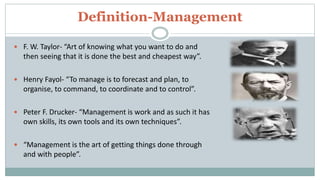
 F. W. Taylor- “Art of knowing what you want to do and
then seeing that it is done the best and cheapest way”.
 Henry Fayol- “To manage is to forecast and plan, to
organise, to command, to coordinate and to control”.
 Peter F. Drucker- “Management is work and as such it has
own skills, its own tools and its own techniques”.
 “Management is the art of getting things done through
and with people”.
Management can be defined in detail in following categories :
 Management as a process.
 Management as an activity.
 Management as a descipline.
 Management as a group.
 Management as a science.
 Management as an art.
 Management as a profession.
Roles of managers
 Henry mintzberg conducted a
comprehensive study of the
nature of managerial roles in
1973.
 He identified ten basic roles
performed by managers and
classified them under three
heads.
MANAGERIAL ROLES
INTERPERSONAL
ROLES
INFORMATIONAL
ROLES
DECISIONAL ROLES
FIGUREHEAD. MONITOR ENTREPRENEUR
LEADER. DISSEMINATOR DISTURBANCE HANDLER.
LIAISON SPOKESPERSON RESOURCE ALLOCATOR.
NEGOTIATOR.
Interpersonal roles
 Figurehead: This role is necessary because
of the position occupied. It consists of such
duties as signing certain documents required
by law and officially receiving visitors.
 leader: A manager serves as a leader i.e., he
trains, encourages, remunerates, judges the
subordinates.
 Liaison : A manager serves as a liaison
between outside contacts such as community,
suppliers and other organisations.
Informational roles
 Monitor : As monitors, managers gather
information in order to be well informed.
 Disseminators : Managers are
disseminators of information flowing from
both external and internal sources.
 Spokesperson : Managers are
spokesperson of the organisations. They
speak for subordinates to superiors and
represent upper management to
subordinates.
Decisional roles
 Entrepreneurs : Managers as entrepreneurs are initiator, innovator,
problem discoverers, and designer of improvement projects that direct &
control change in the organisation.
 Disturbance Handler : As disturbance handler, managers react to
situations that are unexpected such as mass absenteeism, resignation of
subordinates, or losing of customers.
 Resource Allocator : A third decisional role is that of resource
allocator, i.e., who will get what ?
 Negotiators : Finally managers are negotiators, the managers negotiate
with customers, suppliers, etc.
Thank you.
THANK YOU…..

MANAGEMENT : INTRODUCTION & DEFINITION ,MANAGERIAL ROLES

  • 1.
    NAME - NAVNEETCHANDRA COURSE -BBA SEMESTER -1 ROLL NO. -BBA/15003/17 SUBJECT -1001-GENERAL PRINCIPLES OF MANAGEMENT. PRESENTATION AT BIT PATNA Assignment Topic : Introduction, Definition, Managerial Role.
  • 2.
    INTRODUCTION  Management isan art of manage men tactfully.  One of the most important human activities is managing.  Managing has been essential to ensure the coordination of individual efforts.
  • 3.
    Definition-Management  F. W.Taylor- “Art of knowing what you want to do and then seeing that it is done the best and cheapest way”.  Henry Fayol- “To manage is to forecast and plan, to organise, to command, to coordinate and to control”.  Peter F. Drucker- “Management is work and as such it has own skills, its own tools and its own techniques”.  “Management is the art of getting things done through and with people”.
  • 4.
    Management can bedefined in detail in following categories :  Management as a process.  Management as an activity.  Management as a descipline.  Management as a group.  Management as a science.  Management as an art.  Management as a profession.
  • 5.
    Roles of managers Henry mintzberg conducted a comprehensive study of the nature of managerial roles in 1973.  He identified ten basic roles performed by managers and classified them under three heads.
  • 6.
    MANAGERIAL ROLES INTERPERSONAL ROLES INFORMATIONAL ROLES DECISIONAL ROLES FIGUREHEAD.MONITOR ENTREPRENEUR LEADER. DISSEMINATOR DISTURBANCE HANDLER. LIAISON SPOKESPERSON RESOURCE ALLOCATOR. NEGOTIATOR.
  • 7.
    Interpersonal roles  Figurehead:This role is necessary because of the position occupied. It consists of such duties as signing certain documents required by law and officially receiving visitors.  leader: A manager serves as a leader i.e., he trains, encourages, remunerates, judges the subordinates.  Liaison : A manager serves as a liaison between outside contacts such as community, suppliers and other organisations.
  • 8.
    Informational roles  Monitor: As monitors, managers gather information in order to be well informed.  Disseminators : Managers are disseminators of information flowing from both external and internal sources.  Spokesperson : Managers are spokesperson of the organisations. They speak for subordinates to superiors and represent upper management to subordinates.
  • 9.
    Decisional roles  Entrepreneurs: Managers as entrepreneurs are initiator, innovator, problem discoverers, and designer of improvement projects that direct & control change in the organisation.  Disturbance Handler : As disturbance handler, managers react to situations that are unexpected such as mass absenteeism, resignation of subordinates, or losing of customers.  Resource Allocator : A third decisional role is that of resource allocator, i.e., who will get what ?  Negotiators : Finally managers are negotiators, the managers negotiate with customers, suppliers, etc.
  • 10.