University of Siena
Access Control M. Barni, University of Siena
Cybersecurity
Access Control
Mauro Barni
University of Siena
University of Siena
Access Control M. Barni, University of Siena
Access control: a crucial building block
• NISTIR 7298 defines access control as the process of
granting or denying specific requests to:
– obtain and use information and related information
processing services
– enter specific physical facilities.
• RFC 4949, Internet Security Glossary, defines access
control as a process by which use of system resources
is regulated according to a security policy and is
permitted only by authorized entities according to that
policy.
University of Siena
Access Control M. Barni, University of Siena
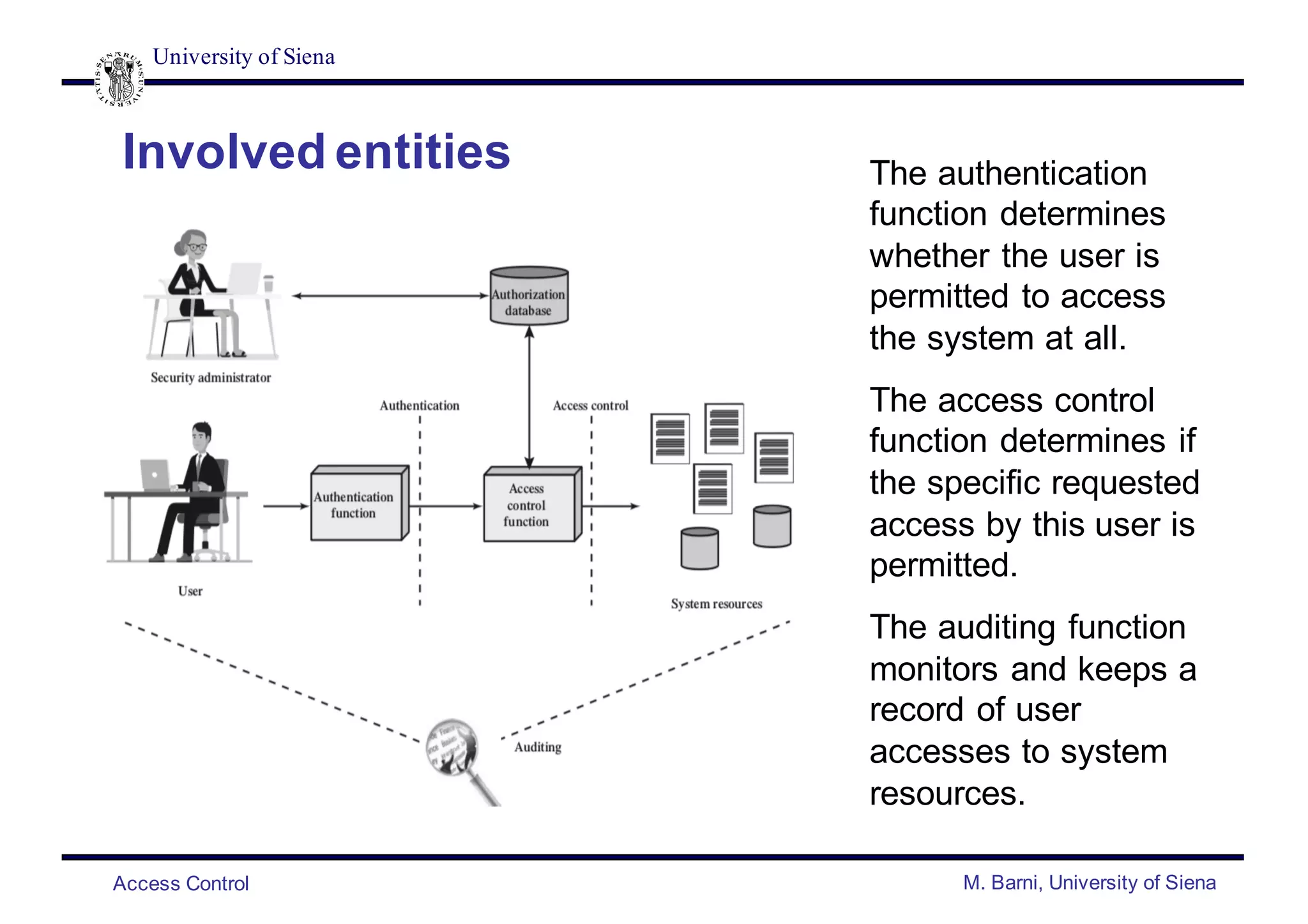
Involved entities The authentication
function determines
whether the user is
permitted to access
the system at all.
The access control
function determines if
the specific requested
access by this user is
permitted.
The auditing function
monitors and keeps a
record of user
accesses to system
resources.
University of Siena
Access Control M. Barni, University of Siena
Access control policies: DAC
• Discretionary access control
Controls access based on the identity of the requestor
and on access rules stating what requestors are (or are
not) allowed to do. This policy is termed discretionary
because an entity might have access rights that permit
the entity, by its own volition, to enable another entity
to access some resource.
University of Siena
Access Control M. Barni, University of Siena
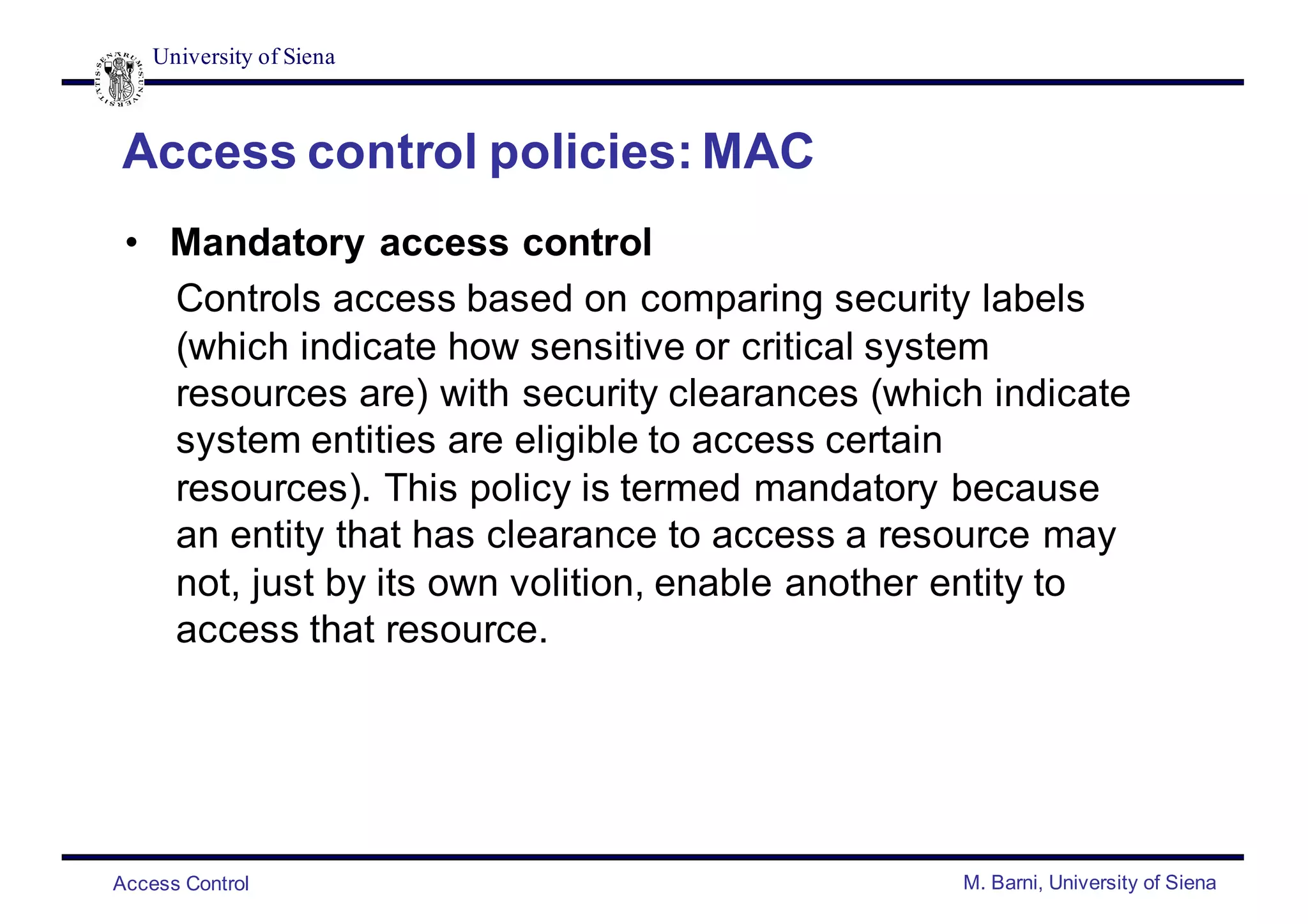
Access control policies: MAC
• Mandatory access control
Controls access based on comparing security labels
(which indicate how sensitive or critical system
resources are) with security clearances (which indicate
system entities are eligible to access certain
resources). This policy is termed mandatory because
an entity that has clearance to access a resource may
not, just by its own volition, enable another entity to
access that resource.
University of Siena
Access Control M. Barni, University of Siena
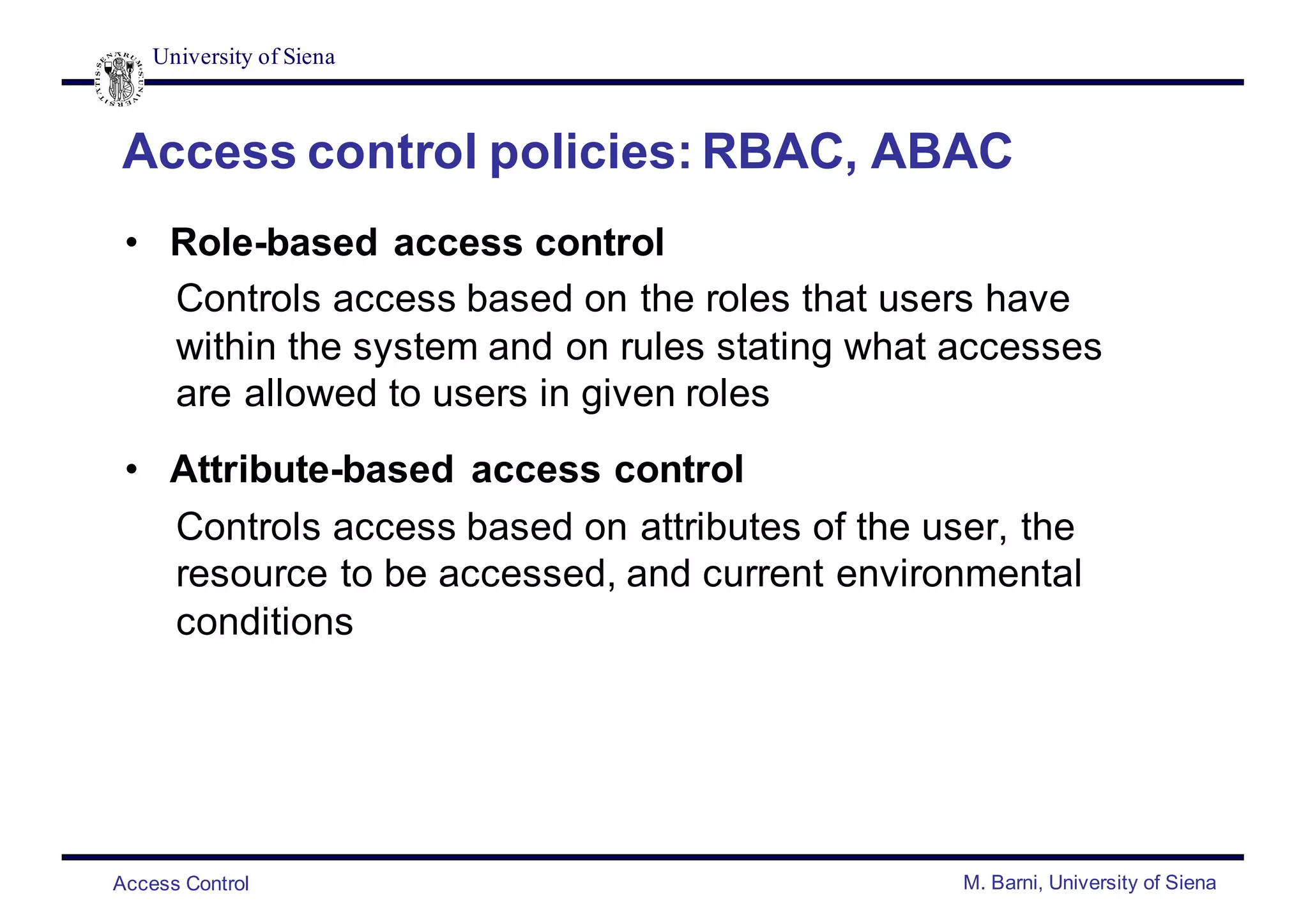
Access control policies: RBAC, ABAC
• Role-based access control
Controls access based on the roles that users have
within the system and on rules stating what accesses
are allowed to users in given roles
• Attribute-based access control
Controls access based on attributes of the user, the
resource to be accessed, and current environmental
conditions
University of Siena
Access Control M. Barni, University of Siena
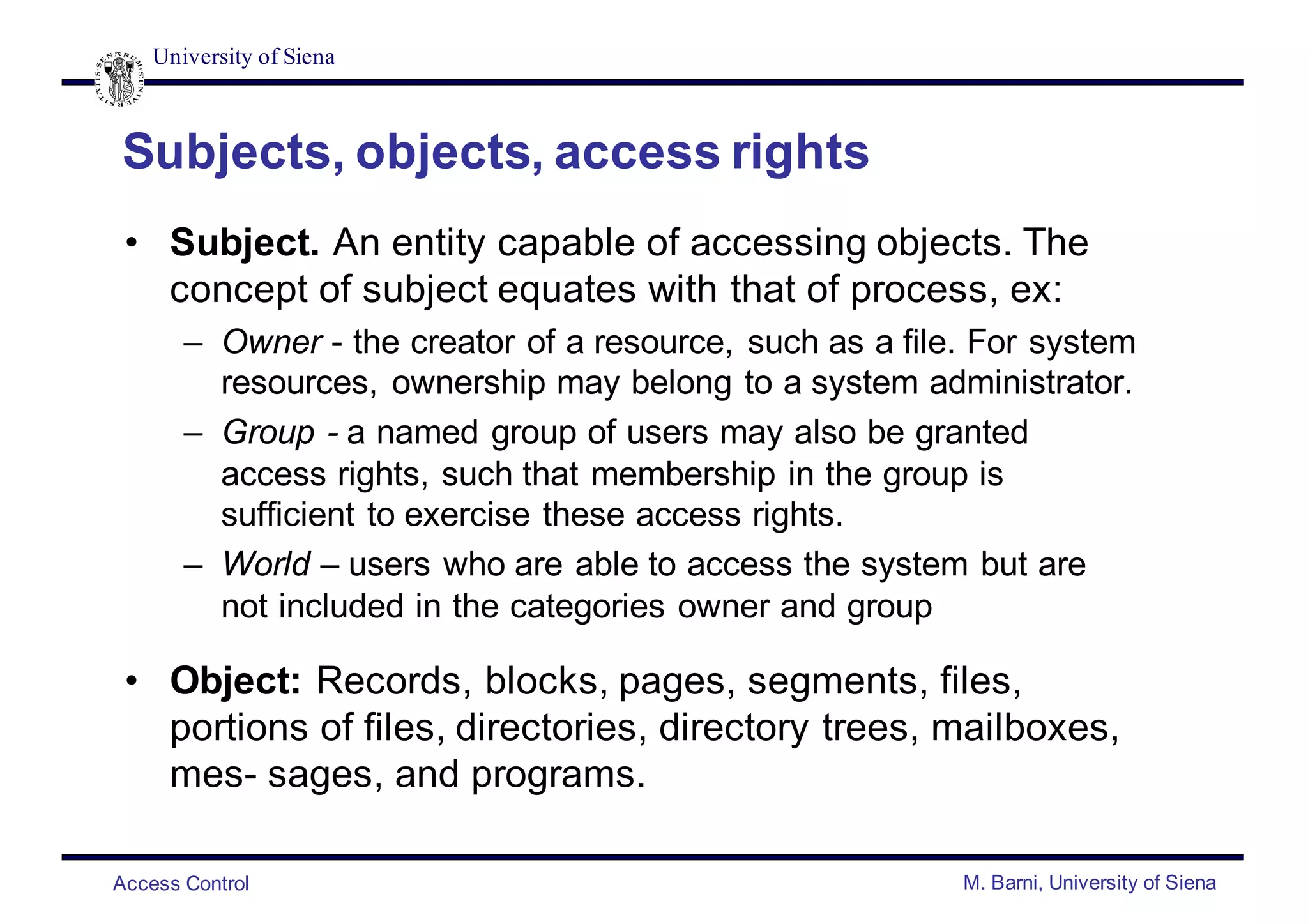
Subjects, objects, access rights
• Subject. An entity capable of accessing objects. The
concept of subject equates with that of process, ex:
– Owner - the creator of a resource, such as a file. For system
resources, ownership may belong to a system administrator.
– Group - a named group of users may also be granted
access rights, such that membership in the group is
sufficient to exercise these access rights.
– World – users who are able to access the system but are
not included in the categories owner and group
• Object: Records, blocks, pages, segments, files,
portions of files, directories, directory trees, mailboxes,
mes- sages, and programs.
University of Siena
Access Control M. Barni, University of Siena
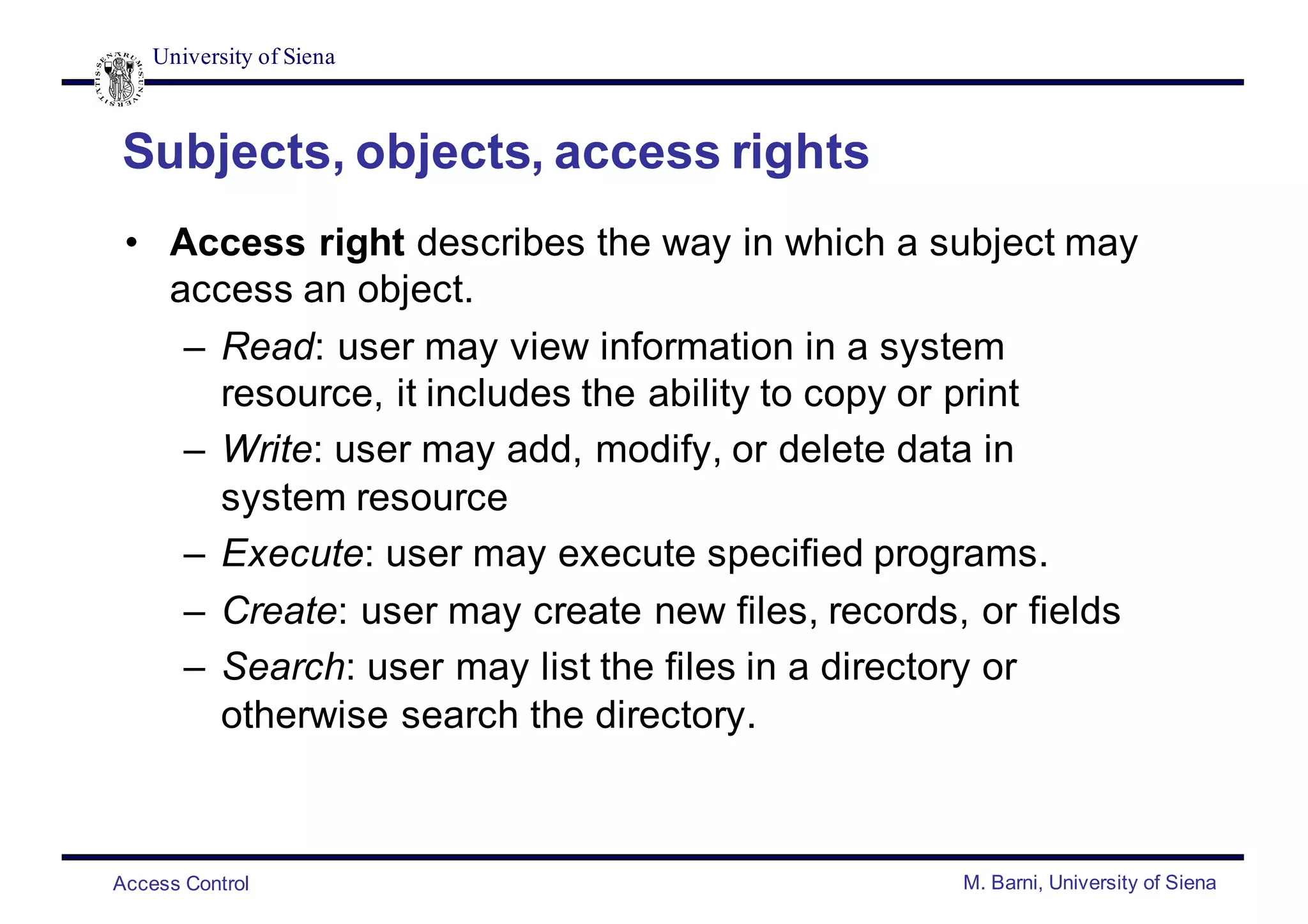
Subjects, objects, access rights
• Access right describes the way in which a subject may
access an object.
– Read: user may view information in a system
resource, it includes the ability to copy or print
– Write: user may add, modify, or delete data in
system resource
– Execute: user may execute specified programs.
– Create: user may create new files, records, or fields
– Search: user may list the files in a directory or
otherwise search the directory.
University of Siena
Access Control M. Barni, University of Siena
Discretionary Access Control
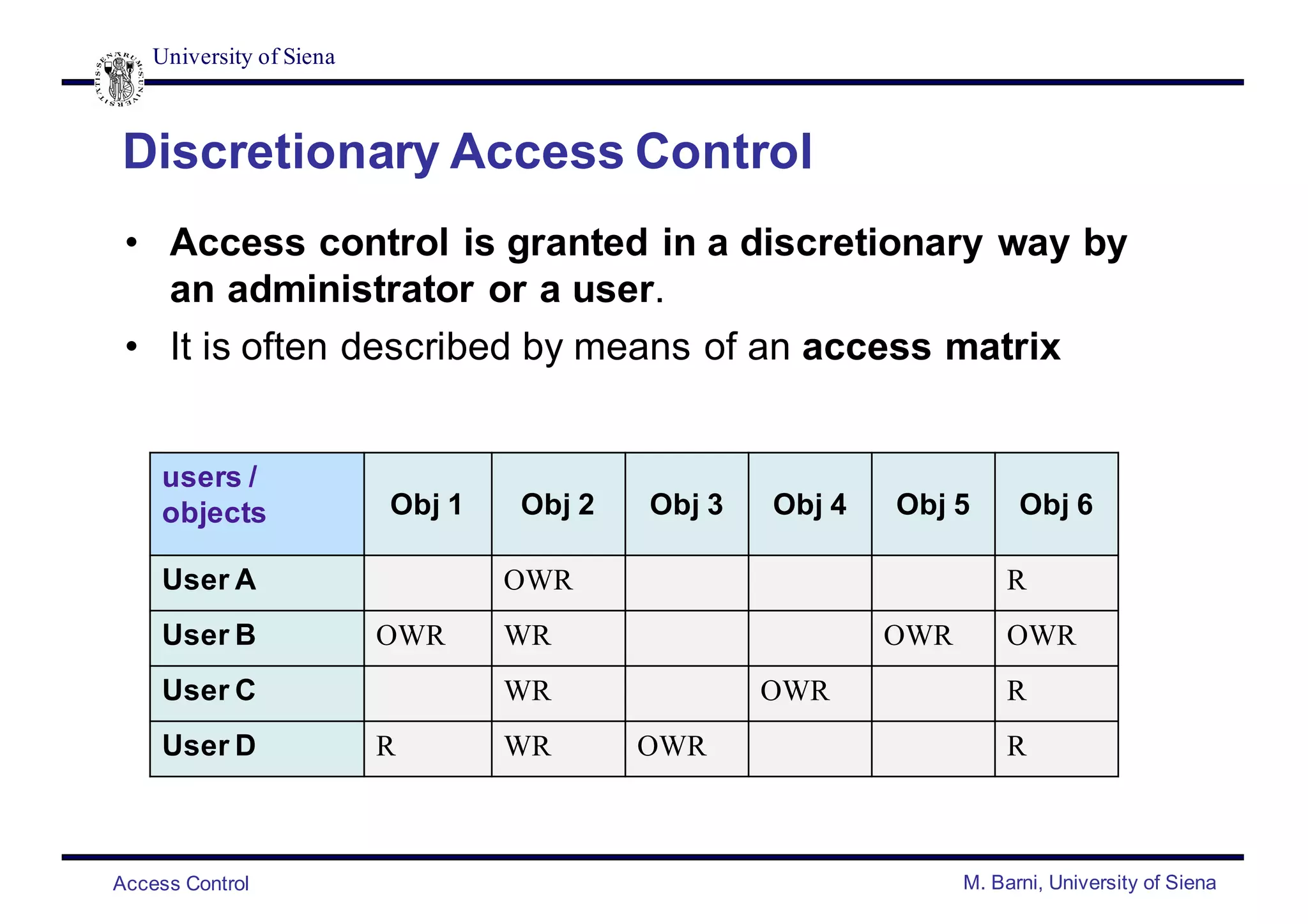
• Access control is granted in a discretionary way by
an administrator or a user.
• It is often described by means of an access matrix
users /
objects Obj 1 Obj 2 Obj 3 Obj 4 Obj 5 Obj 6
User A OWR R
User B OWR WR OWR OWR
User C WR OWR R
User D R WR OWR R
University of Siena
Access Control M. Barni, University of Siena
Access control lists
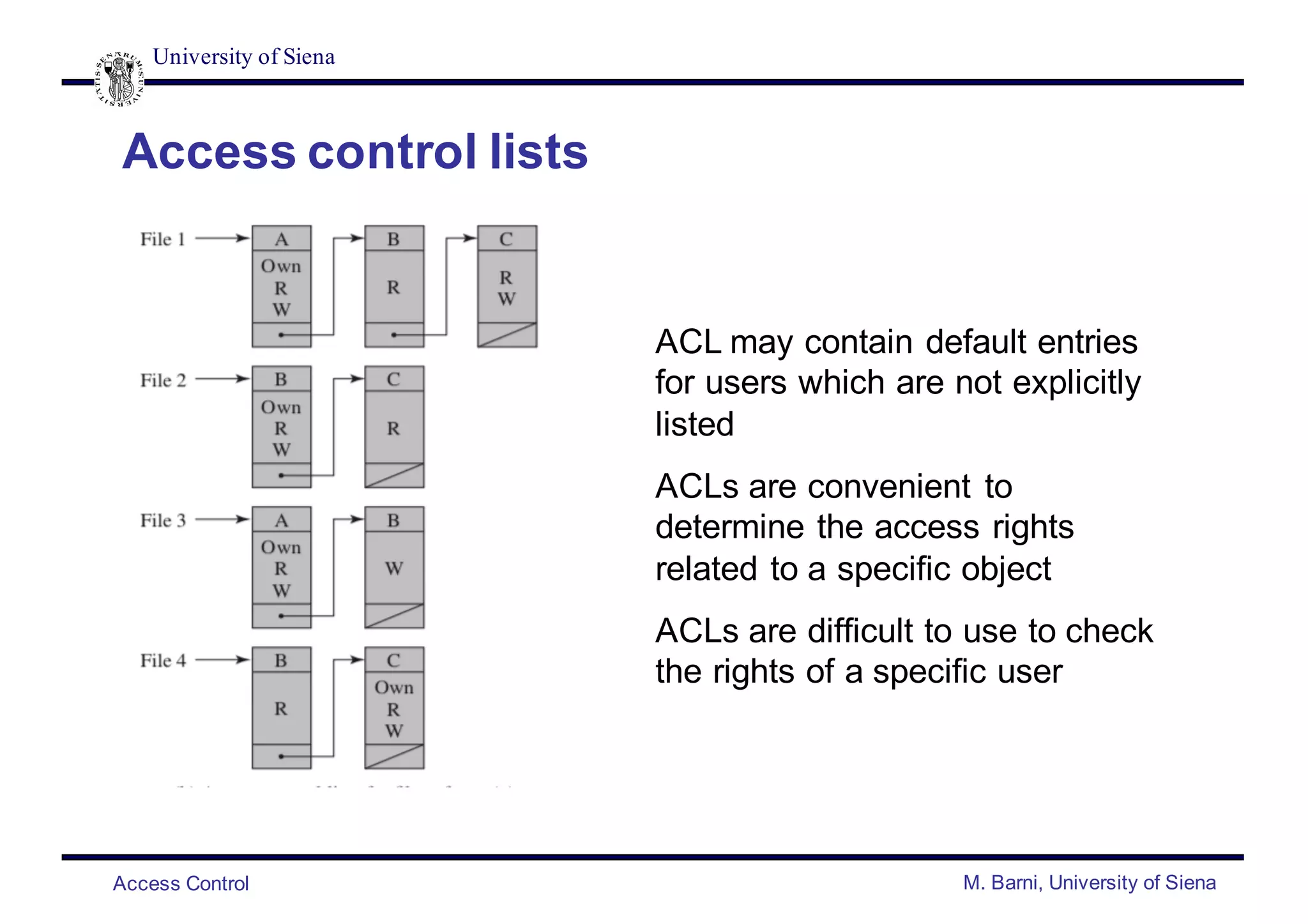
ACL may contain default entries
for users which are not explicitly
listed
ACLs are convenient to
determine the access rights
related to a specific object
ACLs are difficult to use to check
the rights of a specific user
University of Siena
Access Control M. Barni, University of Siena
Capability tickets
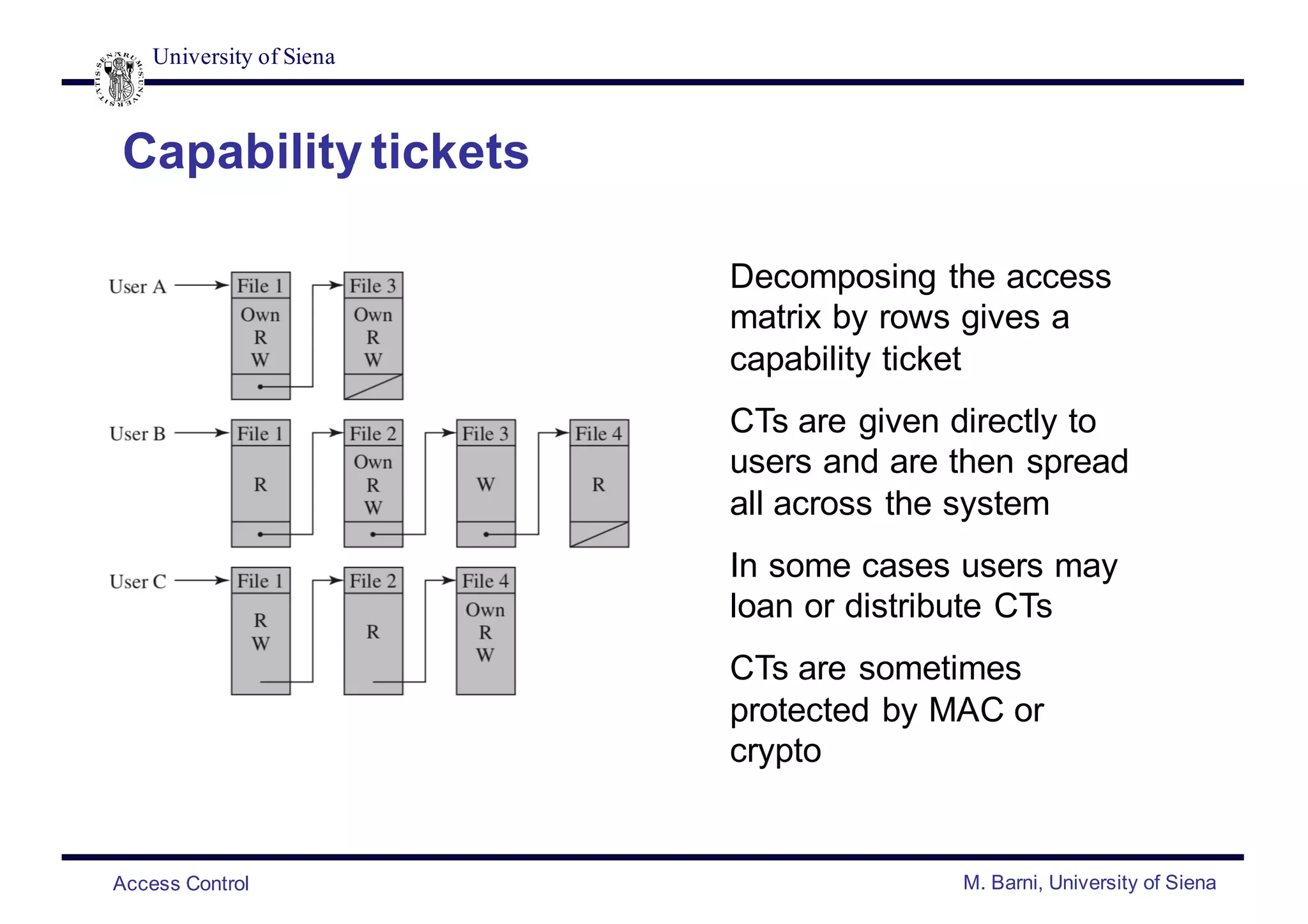
Decomposing the access
matrix by rows gives a
capability ticket
CTs are given directly to
users and are then spread
all across the system
In some cases users may
loan or distribute CTs
CTs are sometimes
protected by MAC or
crypto
University of Siena
Access Control M. Barni, University of Siena
DAC Access control model
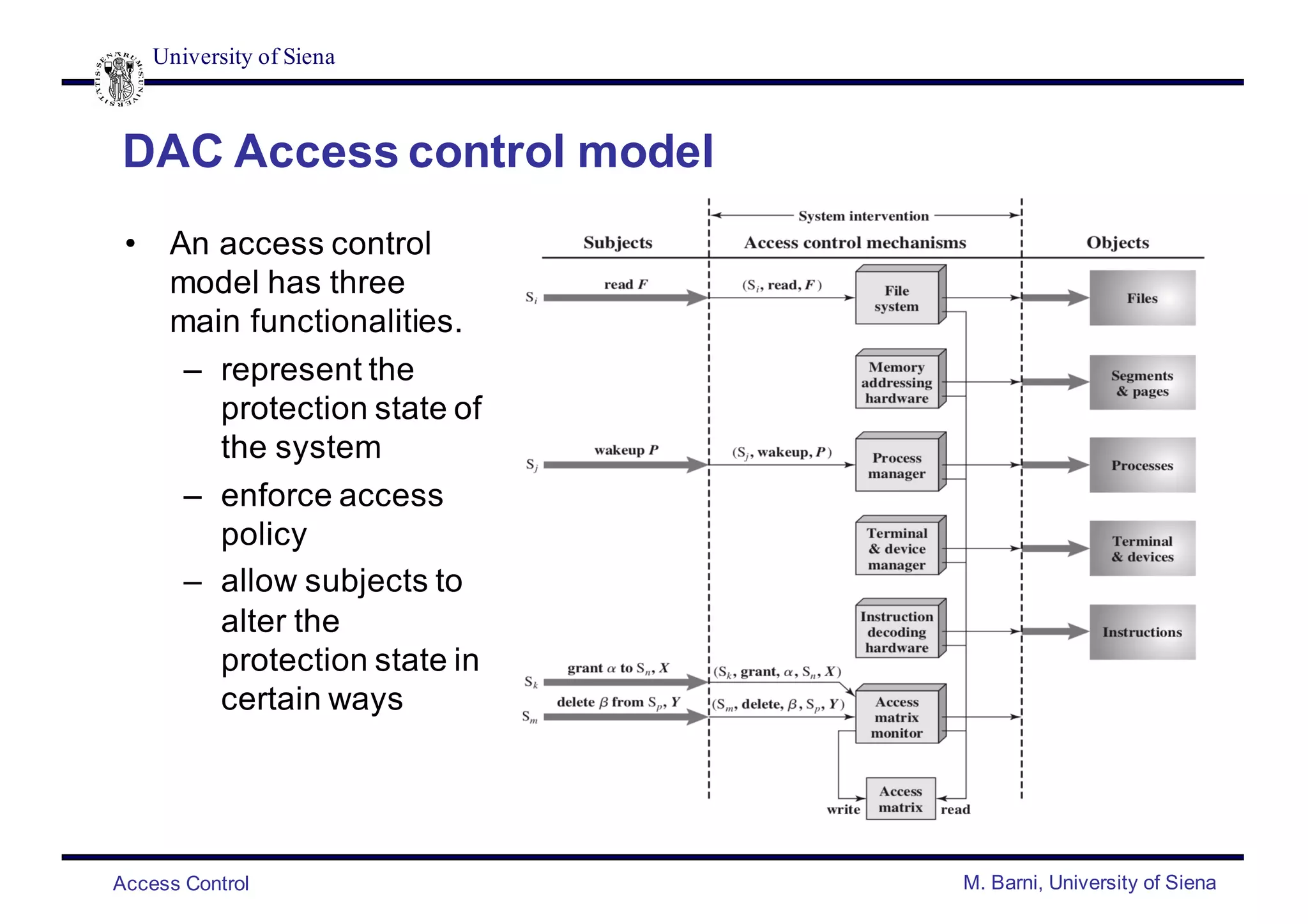
• An access control
model has three
main functionalities.
– represent the
protection state of
the system
– enforce access
policy
– allow subjects to
alter the
protection state in
certain ways
University of Siena
Access Control M. Barni, University of Siena
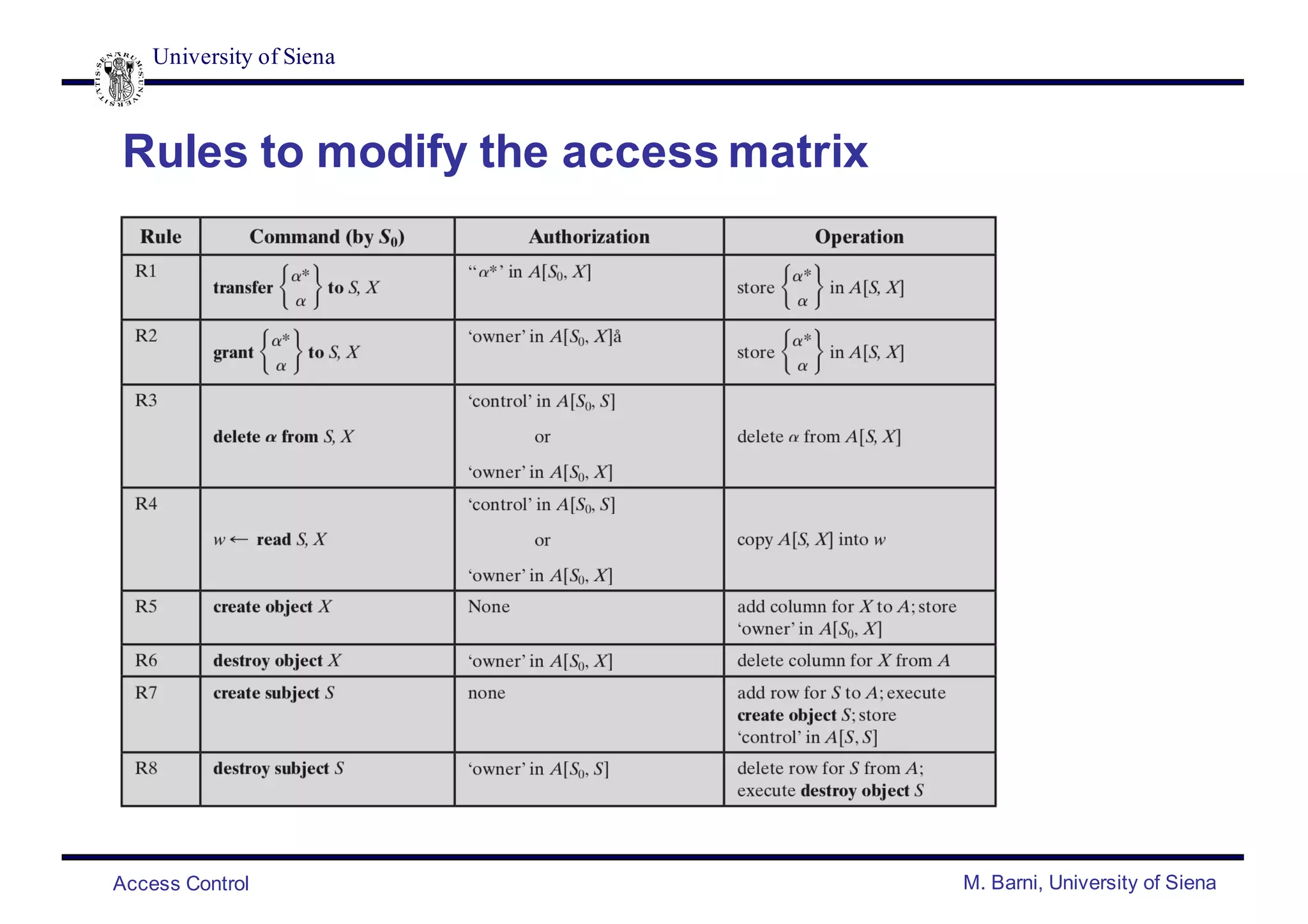
Rules to modify the access matrix
University of Siena
Access Control M. Barni, University of Siena
Role-Based Access Control: RBAC
• Access rights are assigned on the base of roles rather
than to users directly
• Users are assigned to roles either statically or dynamically
according to their responsibilities in the system
• Relationship between users and roles is many to many
• RBAC is getting more and more popularity due to its
flexibility with respect to DAC
University of Siena
Access Control M. Barni, University of Siena
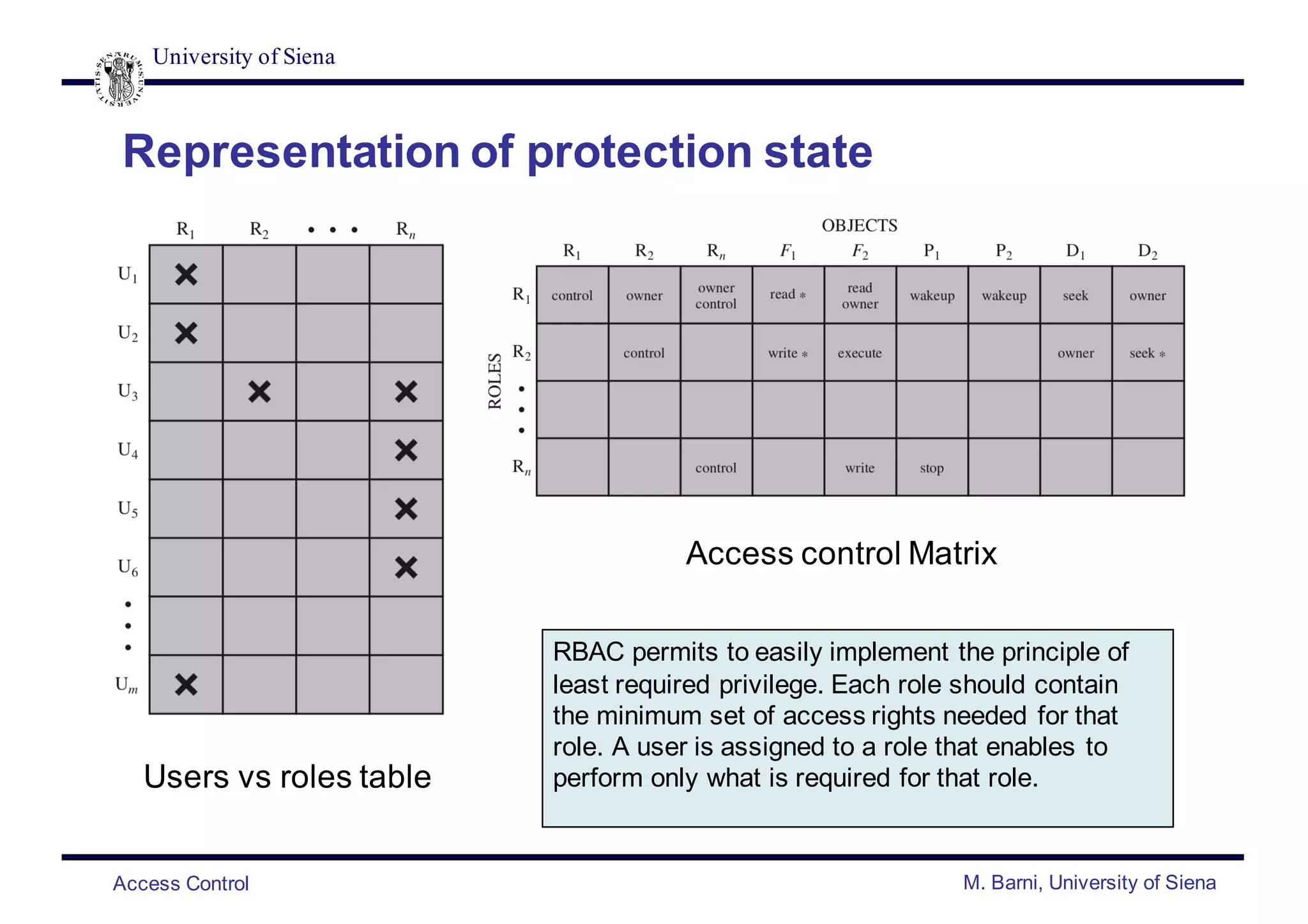
Representation of protection state
Users vs roles table
Access control Matrix
RBAC permits to easily implement the principle of
least required privilege. Each role should contain
the minimum set of access rights needed for that
role. A user is assigned to a role that enables to
perform only what is required for that role.
University of Siena
Access Control M. Barni, University of Siena
Attribute-Based Access Control: ABAC
• New approach, which is gaining consensus due to its
extreme flexibility (at the expense of complexity)
• Can implement DAC, MAC and RBAC as special cases
• Access control is granted based on rules applied to
attributes of both the objects and the subjects
requesting access
• Research still going on
University of Siena
Access Control M. Barni, University of Siena
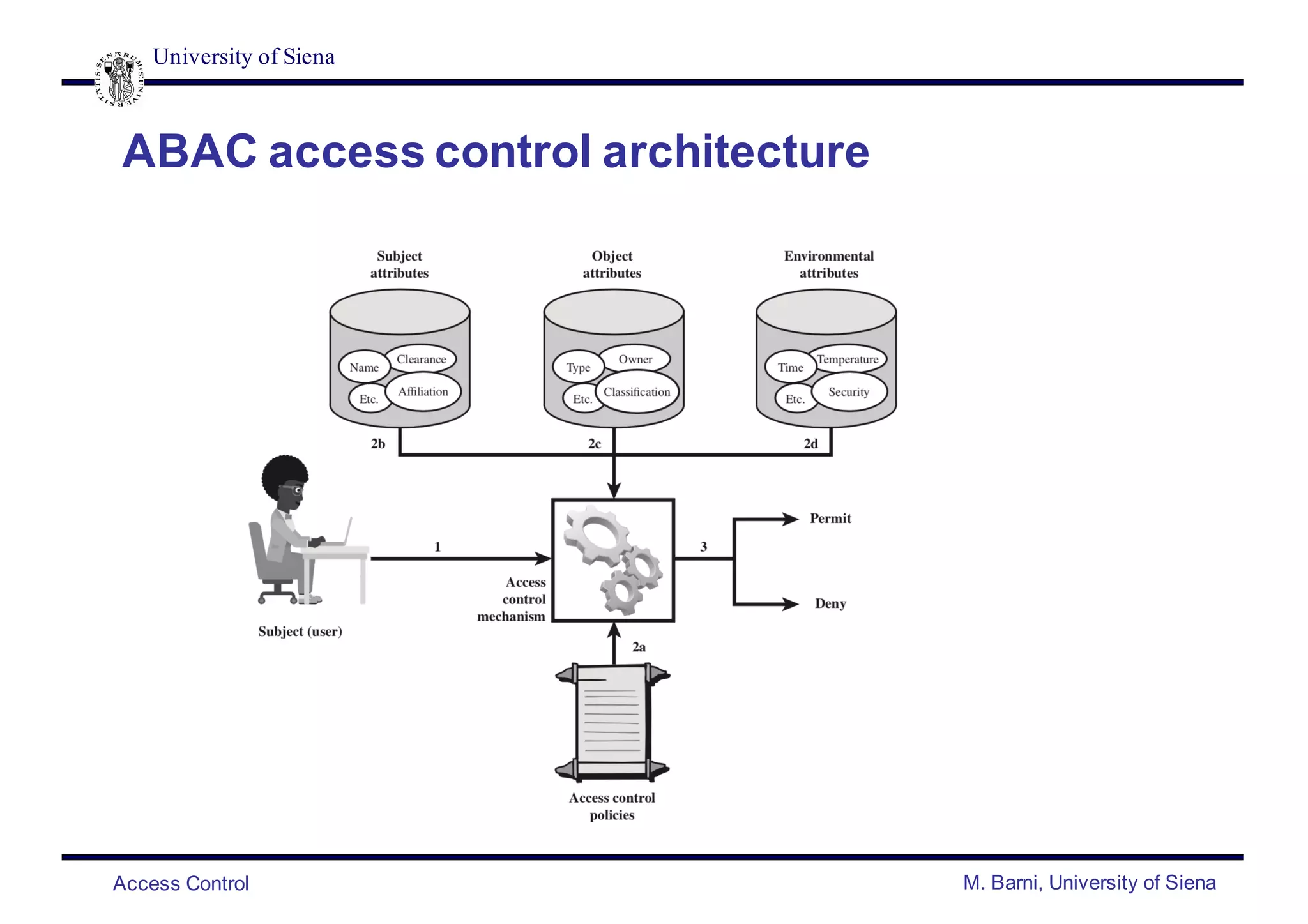
Attributes
• Subject attributes: each subject has associated attributes that define
the identity and characteristics of the subject. They may include the
subject’s identifier, name, organization, job title, and so on. A
subject’s role can also be viewed as an attribute.
• Object attributes: objects have attributes that can be lever- aged to
make access control decisions. A Microsoft Word document, for
example, may have attributes such as title, subject, date, and
author. Object attributes can often be extracted from the metadata
of the object.
• Environment attributes: they describe the operational, technical, and
even situational environment or context in which the information
access occurs. Examples include current date and time, the
network’s security level etc …
University of Siena
Access Control M. Barni, University of Siena
ABAC access control architecture
University of Siena
Access Control M. Barni, University of Siena
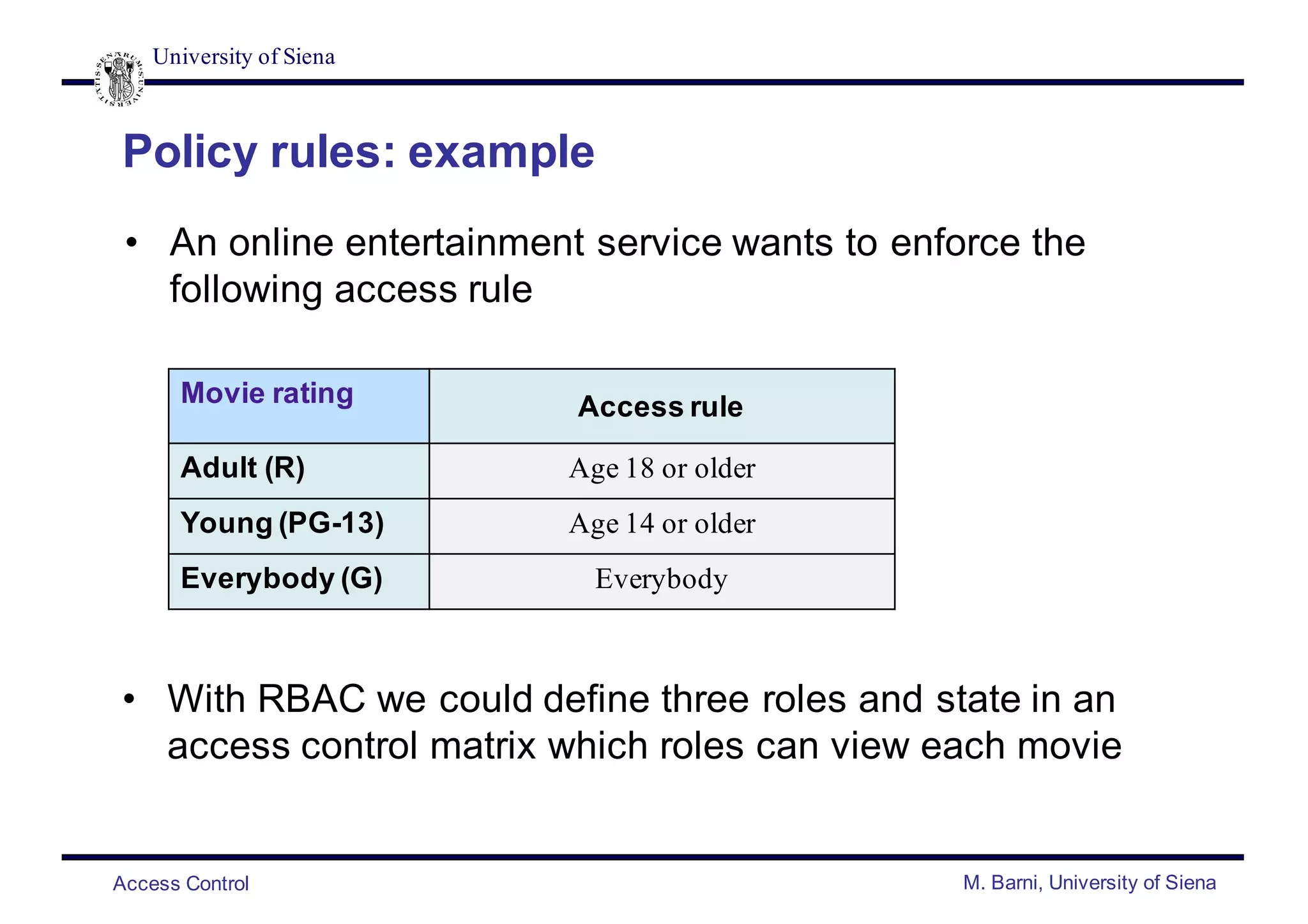
Policy rules: example
• An online entertainment service wants to enforce the
following access rule
Movie rating Access rule
Adult (R) Age 18 or older
Young (PG-13) Age 14 or older
Everybody (G) Everybody
• With RBAC we could define three roles and state in an
access control matrix which roles can view each movie
University of Siena
Access Control M. Barni, University of Siena
Policy rules: example
• With ABAC we can define the following attributes and
policy rule
Subject/
Object
Attributes Values
User Age [1-100]
Movie Rating {R, PG-13, G}
University of Siena
Access Control M. Barni, University of Siena
Policy rules: example
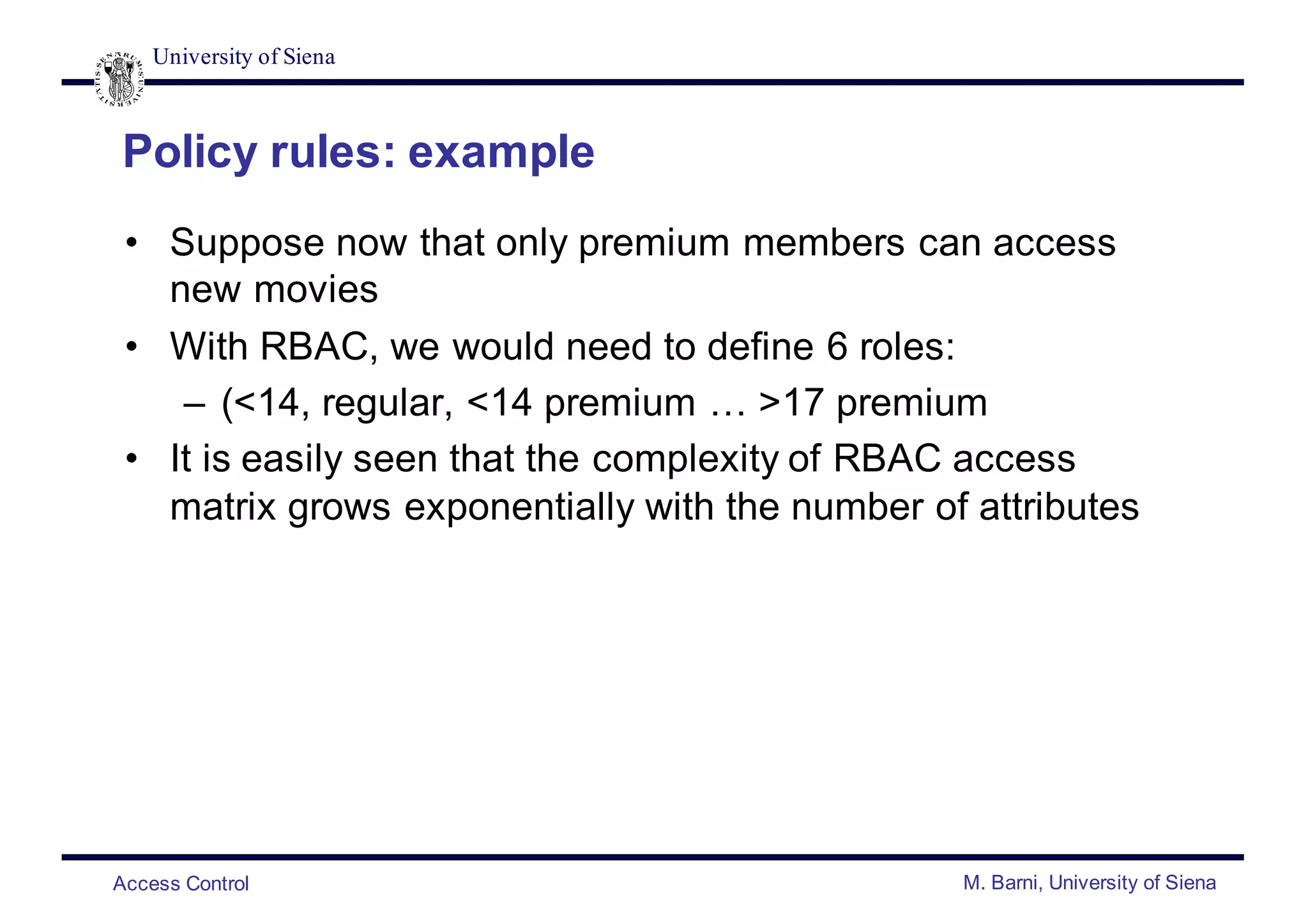
• Suppose now that only premium members can access
new movies
• With RBAC, we would need to define 6 roles:
– (<14, regular, <14 premium … >17 premium
• It is easily seen that the complexity of RBAC access
matrix grows exponentially with the number of attributes
University of Siena
Access Control M. Barni, University of Siena
Policy rules: example
• With ABAC everything is much simpler
Subject/Object Attributes Values
User Age [1-100]
User Subscription {Regular, Premium}
Movie Release {New release, old release}
Movie Rating {R, PG-13, G}
• Think about a new rule according to which regular users can
access new movies in promotional periods
University of Siena
Access Control M. Barni, University of Siena
References
• W. Stallings, L. Brown, “Computer security: principles
and practices”, Pearson, 4-th edition. Chapter 4.
• Lectures notes (these slides)

CyberSec_AccessControl.pdf

  • 1.
    University of Siena AccessControl M. Barni, University of Siena Cybersecurity Access Control Mauro Barni University of Siena
  • 2.
    University of Siena AccessControl M. Barni, University of Siena Access control: a crucial building block • NISTIR 7298 defines access control as the process of granting or denying specific requests to: – obtain and use information and related information processing services – enter specific physical facilities. • RFC 4949, Internet Security Glossary, defines access control as a process by which use of system resources is regulated according to a security policy and is permitted only by authorized entities according to that policy.
  • 3.
    University of Siena AccessControl M. Barni, University of Siena Involved entities The authentication function determines whether the user is permitted to access the system at all. The access control function determines if the specific requested access by this user is permitted. The auditing function monitors and keeps a record of user accesses to system resources.
  • 4.
    University of Siena AccessControl M. Barni, University of Siena Access control policies: DAC • Discretionary access control Controls access based on the identity of the requestor and on access rules stating what requestors are (or are not) allowed to do. This policy is termed discretionary because an entity might have access rights that permit the entity, by its own volition, to enable another entity to access some resource.
  • 5.
    University of Siena AccessControl M. Barni, University of Siena Access control policies: MAC • Mandatory access control Controls access based on comparing security labels (which indicate how sensitive or critical system resources are) with security clearances (which indicate system entities are eligible to access certain resources). This policy is termed mandatory because an entity that has clearance to access a resource may not, just by its own volition, enable another entity to access that resource.
  • 6.
    University of Siena AccessControl M. Barni, University of Siena Access control policies: RBAC, ABAC • Role-based access control Controls access based on the roles that users have within the system and on rules stating what accesses are allowed to users in given roles • Attribute-based access control Controls access based on attributes of the user, the resource to be accessed, and current environmental conditions
  • 7.
    University of Siena AccessControl M. Barni, University of Siena Subjects, objects, access rights • Subject. An entity capable of accessing objects. The concept of subject equates with that of process, ex: – Owner - the creator of a resource, such as a file. For system resources, ownership may belong to a system administrator. – Group - a named group of users may also be granted access rights, such that membership in the group is sufficient to exercise these access rights. – World – users who are able to access the system but are not included in the categories owner and group • Object: Records, blocks, pages, segments, files, portions of files, directories, directory trees, mailboxes, mes- sages, and programs.
  • 8.
    University of Siena AccessControl M. Barni, University of Siena Subjects, objects, access rights • Access right describes the way in which a subject may access an object. – Read: user may view information in a system resource, it includes the ability to copy or print – Write: user may add, modify, or delete data in system resource – Execute: user may execute specified programs. – Create: user may create new files, records, or fields – Search: user may list the files in a directory or otherwise search the directory.
  • 9.
    University of Siena AccessControl M. Barni, University of Siena Discretionary Access Control • Access control is granted in a discretionary way by an administrator or a user. • It is often described by means of an access matrix users / objects Obj 1 Obj 2 Obj 3 Obj 4 Obj 5 Obj 6 User A OWR R User B OWR WR OWR OWR User C WR OWR R User D R WR OWR R
  • 10.
    University of Siena AccessControl M. Barni, University of Siena Access control lists ACL may contain default entries for users which are not explicitly listed ACLs are convenient to determine the access rights related to a specific object ACLs are difficult to use to check the rights of a specific user
  • 11.
    University of Siena AccessControl M. Barni, University of Siena Capability tickets Decomposing the access matrix by rows gives a capability ticket CTs are given directly to users and are then spread all across the system In some cases users may loan or distribute CTs CTs are sometimes protected by MAC or crypto
  • 12.
    University of Siena AccessControl M. Barni, University of Siena DAC Access control model • An access control model has three main functionalities. – represent the protection state of the system – enforce access policy – allow subjects to alter the protection state in certain ways
  • 13.
    University of Siena AccessControl M. Barni, University of Siena Rules to modify the access matrix
  • 14.
    University of Siena AccessControl M. Barni, University of Siena Role-Based Access Control: RBAC • Access rights are assigned on the base of roles rather than to users directly • Users are assigned to roles either statically or dynamically according to their responsibilities in the system • Relationship between users and roles is many to many • RBAC is getting more and more popularity due to its flexibility with respect to DAC
  • 15.
    University of Siena AccessControl M. Barni, University of Siena Representation of protection state Users vs roles table Access control Matrix RBAC permits to easily implement the principle of least required privilege. Each role should contain the minimum set of access rights needed for that role. A user is assigned to a role that enables to perform only what is required for that role.
  • 16.
    University of Siena AccessControl M. Barni, University of Siena Attribute-Based Access Control: ABAC • New approach, which is gaining consensus due to its extreme flexibility (at the expense of complexity) • Can implement DAC, MAC and RBAC as special cases • Access control is granted based on rules applied to attributes of both the objects and the subjects requesting access • Research still going on
  • 17.
    University of Siena AccessControl M. Barni, University of Siena Attributes • Subject attributes: each subject has associated attributes that define the identity and characteristics of the subject. They may include the subject’s identifier, name, organization, job title, and so on. A subject’s role can also be viewed as an attribute. • Object attributes: objects have attributes that can be lever- aged to make access control decisions. A Microsoft Word document, for example, may have attributes such as title, subject, date, and author. Object attributes can often be extracted from the metadata of the object. • Environment attributes: they describe the operational, technical, and even situational environment or context in which the information access occurs. Examples include current date and time, the network’s security level etc …
  • 18.
    University of Siena AccessControl M. Barni, University of Siena ABAC access control architecture
  • 19.
    University of Siena AccessControl M. Barni, University of Siena Policy rules: example • An online entertainment service wants to enforce the following access rule Movie rating Access rule Adult (R) Age 18 or older Young (PG-13) Age 14 or older Everybody (G) Everybody • With RBAC we could define three roles and state in an access control matrix which roles can view each movie
  • 20.
    University of Siena AccessControl M. Barni, University of Siena Policy rules: example • With ABAC we can define the following attributes and policy rule Subject/ Object Attributes Values User Age [1-100] Movie Rating {R, PG-13, G}
  • 21.
    University of Siena AccessControl M. Barni, University of Siena Policy rules: example • Suppose now that only premium members can access new movies • With RBAC, we would need to define 6 roles: – (<14, regular, <14 premium … >17 premium • It is easily seen that the complexity of RBAC access matrix grows exponentially with the number of attributes
  • 22.
    University of Siena AccessControl M. Barni, University of Siena Policy rules: example • With ABAC everything is much simpler Subject/Object Attributes Values User Age [1-100] User Subscription {Regular, Premium} Movie Release {New release, old release} Movie Rating {R, PG-13, G} • Think about a new rule according to which regular users can access new movies in promotional periods
  • 23.
    University of Siena AccessControl M. Barni, University of Siena References • W. Stallings, L. Brown, “Computer security: principles and practices”, Pearson, 4-th edition. Chapter 4. • Lectures notes (these slides)