Master
Data
Management
Sreekanth N
Agenda
• Introduction
• Objective of MDM
• Who needs MDM?
• Solutions
• Conclusion
• References
Introduction
• In business, master data management is a method used to define and
manage the critical data of an organization to provide, with data
integration, a single point of reference.
• The data that is mastered may include reference
• data- the set of permissible values and
• analytical data that supports decision making
• In computing, a master data management tool can be used to support
master data management by
• removing duplicates,
• standardizing data and
• incorporating rules
• Thus eliminating incorrect data from entering the system in order to create
an authoritative source of master data.
Objective of MDM
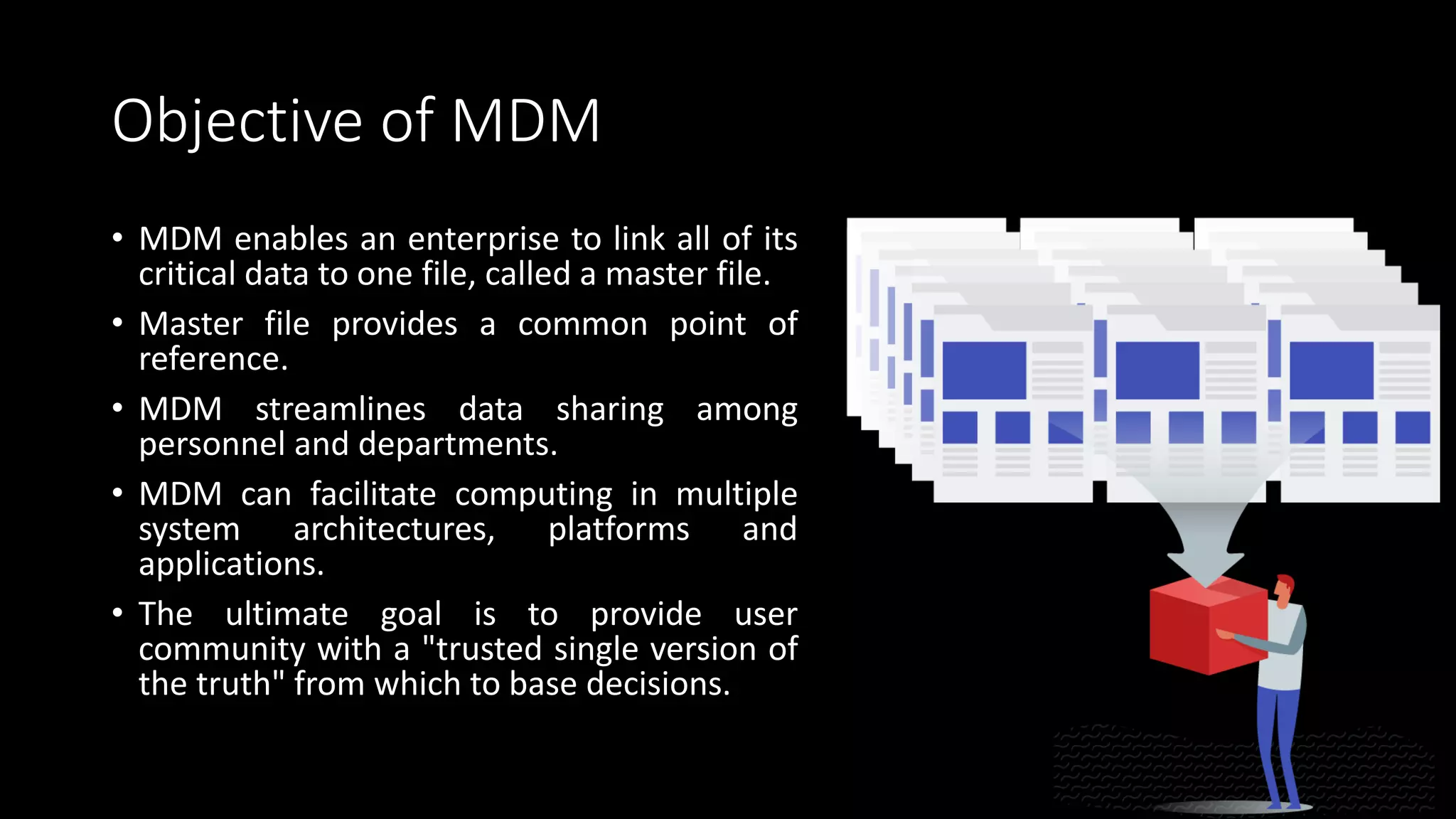
• MDM enables an enterprise to link all of its
critical data to one file, called a master file.
• Master file provides a common point of
reference.
• MDM streamlines data sharing among
personnel and departments.
• MDM can facilitate computing in multiple
system architectures, platforms and
applications.
• The ultimate goal is to provide user
community with a "trusted single version of
the truth" from which to base decisions.
Who needs MDM?
• MDM is of particular interest to
• large organizations,
• highly data distributed organizations
• those that have frequent or large-scale merger and
• acquisition activity.
• Acquiring another company creates wide-reaching data integration
challenges that MDM is designed to mitigate.
• MDM can accelerate the time-to-value from an acquisition.
• MDM also helps companies with segmented product lines, preventing
disintegrated customer experiences.
Solutions
• The common baseline for Master Data Management solutions comprises the
following processes:
• Source identification - the 'system of record' needs to be identified first.
• Data collection - the data needs to be collected from various sources as some
sources may attach a new piece of information, while dropping pieces which they
are not interested in.
• Transformation - the transformation step takes place both during the input, while
data are converted into a format for MDM processing, as well as on the output
when distributing the master records back to the particular systems and
applications.
• Data consolidation - the records from various systems which represent the same
physical entity are consolidated into one record - a master record. The record is
assigned a version number to enable a mechanism to check which version of
record is being used in particular systems.
Solutions
• Data deduplication - often there are separate records in the company's
systems, which in fact identify the same entity. It is vital that these
duplicates are deduplicated and maintained as one master record.
• Error detection - based on the rules and metrics, the incomplete records or
records containing inconsistent data should be identified and sent to their
respective owners before publishing them to all the other applications.
• Data correction - related to error detection, this step notifies the owner of
the data record that there is a need to review the record manually.
• Data distribution/synchronization - the master records are distributed to
the systems in the enterprise. The goal is that all the systems are using the
same version of the record as soon as possible after the publication of the
new record.
Conclusion
• By providing one point of reference for critical
information, MDM eliminates costly redundancies
that occur when organizations rely upon multiple,
conflicting sources of information.
• For example, MDM can make sure that when
customer contact information changes, the
organization will not attempt sales or marketing
outreach using both the old and new information.
• Having multiple sources of information is a
widespread problem, especially in large
organizations, and the associated costs can be very
high.
References
• https://www.dataintegration.info/master-data-management
• https://www.informatica.com/in/services-and-training/glossary-of-
terms/master-data-management-definition.html#fbid=4uINlE3Q6wV
• https://en.wikipedia.org/wiki/Master_data_management
Master Data Management

Master Data Management

  • 1.
  • 2.
    Agenda • Introduction • Objectiveof MDM • Who needs MDM? • Solutions • Conclusion • References
  • 3.
    Introduction • In business,master data management is a method used to define and manage the critical data of an organization to provide, with data integration, a single point of reference. • The data that is mastered may include reference • data- the set of permissible values and • analytical data that supports decision making • In computing, a master data management tool can be used to support master data management by • removing duplicates, • standardizing data and • incorporating rules • Thus eliminating incorrect data from entering the system in order to create an authoritative source of master data.
  • 4.
    Objective of MDM •MDM enables an enterprise to link all of its critical data to one file, called a master file. • Master file provides a common point of reference. • MDM streamlines data sharing among personnel and departments. • MDM can facilitate computing in multiple system architectures, platforms and applications. • The ultimate goal is to provide user community with a "trusted single version of the truth" from which to base decisions.
  • 5.
    Who needs MDM? •MDM is of particular interest to • large organizations, • highly data distributed organizations • those that have frequent or large-scale merger and • acquisition activity. • Acquiring another company creates wide-reaching data integration challenges that MDM is designed to mitigate. • MDM can accelerate the time-to-value from an acquisition. • MDM also helps companies with segmented product lines, preventing disintegrated customer experiences.
  • 6.
    Solutions • The commonbaseline for Master Data Management solutions comprises the following processes: • Source identification - the 'system of record' needs to be identified first. • Data collection - the data needs to be collected from various sources as some sources may attach a new piece of information, while dropping pieces which they are not interested in. • Transformation - the transformation step takes place both during the input, while data are converted into a format for MDM processing, as well as on the output when distributing the master records back to the particular systems and applications. • Data consolidation - the records from various systems which represent the same physical entity are consolidated into one record - a master record. The record is assigned a version number to enable a mechanism to check which version of record is being used in particular systems.
  • 7.
    Solutions • Data deduplication- often there are separate records in the company's systems, which in fact identify the same entity. It is vital that these duplicates are deduplicated and maintained as one master record. • Error detection - based on the rules and metrics, the incomplete records or records containing inconsistent data should be identified and sent to their respective owners before publishing them to all the other applications. • Data correction - related to error detection, this step notifies the owner of the data record that there is a need to review the record manually. • Data distribution/synchronization - the master records are distributed to the systems in the enterprise. The goal is that all the systems are using the same version of the record as soon as possible after the publication of the new record.
  • 8.
    Conclusion • By providingone point of reference for critical information, MDM eliminates costly redundancies that occur when organizations rely upon multiple, conflicting sources of information. • For example, MDM can make sure that when customer contact information changes, the organization will not attempt sales or marketing outreach using both the old and new information. • Having multiple sources of information is a widespread problem, especially in large organizations, and the associated costs can be very high.
  • 9.

Editor's Notes

  • #7 If the same record is stored in multiple systems, the system which holds the most relevant copy of that record is referred to as a 'system of record'.