Return on Investment:
Training and Development
Session 1
ROI and Evaluation
Objectives
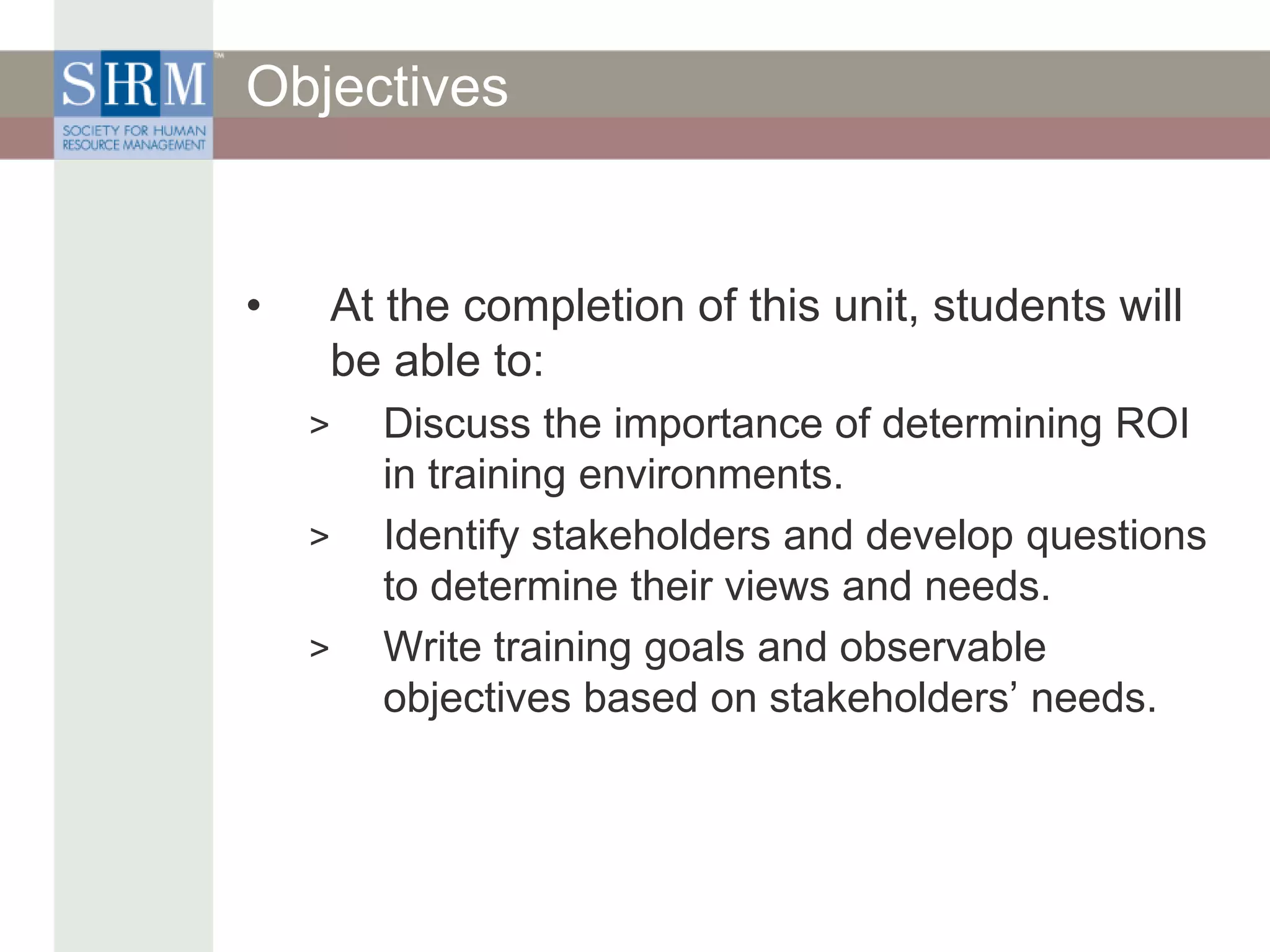
• At the completion of this unit, students will
be able to:
> Discuss the importance of determining ROI
in training environments.
> Identify stakeholders and develop questions
to determine their views and needs.
> Write training goals and observable
objectives based on stakeholders’ needs.
Objectives
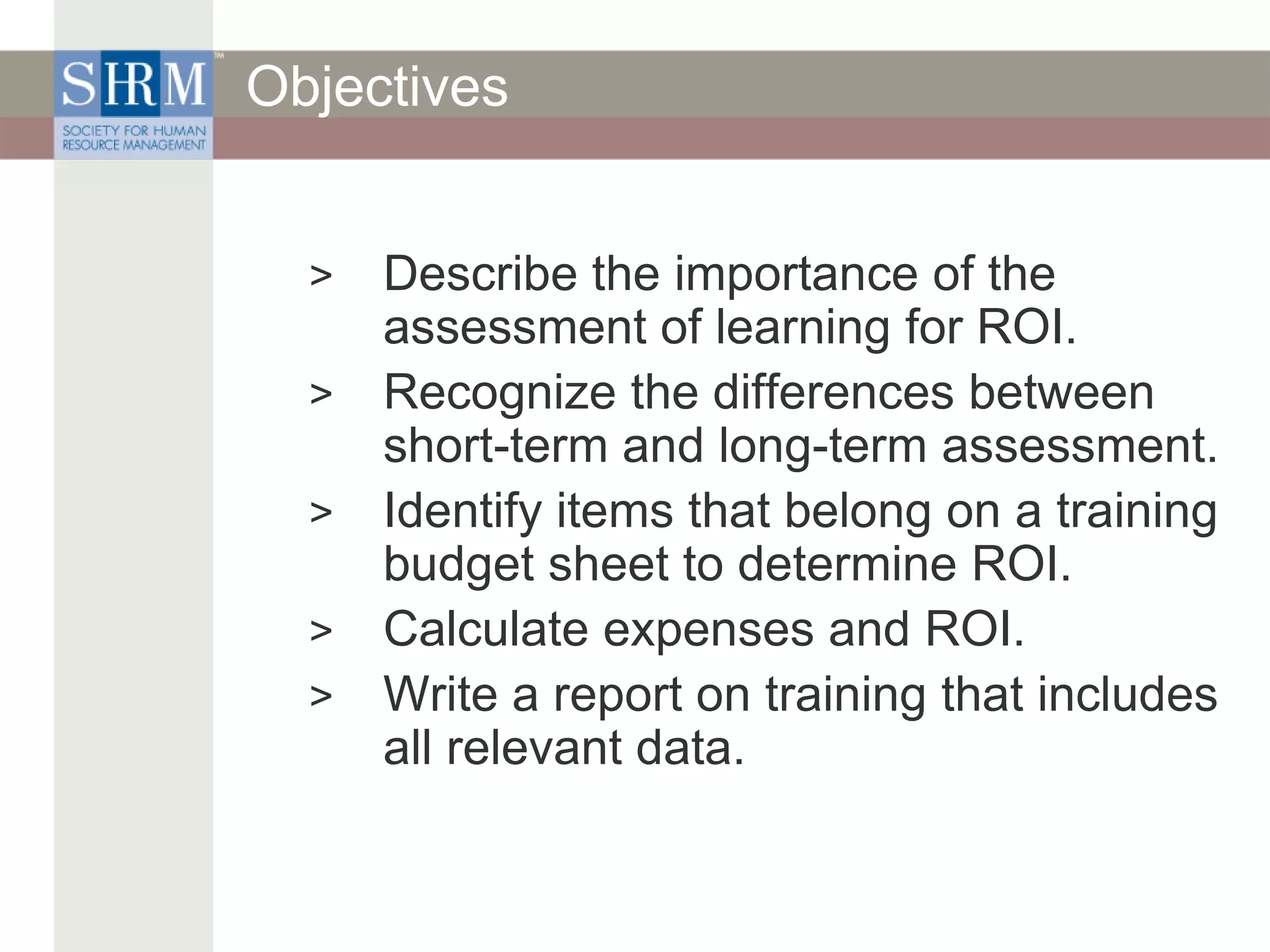
> Describe the importance of the
assessment of learning for ROI.
> Recognize the differences between
short-term and long-term assessment.
> Identify items that belong on a training
budget sheet to determine ROI.
> Calculate expenses and ROI.
> Write a report on training that includes
all relevant data.
Return on Investment
• Rooted in manufacturing.
• Advanced to banking, health care, non-
profit, public and education sectors.
• Part of quality and efficiency
methodologies.
ROI Is Used To:
> Quantify the effectiveness of training.
> Manage the training budget.
> Provide evidence to management
and other stakeholders.
> Build trust and respect for ourselves
and our unit.
> Earn the ears of senior management.
> Identify areas for improvement.
> Provide data requested by senior
management.
> Keep our jobs.
Models
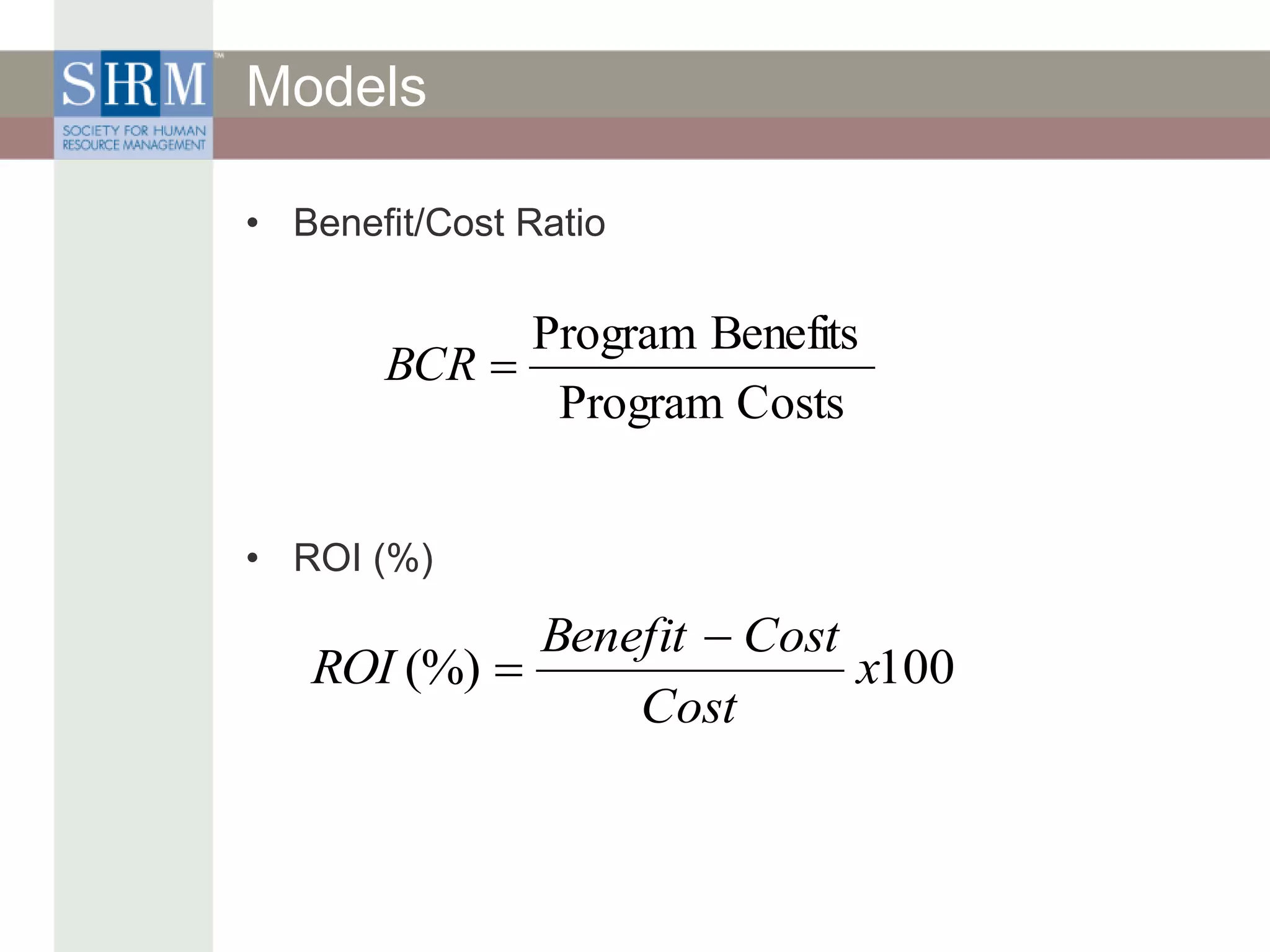
• Benefit/Cost Ratio
• ROI (%)
Costs
Program
Benefits
Program

BCR
100
(%) x
Cost
Cost
Benefit
ROI


Why is ROI important to you?
Evaluation Levels
1. Reaction and Planned Action
2. Learning
3. Application and Implementation
4. Business Impact
5. Return on Investment
Stakeholders
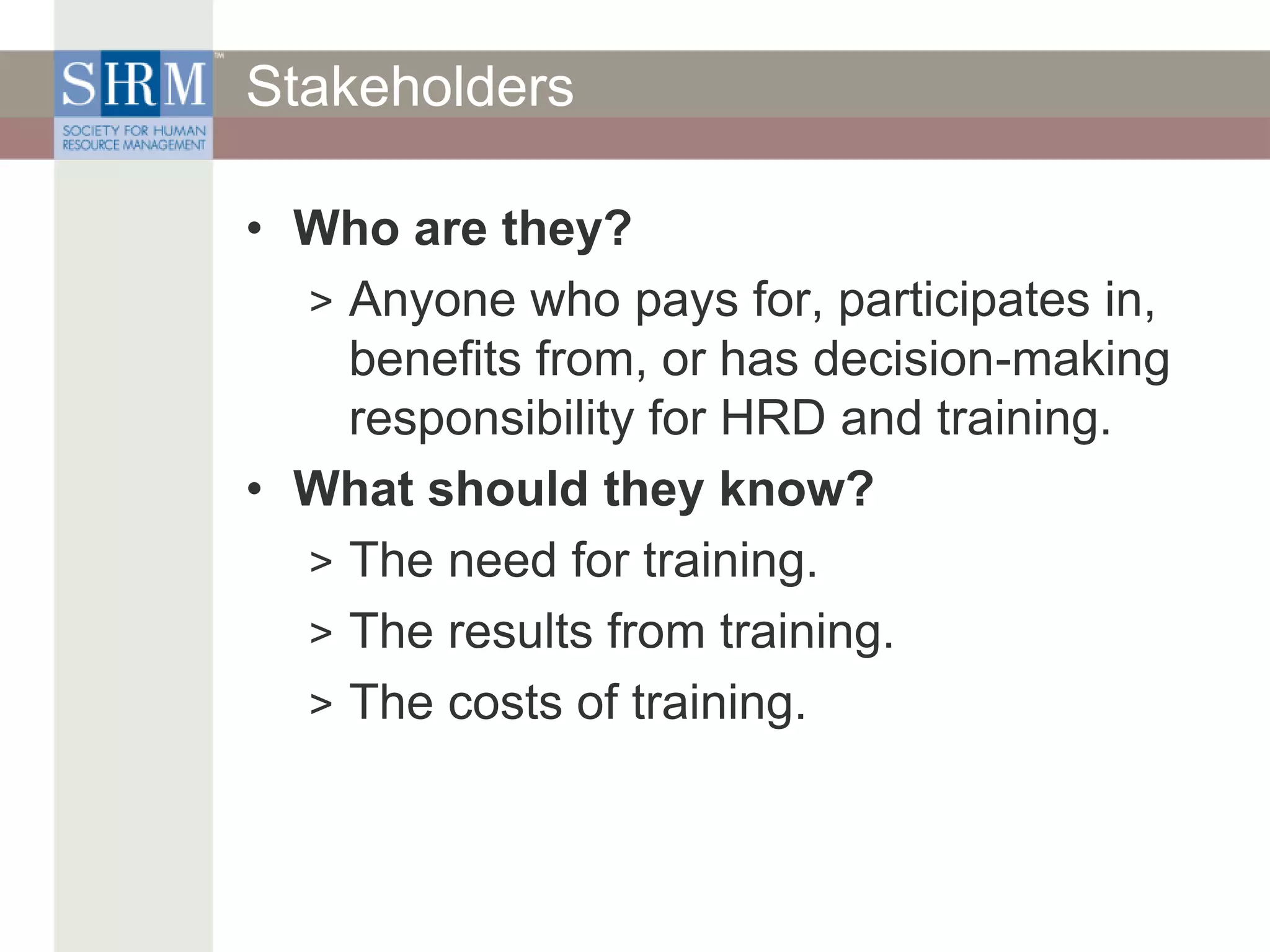
• Who are they?
> Anyone who pays for, participates in,
benefits from, or has decision-making
responsibility for HRD and training.
• What should they know?
> The need for training.
> The results from training.
> The costs of training.
Needs Assessment and Task Analysis
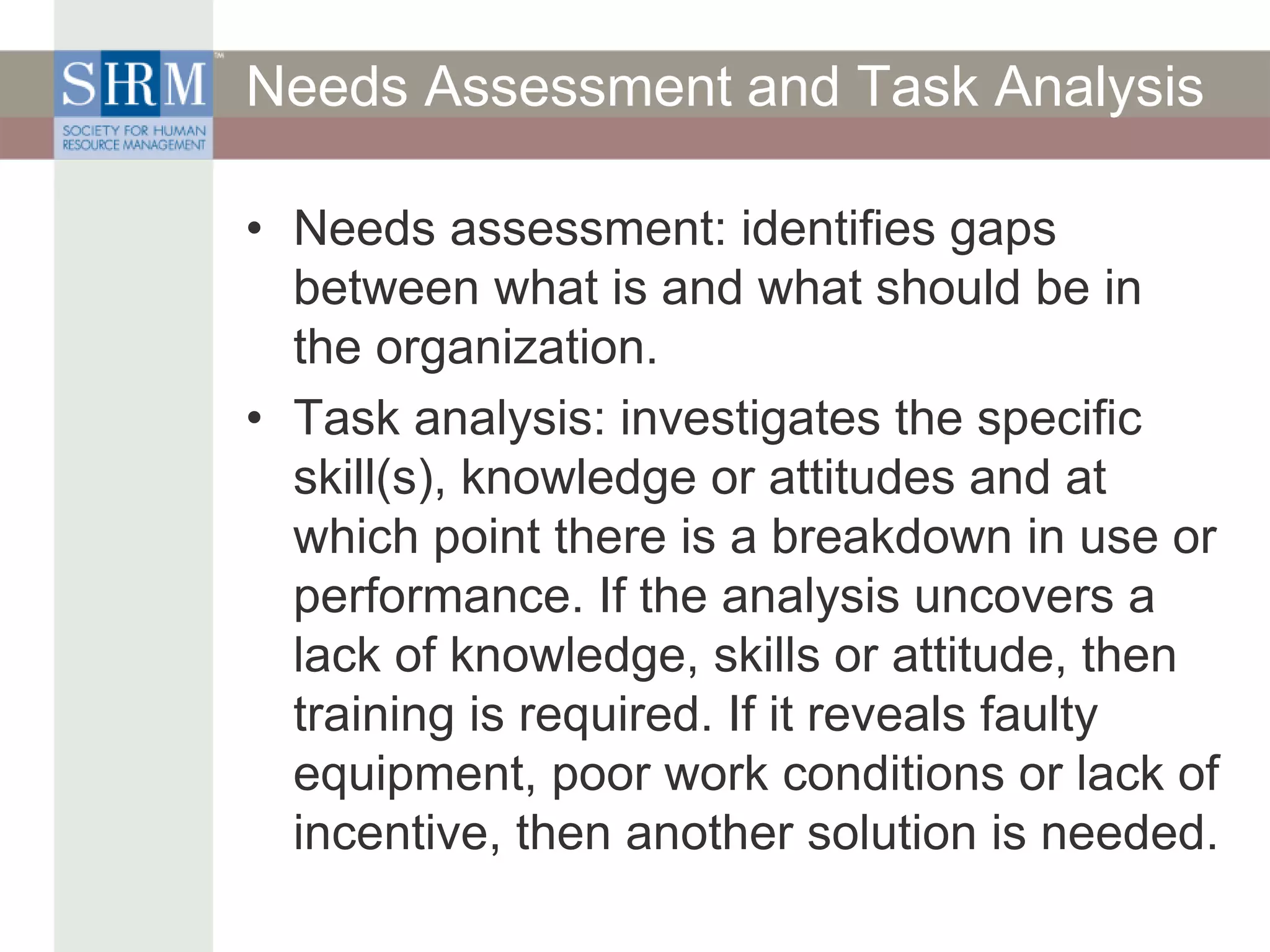
• Needs assessment: identifies gaps
between what is and what should be in
the organization.
• Task analysis: investigates the specific
skill(s), knowledge or attitudes and at
which point there is a breakdown in use or
performance. If the analysis uncovers a
lack of knowledge, skills or attitude, then
training is required. If it reveals faulty
equipment, poor work conditions or lack of
incentive, then another solution is needed.
Return on Investment:
Training and Development
Session 2
Goals, Objectives, Assessment
Goals
• Organizational Goals
These goals are typically targeted
toward the organizational level and
include such things as productivity, net
income, inventory and cash cycles, and
customer satisfaction.
• Learning Goals
These goals typically focus on the
individuals in the organization and their
performance, knowledge and skills.
Writing Objectives
Easy as A, B, C, D
Audience: Who?
Behavior: What do “they” do?
Condition: What is the setting and
method of evaluation?
Degree: Measurement to be met.
Example Objective
Audience
Behavior
Condition
Degree
At the completion of the course the learner
will be able to score 85% or better on a
written multiple choice 25 question test
Example Verbs
• Verbs to Use:
> Discuss
> Explain
> Demonstrate
> Identify
> List
> Perform
> Compare/Contrast
> Score (on an
assessment)
• Verbs to Avoid
> Understand
> Comprehend
> Know
> Do
Objectives in ROI
• Course objectives: What is it that the
learners will be able to do upon course
completion?
• Application objectives: What goals do
the HRD/training practitioner have for the
application of the skills gained in training?
• Impact objectives: What effect will
accomplishing the application objectives
have on the organization?
Example Objectives
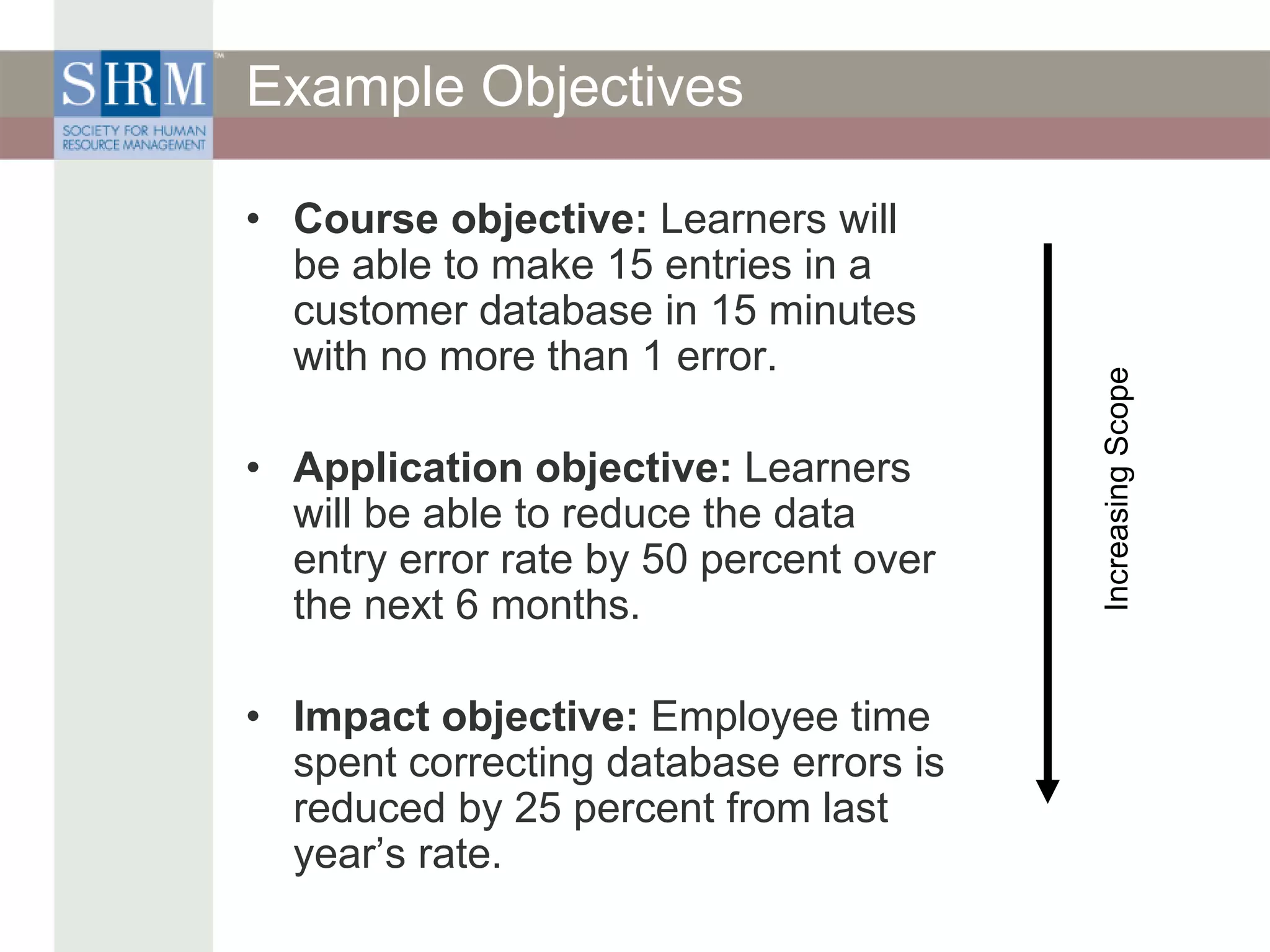
• Course objective: Learners will
be able to make 15 entries in a
customer database in 15 minutes
with no more than 1 error.
• Application objective: Learners
will be able to reduce the data
entry error rate by 50 percent over
the next 6 months.
• Impact objective: Employee time
spent correcting database errors is
reduced by 25 percent from last
year’s rate.
Increasing
Scope
Learning Assessment
• Alignment between assessment and objective is
paramount.
> Easy to do with well-written objectives.
• Cognitive, psychomotor and affective domains
are assessed in different ways.
> Cognitive: written and oral tests; discussion;
compare/contrast exercises.
> Psychomotor: demonstration; performance.
> Affective: longitudinal observation and/or
discussion.
• Be sure to use the right type of assessment for
each objective of the learning event.
Return on Investment:
Training and Development
Session 3
Costs, Budgets, Accounting
• Quantifying ROI means accounting for all
the costs of the program.
> Fixed costs: independent of the number
of participants.
> Variable costs: Dependent on the
number of participants.
• There are costs at every step – make sure
to account for them all.
Output Measures
Outputs are product-driven and include
data that are not performance-based but
rather outcomes of changes in
performance or investment in equipment.
Examples include:
> Units built.
> Time it takes to build the units.
> Income from sale of units.
Benefits and Soft Skills
• Change in:
> Attitude, work climate, leadership,
teamwork.
• We desire these changes because they
ultimately effect productivity.
> Allow time for change in attitude or
behavior, then measure these changes
and report qualitatively.
> Allow time for change in productivity,
then measure for data and report
quantitatively.
Karen Kaminski
Tobin P. Lopes
Models
• Benefit/Cost Ratio
• ROI (%)
• Phillips – See Figure 2-2 in text.
Costs
Program
Benefits
Program

BCR
100
(%) x
Cost
Cost
Benefit
ROI


Benefit/Cost Ratio Example
• Data entry clerks’ average wage: $9.50/hr.
• Five hours per week were spent correcting errors before
training.
• 20 percent less time correcting errors saves one hour each
week.
• 40 clerks.
BCR = .076 for one week. What about 13 weeks? 26 weeks?
076
.
$5,000
hr
9.50x40x1


BCR
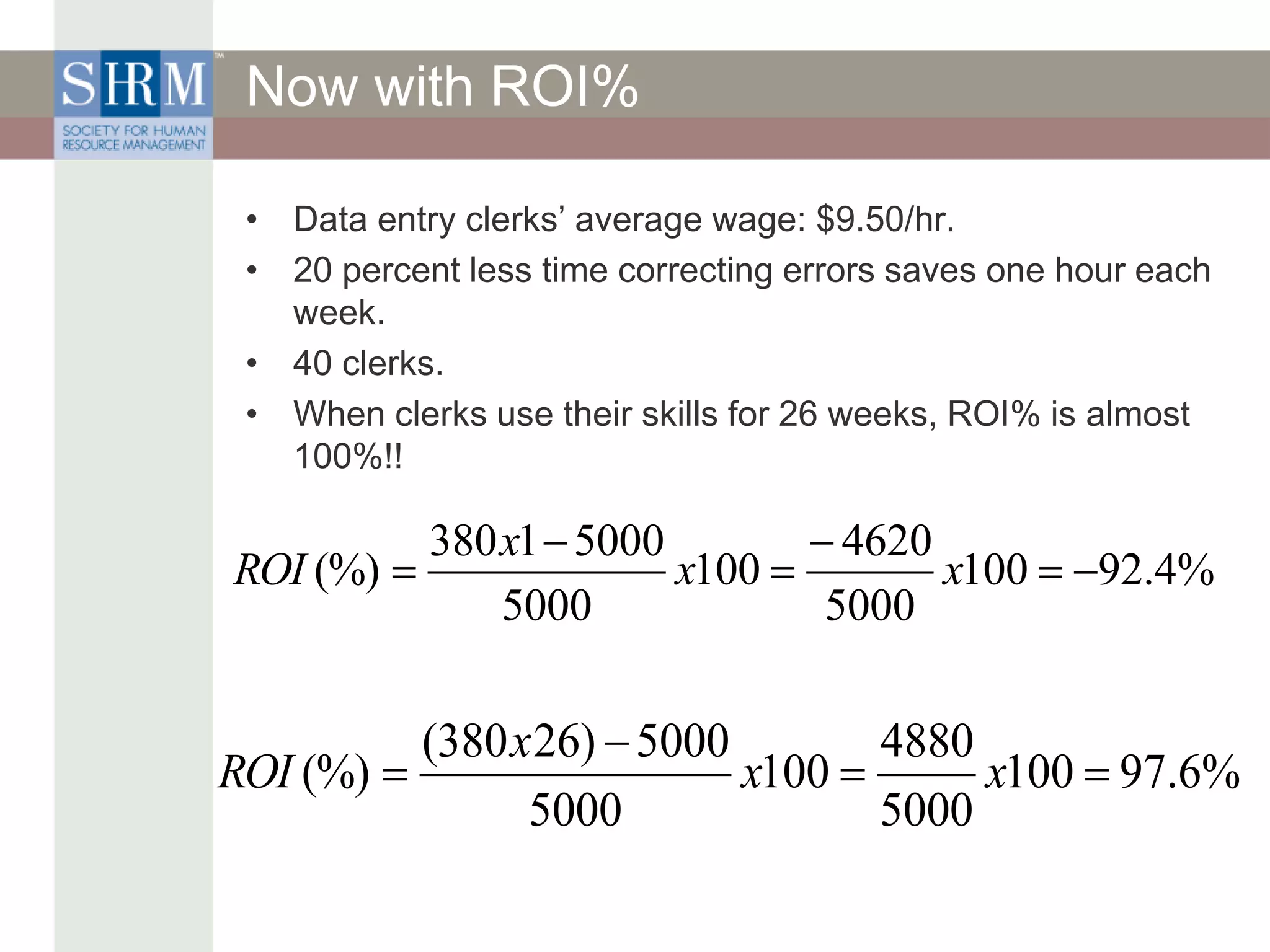
Now with ROI%
• Data entry clerks’ average wage: $9.50/hr.
• 20 percent less time correcting errors saves one hour each
week.
• 40 clerks.
• When clerks use their skills for 26 weeks, ROI% is almost
100%!!
%
4
.
92
100
5000
4620
100
5000
5000
1
380
(%) 




 x
x
x
ROI
%
6
.
97
100
5000
4880
100
5000
5000
)
26
380
(
(%) 


 x
x
x
ROI
Create a Data Collection Plan
• What?
• New information that needs to be
recorded?
• Who?
• When?
• How?
Additional Thoughts
• Access to learners after training:
> Do you have access to learners to
follow up on application and use of the
knowledge and skills developed during
the training?
• Isolating training effects:
> Consider what else may have occurred
at the same time as the training that
may have made a difference.
Trend Line Example
Trend Line
35
Y axis: 30
Number of
Customer Complaints 25
Projected Value 20
Before Training
15
Training Intervention
10
New Projected Value
After Training J F M A M J J A S O N D
X axis: Months
Return on Investment:
Training and Development
Session 4
Reporting Your Findings
Review of ROI
> Justify the training budget.
> Quantify effectiveness of training.
> Provide evidence to management and
other stakeholders.
> Build trust and respect for ourselves
and our unit.
> Earn the ears of senior management.
> Identify areas for improvement.
> Respond to management directive.
> Keep our jobs.
Stakeholders: Review
• Customer
• Employee
• Supervisor
• Subordinate
• President
• Board of Directors
• Stockholders
Reporting
• Needs to be:
> Timely, targeted and unbiased.
• The purpose is to:
> Illustrate success.
> Secure approval.
> Gain acknowledgement/agreement on
solutions.
> Build credibility.
> Enhance marketing.
Reporting
• Who needs to know?
• What do they need to know?
> How will you inform them?
• Presentation.
• Briefing paper.
• Detailed report.
• Letter.
• When and where?
• Who will present?
• Feedback?
Items to Include in a Report
• Executive summary.
• Title of training.
> Goals and objectives.
> Who participated, when/where, length.
• Assessment and outcomes.
• Evaluation.
• Budget.
• Recommendations.
Summary
• Know your audience:
> Who, existing and desired skills,
knowledge and attitude (audience
analysis).
• Expectations of/from organization:
> Goals and objectives, stakeholders.
• Assessment and evaluation:
> Budget, data collection.
• Reporting.
Finally
Take action on the data collected.
Use it to enhance your training and
therefore your organization.

ROI PPT_Final.ppt

  • 1.
    Return on Investment: Trainingand Development Session 1 ROI and Evaluation
  • 2.
    Objectives • At thecompletion of this unit, students will be able to: > Discuss the importance of determining ROI in training environments. > Identify stakeholders and develop questions to determine their views and needs. > Write training goals and observable objectives based on stakeholders’ needs.
  • 3.
    Objectives > Describe theimportance of the assessment of learning for ROI. > Recognize the differences between short-term and long-term assessment. > Identify items that belong on a training budget sheet to determine ROI. > Calculate expenses and ROI. > Write a report on training that includes all relevant data.
  • 4.
    Return on Investment •Rooted in manufacturing. • Advanced to banking, health care, non- profit, public and education sectors. • Part of quality and efficiency methodologies.
  • 5.
    ROI Is UsedTo: > Quantify the effectiveness of training. > Manage the training budget. > Provide evidence to management and other stakeholders. > Build trust and respect for ourselves and our unit. > Earn the ears of senior management. > Identify areas for improvement. > Provide data requested by senior management. > Keep our jobs.
  • 6.
    Models • Benefit/Cost Ratio •ROI (%) Costs Program Benefits Program  BCR 100 (%) x Cost Cost Benefit ROI  
  • 7.
    Why is ROIimportant to you?
  • 8.
    Evaluation Levels 1. Reactionand Planned Action 2. Learning 3. Application and Implementation 4. Business Impact 5. Return on Investment
  • 9.
    Stakeholders • Who arethey? > Anyone who pays for, participates in, benefits from, or has decision-making responsibility for HRD and training. • What should they know? > The need for training. > The results from training. > The costs of training.
  • 10.
    Needs Assessment andTask Analysis • Needs assessment: identifies gaps between what is and what should be in the organization. • Task analysis: investigates the specific skill(s), knowledge or attitudes and at which point there is a breakdown in use or performance. If the analysis uncovers a lack of knowledge, skills or attitude, then training is required. If it reveals faulty equipment, poor work conditions or lack of incentive, then another solution is needed.
  • 11.
    Return on Investment: Trainingand Development Session 2 Goals, Objectives, Assessment
  • 12.
    Goals • Organizational Goals Thesegoals are typically targeted toward the organizational level and include such things as productivity, net income, inventory and cash cycles, and customer satisfaction. • Learning Goals These goals typically focus on the individuals in the organization and their performance, knowledge and skills.
  • 13.
    Writing Objectives Easy asA, B, C, D Audience: Who? Behavior: What do “they” do? Condition: What is the setting and method of evaluation? Degree: Measurement to be met.
  • 14.
    Example Objective Audience Behavior Condition Degree At thecompletion of the course the learner will be able to score 85% or better on a written multiple choice 25 question test
  • 15.
    Example Verbs • Verbsto Use: > Discuss > Explain > Demonstrate > Identify > List > Perform > Compare/Contrast > Score (on an assessment) • Verbs to Avoid > Understand > Comprehend > Know > Do
  • 16.
    Objectives in ROI •Course objectives: What is it that the learners will be able to do upon course completion? • Application objectives: What goals do the HRD/training practitioner have for the application of the skills gained in training? • Impact objectives: What effect will accomplishing the application objectives have on the organization?
  • 17.
    Example Objectives • Courseobjective: Learners will be able to make 15 entries in a customer database in 15 minutes with no more than 1 error. • Application objective: Learners will be able to reduce the data entry error rate by 50 percent over the next 6 months. • Impact objective: Employee time spent correcting database errors is reduced by 25 percent from last year’s rate. Increasing Scope
  • 18.
    Learning Assessment • Alignmentbetween assessment and objective is paramount. > Easy to do with well-written objectives. • Cognitive, psychomotor and affective domains are assessed in different ways. > Cognitive: written and oral tests; discussion; compare/contrast exercises. > Psychomotor: demonstration; performance. > Affective: longitudinal observation and/or discussion. • Be sure to use the right type of assessment for each objective of the learning event.
  • 19.
    Return on Investment: Trainingand Development Session 3 Costs, Budgets, Accounting
  • 20.
    Costs, Budgets, Accounting •Quantifying ROI means accounting for all the costs of the program. > Fixed costs: independent of the number of participants. > Variable costs: Dependent on the number of participants. • There are costs at every step – make sure to account for them all.
  • 21.
    Output Measures Outputs areproduct-driven and include data that are not performance-based but rather outcomes of changes in performance or investment in equipment. Examples include: > Units built. > Time it takes to build the units. > Income from sale of units.
  • 22.
    Benefits and SoftSkills • Change in: > Attitude, work climate, leadership, teamwork. • We desire these changes because they ultimately effect productivity. > Allow time for change in attitude or behavior, then measure these changes and report qualitatively. > Allow time for change in productivity, then measure for data and report quantitatively.
  • 23.
    Karen Kaminski Tobin P.Lopes Models • Benefit/Cost Ratio • ROI (%) • Phillips – See Figure 2-2 in text. Costs Program Benefits Program  BCR 100 (%) x Cost Cost Benefit ROI  
  • 24.
    Benefit/Cost Ratio Example •Data entry clerks’ average wage: $9.50/hr. • Five hours per week were spent correcting errors before training. • 20 percent less time correcting errors saves one hour each week. • 40 clerks. BCR = .076 for one week. What about 13 weeks? 26 weeks? 076 . $5,000 hr 9.50x40x1   BCR
  • 25.
    Now with ROI% •Data entry clerks’ average wage: $9.50/hr. • 20 percent less time correcting errors saves one hour each week. • 40 clerks. • When clerks use their skills for 26 weeks, ROI% is almost 100%!! % 4 . 92 100 5000 4620 100 5000 5000 1 380 (%)       x x x ROI % 6 . 97 100 5000 4880 100 5000 5000 ) 26 380 ( (%)     x x x ROI
  • 26.
    Create a DataCollection Plan • What? • New information that needs to be recorded? • Who? • When? • How?
  • 27.
    Additional Thoughts • Accessto learners after training: > Do you have access to learners to follow up on application and use of the knowledge and skills developed during the training? • Isolating training effects: > Consider what else may have occurred at the same time as the training that may have made a difference.
  • 28.
    Trend Line Example TrendLine 35 Y axis: 30 Number of Customer Complaints 25 Projected Value 20 Before Training 15 Training Intervention 10 New Projected Value After Training J F M A M J J A S O N D X axis: Months
  • 29.
    Return on Investment: Trainingand Development Session 4 Reporting Your Findings
  • 30.
    Review of ROI >Justify the training budget. > Quantify effectiveness of training. > Provide evidence to management and other stakeholders. > Build trust and respect for ourselves and our unit. > Earn the ears of senior management. > Identify areas for improvement. > Respond to management directive. > Keep our jobs.
  • 31.
    Stakeholders: Review • Customer •Employee • Supervisor • Subordinate • President • Board of Directors • Stockholders
  • 32.
    Reporting • Needs tobe: > Timely, targeted and unbiased. • The purpose is to: > Illustrate success. > Secure approval. > Gain acknowledgement/agreement on solutions. > Build credibility. > Enhance marketing.
  • 33.
    Reporting • Who needsto know? • What do they need to know? > How will you inform them? • Presentation. • Briefing paper. • Detailed report. • Letter. • When and where? • Who will present? • Feedback?
  • 34.
    Items to Includein a Report • Executive summary. • Title of training. > Goals and objectives. > Who participated, when/where, length. • Assessment and outcomes. • Evaluation. • Budget. • Recommendations.
  • 35.
    Summary • Know youraudience: > Who, existing and desired skills, knowledge and attitude (audience analysis). • Expectations of/from organization: > Goals and objectives, stakeholders. • Assessment and evaluation: > Budget, data collection. • Reporting.
  • 36.
    Finally Take action onthe data collected. Use it to enhance your training and therefore your organization.