• What is Oxidative stress
• Why is Oxidative Stress important
• How does Selenium fit into Oxidative stress
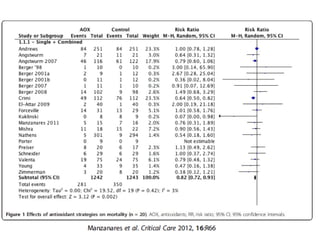
• Selenium (Se) in critical illness
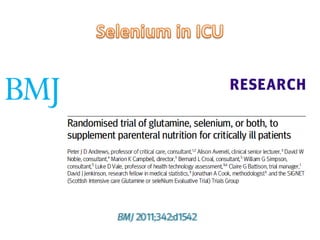
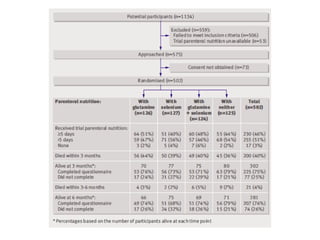
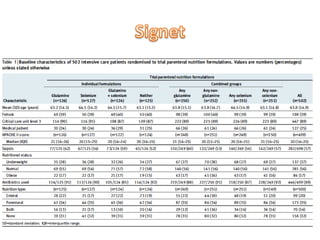
• What’s the current evidence for Se in ICU
• Oxidant production is normally balanced by
antioxidant systems (Reduction by enzyme
scavengers and dietary antioxidants)
• Redox imbalance is caused by excessive
production of ROS / NOS or decrease in
antioxidants + destruction of enzyme
scavengers.
• When ROS > Reductive capacity there is
OXIDATIVE STRESS
• Selenium is a trace mineral found in minute
quantities in the body
• RDA 60ug /day
• Serum Se level for optimal Selenoprotein
function is around 100ug/L
• In Serum 40% GSH-Px / 10% Albumin / 50%
Selenoprotein-P
• Found in Bread, cereals, fish, meat
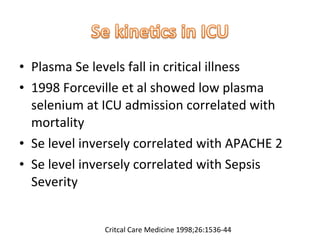
• Plasma Se levels fall in critical illness
• 1998 Forceville et al showed low plasma
selenium at ICU admission correlated with
mortality
• Se level inversely correlated with APACHE 2
• Se level inversely correlated with Sepsis
Severity
Critcal Care Medicine 1998;26:1536-44
© Williams & Wilkins 1998. All Rights Reserved. Published by Lippincott Williams & Wilkins, Inc. 3
Figure 1
Selenium, systemic immune response syndrome, sepsis,
and outcome in critically ill patients.
Forceville, Xavier; Vitoux, Dominique; Gauzit, Remy;
Combes, Alain; Lahilaire, Pierre; Chappuis, Philippe
Critical Care Medicine. 26(9):1536-1544, September
1998.
Figure 1 . Admission plasma selenium concentration
related to Acute Physiology and Chronic Health
Evaluation (APACHE) II severity score. Dashed line, mean
+/- SD normal plasma selenium value (1.00 +/- 0.15
[micro sign]mol/L). r2 = .11; p < .0001.
© Williams & Wilkins 1998. All Rights Reserved. Published by Lippincott Williams & Wilkins, Inc. 5
Figure 2
Selenium, systemic immune response syndrome, sepsis,
and outcome in critically ill patients.
Forceville, Xavier; Vitoux, Dominique; Gauzit, Remy;
Combes, Alain; Lahilaire, Pierre; Chappuis, Philippe
Critical Care Medicine. 26(9):1536-1544, September
1998.
Figure 2 . Admission plasma selenium concentration
related to severity of sepsis. p <or=to .05 for sepsis vs.
severe sepsis; p <or=to .05 for sepsis vs. septic shock
(analysis of variance). Dashed line, mean +/- SD normal
plasma selenium concentration (1.00 +/- 0.15 [micro
sign]mol/L); n, number of patients, including, in
parentheses, number of nonsurviving patients, for each
sepsis severity grade. Values are expressed as median
(middle line in the box) with the top and bottom of the
box encompassing the 25th to the 75th percentiles;
capped lines indicate the tenth to 90th percentiles of the
data; circles, values above the 90th and below the tenth
percentiles.
• Why exactly is the Se level low in SIRS
– Change in Albumin concentration
– Changes in distribution of Selenoprotein-P
– Consumed in REDOX
– Haemo-diluton
– Reduced Nutritional intake
• 1999 Angstwurm etal demonstrated
increased plasma Se levels and GSH-Px after
replacing Se
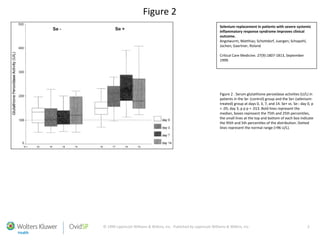
• Activity of the Se-dependent enzyme GSH-Px
parallels serum Se with increasing activity
after replacement.
• Similar results in small studies with Trauma
Critical care medicine 1999;27:1807-13
© 1999 Lippincott Williams & Wilkins, Inc. Published by Lippincott Williams & Wilkins, Inc. 2
Figure 1
Selenium replacement in patients with severe systemic
inflammatory response syndrome improves clinical
outcome.
Angstwurm, Matthias; Schottdorf, Juergen; Schopohl,
Jochen; Gaertner, Roland
Critical Care Medicine. 27(9):1807-1813, September
1999.
Figure 1 . Serum selenium concentrations ([mu]g/L) in
patients in the Se- (control) group and the Se+ (selenium-
treated) group at days 0, 3, 7, and 14. Se+ vs. Se-: day 0, p
> .05; day 3, p p p = .003. Bold lines represent the
median, boxes represent 75th and 25th percentiles, the
small lines at the top and bottom of each box indicate the
95th and 5th percentiles of the distribution. Dotted lines
represent the normal range (70-120 [mu]g/L, 0.88-1.52
[mu]mol/L).
© 1999 Lippincott Williams & Wilkins, Inc. Published by Lippincott Williams & Wilkins, Inc. 3
Figure 2
Selenium replacement in patients with severe systemic
inflammatory response syndrome improves clinical
outcome.
Angstwurm, Matthias; Schottdorf, Juergen; Schopohl,
Jochen; Gaertner, Roland
Critical Care Medicine. 27(9):1807-1813, September
1999.
Figure 2 . Serum glutathione peroxidase activities (U/L) in
patients in the Se- (control) group and the Se+ (selenium-
treated) group at days 0, 3, 7, and 14. Se+ vs. Se-: day 0, p
> .05; day 3, p p p = .013. Bold lines represent the
median, boxes represent the 75th and 25th percentiles,
the small lines at the top and bottom of each box indicate
the 95th and 5th percentiles of the distribution. Dotted
lines represent the normal range (>96 U/L).
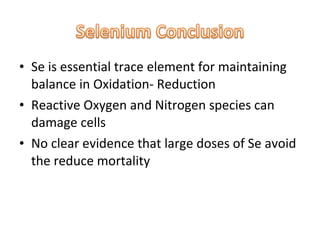
• Se is essential trace element for maintaining
balance in Oxidation- Reduction
• Reactive Oxygen and Nitrogen species can
damage cells
• No clear evidence that large doses of Se avoid
the reduce mortality

Roger Harris on Oxidative Stress

  • 2.
    • What isOxidative stress • Why is Oxidative Stress important • How does Selenium fit into Oxidative stress • Selenium (Se) in critical illness • What’s the current evidence for Se in ICU
  • 3.
    • Oxidant productionis normally balanced by antioxidant systems (Reduction by enzyme scavengers and dietary antioxidants) • Redox imbalance is caused by excessive production of ROS / NOS or decrease in antioxidants + destruction of enzyme scavengers. • When ROS > Reductive capacity there is OXIDATIVE STRESS
  • 6.
    • Selenium isa trace mineral found in minute quantities in the body • RDA 60ug /day • Serum Se level for optimal Selenoprotein function is around 100ug/L • In Serum 40% GSH-Px / 10% Albumin / 50% Selenoprotein-P • Found in Bread, cereals, fish, meat
  • 7.
    • Plasma Selevels fall in critical illness • 1998 Forceville et al showed low plasma selenium at ICU admission correlated with mortality • Se level inversely correlated with APACHE 2 • Se level inversely correlated with Sepsis Severity Critcal Care Medicine 1998;26:1536-44
  • 8.
    © Williams &Wilkins 1998. All Rights Reserved. Published by Lippincott Williams & Wilkins, Inc. 3 Figure 1 Selenium, systemic immune response syndrome, sepsis, and outcome in critically ill patients. Forceville, Xavier; Vitoux, Dominique; Gauzit, Remy; Combes, Alain; Lahilaire, Pierre; Chappuis, Philippe Critical Care Medicine. 26(9):1536-1544, September 1998. Figure 1 . Admission plasma selenium concentration related to Acute Physiology and Chronic Health Evaluation (APACHE) II severity score. Dashed line, mean +/- SD normal plasma selenium value (1.00 +/- 0.15 [micro sign]mol/L). r2 = .11; p < .0001.
  • 9.
    © Williams &Wilkins 1998. All Rights Reserved. Published by Lippincott Williams & Wilkins, Inc. 5 Figure 2 Selenium, systemic immune response syndrome, sepsis, and outcome in critically ill patients. Forceville, Xavier; Vitoux, Dominique; Gauzit, Remy; Combes, Alain; Lahilaire, Pierre; Chappuis, Philippe Critical Care Medicine. 26(9):1536-1544, September 1998. Figure 2 . Admission plasma selenium concentration related to severity of sepsis. p <or=to .05 for sepsis vs. severe sepsis; p <or=to .05 for sepsis vs. septic shock (analysis of variance). Dashed line, mean +/- SD normal plasma selenium concentration (1.00 +/- 0.15 [micro sign]mol/L); n, number of patients, including, in parentheses, number of nonsurviving patients, for each sepsis severity grade. Values are expressed as median (middle line in the box) with the top and bottom of the box encompassing the 25th to the 75th percentiles; capped lines indicate the tenth to 90th percentiles of the data; circles, values above the 90th and below the tenth percentiles.
  • 10.
    • Why exactlyis the Se level low in SIRS – Change in Albumin concentration – Changes in distribution of Selenoprotein-P – Consumed in REDOX – Haemo-diluton – Reduced Nutritional intake
  • 11.
    • 1999 Angstwurmetal demonstrated increased plasma Se levels and GSH-Px after replacing Se • Activity of the Se-dependent enzyme GSH-Px parallels serum Se with increasing activity after replacement. • Similar results in small studies with Trauma Critical care medicine 1999;27:1807-13
  • 12.
    © 1999 LippincottWilliams & Wilkins, Inc. Published by Lippincott Williams & Wilkins, Inc. 2 Figure 1 Selenium replacement in patients with severe systemic inflammatory response syndrome improves clinical outcome. Angstwurm, Matthias; Schottdorf, Juergen; Schopohl, Jochen; Gaertner, Roland Critical Care Medicine. 27(9):1807-1813, September 1999. Figure 1 . Serum selenium concentrations ([mu]g/L) in patients in the Se- (control) group and the Se+ (selenium- treated) group at days 0, 3, 7, and 14. Se+ vs. Se-: day 0, p > .05; day 3, p p p = .003. Bold lines represent the median, boxes represent 75th and 25th percentiles, the small lines at the top and bottom of each box indicate the 95th and 5th percentiles of the distribution. Dotted lines represent the normal range (70-120 [mu]g/L, 0.88-1.52 [mu]mol/L).
  • 13.
    © 1999 LippincottWilliams & Wilkins, Inc. Published by Lippincott Williams & Wilkins, Inc. 3 Figure 2 Selenium replacement in patients with severe systemic inflammatory response syndrome improves clinical outcome. Angstwurm, Matthias; Schottdorf, Juergen; Schopohl, Jochen; Gaertner, Roland Critical Care Medicine. 27(9):1807-1813, September 1999. Figure 2 . Serum glutathione peroxidase activities (U/L) in patients in the Se- (control) group and the Se+ (selenium- treated) group at days 0, 3, 7, and 14. Se+ vs. Se-: day 0, p > .05; day 3, p p p = .013. Bold lines represent the median, boxes represent the 75th and 25th percentiles, the small lines at the top and bottom of each box indicate the 95th and 5th percentiles of the distribution. Dotted lines represent the normal range (>96 U/L).
  • 20.
    • Se isessential trace element for maintaining balance in Oxidation- Reduction • Reactive Oxygen and Nitrogen species can damage cells • No clear evidence that large doses of Se avoid the reduce mortality

Editor's Notes

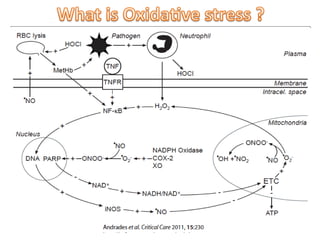
  • #5 Pathogens activate the immune system which causes a burst in Oxidation and an excess of H2O2 and HOCl. Inside the cell the H2O2 acts to stimulate NF-kB also activated by cytokines and Met-Hb. This stimulates inducible nitricoxide synthase (iNOS) thus producing NO which provokes inhibition of the electron transfer chain (ECT). This results in the production of SuperOxide (ONOO) which then decomposes to the highly reactive species OH and NO2….. which then damage the mitochondria and together with the inhibition of the ECT cause a fall in the production of ATP. In the Cytosyl increased activities of three enzymes (NADPH Oxidase / Cox2 / Xanthine Oxidase XO) produces superoxide ONOO which via DNA damage poly (ADP-ribose) polymerase (PARP) activation and consumption of NAD+ impairing the ETC. Superoxide is dismutased in the mitochondria by Manganeese superoxide dismutase (MnSOD) to H2O2 which closes the positive feedback loop. Over producyion of intracellular NO leads to leakage into the plasma which lyses RBCand HOCL causes pore formation in the RBC membranes t.hus freeing Met-Hb which increases Fe availability for pathogen proliferation. Met-Hb provokes the activation of NF-kB closing the NO generating loop
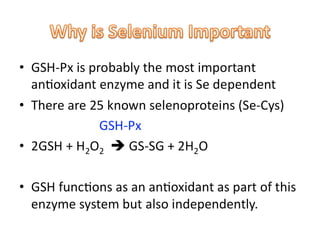
  • #6 GSH is the reduced monomeric Glutathione GS-SG represents Glutathione Disulphide This is a Multiple step reaction involving selnocysteine. Selenoproteins are proteins that contain a Se-cysteine residue (Se-Cys) Important to remember that GSH supplementation has not been found to be helpful???
  • #8 134 consecutive admissions with sepsis / SIRS
  • #12 Single centre Randomised controlled open label pilot study. 42 Patients with SIRS and minimum APACHE 2 of 15 Se replaced in decreasing amounts starting with 500ug
  • #13 Se levels normalised within 3 days in the Rx group GSH-Px levels also normalised within 3 days in the RX group
  • #17 Randomised controlled factorial designed trial 500 patients needing ICU/HDU greater than 24hrs and needing PN Either 20.2g glutamine or 500ug Se or both
  • #19 Apache 2 score 20 27% were under nourished
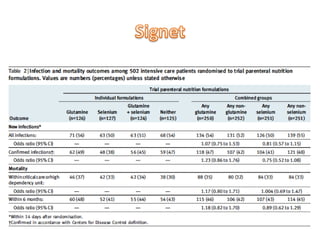
  • #20 No Reduction in Infections with either Glutamine or Se Multiple sub-group analyis with small groups Controversy with dose and duration of treatment