Rodents and disease
Pratima Neupane
Rodents and diseases
• Worldwide, rats and mice spread - 35 diseases.
• Diseases spread to humans directly, through
handling of rodents, through contact with
rodent feces, urine, or saliva, or through rodent
bites.
• Diseases spread indirectly through ticks, mites
or fleas that have fed on an infected rodent.
A number of diseases are associated
with rodents. Broadly these are:
• Bacterial: Plague, tularaemia, salmonellosis;
• Viral: Lassa fever, haemorrhagic fever, encephalitis
• Rickettsial: scrub typus, murine typhus, rickettsial
pox;
• Parasitic: hymenolepis diminuta, leishmaniasis,
babesiasis, amoebiasis, trichinosis, Chagas disease;
• Others: rat bite fever, leptospirosis, histoplasmosis,
ring worm etc.
• Yersinia. pseudotuberculosis - rodents and
other small mammals.
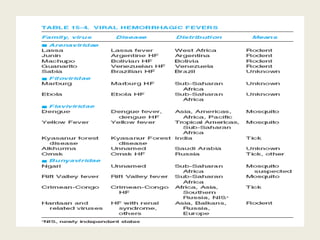
• Various viral haemorrhagic fevers in South
America, - exposed to new viruses - circulated
within wilderness ecosystems.
• For example, the Junin virus, causing
Argentine haemorrhagic fever, naturally
infects wild rodents (the mouse Callomys
callosus).
• Hantavirus pulmonary syndrome appeared in the U.S.
in 1993 when the deer mouse population increased
with food surplus
• New sources of food after deforestation, or climate
change - One example is Lassa fever, first in West
Africa in 1969,
• An outbreak of sine nombre virus in the United States
in 1993 – drought – rodent contact to human
Rodents and diseases
• Worldwide, rats and mice spread - 35 diseases.
• Diseases spread to humans directly, through
handling of rodents, through contact with
rodent feces, urine, or saliva, or through rodent
bites.
• Diseases spread indirectly through ticks, mites
or fleas that have fed on an infected rodent.
• Hantavirus pulmonary syndrome appeared in the U.S.
in 1993 when the deer mouse population increased
with food surplus
• New sources of food after deforestation, or climate
change - One example is Lassa fever, first in West
Africa in 1969,
• An outbreak of sine nombre virus in the United States
in 1993 – drought – rodent contact to human
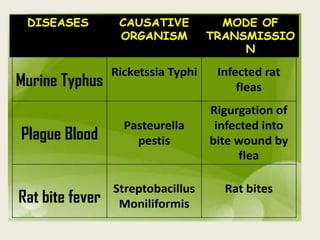
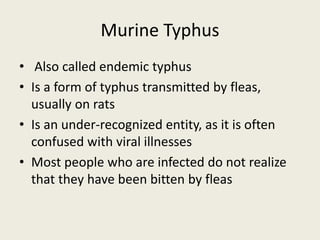
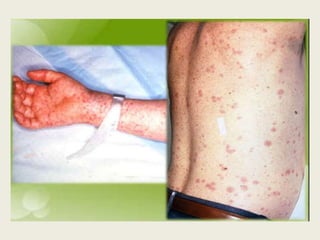
Murine Typhus
• Also called endemic typhus
• Is a form of typhus transmitted by fleas,
usually on rats
• Is an under-recognized entity, as it is often
confused with viral illnesses
• Most people who are infected do not realize
that they have been bitten by fleas
Rat bite fever
• Is an acute, febrile human illness
• Caused by bacteria transmitted by rodents,
rats or mice in most cases, which is passed
from rodent to human via the rodent's urine
or mucous secretions
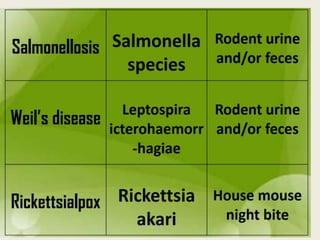
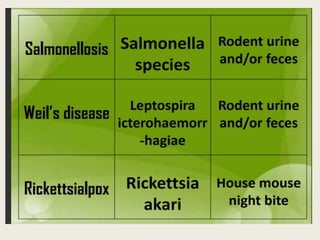
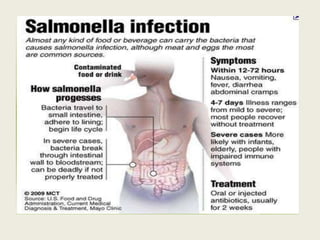
Salmonellosis
• Is an infection with Salmonella bacteria
• Most people infected with Salmonella develop
diarrhea, fever, vomiting, and abdominal
cramps 12 to 72 hours after infection
Weil’s disease
• Is the acute human form of a bacterial infection
with a raft of different names: mud fever, swamp
fever, haemorrhagic jaundice, swineherd's
disease, sewerman's flu.
• The infection is caught through contact with
infected animal urine (mainly from rodents, cattle
or pigs), generally in contaminated water, and
typically enters the body through cuts or scrapes,
or the lining of the nose, mouth, throat or eyes
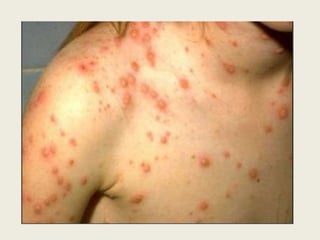
Rickettsialpox
• Is an illness caused by bacteria of the Rickettsia
genus
• The first symptom is a bump formed by the
bite, eventually resulting in a black, crusty scab
• Is treated with doxycycline. Doxycycline is a
member of the tetracycline antibiotics group,
and is commonly used to treat a variety of
infections
Rodents & disease.pptx

Rodents & disease.pptx

  • 1.
  • 2.
    Rodents and diseases •Worldwide, rats and mice spread - 35 diseases. • Diseases spread to humans directly, through handling of rodents, through contact with rodent feces, urine, or saliva, or through rodent bites. • Diseases spread indirectly through ticks, mites or fleas that have fed on an infected rodent.
  • 3.
    A number ofdiseases are associated with rodents. Broadly these are: • Bacterial: Plague, tularaemia, salmonellosis; • Viral: Lassa fever, haemorrhagic fever, encephalitis • Rickettsial: scrub typus, murine typhus, rickettsial pox; • Parasitic: hymenolepis diminuta, leishmaniasis, babesiasis, amoebiasis, trichinosis, Chagas disease; • Others: rat bite fever, leptospirosis, histoplasmosis, ring worm etc.
  • 4.
    • Yersinia. pseudotuberculosis- rodents and other small mammals. • Various viral haemorrhagic fevers in South America, - exposed to new viruses - circulated within wilderness ecosystems. • For example, the Junin virus, causing Argentine haemorrhagic fever, naturally infects wild rodents (the mouse Callomys callosus).
  • 5.
    • Hantavirus pulmonarysyndrome appeared in the U.S. in 1993 when the deer mouse population increased with food surplus • New sources of food after deforestation, or climate change - One example is Lassa fever, first in West Africa in 1969, • An outbreak of sine nombre virus in the United States in 1993 – drought – rodent contact to human
  • 6.
    Rodents and diseases •Worldwide, rats and mice spread - 35 diseases. • Diseases spread to humans directly, through handling of rodents, through contact with rodent feces, urine, or saliva, or through rodent bites. • Diseases spread indirectly through ticks, mites or fleas that have fed on an infected rodent.
  • 7.
    • Hantavirus pulmonarysyndrome appeared in the U.S. in 1993 when the deer mouse population increased with food surplus • New sources of food after deforestation, or climate change - One example is Lassa fever, first in West Africa in 1969, • An outbreak of sine nombre virus in the United States in 1993 – drought – rodent contact to human
  • 11.
    Murine Typhus • Alsocalled endemic typhus • Is a form of typhus transmitted by fleas, usually on rats • Is an under-recognized entity, as it is often confused with viral illnesses • Most people who are infected do not realize that they have been bitten by fleas
  • 13.
    Rat bite fever •Is an acute, febrile human illness • Caused by bacteria transmitted by rodents, rats or mice in most cases, which is passed from rodent to human via the rodent's urine or mucous secretions
  • 15.
    Salmonellosis • Is aninfection with Salmonella bacteria • Most people infected with Salmonella develop diarrhea, fever, vomiting, and abdominal cramps 12 to 72 hours after infection
  • 17.
    Weil’s disease • Isthe acute human form of a bacterial infection with a raft of different names: mud fever, swamp fever, haemorrhagic jaundice, swineherd's disease, sewerman's flu. • The infection is caught through contact with infected animal urine (mainly from rodents, cattle or pigs), generally in contaminated water, and typically enters the body through cuts or scrapes, or the lining of the nose, mouth, throat or eyes
  • 19.
    Rickettsialpox • Is anillness caused by bacteria of the Rickettsia genus • The first symptom is a bump formed by the bite, eventually resulting in a black, crusty scab • Is treated with doxycycline. Doxycycline is a member of the tetracycline antibiotics group, and is commonly used to treat a variety of infections