

The Social Economy and the Crisis Robin Murray, Julie Caulier-Grice & Geoff MulganLisbon  15th July 2009
From the micro economics of social venturing To the macro economics of social innovation and the global economic crisis
5 propositionsProposition 1The present crisis is about a long wave transition from the 20th century paradigm of mass production, to what? to the 21st century paradigm of the distributed digital economy?
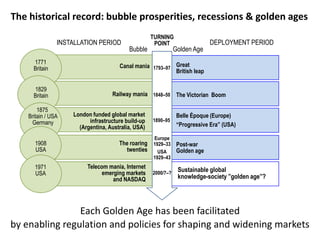
TURNINGPOINTBubbleGolden Age1793–97GreatBritish leapCanal mania1848–50 Railway maniaThe Victorian  BoomLondon funded global marketinfrastructure build-up(Argentina, Australia, USA)Belle Époque (Europe)“Progressive Era” (USA)1890–95 The roaring twentiesEurope1929–33USA1929–43Post-warGolden ageTelecom mania, Internet emerging marketsand NASDAQSustainable global knowledge-society ”golden age”?2000/7–? The historical record: bubble prosperities, recessions & golden agesDEPLOYMENT PERIODINSTALLATION PERIOD 1771Britain1829Britain1875 Britain / USAGermany1908 USA1971 USAEach Golden Age has been facilitatedby enabling regulation and policies for shaping and widening markets
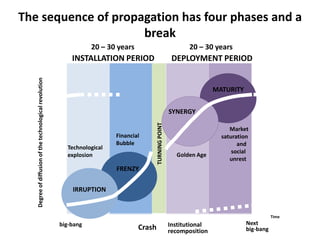
MATURITY        SYNERGYFinancialBubble       Market saturation            and        social        unrestTechnologicalexplosionGolden Age  FRENZY                                                  TURNING POINTIRRUPTIONCrashInstitutionalrecompositionThe sequence of propagation has four phases and a break20 – 30 years20 – 30 yearsINSTALLATION PERIODDEPLOYMENT PERIODDegree of diffusion of the technological revolutionTime    big-bangNextbig-bang
Proposition 2Strong social and technological tides which provide the basis for the expansion of the social economy
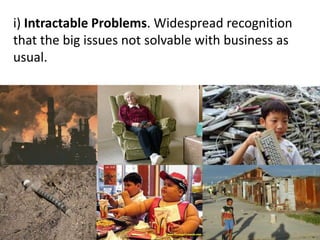
i) Intractable Problems. Widespread recognition that the big issues not solvable with business as usual.
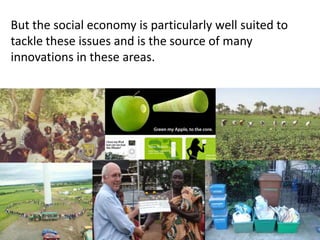
But the social economy is particularly well suited to tackle these issues and is the source of many innovations in these areas.
ii) Insistent voices, active lives.The rise of expressive culture - the post modern citizen actively searching for identity, meaning and self improvement , individually and collectively through social movements
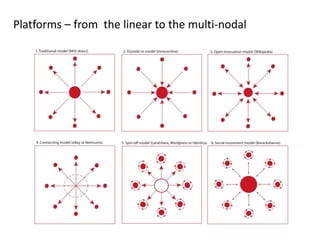
iii) Digital economy reconfiguring production around the user.  The Lego principle.  Households become designers, processors and assemblers. The house becomes an office/recording studio/learning lab/doctors’ surgery/power station.  Rise of distributed systems and the support economy
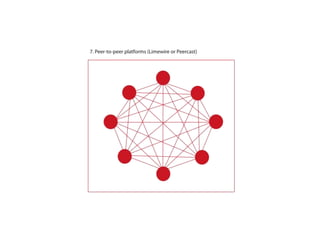
Platforms – from  the linear to the multi-nodal
Proposition 3Social economy can become an innovative driver of economic transformation in the deployment period – social SchumpeterCan do so only if conditions transformed in each part of the social economy and their inter-relations
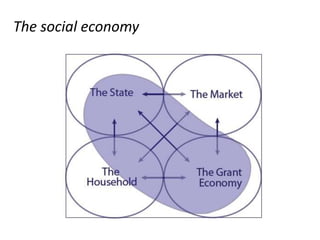
The social economy
State. Innovation episodic and centralised. Requires transformation of public finance and systems of accountability related to itGrant economy. Seed bed of innovation but fragile economicallyMarket 55,000 social enterprises in UK. Requires new mediating institutionsHouseholds: conditions for participation
Proposition 4Crisis in macro economic policy. Battle against recessions being fought with weapons of the last war. 4 differentiated counter-cyclical policies required that focus on investment and creating conditions of next wave
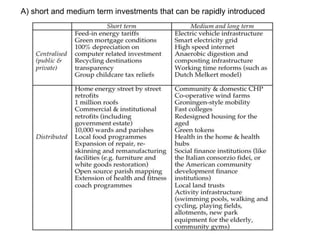
A) short and medium term investments that can be rapidly introduced
B) Factor Four innovations for services faced by cuts (e.g. Elderpower in Maine)C) Innovative use of resources freed up by the market – people/land/buildings/ideas + encouraging initiatives insulated from the market (exchange systems/local food/volunteering)D) Regulatory changes creating conditions for SI
Proposition 5The coming years are a critical moment of danger and possibility.Danger from crisis (debt overhangs and credit shortage/unemployment/cuts to grant programmes & social servicesPossibilities: 1930s, Argentina, favellas
ConclusionJust as 1930s crisis generated alternatives based on mass production model (Soviet, social democracy, fascism) so current crisis suggests alternatives based on distributed digital economy
References:Eric Beinhocker, The Origin of Wealth, Random House, 2007Bill Ivey, Arts Inc, University of California Press, 2008Francois Jegou and Ezio Manzini, Collaborative Services: social innovation and design for sustainability, Poli Design 2008Jim Maxmin and Soshana Zuboff, The Support EconomyCarlota Perez, Technological Revolutions and Financial Capital, Edward Elgar 2002Walter Stahel, The Performance Economy, Palgrave 2006Robin Murrayrobinmurray(AT)blueyonder.co.ukJulie Caulier-Gricejulie.caulier-grice(AT)youngfoundation.orgGeoff Mulgangeoff.mulgan(AT)youngfoundation.org

Robin Murray Methods And Tools July 2009

  • 1.
    The Social Economyand the Crisis Robin Murray, Julie Caulier-Grice & Geoff MulganLisbon 15th July 2009
  • 2.
    From the microeconomics of social venturing To the macro economics of social innovation and the global economic crisis
  • 3.
    5 propositionsProposition 1Thepresent crisis is about a long wave transition from the 20th century paradigm of mass production, to what? to the 21st century paradigm of the distributed digital economy?
  • 4.
    TURNINGPOINTBubbleGolden Age1793–97GreatBritish leapCanalmania1848–50 Railway maniaThe Victorian BoomLondon funded global marketinfrastructure build-up(Argentina, Australia, USA)Belle Époque (Europe)“Progressive Era” (USA)1890–95 The roaring twentiesEurope1929–33USA1929–43Post-warGolden ageTelecom mania, Internet emerging marketsand NASDAQSustainable global knowledge-society ”golden age”?2000/7–? The historical record: bubble prosperities, recessions & golden agesDEPLOYMENT PERIODINSTALLATION PERIOD 1771Britain1829Britain1875 Britain / USAGermany1908 USA1971 USAEach Golden Age has been facilitatedby enabling regulation and policies for shaping and widening markets
  • 5.
    MATURITY SYNERGYFinancialBubble Market saturation and social unrestTechnologicalexplosionGolden Age FRENZY TURNING POINTIRRUPTIONCrashInstitutionalrecompositionThe sequence of propagation has four phases and a break20 – 30 years20 – 30 yearsINSTALLATION PERIODDEPLOYMENT PERIODDegree of diffusion of the technological revolutionTime big-bangNextbig-bang
  • 6.
    Proposition 2Strong socialand technological tides which provide the basis for the expansion of the social economy
  • 7.
    i) Intractable Problems.Widespread recognition that the big issues not solvable with business as usual.
  • 8.
    But the socialeconomy is particularly well suited to tackle these issues and is the source of many innovations in these areas.
  • 9.
    ii) Insistent voices,active lives.The rise of expressive culture - the post modern citizen actively searching for identity, meaning and self improvement , individually and collectively through social movements
  • 11.
    iii) Digital economyreconfiguring production around the user. The Lego principle. Households become designers, processors and assemblers. The house becomes an office/recording studio/learning lab/doctors’ surgery/power station. Rise of distributed systems and the support economy
  • 13.
    Platforms – from the linear to the multi-nodal
  • 15.
    Proposition 3Social economycan become an innovative driver of economic transformation in the deployment period – social SchumpeterCan do so only if conditions transformed in each part of the social economy and their inter-relations
  • 16.
  • 17.
    State. Innovation episodicand centralised. Requires transformation of public finance and systems of accountability related to itGrant economy. Seed bed of innovation but fragile economicallyMarket 55,000 social enterprises in UK. Requires new mediating institutionsHouseholds: conditions for participation
  • 18.
    Proposition 4Crisis inmacro economic policy. Battle against recessions being fought with weapons of the last war. 4 differentiated counter-cyclical policies required that focus on investment and creating conditions of next wave
  • 19.
    A) short andmedium term investments that can be rapidly introduced
  • 20.
    B) Factor Fourinnovations for services faced by cuts (e.g. Elderpower in Maine)C) Innovative use of resources freed up by the market – people/land/buildings/ideas + encouraging initiatives insulated from the market (exchange systems/local food/volunteering)D) Regulatory changes creating conditions for SI
  • 21.
    Proposition 5The comingyears are a critical moment of danger and possibility.Danger from crisis (debt overhangs and credit shortage/unemployment/cuts to grant programmes & social servicesPossibilities: 1930s, Argentina, favellas
  • 22.
    ConclusionJust as 1930scrisis generated alternatives based on mass production model (Soviet, social democracy, fascism) so current crisis suggests alternatives based on distributed digital economy
  • 23.
    References:Eric Beinhocker, TheOrigin of Wealth, Random House, 2007Bill Ivey, Arts Inc, University of California Press, 2008Francois Jegou and Ezio Manzini, Collaborative Services: social innovation and design for sustainability, Poli Design 2008Jim Maxmin and Soshana Zuboff, The Support EconomyCarlota Perez, Technological Revolutions and Financial Capital, Edward Elgar 2002Walter Stahel, The Performance Economy, Palgrave 2006Robin Murrayrobinmurray(AT)blueyonder.co.ukJulie Caulier-Gricejulie.caulier-grice(AT)youngfoundation.orgGeoff Mulgangeoff.mulgan(AT)youngfoundation.org

Editor's Notes

  • #17 Better learning across boundaries – e.g. bolsa familial or grameen bank (something we support via SIX)… or more targeted networks like SHAK