Social Innovation
and
the labour market
Peter Ramsden
BerlinTransfer
10th June 2014
100 years of innovation in job
centres
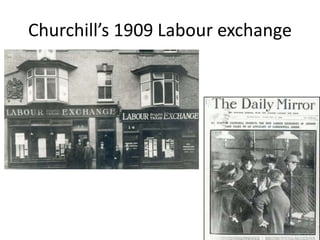
Churchill’s 1909 Labour exchange
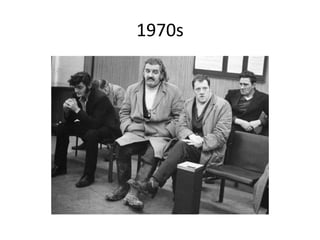
1970s
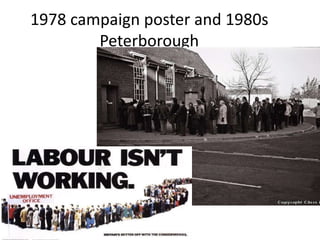
1978 campaign poster and 1980s
Peterborough
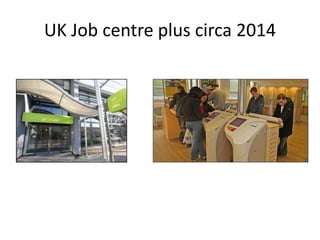
UK Job centre plus circa 2014
New challenges: The future labour
market
• No job for life
• Not much security (zero hours contracts, yet more
flexibility)
• under-employment
• Self-employment an option at key transitions (from
education to employment, from employment to
retirement)
• Patching a portfolio of jobs and personal projects
(subsidising what you want to do with what you have
to do)
• Certain groups will struggle – migrants, lone parents,
youth, and disabled
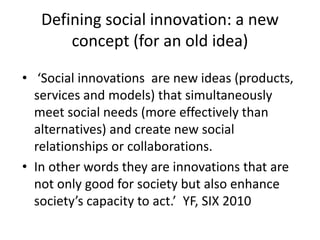
• ‘Social innovations are new ideas (products,
services and models) that simultaneously
meet social needs (more effectively than
alternatives) and create new social
relationships or collaborations.
• In other words they are innovations that are
not only good for society but also enhance
society’s capacity to act.’ YF, SIX 2010
Defining social innovation: a new
concept (for an old idea)
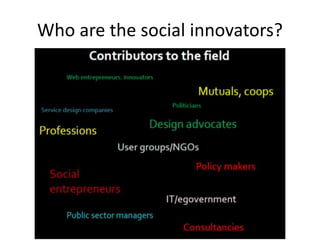
Who are the social innovators?
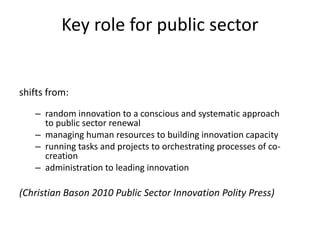
shifts from:
– random innovation to a conscious and systematic approach
to public sector renewal
– managing human resources to building innovation capacity
– running tasks and projects to orchestrating processes of co-
creation
– administration to leading innovation
(Christian Bason 2010 Public Sector Innovation Polity Press)
Key role for public sector
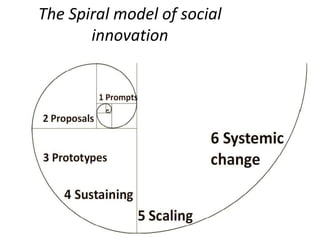
The Spiral model of social
innovation
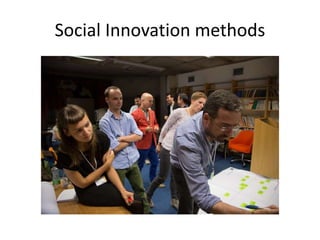
Social Innovation methods
• Co-everything – co-creation, co-design co-
production, co-management, co-ownership
• Open rather than closed approach to the sharing
and ownership of knowledge
• Demand-led rather than supply driven
• Designed ‘solutions’ – many prototypes
• Tailored rather than mass produced,
• solutions have to be adapted to local
circumstances
No single method
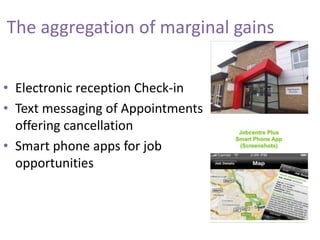
The aggregation of marginal gains
• Electronic reception Check-in
• Text messaging of Appointments
offering cancellation
• Smart phone apps for job
opportunities
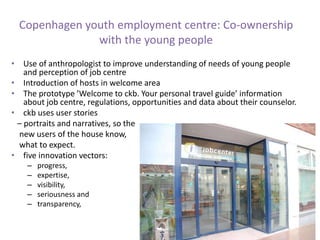
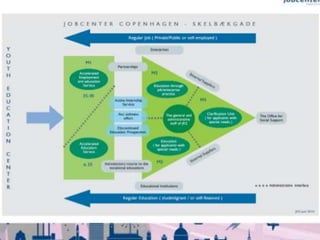
Copenhagen youth employment centre: Co-ownership
with the young people
• Use of anthropologist to improve understanding of needs of young people
and perception of job centre
• Introduction of hosts in welcome area
• The prototype ’Welcome to ckb. Your personal travel guide’ information
about job centre, regulations, opportunities and data about their counselor.
• ckb uses user stories
– portraits and narratives, so the
new users of the house know,
what to expect.
• five innovation vectors:
– progress,
– expertise,
– visibility,
– seriousness and
– transparency,
New financing: funny money
 micro finance, micro credit and peer to
peer (e.g. Kiva)
 diaspora finance
 Alternative currencies – time banks, air
miles, LETS local exchange trading systems,
points money, internet money
 Impact investing and exotic products like
Social Impact Bonds
 Crowd funding
 Challenges (e.g. Bloomberg challenge)
System change
• Reframing the question
• Moving from ‘end-of-pipe’
• Focusing on results (not outputs)
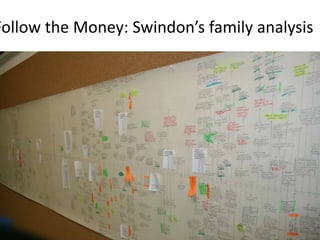
Follow the Money: Swindon’s family analysis
Title of presentation I I Page
19
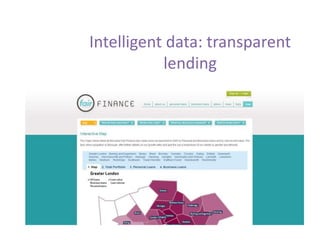
Intelligent data: transparent
lending
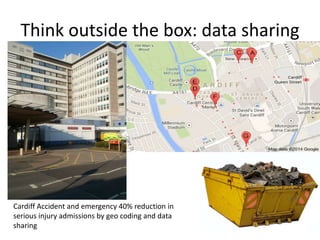
Think outside the box: data sharing
Cardiff Accident and emergency 40% reduction in
serious injury admissions by geo coding and data
sharing
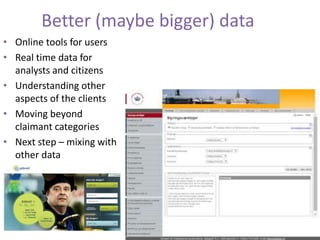
Better (maybe bigger) data
• Online tools for users
• Real time data for
analysts and citizens
• Understanding other
aspects of the clients
• Moving beyond
claimant categories
• Next step – mixing with
other data
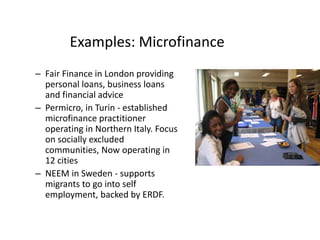
Examples: Microfinance
– Fair Finance in London providing
personal loans, business loans
and financial advice
– Permicro, in Turin - established
microfinance practitioner
operating in Northern Italy. Focus
on socially excluded
communities, Now operating in
12 cities
– NEEM in Sweden - supports
migrants to go into self
employment, backed by ERDF.
Crowd funding
 What is it?
 Is it new? Mark Twain, Beethoven,
Mozart used crowd funding
 Can it replace bank finance for
start-ups
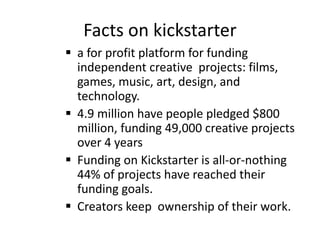
Facts on kickstarter
 a for profit platform for funding
independent creative projects: films,
games, music, art, design, and
technology.
 4.9 million have people pledged $800
million, funding 49,000 creative projects
over 4 years
 Funding on Kickstarter is all-or-nothing
44% of projects have reached their
funding goals.
 Creators keep ownership of their work.
Social Impact Bonds SIBS
 A public private financial circuit
 Bond holders get a return if they achieve target social
impacts
 Peterborough Prison Bond is first example aimed to
reduce recidivism on short term sentences from over 60%
 Reduction by 7.5% over 5 years to achieve return
 ‘Through the door’ services delivered by two social
enterprises (St Giles and Ormiston). Main advantage is
long term funding
 £5million initial offering mostly raised from trusts
 New bonds for reducing street homelessness in London,
recidivism at Rikers island prison, pre school provision in
Utah, investing in success on East coast
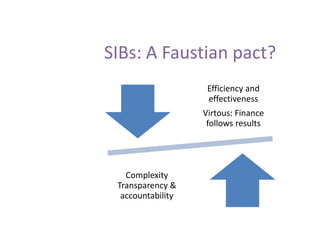
SIBs: A Faustian pact?
Efficiency and
effectiveness
Virtous: Finance
follows results
Complexity
Transparency &
accountability
How to judge whether new
finance will be good?
 Is it transparent? Is it accountable?
 Do you understand it? Will others?
 Does it meet real human needs?
 what types of projects does it deliver on
the ground?
 Who benefits and who loses?
 How long will it take to set up?
 Should you do this? (legally, morally,
practically, financially)
Judging the results
• Randomised control groups are
OECD ‘gold standard’
• Used in social experiments (see jpal
europe
• Qualitative results are also
important and harder to measure
• Value for money and social return
on investment are key measures
Social innovation can make a major
contribution to labour market policies
 Involving users and front-line
staff often combined with
designers is a key part of the
method
 Marginal gains can make a
contribution but sometimes
systemic change is required
 Finance can drive innovation
especially when linked to results
 But metrics are slippery and
need careful calibration
 Scaling is harder than spreading
 Beware of ‘technocratic
solutionism’
Thank you for your attention!
Peterramsden2@gmail.com

Peter_Ramsden_SI_Conference_June_2014

  • 1.
    Social Innovation and the labourmarket Peter Ramsden BerlinTransfer 10th June 2014
  • 2.
    100 years ofinnovation in job centres
  • 3.
  • 4.
  • 5.
    1978 campaign posterand 1980s Peterborough
  • 6.
    UK Job centreplus circa 2014
  • 7.
    New challenges: Thefuture labour market • No job for life • Not much security (zero hours contracts, yet more flexibility) • under-employment • Self-employment an option at key transitions (from education to employment, from employment to retirement) • Patching a portfolio of jobs and personal projects (subsidising what you want to do with what you have to do) • Certain groups will struggle – migrants, lone parents, youth, and disabled
  • 8.
    • ‘Social innovationsare new ideas (products, services and models) that simultaneously meet social needs (more effectively than alternatives) and create new social relationships or collaborations. • In other words they are innovations that are not only good for society but also enhance society’s capacity to act.’ YF, SIX 2010 Defining social innovation: a new concept (for an old idea)
  • 9.
    Who are thesocial innovators?
  • 10.
    shifts from: – randominnovation to a conscious and systematic approach to public sector renewal – managing human resources to building innovation capacity – running tasks and projects to orchestrating processes of co- creation – administration to leading innovation (Christian Bason 2010 Public Sector Innovation Polity Press) Key role for public sector
  • 11.
    The Spiral modelof social innovation
  • 12.
  • 13.
    • Co-everything –co-creation, co-design co- production, co-management, co-ownership • Open rather than closed approach to the sharing and ownership of knowledge • Demand-led rather than supply driven • Designed ‘solutions’ – many prototypes • Tailored rather than mass produced, • solutions have to be adapted to local circumstances No single method
  • 14.
    The aggregation ofmarginal gains • Electronic reception Check-in • Text messaging of Appointments offering cancellation • Smart phone apps for job opportunities
  • 15.
    Copenhagen youth employmentcentre: Co-ownership with the young people • Use of anthropologist to improve understanding of needs of young people and perception of job centre • Introduction of hosts in welcome area • The prototype ’Welcome to ckb. Your personal travel guide’ information about job centre, regulations, opportunities and data about their counselor. • ckb uses user stories – portraits and narratives, so the new users of the house know, what to expect. • five innovation vectors: – progress, – expertise, – visibility, – seriousness and – transparency,
  • 17.
    New financing: funnymoney  micro finance, micro credit and peer to peer (e.g. Kiva)  diaspora finance  Alternative currencies – time banks, air miles, LETS local exchange trading systems, points money, internet money  Impact investing and exotic products like Social Impact Bonds  Crowd funding  Challenges (e.g. Bloomberg challenge)
  • 18.
    System change • Reframingthe question • Moving from ‘end-of-pipe’ • Focusing on results (not outputs)
  • 19.
    Follow the Money:Swindon’s family analysis Title of presentation I I Page 19
  • 20.
  • 21.
    Think outside thebox: data sharing Cardiff Accident and emergency 40% reduction in serious injury admissions by geo coding and data sharing
  • 22.
    Better (maybe bigger)data • Online tools for users • Real time data for analysts and citizens • Understanding other aspects of the clients • Moving beyond claimant categories • Next step – mixing with other data
  • 23.
    Examples: Microfinance – FairFinance in London providing personal loans, business loans and financial advice – Permicro, in Turin - established microfinance practitioner operating in Northern Italy. Focus on socially excluded communities, Now operating in 12 cities – NEEM in Sweden - supports migrants to go into self employment, backed by ERDF.
  • 24.
    Crowd funding  Whatis it?  Is it new? Mark Twain, Beethoven, Mozart used crowd funding  Can it replace bank finance for start-ups
  • 25.
    Facts on kickstarter a for profit platform for funding independent creative projects: films, games, music, art, design, and technology.  4.9 million have people pledged $800 million, funding 49,000 creative projects over 4 years  Funding on Kickstarter is all-or-nothing 44% of projects have reached their funding goals.  Creators keep ownership of their work.
  • 26.
    Social Impact BondsSIBS  A public private financial circuit  Bond holders get a return if they achieve target social impacts  Peterborough Prison Bond is first example aimed to reduce recidivism on short term sentences from over 60%  Reduction by 7.5% over 5 years to achieve return  ‘Through the door’ services delivered by two social enterprises (St Giles and Ormiston). Main advantage is long term funding  £5million initial offering mostly raised from trusts  New bonds for reducing street homelessness in London, recidivism at Rikers island prison, pre school provision in Utah, investing in success on East coast
  • 27.
    SIBs: A Faustianpact? Efficiency and effectiveness Virtous: Finance follows results Complexity Transparency & accountability
  • 28.
    How to judgewhether new finance will be good?  Is it transparent? Is it accountable?  Do you understand it? Will others?  Does it meet real human needs?  what types of projects does it deliver on the ground?  Who benefits and who loses?  How long will it take to set up?  Should you do this? (legally, morally, practically, financially)
  • 29.
    Judging the results •Randomised control groups are OECD ‘gold standard’ • Used in social experiments (see jpal europe • Qualitative results are also important and harder to measure • Value for money and social return on investment are key measures
  • 30.
    Social innovation canmake a major contribution to labour market policies  Involving users and front-line staff often combined with designers is a key part of the method  Marginal gains can make a contribution but sometimes systemic change is required  Finance can drive innovation especially when linked to results  But metrics are slippery and need careful calibration  Scaling is harder than spreading  Beware of ‘technocratic solutionism’
  • 31.
    Thank you foryour attention! Peterramsden2@gmail.com

Editor's Notes

  • #20 This is one of the images included in evidence given by one of the Social Innovation workstream cities. Any idea what it shows? This is a record of public sector interventions with a single family over an 18 year period. It comes from Swindon (UK) which found that it was spending around €300,000 per annum per struggling family without any measurable impact. On the contrary, the interventions were found to disempower the families and to do nothing to break cycles of disadvantage where the children were not missing school, more likely to engage in delinquent activity and be at high risk of becoming NEET. In response, Swindon completely re-engineered its services – based on a coproduction model working with the families. A central element of this change process was a rethink of the role of the municipality – partly because its traditional function was under extreme pressure due to financial constraints and the increased demand for services. Other cities providing evidence to our workstream – including Barcelona, Riga, Copenhagen, Berlin and Nantes – confirmed the Swindon message. We need to use our resources much more effectively to support young people – this requires new trusted relationships with them (often involving youth-led NGOs), inspirational leadership and a willingness to innovate and to take risks. In short, it needs a new set of behaviours from local authorities.