ASTROPHIL AND STELLA 
How Astrophil and Stella both adheres to and departs from the 
conventions of Petrarchan love and discuss their significance. 
Matt Nolan
ASTROPHIL AND STELLA 
• The collection of 108 sonnets and 11 songs has an autobiographical tone, Probably because Sidney had to 
produce fresh and original poetry which came from the heart, in order to break away from the 
conventional sonnets which had become familiar and predictable. 
• Although many of the sonnets portray a love which is dissimilar to Petrarchan ideologies, many of the 
themes, such as longing, frustration, and self-loathing still remain. The songs in particular reflect the 
questionable morality of Astrophil who is attempting to win over the married Stella. He steals kisses off 
of her while she sleeps, worrying about her anger and then later wishes he was more adventurous, Song 
ii, Astrophil is turned away time and time again by Stella but keeps returning no matter how much she 
declines. 
• Astrophil’s morality should be frowned upon rather than encouraged, however modern critics praise his 
resilience as he is driven by love. However, critics such as Thomas Roche JR. believe Sidney “wanted us 
to be delighted by Astrophil’s wit” and that he “teaches morality by negative example” as Astrophil only 
finds despair at the end of his longing because he blindly followed his desires. 
• Songs: Each song has an important role in the narrative of Astrophil and Stella, they should not be read 
all at once but alongside the relevant sonnets, Song 2, Song 8, and Song 11 are particularly important in 
terms of the plot. The stolen kiss in Song 2 is the closest Astrophil ever gets to the manifestation of his 
physical desire for Stella. Song 8 is the beginning of the end in their relationship; Stella admits that she 
loves Astrophil, but won’t leave her husband. Song 11 Stella finally dismisses Astrophil for good, 
destroying any of his hope for a future relationship.
THEMES MADE POPULAR BY THE 
PETRARCHAN IDEOLOGIES OF LOVE 
• Love at first sight 
• obsessive yearning and 
lovesickness 
• Frustration 
• The lady as ideally beautiful, 
ideally virtuous, miraculous, 
beloved in heaven, and destined to 
early death 
• The god of love with his arrows, 
fires, whips, chains 
• War within the self-hope, 
fear, joy, 
sorrow. 
• Allegory 
• personification 
• Wooing, exhortation, 
outcry 
• Self-accusation, self-defence 
• Repentance, and the 
farewell to love.
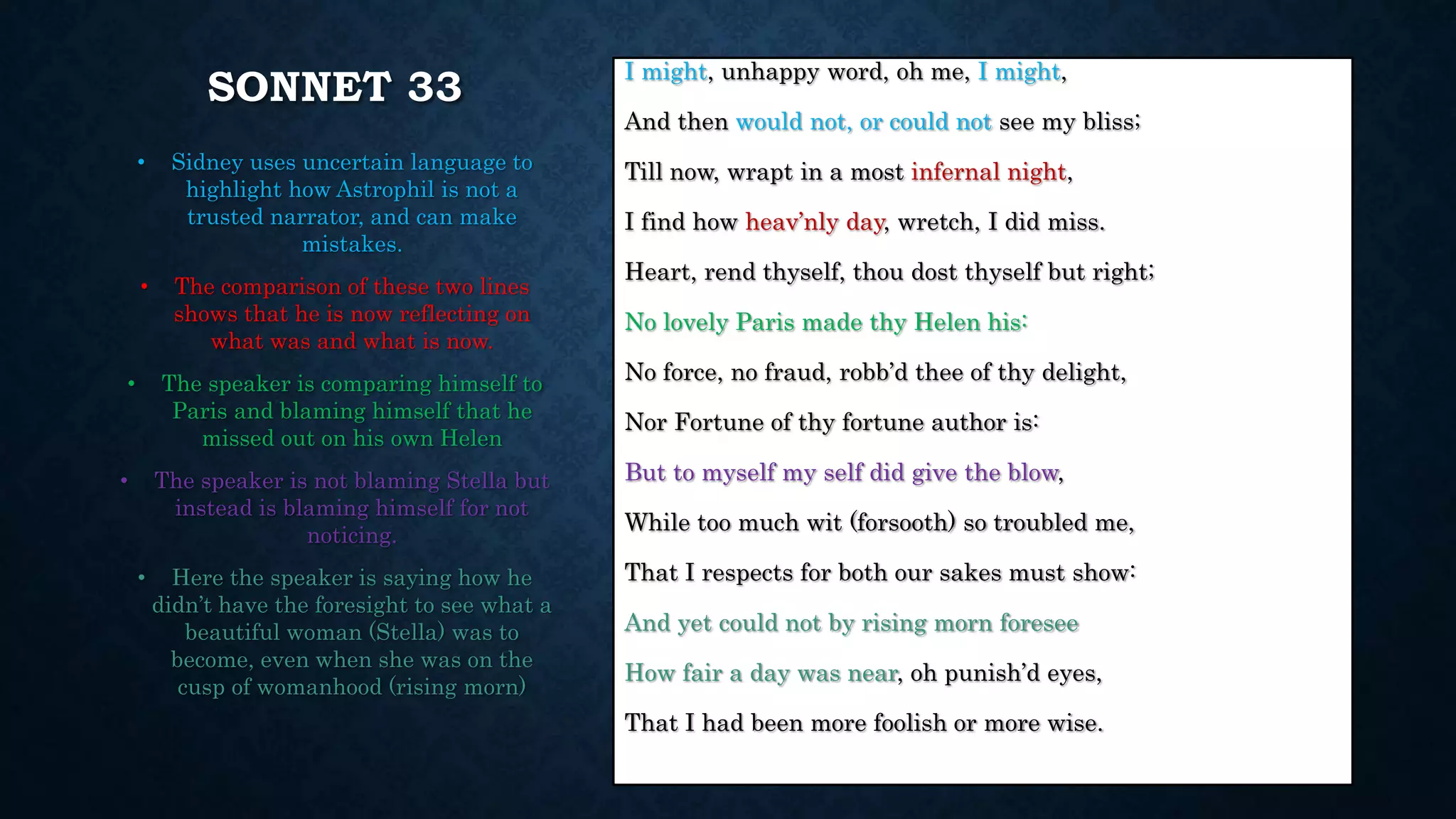
SONNET 33 
I might, unhappy word, oh me, I might, 
And then would not, or could not see my bliss; 
Till now, wrapt in a most infernal night, 
I find how heav’nly day, wretch, I did miss. 
Heart, rend thyself, thou dost thyself but right; 
No lovely Paris made thy Helen his: 
No force, no fraud, robb’d thee of thy delight, 
Nor Fortune of thy fortune author is: 
But to myself my self did give the blow, 
While too much wit (forsooth) so troubled me, 
That I respects for both our sakes must show: 
And yet could not by rising morn foresee 
How fair a day was near, oh punish’d eyes, 
That I had been more foolish or more wise. 
In this sonnet Astrophil is grieving that he 
had not noticed Stella’s beauty sooner. When 
he first met her she was not blossomed into 
the beautiful mature woman she became. 
Contextually, Sidney first met, what is 
believed to be the influence for Stella, 
Penelope Devereux when she was 12 years 
old and couldn’t see her as a beautiful 
woman, but still as a child. 
This sonnet both adheres to and departs from 
the typical Petrarchan and platonic 
ideologies of love. 
The frustration and self-loathing is found 
both in this sonnet and other sonnets which 
adhere to Petrarchan ideologies. 
However, the speaker, Astrophil, does not 
blame his love interest for ‘trapping’ or 
‘tormenting’ him, but instead admits he 
shouldn’t have dismissed her so easily.
SONNET 33 I might, unhappy word, oh me, I might, 
And then would not, or could not see my bliss; 
Till now, wrapt in a most infernal night, 
I find how heav’nly day, wretch, I did miss. 
Heart, rend thyself, thou dost thyself but right; 
No lovely Paris made thy Helen his: 
No force, no fraud, robb’d thee of thy delight, 
Nor Fortune of thy fortune author is: 
But to myself my self did give the blow, 
While too much wit (forsooth) so troubled me, 
That I respects for both our sakes must show: 
And yet could not by rising morn foresee 
How fair a day was near, oh punish’d eyes, 
That I had been more foolish or more wise. 
• Sidney uses uncertain language to 
highlight how Astrophil is not a 
trusted narrator, and can make 
mistakes. 
• The comparison of these two lines 
shows that he is now reflecting on 
what was and what is now. 
• The speaker is comparing himself to 
Paris and blaming himself that he 
missed out on his own Helen 
• The speaker is not blaming Stella but 
instead is blaming himself for not 
noticing. 
• Here the speaker is saying how he 
didn’t have the foresight to see what a 
beautiful woman (Stella) was to 
become, even when she was on the 
cusp of womanhood (rising morn)
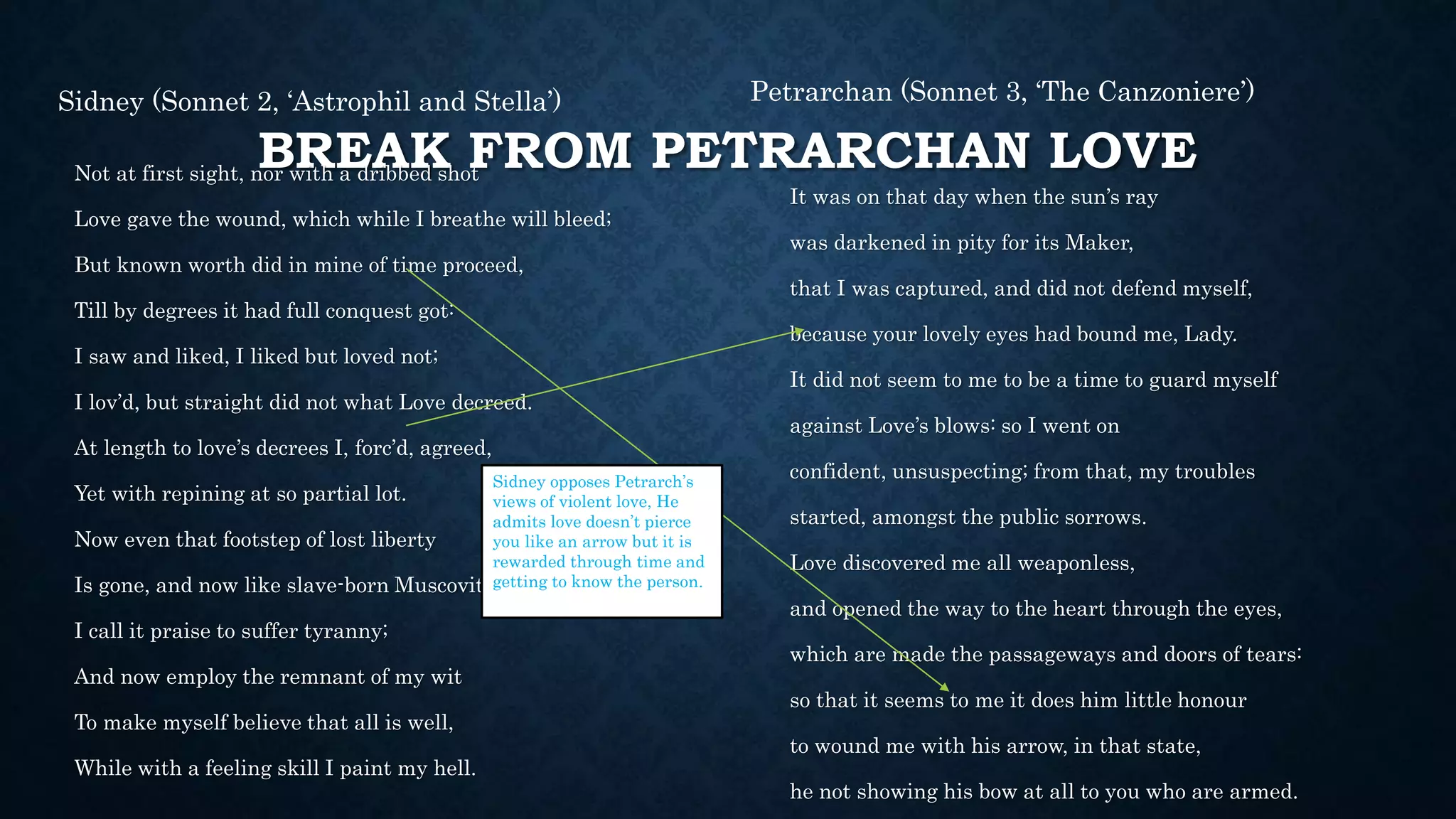
Sidney (Sonnet 2, ‘Astrophil and Stella’) Petrarchan (Sonnet 3, ‘The Canzoniere’) 
BREAK FROM PETRARCHAN LOVE Not at first sight, nor with a dribbed shot 
Love gave the wound, which while I breathe will bleed; 
But known worth did in mine of time proceed, 
Till by degrees it had full conquest got: 
I saw and liked, I liked but loved not; 
I lov’d, but straight did not what Love decreed. 
At length to love’s decrees I, forc’d, agreed, 
Yet with repining at so partial lot. 
Now even that footstep of lost liberty 
Is gone, and now like slave-born Muscovite 
I call it praise to suffer tyranny; 
And now employ the remnant of my wit 
To make myself believe that all is well, 
While with a feeling skill I paint my hell. 
It was on that day when the sun’s ray 
was darkened in pity for its Maker, 
that I was captured, and did not defend myself, 
because your lovely eyes had bound me, Lady. 
It did not seem to me to be a time to guard myself 
against Love’s blows: so I went on 
confident, unsuspecting; from that, my troubles 
started, amongst the public sorrows. 
Love discovered me all weaponless, 
and opened the way to the heart through the eyes, 
which are made the passageways and doors of tears: 
so that it seems to me it does him little honour 
to wound me with his arrow, in that state, 
he not showing his bow at all to you who are armed. 
Sidney opposes Petrarch’s 
views of violent love, He 
admits love doesn’t pierce 
you like an arrow but it is 
rewarded through time and 
getting to know the person.
SIMILAR TO PETRARCHAN LOVE 
Sidney (Sonnet 2, ‘Astrophil and Stella’) Petrarchan (Sonnet 3, ‘The Canzoniere’) 
Not at first sight, nor with a dribbed shot 
Love gave the wound, which while I breathe will bleed; 
But known worth did in mine of time proceed, 
Till by degrees it had full conquest got: 
I saw and liked, I liked but loved not; 
I lov’d, but straight did not what Love decreed. 
At length to love’s decrees I, forc’d, agreed, 
Yet with repining at so partial lot. 
Now even that footstep of lost liberty 
Is gone, and now like slave-born Muscovite 
I call it praise to suffer tyranny; 
And now employ the remnant of my wit 
To make myself believe that all is well, 
While with a feeling skill I paint my hell. 
It was on that day when the sun’s ray 
was darkened in pity for its Maker, 
that I was captured, and did not defend myself, 
because your lovely eyes had bound me, Lady. 
It did not seem to me to be a time to guard myself 
against Love’s blows: so I went on 
confident, unsuspecting; from that, my troubles 
started, amongst the public sorrows. 
Love discovered me all weaponless, 
and opened the way to the heart through the eyes, 
which are made the passageways and doors of tears: 
so that it seems to me it does him little honour 
to wound me with his arrow, in that state, 
he not showing his bow at all to you who are armed. 
Both poets show an 
understanding that love has 
captured them like slaves. 
They both transform their 
anguish into an art form, and 
make them ‘public sorrows’.
CONCLUSION 
• Astrophil and Stella can be mostly interpreted as a warning: Go, and do not likewise as Astrophil, may not be an 
ambassador for Platonic or Petrarchan love, but is still a slave to his desires. He pursues his love, rather than 
his passion, but the morality is flawed, and although he loves Stella, he is too late and she is married. 
• The concept of forbidden love is popular amongst Petrarchan ideologies but Sidney subverts the expectations of 
the readers to make Astrophil seem better, than other Renaissance lovers, through his love of Stella’s inner 
beauty, as well as her physical appearance. 
• The themes seen in Astrophil and Stella compared to Petrarchan/Petrarchan-inspired poetry share similarities 
in pain and longing, but Sidney does not use as much violent language to describe Astrophil’s affection. Also, 
instead of love at first sight, their love is one which grows through time and surpasses physical beauty. 
• The significance of both the similarities and differences between Sidney’s work and Petrarchan ideologies is that 
it shows how Sidney wanted to inspire others into being more rational with love, rather than just reusing the 
conventions of the time, set about by Petrarch.

Astrophil and stella

  • 1.
    ASTROPHIL AND STELLA How Astrophil and Stella both adheres to and departs from the conventions of Petrarchan love and discuss their significance. Matt Nolan
  • 2.
    ASTROPHIL AND STELLA • The collection of 108 sonnets and 11 songs has an autobiographical tone, Probably because Sidney had to produce fresh and original poetry which came from the heart, in order to break away from the conventional sonnets which had become familiar and predictable. • Although many of the sonnets portray a love which is dissimilar to Petrarchan ideologies, many of the themes, such as longing, frustration, and self-loathing still remain. The songs in particular reflect the questionable morality of Astrophil who is attempting to win over the married Stella. He steals kisses off of her while she sleeps, worrying about her anger and then later wishes he was more adventurous, Song ii, Astrophil is turned away time and time again by Stella but keeps returning no matter how much she declines. • Astrophil’s morality should be frowned upon rather than encouraged, however modern critics praise his resilience as he is driven by love. However, critics such as Thomas Roche JR. believe Sidney “wanted us to be delighted by Astrophil’s wit” and that he “teaches morality by negative example” as Astrophil only finds despair at the end of his longing because he blindly followed his desires. • Songs: Each song has an important role in the narrative of Astrophil and Stella, they should not be read all at once but alongside the relevant sonnets, Song 2, Song 8, and Song 11 are particularly important in terms of the plot. The stolen kiss in Song 2 is the closest Astrophil ever gets to the manifestation of his physical desire for Stella. Song 8 is the beginning of the end in their relationship; Stella admits that she loves Astrophil, but won’t leave her husband. Song 11 Stella finally dismisses Astrophil for good, destroying any of his hope for a future relationship.
  • 3.
    THEMES MADE POPULARBY THE PETRARCHAN IDEOLOGIES OF LOVE • Love at first sight • obsessive yearning and lovesickness • Frustration • The lady as ideally beautiful, ideally virtuous, miraculous, beloved in heaven, and destined to early death • The god of love with his arrows, fires, whips, chains • War within the self-hope, fear, joy, sorrow. • Allegory • personification • Wooing, exhortation, outcry • Self-accusation, self-defence • Repentance, and the farewell to love.
  • 4.
    SONNET 33 Imight, unhappy word, oh me, I might, And then would not, or could not see my bliss; Till now, wrapt in a most infernal night, I find how heav’nly day, wretch, I did miss. Heart, rend thyself, thou dost thyself but right; No lovely Paris made thy Helen his: No force, no fraud, robb’d thee of thy delight, Nor Fortune of thy fortune author is: But to myself my self did give the blow, While too much wit (forsooth) so troubled me, That I respects for both our sakes must show: And yet could not by rising morn foresee How fair a day was near, oh punish’d eyes, That I had been more foolish or more wise. In this sonnet Astrophil is grieving that he had not noticed Stella’s beauty sooner. When he first met her she was not blossomed into the beautiful mature woman she became. Contextually, Sidney first met, what is believed to be the influence for Stella, Penelope Devereux when she was 12 years old and couldn’t see her as a beautiful woman, but still as a child. This sonnet both adheres to and departs from the typical Petrarchan and platonic ideologies of love. The frustration and self-loathing is found both in this sonnet and other sonnets which adhere to Petrarchan ideologies. However, the speaker, Astrophil, does not blame his love interest for ‘trapping’ or ‘tormenting’ him, but instead admits he shouldn’t have dismissed her so easily.
  • 5.
    SONNET 33 Imight, unhappy word, oh me, I might, And then would not, or could not see my bliss; Till now, wrapt in a most infernal night, I find how heav’nly day, wretch, I did miss. Heart, rend thyself, thou dost thyself but right; No lovely Paris made thy Helen his: No force, no fraud, robb’d thee of thy delight, Nor Fortune of thy fortune author is: But to myself my self did give the blow, While too much wit (forsooth) so troubled me, That I respects for both our sakes must show: And yet could not by rising morn foresee How fair a day was near, oh punish’d eyes, That I had been more foolish or more wise. • Sidney uses uncertain language to highlight how Astrophil is not a trusted narrator, and can make mistakes. • The comparison of these two lines shows that he is now reflecting on what was and what is now. • The speaker is comparing himself to Paris and blaming himself that he missed out on his own Helen • The speaker is not blaming Stella but instead is blaming himself for not noticing. • Here the speaker is saying how he didn’t have the foresight to see what a beautiful woman (Stella) was to become, even when she was on the cusp of womanhood (rising morn)
  • 6.
    Sidney (Sonnet 2,‘Astrophil and Stella’) Petrarchan (Sonnet 3, ‘The Canzoniere’) BREAK FROM PETRARCHAN LOVE Not at first sight, nor with a dribbed shot Love gave the wound, which while I breathe will bleed; But known worth did in mine of time proceed, Till by degrees it had full conquest got: I saw and liked, I liked but loved not; I lov’d, but straight did not what Love decreed. At length to love’s decrees I, forc’d, agreed, Yet with repining at so partial lot. Now even that footstep of lost liberty Is gone, and now like slave-born Muscovite I call it praise to suffer tyranny; And now employ the remnant of my wit To make myself believe that all is well, While with a feeling skill I paint my hell. It was on that day when the sun’s ray was darkened in pity for its Maker, that I was captured, and did not defend myself, because your lovely eyes had bound me, Lady. It did not seem to me to be a time to guard myself against Love’s blows: so I went on confident, unsuspecting; from that, my troubles started, amongst the public sorrows. Love discovered me all weaponless, and opened the way to the heart through the eyes, which are made the passageways and doors of tears: so that it seems to me it does him little honour to wound me with his arrow, in that state, he not showing his bow at all to you who are armed. Sidney opposes Petrarch’s views of violent love, He admits love doesn’t pierce you like an arrow but it is rewarded through time and getting to know the person.
  • 7.
    SIMILAR TO PETRARCHANLOVE Sidney (Sonnet 2, ‘Astrophil and Stella’) Petrarchan (Sonnet 3, ‘The Canzoniere’) Not at first sight, nor with a dribbed shot Love gave the wound, which while I breathe will bleed; But known worth did in mine of time proceed, Till by degrees it had full conquest got: I saw and liked, I liked but loved not; I lov’d, but straight did not what Love decreed. At length to love’s decrees I, forc’d, agreed, Yet with repining at so partial lot. Now even that footstep of lost liberty Is gone, and now like slave-born Muscovite I call it praise to suffer tyranny; And now employ the remnant of my wit To make myself believe that all is well, While with a feeling skill I paint my hell. It was on that day when the sun’s ray was darkened in pity for its Maker, that I was captured, and did not defend myself, because your lovely eyes had bound me, Lady. It did not seem to me to be a time to guard myself against Love’s blows: so I went on confident, unsuspecting; from that, my troubles started, amongst the public sorrows. Love discovered me all weaponless, and opened the way to the heart through the eyes, which are made the passageways and doors of tears: so that it seems to me it does him little honour to wound me with his arrow, in that state, he not showing his bow at all to you who are armed. Both poets show an understanding that love has captured them like slaves. They both transform their anguish into an art form, and make them ‘public sorrows’.
  • 8.
    CONCLUSION • Astrophiland Stella can be mostly interpreted as a warning: Go, and do not likewise as Astrophil, may not be an ambassador for Platonic or Petrarchan love, but is still a slave to his desires. He pursues his love, rather than his passion, but the morality is flawed, and although he loves Stella, he is too late and she is married. • The concept of forbidden love is popular amongst Petrarchan ideologies but Sidney subverts the expectations of the readers to make Astrophil seem better, than other Renaissance lovers, through his love of Stella’s inner beauty, as well as her physical appearance. • The themes seen in Astrophil and Stella compared to Petrarchan/Petrarchan-inspired poetry share similarities in pain and longing, but Sidney does not use as much violent language to describe Astrophil’s affection. Also, instead of love at first sight, their love is one which grows through time and surpasses physical beauty. • The significance of both the similarities and differences between Sidney’s work and Petrarchan ideologies is that it shows how Sidney wanted to inspire others into being more rational with love, rather than just reusing the conventions of the time, set about by Petrarch.