Road Accident Prone Site Detection
Project
using
Geospatial Technology and its
Application
Submitted By
Mahendra Gupta and Shabeen Taj
Karnataka State Council for Science and Technology
Indian Institute of Science Campus,
Bengaluru - 560012
Outline
1. Introduction
2. Objective
3. Road accident prone site detection
4. Methodology
5. Conclusion
5/8/2016 2KSCST
1. Introduction
According to report of Ministry of Road Transport & Highways,
Govt. of India
 As per 2011 Report
1 accident per minute
And
1 death per 3.7 minute
 Accident was 9th leading
cause in 2005, and it is expected
it will be 5th death cause in 2030
world wide
126896
133938
136834
139091
137423
2009 2010 2011 2012 2013
Number of Accidents
5/8/2016 3KSCST
Causes of Road Accidents
The three different types of factors that
contribute to road Accidents:
1. Human Factors
2. Vehicle Factors and
3. RoadwayFactors
5/8/2016 4KSCST
Road Parameters Affecting the Road Safety
1. Cross-Section
of the Road
3. Curvature of the
Roadway
2. Roadside
Condition
5/8/2016 5KSCST
4. Access Management
The concept that access-related
vehicular manoeuvres and
volumes can have serious
consequences on the
performance of traffic operations
and road safety
5. Sight distance
A sight distance of sufficient
length is necessary so that a
driver can control the operation
of their vehicles to avoid hitting
an unexpected object on the road
5/8/2016 6KSCST
2. Objective
Objective of this work is detection of road accident prone
sites with the help of GIS technologies and past accident data.
3. Road Accident Site Detection
Road accident prone site detection is the process of detection
of sites on roads where accidents are more likely to happen
5/8/2016 7KSCST
4. Methodology
1. Define the area of study.
2. Digitized roads and other spatial entities.
3. Collect the accidental data of that region.
4. Overlay the accident points on the geocoded map.
5. Identify the high accident density region.
6. Mark them as accident prone and suggest required
sign for that region.
7. Propose appropriatesign board for that reason.
8. end
5/8/2016 8KSCST
5/8/2016 9KSCST
Digitized Road Network
5/8/2016 10KSCST
Road network Overlaying with minor accident
5/8/2016 11KSCST
Road network overlying with minor and
fatal accidents
5/8/2016 12KSCST
Detected sites as accident prone
5/8/2016 13KSCST
5/8/2016 14KSCST
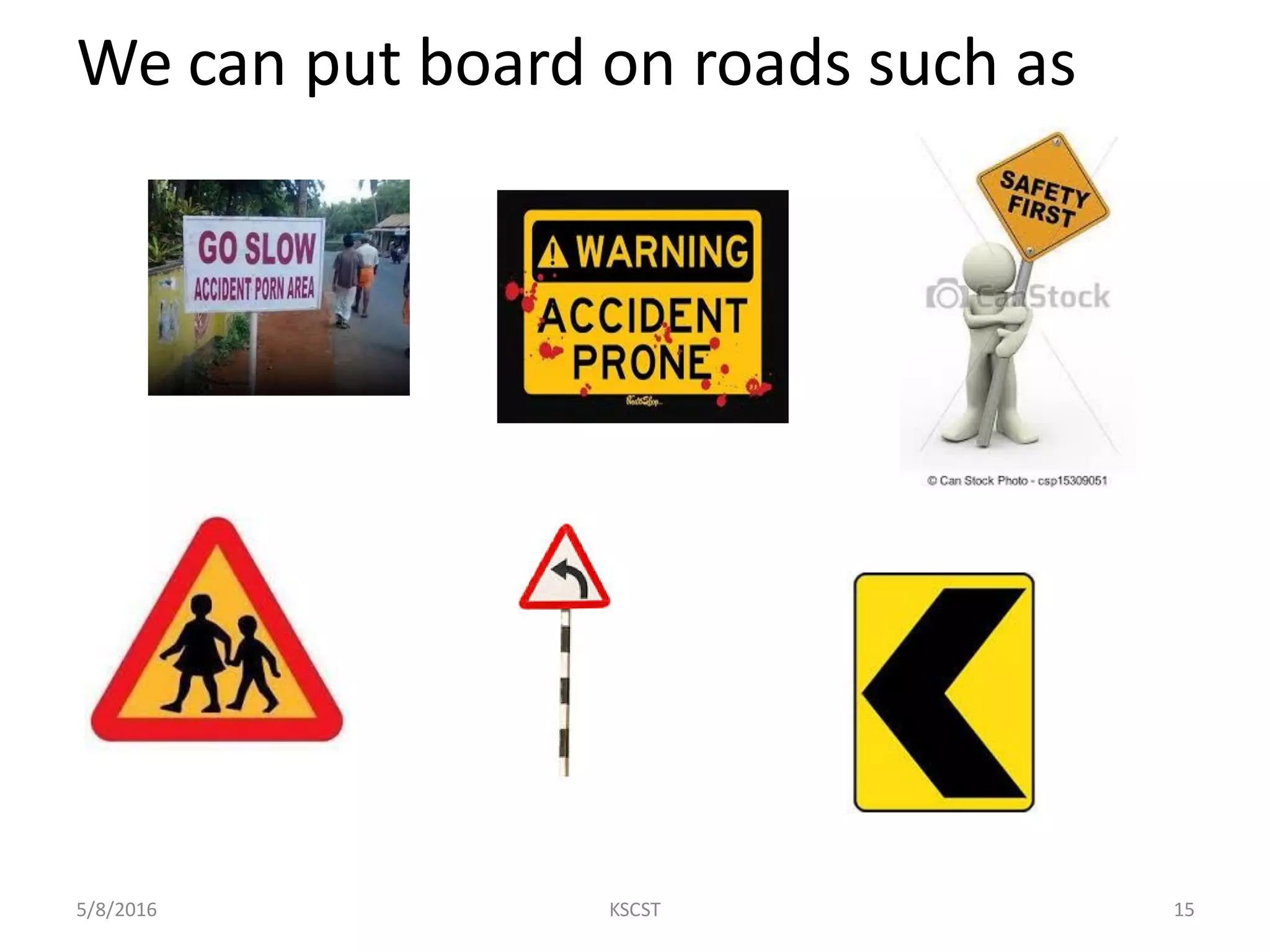
We can put board on roads such as
5/8/2016 15KSCST
5. Conclusion
• With the help of past data and GIS
technologies it very easy to detect.
• Reduced accident at some extent.
• Not a quantified way to present how much
that area is prone.
• It need ground truth to decide type of sign
board
5/8/2016 16KSCST
References
• [1] http://www.unescap.org/sites/default/files/2.12.India_.pdf
• [2]World Health Organization (WHO).2004.World Report on Road Traffic Injury Prevention
Washington, DC.
• [3 ] Haddon, W. 1972. A Logistic Framework for Categorizing HighwaySafety Phenomena and
Activity.
• [4 ] The Journal of Trauma, Vol. 12, Lippincon Williams and Wilkins, Washington, DC, pp. 193-207
• [5] Expert Group Meeting on Progress in Road Safety Improvement in Asia and the Pacific, 8-10 May
2013, Seoul, Republic of Korea. Retrieved from:
http://www.unescap.org/ttdw/common/Meetings/TIS/ EGM-Roadsafety-2013/ppt/4.2.KEC.pdf
• [4] Global Plan for the Decade of Action for Road Safety 2011-2020,United Nations, New York.
Retrieved from: http://www.who.int/roadsafety/decade_of_action/plan/plan_english.pdf
• [5] Zegeer C. V., Reinfurt W., Hummer J. Herf L. and Hunter W. 1988. Effect of Lane and Shoulder
Width on Accident Reduction on Rural, Two-Lane Roads. Transportation Research Record. Vol. 806.
Transportation Research Board. Washington, DC.
• [6] Zegeer C. V., Deen R. C., and Mayes J. G. 1981. Safety Effects of Cross-Section Design for Two-
Lane Roads. Transportation Research Record. Vol. 1195.Transportation Research Board.
Washington, DC
5/8/2016 17KSCST
?
5/8/2016 18KSCST
Thank you!
5/8/2016 19KSCST

Road accident prone site detection.

  • 1.
    Road Accident ProneSite Detection Project using Geospatial Technology and its Application Submitted By Mahendra Gupta and Shabeen Taj Karnataka State Council for Science and Technology Indian Institute of Science Campus, Bengaluru - 560012
  • 2.
    Outline 1. Introduction 2. Objective 3.Road accident prone site detection 4. Methodology 5. Conclusion 5/8/2016 2KSCST
  • 3.
    1. Introduction According toreport of Ministry of Road Transport & Highways, Govt. of India  As per 2011 Report 1 accident per minute And 1 death per 3.7 minute  Accident was 9th leading cause in 2005, and it is expected it will be 5th death cause in 2030 world wide 126896 133938 136834 139091 137423 2009 2010 2011 2012 2013 Number of Accidents 5/8/2016 3KSCST
  • 4.
    Causes of RoadAccidents The three different types of factors that contribute to road Accidents: 1. Human Factors 2. Vehicle Factors and 3. RoadwayFactors 5/8/2016 4KSCST
  • 5.
    Road Parameters Affectingthe Road Safety 1. Cross-Section of the Road 3. Curvature of the Roadway 2. Roadside Condition 5/8/2016 5KSCST
  • 6.
    4. Access Management Theconcept that access-related vehicular manoeuvres and volumes can have serious consequences on the performance of traffic operations and road safety 5. Sight distance A sight distance of sufficient length is necessary so that a driver can control the operation of their vehicles to avoid hitting an unexpected object on the road 5/8/2016 6KSCST
  • 7.
    2. Objective Objective ofthis work is detection of road accident prone sites with the help of GIS technologies and past accident data. 3. Road Accident Site Detection Road accident prone site detection is the process of detection of sites on roads where accidents are more likely to happen 5/8/2016 7KSCST
  • 8.
    4. Methodology 1. Definethe area of study. 2. Digitized roads and other spatial entities. 3. Collect the accidental data of that region. 4. Overlay the accident points on the geocoded map. 5. Identify the high accident density region. 6. Mark them as accident prone and suggest required sign for that region. 7. Propose appropriatesign board for that reason. 8. end 5/8/2016 8KSCST
  • 9.
  • 10.
  • 11.
    Road network Overlayingwith minor accident 5/8/2016 11KSCST
  • 12.
    Road network overlyingwith minor and fatal accidents 5/8/2016 12KSCST
  • 13.
    Detected sites asaccident prone 5/8/2016 13KSCST
  • 14.
  • 15.
    We can putboard on roads such as 5/8/2016 15KSCST
  • 16.
    5. Conclusion • Withthe help of past data and GIS technologies it very easy to detect. • Reduced accident at some extent. • Not a quantified way to present how much that area is prone. • It need ground truth to decide type of sign board 5/8/2016 16KSCST
  • 17.
    References • [1] http://www.unescap.org/sites/default/files/2.12.India_.pdf •[2]World Health Organization (WHO).2004.World Report on Road Traffic Injury Prevention Washington, DC. • [3 ] Haddon, W. 1972. A Logistic Framework for Categorizing HighwaySafety Phenomena and Activity. • [4 ] The Journal of Trauma, Vol. 12, Lippincon Williams and Wilkins, Washington, DC, pp. 193-207 • [5] Expert Group Meeting on Progress in Road Safety Improvement in Asia and the Pacific, 8-10 May 2013, Seoul, Republic of Korea. Retrieved from: http://www.unescap.org/ttdw/common/Meetings/TIS/ EGM-Roadsafety-2013/ppt/4.2.KEC.pdf • [4] Global Plan for the Decade of Action for Road Safety 2011-2020,United Nations, New York. Retrieved from: http://www.who.int/roadsafety/decade_of_action/plan/plan_english.pdf • [5] Zegeer C. V., Reinfurt W., Hummer J. Herf L. and Hunter W. 1988. Effect of Lane and Shoulder Width on Accident Reduction on Rural, Two-Lane Roads. Transportation Research Record. Vol. 806. Transportation Research Board. Washington, DC. • [6] Zegeer C. V., Deen R. C., and Mayes J. G. 1981. Safety Effects of Cross-Section Design for Two- Lane Roads. Transportation Research Record. Vol. 1195.Transportation Research Board. Washington, DC 5/8/2016 17KSCST
  • 18.
  • 19.