Revised National Tuberculosis
Control Programme
Tuberculosis
• TB is an infectious disease caused
predominately by Mycobacterium tuberculosis
• Commonly transmitted when a person with
untreated TB coughs or sneezes.
• Usually affects the lungs. But can affect any
part of the body.
• (LN’s, pleura, bones and joints, genito-urinary
tract, nervous system, abdominal TB, skin, etc.
Burden Of TB
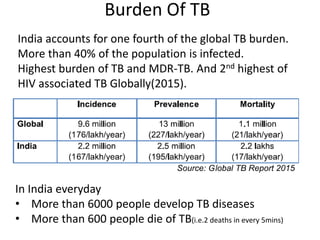
In India everyday
• More than 6000 people develop TB diseases
• More than 600 people die of TB(i.e.2 deaths in every 5mins)
India accounts for one fourth of the global TB burden.
More than 40% of the population is infected.
Highest burden of TB and MDR-TB. And 2nd highest of
HIV associated TB Globally(2015).
• Estimated Multi-drug resistant TB
– ~3% in new cases
– 12-17% in re-treatment cases
• TB-HIV
– ~2.31 million people living with HIV (PLWHA)
– 10-15% annual risk (60% lifetime risk) of developing active
TB disease in PLWHA
– Estimated ~ 5% of TB patients are HIV infected
Burden Of TB
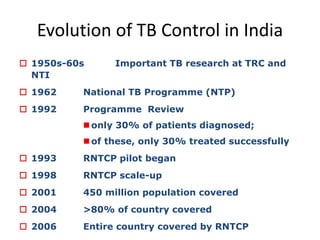
Evolution of TB Control in India
 1950s-60s Important TB research at TRC and
NTI
 1962 National TB Programme (NTP)
 1992 Programme Review
 only 30% of patients diagnosed;
 of these, only 30% treated successfully
 1993 RNTCP pilot began
 1998 RNTCP scale-up
 2001 450 million population covered
 2004 >80% of country covered
 2006 Entire country covered by RNTCP
National Tuberculosis Programme
(NTP)
 Operational since 1962.
 Unacceptably low success rate.
 Spread of multidrug resistant TB.
 Managerial weakness
 Inadequate funding.
 Over-reliance of X-ray for diagnosis.
 Frequent interrupted supplies of drugs.
 Low rate of treatment completion.
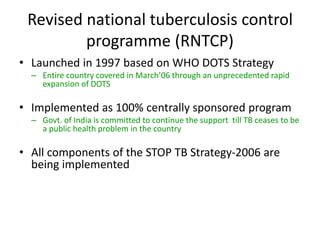
Revised national tuberculosis control
programme (RNTCP)
• Launched in 1997 based on WHO DOTS Strategy
– Entire country covered in March’06 through an unprecedented rapid
expansion of DOTS
• Implemented as 100% centrally sponsored program
– Govt. of India is committed to continue the support till TB ceases to be
a public health problem in the country
• All components of the STOP TB Strategy-2006 are
being implemented
Stop TB Strategy
• Pursuing High quality DOTS expansion and
enhancement
• Addressing TB-HIV,MDR-TB and other
challenges
• Contributing to health system strengthening
• Engaging all care providers
• Empowering patients and communities
• Enabling and promoting research
Objectives of RNTCP
 Achievement of at least 85% cure rate of
infectious cases; through DOTS involving
peripheral health functionaries.
 Augmentation of case finding activities
through quality sputum microscopy to detect
at least 70% of estimated cases.
The 5 components of DOTS
 Political & administrative
commitment
 Diagnosis by good quality sputum
microscopy
 Adequate supply of good quality
drugs
 Directly observed treatment
 Systematic monitoring &
Accountability
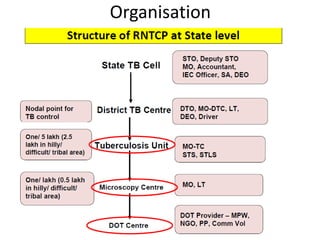
Organisation
Organisation
RNTCP Laboratory Network
National Reference Laboratory (NRL)
 NRL conducts annual On-site evaluation/supervisory
visits to laboratories for assessing quality of
microscopy, Culture and DST, and for improvement of
overall laboratory quality .
 The programme has provided HR support by way of
three microbiologists and four senior laboratory
technicians to each NRL for these activities under the
head of NRL strengthening.
 The functions of the NRLs include conduct of Culture
and DST trainings to the IRLs, develop SOPs for the
technical procedures, equipment maintenance,
infection control, and recording and reporting.
Intermediate Reference Laboratory
(IRL)
 There is at least one IRL per state.
 Its functions is to provide culture and DST for the
category IV services in the State .
 The IRL conducts on-site evaluation visits to districts
for sputum microscopy at least once a year.
 The IRL undertakes panel testing of STLS at each DTC.
 The IRL ensures the proficiency of staff performing
RNTCP smear microscopy activities by providing
training to laboratory technicians and STLS.
Designated Microscopy Centre (DMC)
 The most peripheral laboratory under the RNTCP
network is the designated microscopy centre (DMC)
which serves a population of around 100,000 (50,000
in tribal and hilly areas).
 RNTCP has provided financial assistance for
upgrading existing health facilities, supplied a
binocular microscope for each DMC and ensured
adequate supply of staining reagent and
consumables at the DMCs.
 DMCs are manned by a trained laboratory technician
(LT) of the state health system.
RNTCP External Quality Assessment
o Panel testing
o On‐site evaluation
o Random blinded rechecking of routine slides
Case Definitions
• Presumptive PTB: any of the symptoms and signs
suggestive of TB including cough >2 weeks,
significant weight loss, haemoptysis, any
abnormality in CXR.
• Presumptive EPTB: presence of organ specific
signs and symptoms like swelling of LN, pain and
swelling of joints, neck stiffness, disorientation,
etc and/or constitutional symptoms like
significant weight loss, persistent fever ≥2weeks,
night sweats.
• Presumptive paediatric TB: children with
persistent fever and/or cough for >2weeks, loss
of weight/no weight gain and/or history of
contact with infectious TB cases.
• Presumptive DR TB: TB pts who have failed
treatment with first line drugs, paedritic TB non
responders, TB pts who are contacts od DR TB,
pts found +ve on any follow up sputum smear
examination during treatment with first line
drugs, previously treated cases, HIV co-infection.
Case Definitions
Diagnostic Tools
1. Smear Microscopy (for AFB)
• – Sputum smear
stained with Zeil-
Nelson Staining or
• – Fluorescence
stains and
examined under
direct or indirect
microscopy with or
without LED.
Sputum AFB Grading
No of fields to
examine
Grading Result
No AFB in 100 fields 100 0 Neg
1-9 AFB per 100
fields
100 Scanty Pos
10-99 AFB per 100
fields
100 1+ Pos
1-10 AFB per field 50 2+ Pos
>10 AFB per field 20 3+ Pos
2. Culture
• – Solid (Lowenstein Jansen) media or Liquid
media (Middle Brook) using manual,
semiautomatic or automatic machines e.g.
Bactec , MGIT etc.
• Drug sensitivity testing
3. Rapid diagnostic molecular test
• – Conventional PCR
based Line Probe
Assay for MTB
complex or Real-time
PCR based Nucleic
Acid Amplification
Test (NAAT) for MTB
complex e.g.
GeneXpert
CBNAAT (Cartridge Based Nucleic Acid
Amplification Test)
 CBNAAT is an automated Cartridge
Based Nucleic Acid Amplification Test
that has demonstrated its potential
to detect tuberculosis and Rifampicin
resistance with high accuracy.
 It is also called Gene Xpert MTB/RIF
(Cepheid Inc, USA) test, a highly
sensitive and specific tool with a
quick turn-around time (TAT), offers
early diagnosis of TB and DR-TB) in
the programmatic settings amongst
adult and children as well.
X-ray is an Important Complementary Tool
• Highly sensitive; with low specificity
• Plays a useful supportive role:
• May lead to over-diagnosis
– May miss the diagnosis of other diseases
(e.g. malignancies)
• NOT a good tool for follow-up of patients on
ATT
• Note: Diagnosis of TB based on radiology (e.g.
X-ray) will be termed as clinical TB.
Others:
Tuberculin skin test- may be used as a
complimentary test in children.
Serological tests: unreliable and banned.
Multi Drug Resistance Tuberculosis
(MDR-TB)/ Rifampicin Resistance
• Patient with a drug susceptibility test result from a
RNTCP-certified laboratory or WRD (WHO-endorsed
Rapid Diagnostics) drug susceptibility test report
showing resistance to rifampicin.
• Rapid Molecular Test ( LPA/ CB-NAAT)
• Liquid Culture & DST
• Solid Culture & DST
Diagnostic Algorithm for PTB
2016 Guidelines
Diagnostic Algorithm for Paedatric TB
2016 Guidelines
MDR TB
Cases
Microbiologically
confirmed TB Case
Clinically diagnosed
TB case
Anatomical site TB Rx History Drug resistance
Pulmonary TB
Extra Pulmonary TB
New case
Previously treated
Transferred in
MR
PDR
MDR
XDR
RR
Recurrent Rx after
Failure
Rx after loss to
follow up
Others
Miliary
TB
 Cure: initially sputum smear positive who has completed
treatment and has negative sputum smear on two occasions,
one od which is at the end of treatment.
 Treatment completed: A patient who has completed
treatment according to guidelines but does not meet the
definition for cure or treatment failure due to lack of
bacteriological results.
 Treatment failure: if still positive at the end of 5 mths or more
after initiation of treatment and not put on MDR TB
 Treatment default: A patient whose treatment was
interrupted for 2 or >2 consecutive months for any reasons.
Anti TB Drugs
New Anti TB drugs
• Bedaquiline
• Delamanid
• Pretomanid
• NC-002, NC-003
• Sutezolid
• SQ 109
• Benzothiazinones
Repurposed Anti TB drugs
• Linezolid
• Clofazamine
• Imipenem/ Meropenem
• Amoxicillin – Clavulanate
• Thioacetazone
• Clarithromycin
Bedaquiline (BDQ)
• New class of drug - Diarylquinone.
• Specifically targets Mycobacterial ATP Synthase.
• Strong Bactericidal and sterilizing activity.
• June 2013 – WHO published Interim policy guidance
for use of BDQ in conjunction with WHO
recommended MDR-TB STRs.
• 2016 – RNTCP is introducing BDQ through
conditional access programme at 6 sites in India.
Has extended half life. Will be present in plasma upto
5.5 months after stopping BDQ
Criteria to receive BDQ (Apex Committee):
• Adults >18y with Pulmonary MDR-TB
• Non pregnant females using non-hormonal birth
control methods.
• Absence of arrhythmias or Controlled stable
arrhythmias.
Rx of Drug sensitive TB:
Till 2015 2016
Thrice weekly regimen Once daily for all Paediatric &
PLHIV cases – 104 districts
Individual drug doses based on
3 weight bands for MDR TB Rx
FDCs based on weight bands (4
in adult, & in child) for TB Rx
Continuation of IP for 1 month
if sputum positive
IP need not be continued
CP is with HR CP includes Ethambutol (HRE)
For EP Tb cases, CP is for 7 mo For EP TB cases, CP is extended
for 12-24 wks (3-6mo)
For TBM cases Inj SM added in
IP
No change in IP
Follow Up sputum tests:
At the end of Intensive Phase
Two months into Continuation Phase
At the end of Continuation Phase
Drug Resistance
• Drug Resistant case: A patient whose TB is due
to tubercle bacilli that are resistant in vitro to
at least to one Anti TB drug according to
accredited laboratory methods in an RNTCP
accredited laboratory
• MONO RESISTANCE: A patient whose TB is due
to tubercle bacilli that are resistant in vitro to
exactly to one anti TB drug in an RNTCP
accredited laboratory
• POLY RESISTANCE: A patient whose TB is due
to tubercle bacilli that are resistant in vitro to
more than one anti TB drug, except not due to
INH and Rifampicin in an RNTCP accredited
laboratory
Drug Resistance
Multi Drug Resistant TB (MDR-TB)
• DEFINITION: An isolate of M. Tuberculosis
resistant to at least INH and Rifampicin with or
without other antitubercular drugs based on
DST result from an RNTCP accredited culture
and DST laboratory.
How does drug resistance happen?
• When these drugs are misused or
mismanaged.
– When patients do not complete their full course
of treatment;
– When health-care providers prescribe the wrong
treatment, the wrong dose, or length of time for
taking the drugs;
– When the supply of drugs is not always available;
– When the drugs are of poor quality.
Who is at risk for getting MDR TB?
People who
– Are irregular in taking medicines
– Do not take all of their TB medicine as told by
their doctor or nurse
– Relapse
– Come from areas of the world where drug-
resistant TB is common
– Have been exposed to DR TB
Extensively drug resistant TB-XDRTB
• DEFINITION: TB showing resistance to INH,
Rifampicin, and any fluroquinoline, and at least
one of the three injectable drugs used in Anti TB
treatment: Capriomycin, Kanamycin and
Amikacin
Programmatic management of drug
resistant TB (PMDT) services
 The term “Programmatic Management of Drug Resistant TB”
(PMDT) (erstwhile DOTS Plus), refers to programme based
MDR TB diagnosis, management and treatment.
 RNTCP introduced the PMDT services since 2007 to address
the MDR TB issue in the country.
 MDR-TB suspect criteria as per current programme guidelines.
 Criteria A: All failures of new TB cases, Smear +ve previously
treated cases who remain smear +ve at 4th month onwards, All
pulmonary TB cases who are contacts with known MDR TB case
 Criteria B – in addition to Criteria A, All smear +ve previously
treated pulmonary TB cases at diagnosis, Any smear +ve follow
up result in new or previously treated cases
 Criteria C – in addition to Criteria B, All smear −ve previously
treated pulmonary TB cases at diagnosis HIV TB co-infected
cases at diagnosis
Policy changes related to the DOTS
plus
• The definition of the MDR suspects has been revised to include ‘contacts
of MDR cases who are found to be smear positive; besides Category I
failures and Category II patients who are smear positive at 4 months or
later.
• The existing exclusion criteria for MDR suspects i.e. Age < 15 years and
history of intake of second line drugs for more than 1 month in the past
has been withdrawn. A new weight band (16-25 Kgs) has been added for
the treatment of the paediatric MDR patients.
• In order to make Category IV regimen more effective it has been decided
to replace Ofloxacin with Levofloxacin.
• Guidelines for the management of MDR patients with pregnancy have
been finalized.
• Guidelines for the management of Extensively Drug Resistant TB (XDR TB)
patients with Category V regimen have been formulated.
RR/MDR TB Mx
Drugs given are -
• Kanamycin
• Levofloxacin
• Ethionamide
• Pyrazinamide
• Ethambutol
• Cycloserine
For MDR TB cases, IP can be extended for 3mo maximum
For all MDR TB cases with additional resistance, IP can be extended for maximum 6mo.
XDR TB Mx
Drugs given are –
• Capreomycin
• Moxifloxacin
• Linezolid
• PAS
• Clofazamine
• Amoxi/Clav
• High Dose INH
Weight Bands
• Recommendation of drug doses according to weight
have been made since 2010 itself.
• New (2016) guidelines by Govt of India Central TB
Division provides number of FDCs according to
weight bands.
• 4 weight bands for Adults, 7 for children.
• This is to prevent further drug resistance and assured
bioavailability by increasing drug compliance.
Adults
Paediatric
Paediatric
• STRs to drug sensitive and MDR TB for paediatric age
group are similar to adult, with dose changes.
• INH Preventive therapy for <6y age children who are
– Close contacts of TB
– Excluded to have active TB
• Irrespective of BCG and nutritional status.
• INH 10mg/kg for 6mo given.
Link between TB and HIV
• HIV co-infection strongest known risk factor for the
progression of latent TB infection
• Conversely, TB is amongst the most common causes
of morbidity and mortality in people living with
HIV/AIDS
• Immune response to TB bacilli increases HIV
replication leading to a rapid progression of HIV
disease
• Optimal access to DOTS will significantly reduce
morbidity and mortality in PLWHA
• PLHA’s should be screened for TB and vise versa.
Treatment of TB in HIV
• TB can be successfully treated even in HIV-infected patients
• But, cannot alone prevent people from dying of AIDS
– In addition to TB treatment, ART and CPT needed for those eligible
• Daily DOTS is the treatment of choice.
• Supply of ATT drugs at ART center itself.
• If ART is not started:
• Start pt on ATT. Once pt tolerates the treatment(2-wks-2mth)
then start ART.
• New pts TLE is preferred.
• Drug interactions between Rifampicin and ARVs
– National policy is to start ART after completing anti-TB treatment, or
modify ART by replacing Nevirapine with Efavirenz for the duration of TB
treatment
Surveillance
Case-based web-based reporting
system (NIKSHAY)
• The database of RNTCP was conventionally on
Epiinfo based software for reporting with electronic
data transmission from district level upwards.
• CTD in collaboration with National Informatics Centre
(NIC) developed a case based web-based online
(Cloud) application - ‘Nikshay’, launched in May
2012, which has been now scaled up nationally.
NIKSHAY
• It has following components –
• • Master management
• • User details
• • TB patient registration &
detail of diagnosis, DOT
provider, HIV status, follow up,
contact tracing, outcome
• • Details of Solid and liquid
culture & Drug Sensitivity
Testing (DST), Luciferin Probe
Assay (LPA), CBNAAT
• • DRTB patient registration
with details
• • Referral & transfer of patients
• • Private health facility
registration and notification
• • Mobile application for TB
notification
• • SMS alert to patients on
registration and to programme
• officer
• • Automated periodic report
(case finding, sputum
conversion and outcome).
Pill Adherence:
Newer methods to check adherence in daily DOTS.
Mobile based missed call registrations.
Some tablets have a number on the underside. Pts have to
a give a missed call on that number from their phone which
records adherence.
End TB Strategy
• WHO’s End TB Strategy
The strategy aims to end the global TB
epidemic, with targets to reduce TB deaths by
95% and to cut new cases by 90% between
2015 and 2035, and to ensure that no family
100% is burdened with catastrophic
expenses due to TB.
Revised national tuberculosis control programme

Revised national tuberculosis control programme

  • 1.
  • 2.
    Tuberculosis • TB isan infectious disease caused predominately by Mycobacterium tuberculosis • Commonly transmitted when a person with untreated TB coughs or sneezes. • Usually affects the lungs. But can affect any part of the body. • (LN’s, pleura, bones and joints, genito-urinary tract, nervous system, abdominal TB, skin, etc.
  • 3.
    Burden Of TB InIndia everyday • More than 6000 people develop TB diseases • More than 600 people die of TB(i.e.2 deaths in every 5mins) India accounts for one fourth of the global TB burden. More than 40% of the population is infected. Highest burden of TB and MDR-TB. And 2nd highest of HIV associated TB Globally(2015).
  • 4.
    • Estimated Multi-drugresistant TB – ~3% in new cases – 12-17% in re-treatment cases • TB-HIV – ~2.31 million people living with HIV (PLWHA) – 10-15% annual risk (60% lifetime risk) of developing active TB disease in PLWHA – Estimated ~ 5% of TB patients are HIV infected Burden Of TB
  • 5.
    Evolution of TBControl in India  1950s-60s Important TB research at TRC and NTI  1962 National TB Programme (NTP)  1992 Programme Review  only 30% of patients diagnosed;  of these, only 30% treated successfully  1993 RNTCP pilot began  1998 RNTCP scale-up  2001 450 million population covered  2004 >80% of country covered  2006 Entire country covered by RNTCP
  • 6.
    National Tuberculosis Programme (NTP) Operational since 1962.  Unacceptably low success rate.  Spread of multidrug resistant TB.  Managerial weakness  Inadequate funding.  Over-reliance of X-ray for diagnosis.  Frequent interrupted supplies of drugs.  Low rate of treatment completion.
  • 7.
    Revised national tuberculosiscontrol programme (RNTCP) • Launched in 1997 based on WHO DOTS Strategy – Entire country covered in March’06 through an unprecedented rapid expansion of DOTS • Implemented as 100% centrally sponsored program – Govt. of India is committed to continue the support till TB ceases to be a public health problem in the country • All components of the STOP TB Strategy-2006 are being implemented
  • 8.
    Stop TB Strategy •Pursuing High quality DOTS expansion and enhancement • Addressing TB-HIV,MDR-TB and other challenges • Contributing to health system strengthening • Engaging all care providers • Empowering patients and communities • Enabling and promoting research
  • 9.
    Objectives of RNTCP Achievement of at least 85% cure rate of infectious cases; through DOTS involving peripheral health functionaries.  Augmentation of case finding activities through quality sputum microscopy to detect at least 70% of estimated cases.
  • 10.
    The 5 componentsof DOTS  Political & administrative commitment  Diagnosis by good quality sputum microscopy  Adequate supply of good quality drugs  Directly observed treatment  Systematic monitoring & Accountability
  • 11.
  • 12.
  • 13.
  • 14.
    National Reference Laboratory(NRL)  NRL conducts annual On-site evaluation/supervisory visits to laboratories for assessing quality of microscopy, Culture and DST, and for improvement of overall laboratory quality .  The programme has provided HR support by way of three microbiologists and four senior laboratory technicians to each NRL for these activities under the head of NRL strengthening.  The functions of the NRLs include conduct of Culture and DST trainings to the IRLs, develop SOPs for the technical procedures, equipment maintenance, infection control, and recording and reporting.
  • 15.
    Intermediate Reference Laboratory (IRL) There is at least one IRL per state.  Its functions is to provide culture and DST for the category IV services in the State .  The IRL conducts on-site evaluation visits to districts for sputum microscopy at least once a year.  The IRL undertakes panel testing of STLS at each DTC.  The IRL ensures the proficiency of staff performing RNTCP smear microscopy activities by providing training to laboratory technicians and STLS.
  • 16.
    Designated Microscopy Centre(DMC)  The most peripheral laboratory under the RNTCP network is the designated microscopy centre (DMC) which serves a population of around 100,000 (50,000 in tribal and hilly areas).  RNTCP has provided financial assistance for upgrading existing health facilities, supplied a binocular microscope for each DMC and ensured adequate supply of staining reagent and consumables at the DMCs.  DMCs are manned by a trained laboratory technician (LT) of the state health system.
  • 17.
    RNTCP External QualityAssessment o Panel testing o On‐site evaluation o Random blinded rechecking of routine slides
  • 18.
    Case Definitions • PresumptivePTB: any of the symptoms and signs suggestive of TB including cough >2 weeks, significant weight loss, haemoptysis, any abnormality in CXR. • Presumptive EPTB: presence of organ specific signs and symptoms like swelling of LN, pain and swelling of joints, neck stiffness, disorientation, etc and/or constitutional symptoms like significant weight loss, persistent fever ≥2weeks, night sweats.
  • 19.
    • Presumptive paediatricTB: children with persistent fever and/or cough for >2weeks, loss of weight/no weight gain and/or history of contact with infectious TB cases. • Presumptive DR TB: TB pts who have failed treatment with first line drugs, paedritic TB non responders, TB pts who are contacts od DR TB, pts found +ve on any follow up sputum smear examination during treatment with first line drugs, previously treated cases, HIV co-infection. Case Definitions
  • 20.
  • 21.
    1. Smear Microscopy(for AFB) • – Sputum smear stained with Zeil- Nelson Staining or • – Fluorescence stains and examined under direct or indirect microscopy with or without LED.
  • 22.
    Sputum AFB Grading Noof fields to examine Grading Result No AFB in 100 fields 100 0 Neg 1-9 AFB per 100 fields 100 Scanty Pos 10-99 AFB per 100 fields 100 1+ Pos 1-10 AFB per field 50 2+ Pos >10 AFB per field 20 3+ Pos
  • 23.
    2. Culture • –Solid (Lowenstein Jansen) media or Liquid media (Middle Brook) using manual, semiautomatic or automatic machines e.g. Bactec , MGIT etc. • Drug sensitivity testing
  • 24.
    3. Rapid diagnosticmolecular test • – Conventional PCR based Line Probe Assay for MTB complex or Real-time PCR based Nucleic Acid Amplification Test (NAAT) for MTB complex e.g. GeneXpert
  • 25.
    CBNAAT (Cartridge BasedNucleic Acid Amplification Test)  CBNAAT is an automated Cartridge Based Nucleic Acid Amplification Test that has demonstrated its potential to detect tuberculosis and Rifampicin resistance with high accuracy.  It is also called Gene Xpert MTB/RIF (Cepheid Inc, USA) test, a highly sensitive and specific tool with a quick turn-around time (TAT), offers early diagnosis of TB and DR-TB) in the programmatic settings amongst adult and children as well.
  • 26.
    X-ray is anImportant Complementary Tool • Highly sensitive; with low specificity • Plays a useful supportive role: • May lead to over-diagnosis – May miss the diagnosis of other diseases (e.g. malignancies) • NOT a good tool for follow-up of patients on ATT • Note: Diagnosis of TB based on radiology (e.g. X-ray) will be termed as clinical TB.
  • 27.
    Others: Tuberculin skin test-may be used as a complimentary test in children. Serological tests: unreliable and banned.
  • 28.
    Multi Drug ResistanceTuberculosis (MDR-TB)/ Rifampicin Resistance • Patient with a drug susceptibility test result from a RNTCP-certified laboratory or WRD (WHO-endorsed Rapid Diagnostics) drug susceptibility test report showing resistance to rifampicin. • Rapid Molecular Test ( LPA/ CB-NAAT) • Liquid Culture & DST • Solid Culture & DST
  • 29.
  • 30.
  • 31.
  • 32.
  • 34.
  • 35.
    Cases Microbiologically confirmed TB Case Clinicallydiagnosed TB case Anatomical site TB Rx History Drug resistance Pulmonary TB Extra Pulmonary TB New case Previously treated Transferred in MR PDR MDR XDR RR Recurrent Rx after Failure Rx after loss to follow up Others Miliary TB
  • 36.
     Cure: initiallysputum smear positive who has completed treatment and has negative sputum smear on two occasions, one od which is at the end of treatment.  Treatment completed: A patient who has completed treatment according to guidelines but does not meet the definition for cure or treatment failure due to lack of bacteriological results.  Treatment failure: if still positive at the end of 5 mths or more after initiation of treatment and not put on MDR TB  Treatment default: A patient whose treatment was interrupted for 2 or >2 consecutive months for any reasons.
  • 37.
  • 38.
    New Anti TBdrugs • Bedaquiline • Delamanid • Pretomanid • NC-002, NC-003 • Sutezolid • SQ 109 • Benzothiazinones
  • 39.
    Repurposed Anti TBdrugs • Linezolid • Clofazamine • Imipenem/ Meropenem • Amoxicillin – Clavulanate • Thioacetazone • Clarithromycin
  • 40.
    Bedaquiline (BDQ) • Newclass of drug - Diarylquinone. • Specifically targets Mycobacterial ATP Synthase. • Strong Bactericidal and sterilizing activity. • June 2013 – WHO published Interim policy guidance for use of BDQ in conjunction with WHO recommended MDR-TB STRs. • 2016 – RNTCP is introducing BDQ through conditional access programme at 6 sites in India.
  • 41.
    Has extended halflife. Will be present in plasma upto 5.5 months after stopping BDQ Criteria to receive BDQ (Apex Committee): • Adults >18y with Pulmonary MDR-TB • Non pregnant females using non-hormonal birth control methods. • Absence of arrhythmias or Controlled stable arrhythmias.
  • 42.
    Rx of Drugsensitive TB: Till 2015 2016 Thrice weekly regimen Once daily for all Paediatric & PLHIV cases – 104 districts Individual drug doses based on 3 weight bands for MDR TB Rx FDCs based on weight bands (4 in adult, & in child) for TB Rx Continuation of IP for 1 month if sputum positive IP need not be continued CP is with HR CP includes Ethambutol (HRE) For EP Tb cases, CP is for 7 mo For EP TB cases, CP is extended for 12-24 wks (3-6mo) For TBM cases Inj SM added in IP No change in IP
  • 43.
    Follow Up sputumtests: At the end of Intensive Phase Two months into Continuation Phase At the end of Continuation Phase
  • 44.
    Drug Resistance • DrugResistant case: A patient whose TB is due to tubercle bacilli that are resistant in vitro to at least to one Anti TB drug according to accredited laboratory methods in an RNTCP accredited laboratory • MONO RESISTANCE: A patient whose TB is due to tubercle bacilli that are resistant in vitro to exactly to one anti TB drug in an RNTCP accredited laboratory
  • 45.
    • POLY RESISTANCE:A patient whose TB is due to tubercle bacilli that are resistant in vitro to more than one anti TB drug, except not due to INH and Rifampicin in an RNTCP accredited laboratory Drug Resistance
  • 46.
    Multi Drug ResistantTB (MDR-TB) • DEFINITION: An isolate of M. Tuberculosis resistant to at least INH and Rifampicin with or without other antitubercular drugs based on DST result from an RNTCP accredited culture and DST laboratory.
  • 47.
    How does drugresistance happen? • When these drugs are misused or mismanaged. – When patients do not complete their full course of treatment; – When health-care providers prescribe the wrong treatment, the wrong dose, or length of time for taking the drugs; – When the supply of drugs is not always available; – When the drugs are of poor quality.
  • 48.
    Who is atrisk for getting MDR TB? People who – Are irregular in taking medicines – Do not take all of their TB medicine as told by their doctor or nurse – Relapse – Come from areas of the world where drug- resistant TB is common – Have been exposed to DR TB
  • 49.
    Extensively drug resistantTB-XDRTB • DEFINITION: TB showing resistance to INH, Rifampicin, and any fluroquinoline, and at least one of the three injectable drugs used in Anti TB treatment: Capriomycin, Kanamycin and Amikacin
  • 50.
    Programmatic management ofdrug resistant TB (PMDT) services  The term “Programmatic Management of Drug Resistant TB” (PMDT) (erstwhile DOTS Plus), refers to programme based MDR TB diagnosis, management and treatment.  RNTCP introduced the PMDT services since 2007 to address the MDR TB issue in the country.  MDR-TB suspect criteria as per current programme guidelines.  Criteria A: All failures of new TB cases, Smear +ve previously treated cases who remain smear +ve at 4th month onwards, All pulmonary TB cases who are contacts with known MDR TB case  Criteria B – in addition to Criteria A, All smear +ve previously treated pulmonary TB cases at diagnosis, Any smear +ve follow up result in new or previously treated cases  Criteria C – in addition to Criteria B, All smear −ve previously treated pulmonary TB cases at diagnosis HIV TB co-infected cases at diagnosis
  • 51.
    Policy changes relatedto the DOTS plus • The definition of the MDR suspects has been revised to include ‘contacts of MDR cases who are found to be smear positive; besides Category I failures and Category II patients who are smear positive at 4 months or later. • The existing exclusion criteria for MDR suspects i.e. Age < 15 years and history of intake of second line drugs for more than 1 month in the past has been withdrawn. A new weight band (16-25 Kgs) has been added for the treatment of the paediatric MDR patients. • In order to make Category IV regimen more effective it has been decided to replace Ofloxacin with Levofloxacin. • Guidelines for the management of MDR patients with pregnancy have been finalized. • Guidelines for the management of Extensively Drug Resistant TB (XDR TB) patients with Category V regimen have been formulated.
  • 52.
    RR/MDR TB Mx Drugsgiven are - • Kanamycin • Levofloxacin • Ethionamide • Pyrazinamide • Ethambutol • Cycloserine For MDR TB cases, IP can be extended for 3mo maximum For all MDR TB cases with additional resistance, IP can be extended for maximum 6mo.
  • 53.
    XDR TB Mx Drugsgiven are – • Capreomycin • Moxifloxacin • Linezolid • PAS • Clofazamine • Amoxi/Clav • High Dose INH
  • 54.
    Weight Bands • Recommendationof drug doses according to weight have been made since 2010 itself. • New (2016) guidelines by Govt of India Central TB Division provides number of FDCs according to weight bands. • 4 weight bands for Adults, 7 for children. • This is to prevent further drug resistance and assured bioavailability by increasing drug compliance.
  • 55.
  • 57.
  • 58.
    Paediatric • STRs todrug sensitive and MDR TB for paediatric age group are similar to adult, with dose changes. • INH Preventive therapy for <6y age children who are – Close contacts of TB – Excluded to have active TB • Irrespective of BCG and nutritional status. • INH 10mg/kg for 6mo given.
  • 59.
    Link between TBand HIV • HIV co-infection strongest known risk factor for the progression of latent TB infection • Conversely, TB is amongst the most common causes of morbidity and mortality in people living with HIV/AIDS • Immune response to TB bacilli increases HIV replication leading to a rapid progression of HIV disease • Optimal access to DOTS will significantly reduce morbidity and mortality in PLWHA • PLHA’s should be screened for TB and vise versa.
  • 60.
    Treatment of TBin HIV • TB can be successfully treated even in HIV-infected patients • But, cannot alone prevent people from dying of AIDS – In addition to TB treatment, ART and CPT needed for those eligible • Daily DOTS is the treatment of choice. • Supply of ATT drugs at ART center itself. • If ART is not started: • Start pt on ATT. Once pt tolerates the treatment(2-wks-2mth) then start ART. • New pts TLE is preferred. • Drug interactions between Rifampicin and ARVs – National policy is to start ART after completing anti-TB treatment, or modify ART by replacing Nevirapine with Efavirenz for the duration of TB treatment
  • 61.
  • 62.
    Case-based web-based reporting system(NIKSHAY) • The database of RNTCP was conventionally on Epiinfo based software for reporting with electronic data transmission from district level upwards. • CTD in collaboration with National Informatics Centre (NIC) developed a case based web-based online (Cloud) application - ‘Nikshay’, launched in May 2012, which has been now scaled up nationally.
  • 63.
    NIKSHAY • It hasfollowing components – • • Master management • • User details • • TB patient registration & detail of diagnosis, DOT provider, HIV status, follow up, contact tracing, outcome • • Details of Solid and liquid culture & Drug Sensitivity Testing (DST), Luciferin Probe Assay (LPA), CBNAAT • • DRTB patient registration with details • • Referral & transfer of patients • • Private health facility registration and notification • • Mobile application for TB notification • • SMS alert to patients on registration and to programme • officer • • Automated periodic report (case finding, sputum conversion and outcome).
  • 64.
    Pill Adherence: Newer methodsto check adherence in daily DOTS. Mobile based missed call registrations. Some tablets have a number on the underside. Pts have to a give a missed call on that number from their phone which records adherence.
  • 65.
  • 66.
    • WHO’s EndTB Strategy The strategy aims to end the global TB epidemic, with targets to reduce TB deaths by 95% and to cut new cases by 90% between 2015 and 2035, and to ensure that no family 100% is burdened with catastrophic expenses due to TB.

Editor's Notes