






Workshop:
Introduction to Mindfulness
Udana Bandara
Head, Rakuten Mindfulness Network
Rakuten, Inc.
https://www.rakuten-mindfulness.org/
2
Contents
1. Check-in
2. What is Mindfulness?
3. Popularity of Mindfulness
4. Why?
5. How to learn/become mindful?
6. Resources & support in Rakuten
7. Check-out
3
1. Check In
4
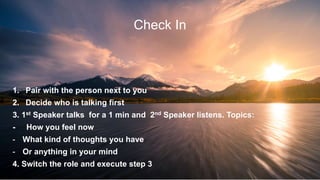
Check In
1. Pair with the person next to you
2. Decide who is talking first
3. 1st Speaker talks for a 1 min and 2nd Speaker listens. Topics:
- How you feel now
- What kind of thoughts you have
- Or anything in your mind
4. Switch the role and execute step 3
5
2. What is Mindfulness
6
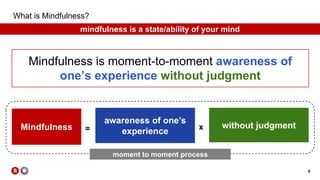
What is Mindfulness?
Mindfulness is moment-to-moment awareness of
one’s experience without judgment
mindfulness is a state/ability of your mind
= xMindfulness
awareness of one’s
experience
without judgment
moment to moment process
7
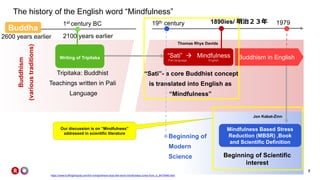
Buddhism
(varioustraditions)
Beginning of
Modern
Science
2600 years earlier 2100 years earlier
Tripitaka: Buddhist
Teachings written in Pali
Language
“Sati”- a core Buddhist concept
is translated into English as
“Mindfulness”
Buddhism in English
Mindfulness Based Stress
Reduction (MBSR) ,Book
and Scientific Definition
Beginning of Scientific
interest
Writing of Tripitaka
1st century BC 19th century
“Sati”  Mindfulness
Pali language English
1979
Jon Kabat-Zinn
Thomas Rhys Davids
Buddha
https://www.huffingtonpost.com/tim-lomas/where-does-the-word-mindfulness-come-from_b_9470546.html
The history of the English word “Mindfulness”
1890ies/ 明治23年
Our discussion is on “Mindfulness”
addressed in scientific literature
8
3. Popularity of Mindfulness
9
Many Well Known Mindfulness Practitioners
“Mindfulness can no longer be considered a nice-to-have for executives. It’s a must-
have” C. Congleton et al Jan. 2015
Photo Credit : Emma Watson by David Shankbone, Marc Benioff by Schreibvieh, Melinda Gates Copyright by World Economic Forum swiss-image.ch/Photo by Remy Steinegger , Steve Kerr by Keith Allison,
Emma Watson
Actress
Marc Benioff
CEO,
Salesforce
Melinda Gates
Philanthropist
Steve Kerr
Coach,
Golden State Warriors
10
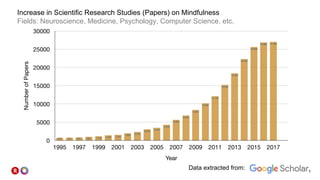
Data extracted from:
Increase in Scientific Research Studies (Papers) on Mindfulness
Fields: Neuroscience, Medicine, Psychology, Computer Science, etc.
11
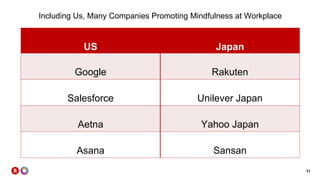
Including Us, Many Companies Promoting Mindfulness at Workplace
US Japan
Google Rakuten
Salesforce Unilever Japan
Aetna Yahoo Japan
Asana Sansan
12
4. Why?
13
There are two main reasons
Our modern living environment and lifestyle
Scientific Knowledge on mindfulness
14
Our modern living environment and lifestyle
Scientific knowledge on mindfulness
15
Living environment design to grab our attention
16
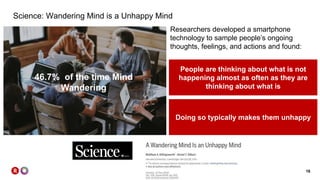
Science: Wandering Mind is a Unhappy Mind
46.7% of the time Mind
Wandering
People are thinking about what is not
happening almost as often as they are
thinking about what is
Doing so typically makes them unhappy
Researchers developed a smartphone
technology to sample people’s ongoing
thoughts, feelings, and actions and found:
17
Our modern living environment and lifestyle
Scientific knowledge on mindfulness
18
Scientific Studies Shows Mindfulness is Highly Effective
With advancements of tools such as fMRI, EEG scientist are able to study
mindfulness.
According to their studies, it bolsters our concentration powers,
attention, provide better control of our emotions and strengthens our
immune systems.
19
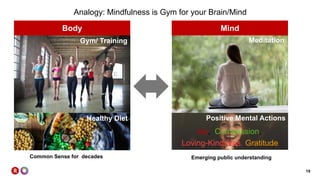
Emerging public understanding
Gym/ Training
Body Mind
Meditation
Healthy Diet
Joy, Compassion,
Loving-Kindness, Gratitude
Positive Mental Actions
Common Sense for decades
Analogy: Mindfulness is Gym for your Brain/Mind
20
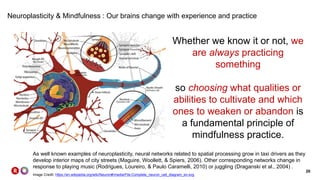
Neuroplasticity & Mindfulness : Our brains change with experience and practice
As well known examples of neuroplasticity, neural networks related to spatial processing grow in taxi drivers as they
develop interior maps of city streets (Maguire, Woollett, & Spiers, 2006). Other corresponding networks change in
response to playing music (Rodrigues, Loureiro, & Paulo Caramelli, 2010) or juggling (Draganski et al., 2004) .
Whether we know it or not, we
are always practicing
something
so choosing what qualities or
abilities to cultivate and which
ones to weaken or abandon is
a fundamental principle of
mindfulness practice.
Image Credit: https://en.wikipedia.org/wiki/Neuron#/media/File:Complete_neuron_cell_diagram_en.svg
21
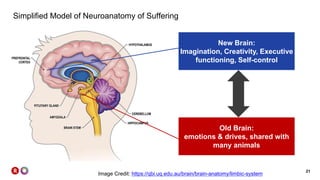
Simplified Model of Neuroanatomy of Suffering
Image Credit: https://qbi.uq.edu.au/brain/brain-anatomy/limbic-system
New Brain:
Imagination, Creativity, Executive
functioning, Self-control
Old Brain:
emotions & drives, shared with
many animals
22
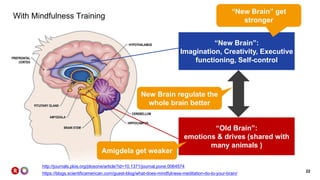
With Mindfulness Training
“New Brain”:
Imagination, Creativity, Executive
functioning, Self-control
“Old Brain”:
emotions & drives (shared with
many animals )
Amigdela get weaker
New Brain regulate the
whole brain better
“New Brain” get
stronger
https://blogs.scientificamerican.com/guest-blog/what-does-mindfulness-meditation-do-to-your-brain/
http://journals.plos.org/plosone/article?id=10.1371/journal.pone.0064574
23
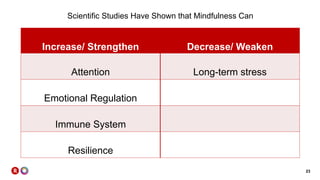
Scientific Studies Have Shown that Mindfulness Can
Increase/ Strengthen Decrease/ Weaken
Attention Long-term stress
Emotional Regulation
Immune System
Resilience
24
5. How to become mindful?
25
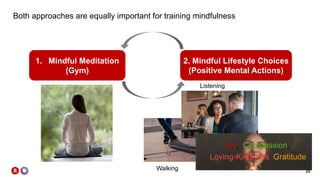
Both approaches are equally important for training mindfulness
1. Mindful Meditation
(Gym)
2. Mindful Lifestyle Choices
(Positive Mental Actions)
Listening
Walking
Joy, Compassion,
Loving-Kindness, Gratitude
26
5.1 Mindfulness Meditation
27
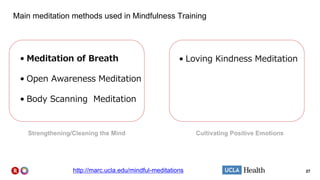
Main meditation methods used in Mindfulness Training
• Meditation of Breath
• Open Awareness Meditation
• Body Scanning Meditation
• Loving Kindness Meditation
Cultivating Positive EmotionsStrengthening/Cleaning the Mind
http://marc.ucla.edu/mindful-meditations
28
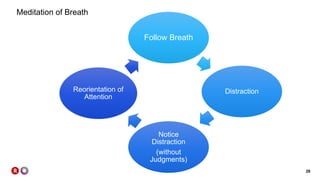
Meditation of Breath
Follow Breath
Distraction
Notice
Distraction
(without
Judgments)
Reorientation of
Attention
29
Meditation of Breath
2
Meditation of Breath
https://www.uclahealth.org/marc/body.cfm?id=22&iirf_redirect=1
30
How was it?
31
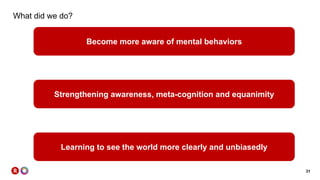
What did we do?
Become more aware of mental behaviors
Strengthening awareness, meta-cognition and equanimity
Learning to see the world more clearly and unbiasedly
32
5.2 Mindful Listening
33
Listening to someone with full attention, without any judgments.
34
[1] Mindfulness Listening Practice
1. Pair with the person next to you
2. Decide who will be the speaker first time
3. The speaker will talk about “my ideal boss” for 2 mins.
4. The listener will practice mindful-listening, without getting lost in
your own thoughts (no talking is allowed within the 2 mins), listen
fully without judgments, see what was said beyond words
35
[1] Mindful Listening
1. Now the listener summarize what was said in 1 mins.
2. The 1st speaker listen mindfully
36
Listening to someone with full attention, without any judgments.
36
37
[2] Mindfulness Listening Practice
1. As the second part, now we switch the roles
2. The speaker can talk about “my ideal subordinate” for 2 mins.
3. The listener will practice mindful-listening, without getting lost in
your own thoughts (no talking is allowed within the 2 mins), listen
fully without judgments, see what was said beyond words
38
[2] Mindful Listening
1. Now the listener summarize what was said in 1 mins.
2. The 1st speaker listen mindfully
39
How was it?
40
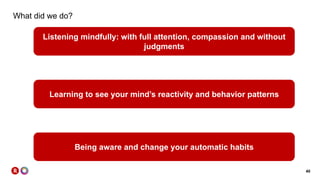
What did we do?
Listening mindfully: with full attention, compassion and without
judgments
Learning to see your mind’s reactivity and behavior patterns
Being aware and change your automatic habits
41
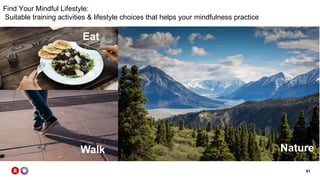
Find Your Mindful Lifestyle:
Suitable training activities & lifestyle choices that helps your mindfulness practice
NatureWalk
Eat
42
6. Support & Other Resources
43
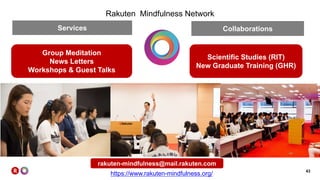
Rakuten Mindfulness Network
https://www.rakuten-mindfulness.org/
rakuten-mindfulness@mail.rakuten.com
Group Meditation
News Letters
Workshops & Guest Talks
Scientific Studies (RIT)
New Graduate Training (GHR)
Services Collaborations
44
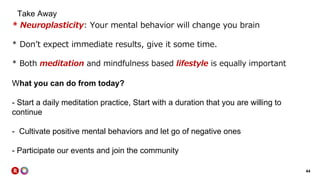
Take Away
* Neuroplasticity: Your mental behavior will change you brain
* Don’t expect immediate results, give it some time.
* Both meditation and mindfulness based lifestyle is equally important
What you can do from today?
- Start a daily meditation practice, Start with a duration that you are willing to
continue
- Cultivate positive mental behaviors and let go of negative ones
- Participate our events and join the community
454
Check-Out
Share your experience today
( 2 mins)
46
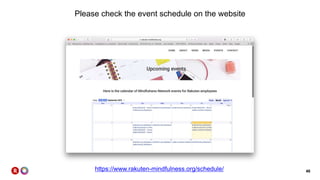
Please check the event schedule on the website
https://www.rakuten-mindfulness.org/schedule/
Rakuten Mindfulness Network
https://www.rakuten-mindfulness.org/

Rmn introduction to mindfulness

  • 1.
    Workshop: Introduction to Mindfulness UdanaBandara Head, Rakuten Mindfulness Network Rakuten, Inc. https://www.rakuten-mindfulness.org/
  • 2.
    2 Contents 1. Check-in 2. Whatis Mindfulness? 3. Popularity of Mindfulness 4. Why? 5. How to learn/become mindful? 6. Resources & support in Rakuten 7. Check-out
  • 3.
  • 4.
    4 Check In 1. Pairwith the person next to you 2. Decide who is talking first 3. 1st Speaker talks for a 1 min and 2nd Speaker listens. Topics: - How you feel now - What kind of thoughts you have - Or anything in your mind 4. Switch the role and execute step 3
  • 5.
    5 2. What isMindfulness
  • 6.
    6 What is Mindfulness? Mindfulnessis moment-to-moment awareness of one’s experience without judgment mindfulness is a state/ability of your mind = xMindfulness awareness of one’s experience without judgment moment to moment process
  • 7.
    7 Buddhism (varioustraditions) Beginning of Modern Science 2600 yearsearlier 2100 years earlier Tripitaka: Buddhist Teachings written in Pali Language “Sati”- a core Buddhist concept is translated into English as “Mindfulness” Buddhism in English Mindfulness Based Stress Reduction (MBSR) ,Book and Scientific Definition Beginning of Scientific interest Writing of Tripitaka 1st century BC 19th century “Sati”  Mindfulness Pali language English 1979 Jon Kabat-Zinn Thomas Rhys Davids Buddha https://www.huffingtonpost.com/tim-lomas/where-does-the-word-mindfulness-come-from_b_9470546.html The history of the English word “Mindfulness” 1890ies/ 明治23年 Our discussion is on “Mindfulness” addressed in scientific literature
  • 8.
    8 3. Popularity ofMindfulness
  • 9.
    9 Many Well KnownMindfulness Practitioners “Mindfulness can no longer be considered a nice-to-have for executives. It’s a must- have” C. Congleton et al Jan. 2015 Photo Credit : Emma Watson by David Shankbone, Marc Benioff by Schreibvieh, Melinda Gates Copyright by World Economic Forum swiss-image.ch/Photo by Remy Steinegger , Steve Kerr by Keith Allison, Emma Watson Actress Marc Benioff CEO, Salesforce Melinda Gates Philanthropist Steve Kerr Coach, Golden State Warriors
  • 10.
    10 Data extracted from: Increasein Scientific Research Studies (Papers) on Mindfulness Fields: Neuroscience, Medicine, Psychology, Computer Science, etc.
  • 11.
    11 Including Us, ManyCompanies Promoting Mindfulness at Workplace US Japan Google Rakuten Salesforce Unilever Japan Aetna Yahoo Japan Asana Sansan
  • 12.
  • 13.
    13 There are twomain reasons Our modern living environment and lifestyle Scientific Knowledge on mindfulness
  • 14.
    14 Our modern livingenvironment and lifestyle Scientific knowledge on mindfulness
  • 15.
    15 Living environment designto grab our attention
  • 16.
    16 Science: Wandering Mindis a Unhappy Mind 46.7% of the time Mind Wandering People are thinking about what is not happening almost as often as they are thinking about what is Doing so typically makes them unhappy Researchers developed a smartphone technology to sample people’s ongoing thoughts, feelings, and actions and found:
  • 17.
    17 Our modern livingenvironment and lifestyle Scientific knowledge on mindfulness
  • 18.
    18 Scientific Studies ShowsMindfulness is Highly Effective With advancements of tools such as fMRI, EEG scientist are able to study mindfulness. According to their studies, it bolsters our concentration powers, attention, provide better control of our emotions and strengthens our immune systems.
  • 19.
    19 Emerging public understanding Gym/Training Body Mind Meditation Healthy Diet Joy, Compassion, Loving-Kindness, Gratitude Positive Mental Actions Common Sense for decades Analogy: Mindfulness is Gym for your Brain/Mind
  • 20.
    20 Neuroplasticity & Mindfulness: Our brains change with experience and practice As well known examples of neuroplasticity, neural networks related to spatial processing grow in taxi drivers as they develop interior maps of city streets (Maguire, Woollett, & Spiers, 2006). Other corresponding networks change in response to playing music (Rodrigues, Loureiro, & Paulo Caramelli, 2010) or juggling (Draganski et al., 2004) . Whether we know it or not, we are always practicing something so choosing what qualities or abilities to cultivate and which ones to weaken or abandon is a fundamental principle of mindfulness practice. Image Credit: https://en.wikipedia.org/wiki/Neuron#/media/File:Complete_neuron_cell_diagram_en.svg
  • 21.
    21 Simplified Model ofNeuroanatomy of Suffering Image Credit: https://qbi.uq.edu.au/brain/brain-anatomy/limbic-system New Brain: Imagination, Creativity, Executive functioning, Self-control Old Brain: emotions & drives, shared with many animals
  • 22.
    22 With Mindfulness Training “NewBrain”: Imagination, Creativity, Executive functioning, Self-control “Old Brain”: emotions & drives (shared with many animals ) Amigdela get weaker New Brain regulate the whole brain better “New Brain” get stronger https://blogs.scientificamerican.com/guest-blog/what-does-mindfulness-meditation-do-to-your-brain/ http://journals.plos.org/plosone/article?id=10.1371/journal.pone.0064574
  • 23.
    23 Scientific Studies HaveShown that Mindfulness Can Increase/ Strengthen Decrease/ Weaken Attention Long-term stress Emotional Regulation Immune System Resilience
  • 24.
    24 5. How tobecome mindful?
  • 25.
    25 Both approaches areequally important for training mindfulness 1. Mindful Meditation (Gym) 2. Mindful Lifestyle Choices (Positive Mental Actions) Listening Walking Joy, Compassion, Loving-Kindness, Gratitude
  • 26.
  • 27.
    27 Main meditation methodsused in Mindfulness Training • Meditation of Breath • Open Awareness Meditation • Body Scanning Meditation • Loving Kindness Meditation Cultivating Positive EmotionsStrengthening/Cleaning the Mind http://marc.ucla.edu/mindful-meditations
  • 28.
    28 Meditation of Breath FollowBreath Distraction Notice Distraction (without Judgments) Reorientation of Attention
  • 29.
    29 Meditation of Breath 2 Meditationof Breath https://www.uclahealth.org/marc/body.cfm?id=22&iirf_redirect=1
  • 30.
  • 31.
    31 What did wedo? Become more aware of mental behaviors Strengthening awareness, meta-cognition and equanimity Learning to see the world more clearly and unbiasedly
  • 32.
  • 33.
    33 Listening to someonewith full attention, without any judgments.
  • 34.
    34 [1] Mindfulness ListeningPractice 1. Pair with the person next to you 2. Decide who will be the speaker first time 3. The speaker will talk about “my ideal boss” for 2 mins. 4. The listener will practice mindful-listening, without getting lost in your own thoughts (no talking is allowed within the 2 mins), listen fully without judgments, see what was said beyond words
  • 35.
    35 [1] Mindful Listening 1.Now the listener summarize what was said in 1 mins. 2. The 1st speaker listen mindfully
  • 36.
    36 Listening to someonewith full attention, without any judgments. 36
  • 37.
    37 [2] Mindfulness ListeningPractice 1. As the second part, now we switch the roles 2. The speaker can talk about “my ideal subordinate” for 2 mins. 3. The listener will practice mindful-listening, without getting lost in your own thoughts (no talking is allowed within the 2 mins), listen fully without judgments, see what was said beyond words
  • 38.
    38 [2] Mindful Listening 1.Now the listener summarize what was said in 1 mins. 2. The 1st speaker listen mindfully
  • 39.
  • 40.
    40 What did wedo? Listening mindfully: with full attention, compassion and without judgments Learning to see your mind’s reactivity and behavior patterns Being aware and change your automatic habits
  • 41.
    41 Find Your MindfulLifestyle: Suitable training activities & lifestyle choices that helps your mindfulness practice NatureWalk Eat
  • 42.
    42 6. Support &Other Resources
  • 43.
    43 Rakuten Mindfulness Network https://www.rakuten-mindfulness.org/ rakuten-mindfulness@mail.rakuten.com GroupMeditation News Letters Workshops & Guest Talks Scientific Studies (RIT) New Graduate Training (GHR) Services Collaborations
  • 44.
    44 Take Away * Neuroplasticity:Your mental behavior will change you brain * Don’t expect immediate results, give it some time. * Both meditation and mindfulness based lifestyle is equally important What you can do from today? - Start a daily meditation practice, Start with a duration that you are willing to continue - Cultivate positive mental behaviors and let go of negative ones - Participate our events and join the community
  • 45.
  • 46.
    46 Please check theevent schedule on the website https://www.rakuten-mindfulness.org/schedule/
  • 47.

Editor's Notes

  • #8 Key Points: Mindfulness the concept has 2600 years old roots Many Asian countries influenced by Buddhism including Japan value this concepts through out the history “Mindfulness” is the English word created to translate the Pali term “Sathi” into English in 1890ies The word is used in English Buddhist studies in US, and UK Jon Kabat-Zinn iniatiated the scientific interest of Mindfulness by his pioneering work of MBSR ( Mindfulness Based Stress Reduction) and used the term Mindfulness in scientific context The limitation of science based “mindfulness”, enhancing human wellbeing rather than aiming for the grander objective enlightenment (nibbana, さとり) as in Buddhism From here our discussion is limit to explanation and practices explored by scientific community
  • #16 How long can you go without checking your social media account ?
  • #21 1.
  • #37 The Lecture ask who has given 100% marks. And question the the person talked how he feel about.