A Mindful Moment
1
Copyright © 2017 – All Rights Reserved
A Mindful Moment
2
Copyright © 2017 – All Rights Reserved
Copyright © 2017
All rights reserved. No part of this book may be reproduced, stored in a retrieval system,
or transmitted in any form or by any means, electronic, mechanical, photocopying,
recording, scanning, or otherwise, without the prior written permission of the publisher.
Disclaimer
All the material contained in this book is provided for educational and informational
purposes only. No responsibility can be taken for any results or outcomes resulting from
the use of this material.
While every attempt has been made to provide information that is both accurate and
effective, the author does not assume any responsibility for the accuracy or use/misuse
of this information.
You are encouraged to print this book for easy reading.
Use this information at your own risk.
A Mindful Moment
3
Copyright © 2017 – All Rights Reserved
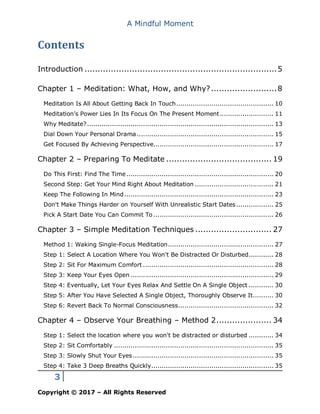
Contents
Introduction .........................................................................5
Chapter 1 – Meditation: What, How, and Why?.........................8
Meditation Is All About Getting Back In Touch............................................... 10
Meditation’s Power Lies In Its Focus On The Present Moment.......................... 11
Why Meditate?.......................................................................................... 13
Dial Down Your Personal Drama.................................................................. 15
Get Focused By Achieving Perspective.......................................................... 17
Chapter 2 – Preparing To Meditate ........................................ 19
Do This First: Find The Time....................................................................... 20
Second Step: Get Your Mind Right About Meditation ...................................... 21
Keep The Following In Mind........................................................................ 23
Don't Make Things Harder on Yourself With Unrealistic Start Dates.................. 25
Pick A Start Date You Can Commit To .......................................................... 26
Chapter 3 – Simple Meditation Techniques ............................. 27
Method 1: Waking Single-Focus Meditation................................................... 27
Step 1: Select A Location Where You Won't Be Distracted Or Disturbed............ 28
Step 2: Sit For Maximum Comfort ............................................................... 28
Step 3: Keep Your Eyes Open ..................................................................... 29
Step 4: Eventually, Let Your Eyes Relax And Settle On A Single Object ............ 30
Step 5: After You Have Selected A Single Object, Thoroughly Observe It.......... 30
Step 6: Revert Back To Normal Consciousness.............................................. 32
Chapter 4 – Observe Your Breathing – Method 2..................... 34
Step 1: Select the location where you won't be distracted or disturbed ............ 34
Step 2: Sit Comfortably ............................................................................. 35
Step 3: Slowly Shut Your Eyes.................................................................... 35
Step 4: Take 3 Deep Breaths Quickly........................................................... 35
A Mindful Moment
4
Copyright © 2017 – All Rights Reserved
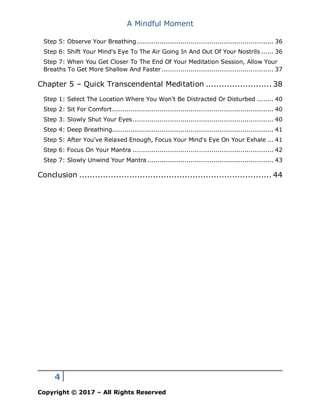
Step 5: Observe Your Breathing.................................................................. 36
Step 6: Shift Your Mind's Eye To The Air Going In And Out Of Your Nostrils ...... 36
Step 7: When You Get Closer To The End Of Your Meditation Session, Allow Your
Breaths To Get More Shallow And Faster...................................................... 37
Chapter 5 – Quick Transcendental Meditation ......................... 38
Step 1: Select The Location Where You Won't Be Distracted Or Disturbed ........ 40
Step 2: Sit For Comfort.............................................................................. 40
Step 3: Slowly Shut Your Eyes.................................................................... 40
Step 4: Deep Breathing.............................................................................. 41
Step 5: After You've Relaxed Enough, Focus Your Mind's Eye On Your Exhale ... 41
Step 6: Focus On Your Mantra .................................................................... 42
Step 7: Slowly Unwind Your Mantra............................................................. 43
Conclusion ......................................................................... 44
A Mindful Moment
5
Copyright © 2017 – All Rights Reserved
Introduction
Hello and welcome to our short, no-fluff beginners guide to quick
& effective meditation techniques for people on the go.
Let's face it; time is a luxury for most people. In fact, most
Americans are so busy that they wish there were more hours in a
day. Can you imagine that? You spend a tremendous amount of
time at work, and when everything is said and done, it appears
that you could have put in more time. That's just how busy we
are.
Interestingly enough, as busy as Americans seem to be, their
productivity is fairly stagnant. There was a huge burst of
productivity in past decades, but by and large, it has plateaued.
Still, people work more and more hours nowadays.
It is quite a paradox: people are working more and tiring
themselves out, but really not achieving all that much. Still, given
how busy we are, it's not a surprise that most of us are stressed
A Mindful Moment
6
Copyright © 2017 – All Rights Reserved
out, frustrated and can't find inner calm. No wonder meditation
and mindfulness are hot nowadays. Americans are starved for a
quick daily mental “hack” that effectively recharges their mental,
emotional and physical batteries without taking too much time
and effort.
Meditation is the best solution you can find to get the balance
you're looking for without having to pop pills or sign up for
expensive retreats. Best of all, it only takes a few minutes of your
day.
This book teaches you the benefits of meditation, how it works,
how to find the time to practice it, as well as three quick and
easy, relatively effortless techniques that get your personal
meditation practice off on the right foot.
Keep in mind that the techniques outlined in this book are meant
strictly to get you going. Once you have mastered and gotten
used to them, feel free to modify them to fit your particular set of
circumstances. Take complete and total ownership of them, so
they reflect your daily needs and priorities.
A Mindful Moment
7
Copyright © 2017 – All Rights Reserved
Make them fit your plan. Still, you should master these
techniques, and subsequently pick which one is the most
comfortable and convenient to you. You can then take liberty with
that technique and to fine-tune it, so it produces better results.
Well that’s a basic overview of what we will cover in the
beginner’s guide, in the first chapter we will look at the how,
what and why of meditation.
Are you ready? Let’s dive in…
A Mindful Moment
8
Copyright © 2017 – All Rights Reserved
Chapter 1 – Meditation: What, How,
and Why?
Meditation is all about actively triggering your mind’s internal
relaxation processes. That's all it is.
A lot of people are under the impression that meditation is some
sort of quasi-religious, mystical, or even deeply personal
philosophical journey into your inner world. Actually, if you were
to strip out the fluff, packaging and mass media imagery
surrounding meditation, it really all boils down to tapping into an
internal mental process that we all already have.
I know that sounds shocking because when people think of
meditation, they often think about Buddhist monks high on top of
some solitary hill, or some Christian monk hidden away in the
stony interior chamber of a monastery somewhere in a distant
forest. Nothing could be further from the truth.
A Mindful Moment
9
Copyright © 2017 – All Rights Reserved
Meditation, when stripped down to its essentials is really all about
rediscovering the internal processes and mental machinery you
already have to achieve a deep state of relaxation. Your mind in
fact has existing processes that protect it from overheating and
breaking down from the wear and tear of all the data processing
it does at any given day.
If you focus on what you think about, and what you choose to
perceive in any given second, you'd be surprised as to how much
information actually flows through your mind. Some peg this data
flow to around ninety thousand to a hundred twenty thousand
thoughts. It really varies from person to person, but that's a lot
of information, and to think that those are only conscious
thoughts. This means there are many other things we perceive
that we do not think about. So, given all that data you should be
able to understand how much stress and pressure your mind is
under.
This is why you have to sleep. The more you sleep, the clearer
your mind would be the following day, and the more relaxed you
would be. In addition, when you sleep, you recharge your
willpower, and you will be able to focus more on whatever you
need to do the next day. Sleep, and this internal relaxation
A Mindful Moment
10
Copyright © 2017 – All Rights Reserved
process formed your personal relaxation core. This core is
required for your mind to stay healthy and remain up to the job.
Meditation Is All About Getting Back In Touch
The bottom line with meditation is that it's all about getting back
in touch with your relaxation core. This sounds great and
everything, but what complicates it is that you are going to have
to do it in a conscious and purposeful way. That's right. You're
going to have it operate on purpose.
It's already operating. The problem is if you find yourself in a
high-stress environment pretty much all the time, this internal
process is going to face a lot of pressure. You're going to
essentially wear it down.
It is no surprise that people often space out, or achieve a relaxed
mental state on an erratic or sporadic basis. Wouldn't it be nice to
consciously and purposefully tap that relaxation process based on
your agenda and schedule? You have a lot more power over this
relaxation core than you give yourself credit for. In fact, you have
A Mindful Moment
11
Copyright © 2017 – All Rights Reserved
a lot more say in how your mind processes things than you
realize, and believe it or not, people achieve meditative states
quite a bit. It's unplanned, random, even the results are often
erratic and unpredictable, but it does happen.
For example, have you ever talked to somebody, and in the
middle of the conversation, you catch yourself drifting? From the
eyes of the person that you're talking to, you would have that
distant gaze in your eyes. It's as if you have entered a different
state of mind. That is part of your relaxation core. If you were to
explore that further, dig deeper and further, and trigger it on
purpose, you would actually achieve a level of mental and
physical relaxation that can be quite deep.
Meditation’s Power Lies In Its Focus On The
Present Moment
So, what is it about this internal self-correcting mechanism that
all people already have? It really involves an interplay between
the data that your mind chooses to perceive and how your mind
acts on that data. These two things have to be present.
A Mindful Moment
12
Copyright © 2017 – All Rights Reserved
The good news is that meditation simplifies it quite a bit. Instead
of you waiting for the right thing to happen at the right time, so
you can feel and the right range of emotions that would put you
in the right frame of mind, you just need to focus on the present
moment. That's all you need to do.
Using the simple meditation techniques that I will outline in this
book, you just have to wrap your mind around the present
moment, and everything pretty much falls into place.
A deep sense of calm, relaxation and inner serenity will come
over you if you practice these enough times. Of course, at first,
you probably would have a pretty difficult time achieving that
state, but the more you do it, and the more you try, the closer
you get to achieving that state. It's easy to see why this is the
case because when you focus in the present moment, the
moment that you're in takes all your focusing energy.
Your thoughts take up less and less energy. There's no past to
have regrets over, or feel guilty about. There's no future to worry
A Mindful Moment
13
Copyright © 2017 – All Rights Reserved
yourself sick over. Instead, all you have is the present moment.
All you have is the second of time that you're currently in. You
live that time moment by moment, second by second by focusing
all your mental and emotional processing energies on each and
every passing second.
Why Meditate?
Just in case we're not on the same page yet, or you're kind of
hazy as to why you even picked up this book. Let me tell you;
people want to meditate because they want to get a handle on
stress on so many levels.
Mental stress actually plays out on many different levels. It's not
just about stress on your intellectual faculties. You're not just
feeling pressure on how you think about things, and whether your
decisions would be the right ones. While that is important there,
there are actually a lot of other things going on.
One is your ability to maintain some sort of emotional distance
between your thoughts and the decisions you need to make.
A Mindful Moment
14
Copyright © 2017 – All Rights Reserved
Unfortunately, a lot of people tend to respond out of emotion, or
act impulsively when they're under a lot of stress. Sadly, a lot of
them come to regret that decision. They simply have let their
emotions get the better of them.
Oftentimes, they live life in a state of intense emotional
sensitivity. It seems like everything that they think about and
every phenomenon they observe in the real world is all about
them. It's as if the whole world revolves around them. It's either
all a judgment on them, or it's supposed to benefit them, and this
is just too much of a heavy load to bear when you make yourself
the center of your personal universe, and you tend to take things
emotionally.
Moreover, stress manifests itself in physiological or physical
symptoms. People who are under a tremendous amount of stress
exhibit high blood pressure and other cardiovascular symptoms.
Meditation enables you to get a handle on all of these. By working
with your rational and intellectual faculties, its effects trickle
down and impact your emotions, your physical state and your
overall health. In fact, there are several volumes of scientific
A Mindful Moment
15
Copyright © 2017 – All Rights Reserved
literature exploring the health benefits of meditation, and it's not
all in your mind.
According to hundreds of studies done in the 60s, the 70s and the
80s, meditation actually has significant, measurable and
substantial effects on cardiovascular health, as well as relieving
physical stress.
Dial Down Your Personal Drama
One particularly important body of benefits you would get from
meditation involves your emotions. If you practice meditation,
you will finally get to stop being triggered by certain memories.
If you keep thinking back to a traumatic past, chances are, the
more you think back, the more vivid those memories become,
and you get trapped into a downward spiral. You don't want to
remember these memories, but they emotionally trigger you so
much, and you get so upset that you can't help but think about
those memories again. The association gets stronger and
A Mindful Moment
16
Copyright © 2017 – All Rights Reserved
stronger, and eventually you become extremely emotionally
sensitive.
The worst part to all of this is that this happened in the past. It's
not like you can jump into a time machine and change what
happened in the past. The past is the past, but you're still a slave
to it because the moment you think about those past events, you
get emotionally upset.
Another sign of personal drama that meditation can help you with
is always assuming the worst. How many times do you do this? If
you are faced with an opportunity or a challenge, you always
assume that the worst situation will take place.
Other people also need meditation because they constantly read
too much into situations. They read the conclusion that they want
into situations. They don't allow life to play out naturally in front
of them that they have to have the final word. They have to make
everything fit into their negative personal narrative.
A Mindful Moment
17
Copyright © 2017 – All Rights Reserved
The bottom line? With meditation and stronger control over your
thought processes and their impact on your emotions, you will be
able to finally stop letting your emotions get the better of you.
Get Focused By Achieving Perspective
If you've ever found yourself at work running around in circles
and feeling really busy, but at the end of the day, you're
essentially just chasing your tail, listen up. The reason you're
doing this is because you're not able to focus properly. Instead of
focusing on the things that need to get done, so you can do your
work as efficiently and effectively as possible, you spend an
inordinate and disproportionate amount of your time chasing your
tail.
You're focusing on busy work, looking busy, or tricking your mind
into thinking that it's busy. Whatever the case may be, you're
engaged in all sorts of games that really cut down on your
productivity, and this then leads to an erosion of your self-
confidence.
A Mindful Moment
18
Copyright © 2017 – All Rights Reserved
All that you can control in your life is the present moment. The
past is the past. The future has yet to happen. So, this means
that the only thing we have total control over is how we think and
respond to the present moment.
When you practice meditation, you boost your mental focus and
your confidence. This leads to you becoming a more patient
person. Regardless of whatever is challenging you right now,
you're not going to let it get the better of you. Instead, you're
going to focus on your plan.
You're going to focus on putting in the work and paying your dues
day after day, week after week, month after month. This intense
focus, regardless of what you're feeling and whatever else is
going on in your life, essentially lays the foundation for greater
and greater levels of success.
Discipline is required for success. By using meditation to enable
you to focus on the hard and necessary now, you set yourself up
for greater and greater future rewards.
A Mindful Moment
19
Copyright © 2017 – All Rights Reserved
Chapter 2 – Preparing To Meditate
As the old saying goes, “If you fail to plan, what you're really
doing is you're planning to fail.” If you want to meditate correctly,
you have to prepare to meditate first. Don't just rush in, or just
jump in with both feet and expect the best. That's not going to
happen.
If you just rush in without any advanced thinking or planning,
whatsoever, you're just setting yourself up for failure. It doesn't
really get any simpler than that. A lot of people who would tell
you that meditation doesn't work, or meditation isn't for them
simply didn't bother to plan to meditate because, by and large, it
is safe to say that meditation would work for everybody, as long
as they planned properly, and as long as they follow the right
steps. A little bit of advanced planning can go a long way.
Here are the steps that I followed to get started on my daily
meditation practice.
A Mindful Moment
20
Copyright © 2017 – All Rights Reserved
Do This First: Find The Time
You're probably thinking to yourself, “Meditation sounds
awesome, but the problem is I just don't have the time. I'm too
busy at work, and I'm stressed out enough as it is, and at the
end of the day, I'm unable to achieve much of anything. This is
why I have to spend even more time at the office to try to
achieve something.”
I can understand where you're coming from because this is the
mentality of way too many Americans, but you in fact have a lot
of time. If you don't believe me, pay attention to the results that
you actually managed to achieve in the span of a typical workday.
Trace that back to the things that you actually do. You would be
shocked to discover that roughly 20% of your daily tasks are
actually the ones that are responsible for 80% of your results.
Imagine that 20% of the things you do produce 80% of your
results. What's the implication of this? 80% of your time is spent
working on worrying over and planning for 20% of your results.
In other words, you spend all that time, and you really don't
achieve much with that time. So, wouldn't it be nice simply to
A Mindful Moment
21
Copyright © 2017 – All Rights Reserved
expand the time you have for the actions that produce 80% of
your results and free up large chunks of the 80% of your actions
and tasks that only account for 20% of your results. This is the
logical way to do it, so find the time.
Furthermore, you can free up a lot more time by imposing tight
deadlines on common tasks that you do. Like, for example,
checking email or checking updates. You can set yourself up to do
those on a tight deadline of maybe 5 minutes instead of taking
half an hour. If you are able to do that, then you automatically
have 25 minutes to spare.
Both approaches described above squeeze out the extra time
from your schedule. You actually have a lot more time than you
care to realize.
Second Step: Get Your Mind Right About
Meditation
A Mindful Moment
22
Copyright © 2017 – All Rights Reserved
One of the most common reasons people fail with meditation is
because they approach it operating under all sorts of common
myths and misconceptions. Some people are under the
impression that if you meditate, you automatically become
religious because it is an act of faith. Other people think that
meditation is just too hard because it requires too much effort in
terms of brain power and brain focus. Even others are convinced
that when you meditate, you get so relaxed, and you tap into so
much inner peace that you lack the ambition and fire in the belly
that you need to achieve success in life.
I've got some great news for you. None of these are correct.
That's right. The meditation neither makes you religious, requires
a tremendous amount of effort, nor makes you a lazy bum. None
of them apply.
You have to neutralize unproductive assumptions as well. One
common assumption is that you just need to follow the
techniques and follow the instructions to the letter, and there
would be a smooth transition. Everything would be quick and
easy. This is a problem because most things you try in life that
are brand-new to you are not quick and easy. Understand that
you have to come in with the right expectations.
A Mindful Moment
23
Copyright © 2017 – All Rights Reserved
So, what is the workaround? Very simple… expect resistance!
Expect a rough start, and you would have the right mental
framework, so when you do experience a rough start, you are in
problem-solving mode.
Now, compare this with assuming that everything will be quick
and easy, and you face a challenge. Chances are, you probably
would want to quit because you thought it was going to be a
smooth transition. Do you see how that works?
Keep The Following In Mind
To prepare adequately for your meditation practice, keep in mind
the following facts.
First, effective meditation doesn't have to take massive blocks of
time. You don't have to meditate for an hour straight or one hour
total every single day for you to benefit from meditation. In fact,
according to most people surveyed, 15 to 20 minutes is plenty.
A Mindful Moment
24
Copyright © 2017 – All Rights Reserved
Second you don't have to believe that it works. Let me repeat
that; you don't have to believe that it works. Just go through the
process and feel it make changes. Unlike a religious system that
requires belief for it to work for you, meditation is all about
experiencing, so just go through the process, experience it for
yourself, and everything else will fall into place.
Third, you don't have to expend any effort. I know this is mind-
blowing to a lot of people because a lot of people think that when
you meditate, you actually have to put in a lot of effort.
Sometimes, you have to physically exercise. Well, that's yoga.
This is meditation. These are two totally different things.
You just have to go through the process, and you would see how
effortless it is because you're just tapping into how your mind is
already working. Your mind is in operation 24 hours a day, 7 days
a week and 365 days a year. You just tap into that internal
biochemical, psychological machinery, and everything else will
snap into place. You just have to go through the process. Effort is
not really part of the equation.
A Mindful Moment
25
Copyright © 2017 – All Rights Reserved
Don't Make Things Harder on Yourself With
Unrealistic Start Dates
Finally, one common way people tend to undermine their success
is when they set very unrealistic start dates. This often takes two
forms. Either you set the date too remotely, or you set it too
close to today's day.
Why are both of these problematic? When you set it too remotely,
you no longer get that sense of urgency that you need to get
going. There's no mechanism that forces you to take action as
soon as possible because the date is so remote that there's no
consequence.
Similarly, if you pick a date that is too near, like, let's say
tomorrow, it's so close you become so intimidated that it's not a
surprise that people simply just drop everything and not start.
You can't freak yourself out that way. It has to be remote enough
to be comfortable, but not so remote that it robs you of any
sense of urgency.
A Mindful Moment
26
Copyright © 2017 – All Rights Reserved
Pick A Start Date You Can Commit To
The bottom line is once you have identified a comfortable start
date, stick to it. Commit to it and look forward to your initial
meditation target timeframe of 15 to 20 minutes. It’s important
to make sure that you do this daily. It's better to be consistent
rather than put in a tremendous amount of time, but only doing it
once in a blue moon.
A Mindful Moment
27
Copyright © 2017 – All Rights Reserved
Chapter 3 – Simple Meditation
Techniques
Method 1: Waking Single-Focus Meditation
The objective of this meditation technique is to remain fully
awake throughout the whole session.
You focus on one object purposefully until you reach the point
where you're no longer thinking about anything else. You just
observe. You're not analysing, processing, reading into or
otherwise interpreting what you're seeing. Instead, you just allow
yourself to observe an object in front of you and take in as much
information about the object as possible. The key here is to do it
in a systematic and methodical way.
A Mindful Moment
28
Copyright © 2017 – All Rights Reserved
Step 1: Select A Location Where You Won't Be
Distracted Or Disturbed
If you have gadgets or have mobile devices that send out all sorts
of notification sounds due to email or social media, you need to
turn them all off. Remember, you're just doing this for 15 to 20
minutes. It's not that long, so you can afford to turn off all your
gadgets.
Step 2: Sit For Maximum Comfort
You don't have to sit like a Buddhist monk, or use the lotus
position. There's no need for overly dramatic body positioning.
It's okay just be comfortable.
Keep in mind that you shouldn't be so comfortable that you fall
asleep. You have to be comfortable, but at the same time remain
fully awake. This is why I insist that you should keep your back
straight. Don't slouch. Again, this is just going to be for 20
A Mindful Moment
29
Copyright © 2017 – All Rights Reserved
minutes, so I'm sure you can handle not slouching for 15 to 20
minutes.
Step 3: Keep Your Eyes Open
Unlike other meditation techniques that require you to shut your
eyes, this technique allows you to keep your eyes open. In fact, it
requires you to keep your eyes open because this is not going to
work if your eyes are shut close.
Make sure your eyes are fully open, and then effortlessly and
naturally scan the scene in front of you. You're not looking for
anything in particular. Just allow your eyes to go around the room
and just take in everything. Just look at everything as much as
you can. You can do one pass or two passes.
As you do these, take a deep, slow breath. Repeat that as your
eyes scan slowly across the room. Take a slow deep, breath.
Keep repeating this breathing pattern. Don't focus on your
breath. Just focus on what you're looking at as your eyes scan.
Remember, your eyes aren't settling on any object yet.
A Mindful Moment
30
Copyright © 2017 – All Rights Reserved
Step 4: Eventually, Let Your Eyes Relax And
Settle On A Single Object
There is no right or wrong answer here. It doesn't really matter
what kind of object your eyes settle on. As long as it feels
natural, or you're not forcing it, it's okay. Maybe your eyes will
settle on the floor or on a doorknob. It doesn't really matter, as
long as it's natural, and you allowed it to settle slowly and gently
on a particular object, then you're fin.
Step 5: After You Have Selected A Single
Object, Thoroughly Observe It
This is important. You must observe it. You're not describing it to
yourself, analyzing it, interpreting it, or figuring out what it
means. You're not even cross-referencing it to things that you've
seen or perceived in the past. You're not doing any of that. Don't
A Mindful Moment
31
Copyright © 2017 – All Rights Reserved
do that. Instead, choose to observe each and every one of the
basic elements of the object.
Pay attention to its shape. Take note of how light bounces out of
it. Pay close attention to the specific colors on the object.
Observe its texture, and so on and so forth. In other words, keep
your observation shallow in terms of what you can see in front of
you. Focus on what you can see in front of you, or what's right
there.
Don't read into the object, try to pick it apart with your mind, and
assume all sorts of things. You're not doing that. Instead, you're
just observing and taking in as many details as possible, but
you're doing this in on an element by element basis.
This is very important. Instead of just observing everything all at
once, choose to observe the object based on its elements. You
can start with shape, then you can go on to how the light
bounces off of it, and afterwards, you can move on to color, and
so on and so forth. Go from element to element, but you have to
do this slowly.
A Mindful Moment
32
Copyright © 2017 – All Rights Reserved
If you do this right, you will reach a point where you're not
thinking about anything else except the element of that object
that you are choosing to observe at that present time.
Step 6: Revert Back To Normal Consciousness
Start the process of going back to your normal consciousness by
dialing back your observation and zooming out
When you zoom out, you go from looking at how light bounces off
the surface of the object to the overall shape and appearance of
the object. You then zoom out again, and you start seeing the
whole scene within the room. You zoom out again, and you see
the whole room.
Slowly start looking at other objects and allow yourself to take
faster, shallow breaths again
A Mindful Moment
33
Copyright © 2017 – All Rights Reserved
While you were closely observing the object, your breath was
deep and slow. Now, you're using your normal breath, which is
shallow and fast. You should also just allow your eyes to move
around the room. You're back to your normal consciousness.
The total time for this should be around 15 to 20 minutes.
A Mindful Moment
34
Copyright © 2017 – All Rights Reserved
Chapter 4 – Observe Your Breathing
– Method 2
The objective here is to eliminate all thought by restricting your
focus to one aspect of your breathing. You're not just focusing on
your breathing. You're not just being aware of your breathing and
your breathing alone. You're actually drilling deeper than that.
You're zeroing in on one aspect of your breath. That's how
specific this technique is.
If you were able to reach that level, it's highly likely that you will
not be thinking about anything else. You know all your focus is on
your breath.
Step 1: Select the location where you won't
be distracted or disturbed
Once again, turn off all gadgets and notifications.
A Mindful Moment
35
Copyright © 2017 – All Rights Reserved
Step 2: Sit Comfortably
Be comfortable in your seating but make sure you're not so
comfortable that you're likely to fall asleep
Step 3: Slowly Shut Your Eyes
Now that you were sitting upright on a chair or on the floor,
slowly shut your eyes while looking straight ahead.
Step 4: Take 3 Deep Breaths Quickly
Basically, this is your normal breath, but you speed it up a little
bit. Next, expand your lungs and abdomen fully. You're still
breathing quickly, but this time, you're taking in a lot of air, and
then you're pushing out a lot of air from your body. After you've
done those 3 deep breaths, the next step is to take another 3
deep breaths at a slower pace.
A Mindful Moment
36
Copyright © 2017 – All Rights Reserved
Keep breathing in sets of 3’s, with each set involving a slower and
slower pace. Let yourself relax. Usually, if you are around breath
6 to 9, you start relaxing. The more you do it, the more you
relax, the calmer you get.
Step 5: Observe Your Breathing
After You've Relaxed Enough, Breathe In Very Slowly And
“Observe” The Air Getting Into Your Nostrils
Assume that in the center of your mind, there’s a camera, and
you're seeing the air get into your nostrils. Zoom in on the air
going into your nostrils. Allow yourself to track the air as it goes
to your lungs, and then to your diaphragm. Hold it for a few
seconds, and observe it start going back in the other direction.
Do these several times each at an increasingly slower pace.
Step 6: Shift Your Mind's Eye To The Air Going
In And Out Of Your Nostrils
A Mindful Moment
37
Copyright © 2017 – All Rights Reserved
Eventually, focus on the narrow point of skin that feels the air
enter and leave your nostrils. Keep narrowing your mind's eye’s
focus until you isolate that specific narrow piece of flesh. Keep
your mind trained on this and this alone. This should be your
whole focus.
Feel the air coming in. Feel the air going out. Feel the air coming
in and make contact with that piece of skin. Keep your eyes on
that skin. Let the air go out, and you will feel it pass through that
piece of skin. The narrower and the smaller the space, the better.
This means that you are focusing intently.
Step 7: When You Get Closer To The End Of
Your Meditation Session, Allow Your Breaths
To Get More Shallow And Faster
Train your mind's eye to the rest of your body. Observe your
whole body from. Observe it slowly until you become fully aware
of your surroundings and your body. Slowly, open your eyes.
Take care not to shock your eyes due to the light. Slowly, open
them.
A Mindful Moment
38
Copyright © 2017 – All Rights Reserved
Chapter 5 – Quick Transcendental
Meditation
Chances are, if you've ever googled meditation, then you
probably come across the phrase Transcendental Meditation. This
is quite a popular “flavor” of meditation. In fact, it's been around
for several decades. It has many adherents throughout the years.
The most famous include George Harrison of the Beatles.
Actually, the Beatles as a group went to India, specifically to
practice Transcendental Meditation.
The reason this is so popular because it's so easy. It requires no
effort, and you basically just focus on something you can control
until you reach a point where your thoughts quickly vaporize, or
you don't develop thoughts at all. This leads to a tingling or a
physical sense of peace, inner calm and personal release.
This is one of the most powerful meditation practices you could
ever learn because it packs a lot of power in a very simple form.
It doesn't take much effort to do it. With that said, keep in mind
that it's not that you're not going to just follow these instructions,
A Mindful Moment
39
Copyright © 2017 – All Rights Reserved
and all of a sudden, achieve amazing results. You have to get
used to the pattern. You have to meditate consistently, and
eventually, you will get its full range of benefits.
Before you start, make sure that you pick a made-up word that
has absolutely no meaning. This is very important. It has to have
no personal meaning to you, nor should it have an objective
meaning. The reason you're doing that is you want this nonsense
word not to trigger thoughts. You don't want any thoughts. That's
the antithesis of Transcendental Meditation.
The whole point of this practice is not to develop thoughts in the
first place. The objective here is pretty straightforward. TM builds
on method 2, chasing your breath with the use of meaningless
words designed to pace your breathing.
These are called mantras. The mantra is not something that
you're going to verbally say. Instead, you mentally recite it.
A Mindful Moment
40
Copyright © 2017 – All Rights Reserved
To recap, it must have it must have absolutely no meaning to
you, and you mentally recite it. People don't hear it. You don't
hear it. You just mentally recite it in your mind,
Step 1: Select The Location Where You Won't
Be Distracted Or Disturbed
Make sure all gadgets are turned off. Make sure notifications are
turned off.
Step 2: Sit For Comfort
Don't get too comfortable that you’ll fall asleep.
Step 3: Slowly Shut Your Eyes
A Mindful Moment
41
Copyright © 2017 – All Rights Reserved
Step 4: Deep Breathing
Take 3 deep breaths, quickly, expand your lungs, and add them
in fully, take another 3 deep breaths at a slower pace, keep
breathing in sets of 3’s.
Usually, you achieve a relaxed state between breath 3 and 9. Let
yourself relax. Let yourself unwind and uncoil.
Step 5: After You've Relaxed Enough, Focus
Your Mind's Eye On Your Exhale
Let all the air out, hold it for a few seconds, and then mentally
recite your mantra. Slowly, let the air in. Slowly, breathe it in.
Don't force it, or distend your lungs or your diaphragm, just
absorb enough air comfortably, hold it, and mentally recite your
mantra. Let it go, slowly breathe it out, and then recite your
mantra again as you hold it. Keep repeating this until you reach a
deep state of relaxation, and you sense a tingling sensation at the
ends of your limbs, as well as your arms.
A Mindful Moment
42
Copyright © 2017 – All Rights Reserved
Step 6: Focus On Your Mantra
Lose sight of your breath, just focus on your mantra. This is the
higher level of TM. You know you're doing well, and once you
reach this level. Just focus on your mantra.
Again, don't focus on your breath, focus on your mantra. If you’re
doing it right, you're still breathing correctly, but your mantra is
pacing your breath. Allow yourself to achieve greater and greater
states of relaxation.
Quick tip: If you are still developing thoughts, you're not doing
this right. Focus more on your mantra until thoughts are all but
impossible for you to form.
A Mindful Moment
43
Copyright © 2017 – All Rights Reserved
Step 7: Slowly Unwind Your Mantra
As you get closer and closer to the end of your session, start
speeding up your breathing, and slowly unwind your mantra until
you stop mentally reciting it
Just focus on your breath, then start perceiving your body and
your surroundings until you become fully awake.
Gently open your eyes bit by bit so they don't get hurt by the
light
A Mindful Moment
44
Copyright © 2017 – All Rights Reserved
Conclusion
Congratulations on making it to the end of this quick, intro guide
on effective meditation techniques for people on the go
You may be surprised to know that the majority of people who
start something never complete it.
Take your time and progress at your own pace. This is not a race.
The more you understand and comprehend what is happening
when you meditate the better, however, if you are serious about
starting meditation because of the benefits that you want to get
from it, don't wait.
Set a time and stick to it. Don't wait for it to feel right, or for all
the right things to fall in the right place. You have no control
about what's going on.
A Mindful Moment
45
Copyright © 2017 – All Rights Reserved
As the old saying goes, “Life is what happens when you're making
other plans.” So, stick to the plan, regardless of what's going on,
what you're feeling, or your personal circumstances. Just stick to
the plan, start it, and commit to it. Once you've done that, you
will start benefiting from meditation.
At first, it's going to be challenging, or the benefits are going to
be so small that it's hard to spot. However, if you keep at it, you
will eventually achieve a point of momentum, and you would be
so glad you have adopted a meditation practice.
I wish you nothing but peace.

Mindful moment

  • 1.
    A Mindful Moment 1 Copyright© 2017 – All Rights Reserved
  • 2.
    A Mindful Moment 2 Copyright© 2017 – All Rights Reserved Copyright © 2017 All rights reserved. No part of this book may be reproduced, stored in a retrieval system, or transmitted in any form or by any means, electronic, mechanical, photocopying, recording, scanning, or otherwise, without the prior written permission of the publisher. Disclaimer All the material contained in this book is provided for educational and informational purposes only. No responsibility can be taken for any results or outcomes resulting from the use of this material. While every attempt has been made to provide information that is both accurate and effective, the author does not assume any responsibility for the accuracy or use/misuse of this information. You are encouraged to print this book for easy reading. Use this information at your own risk.
  • 3.
    A Mindful Moment 3 Copyright© 2017 – All Rights Reserved Contents Introduction .........................................................................5 Chapter 1 – Meditation: What, How, and Why?.........................8 Meditation Is All About Getting Back In Touch............................................... 10 Meditation’s Power Lies In Its Focus On The Present Moment.......................... 11 Why Meditate?.......................................................................................... 13 Dial Down Your Personal Drama.................................................................. 15 Get Focused By Achieving Perspective.......................................................... 17 Chapter 2 – Preparing To Meditate ........................................ 19 Do This First: Find The Time....................................................................... 20 Second Step: Get Your Mind Right About Meditation ...................................... 21 Keep The Following In Mind........................................................................ 23 Don't Make Things Harder on Yourself With Unrealistic Start Dates.................. 25 Pick A Start Date You Can Commit To .......................................................... 26 Chapter 3 – Simple Meditation Techniques ............................. 27 Method 1: Waking Single-Focus Meditation................................................... 27 Step 1: Select A Location Where You Won't Be Distracted Or Disturbed............ 28 Step 2: Sit For Maximum Comfort ............................................................... 28 Step 3: Keep Your Eyes Open ..................................................................... 29 Step 4: Eventually, Let Your Eyes Relax And Settle On A Single Object ............ 30 Step 5: After You Have Selected A Single Object, Thoroughly Observe It.......... 30 Step 6: Revert Back To Normal Consciousness.............................................. 32 Chapter 4 – Observe Your Breathing – Method 2..................... 34 Step 1: Select the location where you won't be distracted or disturbed ............ 34 Step 2: Sit Comfortably ............................................................................. 35 Step 3: Slowly Shut Your Eyes.................................................................... 35 Step 4: Take 3 Deep Breaths Quickly........................................................... 35
  • 4.
    A Mindful Moment 4 Copyright© 2017 – All Rights Reserved Step 5: Observe Your Breathing.................................................................. 36 Step 6: Shift Your Mind's Eye To The Air Going In And Out Of Your Nostrils ...... 36 Step 7: When You Get Closer To The End Of Your Meditation Session, Allow Your Breaths To Get More Shallow And Faster...................................................... 37 Chapter 5 – Quick Transcendental Meditation ......................... 38 Step 1: Select The Location Where You Won't Be Distracted Or Disturbed ........ 40 Step 2: Sit For Comfort.............................................................................. 40 Step 3: Slowly Shut Your Eyes.................................................................... 40 Step 4: Deep Breathing.............................................................................. 41 Step 5: After You've Relaxed Enough, Focus Your Mind's Eye On Your Exhale ... 41 Step 6: Focus On Your Mantra .................................................................... 42 Step 7: Slowly Unwind Your Mantra............................................................. 43 Conclusion ......................................................................... 44
  • 5.
    A Mindful Moment 5 Copyright© 2017 – All Rights Reserved Introduction Hello and welcome to our short, no-fluff beginners guide to quick & effective meditation techniques for people on the go. Let's face it; time is a luxury for most people. In fact, most Americans are so busy that they wish there were more hours in a day. Can you imagine that? You spend a tremendous amount of time at work, and when everything is said and done, it appears that you could have put in more time. That's just how busy we are. Interestingly enough, as busy as Americans seem to be, their productivity is fairly stagnant. There was a huge burst of productivity in past decades, but by and large, it has plateaued. Still, people work more and more hours nowadays. It is quite a paradox: people are working more and tiring themselves out, but really not achieving all that much. Still, given how busy we are, it's not a surprise that most of us are stressed
  • 6.
    A Mindful Moment 6 Copyright© 2017 – All Rights Reserved out, frustrated and can't find inner calm. No wonder meditation and mindfulness are hot nowadays. Americans are starved for a quick daily mental “hack” that effectively recharges their mental, emotional and physical batteries without taking too much time and effort. Meditation is the best solution you can find to get the balance you're looking for without having to pop pills or sign up for expensive retreats. Best of all, it only takes a few minutes of your day. This book teaches you the benefits of meditation, how it works, how to find the time to practice it, as well as three quick and easy, relatively effortless techniques that get your personal meditation practice off on the right foot. Keep in mind that the techniques outlined in this book are meant strictly to get you going. Once you have mastered and gotten used to them, feel free to modify them to fit your particular set of circumstances. Take complete and total ownership of them, so they reflect your daily needs and priorities.
  • 7.
    A Mindful Moment 7 Copyright© 2017 – All Rights Reserved Make them fit your plan. Still, you should master these techniques, and subsequently pick which one is the most comfortable and convenient to you. You can then take liberty with that technique and to fine-tune it, so it produces better results. Well that’s a basic overview of what we will cover in the beginner’s guide, in the first chapter we will look at the how, what and why of meditation. Are you ready? Let’s dive in…
  • 8.
    A Mindful Moment 8 Copyright© 2017 – All Rights Reserved Chapter 1 – Meditation: What, How, and Why? Meditation is all about actively triggering your mind’s internal relaxation processes. That's all it is. A lot of people are under the impression that meditation is some sort of quasi-religious, mystical, or even deeply personal philosophical journey into your inner world. Actually, if you were to strip out the fluff, packaging and mass media imagery surrounding meditation, it really all boils down to tapping into an internal mental process that we all already have. I know that sounds shocking because when people think of meditation, they often think about Buddhist monks high on top of some solitary hill, or some Christian monk hidden away in the stony interior chamber of a monastery somewhere in a distant forest. Nothing could be further from the truth.
  • 9.
    A Mindful Moment 9 Copyright© 2017 – All Rights Reserved Meditation, when stripped down to its essentials is really all about rediscovering the internal processes and mental machinery you already have to achieve a deep state of relaxation. Your mind in fact has existing processes that protect it from overheating and breaking down from the wear and tear of all the data processing it does at any given day. If you focus on what you think about, and what you choose to perceive in any given second, you'd be surprised as to how much information actually flows through your mind. Some peg this data flow to around ninety thousand to a hundred twenty thousand thoughts. It really varies from person to person, but that's a lot of information, and to think that those are only conscious thoughts. This means there are many other things we perceive that we do not think about. So, given all that data you should be able to understand how much stress and pressure your mind is under. This is why you have to sleep. The more you sleep, the clearer your mind would be the following day, and the more relaxed you would be. In addition, when you sleep, you recharge your willpower, and you will be able to focus more on whatever you need to do the next day. Sleep, and this internal relaxation
  • 10.
    A Mindful Moment 10 Copyright© 2017 – All Rights Reserved process formed your personal relaxation core. This core is required for your mind to stay healthy and remain up to the job. Meditation Is All About Getting Back In Touch The bottom line with meditation is that it's all about getting back in touch with your relaxation core. This sounds great and everything, but what complicates it is that you are going to have to do it in a conscious and purposeful way. That's right. You're going to have it operate on purpose. It's already operating. The problem is if you find yourself in a high-stress environment pretty much all the time, this internal process is going to face a lot of pressure. You're going to essentially wear it down. It is no surprise that people often space out, or achieve a relaxed mental state on an erratic or sporadic basis. Wouldn't it be nice to consciously and purposefully tap that relaxation process based on your agenda and schedule? You have a lot more power over this relaxation core than you give yourself credit for. In fact, you have
  • 11.
    A Mindful Moment 11 Copyright© 2017 – All Rights Reserved a lot more say in how your mind processes things than you realize, and believe it or not, people achieve meditative states quite a bit. It's unplanned, random, even the results are often erratic and unpredictable, but it does happen. For example, have you ever talked to somebody, and in the middle of the conversation, you catch yourself drifting? From the eyes of the person that you're talking to, you would have that distant gaze in your eyes. It's as if you have entered a different state of mind. That is part of your relaxation core. If you were to explore that further, dig deeper and further, and trigger it on purpose, you would actually achieve a level of mental and physical relaxation that can be quite deep. Meditation’s Power Lies In Its Focus On The Present Moment So, what is it about this internal self-correcting mechanism that all people already have? It really involves an interplay between the data that your mind chooses to perceive and how your mind acts on that data. These two things have to be present.
  • 12.
    A Mindful Moment 12 Copyright© 2017 – All Rights Reserved The good news is that meditation simplifies it quite a bit. Instead of you waiting for the right thing to happen at the right time, so you can feel and the right range of emotions that would put you in the right frame of mind, you just need to focus on the present moment. That's all you need to do. Using the simple meditation techniques that I will outline in this book, you just have to wrap your mind around the present moment, and everything pretty much falls into place. A deep sense of calm, relaxation and inner serenity will come over you if you practice these enough times. Of course, at first, you probably would have a pretty difficult time achieving that state, but the more you do it, and the more you try, the closer you get to achieving that state. It's easy to see why this is the case because when you focus in the present moment, the moment that you're in takes all your focusing energy. Your thoughts take up less and less energy. There's no past to have regrets over, or feel guilty about. There's no future to worry
  • 13.
    A Mindful Moment 13 Copyright© 2017 – All Rights Reserved yourself sick over. Instead, all you have is the present moment. All you have is the second of time that you're currently in. You live that time moment by moment, second by second by focusing all your mental and emotional processing energies on each and every passing second. Why Meditate? Just in case we're not on the same page yet, or you're kind of hazy as to why you even picked up this book. Let me tell you; people want to meditate because they want to get a handle on stress on so many levels. Mental stress actually plays out on many different levels. It's not just about stress on your intellectual faculties. You're not just feeling pressure on how you think about things, and whether your decisions would be the right ones. While that is important there, there are actually a lot of other things going on. One is your ability to maintain some sort of emotional distance between your thoughts and the decisions you need to make.
  • 14.
    A Mindful Moment 14 Copyright© 2017 – All Rights Reserved Unfortunately, a lot of people tend to respond out of emotion, or act impulsively when they're under a lot of stress. Sadly, a lot of them come to regret that decision. They simply have let their emotions get the better of them. Oftentimes, they live life in a state of intense emotional sensitivity. It seems like everything that they think about and every phenomenon they observe in the real world is all about them. It's as if the whole world revolves around them. It's either all a judgment on them, or it's supposed to benefit them, and this is just too much of a heavy load to bear when you make yourself the center of your personal universe, and you tend to take things emotionally. Moreover, stress manifests itself in physiological or physical symptoms. People who are under a tremendous amount of stress exhibit high blood pressure and other cardiovascular symptoms. Meditation enables you to get a handle on all of these. By working with your rational and intellectual faculties, its effects trickle down and impact your emotions, your physical state and your overall health. In fact, there are several volumes of scientific
  • 15.
    A Mindful Moment 15 Copyright© 2017 – All Rights Reserved literature exploring the health benefits of meditation, and it's not all in your mind. According to hundreds of studies done in the 60s, the 70s and the 80s, meditation actually has significant, measurable and substantial effects on cardiovascular health, as well as relieving physical stress. Dial Down Your Personal Drama One particularly important body of benefits you would get from meditation involves your emotions. If you practice meditation, you will finally get to stop being triggered by certain memories. If you keep thinking back to a traumatic past, chances are, the more you think back, the more vivid those memories become, and you get trapped into a downward spiral. You don't want to remember these memories, but they emotionally trigger you so much, and you get so upset that you can't help but think about those memories again. The association gets stronger and
  • 16.
    A Mindful Moment 16 Copyright© 2017 – All Rights Reserved stronger, and eventually you become extremely emotionally sensitive. The worst part to all of this is that this happened in the past. It's not like you can jump into a time machine and change what happened in the past. The past is the past, but you're still a slave to it because the moment you think about those past events, you get emotionally upset. Another sign of personal drama that meditation can help you with is always assuming the worst. How many times do you do this? If you are faced with an opportunity or a challenge, you always assume that the worst situation will take place. Other people also need meditation because they constantly read too much into situations. They read the conclusion that they want into situations. They don't allow life to play out naturally in front of them that they have to have the final word. They have to make everything fit into their negative personal narrative.
  • 17.
    A Mindful Moment 17 Copyright© 2017 – All Rights Reserved The bottom line? With meditation and stronger control over your thought processes and their impact on your emotions, you will be able to finally stop letting your emotions get the better of you. Get Focused By Achieving Perspective If you've ever found yourself at work running around in circles and feeling really busy, but at the end of the day, you're essentially just chasing your tail, listen up. The reason you're doing this is because you're not able to focus properly. Instead of focusing on the things that need to get done, so you can do your work as efficiently and effectively as possible, you spend an inordinate and disproportionate amount of your time chasing your tail. You're focusing on busy work, looking busy, or tricking your mind into thinking that it's busy. Whatever the case may be, you're engaged in all sorts of games that really cut down on your productivity, and this then leads to an erosion of your self- confidence.
  • 18.
    A Mindful Moment 18 Copyright© 2017 – All Rights Reserved All that you can control in your life is the present moment. The past is the past. The future has yet to happen. So, this means that the only thing we have total control over is how we think and respond to the present moment. When you practice meditation, you boost your mental focus and your confidence. This leads to you becoming a more patient person. Regardless of whatever is challenging you right now, you're not going to let it get the better of you. Instead, you're going to focus on your plan. You're going to focus on putting in the work and paying your dues day after day, week after week, month after month. This intense focus, regardless of what you're feeling and whatever else is going on in your life, essentially lays the foundation for greater and greater levels of success. Discipline is required for success. By using meditation to enable you to focus on the hard and necessary now, you set yourself up for greater and greater future rewards.
  • 19.
    A Mindful Moment 19 Copyright© 2017 – All Rights Reserved Chapter 2 – Preparing To Meditate As the old saying goes, “If you fail to plan, what you're really doing is you're planning to fail.” If you want to meditate correctly, you have to prepare to meditate first. Don't just rush in, or just jump in with both feet and expect the best. That's not going to happen. If you just rush in without any advanced thinking or planning, whatsoever, you're just setting yourself up for failure. It doesn't really get any simpler than that. A lot of people who would tell you that meditation doesn't work, or meditation isn't for them simply didn't bother to plan to meditate because, by and large, it is safe to say that meditation would work for everybody, as long as they planned properly, and as long as they follow the right steps. A little bit of advanced planning can go a long way. Here are the steps that I followed to get started on my daily meditation practice.
  • 20.
    A Mindful Moment 20 Copyright© 2017 – All Rights Reserved Do This First: Find The Time You're probably thinking to yourself, “Meditation sounds awesome, but the problem is I just don't have the time. I'm too busy at work, and I'm stressed out enough as it is, and at the end of the day, I'm unable to achieve much of anything. This is why I have to spend even more time at the office to try to achieve something.” I can understand where you're coming from because this is the mentality of way too many Americans, but you in fact have a lot of time. If you don't believe me, pay attention to the results that you actually managed to achieve in the span of a typical workday. Trace that back to the things that you actually do. You would be shocked to discover that roughly 20% of your daily tasks are actually the ones that are responsible for 80% of your results. Imagine that 20% of the things you do produce 80% of your results. What's the implication of this? 80% of your time is spent working on worrying over and planning for 20% of your results. In other words, you spend all that time, and you really don't achieve much with that time. So, wouldn't it be nice simply to
  • 21.
    A Mindful Moment 21 Copyright© 2017 – All Rights Reserved expand the time you have for the actions that produce 80% of your results and free up large chunks of the 80% of your actions and tasks that only account for 20% of your results. This is the logical way to do it, so find the time. Furthermore, you can free up a lot more time by imposing tight deadlines on common tasks that you do. Like, for example, checking email or checking updates. You can set yourself up to do those on a tight deadline of maybe 5 minutes instead of taking half an hour. If you are able to do that, then you automatically have 25 minutes to spare. Both approaches described above squeeze out the extra time from your schedule. You actually have a lot more time than you care to realize. Second Step: Get Your Mind Right About Meditation
  • 22.
    A Mindful Moment 22 Copyright© 2017 – All Rights Reserved One of the most common reasons people fail with meditation is because they approach it operating under all sorts of common myths and misconceptions. Some people are under the impression that if you meditate, you automatically become religious because it is an act of faith. Other people think that meditation is just too hard because it requires too much effort in terms of brain power and brain focus. Even others are convinced that when you meditate, you get so relaxed, and you tap into so much inner peace that you lack the ambition and fire in the belly that you need to achieve success in life. I've got some great news for you. None of these are correct. That's right. The meditation neither makes you religious, requires a tremendous amount of effort, nor makes you a lazy bum. None of them apply. You have to neutralize unproductive assumptions as well. One common assumption is that you just need to follow the techniques and follow the instructions to the letter, and there would be a smooth transition. Everything would be quick and easy. This is a problem because most things you try in life that are brand-new to you are not quick and easy. Understand that you have to come in with the right expectations.
  • 23.
    A Mindful Moment 23 Copyright© 2017 – All Rights Reserved So, what is the workaround? Very simple… expect resistance! Expect a rough start, and you would have the right mental framework, so when you do experience a rough start, you are in problem-solving mode. Now, compare this with assuming that everything will be quick and easy, and you face a challenge. Chances are, you probably would want to quit because you thought it was going to be a smooth transition. Do you see how that works? Keep The Following In Mind To prepare adequately for your meditation practice, keep in mind the following facts. First, effective meditation doesn't have to take massive blocks of time. You don't have to meditate for an hour straight or one hour total every single day for you to benefit from meditation. In fact, according to most people surveyed, 15 to 20 minutes is plenty.
  • 24.
    A Mindful Moment 24 Copyright© 2017 – All Rights Reserved Second you don't have to believe that it works. Let me repeat that; you don't have to believe that it works. Just go through the process and feel it make changes. Unlike a religious system that requires belief for it to work for you, meditation is all about experiencing, so just go through the process, experience it for yourself, and everything else will fall into place. Third, you don't have to expend any effort. I know this is mind- blowing to a lot of people because a lot of people think that when you meditate, you actually have to put in a lot of effort. Sometimes, you have to physically exercise. Well, that's yoga. This is meditation. These are two totally different things. You just have to go through the process, and you would see how effortless it is because you're just tapping into how your mind is already working. Your mind is in operation 24 hours a day, 7 days a week and 365 days a year. You just tap into that internal biochemical, psychological machinery, and everything else will snap into place. You just have to go through the process. Effort is not really part of the equation.
  • 25.
    A Mindful Moment 25 Copyright© 2017 – All Rights Reserved Don't Make Things Harder on Yourself With Unrealistic Start Dates Finally, one common way people tend to undermine their success is when they set very unrealistic start dates. This often takes two forms. Either you set the date too remotely, or you set it too close to today's day. Why are both of these problematic? When you set it too remotely, you no longer get that sense of urgency that you need to get going. There's no mechanism that forces you to take action as soon as possible because the date is so remote that there's no consequence. Similarly, if you pick a date that is too near, like, let's say tomorrow, it's so close you become so intimidated that it's not a surprise that people simply just drop everything and not start. You can't freak yourself out that way. It has to be remote enough to be comfortable, but not so remote that it robs you of any sense of urgency.
  • 26.
    A Mindful Moment 26 Copyright© 2017 – All Rights Reserved Pick A Start Date You Can Commit To The bottom line is once you have identified a comfortable start date, stick to it. Commit to it and look forward to your initial meditation target timeframe of 15 to 20 minutes. It’s important to make sure that you do this daily. It's better to be consistent rather than put in a tremendous amount of time, but only doing it once in a blue moon.
  • 27.
    A Mindful Moment 27 Copyright© 2017 – All Rights Reserved Chapter 3 – Simple Meditation Techniques Method 1: Waking Single-Focus Meditation The objective of this meditation technique is to remain fully awake throughout the whole session. You focus on one object purposefully until you reach the point where you're no longer thinking about anything else. You just observe. You're not analysing, processing, reading into or otherwise interpreting what you're seeing. Instead, you just allow yourself to observe an object in front of you and take in as much information about the object as possible. The key here is to do it in a systematic and methodical way.
  • 28.
    A Mindful Moment 28 Copyright© 2017 – All Rights Reserved Step 1: Select A Location Where You Won't Be Distracted Or Disturbed If you have gadgets or have mobile devices that send out all sorts of notification sounds due to email or social media, you need to turn them all off. Remember, you're just doing this for 15 to 20 minutes. It's not that long, so you can afford to turn off all your gadgets. Step 2: Sit For Maximum Comfort You don't have to sit like a Buddhist monk, or use the lotus position. There's no need for overly dramatic body positioning. It's okay just be comfortable. Keep in mind that you shouldn't be so comfortable that you fall asleep. You have to be comfortable, but at the same time remain fully awake. This is why I insist that you should keep your back straight. Don't slouch. Again, this is just going to be for 20
  • 29.
    A Mindful Moment 29 Copyright© 2017 – All Rights Reserved minutes, so I'm sure you can handle not slouching for 15 to 20 minutes. Step 3: Keep Your Eyes Open Unlike other meditation techniques that require you to shut your eyes, this technique allows you to keep your eyes open. In fact, it requires you to keep your eyes open because this is not going to work if your eyes are shut close. Make sure your eyes are fully open, and then effortlessly and naturally scan the scene in front of you. You're not looking for anything in particular. Just allow your eyes to go around the room and just take in everything. Just look at everything as much as you can. You can do one pass or two passes. As you do these, take a deep, slow breath. Repeat that as your eyes scan slowly across the room. Take a slow deep, breath. Keep repeating this breathing pattern. Don't focus on your breath. Just focus on what you're looking at as your eyes scan. Remember, your eyes aren't settling on any object yet.
  • 30.
    A Mindful Moment 30 Copyright© 2017 – All Rights Reserved Step 4: Eventually, Let Your Eyes Relax And Settle On A Single Object There is no right or wrong answer here. It doesn't really matter what kind of object your eyes settle on. As long as it feels natural, or you're not forcing it, it's okay. Maybe your eyes will settle on the floor or on a doorknob. It doesn't really matter, as long as it's natural, and you allowed it to settle slowly and gently on a particular object, then you're fin. Step 5: After You Have Selected A Single Object, Thoroughly Observe It This is important. You must observe it. You're not describing it to yourself, analyzing it, interpreting it, or figuring out what it means. You're not even cross-referencing it to things that you've seen or perceived in the past. You're not doing any of that. Don't
  • 31.
    A Mindful Moment 31 Copyright© 2017 – All Rights Reserved do that. Instead, choose to observe each and every one of the basic elements of the object. Pay attention to its shape. Take note of how light bounces out of it. Pay close attention to the specific colors on the object. Observe its texture, and so on and so forth. In other words, keep your observation shallow in terms of what you can see in front of you. Focus on what you can see in front of you, or what's right there. Don't read into the object, try to pick it apart with your mind, and assume all sorts of things. You're not doing that. Instead, you're just observing and taking in as many details as possible, but you're doing this in on an element by element basis. This is very important. Instead of just observing everything all at once, choose to observe the object based on its elements. You can start with shape, then you can go on to how the light bounces off of it, and afterwards, you can move on to color, and so on and so forth. Go from element to element, but you have to do this slowly.
  • 32.
    A Mindful Moment 32 Copyright© 2017 – All Rights Reserved If you do this right, you will reach a point where you're not thinking about anything else except the element of that object that you are choosing to observe at that present time. Step 6: Revert Back To Normal Consciousness Start the process of going back to your normal consciousness by dialing back your observation and zooming out When you zoom out, you go from looking at how light bounces off the surface of the object to the overall shape and appearance of the object. You then zoom out again, and you start seeing the whole scene within the room. You zoom out again, and you see the whole room. Slowly start looking at other objects and allow yourself to take faster, shallow breaths again
  • 33.
    A Mindful Moment 33 Copyright© 2017 – All Rights Reserved While you were closely observing the object, your breath was deep and slow. Now, you're using your normal breath, which is shallow and fast. You should also just allow your eyes to move around the room. You're back to your normal consciousness. The total time for this should be around 15 to 20 minutes.
  • 34.
    A Mindful Moment 34 Copyright© 2017 – All Rights Reserved Chapter 4 – Observe Your Breathing – Method 2 The objective here is to eliminate all thought by restricting your focus to one aspect of your breathing. You're not just focusing on your breathing. You're not just being aware of your breathing and your breathing alone. You're actually drilling deeper than that. You're zeroing in on one aspect of your breath. That's how specific this technique is. If you were able to reach that level, it's highly likely that you will not be thinking about anything else. You know all your focus is on your breath. Step 1: Select the location where you won't be distracted or disturbed Once again, turn off all gadgets and notifications.
  • 35.
    A Mindful Moment 35 Copyright© 2017 – All Rights Reserved Step 2: Sit Comfortably Be comfortable in your seating but make sure you're not so comfortable that you're likely to fall asleep Step 3: Slowly Shut Your Eyes Now that you were sitting upright on a chair or on the floor, slowly shut your eyes while looking straight ahead. Step 4: Take 3 Deep Breaths Quickly Basically, this is your normal breath, but you speed it up a little bit. Next, expand your lungs and abdomen fully. You're still breathing quickly, but this time, you're taking in a lot of air, and then you're pushing out a lot of air from your body. After you've done those 3 deep breaths, the next step is to take another 3 deep breaths at a slower pace.
  • 36.
    A Mindful Moment 36 Copyright© 2017 – All Rights Reserved Keep breathing in sets of 3’s, with each set involving a slower and slower pace. Let yourself relax. Usually, if you are around breath 6 to 9, you start relaxing. The more you do it, the more you relax, the calmer you get. Step 5: Observe Your Breathing After You've Relaxed Enough, Breathe In Very Slowly And “Observe” The Air Getting Into Your Nostrils Assume that in the center of your mind, there’s a camera, and you're seeing the air get into your nostrils. Zoom in on the air going into your nostrils. Allow yourself to track the air as it goes to your lungs, and then to your diaphragm. Hold it for a few seconds, and observe it start going back in the other direction. Do these several times each at an increasingly slower pace. Step 6: Shift Your Mind's Eye To The Air Going In And Out Of Your Nostrils
  • 37.
    A Mindful Moment 37 Copyright© 2017 – All Rights Reserved Eventually, focus on the narrow point of skin that feels the air enter and leave your nostrils. Keep narrowing your mind's eye’s focus until you isolate that specific narrow piece of flesh. Keep your mind trained on this and this alone. This should be your whole focus. Feel the air coming in. Feel the air going out. Feel the air coming in and make contact with that piece of skin. Keep your eyes on that skin. Let the air go out, and you will feel it pass through that piece of skin. The narrower and the smaller the space, the better. This means that you are focusing intently. Step 7: When You Get Closer To The End Of Your Meditation Session, Allow Your Breaths To Get More Shallow And Faster Train your mind's eye to the rest of your body. Observe your whole body from. Observe it slowly until you become fully aware of your surroundings and your body. Slowly, open your eyes. Take care not to shock your eyes due to the light. Slowly, open them.
  • 38.
    A Mindful Moment 38 Copyright© 2017 – All Rights Reserved Chapter 5 – Quick Transcendental Meditation Chances are, if you've ever googled meditation, then you probably come across the phrase Transcendental Meditation. This is quite a popular “flavor” of meditation. In fact, it's been around for several decades. It has many adherents throughout the years. The most famous include George Harrison of the Beatles. Actually, the Beatles as a group went to India, specifically to practice Transcendental Meditation. The reason this is so popular because it's so easy. It requires no effort, and you basically just focus on something you can control until you reach a point where your thoughts quickly vaporize, or you don't develop thoughts at all. This leads to a tingling or a physical sense of peace, inner calm and personal release. This is one of the most powerful meditation practices you could ever learn because it packs a lot of power in a very simple form. It doesn't take much effort to do it. With that said, keep in mind that it's not that you're not going to just follow these instructions,
  • 39.
    A Mindful Moment 39 Copyright© 2017 – All Rights Reserved and all of a sudden, achieve amazing results. You have to get used to the pattern. You have to meditate consistently, and eventually, you will get its full range of benefits. Before you start, make sure that you pick a made-up word that has absolutely no meaning. This is very important. It has to have no personal meaning to you, nor should it have an objective meaning. The reason you're doing that is you want this nonsense word not to trigger thoughts. You don't want any thoughts. That's the antithesis of Transcendental Meditation. The whole point of this practice is not to develop thoughts in the first place. The objective here is pretty straightforward. TM builds on method 2, chasing your breath with the use of meaningless words designed to pace your breathing. These are called mantras. The mantra is not something that you're going to verbally say. Instead, you mentally recite it.
  • 40.
    A Mindful Moment 40 Copyright© 2017 – All Rights Reserved To recap, it must have it must have absolutely no meaning to you, and you mentally recite it. People don't hear it. You don't hear it. You just mentally recite it in your mind, Step 1: Select The Location Where You Won't Be Distracted Or Disturbed Make sure all gadgets are turned off. Make sure notifications are turned off. Step 2: Sit For Comfort Don't get too comfortable that you’ll fall asleep. Step 3: Slowly Shut Your Eyes
  • 41.
    A Mindful Moment 41 Copyright© 2017 – All Rights Reserved Step 4: Deep Breathing Take 3 deep breaths, quickly, expand your lungs, and add them in fully, take another 3 deep breaths at a slower pace, keep breathing in sets of 3’s. Usually, you achieve a relaxed state between breath 3 and 9. Let yourself relax. Let yourself unwind and uncoil. Step 5: After You've Relaxed Enough, Focus Your Mind's Eye On Your Exhale Let all the air out, hold it for a few seconds, and then mentally recite your mantra. Slowly, let the air in. Slowly, breathe it in. Don't force it, or distend your lungs or your diaphragm, just absorb enough air comfortably, hold it, and mentally recite your mantra. Let it go, slowly breathe it out, and then recite your mantra again as you hold it. Keep repeating this until you reach a deep state of relaxation, and you sense a tingling sensation at the ends of your limbs, as well as your arms.
  • 42.
    A Mindful Moment 42 Copyright© 2017 – All Rights Reserved Step 6: Focus On Your Mantra Lose sight of your breath, just focus on your mantra. This is the higher level of TM. You know you're doing well, and once you reach this level. Just focus on your mantra. Again, don't focus on your breath, focus on your mantra. If you’re doing it right, you're still breathing correctly, but your mantra is pacing your breath. Allow yourself to achieve greater and greater states of relaxation. Quick tip: If you are still developing thoughts, you're not doing this right. Focus more on your mantra until thoughts are all but impossible for you to form.
  • 43.
    A Mindful Moment 43 Copyright© 2017 – All Rights Reserved Step 7: Slowly Unwind Your Mantra As you get closer and closer to the end of your session, start speeding up your breathing, and slowly unwind your mantra until you stop mentally reciting it Just focus on your breath, then start perceiving your body and your surroundings until you become fully awake. Gently open your eyes bit by bit so they don't get hurt by the light
  • 44.
    A Mindful Moment 44 Copyright© 2017 – All Rights Reserved Conclusion Congratulations on making it to the end of this quick, intro guide on effective meditation techniques for people on the go You may be surprised to know that the majority of people who start something never complete it. Take your time and progress at your own pace. This is not a race. The more you understand and comprehend what is happening when you meditate the better, however, if you are serious about starting meditation because of the benefits that you want to get from it, don't wait. Set a time and stick to it. Don't wait for it to feel right, or for all the right things to fall in the right place. You have no control about what's going on.
  • 45.
    A Mindful Moment 45 Copyright© 2017 – All Rights Reserved As the old saying goes, “Life is what happens when you're making other plans.” So, stick to the plan, regardless of what's going on, what you're feeling, or your personal circumstances. Just stick to the plan, start it, and commit to it. Once you've done that, you will start benefiting from meditation. At first, it's going to be challenging, or the benefits are going to be so small that it's hard to spot. However, if you keep at it, you will eventually achieve a point of momentum, and you would be so glad you have adopted a meditation practice. I wish you nothing but peace.